Posted originally on the CTH on December 9, 2022 | Sundance
When it comes to congress and the graft that is Ukraine, nothing should come as a surprise. Last month, the Biden administration asked Congress for another $37.7 billion in support for Ukraine. If that passes, and it certainly will, Congress will have approved more than $100 billion in Ukraine-related spending.
To wit, yesterday congress slipped Ukraine Debt Payment Relief, into the 4,400 page National Defense Authorization Act (NDAA) which will make the Senate happy as the intent of the upper chamber is to continue the laundry operation.
(Via Fox News) – The National Defense Authorization Act (NDAA) for fiscal year 2023 passed the House Thursday afternoon in a 350-80 vote. Included in that 4,400-page bill is a section on “Ukraine Debt Payment Relief.”
That section says the U.S. treasury secretary will instruct U.S. representatives of international financial institutions to “use the voice, vote, and influence of the United States to advocate that the respective institution immediately provide appropriate debt service relief to Ukraine.”
It instructs Treasury to commence “immediate efforts” with other governments and commercial creditors to “pursue comprehensive debt payment relief for Ukraine.”
The language talks only about debt payment relief, and not forgiveness of the assistance given to Ukraine this year to defend itself from to Russia’s invasion. (read more)
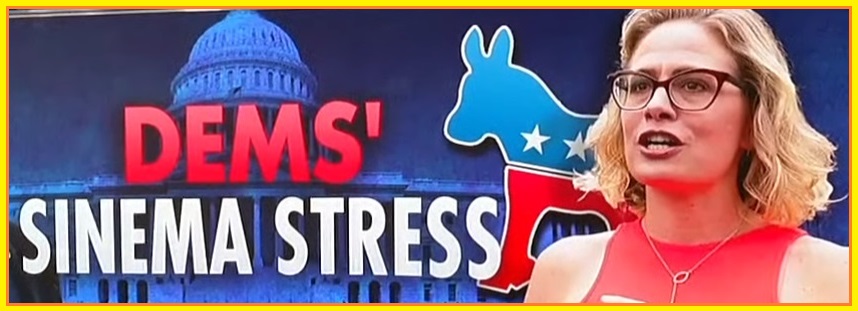
Arizona Senator Kyrsten Sinema announced she is changing her political affiliation to “independent”, a smart and strategic status considering her upcoming Arizona election challenge.
As an independent in the Senate, not much will really change as far as the voting and caucusing is concerned. However, from the standpoint of having to gain votes for reelection in Arizona and accepting the complete chaos that is now Arizona voting, the strategy will likely play well.
As a Democrat Sinema was likely to face a well-funded primary challenge from her left, while simultaneously she will likely face a strong opponent from the Republican side, by taking a place to avoid the primary and position herself as a third-party candidate, she can likely carve out enough votes to win a 3-way race.
(Politico) – In a 45-minute interview, the first-term senator told POLITICO that she will not caucus with Republicans and suggested that she intends to vote the same way she has for four years in the Senate. “Nothing will change about my values or my behavior,” she said.
Provided that Sinema sticks to that vow, Democrats will still have a workable Senate majority in the next Congress, though it will not exactly be the neat and tidy 51 seats they assumed. They’re expected to also have the votes to control Senate committees. And Sinema’s move means Sen. Joe Manchin (D-W.Va.) — a pivotal swing vote in the 50-50 chamber the past two years — will hold onto some but not all of his outsized influence in the Democratic caucus.
Sinema would not address whether she will run for reelection in 2024, and informed Senate Majority Leader Chuck Schumer of her decision on Thursday.
“I don’t anticipate that anything will change about the Senate structure,” Sinema said, adding that some of the exact mechanics of how her switch affects the chamber is “a question for Chuck Schumer … I intend to show up to work, do the same work that I always do. I just intend to show up to work as an independent.” (read more)
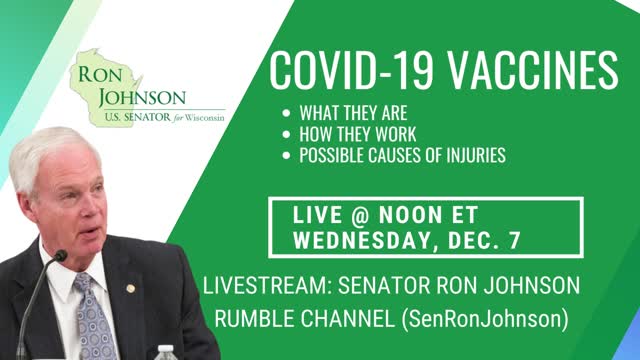
U.S. Sen. Ron Johnson will lead a roundtable discussion, COVID-19 Vaccines: What They Are, How They Work, and Possible Causes of Injuries, to shed light on the current state of knowledge surrounding the vaccine and the path forward. Medical experts and doctors who specialize in COVID-19 vaccine research and treatment will join Sen. Johnson at the roundtable.
Today, we learned more about the FBI’s influence operation during the 2020 election election. Yesterday, as part of a civil rights suit against the Biden Administration, Missouri Attorney General (and Senator-elect) Eric Schmitt released the deposition transcript of Dr. Anthony Fauci.
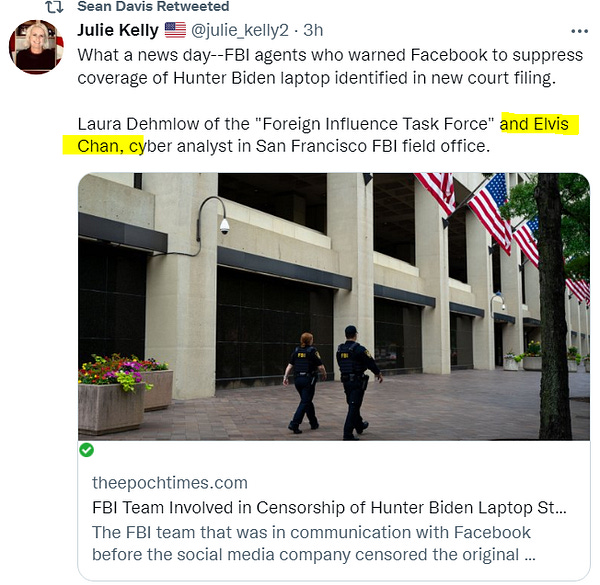
And just now, he just posted the transcript of FBI Supervisory Special Agent Elvis Chan. Read it here.
The importance of SSA Chan shouldn’t be understated. He was at the front-lines of the FBI’s efforts to curb speech on social media during the 2020 election. It was Chan who has been reported to have had “weekly meetings with major social media companies to warn against Russian disinformation attempts ahead of the 2020 election.”
Chan’s testimony provides insight into these efforts. Here are the highlights.
Chan and the 2016 DNC “Hack”
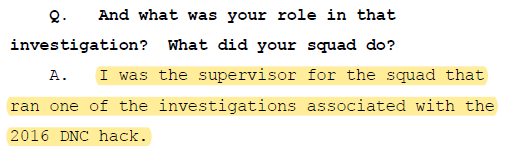
For starters, just so you get an idea of who you’re dealing with, Chan is a firm believer in the still-unproven theory that Russia hacked the DNC/DCCC and then leaked those materials “over the course of the 2016 election.” It gets better: Chan was the supervisor of a squad that helped investigate the 2016 DNC hack.
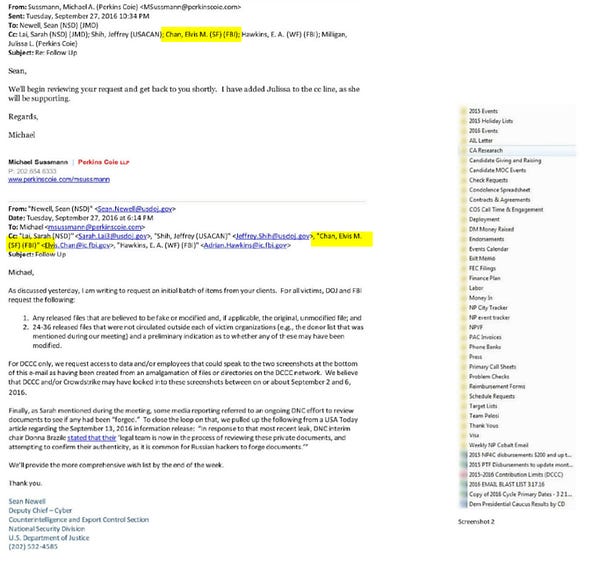
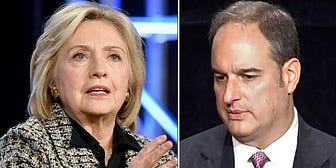
One can’t help but ask whether Chan, a “supervisor”, could have obtained the DNC server. Or if he even though to request it. As observed by our friend Stephen McIntyre, Chan was in contact with DNC/Hillary campaign lawyer Michael Sussmann about that hack.
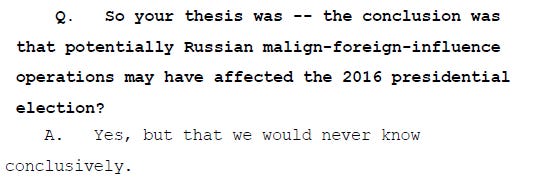
In fact, Chan believes Russia could have influenced the 2016 presidential election:
The 2020 Election – Security Meetings between the US Government and Social Media Companies.
Leading up to the 2020 election, Chan was present during meetings between social media and tech companies, such as Facebook, Microsoft, Google, Twitter, Yahoo, and Reddit, and the U.S. Government, which was represented by CISA (Cybersecurity and Infrastructure Security Agency), Office of the Director of National Intelligence (ODNI), Department of Homeland Security, and the FBI.
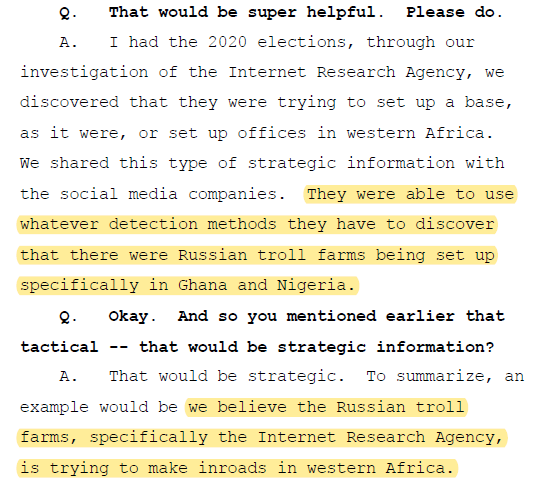
The FBI and other agencies would provide the social media/tech companies with “strategic information” regarding foreign – and specifically Russian – “influence campaigns.” One example of this information sharing had to do with the Russian company “Internet Research Agency” (a troll farm that was indicted by Mueller before those charges were ultimately dismissed by Barr), which had moved their operations to Ghana and Nigeria. Chan and the FBI believe the Internet Research Agency “is trying to make inroads in western Africa.” A warning to the West: your memes are from Russians in Western Africa.
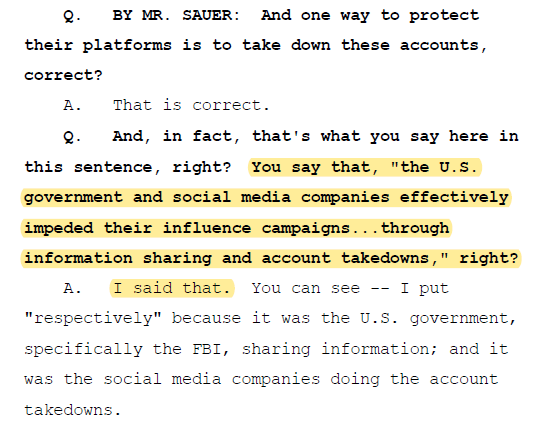
Chan testified that once the social media companies get this information they take down the accounts. The FBI doesn’t “control” what the companies do; they just provide “information” so the social media companies can take whatever steps they deem appropriate. One of those appropriate steps – one of those ways to “protect their platforms” – is to take down those accounts. In fact, Chan concluded in his thesis that the US government essentially assisted with “account takedowns.” It was a joint effort.
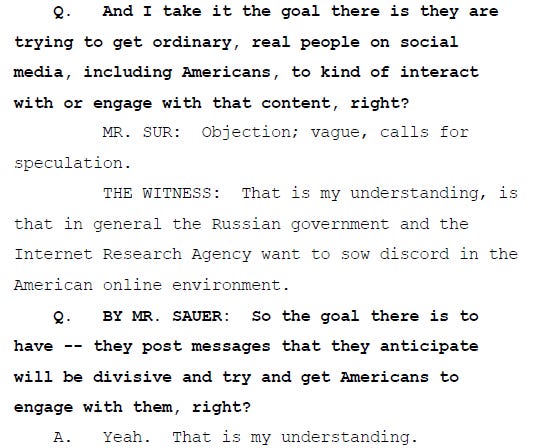
In other words, the social media companies don’t need directions from the US government to remove content because there’s an understanding between the parties. This would include content that the US government deemed to be foreign (Russian) “social media influence campaigns” that focus on current events or “amplify existing content.” This is all for the Russian government’s purpose to “sow discord”:
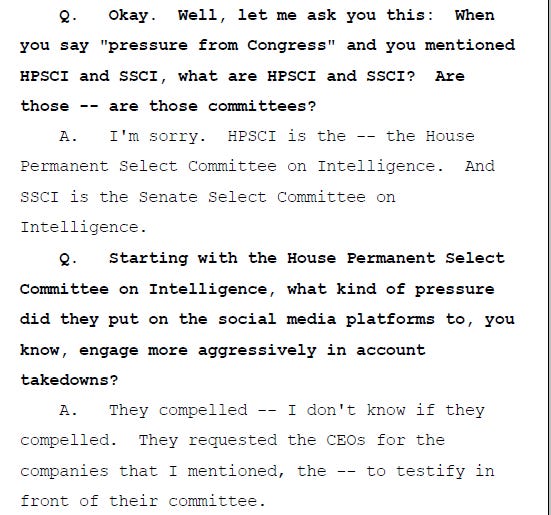
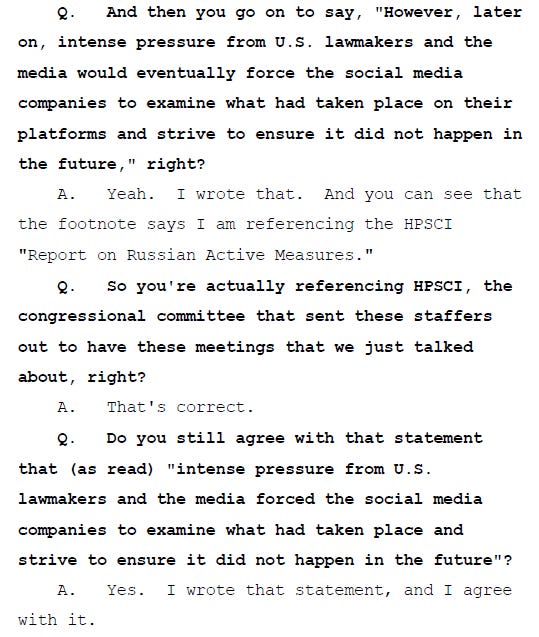
Chan also explained how the FBI would share the “disinformation” or “misinformation” with social media companies. It would take place around the time of quarterly meetings, if not more frequently through secure e-mails if the FBI field offices thought necessary. For example, the FBI might notify Facebook that a certain IP address is associated with the Internet Research Agency. The accounts flagged by the FBI are always removed by the social media companies, in large part because of pressure from Congressional Committees. As explained by Chan:
Around this same time, there were visits from Congressional staffers to pressure social media companies. Senior-level staffers have even visited Facebook, Google, and Twitter as part of these influence – or censorship – campaigns.
Chan continued:
Information about the 2020 Election and the suppression of American content.
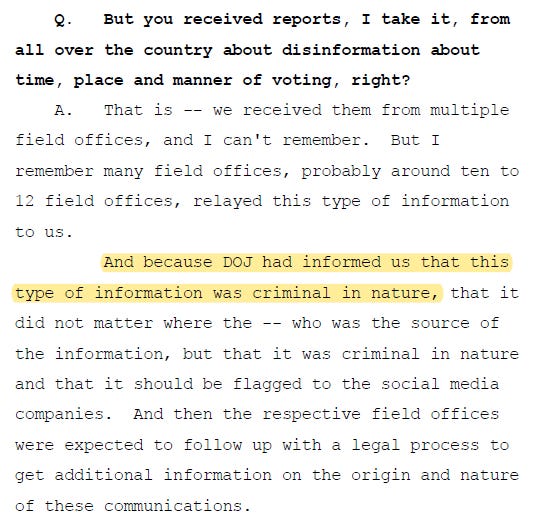
During the 2020 election, the FBI’s San Francisco field office had an election “command post,” which flagged “disinformation” regarding “the time, place or manner of elections in various states.” The flagged content would be referred to the applicable social media platform where it was posted. It didn’t matter whether the content was from Americans or from a foreign actor. Chan explained that the FBI was conducting these actions upon instructions from the DOJ, which had informed them “that this type of information was criminal in nature.”
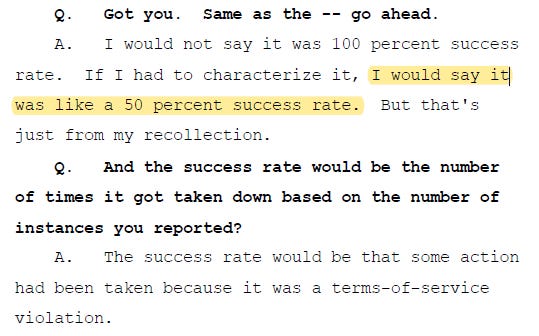
The social media companies sometimes disagreed. In fact, half the time the social media companies wouldn’t remove the content. Chan estimated a 50% success rate.
The Purported 2020 Russian “hack and leak” operation.
There’s a lot to cover here, and hopefully I provided enough background to get to the juicier stuff. Or at least the content that applies, in some ways, to the more concerning suppression of information during the 2020 election and after, such as the Hunter Biden laptop and COVID-19 information.
The Reactionary is a reader-supported publication. To receive new posts and support my work, consider becoming a free or paid subscriber.
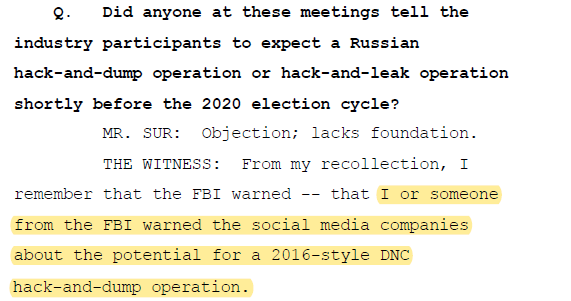
Here’s Chan discussing FBI warnings about a “2016-style DNC hack-and-dump operation” and gave instructions to “stay vigilant” about similar operations that may take place “before the [2020] election”:
Chan didn’t warn the companies based on actionable intelligence. Instead, the FBI gave this warning multiple times out of “an abundance of caution” and based on what allegedly transpired in 2016 with the DNC/DCCC hack.
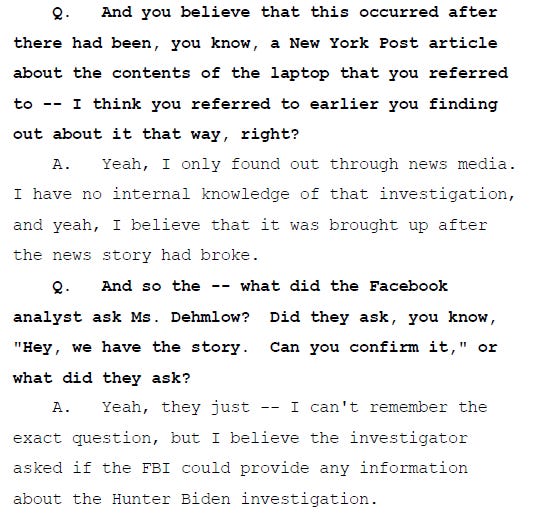
At around that time, Chan wasn’t aware that the FBI had in its possession the Hunter Biden laptop. He only became aware when this information was published by news outlets. Hunter Biden, according to Chan, was never mentioned in the FBI meetings with the social media companies. Facebook, however, asked about the Hunter Biden information. The FBI’s response? “No comment.” Chan explains
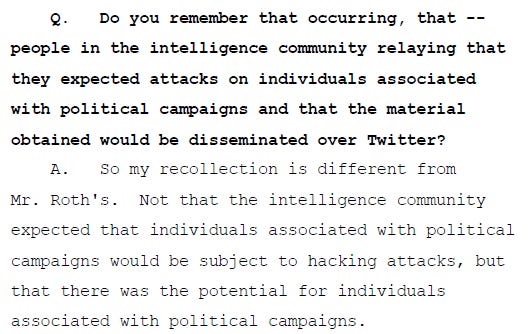
Chan was presented with a declaration from Yoel Roth, the then-Twitter Head of Trust and Safety, in which Roth stated he was informed by people in the intelligence community to “expect” attacks on individuals linked to political campaigns. Chan’s recollection differed, stating that there was only the potential for such attacks.
Roth also stated in his sworn declaration there were rumors “that a hack-and-leak operation would involve Hunter Biden.” Chan couldn’t recall Hunter Biden ever being mentioned in those meetings.
Q: How would you interpret what he said when he says he learned that there were rumors that a hack-and-leak operation would involve Hunter Biden? What do you think he’s referring to?
A: Yeah, in my estimation, we never discussed Hunter Biden specifically with Twitter.
Chan also claimed ignorance to Roth’s contention that Twitter’s belief the Hunter Biden materials could have been hacked was based on “the information security community’s initial reactions.” Chan wasn’t sure if this included the FBI, or if Twitter reached out to the FBI about the Hunter Biden information.
But – if the material were “hacked” – the social media companies were put on notice that they needed policies to address that situation. A harmless question? More of a hint to get social media companies to agree to remove the content. Especially because the FBI had plans to ask the social media companies themselves to remove hacked content.
I hope it’s clear what happened. There’s not a smoking gun – there’s no direct e-mail from Chan or from the FBI to Twitter of Facebook, from what we’ve seen, to remove the Hunter Biden story. That’s by design: there didn’t need to be. The instructions from the US government about “hack and leak” operations were quite clear, and the agency did nothing to dissuade social media companies from “believing” the Hunter Biden materials where hacked. The beauty of this plan, if you can call it that, was that the FBI and Twitter (and Facebook) all gave themselves cover by pointing the finger to the other.
In a close election, that’s what we call tipping the scales.
In related news… Twitter General Counsel James Baker has been “exited.” The story is still developing, but part of the reason appears to be because he was “vetting” the Twitter Files which show FBI/Twitter communications and which inform the decision to ban the Hunter Biden story. More to come as that story develops…
Mac Timred21 hr agoThere is a red hot smoking gun right here, that the DOJ advised that disinformation would be criminal in nature. That right there is the smoking gun. THIS IS NOT LISA MONACO, THIS IS (IN THEORY) BILL BARR’S DOJ. Exactly who at the DOJ communicated this, and pursuant to orders from what chain of command?
Newsmax TV Published originally on Rumble on December 5, 2022
Elon Musk’s release of the “Twitter Files” confirms what Republicans have already been saying. The social media giant was colluding with the F-B-I and the 2020 Biden campaign.
Posted originally on the conservative tree house on November 25, 2022 | Sundance
In a recent court filing [Document Here] President Trump through his legal counsel has requested Judge Cannon to unredact and unseal the search warrant affidavit used as the predicate for the FBI raid on Mar-a-Lago. Apparently, the DOJ have yet to provide President Trump with the constitutionally required predicate documents to support their search.
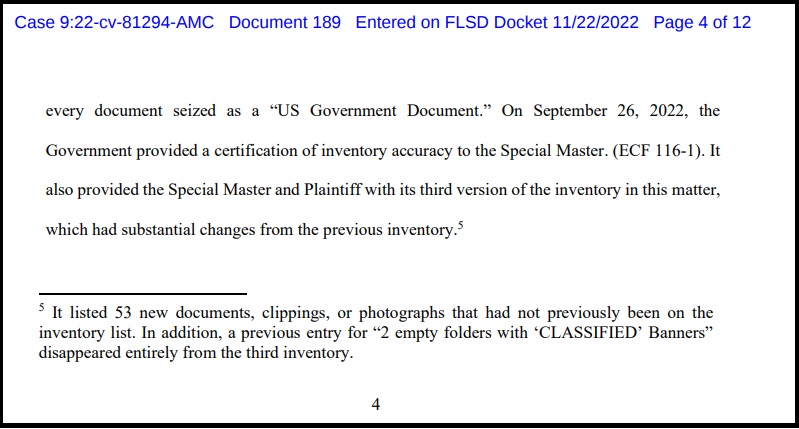
Additionally, the DOJ previously leaked to media about “empty folders with classified banners” as part of the evidence cache they collected. According to the filing the DOJ has since presented three different versions of their evidence collection list, with the most recent list dropping any claims of “two empty folders with classified banners.”
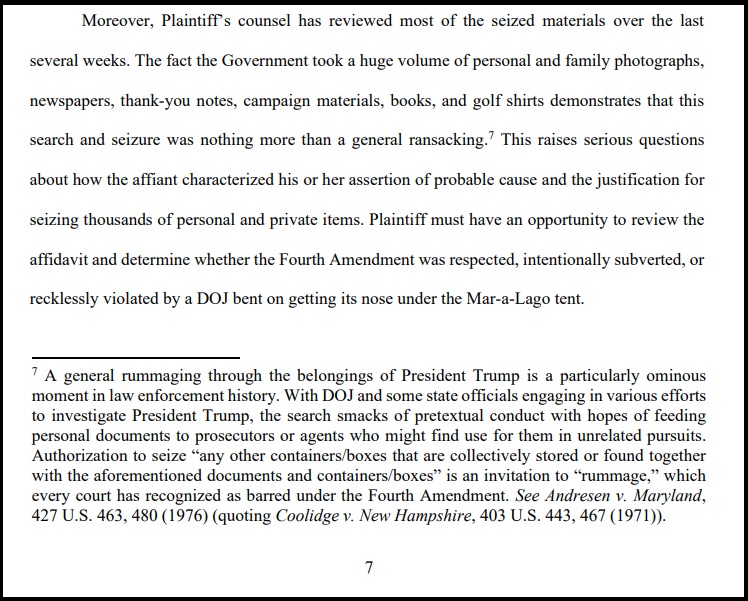
While asking the court to provide the affidavit to the defense team, the lawyers for President Trump are noting the fourth amendment protects everyone against warrantless searches and seizures, and that same protection also guarantees the target the right to receive and review the claimed justification for the warrant.
The unredacted affidavit is obligated to be supplied so that it can be determined if the search warrant was legally valid and predicated. General search warrants are not legally permitted. The warrant must specify what is being searched and why. The DOJ is fighting against this affidavit release. The Trump lawyers are asking the judge to make a decision.
The issue of compartmented (siloed) information, specifically as a tool and technique of the aloof DC system to retain control and influence, is a matter we have discussed on these pages for several years.
Quite literally anything can be classified as a ‘national security interest’ in the deep state effort to retain the illusion of power over the proles, ie us. It is the exact reason why congress exempts themselves from laws and regulations written for everyone else.
In this case we are watching the DOJ National Security Division (DOJ-NSD) deny the production of the material that supports the framework of their search warrant. Again, if Main Justice has nothing to hide, then why are they not willing to stand openly behind the predicate for their search.
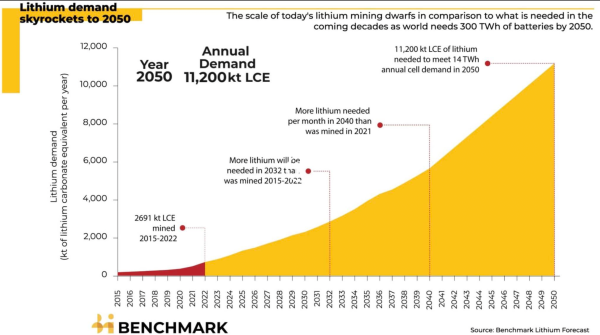
The Daily Chart: Greenies Need to Take More Lithium
So we’re supposed to make the transition to an all-electric future, with our homes, cars and factories all powered by “renewable” sources, and stored in batteries for when the wind doesn’t blow and the sun doesn’t shine. Never mind the “nameplate” capacity factors for wind and solar—have any of the “green energy” advocates done some elementary math on how much more lithium we’ll need to scale up batteries? Here’s one estimate:
As RedState reported, crypto-exchange FTX collapsed after its much-lauded founder, Sam Bankman-Fried, appeared to make improper transfers of customer money. Somewhere between $1-2 billion of that amount has now gone missing and Bankman-Fried also has disappeared.
What makes this so interesting, though, isn’t just that a lot of really wealthy people got scammed. It’s that Bankman-Fried also happens to be one of the top donors to the Democratic Party. In fact, outside of George Soros, no one has done more to bankroll Democrat efforts since the 2020 election. Joe Biden alone received a whopping $5.2 million.
But here’s where things get even weirder. Apparently, while the United States was bankrolling Ukraine and its war effort, that country’s leaders were investing money into FTX.
It was also revealed that FTX had partnered with Ukraine to process donations to their war efforts within days of Joe Biden pledging billions of American taxpayer dollars to the country. Ukraine invested into FTX as the Biden administration funneled funds to the invaded nation, and FTX then made massive donations to Democrats in the US.
There are so many questions that arise from this. For example, why is Ukraine, which we are all assured is broke and needs US taxpayer money, playing around with a Democrat-linked crypto company? This wasn’t just about accepting donations through the portal. The report specifically says that Ukraine actively invested money in FTX.
While that was happening, FTX’s founder was handing out tens of millions of dollars, from the Bahamas, to help elect Democrats back in the United States. That is one of the shadiest things I’ve ever witnessed in politics.
Yes, the chain of custody regarding the funds involved is tough to know. When and where money was sent is something only an investigation of FTX’s internal operation can ascertain. Still, the appearances here are just horrific. Were Democrats funneling taxpayer money to Ukraine, only for some of it to be sent to FTX so it could be funneled back to Democrat campaigns? That’s a question that must be answered, and any attempt to gloss over it will raise major red flags.
I don’t think I’m going out on a limb by suggesting that if another company had been scamming people while bankrolling the Republican Party, it would be major news. There would be calls for investigations as far as the eye could see to figure out whether Republican politicians were using that company as a passthrough to avoid campaign finance laws. Never mind that simply receiving funds from a Ponzi scheme, even without ill intent, is really bad on its own.
This entire situation stinks to high heaven. It appears that Republicans will end up taking the House of Representatives. When that becomes official, GOP members need to dive headfirst into this and figure out what in the world happened. Because having a Democrat mega-donor get exposed like this while also having Ukraine tied up in the mix is too much to ignore.
Front-page contributor for RedState. Visit my archives for more of my latest articles and help out by following me on Twitter @bonchieredstate.
Conservatives did not experience the red wave that they were hoping to see. Voting trends historically show the youth voting in favor of Democrats. As the quote often attributed to John Adams goes, “If You Are Not a Liberal at 25, You Have No Heart. If You Are Not a Conservative at 35, You Have No Brain.”
Pretending to champion one-voter issues with the backing of celebrities adds to this trend. A new NBC poll examined the exit polling data from voters between 18 and 29 (12% of the electorate) and 63% voted Democrat, while only 35% in this age range voted Republican.
People turn to the Republican Party as time goes on. Those 30 to 44 (21% of the electorate) voted 51% in favor of Democrats and 47% in favor of Republicans. The next age bracket, 45 to 64 (39% of the electorate), voted 44% in favor of Democrats and 54% in favor of Republicans. Those 65 and older (28% of the electorate) voted 43% Democrat and 55% Republican.
As we can see, support for conservative leadership grows with age and wisdom.
I have created this site to help people have fun in the kitchen. I write about enjoying life both in and out of my kitchen. Life is short! Make the most of it and enjoy!
This is a library of News Events not reported by the Main Stream Media documenting & connecting the dots on How the Obama Marxist Liberal agenda is destroying America









 Centinel2012
