The Fate of Europe


QUESTION: Marty; Your capital flow models have been remarkable. Do you see Europe as ever getting its act together? We need support to get decisions approved as you know. Will you provide that for us to present to the men above?

Thanks.

Nice to see you in Europe. Rome should be great at this time of year.

PDC

ANSWER: I have covered that is a special report for attendees. It took me a month to write this one. I have tried to cover every aspect so we can deal with the forecasting at the conference rather than all the supportive history. I understand that institutions need the support to justify their decisions. This is the report everyone needs for their files to CYA as the say for decisions.

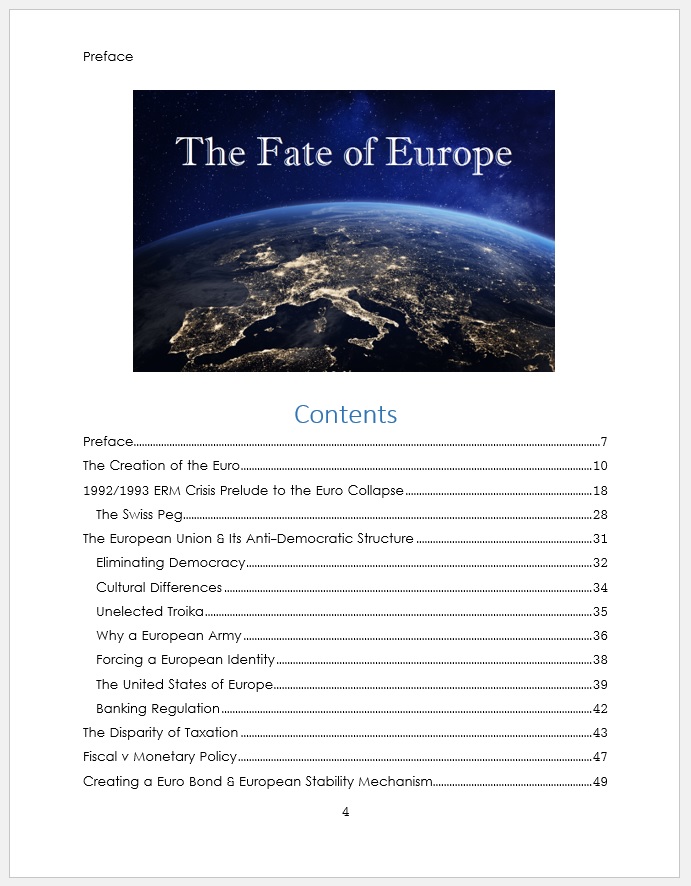
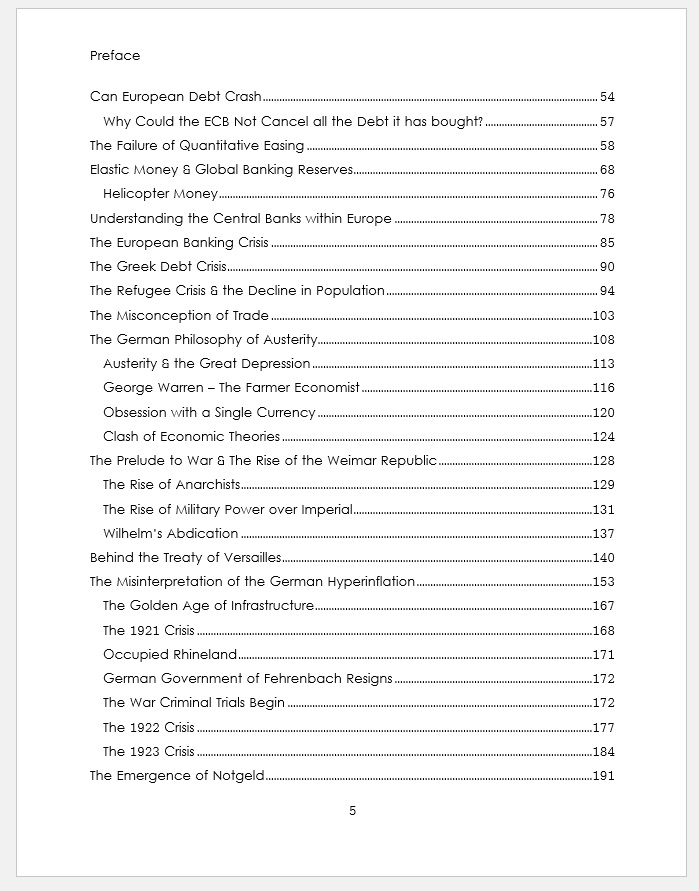
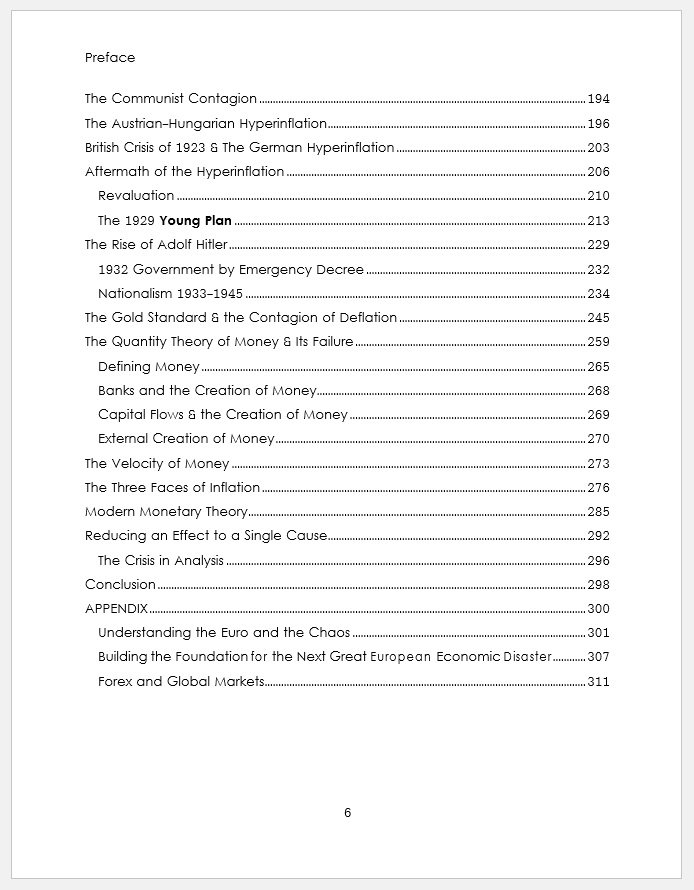
Things look very dicey for Europe and this will be a very interesting WEC. Here is the Index of the Report. I believe this will answer all questions and provide the backup you need to present to any board of directors.


The Consequence of War that Led to the German Hyperinflation


QUESTION: Everyone has a chart of the German DAX postwar. I have never seen a chart of the German stock market before the war. Do you have any?

HVS

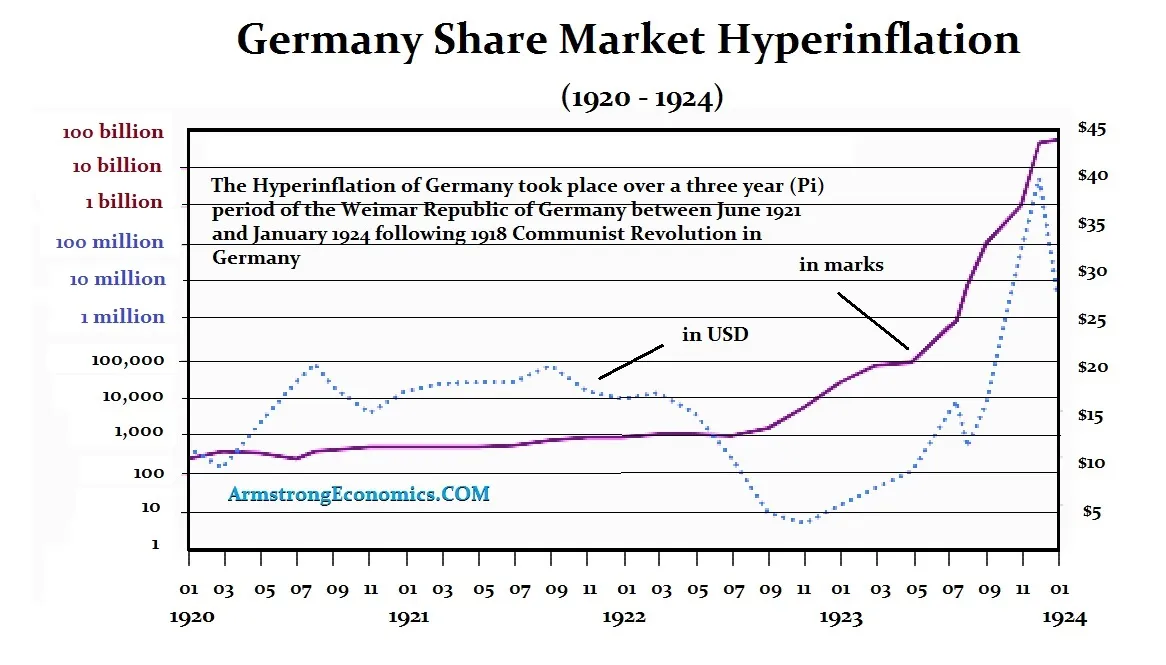
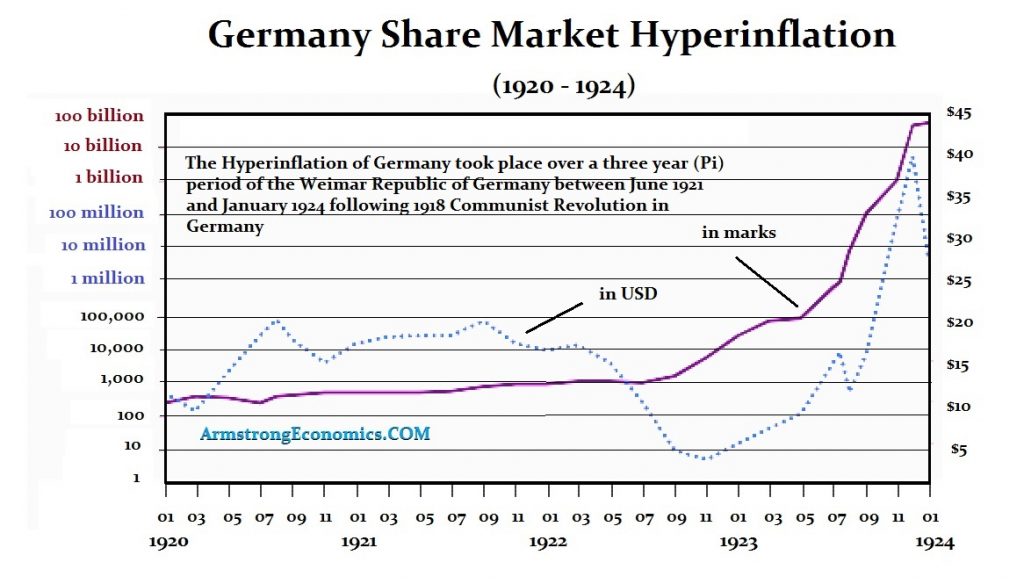
ANSWER: Yes. However, you must understand that because the world was on a gold standard, the arbitrage volatility was reflected in the bond and share markets when the currency was fixed. This is why the German share market closed in August 1914, along with just about everyone else. Here is a chart that show the performance of the German share market during the hyperinflation period. We have the DAX also extended back in time. But don’t forget, the DAX is a total return index. If we plot just price, you will see that the German share market looks very much like France.

The primary stock exchange in Germany was in Berlin. However, there were 21 exchanges in total. The origins of the Frankfurt Stock Exchange date back to medieval trade fairs during the 11th century. By the 16th century, Frankfurt developed into a wealthy and busy city with an economy based on trade and financial services. Annuities in particular were the hot items back then. It was in 1585 when the bourse was established to trade in fixed currency exchange rates. Currencies actually led to exchanges rather than shares. Eventually, Frankfurt developed into an early share market, competing with London and Paris. Mayer Amschel Rothschild and Max Warburg became very influential in the financial trade of Frankfurt.
The Frankfurt Stock Exchange had been a major international center. It was completely wiped out by World War I and its consequences. Back then, foreign shares and bonds traded on cross exchanges since money was fixed. German investors at the start of World War I dumped foreign bonds and shares, fearing that their capital would be restricted or confiscated. This is also why all the exchanges simply closed in Europe. Any capital they managed to free up from the sale of foreign investments was reinvested mostly in German government bonds. They were patriotic and believed in their government. However, by the end of the war, the Frankfurt Stock Exchange lost all foreign securities listings for bonds or shares. Frankfurt lost its standing as an international stock exchange entirely, and that would only begin to resurface in 1949.

In Europe, the fear of catastrophic declines in stock prices was met with controls at first. Overall, stocks and bonds were not allowed to trade below the price they had been trading at on July 31, 1914. Restrictions were also placed on capital. Money movement was highly restricted to preventing any large outflows of capital, forcing many into black markets. One means was to buy collector stamps and coins. They would then export especially rare stamps and then sell them in America. After two world wars, most of the rare stamps happened to be in America and gradually returned to Europe during the late 1960s.

With these restrictions in place, markets reopened in Europe. The London Times began printing stock prices for London and Bordeaux on September 19th and for Paris on December 8, 1914. In January 1915, all shares were allowed to trade on the London Stock Exchange, though with price restrictions. The St. Petersburg exchange reopened in 1917, only to close two months later due to the Russian Revolution. The Berlin Stock Exchange did not reopen until December 1917.

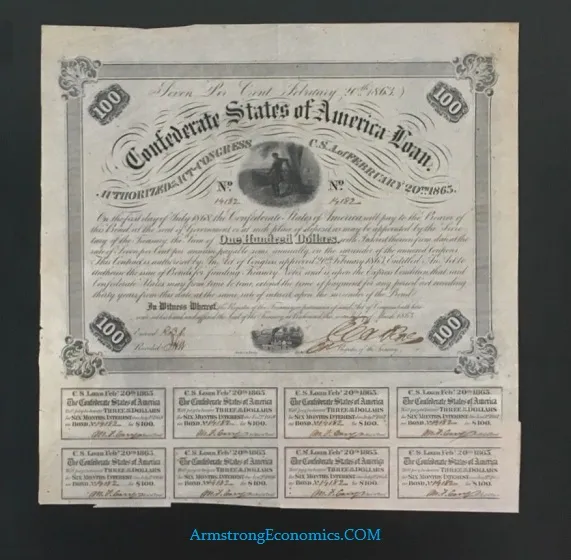
The loss of the war meant those who had invested in German bonds suffered the same fate as those Americans who invested in Confederate bonds. Indeed, to fund World War I, Germany relied more on raising money by selling bonds than imposing taxes. This had the net effect of wiping out the savings of the middle class and upper class. During the hyperinflation going into 1923, the losses in bonds were devastating, but in contrast, equities became a prized object among speculative investors. The Frankfurt stock exchange saw unprecedented losses in the bond markets and shares became the speculation objects that rose sharply going into 1923.

The German war costs covered by taxation, including state and federal combined, was only 13.9% which was lower than 18.2% taxation imposed in Great Britain for the war effort. German debt exploded after 1916. That is when the federal government’s short-term floating debt grew relentlessly, and by the end of the war it accounted for nearly one-third of the German national debt. The seriousness of the German debt crisis, which led to the postwar hyperinflation, was the fact that after 1916 German banks began to purchase more of the government’s floating debt. Government debt dominated the market and banks took on more public debt than private. When the public debt was marginalized by hyperinflation, it also wiped out the banking system.
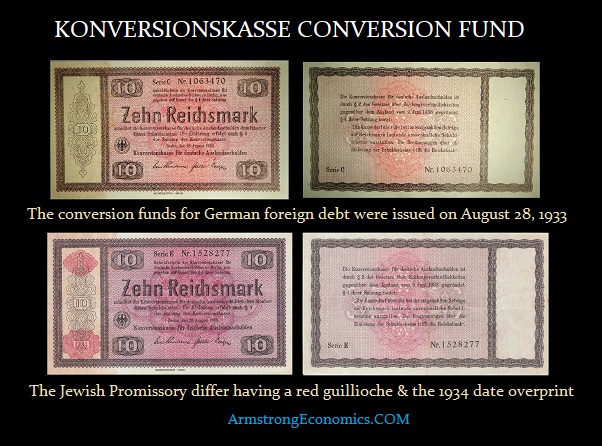
By the end of the war, the international contacts of the Frankfurt Stock Exchange had been lost. Inflation set in and reached its first peak in 1923. In October 1929, the Germany stock exchange prices crashed dramatically on the 25th. The world economic crisis ruled the following years. The economy only began to stabilize in 1932. The following year, the Nazis took over and centralized the nation’s economic policy. The Frankfurt Stock Exchange was merged with the Mannheim Stock Exchange and the number of exchanges nationwide was reduced from 21 to nine. Under the stringent Nazi economic regime, free trade was suffocated as Hitler defaulted on external debt. The majority of capital assets was directed to benefit the war economy. He even issued conversion fund certificates that were exchanged one for one with German marks if you sought to leave the country. This was part of the currency controls but they were worthless once you left the country.

 

Feynman’s Lost Lecture (ft. 3Blue1Brown)


Published on Jul 20, 2018

SUBSCRIBE 4.6M
Check out Grant’s channel: 3blue1brown: https://www.youtube.com/3blue1brown This video recounts a lecture by Richard Feynman giving an elementary demonstration of why planets orbit in ellipses. See the excellent book by Judith and David Goodstein, “Feynman’s lost lecture”, for the full story behind this lecture, and a deeper dive into its content. Tweet referenced at the start: https://twitter.com/3blue1brown/statu… Music by Nathaniel Schroeder: https://soundcloud.com/drschroeder/el… Music by Vincent Rubinetti: https://soundcloud.com/vincerubinetti… Support MinutePhysics on Patreon! http://www.patreon.com/minutephysics Link to Patreon Supporters: http://www.minutephysics.com/supporters/ MinutePhysics is on twitter – @minutephysics And facebook – http://facebook.com/minutephysics And Google+ (does anyone use this any more?) – http://bit.ly/qzEwc6


Rethinking Reality: Space, Time and Gravity


Arizona Public Media
Published on Feb 16, 2017

SUBSCRIBE 10K
With Sam Gralla. At the dawn of the twentieth century, Einstein revolutionized our conception of reality, showing that space and time are not merely the stage on which the show unfolds, but dynamical entities that stretch, bend, and vibrate to give rise to the force we know as gravity. A century later, the vibrations of spacetime have been directly detected as gravitational radiation from colliding black holes, confirming Einstein’s prediction and ushering in a new era in observational astronomy. How did physicists measure these minuscule vibrations, and what does it mean for our understanding of the universe? And what is the next revolution, fomenting right now, in our conception of space and time?

The accelerating Universe: Nobel Laureate Brian Schmidt


Published on Aug 2, 2012

SUBSCRIBE 24K
In 1998 two teams traced back the expansion of the universe over billions of years and discovered that it was accelerating. It was a startling discovery that suggests that more than 70 per cent of the cosmos is contained in a previously unknown form of matter, called Dark Energy. In this video, Brian Schmidt, leader of the High-Redshift Supernova Search Team, describes this discovery and explains how astronomers have used observations to trace our universe’s history back more than 13 billion years, leading them to ponder the ultimate fate of the cosmos. Brian’s work on the accelerating universe was awarded the 2011 Nobel Prize in Physics, jointly with Adam Riess and Saul Perlmutter.

Bell’s Theorem: The Quantum Venn Diagram Paradox


Published on Sep 13, 2017

SUBSCRIBE 4.6M
Featuring 3Blue1Brown Watch the 2nd video on 3Blue1Brown here: https://www.youtube.com/watch?v=MzRCD…

What did NASA’s New Horizons discover around Pluto?


Published on Jan 28, 2018

SUBSCRIBE 206K
In 2015, NASA’s New Horizons space probe whizzed by Pluto. Now it has sent back all of its data, what did it see and discover? https://brilliant.org/astrum/ In this video, I showcase the journey New Horizons took in order to get to Pluto, its moons, geological features, and Pluto’s atmosphere.


Formation of Earth and Solar System – How Did the Solar System Form Documentary


Our Solar System, and all other star systems, form from a collapsing nebula. Often called stellar nurseries, nebulae are the birthplace of stars. They are made up of mostly hydrogen but also contain other matter like gases, dust, ice and rock. The gravity of the nebula pulls this matter into the centre, and the nebula experiences a gravitational collapse. If the compression raises the core temperature enough to reach thermonuclear fusion, the centre mass generates a protostar. This process takes about 10 million years

Jordan Peterson shows you a video of DNA fixing itself


Published on Mar 4, 2018

SUBSCRIBE 45K
In this lecture, he makes the case that we each inhabit a story, describing where we are, where we are going, and the actions we must undertake to get from the former to the latter. These inhabited stories are predicated on an underlying value system (as we must want to be where we are going more than we value where we are). In addition, they are frames of reference, allowing us to perceive (things that move us along; things that get in our way), make most of the world irrelevant (things that have no bearing on our current frame), and determine emotional significance (positive: things that move us along; negative: things that get in our way).

Book on Economics, Written in 1994


From The introduction to my book …

I first had the idea of writing a book such as this about ten years ago. It seemed to me that each of us learns something of value as we go through life, but most of us do not succeed in passing along our knowledge to others before we die. This, then, is my attempt to pass on to others what I, over my fifty-odd years, have come to believe are the truths of life and what I believe may be a path into a better future. Much of what I write about involves economic issues, since I am an economist by training. Economics, however, is a social science, and my excursions into other areas of the social sciences are therefore not totally out of line.

I have had a great deal of “life” experience (both educational and professional) and this book thus covers many subject areas. While analyzing these subjects, I have tried to be logical and objective (as I have tried to be all my life), and hopefully this proclivity is reflected herein. You, the reader, will probably disagree with some or much of what I have written. That’s fine if your disagreement is based on fact; it’s unacceptable, however, if your disagreement is the result of prejudice and preconceived ideas.
Throughout this book, I have included editorial writings, which I felt were astute, and which help to illuminate my ideas. In each case, I have credited the author and distinguished his/her writing from my own.

Much of what I write about could be construed as anti-religious; it is not. It has not been my intention to support or deny the existence of God or a Supreme Being.
A thought that should be kept in mind when reading this book is that virtually nothing we do today is done as it was in the past. By this I mean the “near past”–remember that radio was invented only ninety-nine years ago, and it has been only ninety-one years since the first powered flight. Most of the technology that we now take for granted has been developed in the past fifty years. The corollary to this is that our ideas and attitudes must also be different from those of the past. Try to imagine how people will regard the “absurdly primitive” last decade of the twentieth century in the year 2045 (when all that we know today will have been gone for fifty years). The point is to keep an open mind, don’t pre-judge, and don’t be too certain about anything.

We live in a world of fantastic ideas if only we can keep an open mind!

The link below will allow you to download the book, if you want, and at no cost.

Power Economics