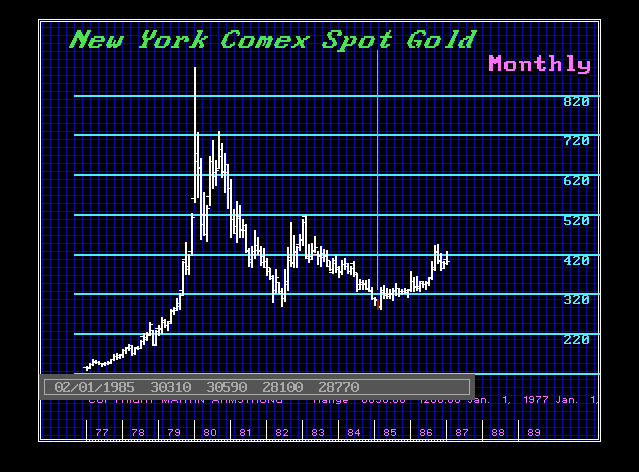
COMMENT: Marty; you should not be so hard on yourself. Nobody has tried harder than you to alter the outcome. Socrates is just unbeatable. I shared your hope that gold would have just cracked $1000 and that would have been a sling-sot up. But it stopped at $1045 and the reversals were elected and that was the end of that. As a long-term trader, I understood what you meant. I remember 1985 when gold just broke $300 and the leading gold analyst ___________ threw in the towel. You called that low and that’s when I started following your work. You weren’t just an analyst, you were a trader.
So ease up. You have done your best. As you said at the WEC, nobody has tried to defeat your own model as much as you, but you have always lost.
I for one hope you do Dubai in the Spring. It would be nice to see everyone in person again.
PD
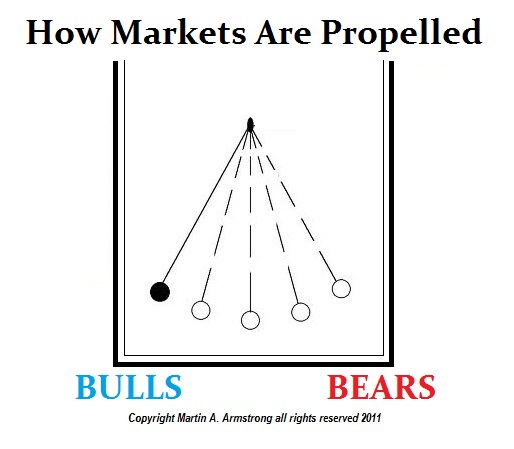
REPLY: Oh, yes. I remember that trade. It takes a trader to understand why I said if gold could crack $1,000, it would then be propelled straight up into a slingshot. Perhaps one of the most important trading tools is that the market is like a pendulum. The further it swings in one direction, the fast it will be propelled in the opposite. That is why when bubble markets peak, the vast majority of the decline takes place in two to three key time units thereafter. The failure of gold to have cracked that $1,000 psychological level is also when it has languished thereafter.
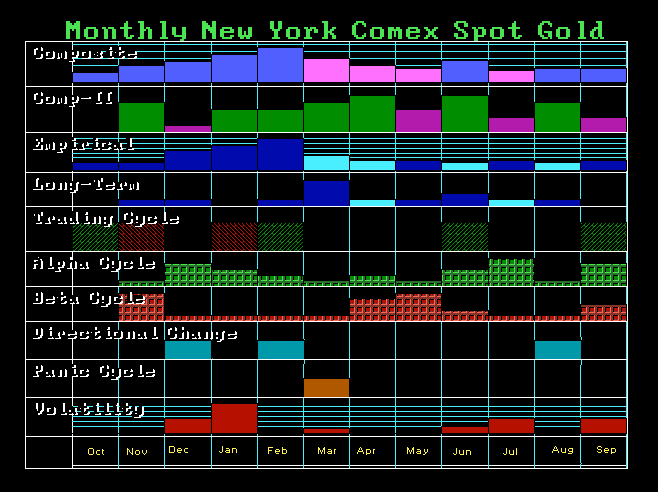
Here is the Array from October 1984. It called all the moves correctly and the major low was February with the Panic Cycle the very next month. The next temp high was on the next Directional Change in August 1985.
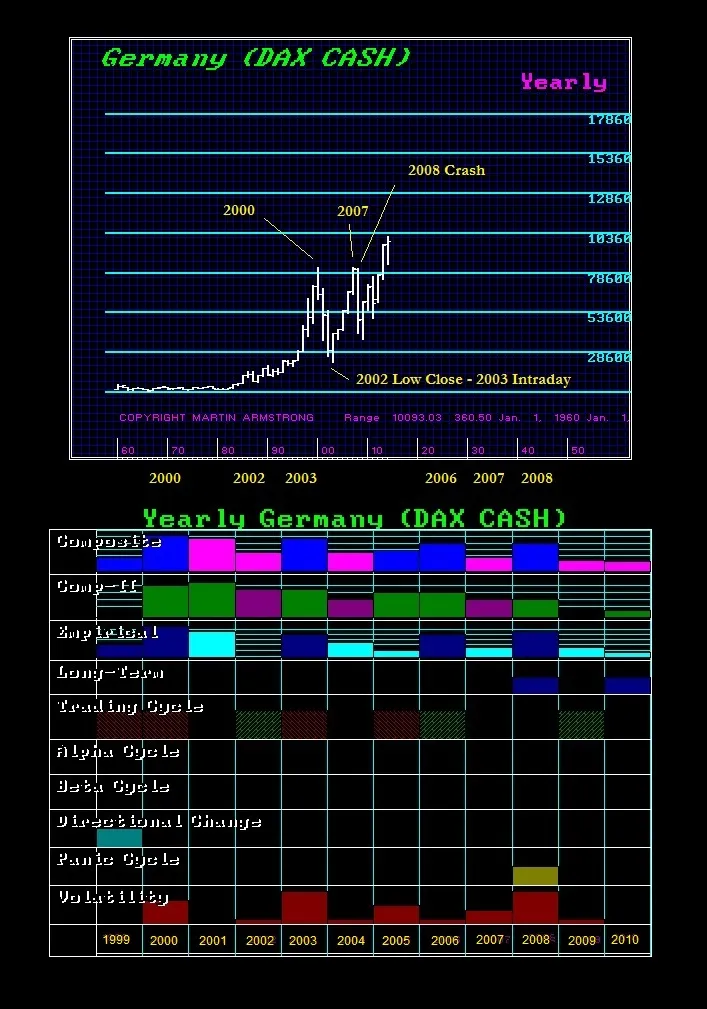
I have to admit, probably the one forecast of Socrates that really impressed me personally was the Array we published in 1999, which you can find on the Wayback Machine. It had targeted a Panic Cycle in 2008 – 10 years in ADVANCE! It was projecting the collapse globally of the 2008-2009 Financial Crisis. Obviously, my personal comments are not forecasts. I cannot beat Socrates and nobody else can possibly beat it.
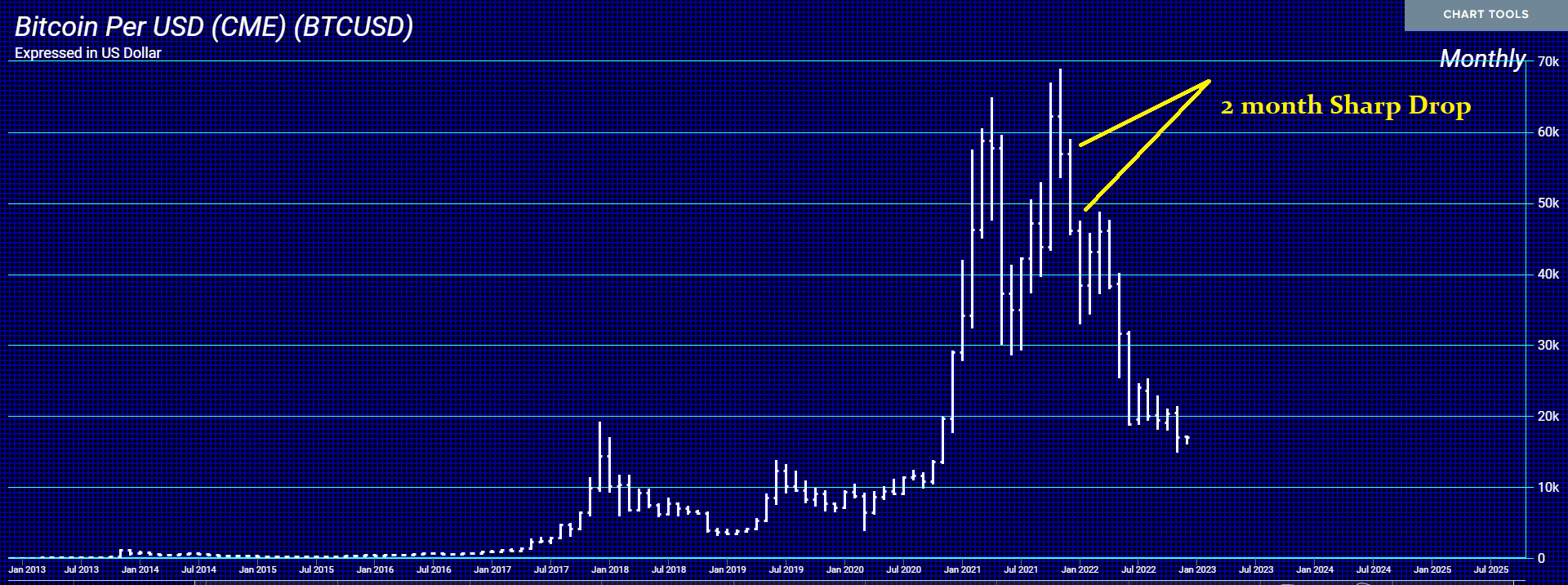
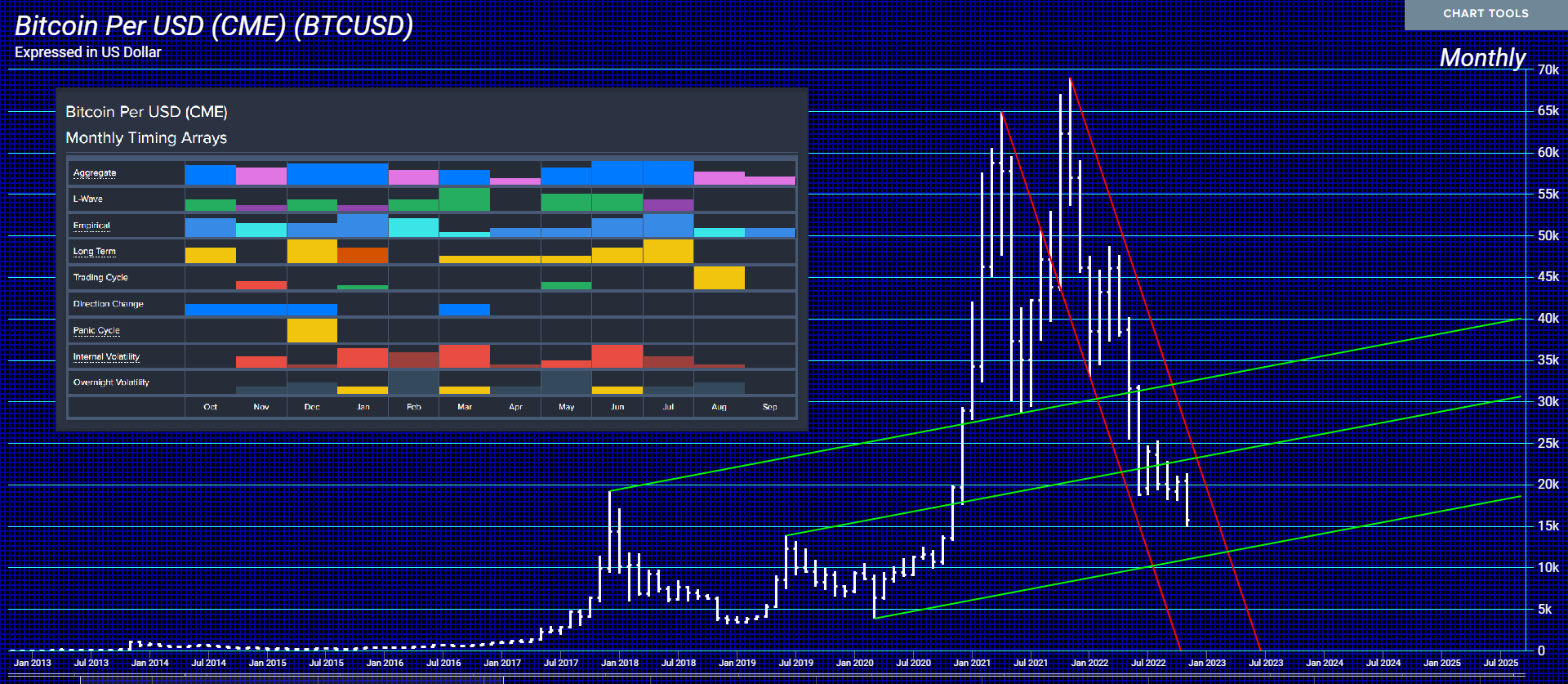
Trading observations are not forecasts. Even look at BitCoin Monthly. You see the standard 2-month decline, temp low, then the pendulum moves back in the opposite direction, but the power is diminished. The power is too strong on the decline side. These are just observations from being a trader. They are NOT the computer. So, yes, my comments are not forecasts but observations. The computer does the forecasting not me. Not even I can defeat Socrates.
COMMENT: Thank you for all you do. Your input has guided me well. I suspect my Bank is in deep trouble. _____ bank in ____ CA. They specialize in small business. First red flag was freezing my account for no reason. I then bounced a check because my account was frozen. They could not give me a reason for freezing my account. Then they offered me, according to them, a great investment deal, that was the second red flag. Then I was contacted by a relationship manger. This was the third red flag.
Will be closing all my accounts with ______ next week.
MC
REPLY: There are clearly problems emerging since interest rates have risen and many banks were not in a position to take the losses on long-term investments.
Always keep some cash. A word to the wise should be sufficient
COMMENT: You Know…years ago, all these different monthly reports did not affect the markets day to day so much.
Now…Today..these reports send huge panic cycles in the markets every time they are announced. Doesn’t that tell you something about the future?? Doesn’t that tell you something about the US economy? The end keeps getting closer.
N
REPLY: This is clearly the uncertainty. Everything seems to be upside down. Nobody understands the future or what might even happen. Will there be war? Will inflation actually stop? Are we headed into a major recession? How can the markets rally facing a major recession? So many questions and most have just opinions.
Even my interpretations of the computer arrays are sometimes wrong. Things are unfolding on such a global scale that concerns are rising everywhere. You have North Korea shooting missiles off over Japan, NATO members think Ukraine should join NATO, and Iran is threatening nuclear war in the Middle East. All of this while Schwab tells the world we will own nothing and be happy. To many, it has become just flip a coin and see if you should buy or sell.
Posted originally on the CTH on December 2, 2022 | Sundance
A slight drop in the overall national pretending index is noted today; actually, more like a twitch toward the reality side of the meter.
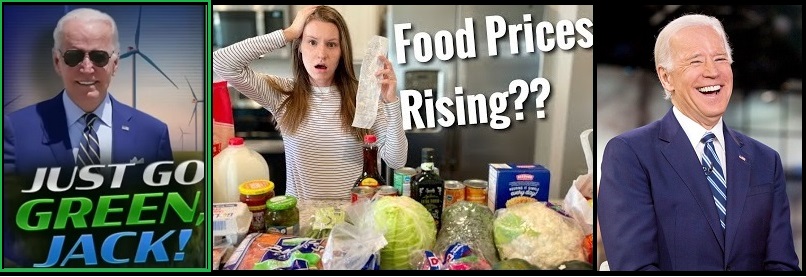
CTH has been outlining the supply side inflation issue in the highly consumable goods sector, specifically the foods sector, for almost two years now. Mainstream and financial pundits have denied its existence.
According to the Friedman view of traditional economics, only monetary policy drives inflation. However, Friedman never lived in -nor fathomed- an era when the collective western governments would intentionally shrink the economy in order to save the planet via climate change.
The intentional diminishment of energy production is the #1 source of increasing consumer prices. Inflation is not an issue of high demand for the subsequent goods produced. Raising interest rates diminishes demand for durable goods but has zero impact on the increasingly higher prices of intentionally scare resources like oil, coal and natural gas.
While maintaining the pretending due to the alignment with multinational and corporate interests, the Wall Street Journal starts admitting today that prices are not likely to drop, regardless of commodity prices. Even with abundant harvests, strong grain & soybean production, abundant pork and beef commodities, the costs associated with the production of food products will stop any downward price pressure.
(WSJ) Global prices for commodities such as wheat and sugar have fallen back to where they were a year ago, but consumers are still likely to feel the pinch at the checkout.
[…] Higher energy and power costs are also fueling food-price inflation. “That product on the shelf has a lot of the oil price built in,” said Kathy Kriskey, a commodity strategist at Invesco.
Costlier energy means it costs more to transport and package food, while supermarkets are paying more to power their stores. Higher gas prices also lead to increased fertilizer costs, while wage bills are also rising rapidly.
Supermarkets have more incentive to freeze than to lower prices, Ms. Kriskey added, since that gives them more flexibility if other input costs such as energy rise further in the coming months. (read more)
Now think about the inflation dynamic from a source origination position.
If the variable of abundance/scarcity is removed from the equation and yet high consumer prices remain – then what was the primary originating cost pressure on the end product?
The globalists can keep pretending, which they certainly are, and yet the answer to that question is obvious.
Our current level of inflation is not an outcome of consumer demand and/or monetary supply. The current level of inflation is a direct outcome of lowering traditional energy development, raising the cost of energy production, making oil, coal and natural gas more expensive, and then watching prices rise from the supply side origination.
The scale of inflation is a direct outcome of the scale of energy price increase. As long as energy prices remain high, regardless of the abundance of the commodity the price for the foodstuff will remain high. Food inflation has nothing to do with food scarcity and everything to do with increases in the costs to produce food.
We are in a price plateau right now, waiting to see how much further energy production will be restricted.
This is what western political leaders call “managing the transition”. Put another way, they are managing the overall decline of western civilization.
Posted originally on the CTH on December 2, 2022 | Sundance
There’s a disconnect in the Main Street data that is perplexing from the standpoint of traditional economic and labor analysis.
There have been significant layoffs in the labor market as the result of diminished consumer spending activity. However, the Bureau of Labor and Statistics (BLS) is reporting a hotter than expected 263,000 new jobs in November [DATA HERE].
There were declines in jobs within the retail sector [-30,000 in Nov, -62,000 since August] and declines in warehousing and transportation [-15, 000 in November, -30,000 since July], which would indicate the outcome of lowered consumer spending on goods, or at least a change in consumer spending priorities.
Simultaneously, there were significant increases in jobs for leisure and hospitality [+88,000 in Nov], with the majority of those gains in food service and drinking. However, that sector is still lower than the pre-pandemic by -980,000 jobs. Also note people are not attending events with high ticket costs, the performing arts and spectator sports segment dropped 7,000 jobs [Table B-1]
Overall, if you were to look at the macro level jobs report, anything attached to the traditional spending of durable goods (retail stores) is declining. However, the jobs related to the service or life experience are growing. Oddly, and perhaps creepily, this dynamic falls in line with the ‘you will own nothing and be happy‘ cliche’ that has been oft spoken about the new post pandemic ‘Build Back Better‘ economy as espoused by the World Economic Forum.
Job gains in the infrastructure of life such as, building and construction, as well as the labor sector associated with skilled domestic service trades like plumbing, electricians, maintenance, etc are continuing to hold stable. The major shift in the labor market surrounds the buying of durable goods which has disappeared along with the disappearance of discretionary income. Which brings us to the wage portion of the BLS report.
Wage growth was a very high 0.6% for November and brings the annual rate of wage growth to 5.1%. This outcome is almost certainly an outcome of workers demanding higher pay to cope with inflation, and employers needing to raise their wage rates in order to retain employees.
We also see an increase in the number of workers holding multiple jobs, as individuals are taking second jobs to cope with massive price increases in housing, food, fuel and energy. As noted within the BLS data:
“In November, the average workweek for all employees on private nonfarm payrolls declined by 0.1 hour to 34.4 hours. In manufacturing, the average workweek for all employees decreased by 0.2 hour to 40.2 hours, and overtime declined by 0.1 hour to 3.1 hours. The average workweek for production and nonsupervisory employees on private nonfarm payrolls decreased by 0.1 hour to 33.9 hours.”
Fewer people are working, but more jobs are being worked – with lowered hours.
Higher wages are good; however, higher wages lead to higher prices for goods and services; which drives inflation higher, which creates the need for higher wages. It’s an upward pressure spiral.
The supply side pressure on inflation, almost exclusively created by the BBB energy policy, shows absolutely no sign of lessening, despite the drop in demand for domestically produced finished consumer goods which has lowered overall industrial demand for energy.
The Build Back Better energy driven policy changes are creating very weird economic outcomes.
Prices are rising. Consumers are squeezed. Jobs attached to spending on goods are declining. Jobs attached to life experience and services expanding.
Ex.1 If you are working two jobs, now you might not have time to mow your grass – so you hire a lawn service. The lawn service guys are charging more because the gasoline and business costs are higher…. which means you need to work a little longer at the second job to pay for the lawn service you don’t have time to do on your own because you need to work the second job. That’s the dynamic we are seeing in the quantification of labor and job growth.
Ex.2 If you are working two jobs, you might not be cooking as much at home. So, you grab dinner/lunch away from home. The restaurants are charging more because the business costs are higher…. which means you need to work a little longer, ask for higher wages, in order to offset the time you don’t have to eat lunch/dinner at home.
This conflicting duality is what I always called the “serfesque driven economy.” It is an outcome of erosion of the middle-class. A status of individuality where your desires for life experience determine the need for your income.
You don’t own a car, you Uber. You don’t own a house, you rent. You don’t need a kitchen, you eat out. Things seem ok, but you eventually become a serf to the people who control transportation costs, housing costs, food costs, etc. Ultimately you have no control over the time you want to spend in enjoyment, because you don’t own the mechanisms of your life and need to work in order to afford maintaining the costs. It’s a weird mental exercise.
There is a real outcome in this dynamic where the wealth gap increases.
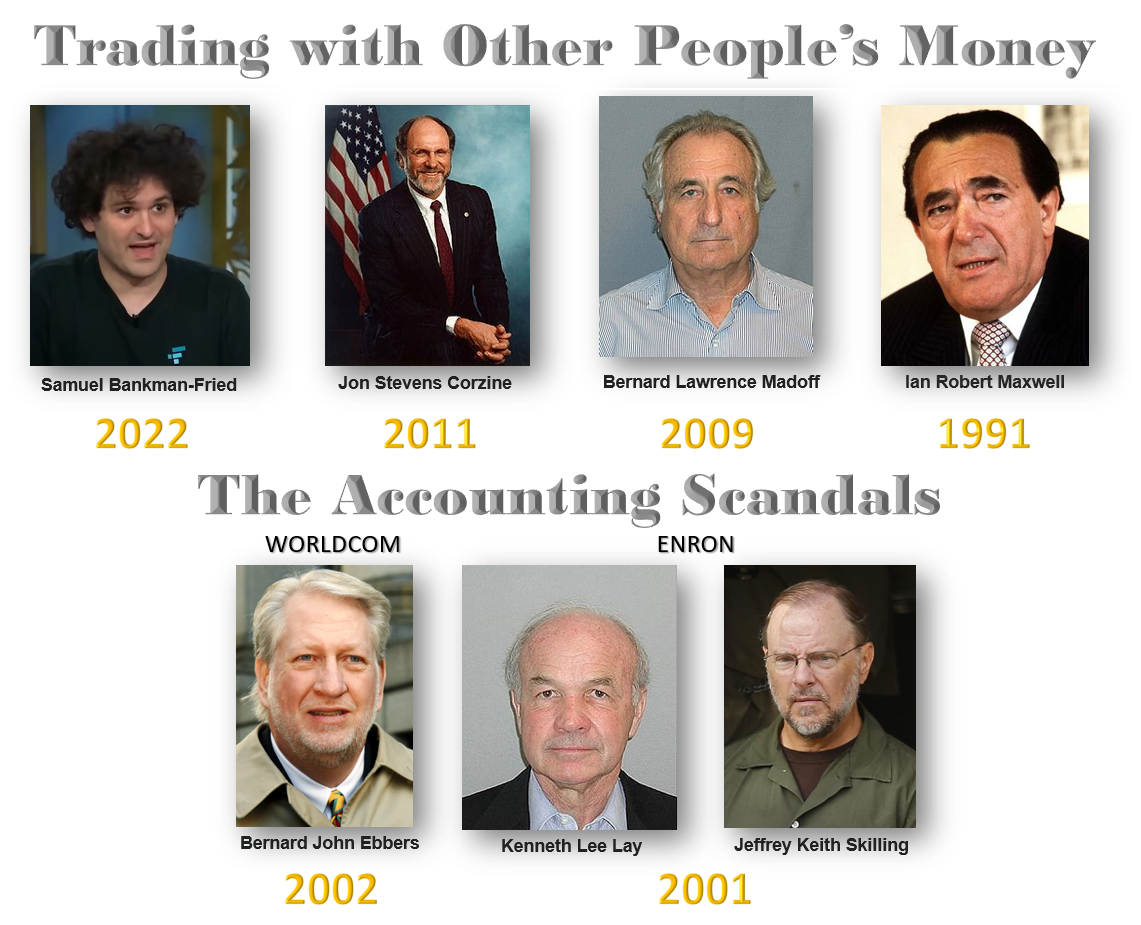
This FTX scandal is the death nil for cryptos. At first, I assumed that perhaps they lost a ton of money because of the implosion of the bond market. But this was not the case. In fact, this is perhaps the worst I have ever seen and it comes from trading losses from kids that had no experience whatsoever with regard to trading. They obviously did not even understand fiduciary responsibility. MF Global was taking client money to trade in London and got the market wrong. Bernie Madoff remains a mystery wrapped up in a political enigma. From 1991 to 2008, Bernie and Ruth Madoff contributed only about $240,000 to federal candidates, parties, and committees. Madoff was not trying to buy influence as was taking place at FTX. Maxwell mysteriously died in 1991 when his trading scandal surfaced, but he was also secretly backing the communist coup against Gorbachev in 1991.
Then there were the accounting scandals of ENRON and Worldcom whereby to hide their losses and failures, they engaged in accounting fraud to cover up the true story. But there were not using other people’s money to trade, they were hiding their bad performance from shareholders hoping to make a comeback.
That is the common denominator. I have been called into many crises. The one thing that always runs through the problem is the refusal to admit a mistake. That seems to lead to losing trades continuing to be held in hope of the infamous COMEBACK. The motive seems to be the same and many of the problems I have been called into to help solve have been in corporations where some strategy went wrong. In these cases of ENRON, Worldcom that were allowed to fester. The trading scandals are perpetuated in the hope that the next trade will win it all back.
Crypto contagion instigated by FTX, has only gotten more interesting since Sam Bankman-Fried sent a series of cryptic tweets spelling out the words “What HAPPENED” after his wealth wipeout. After the collapse of FTX, we are looking at a collapse in confidence in all digital assets.
With this degree of collapse in even Bitcoin, there will be more bankruptcies lining up. Inexperience dominates this young field and facing a stiff recession ahead going into 2023, this meltdown is not over yet. The low in Bitcoin from 2021 high is not likely before 2023. Thus – as they say – it ain’t over until the fat lady sings (a reference to Opera).
Canada is not hiding its depopulation and eugenicsefforts. The Trudeau Administration recently expanded the MAID (Medical Assistance in Dying) program to include those with treatable illnesses or those suffering from poverty. Almost anyone, including children, can request a medically assisted death in Canada with a quick turnaround. Families are unable to protect their loved ones from the law. The MAID program was originally designed for those living in unbearable chronic pain and/or a terminal illness. Poverty or temporary hardship is now considered a terminal illness for which there is no cure besides death.
The Canadian health system is coercing people at their lowest point to end their lives. Canada could prioritize health care and expand assistance to disabled Canadians who are unable to work. Instead, they are clearly discriminating against those suffering from poverty or mental health issues, and doctors are no longer required to treat their patients. The system is encouraging suicide over treatment as it is the most cost-effective option. There is no guarantee those murdered while under medical supervision are capable of making an informed decision; the law will be used to depopulate the undesirables.
The Netherlands and Belgium, where assisted suicide is offered on a medical basis, forbid doctors from suggesting the method unless all other options are exhausted. Canadian doctors are encouraged to offer the option to those deemed too poor to live. “Euthanasia” will not appear on the victim’s death certificate, depending on the province in which they were murdered by their government. In 2021, the number of those requesting MAID in the country rose by over 32% from the year prior, and that number will rise. As the economy turns down, those “too poor to continue living with dignity” will feel obligated to choose a permanent solution to a temporary problem.
“[MAID is] probably the biggest existential threat to disabled people since the Nazis’ program in Germany in the 1930s,” stated Tim Stainton, director of the Canadian Institute for Inclusion and Citizenship at the University of British Columbia. Pope Francis condemned the treatment of the elderly, mentally ill, and poor in Canada. “Patients who, in place of affection, are administered death,” the pope warned.
Adolf Hitler killed off “useless eaters” who did not contribute to his ideal version of society. They were forcibly taken to camps or executed on the spot. Canada is attempting to murder “useless eaters” under the guise of health care and compassion. The general public is turning a blind eye to what could become a genocide of the poor.
The collapse of the FTX Exchange is pretty straightforward insofar as this is the same lesson that constantly repeats in finance time and time again. Basically, FTX lent US$10bn of client funds to their trading arm Alameda, which used it for leveraged their own crypto speculation because the crypto market has been collapsing. Typically, someone like Sam Bankman-Fried had his whole life wrapped up in this venture. Lacking financial controls operating from the Bahamas, moving the money from client funds to his trading arm Alameda was possible. Historically, someone in this position sees his world collapsing but is not prepared to see that unfold for it requires admitting that he was wrong on crypto, to begin with. Consequently, such a person is not trying to actually rob clients’ money, they most likely see it as a temporary loan to save the company and the market will bounce back – or so they believe.
Our computer had picked the high in Bitcoin perfectly and has been projecting the collapse all along the way. But crypto has become a religion and in so doing it clouds the judgment of people who want to believe the story. Alameda blew up in a crypto meltdown because it did not want to accept that the crypto boom was over. The loan he probably thought would be temporary, vanished in the implosion. At first, I would have assumed they had actually invested the money and lost it on the bond market collapse. But that was perhaps too traditional. Here, it appears they were trying to defend their own cryptocurrency and trying to buy the low that kept moving lower. It appears he was allegedly simply using clients’ funds to trade keeping gains for his firm and the clients now suffer the risk.
It appears that they allegedly were trying to defend the crypto market and did not understand that the boom was over. The loans could not then be repaid. As crypto was crashing, some people needed to cash out. The attempt to pull out US$5bn from FTX exposed the fact that the cash was all gone. This is not so unusual. It has happened before. This time, the prosecutors are clamoring to be the one to charge him so they can become famous over his dead body.
FTX was a partner with Klaus Schwab’s World Economic Forum (WEF). Of course, the WEF has suddenly removed the page and is desperately trying to hide their involvement with FTX and Sam Bankman-Fried. Naturally, eliminating paper currency has been the goal of the WEF because they support the end of not just capitalism, but also democracy. Schwab’s push has been his Great Reset and to control society to impose his economic philosophy inspired by Marx and Lenin.
This is by no means the first violation of fiduciary responsibility that presents a custodial risk. MF Global Holdings Ltd., you might recall, was a firm formerly run by New Jersey ex-Gov. Jon Corzine was accused in 2013 of unlawfully using customer money to meet his firm’s funding needs. When MF Global went bust because of trading by ex-Goldman Sach’s Jon Corzine’s trading using his client’s money in London also outside the regulatory eye of the USA, he was NEVER prosecuted for illegally using $1.6 billion of 26,000 client’s money. That is not going to be the case this time. So what is the difference between Corzine and Bankman-Fried? Corzine was ex-Goldman Sachs.
Indeed, Corzine was well-connected right into the White House with Obama. Nobody went to jail and clients had to wait in bankruptcy to get their money – even cash in the accounts was taken. There are clear risks with the broker and clearer. As long as the SEC is run with former Goldman Sachs staff, there will NEVER be an honest regulator. Even when all the banks pled criminally guilty, the SEC exempted everyone from losing their licenses. They would NEVER do that with anyone outside of New York City. The SEC will never prosecute the banks – EVER!!!!
Indeed, several federal investigations had been launched into MF Global, including probes by the Commodity Futures Trading Commission (its main regulator), the Securities and Exchange Commission, the Federal Bureau of Investigation, and Justice Department prosecutors in both Chicago and New York. The brokerage has also been the focus of several congressional hearings. Not a single one charged Corzine with trading with his client’s money. The losses that eventually drove MF Global into bankruptcy stemmed from high-risk bets on European sovereign bonds that Corzine made as he swung for the fences. Corzine bet big that the bond issuers would not default.
Commodity Futures Trading Commission simply fined Jon Corzine only $5 million over MF Global’s rapid descent into bankruptcy on Oct. 31, 2011, as an estimated $1.6 billion of customer money went missing. Anyone else would have been in prison for a minimum of 20 years.
It was Martin Glenn who was the judge in New York on M.F. Global bankruptcy. He was the first one to engage in FORCED LOANS by abandoning the rule of law to help the bankers by protecting them from losses taking client accounts to cover M.F. Global’s losses. He simply allowed the confiscation of client funds when in fact the rule of law should have been that the bankers were responsible and M.F. Global’s losses should have been reversed as they did even when Robert Maxwell’s companies failed in London from his illegal trading taking employee pension funds.
Yes, that was Ghislaine Maxwell’s father and the guy who was in control of the company that Bill Browder worked for before Edmond Safra. Never should the client’s funds be taken for M.F. Global’s losses to the NY Bankers. It was Judge Martin Glen who placed the entire financial; system at risk by trying to protect the bankers. Martin Glenn pampered these bankers making them the new UNTOUCHABLES. We have to be concerned that there really is no rule of law that will protect you in a crisis.
On Bloomberg TV, Sam Bankman-Fried explained why he even created FTX. He said he was experiencing his own frustration at Alameda Research, which was his crypto-focused proprietary trading firm. He was frustrated with the execution he was receiving at various crypto exchanges so he claimed that inspired FTX’s creation in May 2019. FTX grew rapidly to become the third largest crypto exchange in the world, with approximately $16 billion of customer assets under custody over 43 months.
Bankman-Fried stated that Alameda was making lots of money, but it could have been making more and he did not have access to venture capital. Claims of 100% annualized returns are not uncommon in a boom, but any experienced trader knows what goes up, also comes down. Alameda was relying on “cobbling together lines of credit” to expand its capital base. He then created FTX to solve his funding problem creating his own exchange that even the WEF cheered as a partner. He actually created a platform that was tailored for his own company, Alameda, to facilitate its trading needs. FTX coined the phrase “built by traders, for traders.”
There was an obvious conflict of interest questions regarding the close relationship between FTX and Alameda. Being operated from the Bahamas raised questions among those of us who are seasoned financial market observers whether the two were truly arm’s length from each other. However, people were so pumped up on adrenalin with crypto being the end of the dollar and central banks that this new free-wheeling crypto world believed what they wanted to believe and never looked too closely. FTX operated outside the reach of the US regulatory domain and there was a lack of any fiduciary confirmation. When the founder of Binance, the world’s largest crypto exchange, Changpeng Zhao, openly questioned the soundness of the FTX/Alameda nexus on Twitter saying he would sell over $500 million worth of FTX’s token FTT, that was the kiss of death weather or not he realized he would unleash a crypto panic that would engulf the entire industry in a matter of days.
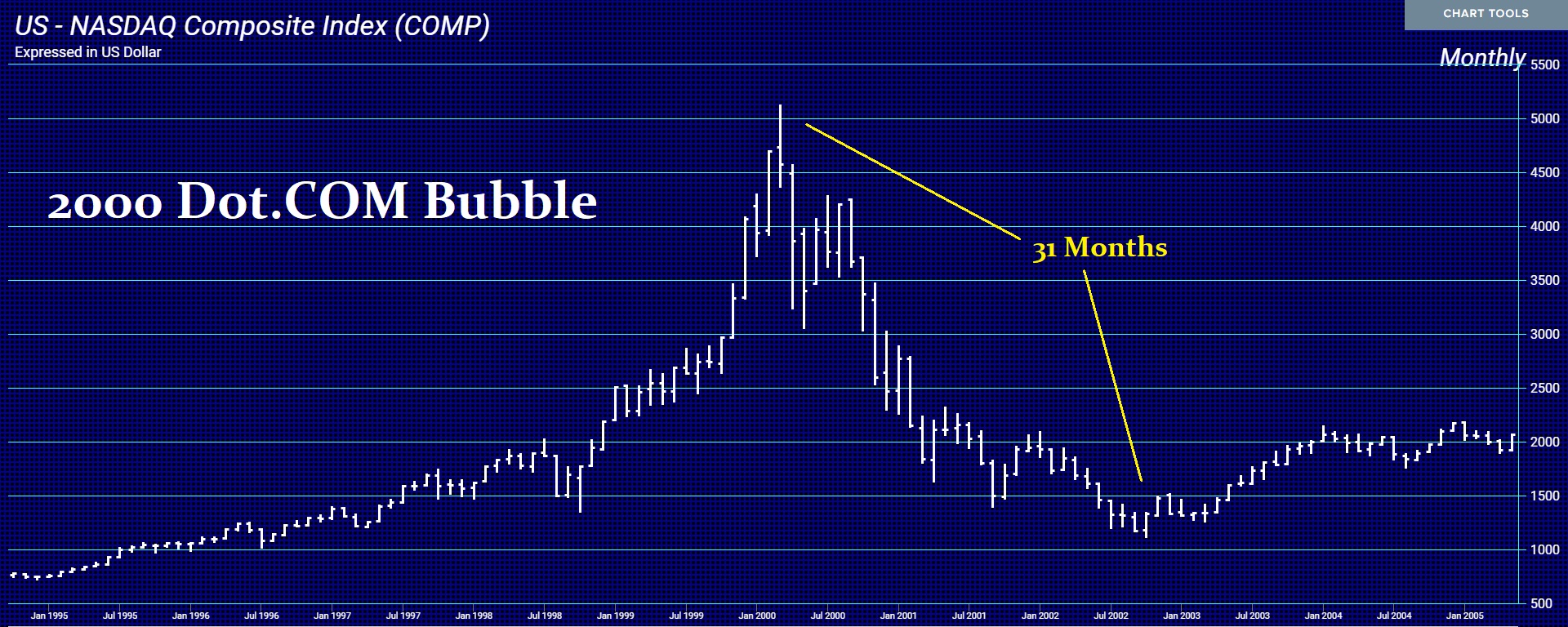
The collapse of FTX will now become a contagion for the crypto world. This 20-something group of inexperienced traders has signaled the demise of an industry that was getting all the hype with no substance. This crypto world will be seen as the DOT COM Bubble of 2000. With a recession on the horizon, the collapse of sovereign debt, and the monetary system as a whole, people will be looking for more of the safe bets rather than roll the dice on crypto. Nothing ever goes straight down. But by year-end, the volatility should perk up everyone’s view of the world.
Posted originally on the conservative tree house on November 14, 2022 | Sundance
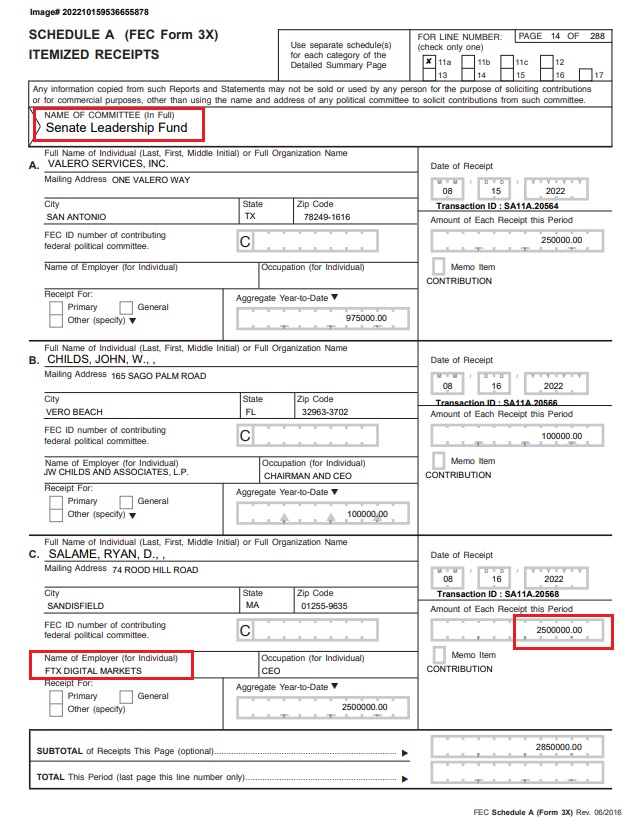
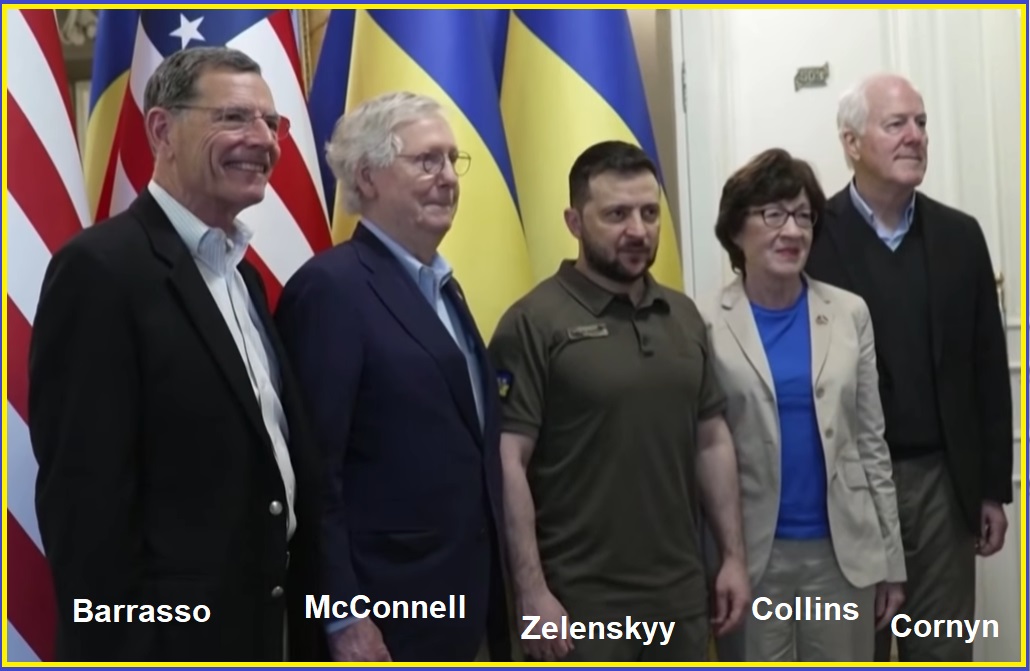
The Senate Leadership Fund is the Political Action Committee (PAC) controlled by Mitch McConnell. Within the quarterly FEC filings of the Senate Leadership Fund, we discover that in addition to funding Joe Biden and Democrats, the ponzi scheme known as the FTX cryptocurrency exchange was also funding Mitch McConnell with $2.5 million. [Document Source]
There is a lot of speculation about U.S. taxpayer funds going to Ukraine, then transferring into the FTX crypto exchange program, then exiting back out with FTX donations to the DC politicians who provided the Ukraine funds. If this ends up being accurate, then the FTX crypto currency operation was being used as a laundry system to funnel money from congress through Ukraine and back into the pockets of politicians.
Do not look for DC politicians to investigate or expose themselves in this potential laundry operation.
Most people think when they vote for a federal politician -a House or Senate representative- they are voting for a person who will go to Washington DC and write or enact legislation. This is the old-fashioned “schoolhouse rock” perspective based on decades past. There is not a single person in congress writing legislation or laws.
In modern politics not a single member of the House of Representatives or Senator writes a law or puts pen to paper to write out a legislative construct. This simply doesn’t happen.
Over the past several decades a system of constructing legislation has taken over Washington DC that more resembles a business operation than a legislative body. Understand this dynamic and you understand how politicians become multi-millionaires on much lesser salaries; and why ‘We The People’ are insignificant and annoying gnats to their business model. Here’s how it works right now.
Outside groups, often called “special interest groups”, are entities that represent their interests in legislative constructs. These groups are often representing foreign governments, Wall Street multinational corporations, banks, financial groups or businesses; or smaller groups of people with a similar connection who come together and form a larger group under an umbrella of interest specific to their affiliation.
Sometimes the groups are social interest groups, activists, climate groups, environmental interests etc. The social interest groups are usually non-profit constructs who depend on the expenditures of government to sustain their cause or need.
The for-profit groups (mostly business) have a purpose in Washington DC to shape policy, legislation and laws favorable to their interests. They have fully staffed offices just like any business would – only their ‘business‘ is getting legislation for their unique interests.
These groups are filled with highly paid lawyers who represent the interests of the entity and actually write laws and legislation briefs.
In the modern era this is actually the origination of the laws that we eventually see passed by congress. Within the walls of these buildings within Washington DC is where the ‘sausage’ is actually made.
Again, no elected official is usually part of this law origination process.
Almost all legislation created is not ‘high profile’, they are obscure changes to current laws, regulations or policies that no-one pays attention to. The passage of the general bills within legislation is not covered in media. Ninety-nine percent of legislative activity happens without anyone outside the system even paying any attention to it.
Once the corporation or representative organizational entity has written the law they want to see passed – they hand it off to the lobbyists.
The lobbyists are people who have deep contacts within the political bodies of the legislative branch, usually former House/Senate staff or former House/Senate politicians themselves.
The lobbyist takes the written brief, the legislative construct, and it’s their job to go to congress and sell it.
“Selling it” means finding politicians who will accept the brief, sponsor their bill and eventually get it to a vote and passage. The lobbyist does this by visiting the politician in their office, or, most currently familiar, by inviting the politician to an event they are hosting. The event is called a junket when it involves travel.
Often the lobbying “event” might be a weekend trip to a ski resort, or a “conference” that takes place at a resort. The actual sales pitch for the bill is usually not too long and the majority of the time is just like a mini vacation etc.
The size of the indulgence within the event, the amount of money the lobbyist is spending, is customarily related to the scale of benefit within the bill the sponsoring business entity is pushing. If the sponsoring business or interest group can gain a lot of financial benefit from the legislation, they spend a lot on the indulgences.
Recap: Corporations (special interest group) write the legislation. Lobbyists take the law and go find politician(s) to support it. Politicians get support from their peers using tenure and status etc. Eventually, if things go according to norm, the legislation gets a vote.
Within every step of the process there are expense account lunches, dinners, trips, venue tickets and a host of other customary financial waypoints to generate/leverage a successful outcome. The amount of money spent is proportional to the benefit derived from the outcome.
The important part to remember is that the origination of the entire process is EXTERNAL to congress.
Congress does not write laws or legislation; special interest groups do. Lobbyists are paid, some very well paid, to get politicians to go along with the need of the legislative group.
When you are voting for a Congressional Rep or a U.S. Senator you are not voting for a person who will write laws. Your rep only votes on legislation to approve or disapprove of constructs that are written by outside groups and sold to them through lobbyists who work for those outside groups.
While all of this is happening the same outside groups who write the laws are providing money for the campaigns of the politicians, they need to pass them. This construct sets up the quid-pro-quo of influence, although much of it is fraught with plausible deniability.
This is the way legislation is created.
If your frame of reference is not established in this basic understanding you can often fall into the trap of viewing a politician, or political vote, through a false prism. The modern origin of all legislative constructs is not within congress.
“we’ll have to pass the bill to, well, find out what is in the bill” etc. ~ Nancy Pelosi 2009
“We rely upon the stupidity of the American voter” ~ Johnathan Gruber 2011, 2012.
Once you understand this process you can understand how politicians get rich.
When a House or Senate member becomes educated on the intent of the legislation, they have attended the sales pitch; and when they find out the likelihood of support for that legislation; they can then position their own (or their families) financial interests to benefit from the consequence of passage. It is a process similar to insider trading on Wall Street, except the trading is based on knowing who will benefit from a legislative passage.
The legislative construct passes from K-Street into the halls of congress through congressional committees. The law originates from the committee to the full House or Senate. Committee seats which vote on these bills are therefore more valuable to the lobbyists. Chairs of these committees are exponentially more valuable.
Now, think about this reality against the backdrop of the 2016 Presidential Election. Legislation is passed based on ideology. In the aftermath of the 2016 election the system within DC was not structurally set-up to receive a Donald Trump presidency.
If Hillary Clinton had won the election, her oval Office desk would be filled with legislation passed by congress which she would have been signing. Heck, she’d have writer’s cramp from all of the special interest legislation, driven by special interest groups that supported her campaign, that would be flowing to her desk.
Why?
Simply because the authors of the legislation, the originating special interest and lobbying groups, were spending millions to fund her campaign. Hillary Clinton would be signing K-Street constructed special interest legislation to repay all of those donors/investors.
Congress would be fast-tracking the passage because the same interest groups also fund the members of congress.
President Donald Trump winning the2016 election threw a monkey wrench into the entire DC system…. In early 2017 the modern legislative machine was frozen in place.
The “America First” policies represented by candidate Donald Trump were not within the legislative constructs coming from the K-Street authors of the legislation. There were no MAGA lobbyists waiting on Trump ideology to advance legislation based on America First objectives.
As a result of an empty feeder system, in early 2017 congress had no bills to advance because all of the myriad of bills and briefs written were not in line with President Trump policy. There was simply no entity within DC writing legislation that was in-line with President Trump’s America-First’ economic and foreign policy agenda.
Exactly the opposite was true. All of the DC legislative briefs and constructs were/are antithetical to Trump policy. There were hundreds of file boxes filled with thousands of legislative constructs that became worthless when Donald Trump won the election.
Those legislative constructs (briefs) representing tens of millions of dollars’ worth of time and influence were just sitting there piled up in boxes under desks and in closets amid K-Street and the congressional offices. Legislation needed to be in-line with an entire new political perspective, and there was no-one, no special interest or lobbying group, currently occupying DC office space with any interest in synergy with Trump policy.
Think about the larger ramifications within that truism. That is also why there was/is so much opposition.
No legislation provided by outside interests means no work for lobbyists who sell it. No work means no money. No money means no expense accounts. No expenses mean politicians paying for their own indulgences etc.
Politicians were not happy without their indulgences, but the issue was actually bigger. No K-Street expenditures also means no personal benefit; and no opportunity to advance financial benefit from the insider trading system.
Without the ability to position personal wealth for benefit, why would a politician stay in office? The income of many long-term politicians on both Republican and Democrat sides of the aisle was completely disrupted by President Trump winning the election. That is one of the key reasons why so many politicians retired immediately thereafter.
When we understand the business of DC, we understand the difference between legislation with a traditional purpose and modern legislation with a financial and political agenda.
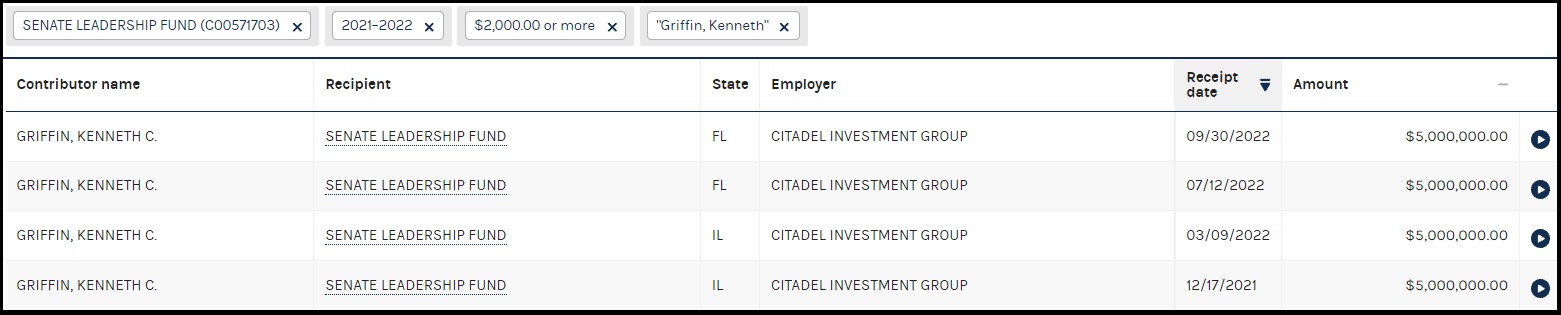
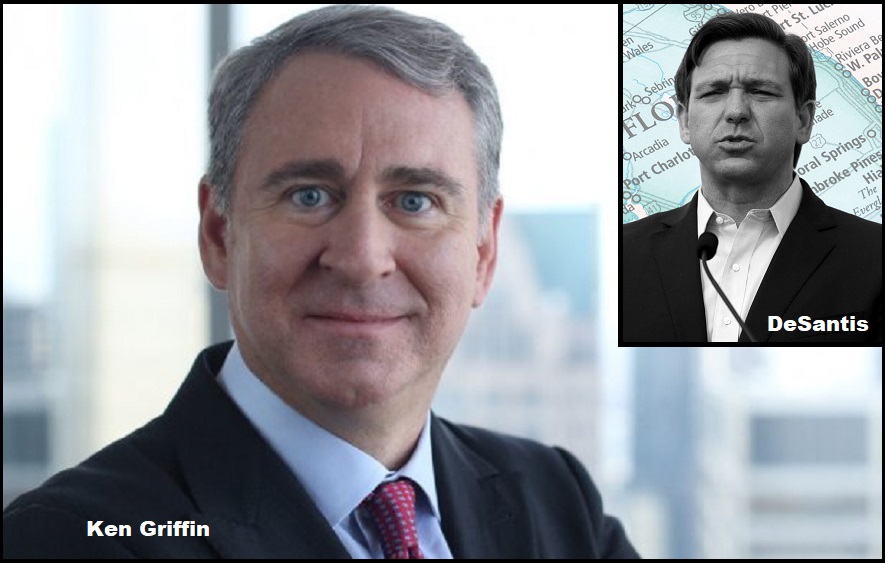
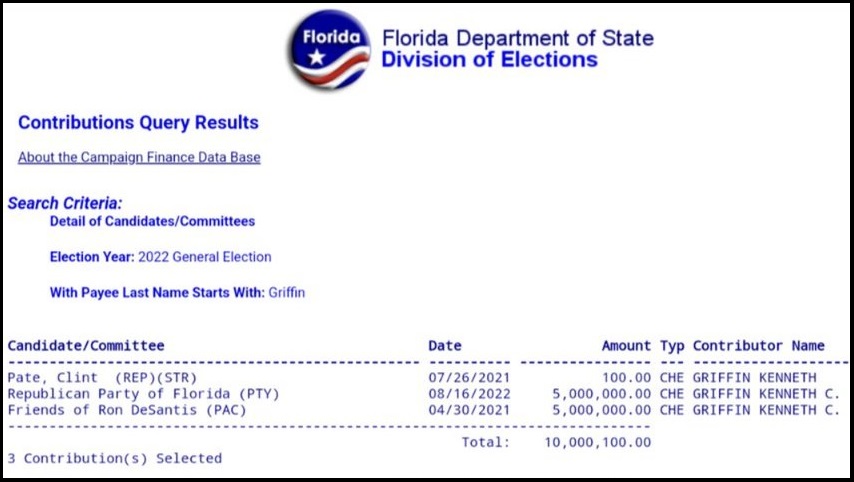
Additionally, while looking for the FTX donations, it’s worth noting that Citadel Investment CEO Ken Griffin also gave Mitch McConnell’s Senate Leadership Fund, $20 million in 2022. This is the same Ken Griffin that is a major donor funding the Ron DeSantis 2024 effort. (SOURCE)
Posted originally on the conservative tree house on November 14, 2022 | Sundance
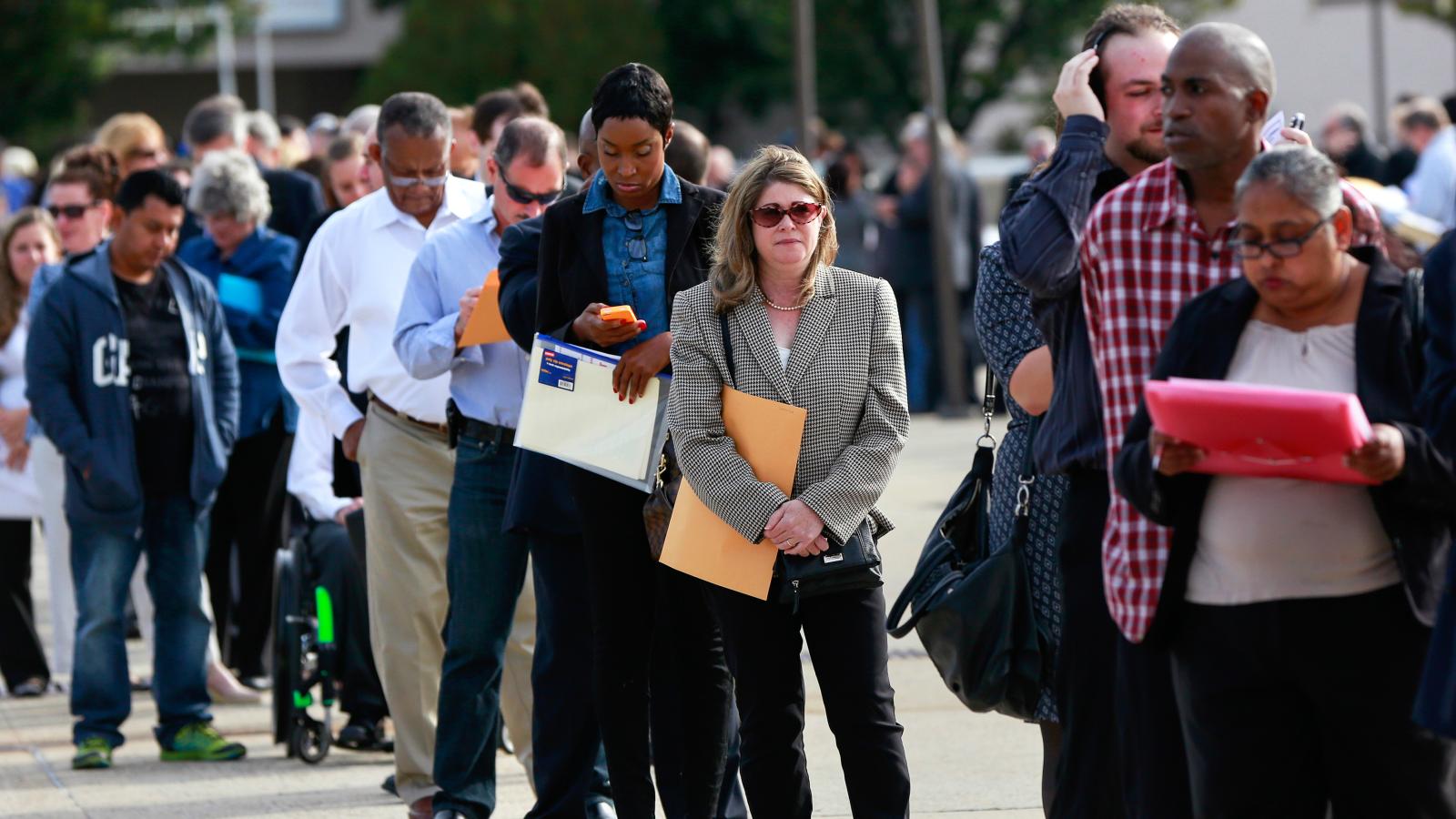
At a time when/if the economy was functioning as most economic pundits have previously proclaimed, Amazon and other retail giants would normally be beefing up workers in anticipation of the holiday shopping season. However, with the midterm election in the rearview mirror, exactly the opposite is happening. {Backstory on prior employment announcements}
According to multiple media reports, Amazon is expected to announce layoffs for approximately 10,000 U.S. workers this week. Yet another indication the economic pretending is coming to an end right after the midterm election is concluded.
(CNBC) – Amazon is planning to lay off approximately 10,000 employees in corporate and technology roles beginning this week, according to a report from The New York Times. Separately, The Wall Street Journal also cited a source saying the company plans to lay off thousands of employees.
Shares of Amazon closed down about 2% on Monday.
The cuts would be the largest in the company’s history and would primarily impact Amazon’s devices organization, retail division and human resources, according to the report. The reported layoffs would represent less than 1% of Amazon’s global workforce and 3% of its corporate employees. (read more)
“Bye”
As previously noted by Yahoo News, a “wave of layoffs” has begun that encompasses dozens of medium and large corporations [SEE HERE].
The layoffs, outlined in Yahoo, cover real estate, tech companies, banking, finance, automakers, EV startups, and brick and mortar stores like 7-11 and GAP. It should not come as a surprise, but it is sad to see, nonetheless.
Within the economy, a great pretending can only last so long… then reality hits.
The skilled trades should likely end up in the best employment situation, with the tech sector the worst. Service industries are also one of the first sectors hit when employment becomes an issue.
With rising interest rates, high inflation, excessive inventories, a shrinking production economy, extreme energy costs and diminished disposable income as a result of inflation and gas prices, there was going to come a time when it all starts to congregate.
2023 looks to be the year when economic pretenses collapse under the weight of having to admit a recession exists.
This is shaping up to be a painful holiday season….
I have created this site to help people have fun in the kitchen. I write about enjoying life both in and out of my kitchen. Life is short! Make the most of it and enjoy!
This is a library of News Events not reported by the Main Stream Media documenting & connecting the dots on How the Obama Marxist Liberal agenda is destroying America

















 Centinel2012