Posted originally on the conservative tree house on May 7, 2021 | Sundance | 134 Comments
Economic forecasters had predicted one million job gains in April. The actual results are “stunningly” and “unexpectedly” far below the expectations. The Bureau of Labor Statistics [SEE HERE] reveals only 266,000 jobs gained in April and downward revisions of March by -146,000. There are almost 7.4 million jobs available; however, despite the available jobs, no-one is going back to work.
Yes, JoeBama’s “free government money” has created the socialist utopia.
The politically correct economic analysts are shocked that minorities (blacks and latinos) are not going back to work; while ignoring the disincentive that government handouts have created in the JoeBama economy. The entire dynamic is ridiculous when you consider we should be entering a phase of the jobs economy where vaccination and COVID mitigation should be leading to massive reopenings of the economy overall.
Inside the numbers, the economic sectors showing the worst jobs recovery are directly related to the blue state shut-downs. Worse yet, there is an underlying scenario showing the economy is not growing despite the ability of businesses to re-open overall. That spells even more trouble.
(CNBC) – “Today’s report was an enormous surprise and shows the labor market hit a hidden pothole in April,” Glassdoor senior economist Daniel Zhao tells CNBC Make It. “Clearly, the labor market has decelerated quite a bit.”
The 6.1% unemployment rate and 9.8 million people unemployed remained steady in April compared with the months prior. (more)
There is no level of spin that can change the reality of this situation. JoeBama’s economic policies are exactly the wrong thing to be doing. Everything, and I do mean every single policy objective, delivered by this administration is AMERICA LAST!
Hiring was a huge letdown in April, with nonfarm payrolls increasing by a much less than expected 266,000 and the unemployment rate rose to 6.1%. Dow Jones estimates had been for 1 million new jobs and an unemployment rate of 5.8%. CNBC’s Jim Cramer discusses what he thinks led to the surprising report.
Posted originally on the conservative tree house May 7, 2021 | Sundance | 157 Comments
This obtuse explanation from Treasury Secretary Janet Yellen about the April jobs report is one for the record books. According to Yellen, the government handing people more free money than they would achieve with a working job is not a disincentive for employment.
To prove her case she cites the hospitality industry hiring people in April. However, what Yellen doesn’t figure into her bizarro logic is that all sectors in all states are not created equal. Yes, the statistics of “sector analysis” apply across the entire nation; however, the underlying economic activity is not equally distributed.
Blue states are more economically closed than red states. The job gains are in the states where the economic activity is strongest and the incentives for workers are the biggest. The lack of people working is disproportionately happening in the blue states where dependency models are strongest. WATCH this nonsense:
These bureaucrats don’t have a lick of common sense. According to Secretary Yellen’s logic, there are times when water is not lacking dryness.
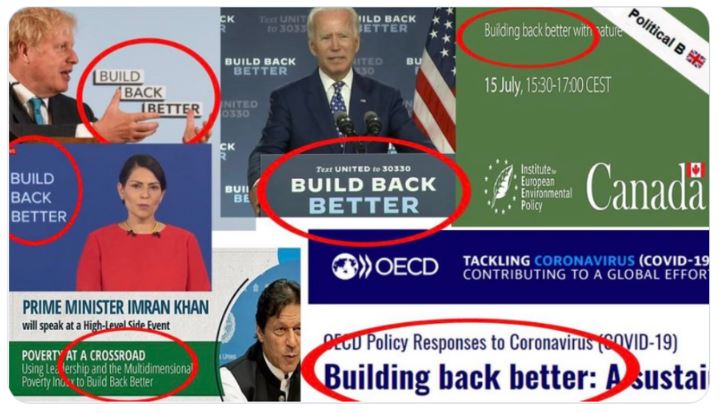
A number of people often send nasty emails because they do not like the forecast that China will become the next financial capital of the world. The forecasts we put out are NOT based upon my OPINION. I simply report what the computer projects. This Great Reset is playing right into our forecast, for they are deliberately destroying the economy so they can “BUILD BACK BETTER,” as they like to say.
The problem is that they are ignorant of world history. The victor in war is NOT simply the person who has the largest army. There must be some advantage and that boils down to economics. The one with the strongest economy is the victor because they have the capacity to fund the war.
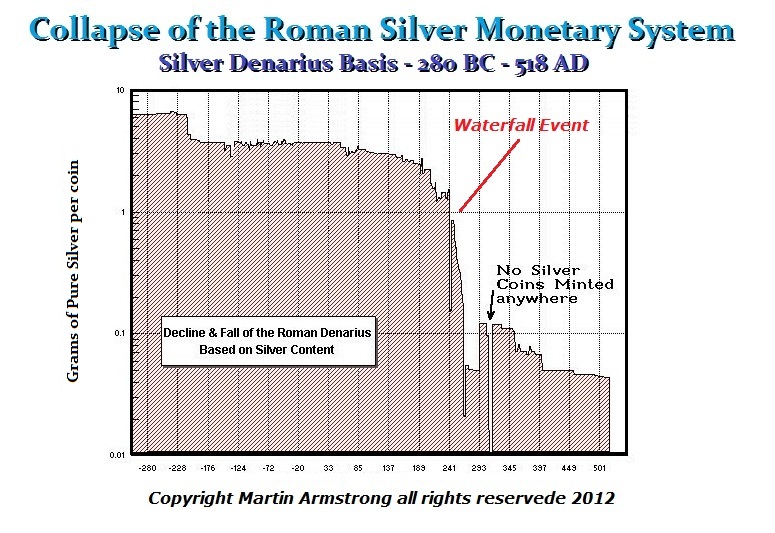
This is why barbarians could never invade Rome until the Roman Empire’s monetary system began to collapse following the capital of Emperor VBalerian I in 260AD. Even Alexander the Great was able to take the Persians because they lost their greatest and were unable to defend against a well-supported army. The South lost against the North in the American Civil War because the North was industrial whereas the South was primarily agrarian.
Deliberately destroying our economy so they can “Build Back Better” while creating food shortages and trying to end raising cattle because of CO2, has set the West on the course to economic decline. This has made the West vulnerable just as was the case with the Roman Empire.
Now everyone is starting to notice and even CNBC says that China will surpass the United States by 2028. Granted, the analytical field seems to notice trends of this nature only when it smacks them in their face. We published the report “China on the Rise” back in 2018.
Now New York City, thanks to Socialists who think they can keep taxing the rich without end, lost its title as the home of more billionaires than anywhere else. Beijing has now taken that title. Some people think my reliance on history is foolish. History repeats because human nature is always the same.
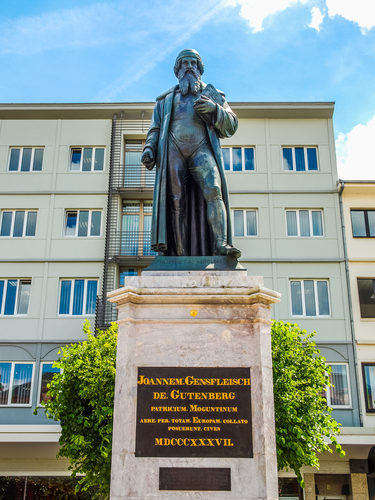
New York is dying. It is, in trading terms, a major SHORT! NYC is following the same path as Mainz. It was the city of Mainz where the Gutenberg printing press was invented. This created an economic boom and everyone wanted to be in Mainz. The politicians saw the boom and presumed the potential tax revenue was linear and would be endless – judging tomorrow by today’s trend. They began to borrow against what they anticipated would be there forever. As they needed the interest to pay for borrowing and became addicted to debt, they raised taxes.
The taxes kept rising so they killed the economic boom and people began to leave. Mainz followed the typical path as we are doing today. They were no longer paying off debt. They entered the Ponzi scheme – issued new debt to pay off the old in a revolving bond auction. Taxes kept rising and people migrated. The printing press was no longer unique to Mainz. The rich left town, taking their capital and entrepreneurship with them. When Mainz lost the confidence of the bond buyers and could no longer sell new debt to pay for the old, the collapse unfolded. Mainz, like Detroit, defaulted. The creditors sacked the city and it was burned to the ground.
The same precise pattern unfolds every time – WITHOUT EXCEPTION. Why? Human nature never changes. Create career politicians and they will always seek to expand government for that is their power base. All that is left is a nice monument commemorating Guttenberg. Of course, they never tell the full story of Mainz.
New York City is making all the same mistakes like clockwork. They think people can be exploited without end. There comes a point where it no longer is beneficial to work as a slave. Why invest in anything if those in power simply want to take whatever you invent.
I pray for 2032 to end corruption and drive a stake through the heart of republican forms of government. We need a new path and anyone who calls for exploiting one class to benefit another should be subject to life imprisonment where they can enjoy carefree and tax-free living in a world of equality.
The orchestrated COVID pandemic to change the economy for the BUILD BACK BETTER Great Reset has set in motion food shortages that are now emerging. Farmers have had to plow their crops under, and one had to kill over 30,000 chickens because they simply could not get them to market. Sales of produced collapsed as much as 75% in 2020 compared to 2019 in some areas. Even in Europe, the cold weather has destroyed crops. As I have said, these morons look at the world only in a single dimension. They had no idea that locking people down to lower CO2 meant that they were also cutting off the supply chain in technology to food.
There is a shortage now of chickens, and don’t worry, it will move to beef as well. Add their scheme for a cyber attack, and the future looks really crazy because nobody will lock these people up, no less dare to investigate them. So be warned. This will get far worse post-2024. We should all send a thank you note to Klaus Schwab and Bill Gates for starters.
COMMENT: I wrote to the ________ news and pointed out that you had a computer model that beat all the models that Gates-funded to use to create these lockdowns. They never responded.
HJ
ANSWER: Oh it is worse than that. One of the top five newspapers in the world wanted to write a story about Socrates and its forecasts with respect to COVID. We spoke, and then two weeks later, the powers from above said NO!
It is not a question of them not being aware. They know precisely about Socrates, yet the powers that be give directions not to cover Socrates, for it goes against the narrative. Perhaps if enough people wrote to Fox or the Hill, they might report something. But they too are afraid of stepping into this mess, for they might drown in a swamp filled with quicksand.
QUESTION: Mr. Armstrong, You say that wheat fell during the Great Depression during the Dust Bowl when supply would have declined. This makes no sense. Would you address that question?
KL
ANSWER: Your problem is typical in analysis. It appears that 99% of the people always try to reduce some event to a single cause and effect. Everything is connected like a line of dominoes. You are not just pushing over a single one. The action has a ripple effect that moves through the entire world economy and is not even restricted to a single nation.
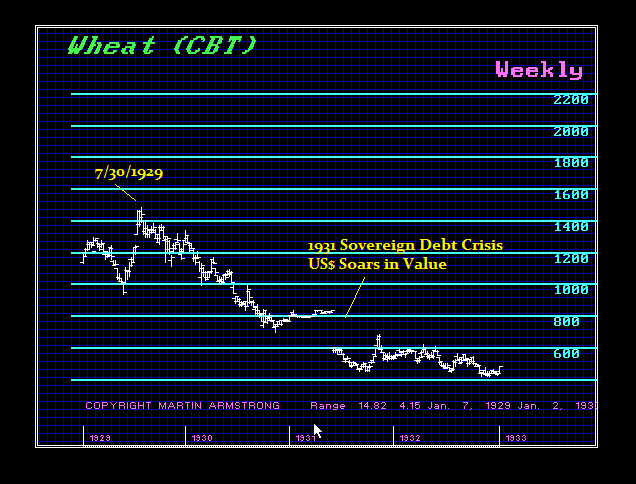
I do not make stuff up to try to prove a point. I have been curious to discover how things really work. When I say we have the largest database in the world, I am not joking. Just as I have been a collector of various things, that includes data. It is easy to find a yearly chart of wheat, but not daily or weekly during that period. Here is how wheat responded during the Great Depression on a weekly basis. Note that it peaked about 4 weeks before the stock market. Then you see a huge gap down in 1931.
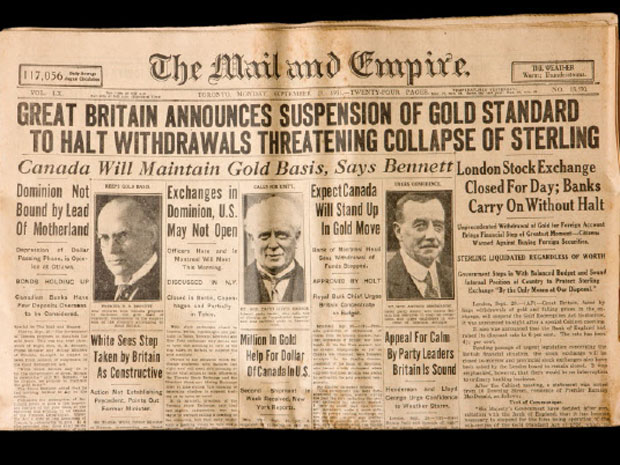
This was caused by the wholesale defaults of just about every nation. Some went into a moratorium and suspended payments on their debt like Britain. But most outright defaulted and you can buy their bonds usually on eBay.
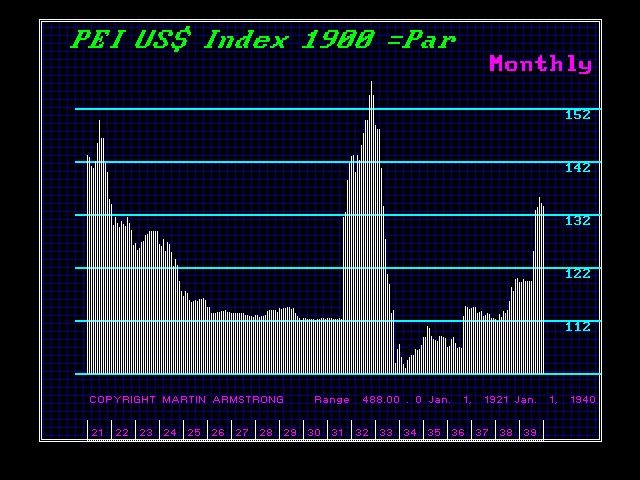
Here is the impact of the 1931 Sovereign Debt Crisis. The dollar soared on our index from roughly the 112 level to nearly 160. That was high which exceeded even World War I levels. That illustrates just how high the dollar rallied. Because wheat was priced in dollars, it fell in terms of dollars while rising in terms of other currencies because of their defaults.
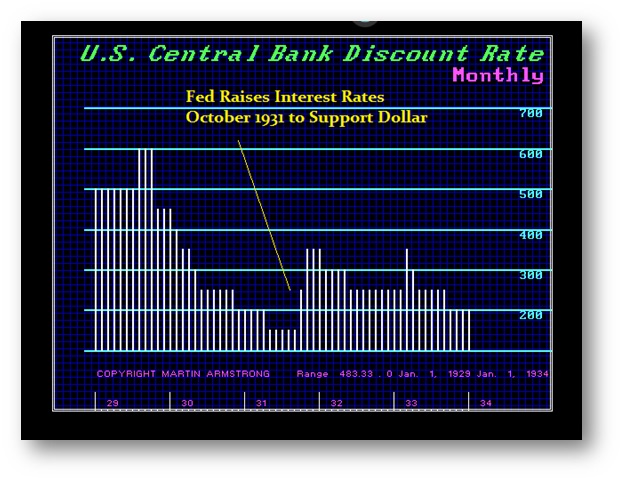
The Federal Reserve raised rates in 1931 during the Depression because they feared that the dollar would collapse because confidence in government globally collapsed.
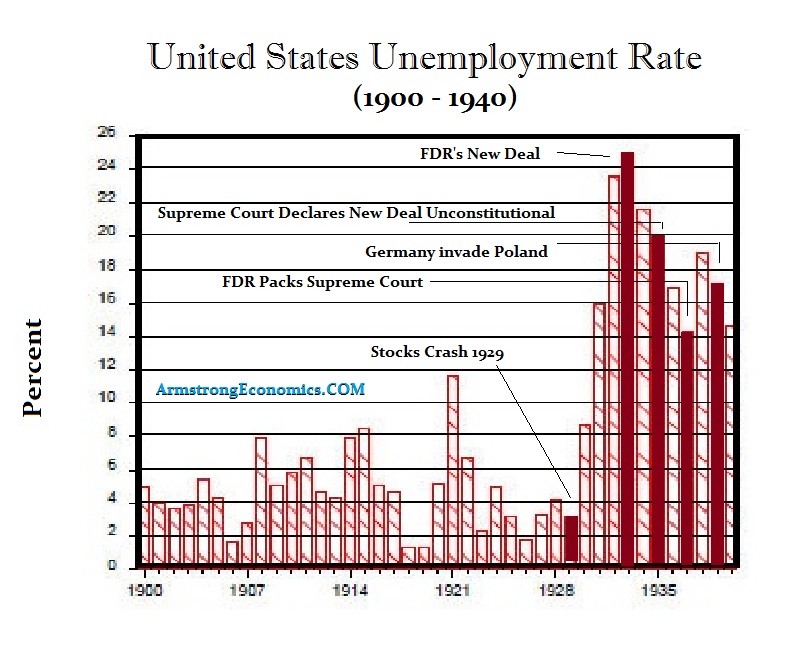
Now, look at the unemployment. It soared as well. Because people lost their jobs, demand declined with supply. So you see, this is a far more complex issue than meets the eye. It is also why I say governments should NEVER be allowed to manipulate the economy. They always focus on a single cause and effect and never look at the whole.
Consequently, while supply contracts, your assumption that price should rise is predicated upon demand remaining the same or rising. Therein lies your answer. That is simply a false assumption.
Posted originally on the conservative tree house April 30, 2021 | Sundance | 116 Comments
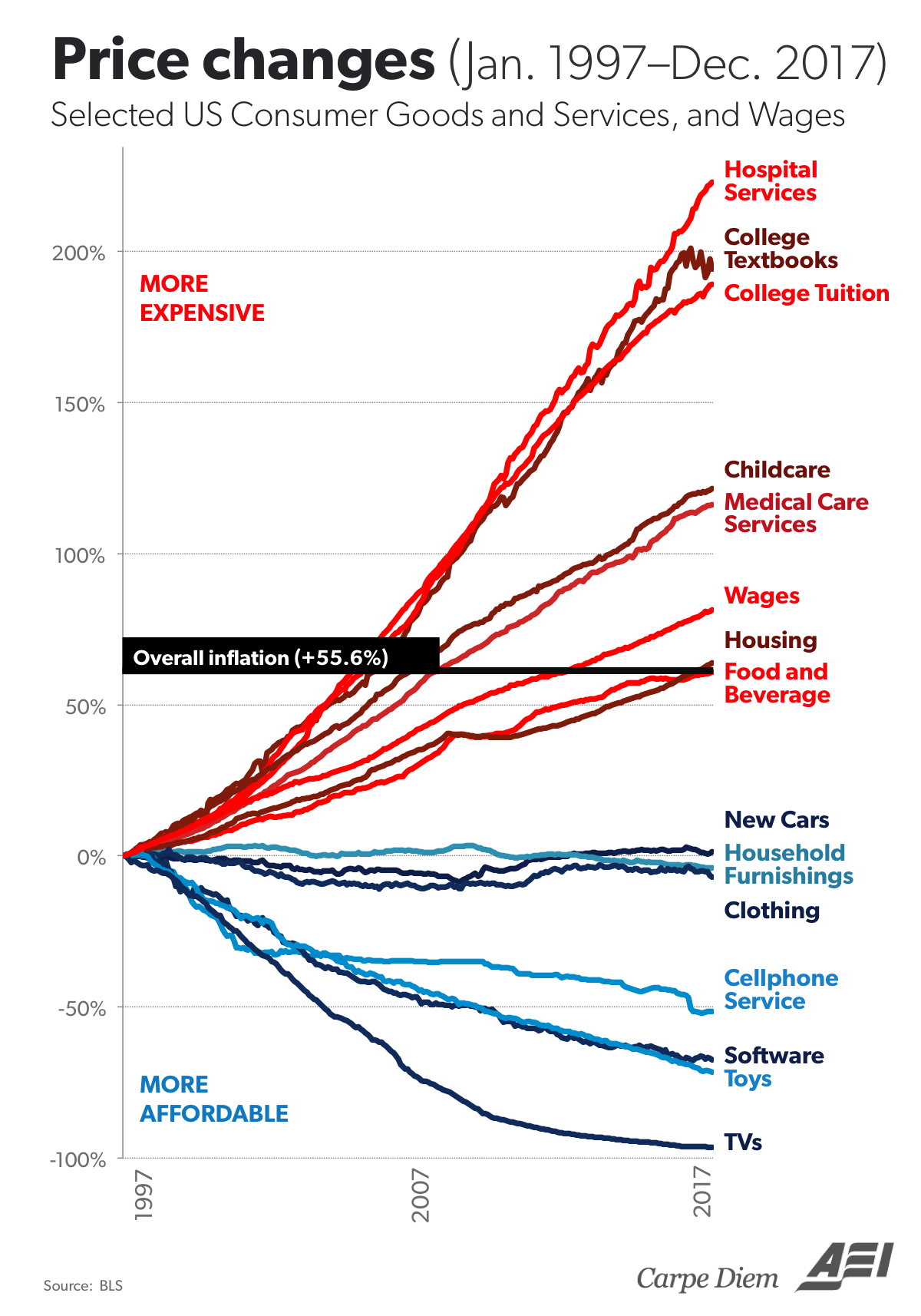
The federal reserve has announced they will support the economic agenda of the Biden administration by allowing rapid inflation. The FED is trying to provide cover for JoeBama’s economic plan. The era when the FED could impact inflation is long past. However, the Joe Biden policy impact will be clear, immediate and concise. The U.S. middle-class and blue-collar worker are about to be crushed under rising prices for consumable products.
Increases in inflation hit the working class (Main St) much harder than the investment class (Wall St) and financial elites. Factually the multinationals benefit from U.S. inflation as it puts pressure on domestic companies to ship their manufacturing overseas. Wall Street likes that. This dynamic has been an issue not-discussed by the financial media for decades. First, the Reuters article (when you see “commodity prices” think about the term “consumables”):
REUTERS – The U.S. Federal Reserve has signaled it will tolerate faster inflation for a time to cement the post-pandemic recovery and boost employment, but the side effect is likely to be a faster rise in commodity prices.
[…] After its latest meeting on Wednesday, the Federal Open Market Committee confirmed it will seek to achieve the *twin objectives of maximum employment and inflation at the rate of 2% over the longer run.
[*NOTE: in the new era of global economics these two are mutually exclusive. The FED is intentionally ignoring this point.]
[…] The committee noted price rises have been running persistently below target, so it aims to achieve inflation moderately above 2% for some time to make up the shortfall and anchor expectations at around the 2% level.
[…] The plan is to run the economy hot to achieve faster job gains, especially among disadvantaged groups that are marginally attached to the labour force, before shifting back to inflation control later in the cycle.
But the resulting pressure on global supply chains while the Fed pursues employment increases is likely to generate significantly quicker price rises for raw materials and a range of manufactured items. (read more)
This perspective is fundamentally false and based on assumptions that are decades old economic arguments. The reality of what will happen is exactly the opposite on the employment front.
The JoeBama administration is attempting to hide their economic program behind the smokescreen of a COVID economic bound; but the reality of what will happen is exactly the opposite. Employment is going to drop far below pre-COVID numbers.
The problem that people do not understand, and the federal reserve will intentionally not consider, is that Macro Economic principles no longer apply in the era of global economics and multinational trade. I have outlined this dynamic for years. What did Trump see that politicians were intent on hiding?
WHAT WAS THE PROBLEM?
Traditional economic principles have revolved around the Macro and Micro with interventionist influences driven by GDP (Gross Domestic Product, or total economic output), interest rates, inflation rates and federally controlled monetary policy designed to steer the broad economic outcomes.
Additionally, in large measure, the various data points which underline macro principles are two dimensional. As the X-Axis goes thus, the Y-Axis responds accordingly… and so it goes…. and so it has historically gone.
Traditional monetary policy centered upon a belief of cause and effect: (ex.1) If inflation grows, it can be reduced by rising interest rates. Or, (ex.2) as GDP shrinks, it too can be affected by decreases in interest rates to stimulate investment/production etc. However, against the backdrop of economic Globalism -vs- economic Americanism, CTH is noting the two dimensional economic approach is no longer a relevant model. There is another economic dimension, a third dimension. An undiscovered depth or distance between the “X” and the “Y”.
I believe it is critical to understand this new dimension in order to understand Trump’s MAGAnomic principles, and the subsequent “America-First” economy he was building.
As the distance between the X and Y increases over time, the affect detaches – slowly and almost invisibly. I believe understanding this hidden distance perspective will reconcile many of the current economic contractions. I also predict this third dimension will eventually be discovered/admitted, and will be extremely consequential in the coming decade.
To understand the basic theory, allow me to introduce a visual image to assist comprehension. Think about the two economies, Wall Street (paper or false economy) and Main Street (real or traditional economy) as two parallel roads or tracks. Think of Wall Street as one train engine and Main Street as another.
The Metaphor – Several decades ago, 1980-ish, our two economic engines started out in South Florida with the Wall Street economy on I-95 the East Coast, and the Main Street economy on I-75 the West Coast. The distance between them less than 100 miles.
As each economy heads North, over time the distance between them grows. As they cross the Florida State line Wall Street’s engine (I-95) is now 200 miles from Main Street’s engine (traveling I-75).
As we have discussed – the legislative outcomes, along with the monetary policy therein, follows the economic engine carrying the greatest political influence. Our historic result is monetary policy followed the Wall Street engine. THIS PART IS CRITICAL:
[…] there had to be a point where the value of the second economy (Wall Street) surpassed the value of the first economy (Main Street). [This important acceptance is just common sense. The U.S. GDP is currently around $20 trillion, but the total valuation of the Wall Street stock market is much larger than our GDP. Wall Street is more valuable than Main Street. It is a simple albeit important reality to accept.]
Investments, and the bets therein, needed to expand outside of the USA. Hence, globalist investing.
However, a second more consequential aspect happened simultaneously. The politicians became more valuable to the Wall Street team than the Main Street team; and Wall Street had deeper pockets because their economy was now larger.
As a consequence Wall Street started funding political candidates and asking for legislation that benefited their interests.
When Main Street was purchasing the legislative influence the outcomes were beneficial to Main Street, and by direct attachment those outcomes also benefited the average American inside the real economy.
When Wall Street began purchasing the legislative influence, the outcomes therein became beneficial to Wall Street. Those benefits are detached from improving the livelihoods of main street Americans because the benefits are “global” needs. Global financial interests, investment interests, are now the primary filter through which the DC legislative outcomes are considered.
Here is an example of the resulting impact as felt by consumers:
♦ TWO ECONOMIES – Time continues to pass as each economy heads North.
Economic Globalism expands. Wall Street’s false (paper) economy becomes the far greater economy. Federal fiscal policy follows and fuels the larger economy. In turn the Wall Street benefactors pay back the politicians.
Economic Nationalism shrinks. Main Street’s real (traditional) economy shrinks. Domestic manufacturing drops. Jobs are off-shored. Main Street companies try to offset the shrinking economy with increased productivity (the fuel). Wages stagnate.
Now it’s 1990 – The Wall Street economic engine (traveling I-95) reaches Northern North Carolina. However, it’s now 500 miles away from Main Street’s engine (traveling I-75). The Appalachian range is the geographic wedge creating the natural divide (a metaphor for ‘trickle down’).
By the time the decade of 2000 arrives – Wall Street’s well fueled engine, and the accompanying DC legislative attention, influence and monetary policy, has reached Philadelphia.
However, Main Street’s engine is in Ohio (they’re now 700 miles apart) and almost out of fuel; there simply is no more productivity to squeeze.
From that moment in time, and from that geographic location, all forward travel is now only going to push the two economies further apart. I-95 now heads North East, and I-75 heads due North through Michigan. The distance between these engines is going to grow much more significantly now with each passing mile/month….
However, and this is a key reference point, if you are judging their advancing progress from a globalist vessel (filled with traditional academic economists) in the mid-Atlantic, both economies (both engines) would seem to be essentially in the same place based on their latitude.
From a two-dimensional linear perspective you cannot tell the distance between them.
It is within this distance between the two economies, which grew over time, where a new economic dimension has been created and is not getting attention. It is critical to understand the detachment.
Within this three dimensional detachment you understand why Near-Zero interest rates no longer drive an expansion of the GDP. The Main Street economic engine is just too far away to gain any substantive benefit.
Despite their domestic origin in NY/DC, traditional fiscal policies (over time) have focused exclusively on the Wall Street, Globalist economy. The Wall Street Economic engine was simply seen as the only economy that would survive. The Main Street engine was viewed by DC, and those who assemble the legislative priorities therein, as a dying engine, lacking fuel, and destined to be service driven only….
Within the new 3rd economic dimension, the distance between Wall Street and Main Street economic engines, you will find the data to reconcile years of odd economic detachment.
Here’s where it gets really interesting. Understanding the distance between the real Main Street economic engine and the false Wall Street economic engine will help all of us to understand the scope of the economic inflation lag during the Trump administration. Which, rather remarkably I would add, was a very interesting dynamic.
Trump was in charge… Now think about these engines doing a turn about and beginning a rapid reverse. GDP could, and as we saw did, expand quickly. However, any interest rate hikes (monetary policy) intended to cool down that expansion -fearful of inflation- would take a long time to traverse the divide. That is exactly what happened.
Jerome Powell attempted to block the America First program with interest hikes; however, his efforts were futile because of the distance between the two economic engines. President Trump was focused on assisting Main Street, and Powell’s attempts at impacting Main Street growth couldn’t impact Trump’s program.
During the Trump era we actually imported deflation because China and other nations were attempting to avoid tariff cost increases; so they devalued their currency. The problem for them was that devaluation of their currency not only made their tariffed goods cheaper, it made the non tariff goods cost less. As a result we were importing deflation from around the world.
Inflation on durable goods could not be significant until those nations stopped devaluing their currency. Simultaneously, as international trade agreements were renegotiated the originating nations of those products were forced into the same type of economic detachment described above.
The global manufacturing economies first responded to increases in export costs (tariffs etc.), by devaluing their currency; then they began driving their own productivity higher as an offset, in the same manner American workers went through in the past three decades. The manufacturing enterprise and the financial sector (connected to the consumer) remained focused on the pricing.
♦ Inflation on imported durable goods sold in America, while necessary, was -as we expected- ultimately minimal during this initial period of Trump policy. Predictably, if we stuck with the program inflation would have expanded significantly as time progressed and off-shored manufacturing found less and less ways to be productive. Over time, imported durable good prices would increase – but it was going to come much later; and by that time our own industrial base would be re-established.
♦ Inflation on domestic consumable goods ‘would’ likely rise at a faster pace. However, as we saw U.S. wage rates were respond faster, naturally faster, than any monetary policy because inflation on fast-turn consumable goods became re-coupled to the ability of wage rates to afford them…. and the labor market was on fire. Wages were factually growing faster than inflation during Trump’s term in office.
The economic policy impact lag, caused by the distance between federal monetary action and the domestic Main Street economy, was -under the Trump policy- now working in our favor. That is, in favor of the middle-class. Within the aforementioned distance between “X” and “Y”, a result of three decades traveled by two divergent economic engines, that was our new economic dimension….
What JoeBama 3.0 is proposing now, and what the Federal Reserve just announced they are going to support, is a return to the prior economic model where Wall Street multinationals benefit and the U.S. middle-class is pushed into their intentionally created “service driven economy”.
Inflation on domestic consumable goods (food, fuel, energy) hurts the U.S. middle-class, it does not hurt the multinationals, the elites and Wall Street investors. It takes a long time for inflation to push up wages when the workforce is experiencing lay-offs due to downsizing, outsourcing and expanded imports of multinational products.
But it doesn’t stop there…. If we get too granular, missing the larger picture, it is difficult to understand. However, if we stay at the elevated perspective, understanding leads to awakening. We start to see how the various JoeBama policies intersect.
In generally approximated terms 2020 has delivered a serious financial blow to Main Street businesses.
The COVID-19 lockdowns and shutdowns have led to business in your local community suffering massive losses of income while simultaneously taking on debt directly from lenders or indirectly from government relief efforts. Main Street has been hit hard, some analysts estimate 40 to 50 percent of those service businesses may not recover.
Conversely, the COVID-19 lockdowns and shutdowns have created a massive income benefit for multinationals, Wall Street corporations and big tech. Amazon, Walmart and massive tech companies had their highest earnings ever recorded.
According to most maco-analysis somewhere around forty percent of Main Street economic wealth was lost or suspended in 2020 due to COVID-19. Simultaneously the multinational firms have seen increases in stock evaluations of forty percent. These two almost identical numbers are not coincidental. The billionaire class (multinationals) have gained wealth in an almost identical amount the middle-class (Main Street) lost.
These empirical results are accepted. No-one is challenging the shift of financial resources was/is directly related to regional COVID policy. The math is the math.
Where things change from simple economic math to downstream consequences is where the story is really told.
This is where we are going…
This is where we have been going ever for decades, COVID-19 has (not coincidentally) just sped up the process.
If you take out a national map and: (1) put a green pin in the areas where the lock-downs are most severe (draw a 100 mile circle); then (2) put a red pin in the areas where the riots and local anxiety was highest in summer 2020; then (3) put a white pin in the seven counties where election fraud was prevalent; then (4) put a blue pin in the areas known as “Opportunity Zones“, what you will see is a direct correlation. This is not accidental.
There are more than 8,760 designated Qualified Opportunity Zones (PDF) located in all 50 States, the District of Columbia, and five United States territories. Investors can defer tax on any prior gains invested in a Qualified Opportunity Fund (QOF) until the earlier of the date on which the investment in a QOF is sold or exchanged or until December 31, 2026. (link)
If you are a member of ‘THE BIG CLUB’ with a massive influx in capital due to the benefits of the COVID-19 lockdowns, limits and regulations, the Opportunity Zones are now the perfect place to expand ownership and wealth. Take advantage of the Main Street weakness, make moves with government authorization, and do so without capital gains.
The regions where real property will be purchased at a low cost will, not coincidentally, be the “opportunity zones” where investment transactions without capital gains can be made. The areas where riots took/take place will sell cheap. “Opportunity zones” allow for mass investment moves from billionaire class without paying capital gains taxes.
The mass accumulation of wealth (multinationals) at the upper tier of Big Tech and the multinational billionaire class (technocrats) during COVID is approximately +40% since it began. 40% of Main Street businesses wiped out. Not coincidentally almost 40% of wealth has been transferred from Main Street to the Wall Street mega-corps and multinationals.
“Never let a crisis go to waste”…
Only in 2020 the “crisis” was (yet again) by design. The highest level of COVID mitigation control in the Blue states is not coincidentally in the same states with the largest number of Opportunity Zone regions. As a direct result of this mass transfer of wealth to the upper tier the “opportunity” is an unprecedented level of Main Street ownership by elite interests and foreign nationals.
It gets worse… Just like the banking and real-estate crisis of ’07/’08 the government steps in to back-fill the Main Street losses to the mass U.S. population. When an individual or family receives the relief money, they still cannot support Main Street because in many areas they remained forcibly closed. Paying down debt and making purchases in the same lock-down strata only ends up putting those relief funds into the hands of the banks and multinationals who were allowed to operate.
Continued consumer spending only feeds the beast that is -by policy via purchased politicians- designed to destroy us. In essence, we are paying the Technocrats, bankers and multinational corporations to fatten their bank accounts while the U.S. government re-opens the economy with a finger on the scale to benefit the multinationals.
This is by design….
This has always been the design…
CTH has been warning about this for well over a decade and we exhibited the (un)natural conclusion with this graphic:
Posted originally on the conservative tree house April 23, 2021 | Sundance | 137 Comments
Let’s start by being intentionally direct with each other. The JoeBama tax proposals are not accidental or misguided; far from it. The intent of Obama’s third term economic policy is to return to forced globalism and diminished U.S. middle-class prosperity…. the often mentioned “service driven economy.”
There is nothing of value behind the obtuse term “service driven economy.” The multinationals are paying for this administration, just like they paid the Obama administration; paying for economic policy that advances their interests.
Congress goes along with the K-Street demands because Wall Street is now the primary benefactor of legislative intent. Nothing about their effort is done with American interests in mind.
Let me also be clear… Ever since I put forth the explanations of “A New Dimension in American Economics” I have been contacted by several prominent people within the financial institutions and academic sphere who agree with the principle. However, every single person states there is too much risk in explaining the intent and motive behind the curtain.
What JoeBama is proposing in his tax plan is specifically intended to rapidly advance the interests of Wall Street and corporate multinationals. Before getting to the baseline of how, let’s first look at his proposals as purposefully leaked:
WASHINGTON (Reuters) -President Joe Biden will roll out a plan to raise taxes on the wealthiest Americans, including the largest-ever increase in levies on investment gains, to fund about $1 trillion in childcare, universal pre-kindergarten education and paid leave for workers, sources familiar with the proposal said.
The plan is part of the White House’s push for a sweeping overhaul of the U.S. tax system to make rich people and big companies pay more and help foot the bill for Biden’s ambitious economic agenda. The proposal calls for increasing the top marginal income tax rate to 39.6% from 37%, the sources said this week. It would also nearly double taxes on capital gains to 39.6% for people earning more than $1 million.
That would be the highest tax rate on investment gains, which are mostly paid by the wealthiest Americans, since the 1920s. The rate has not exceeded 33.8% in the post-World War Two era. […] Sources said details would be released next week before Biden’s address to Congress on Wednesday. Details of the plan may change in coming days. (read more)
We do not need to guess what the impacts would be; we have already seen exactly what results they generate. We have specific examples from both state domestic (see the Connecticut example), and national outcomes. The “rust belt” was created by these policies that incentivize off-shoring and outsourcing that benefits multinationals and hurts U.S. based national companies.
Do not get caught up in the leftist narrative about ‘spreading the wealth‘ between the rich and poor. That is a distractive misnomer created by K-Street as an advanced -albeit false- talking point to deflect political consequences. The JoeBama goal has nothing to do with supporting poor Americans; the goal is to make everyone in the United States less wealthy, including the “poor”. The goal is to assist the multinationals; they are paying for this economic policy.
To understand the baseline, let me repost the explanation from four years ago when candidate Donald Trump outlined his “America First” economic policies. The Trump-era policy was intended to remove the tentacles of the multinationals and support the U.S. middle class. Again, we don’t have to guess whether Trump was right, because we saw the incredible economic growth his policies (regulatory and treasury) generated.
FIRST, THE PROBLEM:
Anyone thinking Donald Trump was not intensely serious about America-First economics received a massive dose of reality when they realized Donald Trump put reinstatement of Glass-Steagall into the 2016 Republican Platform:
“We support reinstating the Glass-Steagall Act of 1933 which prohibits commercial banks from engaging in high-risk investment,” said the platform released by the Republican National Committee. (link)
CONTEXT – Beyond the larger context of Globalists VS Nationalists (Americanism), the internal opposition to Common Sense economic conservatism (Americanism) can be broken down into two categories:
♦ The first group are those who are fundamentally naive about large and historic economic issues; and how the economy was changed, forced to change through the past forty years, by financial interests who created a second, “false“, paper economy.
This first group is generally young, pseudo-intellectual, and their only reference is while formally educated within the last thirty years (they’re under 50). Most of the oppositional (conservative) punditry falls into this category. [Important to note, this group is also joined by the majority of politicians who are approximately the same age.]
♦ The second group are those who truly know better. They are older and wiser, they know the truth because they saw it unfold. However, they are also financially dependent on retention of a global narrative that sold the change in the past 40 years. These are the willfully blind who have sold-out to the benefit of, and enrichment from, the false economy.
This second group is intent on retaining a historic set of false assumptions by fraud and deception. There motives can be debated, but most conservatives as well as almost all democrats in media punditry fit into this second grouping. Their false economic framework is then echo-chambered through think-tanks, and passed down to the younger group #1.
Exhibit “A” would be conservatives standing at CPAC to applaud Speaker Paul Ryan who passed a $2+ trillion Omnibus spending bill to ensure 8 straight years without a budget. See the disconnect?
The world-view of the first group (younger voices, CPAC seal-clappers) is fundamentally seeded on social issues.
They are in no position to speak accurately about economic matters because they don’t have a reference point underpinning their expressed outlook. Their Gen-X and Millennial economic arguments are esoteric opinions . They never experienced the era of industrial giants; they have no form of reference.
♦ In most of the modern post-war industrial era (1950-1980) banking was a boring job and only slide rule bean-counters and actuarial accountants moved into that sector of the workforce. Most people don’t like math – these were not exciting jobs. Inside the most boring division of a boring banking industry were the bond departments within the larger bank and finance companies.
The excitement was in the actual economy of Main Street business. The giants of industry created businesses, built things, manufactured products, created innovation and originated internal domestic wealth in a fast-paced real economy. Natural peaks and economic valleys, as the GDP expanded and contracted, based on internal economic factors of labor, energy, monetary policy and regulation.
Main Street generated the pool of political candidates – because the legislative conduct of politicians had more impact on Main Street. Simply, the business agents had a vested interest in political determinations. Political candidates courted industrialists, business owners, and capitalist giants to support them. As a consequence Main Street USA was in control of DC outcomes.
Despite the liberal talking points to the contrary, this relationship was a natural synergy of business interests and political influence. It just made sense that way, and the grown-ups were generally in charge of it.
♦ Commercial banks courted businesses because bankers needed deposits. Without deposits banks could not generate loans; without loans banks could not generate profits…. and so it was. By rule only 10 percent of a commercial bank’s income could stem from securities.
One exception to this 10% rule was that commercial banks could underwrite government-issued bonds. Investment banks (the bond division) were entirely separate entities. The Glass-Steagall banking laws of 1932 kept it that way.
However, mid 1970’s bank regulators began issuing Glass–Steagall interpretations -that were upheld by courts- and permitted banks and their affiliates to engage in an increasing variety and amount of securities activities. After years of continual erosion of the Glass-Steagall firewall, eventually it disappeared.
This became the origin of the slow-motion explosion of investment banking. If you look back historically from today toward 1980 (ish) what you will find is this is also the ultimate fork where economic globalism began overtaking economic nationalism.
Banks could now make money, much more money, from investment divisions issuing paper financial transactions, not necessarily dependent on actual physical assets; or actual profits and loss. The transactions grew exponentially.
The bond market portion ultimately led to the ’07/’08 housing collapse, and derivative trading (collateralized debt obligations or CDO’s) generated trillions of paper dollars. Long before the ’08 collapse, business schools in 1980 began calling this the second economy (a false economy, or the invisible economy).
The second economy, which ultimately became the global economy, is also the Wall Street investment economy. Two divergent economies: Wall Street (paper), and Main Street (real).
There is no real property, real capital, real tangible assets in the Wall Street economy. The false economy is based on trades and financial transactions, essentially opinions. Paper shifts, and buys and sells based on predictions and bets (derivatives). Insurance products create an even larger subdivision within the false economy as hedgers wagered on negative outcomes. The money wagered is exponential – some say more than a quadrillion currently floats.
♦ Now you realize, in hindsight, there had to be a point where the value of the second economy (Wall Street) surpassed the value of the first economy (Main Street). Investments, and the bets therein, needed to expand outside of the USA. hence, globalist investing.
However, a second more consequential aspect happened simultaneously.
The politicians became more valuable to the Wall Street team than the Main Street team; and Wall Street had deeper pockets because their economy was now larger.
As a consequence Wall Street started funding political candidates and asking for legislation that benefited their interests.
When Main Street was purchasing the legislative influence the outcomes were beneficial to Main Street, and by direct attachment those outcomes also benefited the average American inside the real economy.
When Wall Street began purchasing the legislative influence, the outcomes became beneficial to Wall Street. Those benefits are detached from improving the livelihoods of main street Americans because the benefits are “global” needs. Global financial interests, investment interests, are now the primary filter through which the DC legislative outcomes are considered.
There is a natural disconnect.
♦ When former House Speaker Paul Ryan said: “Donald Trump and I come from two different wings of the party”, he is specifically pointing out this disconnect, yet few drew attention to it. Yes, it is true – Trump represented the Main Street wing, Ryan represented the Wall Street wing.
Going back to the opening paragraphs. The news and opinion punditry never take the time to explain the root cause of the disassociation, because: A) Group one doesn’t understand it; and B) Group two is compensated to remain willfully blind, and to ignore it.
Yes, there was a fundamental ideological conflict within the 2016 election, and Wall Street fought Donald Trump hard. However, for the first time in decades the American middle-class assembled and MAGA Main Street finally beat Wall Street. Every single attack on Trump from that moment forth was created by this shockwave. There were trillions at stake.
So that takes us to the next phase of the dynamic…. What did Trump see that politicians were intent on hiding?
WHAT WAS THE PROBLEM?
Traditional economic principles have revolved around the Macro and Micro with interventionist influences driven by GDP (Gross Domestic Product, or total economic output), interest rates, inflation rates and federally controlled monetary policy designed to steer the broad economic outcomes.
Additionally, in large measure, the various data points which underline macro principles are two dimensional. As the X-Axis goes thus, the Y-Axis responds accordingly… and so it goes…. and so it has historically gone.
Traditional monetary policy centered upon a belief of cause and effect: (ex.1) If inflation grows, it can be reduced by rising interest rates. Or, (ex.2) as GDP shrinks, it too can be affected by decreases in interest rates to stimulate investment/production etc. However, against the backdrop of economic Globalism -vs- economic Americanism, CTH is noting the two dimensional economic approach is no longer a relevant model. There is another economic dimension, a third dimension. An undiscovered depth or distance between the “X” and the “Y”.
I believe it is critical to understand this new dimension in order to understand Trump’s MAGAnomic principles, and the subsequent “America-First” economy he was building.
As the distance between the X and Y increases over time, the affect detaches – slowly and almost invisibly. I believe understanding this hidden distance perspective will reconcile many of the current economic contractions. I also predict this third dimension will eventually be discovered/admitted, and will be extremely consequential in the coming decade.
To understand the basic theory, allow me to introduce a visual image to assist comprehension. Think about the two economies, Wall Street (paper or false economy) and Main Street (real or traditional economy) as two parallel roads or tracks. Think of Wall Street as one train engine and Main Street as another.
The Metaphor – Several decades ago, 1980-ish, our two economic engines started out in South Florida with the Wall Street economy on I-95 the East Coast, and the Main Street economy on I-75 the West Coast. The distance between them less than 100 miles.
As each economy heads North, over time the distance between them grows. As they cross the Florida State line Wall Street’s engine (I-95) is now 200 miles from Main Street’s engine (traveling I-75).
As we have discussed – the legislative outcomes, along with the monetary policy therein, follows the economic engine carrying the greatest political influence. Our historic result is monetary policy followed the Wall Street engine. THIS PART IS CRITICAL:
[…] there had to be a point where the value of the second economy (Wall Street) surpassed the value of the first economy (Main Street). [This important acceptance is just common sense. The U.S. GDP is currently around $20 trillion, but the total valuation of the Wall Street stock market is much larger than our GDP. Wall Street is more valuable than Main Street. It is a simple albeit important reality to accept.]
Investments, and the bets therein, needed to expand outside of the USA. Hence, globalist investing.
However, a second more consequential aspect happened simultaneously. The politicians became more valuable to the Wall Street team than the Main Street team; and Wall Street had deeper pockets because their economy was now larger.
As a consequence Wall Street started funding political candidates and asking for legislation that benefited their interests.
When Main Street was purchasing the legislative influence the outcomes were beneficial to Main Street, and by direct attachment those outcomes also benefited the average American inside the real economy.
When Wall Street began purchasing the legislative influence, the outcomes therein became beneficial to Wall Street. Those benefits are detached from improving the livelihoods of main street Americans because the benefits are “global” needs. Global financial interests, investment interests, are now the primary filter through which the DC legislative outcomes are considered.
Here is an example of the resulting impact as felt by consumers:
♦ TWO ECONOMIES – Time continues to pass as each economy heads North.
Economic Globalism expands. Wall Street’s false (paper) economy becomes the far greater economy. Federal fiscal policy follows and fuels the larger economy. In turn the Wall Street benefactors pay back the politicians.
Economic Nationalism shrinks. Main Street’s real (traditional) economy shrinks. Domestic manufacturing drops. Jobs are off-shored. Main Street companies try to offset the shrinking economy with increased productivity (the fuel). Wages stagnate.
Now it’s 1990 – The Wall Street economic engine (traveling I-95) reaches Northern North Carolina. However, it’s now 500 miles away from Main Street’s engine (traveling I-75). The Appalachian range is the geographic wedge creating the natural divide (a metaphor for ‘trickle down’).
By the time the decade of 2000 arrives – Wall Street’s well fueled engine, and the accompanying DC legislative attention, influence and monetary policy, has reached Philadelphia.
However, Main Street’s engine is in Ohio (they’re now 700 miles apart) and almost out of fuel; there simply is no more productivity to squeeze.
From that moment in time, and from that geographic location, all forward travel is now only going to push the two economies further apart. I-95 now heads North East, and I-75 heads due North through Michigan. The distance between these engines is going to grow much more significantly now with each passing mile/month….
However, and this is a key reference point, if you are judging their advancing progress from a globalist vessel (filled with traditional academic economists) in the mid-Atlantic, both economies (both engines) would seem to be essentially in the same place based on their latitude.
From a two-dimensional linear perspective you cannot tell the distance between them.
It is within this distance between the two economies, which grew over time, where a new economic dimension has been created and is not getting attention. It is critical to understand the detachment.
Within this three dimensional detachment you understand why Near-Zero interest rates no longer drive an expansion of the GDP. The Main Street economic engine is just too far away to gain any substantive benefit.
Despite their domestic origin in NY/DC, traditional fiscal policies (over time) have focused exclusively on the Wall Street, Globalist economy. The Wall Street Economic engine was simply seen as the only economy that would survive. The Main Street engine was viewed by DC, and those who assemble the legislative priorities therein, as a dying engine, lacking fuel, and destined to be service driven only….
Within the new 3rd economic dimension, the distance between Wall Street and Main Street economic engines, you will find the data to reconcile years of odd economic detachment.
Here’s where it gets really interesting. Understanding the distance between the real Main Street economic engine and the false Wall Street economic engine will help all of us to understand the scope of the economic inflation lag during the Trump administration. Which, rather remarkably I would add, was a very interesting dynamic.
Trump was in charge… Now think about these engines doing a turn about and beginning a rapid reverse. GDP could, and as we saw did, expand quickly. However, any interest rate hikes (monetary policy) intended to cool down that expansion -fearful of inflation- would take a long time to traverse the divide. That is exactly what happened.
Jerome Powell attempted to block the America First program with interest hikes; however, his efforts were futile because of the distance between the two economic engines. President Trump was focused on assisting Main Street, and Powell’s attempts at impacting Main Street growth couldn’t impact Trump’s program.
During the Trump era we actually imported deflation because China and other nations were attempting to avoid tariff cost increases; so they devalued their currency. The problem for them was that devaluation of their currency not only made their tariffed goods cheaper, it made the non tariff goods cost less. As a result we were importing deflation from around the world.
Inflation on durable goods could not be significant until those nations stopped devaluing their currency. Simultaneously, as international trade agreements were renegotiated the originating nations of those products were forced into the same type of economic detachment described above.
The global manufacturing economies first responded to increases in export costs (tariffs etc.), by devaluing their currency; then they began driving their own productivity higher as an offset, in the same manner American workers went through in the past three decades. The manufacturing enterprise and the financial sector (connected to the consumer) remained focused on the pricing.
♦ Inflation on imported durable goods sold in America, while necessary, was -as we expected- ultimately minimal during this initial period of Trump policy. Predictably, if we stuck with the program inflation would have expanded significantly as time progressed and off-shored manufacturing found less and less ways to be productive. Over time, imported durable good prices would increase – but it was going to come much later; and by that time our own industrial base would be re-established.
♦ Inflation on domestic consumable goods ‘would’ likely rise at a faster pace. However, as we saw U.S. wage rates were respond faster, naturally faster, than any monetary policy because inflation on fast-turn consumable goods became re-coupled to the ability of wage rates to afford them…. and the labor market was on fire. Wages were factually growing faster than inflation during Trump’s term in office.
The monetary policy impact lag, caused by the distance between federal monetary action and the domestic Main Street economy, was -under the Trump policy- now working in our favor. That is, in favor of the middle-class. Within the aforementioned distance between “X” and “Y”, a result of three decades traveled by two divergent economic engines, that was our new economic dimension …
What JoeBama 3.0 is proposing now is a return to the prior economic model where Wall Street multinationals benefit and the U.S. middle-class is pushed into their intentionally created “service driven economy”.
COMMENT: Mr. Armstrong, a close friend of my is a major celebrity in Hollywood. They too follow you and are joining the exodus from California. So many people are leaving it is remarkable. It looks like the buyers of these expensive homes are foreigners, mainly Chinese, who want the prestige of Hollywood but are exempt from the income taxes.
Just thought you might want to know.
Thanks for being a light in a new age of darkness.
HC
REPLY: Yes, the press seems to be filled with an endless stream of celebs selling their homes in California. I suppose they are all not leftists, or at least they are leftists only in rhetoric, but for themselves, they are more right. I suppose their destination is Texas or Florida.
What is really fascinating is that the great California Gold Rush (1848–1855) was a gold rush that began on January 24, 1848, when gold was found by James W. Marshall at Sutter’s Mill in Coloma, California. The mad rush really began in 1849 and that is when the US began minting California gold into coins. The news of gold brought approximately 300,000 people to California from the rest of the United States and overseas. If we look at 1848 and 2020, that is exactly 172 years or (2 x 8.6 = 17.2). The mad rush out of California is precisely in line. In fact, it was 1849 when Californians sought statehood. That was finally granted and California entered the Union as a free, nonslave state by the Compromise of 1850. California became the 31st state on September 9, 1850
Between 1849 and 1853, about 24,000 young Chinese men immigrated to California. Chinese immigrants soon found that many Californians did not welcome them. In 1852, California placed a high monthly tax on all foreign miners. Chinese miners had no choice but to pay this tax if they wanted to mine for gold in California. California has had a history of punishing people they do not like with burdensome taxation. Interestingly, 172 years from their punitive Chinese taxation will be precisely 2024. It does not look very good for California by 2024. They will realize they have lost their best people like “Atlas Shrugged.”
I have created this site to help people have fun in the kitchen. I write about enjoying life both in and out of my kitchen. Life is short! Make the most of it and enjoy!
This is a library of News Events not reported by the Main Stream Media documenting & connecting the dots on How the Obama Marxist Liberal agenda is destroying America














 Centinel2012