Economic Freedom by the Numbers


Published on Oct 30, 2017

SUBSCRIBE 194K
What’s the evidence that economic freedom is beneficial for society? Prof. Antony Davies shows charts of the free market’s effects on unemployment, inequality, poverty, and even child labor. SUBSCRIBE: http://bit.ly/2dUx6wg LEARN MORE: Who Needs Economic Freedom When You Can Vote? (video): In this clip, Prof. Jason Brennan explains why economic freedoms should matter as much as political freedoms. https://www.youtube.com/watch?v=tgCw0… Economic Freedom and a Better Life (video): Prof. Josh Hall explains how economic freedom leads to greater human well-being. https://www.youtube.com/watch?v=dH5VD… Economic Vs. Civil Liberties (video): Which are more important, economic liberties or civil liberties? To Prof. Aeon Skoble, this distinction is fictitious. https://www.youtube.com/watch?v=oWAyE…


Published on Oct 2, 2017

SUBSCRIBE 194K
If you really want to understand how the world works today, you need to rethink almost everything you’ve been told about inequality. Prof. Antony Davies explains. SUBSCRIBE: http://bit.ly/2dUx6wg LEARN MORE: Debate: Is There Too Much Inequality in America? (video): Prof. Steve Horwitz and Prof. Jeffrey Reiman debate the topic of inequality in America. https://www.youtube.com/watch?v=p047t… Income Inequality or Income Mobility: For What Should We Fight? (blog article): Anne Bradley explains why it’s better to place our focus on income mobility than on income equality. http://www.learnliberty.org/blog/inco… Income Inequality and the Effects of Globalization (video): Prof. Tyler Cowen describes the amazing reductions in global income inequality that have occurred over the last 20 years. https://www.youtube.com/watch?v=ja15p…

What is Communism? A Good Answer from Prof. Howie Baetjer


How is Communism described in theory, and how does it play out in the real world? Join us for our question and answer series with Prof. Howie Baetjer.

The History of Classical Liberalism – Learn Liberty


Published on May 13, 2011

SUBSCRIBE 193K
Historian Stephen Davies describes classical liberalism as a comprehensive philosophy, which has had implications in all the major academic disciplines. Learn More: https://www.learnliberty.org/ At an abstract level, classical liberalism offers three key insights: 1) The goal of life is human happiness and flourishing. 2) Personal choice and individual liberty are crucial in explaining and appreciating how society develops. 3) Commerce, wealth, and trade are preferable to war and conflict. If you agree with these classical liberal insights, you might be a classical liberal! Want to know for sure? Check out Nigel Ashford’s seven minute video entitled “What is Classical Liberalism” http://www.youtube.com/watch?v=iU-8Uz… Watch more videos: http://lrnlbty.co/y5tTcY


College and Housing Bubbles


Published on Oct 23, 2017

SUBSCRIBE 193K
Remember the mid-2000s housing crash that wiped out homeowners? Well, there’s another bubble getting ready to pop, and this one’s in student debt. Prof. Antony Davies explains. SUBSCRIBE: http://bit.ly/2dUx6wg LEARN MORE: Why Do We Have Student Loans? (video): Student loans skyrocketed from the 1980s to the 2007 recession. Professor Brian Domitrovic says this is a bubble that needs to pop. https://www.youtube.com/watch?v=ehn_F… 2016 Presidential Election: Student Debt (video): Forgiving student loan debt and increasing subsidies for higher education were popular ideas on the campaign trail in the 2016 presidential election, and they remain popular ideas today. Professor Don Boudreaux explains why these policy changes would lead to negative outcomes while failing to address the underlying issues at play. https://www.youtube.com/watch?v=pUpDD… How to Solve the Student Debt Crisis (video): Manhattan Institute fellow Jared Meyer talks about how innovation in the student loan industry could help solve the student debt crisis. https://www.youtube.com/watch?v=Anh-5…

College and Housing Bubbles


Published on Oct 23, 2017

SUBSCRIBE 193K
Remember the mid-2000s housing crash that wiped out homeowners? Well, there’s another bubble getting ready to pop, and this one’s in student debt. Prof. Antony Davies explains. SUBSCRIBE: http://bit.ly/2dUx6wg LEARN MORE: Why Do We Have Student Loans? (video): Student loans skyrocketed from the 1980s to the 2007 recession. Professor Brian Domitrovic says this is a bubble that needs to pop. https://www.youtube.com/watch?v=ehn_F… 2016 Presidential Election: Student Debt (video): Forgiving student loan debt and increasing subsidies for higher education were popular ideas on the campaign trail in the 2016 presidential election, and they remain popular ideas today. Professor Don Boudreaux explains why these policy changes would lead to negative outcomes while failing to address the underlying issues at play. https://www.youtube.com/watch?v=pUpDD… How to Solve the Student Debt Crisis (video): Manhattan Institute fellow Jared Meyer talks about how innovation in the student loan industry could help solve the student debt crisis. https://www.youtube.com/watch?v=Anh-5… TRANSCRIPT: For a full transcript please visit: http://www.learnliberty.org/videos/co…

Rethinking Economics


The BBC wrote a piece on the failure of economics. “Many non-economists will say that the economists must have been stupid not to realise what was wrong with their subject. All that I’ve set out here should have been obvious,” the article commented. Indeed, the field of economics has been really a disaster because people are still trying to manipulate it and create the land of Utopia. They assume the power to control and eliminate the business cycle exists, which began with Karl Marx.

We have people focusing on the disparity of income who argue that is the whole problem. Nobody seems to have a mirror or is willing to just look at themselves. Nobody will even question why governments are borrowing year after year with no intention of ever paying anything off. We constantly have fights over raising debt ceilings that will always have to be raised. The question is never asked: “Do we have to revise both the monetary system and the political system to prevent massive civil unrest?” This battle waged by the left to subjugate the right only leads to violence.

Paper written in 2008, just before the market crash, Subject what it would take to convert personal transportation from petroleum to electric power.


The following text in taken from a paper I write in 2008 when it looked like Gasoline might hit $5.00 a gallon by the end of the year and it looked like we could be running out of oil. Obviously, that did not happen because a couple of months latter the Market crashed and a project I was about to finish — was finished as well as all capital dried up and I lost close to $500,000 of investment of which this paper was only a part.  The logic and engineer is still sound today although the financial numbers would need to be adjusted.  Attached at the end are a copy of the paper and the related power point presentation.
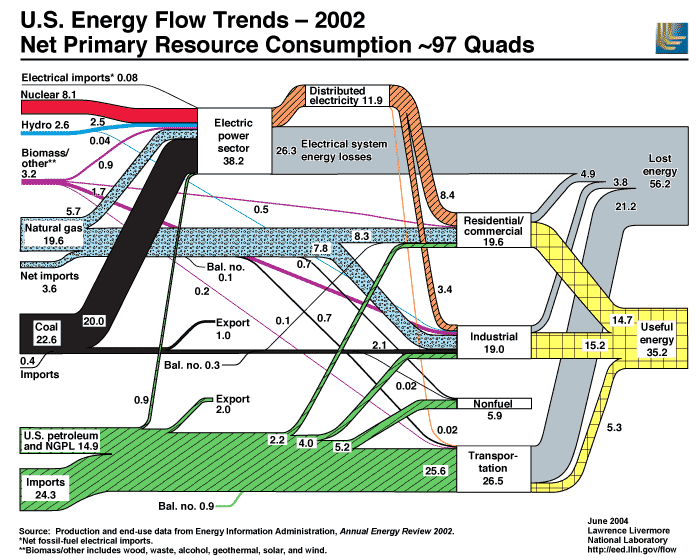
There are almost 250 million vehicles (cars, pickup trucks and SUV’s) on U. S. roads used for personal transportation. They all use some form of ICE as the power source.  They also all use some derivative of petroleum as the fuel i.e. gasoline, E85 or diesel fuel and thereby emit million of tons of CO2 into the atmosphere (about 20 lbs of CO2 per gallon of gasoline burned).

When this transportation system was started emissions and the supply of fuels were hardly on anyone’s mind and so what we have today is a system built with millions of hours of hard work and billions of dollars of capital investment. Today, in hind sight, we might have chosen a different path had we known better. However, this system has served us well for over 100 years and has contributed to the reasons we have the best place in the world to live.

But now we have rising CO2 emissions creating global warming and petroleum supplies running out and both creating issues that threaten our very way of life. So we find ourselves searching for a way out of these serious predicaments that many of us see.  One group focused on the environment sees CO2 emissions which are leading to Climate Change as the most important issue. The other side focused on Economic Growth sees the supply of cheap petroleum “Energy” as the most important issue since without that supply the world economy could collapse.

Both sides have valid points but for some reason they can’t seem to see, how by working together, they could come up with alternatives that satisfy completely both points of view. That would not seem possible, but it is and it will be shown to be so in the body of this White Paper.

The solution is right before our eyes and we just need to focus on the results we want. Doing that shows us that by switching Personal Transportation from gas/diesel fuel to electric power both issues can be solved in one project. From an all-electric vehicle production point of view this process could be started today with existing technology and, in fact, several automakers are planning on introducing limited capacity electric or electric hybrid cars by 2010.

Therefore, why write this paper if these alternative vehicles will soon be for sale.  The answer is that although building the vehicles is now possible albeit with limited driving range to start, there is no infrastructure in place to deliver the electric power to them in the quantities required to convert even a small percentage of today’s almost 250 million vehicles to electric vehicles let alone those yet to be produced.

The bottleneck here is finding a way to deliver the electric power equivalent, of the gasoline that those ICE’s now use, to the electric cars in the form of electric power.  That delivery system has three parts; first the electric power generation, next is the transmission of that power to the user and lastly is the charging of the vehicles battery. All three elements are required before the production of the electric vehicles can begin in earnest or it would be the equivalent of building ICE vehicles and having no gas stations.  Unfortunately the first two “The Grid” is already close to capacity and has its own problems, so we seem to be at an impasse.

A classic chicken or egg quandary … No electric cars, no reason to expand the Grid … No Grid capacity, no reason to build electric cars.

PDF file PROPOSAL PAPER

Power Point,  AN ALTERNATIVE TO OIL

Sweatshop Wages and Third-World Workers: Are the Wages Worth the Sweat?


Published on Jun 7, 2011

SUBSCRIBE 191K
Prof. Ben Powell discusses the economics of sweatshops. He begins with a few photos and personal travel stories to demonstrate typical working conditions in third world countries. He then discusses the economic forces that determine working conditions and wages. Looking at empirical data, he finds that sweatshop workers earn higher wages than non-sweatshop workers in their respective third world country. He concludes with recommendations to activists who want to actually help sweatshop workers. Credits: This lecture was delivered in 2009 at the Metropolitan State College of Denver School of Business, as part of the Exploring Economic Freedom Lecture Series, directed by Prof. Alexandre Padilla. This video was produced and directed by Scott Houck, and edited by Adrienne Christy. Video production provided by the Educational Technology Center at Metropolitan State College of Denver. Video used by LearnLiberty.org with permission.

Debt Loops Rationale and Effects


Published on Oct 25, 2010

SUBSCRIBE 4.8M
Positive and negative effects of China’s devaluing of their currency More free lessons at: http://www.khanacademy.org/video?v=XB…