Are 95% of Bitcoin Trades Fake?


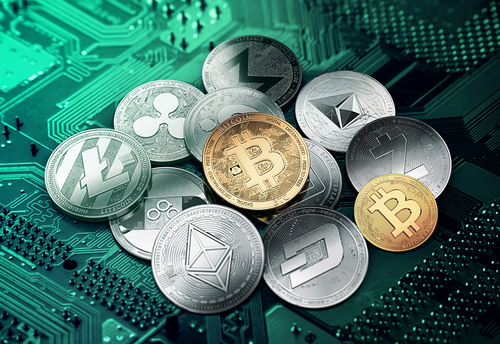
QUESTION: Mr. Armstrong; I love the fact you always stand in the middle. Do you believe that 95% of Bitcoin Trading is fake?

Thank you

KL

ANSWER: I did not conduct that study. It does sound a bit high. However, manipulation has been a historical problem in the commodity world. As I stated before, the manipulations were common practice in commodities during the 1970s. It was brought to Wall Street when Phibro took over Solomon Brothers in the early 80s. By 1991, they were charged with manipulating the US government bond market. How did they do that? The very same way these allegations of fake Bitcoin trades are taking place. You put in bids to pretend the market is deep and so you buy ever increasing the price.

Do I personally believe there is fake trading in Bitcoin taking place off-exchange? Absolutely. Would I assume that 95% is fake? I would question that high of a number. I would have to review their criteria for classifying a trade as fake. I would probably place it at the 50%+ level but not 95%. That is just my opinion based upon historical levels of manipulations in commodities.

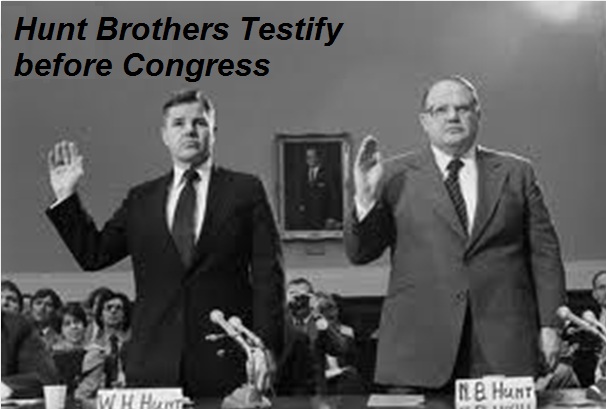
For example, I knew the Hunt brothers as clients in the early 1970s. Only a few months before the high, the world suddenly knew what they were up to. That info was spread by the dealers to get everyone in the retail market to rush in and buy silver with claims it was heading to $100. But the dealers, I believe, bribed the CFTC and the exchange into raising margins to be long on silver and making shorts required to put up a fraction of that margin requirement. The dealers shorted silver, the public lost, and they bankrupted the Hunts. They made so much money that they then began to buy Wall Street.

Inverted Yield Curve Points to Recession?


Last week, the yield on the 10-year U.S. Treasury bill fell below that of the 3-month note for the first time since 2007. This is what everyone calls an Inverted Yield Curve, and is seen as an early indicator of a recession. In that regard, it is conforming to the Economic Confidence Model (ECM) which has been warning that this last leg should be a hard landing economically for most of the world. Nonetheless, while the yield curve has inverted, it has done so in a rather unusual manner. This is NOT suggesting a major recession in the United States. Instead, it is a reflection of global uncertainty outside the USA.

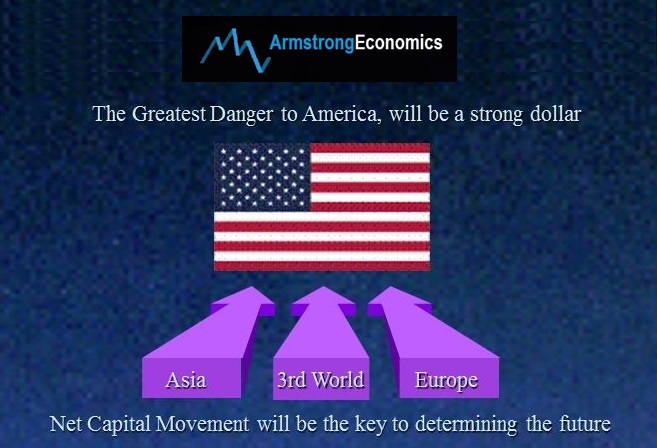
This Inverted Yield Curve is confirming that as the political chaos emerging around the world, and that more and more foreign capital is parking in the dollar. With the May elections on the horizon in Europe, and the October elections in even Canada, April elections in Israel … etc. etc., the capital flows are still pointing ever stronger into the dollar right now. The foreign capital has been buying the 10-year notes driving the spread lower.


We can see that the 10-year premium to the 2-years has been in a major decline ever since our War Cycle turned in 2014. The Yield Curve (10-2yr) has not inverted. This is clearly showing the capital flight to the dollar that has been going on post-2014. This is not reflecting a major recession in the USA, but it is inferring that the ECM will be turning soon

Facebook to Launch a Cryptocurrency & Compete Against Banks?


QUESTION: Why is Facebook going to issue a cryptocurrency? Doesn’t that confirm the evolutionary path of technology?

ND

ANSWER: The term “cryptocurrency” is being thrown around very loosely. It is true that there is increasing hype and speculation regarding a theoretical Facebook Coin. However, this is not a “cryptocurrency” it is simply a digital entry and nothing more. The proposed Facebook Coin is the polar opposite of Bitcoin. AFacebook is creating a pretend cryptocurrency for WhatsApp. This is not a real cryptocurrency. The cryptocurrency enthusiasts are only looking at the label. The Facebook Coin is nothing like Bitcoin (BTC).

Thet Facebook Coin will be pegged to a fiat currency similar to that of Tether (USDT) and USD Coin (USDC) and it will use blockchain technology. The only real unique aspect about Facebook Coin versus a regular stablecoin is that it could be backed by a basket of fiat currencies, all held in Facebook bank accounts. This is more along the lines of the ultimate evolution of what I would expect to become the next reserve currency – a basket of currencies rather than a single currency.

If our sources are correct, this means that a Facebook Coin would easily compete with the rest of the $2-3 billion stablecoin markets where the biggest stablecoin remains Tether (USDT). Tether (USDT) has had some problems with its backing which resulted in its decline by as much as 10% below the value of a U.S. dollar.

That said, since Facebook Coin would be a stablecoin, it will not be possible to invest in it so it would not be a trading vehicle like Bitcoin. That means it would be more of a store of value which is quite different from Bitcoin (BTC) and most other cryptocurrencies where fluctuating prices really prevent them from becoming a true currency digital or otherwise. Clearly, Facebook has no intention of launching a trading cryptocurrency. If they did, it would probably blow Bitcoin out of the water. Facebook is not going this route for it is looking to get into really the digital currency world, not cryptocurrency. However, Facebook’s total stock has a market cap of $463 billion is closer to 4 times that of the entire crypto market cap of $130 billion.

If we pull back the curtain, Facebook is much more interested in a real-world market by creating its own payment network independent of Visa and PayPal. Effectively, venturing into a digital currency world backed by a basket of currencies or allowing clients to select their currency means they would compete for deposits like banks but globally. With Facebook’s immense user base, such as a payment network would be extremely competitive in the banking world. Obviously, Facebook sees that a digital payment network will be unique out of all the other big name fiat payment networks since it will use blockchain technology and its client base to launch it into the future..


Our Flawed Monetary System & Why it is Doomed


QUESTION: You mentioned that Rome had no national debt and no central bank. Exactly how did it function for 1,000 years?

JY

ANSWER: In addition to not having a national debt or a central bank, Rome had no police force or agency charged with enforcing the law. There were specific crimes against the state that would be prosecuted such as arson and treason. But the prosecution of a murder would be carried out by the family. The responsibility for enforcing the law thereby fell on the kin, tribe, gens and patron of the offended individual.

It was the King of England after Magna Carta who began to prosecute people for what was private crimes all so he could make money. By the time of the American Revolution, there were 240 felonies all of which carried the death penalty. So the king got to confiscate all your property and throw your family out on the street all based on what had historically been a private dispute.

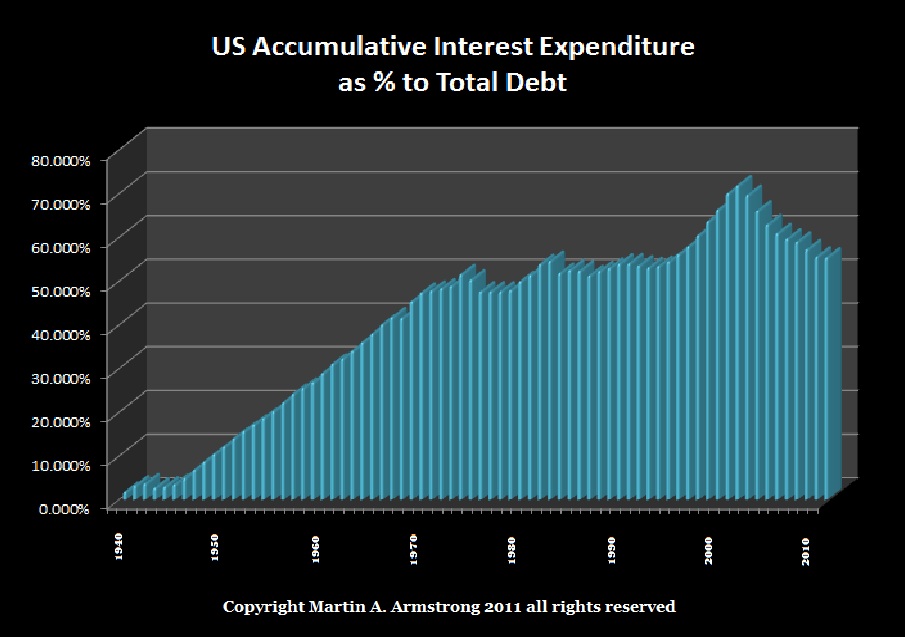
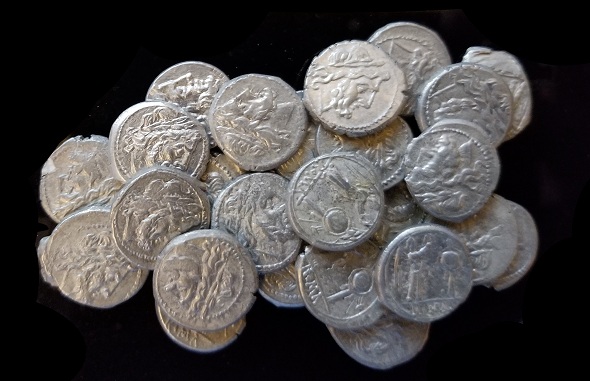
As far as finances, the government simply minted coins to pay its expenses. As I have said, if we just created the money to fund the government rather than borrow, it would be far less inflationary. Because we borrow, with no intention of paying anything off, we must keep paying interest to roll the debt. That suppresses the economy, for it is competing with the private sector. It is a contributing factor as to why 70% of small business get turned down for loans that would expand the economy.

As shown here, the accumulative interest expenditures eventually exceed 70% of the total debt so the money never went to anything such as schools, roads, or social programs. If the government simply created the money, as did Rome, then the economy is segregated between public and private.

Today, the Fed raises interest rates to slow our spending yet it increases the spending of government. It is impossible for the economic theories of Keynes and Marx to ever function when the government is the single greatest borrower. Our current economic system is doomed. No rational person would EVER create such a completely flawed monetary system as this.

Spiral Panic


Armstrong Economics Models

Pujo Committee 1912

One of the often perplexing notions about markets is that there is some huge short-player who overpowers the market and forces it down. Every investigation since the notorious Pujo Hearingsduring the after math of the Panic of 1907 has begun looking for the mythical short player. Never has any investigation every found anyone. It was after a resolution introduced by congressman Charles Lindbergh Sr. to probe Wall Street assuming the crasg was abnormal and must have been caused by someone. Arsène Pujo (1861-1939) of Louisiana was given a congressional authorization to form a subcommittee of the House Committee on Banking and Currency. The lead prosecutor was Samuel Untermyer (1858-1940) who turned it into a ruthless mockery of justice and democracy. There was his famous interrogation of J.P. Morgan (1837-1913) that revealed how much this prosecutor did not know about finance.

  • Untermyer: Is not commercial credit based primarily upon money or property?
  • Morgan:    No, sir. The first thing is character.
  • Untermyer: Before money or property?
  • Morgan:    Before money or anything else. Money cannot buy it … a man I do not trust could not get money from me on all the bonds in Christendom.

Predominately, the problem that confronts the majority is the complete failure to comprehend what actually causes a panic. The assumption that there is some BUYER who buys the high and carries that to a loss all the way down providing the mythical short-player vast profits is another myth. The buyers on the way down are typically short sellers taking a profit providing vital support. There are some courageous attempts at bottom picking. However, these tend to die out the longer the decline prevails.

Pecora Commission Hearings


To find that mythical huge short-player has always been the goal. Herbert Hoover in his memoirs admitted that he had received a telephone call saying there was some plat against him and a huge short position created the 1929 Crash to ruin the Republican Party. Hoover thus began an investigation in search of this mythical short-player. Nobody was found after hauling in everyone from Rockefeller on down. The was the Pecora Investigation which began on March 4, 1932 by the United States Senate Committee on Banking and Currency, While the object was to investigate the causes of the Wall Street Crash of 1929, nothing could be determined so Roosevelt later created the SEC, which has never been able to find the mythical short-player or prevent a single crash.. The name refers to the fourth and final chief counsel for the investigation, Ferdinand Pecora (1882-1971). What was actually revealed was the opposite – the investors were all long and suffered losses right from the biggest names on down. Hoover apologized saying that sometimes when a government becomes enraged, it burns down the barn to get the mouse. Pecora was only in it to become famous. He was appoint to the SEC, but quickly resigned because he was not chairman.

Every investigation wants to hang someone. It is not interested in actually trying to understand how the markets function. The cause of the panic is NOT the short-player, but the concentration of long-players. When everyone who has thought about buying has already bought and is now counting their future profits, the end is near. Lacking a new source of buyers, the market becomes tired. As that unfolds, we end up with a dangerous position. The slightest scare creates a stampede no different than a heard of zebra. One may hear a lion and it starts the run. The others run because of the crowd and may have no idea why. When the majority are long and start to sell, lacking new buyers, they begin a spiral downward. There can be the FLASH CRASH where there is simply no bid. It becomes a Spiral Panic with some buying coming mostly from shorts taking profits. If is is a slow spiral decline rather than an instant flash crash, then there may be some attempts at bottom picking. This type of spiral decline becomes like a relay race with one handing off the torch to the next.

Spiral Panic

Share this:

Capital Flows


Armstrong Economics Models

Intl-Capital-Flows 2


Introduction

The Evolution of the Global Economy

Cap-Flows

The economy is like a child. It grows, matures and evolves. Perhaps the greatest problem we face in attempting to reform our political-economy and move forward, has been the assumption that we are in control. We only to see things in our domestic political-economy and make our investments and policy decisions based upon this myopic domestic perspective. We assume governments are in control even though we do not understand what they are doing. They try desperately to influence what we think and do realizing that we actually respond to what we believe will happen in anticipation.

Yet the economy is far more complex and sophisticated. Everything is actually connected precisely as it is in nature for we are part of nature and that same grand design. The global economy is much like a rain forest with billions of lifeforms all depending on another. To analyze and model this kind of complex environmental and societal economic system requires research that views the system both as a whole and its component parts to reveal the interconnected data that lies hidden beneath the surface.  This allows for the combination of small influences to cascade into larger global trends just as removing one specie in a rain forest will set off a chain reaction since it is either a predator or the prey in relation to other species. This is why we need to see the flow of capital between all the players for linking the global data for the analysis reveals the whole complex system, and not just a subset of all the interesting operations and processes of the system.

We cannot reduce the trend to a single cause and effect. The global economy is akin to a rain forest with countless species interacting with one dependent upon another. Remove one, and you begin a chain reaction with unintended or knowable circumstances. We are incapable to constructing a rain forest because we do not understand all the subtle interconnections. Australian learned that lesson by importing one specie to accomplish one goal that introduced a predator altering the environmental balance. Likewise, altering taxes, trade regulations, and investment regulations alters capital flows that can be extremely destructive.

PlazaAccord

The Plaza accord starting the G5 (now G20) to manipulate the dollar down by 40% in order to reduce the US trade deficit, created the 1987 Crash and sent capital rushing back to Japan that they did not understand creating the 1989 Bubble.  The capital flow chaos unleashed by the G5 was devastating.

CapitalFlow-Japan87-89(2)


The G5 caused the capital withdraw from the USA and the 1987 Crash on a panic the dollar would decline by 40% and that set off a capital concentration back into Japan. As the yen rose and the Nikkei, that attracted foreign investors creating the Bubble in 1989. Capital then fled Japan and moved into South East Asia.

THLAND-Y


The capital then flows to South East Asia and created the peaks in 1994. That was the precise low in the S&P500 back in the USA. Capital then began to shift toward the US and European markets and this flow intensified because of the expect launch of the Euro in 1998. That led to the Currency Crisis of 1997.

1994 SP500


The turning point in 1994.25 marked the precise low in the US share market and the shift in capital flows out of South East Asia. Every single thing is connected on a global scale. We must come to understand that the economy has matured and evolved in ways we have ignored and remain oblivious to their development. In many ways, we still assume the world is flat economically. We fail to grasp the global economic evolution all around us because it confronts our politicians, economists, and the central bankers who prefer the limited domestic economy view in which they can be masters of the universe.

The evolution of our global economy is challenging the very ideas and theories of economics that deprives them of the power they desire as interventionists. If the economy is malleable, then they can control it. If the economy is interlinked, then we are all in this together and we cannot control the economy with raising taxes to create “social justice” without endangering the entire system.

Fish-Bowl-Economy

This basic assumption of a domestic economy within the grasp of government is what I call the Fish Bowl Economy entirely self-contained.  All economic theories are predicated upon this concept and justify government intervention to alter domestic trends that may be set in motion externally.  This domestic myopic view that supports centralized panning and governmental power was the foundation of communism that crumbled to dust. Government, assuming variable degrees of power, has been unable to prevent any crash and always seeks greater power in the aftermath with each event claiming they will prevent the next. They cannot see the global economy for it is beyond their power. This view of a domestic Fish Bowl Economy, excludes the possibility that a fish can leap from one bowl to the next. Therein lies the flaw in economic theories that justify government control.

(Full Work to be Published by 2014)

CapFlow-07-12