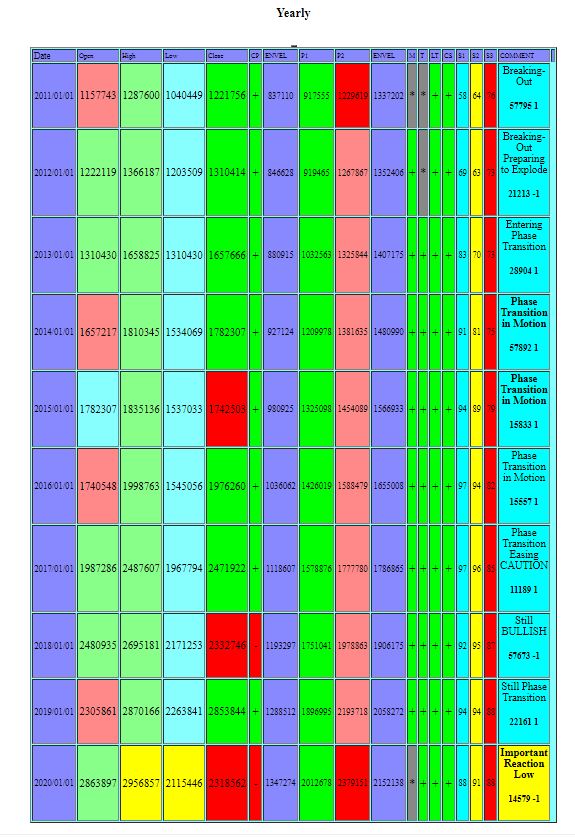
The Global Market Watch Forecast on the Dow


QUESTION: Marty; it all seems to be setting up for your forecast back to new high into 2022. Even the inflationary wave seems oddly reminiscent of 1979 with people hoarding toilet paper again. Is everything still on track?

AD

ANSWER: Yes. As you know, the Global Market Watch is dynamic. So the yearly will change with the market. We have gone down enough in the Dow Jones Industrials for it to come up with a pattern that calls this an Important Reaction Low. If we go further, it may change to a Knee-Jerk Low.  I suggest following that in Socrates. The inflation was showing more between 2022-2024. The Silver/Gold Ratio was warning this was not ready to breakout.

The correction came in on a target from the ECM turn on January 18th, 2020. It was the 21st when Ray Dalio said “cash is trash” which was perfect. The target we gave back at the WEC in October for the correction in January was a minimum correction in the Dow to 21600. So that has been met and now we are fooling around with the Monthly Bearish Reversals below that target.

Ironically, the more pronounced the decline, the higher the probability for the slingshot. You need to create that energy. Government bond markets are collapsing so the traditional flight to quality is a dead issue. There is a panic to dollars right now. This is rising as fears over canceling currencies in Europe and bank holidays.

(Part II) – Coronavirus as a Global Economic Reset…


…there had to be a point where the value of the Wall St economy surpassed the value of the Main St economy… Part I Here

We now look forward, and consider the question: How would the multinational underwriters, the multinational financial systems, reset all transactional tables (the bookkeeping systems underneath the valuation) if the U.S. stock market was ever forced to re-value economic nationalism over multinational globalism?

To first answer the “how” question, we must visit the “why” question. Why would the multinational financial underwriters want to reset their valuations?

Obviously, the global financial system does not act altruistically. What would motivate the global wealth valuation authority (various market investment indexes) to want, or need, a reset.

The answer to the “why” question might not be as challenging as it appears.

First, there has been a seismic shift in how the world looks at the economic exploitation of multinational systems, or globalism.  See Bernie Sanders?  See those yellow vests in France?  See what happened with the U.K. Brexit referendum?  See the shrinking EU influence?  See the open/public confrontation and push-back against China? See Trump? All examples are consequences of the rise of economic nationalism.

Secondly, the original Wall Street corporate motive (during decades of mergers and acquisitions) to shift product manufacturing to Southeast Asia (ASEAN nations) was driven by a lower cost of overall business, higher profit margins and greed.

As a direct outcome economic wealth was shifted from the U.S. to ASEAN nations, and particularly China. Low wages, low regulation, cheap operational costs, incentives and subsidies from Asia equals cheap TV’s, sneakers, furniture and durable goods.

Even with high fuel prices and overseas shipping costs, there was a big difference between U.S. and ASEAN manufacturing costs.  As hundreds of U.S. Wall Street multinationals chased profits the rust-belt was created.

However, over time (three decades) the outflow of U.S. wealth resulted in a higher wealth level in the ASEAN nations.  Over time Asian workers receive higher wages and their standard of living increased.

With 30 years of stagnate wage growth in the U.S, and with rising wages and standards in southeast Asia, the difference in labor costs starts to narrow. Simultaneously, the internal economy in China, Vietnam, S-Korea etc. all started to increase.

The ASEAN workers are now buying stuff they couldn’t afford before.

Instead of a reliance on the U.S. consumer, the internal economy (local demand on a generational scale) starts driving a need in Asia for the same products.  As a result, more U.S. and global multinationals expanded operations in those ASEAN nations because new consumers were created.

However, the multinationals were also taking advantage of (exploiting) prior trade constructs like NAFTA.  Ex. U.S. multinationals used Canada and Mexico to assemble Chinese products for distribution into the U.S.

Along comes Donald Trump who has watched all of this and he wants to change it.

President Trump starts initiating policies that specifically benefit Main Street by speeding up the process of narrowing the cost difference between the U.S. and SE Asia.

President Trump calls these policies “America First”.

Trump lowers the corporate tax rate to offset the ASEAN benefit of Chinese subsidies. A tax policy that also makes corporate tax inversion less likely.

Trump further narrows production costs by lowering U.S. energy costs. A policy to unleash all facets of energy development (ex. pipeline approvals and ANWR opening). Again, lower energy costs in the U.S. narrows the cost difference for manufacturing.

Trump deregulates various industries, again closing the gap between the U.S. and ASEAN nations. Part of this deregulation allows for expanded (easier) raw material development.

With the initial framework established, President Trump starts getting serious.

President Trump puts a big wrench into the cost dynamic with tariffs on imported goods from China and Asia.  Trump then eliminates the three-decade-old NAFTA loopholes that allowed manufacturers to work around origination rules.

The USMCA has more strict origination rules that require parts to originate in North America. The tax/tariff for violating the origination rule(s) are not particularly high, but they are a disincentive. Again, that narrows the cost difference.

All of these policies, lower corp taxes, deregulation, lower energy costs, access to abundant raw materials; closed NAFTA loopholes; and the looming threat of easy to apply tariffs; work together to narrow the cost difference between production in ASEAN nations and production in the U.S.

Then when you factor-in shipping costs & new trade rules, well, the difference is minimal.

So there’s the “why” answer.

♦ The multinational systems (Wall St. valuation underwriters) are now open to a reset in the current global evaluation indexes, because the landscape has completely changed.

A 72″ flat screen TV can be made in the U.S. for the same price as the TV in Vietnam.

However, there’s still another problem… For that, we need a metaphor… so we’ll stick with a fictional TV corporation.

A U.S. electronic multinational has a stock market evaluation based, in part, on their TV assembly operations overseas.  Assume that division of the parent company is 20% of the total company valuation. If that company wants to return the TV division to the U.S. the exit cost of the move is not worth 20% of their total valuation.

The physical land (leased or owned), physical factory (leased or owned), and physical machinery are worth pennies on the original investment dollar.

It is the operation, and the preceding financial result, that carried the Wall Street valuation.  If the TV division is going to relocate into the U.S, Mexico or, less likely Canada, that division is going to have to invest in the move and only recapture a few dollars from the sale of land, factory or equipment they leave behind.

How do they pay for the costs to return to North America?…

…and, more importantly…

How do the multinational underwriters who assigned the divisional valuation, and the investors who subsequently inflated the valuation, lower the divisional valuation to reset for an entirely new landscape and growth/profit opportunity?

In essence what this “TV” example shows is a corporation detaching their valuation from globalism, and reattaching their valuation to economic nationalism, Main Street USA, again.

That’s the opportunity behind Coronavirus….

(Part I) – Coronavirus as a Global Economic Reset…


A very big picture discussion requires a considerable baseline.

The stock market is not the U.S. economy; the stock market is an investment instrument that determines valuations of economic activity company by company. The valuation is considerably arbitrary, based on the determinations of the arbiters (investors). This is empirically true.

However, that said, how would the multinational underwriters, the multinational financial systems, reset all transactional tables (the bookkeeping systems underneath the valuation) …if the U.S. stock market was every forced to re-value economic nationalism over multinational globalism?    Enter “Coronavirus”.

Four years ago CTH first explained a new way to look at the U.S. economic system and how Main Street was/is disconnected from Wall Street.  We presented a metaphor to explain. Before going deeper into the discussion of tomorrow; and at the request of several people who now accept the era of “deglobalization” is upon us,  I first present that prior reference & then will use this as the baseline to describe what could come next.

There is a key phrase at the fulcrum of everything past:

…there had to be a point where the value of the second economy (Wall Street) surpassed the value of the first economy (Main Street).

What we are going to outline in part II is the possibility what happens when this natural truism is reversed.  The objective is to answer: How, specifically would Wall Street reset its evaluative systems if Main Street once again emerged as the priority?

But first, a baseline revisit is needed.

2015/2016 – Traditional economic principles have revolved around the Macro and Micro with interventionist influences driven by GDP (Gross Domestic Product, or total economic output), interest rates, inflation rates and federally controlled monetary policy designed to steer the broad economic outcomes.

Additionally, in large measure, the various data points which underline Macro principles are two dimensional. As the X-Axis goes thus, the Y-Axis responds accordingly… and so it goes…. and so it has historically gone.

trump convention 2

Traditional monetary policy has centered upon a belief of cause and effect: (ex.1) If inflation grows, it can be reduced by rising interest rates. Or, (ex.2) as GDP shrinks, it too can be affected by decreases in interest rates to stimulate investment/production etc.

In short, FEDeral intervention.

However, against the backdrop of economic Globalism -vs- economic Americanism, CTH is noting the two dimensional economic approach is no longer a relevant model. There is another economic dimension, a third dimension. An undiscovered depth or distance between the “X” and the “Y”.

I believe it is critical to understand this new dimension in order to understand Trump economic principles, and the subsequent “America-First” economy he’s building.

As the distance between the X and Y increases over time, the affect detaches – slowly and almost invisibly. I believe understanding this hidden distance perspective will reconcile many of the current economic contractions. I also predict this third dimension will soon be discovered and will be extremely consequential in the coming decade.

To understand the basic theory, allow me to introduce a visual image to assist comprehension. Think about the two economies, Wall Street (paper or false economy) and Main Street (real or traditional economy) as two parallel roads or tracks. Think of Wall Street as one train engine and Main Street as another.

The Metaphor – Several decades ago, 1980-ish, our two economic engines started out in South Florida with the Wall Street economy on I-95 the East Coast, and the Main Street economy on I-75 the West Coast. The distance between them less than 100 miles.

As each economy heads North, over time the distance between them grows. As they cross the Florida State line Wall Street’s engine (I-95) is now 200 miles from Main Street’s engine (traveling I-75).

As we have discussed – the legislative outcomes, along with the monetary policy therein, follows the economic engine carrying the greatest political influence. Our historic result is monetary policy followed the Wall Street engine.

a17b2-hip-replacement-recall-bribery[…] there had to be a point where the value of the second economy (Wall Street) surpassed the value of the first economy (Main Street).

Investments, and the bets therein, needed to expand outside of the USA. hence, global(ist) investing.

However, a second more consequential aspect happened simultaneously. The politicians became more valuable to the Wall Street team than the Main Street team; and Wall Street had deeper pockets because their economy was now larger.

As a consequence Wall Street started funding political candidates and asking for legislation that benefited their interests.

When Main Street was purchasing the legislative influence the outcomes were beneficial to Main Street, and by direct attachment those outcomes also benefited the average American inside the real economy.

When Wall Street began purchasing the legislative influence, the outcomes therein became beneficial to Wall Street. Those benefits are detached from improving the livelihoods of main street Americans because the benefits are “global” needs. Global financial interests, investment interests, are now the primary filter through which the DC legislative outcomes are considered.

There is a natural disconnect. (more)

Here is an example of the resulting impact as felt by consumers:

economy-1

♦ TWO ECONOMIES – Time continues to pass as each economic engine heads North.

Economic Globalism expands. Wall Street’s false (paper) economy becomes the far greater economy. Federal monetary policy follows and fuels the larger economy. (Note: size is determined by value, not by production.) In exchange for policy the Wall Street benefactors pay back the politicians.

Economic Nationalism shrinks. Main Street’s real (traditional) economy shrinks. Domestic manufacturing drops. Jobs are off-shored. Main Street companies try to offset the shrinking economy with increased productivity (their limited fuel). Wages stagnate.

Now it’s 1990 – The Wall Street economic engine (traveling I-95) reaches Northern North Carolina. However, it’s now 500 miles away from Main Street’s engine (traveling I-75). The Appalachian range is the geographic wedge creating the natural divide (a metaphor for ‘trickle down’).

By the time the decade of 2000 arrives – Wall Street’s well fueled engine, and the accompanying DC legislative attention, influence and monetary policy, has reached Philadelphia.

However, Main Street’s engine is in Ohio (they’re now 700 miles apart) and almost out of fuel; there simply is no more productivity to squeeze.  Technological gains, used as fuel for productivity, start to level-off. The engine starts to slow.

From that moment in time, and from that geographic location, all forward travel is now only going to push the two economies further apart. I-95 now heads North East, and I-75 heads due North through Michigan. The distance between these engines is going to grow much more significantly now with each passing mile/month….

However, and this is a key reference point, if you are judging their advancing progress from a globalist vessel (filled with traditional academic economists) in the mid-Atlantic, both economies (both engines) would seem to be essentially in the same place based on their latitude.

From a two-dimensional linear perspective you cannot tell the distance between them.

It is within this distance between the two economies, which grew over time, where a new economic dimension has been created and is not getting attention. It is critical to understand the detachment.

Within this three dimensional detachment you understand why Near-Zero interest rates no longer drive an expansion of the GDP. The Main Street economic engine is just too far away to gain any substantive benefit.

Despite their domestic origin in NY/DC, traditional monetary policies (over time) have focused exclusively on the Wall Street, Globalist economy. The Wall Street Economic engine was simply seen as the only economy that would survive. The Main Street engine was viewed by DC, and those who assemble the legislative priorities therein, as a dying engine, lacking fuel, and destined to be service driven only….

Within the new 3rd economic dimension, the distance between Wall Street and Main Street economic engines, you will find the data to reconcile years of odd economic detachment.

brexit-letter-1

Here’s where it gets really interesting. Understanding the distance between the real Main Street economic engine and the false Wall Street economic engine will help all of us to understand the scope of an upcoming economic lag; which, rather remarkably I would add, is a very interesting dynamic.

Think about these engines doing a turn about and beginning a rapid reverse. GDP can, and in my opinion, will, expand quickly. However, any interest rate hikes (monetary  policy) intended to cool down that expansion -fearful of inflation- will take a long time to traverse the divide.

Additionally, inflation on durable goods will be insignificant – even as international trade agreements are renegotiated, and/or as tariffs are applied. Why? Simply because the originating nations of those products are going to go through the same type of economic detachment described above.

Those global manufacturing economies will first respond to any increases in export costs (tariffs etc.), by driving their own productivity higher as an initial offset, in the same manner American workers went through in the past three decades. The manufacturing enterprise and the financial sector remain focused on the pricing because the consumer is the most important variable. Ultimately prices are determined by wages.

♦ Inflation on imported durable goods sold in America, while necessary, will ultimately be minimal during this initial period; and expand more significantly as time progresses and off-shored manufacturing finds less and less ways to be productive. Over time, durable good prices will increase – but it will come much later.

♦ Inflation on domestic consumable goods ‘may‘ indeed rise at a faster pace. However, it can be expected that U.S. wage rates will respond faster, naturally faster, than any monetary policy because inflation on fast-turn consumable goods become re-coupled to the ability of wage rates to afford them.

The monetary and fiscal policy impact lag, caused by the distance between federal monetary action and the domestic Main Street economy, will now work in our favor. That is, in favor of the middle-class.

Within the aforementioned distance between “X” and “Y”, a result of three decades traveled by two divergent economic engines, is our new economic dimension….

Trump thumbs up

We support reinstating the Glass-Steagall Act of 1933 which prohibits commercial banks from engaging in high-risk investment,” said the platform released by the Republican National Committee. (link)

/snip/

Notice how each of the most critical parts of that predictive outline from four years ago essentially became our reality as President Trump applied his ‘America-First’ agenda.

Now, here’s where it is going to get interesting again as we look forward another four years. 

In part II we will answer: How, specifically would Wall Street reset it’s evaluatory systems if Main Street once again emerged as the priority?… and I will outline how COVID-19 can be the spark to reset that evaluation system.

The Fear Parade


“You never let a serious crisis go to waste….It’s an opportunity to do things you think you could not do before.” — Rahm Emanuel

Whether or not the US had anything to do with the creation and release of the COVID 19 virus, it is sadly predictable that our government will use the situation to further increase its power by lessening our freedom. US government operatives helped commit the 9-11 disaster and as a result we got the foul “Patriot Act” forced upon us, which has nearly obliterated our 4th Amendment.

When government gets more power, it never relinquishes it. The CIA-influenced mass media has drummed up hysteria about this latest virus, and some even imply Trump is to blame. One thing for sure, everything else they drummed up to try and remove our lawfully elected president has failed. Now they will blame Trump for COVID 19 and the collapsing stock market.

During the Boston Marathon bombing, government managed to lock down an entire city. Now the government is seeing if they can lock down an entire country. If they succeed, then it will become routine. “Lock down!—Everyone must be at home so we can administer mandatory vaccines! Or, “Lock Down! Everyone must be at home so we can confiscate your firearms!” And so forth. Our freedom of speech will be restricted. Only government will have the official word along with the CDC and World Health Organization. By the way, Bill Gates helped fund the WHO and I also heard he was part ‘owner’ of the virus patent. Last week he suddenly resigned from Microsoft’s board. Perhaps he knows he’s partially responsible in some manner and is heading to a private location to avoid a hemp necktie.

I’ve read all the conspiracy theories regarding the reason for the release of the virus. One of the most believable contentions is the virus is a distraction from 5G, which is dangerous to humans. Ironically, Wuhan is big on 5G. 4G is fast enough, but 5G is necessary for the globalist power freaks (such as Bill Gates) who desire ‘smart cities’ that monitor everything citizens might do.

The coronavirus mostly affects the infirm and the elderly. Most Americans can and will endure it. We will also most likely be forced to endure an even more tyrannical and oppressive government.

—Ben Garrison

Remember 9/11 and the “Patriot” act- Panic is worthless and can only lead to tyranny!

Tina

The Quantity Theory of Money & the Disaster it Has Caused


QUESTION: You say that the reason why gold went up when the stock market crashed in 1929 is because gold was money back then. But what if you have it the other way around, and the reason why the USD was strong was because it was backed by gold back then? Now the USD is a fiat currency backed by nothing. Maybe the springboard bounce in prices will be in commodities?
RR

ANSWER: Gold acts completely different under a gold standard than as a commodity. You really have to stop looking at money as having to be backed by some tangible item. It is backed by the CONFIDENCE in the people. China, Japan, and Germany, all rose from the ashes without GOLD. How was that possible without some backing? The value of any currency it the total productive capability of its people. China rose to the 2nd larges economy because of its people. Russia was oppressing its people and thus did not boom despite all the resources which others did not have. Under your theory, Russia should have the strongest currency.

The dollar rose ONLY because of the Sovereign Debt Crisis where most of Europe, Asia, and South America defaulted on their debt in 1931. You must look at everything and in the context of the period.

This is why some hedge fund have lost 20% in a week. As long as people are living in the past they will lose every single time. Open your eyes to the real world. Commodities will rise WHEN the people lose confidence in the government. It has nothing to do with backing. That is so old school from the days of a barter economy. So you are worth nothing unless you have gold? Your labor is worth zero?

The Fed Makes a Fool of Itself – There is no Santa Claus


This is the very essence of a financial crisis. Despite the fact that Trump cheered the Fed and they cut rates to ZERO, the risk was what would happen if the market continued to fall. Another steep sell off took place which resulted in the halt of trading again on Wall Street as Monday opened. This is undermining the entire confidence despite the Federal Reserve’s emergency actions to lower interest rates and pump more money into the economy to combat the impact of the coronavirus. The Fed on Sunday slashed interest rates by a full percentage point to zero and said it would buy $700 billion in Treasury securities in a massive emergency move to protect the U.S. economy from the pandemic. President Trump said on Sunday that investors should be “very thrilled” by the move. This has revealed that Trump is too old school like Ray Dalio who at the World Economic Forum and on the turn of the Economic Confidence Model on January 18, 2020, proclaimed that “cash is trash” for which he will now be remembered in history (his interview was Jan 21, 2020).

The S&P 500 quickly plummeted more than 8% after the opening bell, triggering an automatic temporary halt in operations for the third time in the past six trading days. The Dow Jones Industrial Average lost 9.7%, or more than 2,200 points before trading was suspended for 15 minutes.

HELLO! Is the world listening?

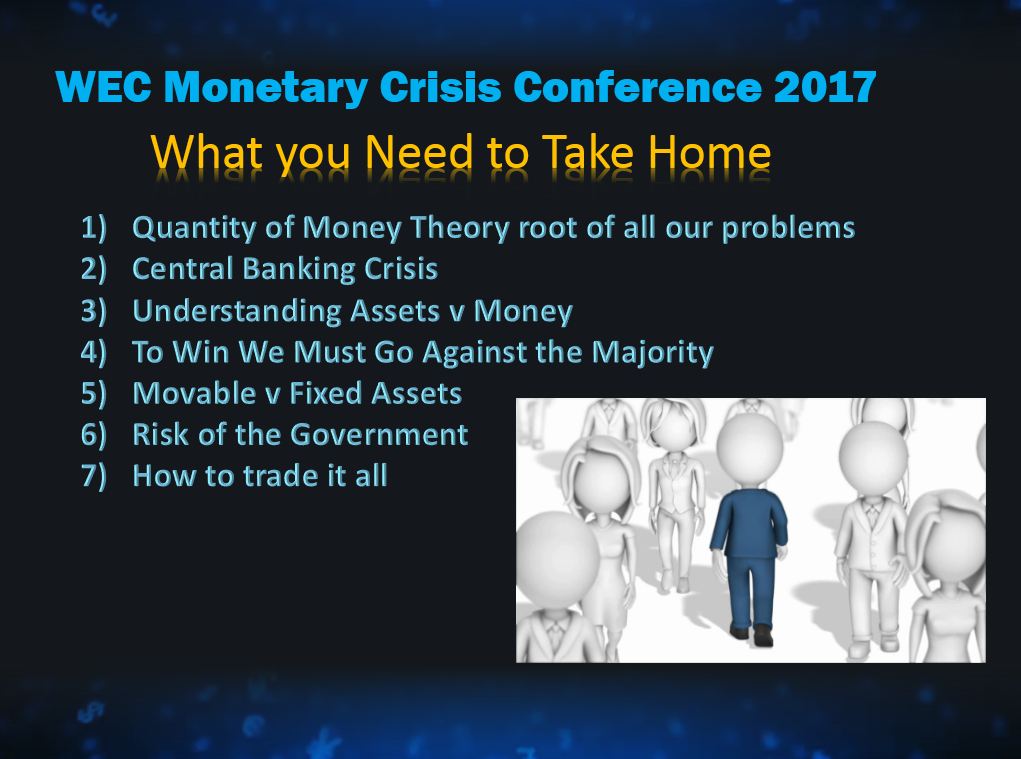
Only a fool tries to catch a falling knife. We have the end of the quarter coming due. The losses among those who have been using the Quantity Theory of Money will be staggering. Those who keep touting this is Quantitative Easing so the dollar must crash and gold will soar, fail to understand the dynamic of the economy and how we all connected. I covered in detail at the 2017 World Economic Conference that the Quantity Theory of Money was the root of all evil. It has not just misled the goldbugs, but central bankers, right down to Trump.

We have warned that we were facing a Central Bank Crisis by 2020, which would then lead into the Monetary Crisis Cycle. We can see this thing coming but the majority MUST always be wrong. This is simply the energy needed behind the business cycle.

What the Fed has done was foolish. They have no real power to control the economy and now people are going to begin to realize, there is no Santa Claus.

Europe Melting Down – Central Bank Chaos


The European markets are crashing from the currencies to the debt – even the Bunds. The smart capital is realizing that this is the end-game. Central Banks are in a state of absolute crisis. We are looking at the extreme volatility that is required to eventually create the slingshot. As we head into the end of the quarter, hedge funds are selling everything to raise cash. All those who have been listening to forecasts all based on the Quantity Theory of Money, including the central banks, are losing everything because they have utterly failed to comprehend the global economy and how it truly functions. You would think after 6 years of negative interest rates in Europe, the ECB buying the bonds because there is no free market left, they would realize that their forecasts of “cash is trash”were so old school from the days of the gold standard and fixed rates.

We as a society seem obsessed with repeating the same mistakes while expecting a different result. Mistakes are supposed to be how we learn, they are not a script for repeating perpetually.

Silver has broken last year’s low. All the European markets have tumbled. The worst possible move was just made. The Fed went all-in and the markets did not respond. Welcome to the Crash of 2020. We have a lot more interesting times just ahead

Why do I Meet With Heads of State


COMMENT: Martin –
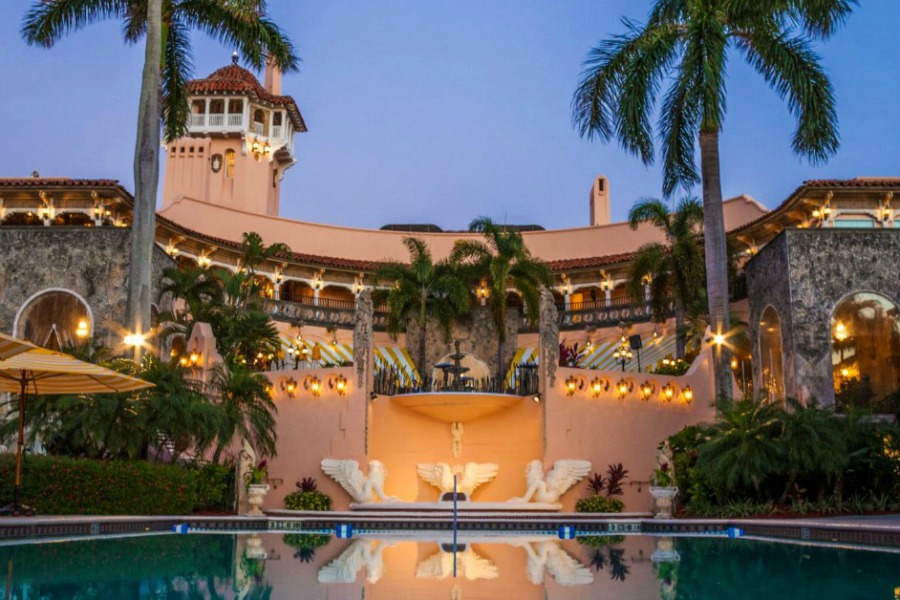
I’m glad you had the opportunity to attend the gathering at Mar E Lago and I hope you had a chance to introduce yourself and your economic track record to president Trump. He is an ego-driven person who loves smearing dirt in the faces of his opponents unnecessarily, but he is business-oriented and I do think he less-dogmatic/ideological that many pols, open to practical ideas, and is working hard to try to reinvigorate America to the extent he know how.

My ears perked up last nite when over dinner my brother in-law claimed Trump said that he will move to restructure the national debt. Have events become dire-enough now that the time has arrived for you to offer your debt-equity swap proposition, and has Trump taken it into favorable consideration ? I hope so.
SC

REPLY: I have been meeting with heads of state since 1980. I was simply the largest adviser in currency and understood how things worked globally from a teenager. When I was 13, I traveled around Europe with my family from Sweden to Italy over the summer. I believe that taught me about currency for every country we visited you had to change your currency.  That was, I believe, my introduction to foreign exchange. So when 1971 came and the floating exchange rate began, I was familiar with the issue and simply applied my trading experience in commodities to the currency.

They did not teach currency in school. After all, everything was fixed. So when the first banking crisis hit in 1973, I just happened to know the executive VP and he called me asking if I would take a look at their currency problem. So from then on, I just had a reputation of being the guy institutions would call over currency questions.

I began meeting with the Reagan Administration and was asked for advice informing the G5 in 1985. That is when I wrote to President disagreeing with the proposal of the Plaza Accord. Because I was regarded as the currency expert, I simply was getting called in around the globe. People ask me all the time, how did I become the largest adviser in the world? I just would say as my secretary had a little stickman holding a sign on her desk – Shit Happens.

I was restructuring companies to create natural hedges offsetting currency risks in one country by a counter-trend set of assets in another. I was redirecting where companies should set up operations and what countries to leave. That led to Margaret Thatcher wanting to meet because she heard a rumor that some guy was behind setting up all the manufacturing plants in Britain. I happened to personally know her economic adviser, Sir Alan Walters. He said that was “Marty” and she wanted to meet.

I have been meeting heads of state my whole career. Some people have called me the Forest Gump of Finance. Whatever crisis hit, I was somehow called in. So it was a joke inside the company who would accompany to Mar-a-Largo. Then it has become a joke that with all the controversy that Trump met with a press agent of the President of Brazil who tested positive for coronavirus 3 days later, some of my staff said, of course, you had to be there for that one as well.

I am in contact with many around the world. I try to help wherever I can. I refuse to accept payments from any government. That actually increases my respect for those who are always trying to hand them bills, they also know that they will skew the advice to what they want to hear. With me, they know I am not for sale. I will always speak my mind and that much they know.

Even when I testified before the House Ways & Means Committee, they knew I had under contract the equivalent of 50% of the US national debt. That is also why the bankers have hated me. They try to manipulate markets and when they lose, they blame me because I refuse to join them.

I have enough to live out my days. It will not change my lifestyle. I try to limit what I do, not expand it. I am not 25. What I do is because I do not like what I see for my family. I get to say – Scotty, please beam me up! They are here and have to finish out their tour of duty. So my motivation has never been money. I have been blessed with the talents not to ever have to worry about that common problem.

For me, it is important to see how various heads of state act in response to various events. What is their thinking process for that to me leads to where they will take us in the future and what path we are walking down. I do not like the press. They often write without regard to what is really going on and are far too often biased in their view of people based upon political dogma. I prefer my own research not filtered by someone who I have to figure out their motive.


Fed Announcement – Speaking in Tongues


QUESTION: Marty, you recently said that there was a shadow repo market. Nobody has ever heard of this. In the Fed’s statement, there is a curious announcement that’s talking about coordinated swap lines. They also said: ” both a collateralized and uncollateralized basis, to support the provision of liquidity to households and businesses and the general smooth functioning of payment systems.” Is this the commercial paper you are talking about?

ML

ANSWER: Yes. They call this “coordinated swap lines” between central banks. It is the shadow uncollateralized Repo Market. They are now coordinating this with the Bank of Canada, the Bank of England, the Bank of Japan, the European Central Bank, the Federal Reserve, and the Swiss National Bank. In other words, the Fed is providing liquidity to other central banks. I have said before. They actually had red phones connecting the central banks after the Plaza Accord. I was sitting there in the room when one of those red phones started to ring. I just call it the shadow Repo Market.

The “uncollateralized” loans mean commercial paper other than government treasuries

Never Let a Good Crisis Go to Waste


QUESTION: Do you think there is some single plot behind this Coronavirus scare?

SH

ANSWER: No. It seems that there are a lot of people using this Coronavirus for personal political agendas. Illinois Tollway is now using it to implement All-Electronic Tolling as Precaution Against Spread of Coronavirus. You have others in Europe saying they should be nationalizing companies since they cannot be bailout under EU rules. Others are using it and blaming Trump as if any government can really prevent such a pandemic.

I do not think this is a single-minded plot. However, history also demonstrates that they will always take advantage of a good crisis. In Europe, the central bank is already at negative rates. There is nothing left for them to do. This is now turning to emergency political measures. The drive to use this as the excuse to eliminate paper currency is a side-benefit on their wish list and this does provide the excuse to justify that action.

Whatever measures you see, they rarely ever reverse. They tend to be permanent.