There’s No Such Thing As An Unregulated Market


Published on Nov 16, 2017

We all want the safety and dependable quality that “regulation” is supposed to provide. Government can provide it to some extent, but markets can do it better, if we let them. Howard Baetjer of Towson University explains.

The International Unit of Account


QUESTION: I only recently learned of your material and am still digesting it. I appreciate that you encourage critical thinking. I hope you find my questions of the same spirit.

In your recent article “Are Two-Tier Monetary Systems a Possible Tool?”, you illustrated how South Africa’s experience could provide an example for nations wanting to untangle their domestic currency from global obligations (i.e., US dollar, presumably others too).
Would you mind elaborating on this concept in relation to the following questions?

My questions:
1) For this 2-tier approach to work, must every nation have a 2-tier money system, or would it suffice to have only the major players do so (i.e., USA, EU, etc)?
2) If every nation had a 2-tier money system, then how would that compare and contrast to a “global SDR” or some other global, non-national currency acting the reserve currency?

I suppose what I am really asking is: Imagine a collection of nations and each nation has a 2-tier system. The nations agree to use each other’s “external” tier when dealing with each other and keep the “internal” tier for solely domestic purposes. Instead, now imagine that same collection of nations decided they would each use a global, non-national currency (SDR or otherwise) as the global reserve currency.

What similarities and differences would these 2 different approaches yield? Are there certain conditions where 1 approach would be desirable over the other approach?

I find this subject both intriguing and very relevant, so I would like to hear your insight.

Thank you for the new (to me) material.

C
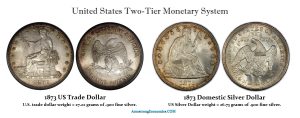
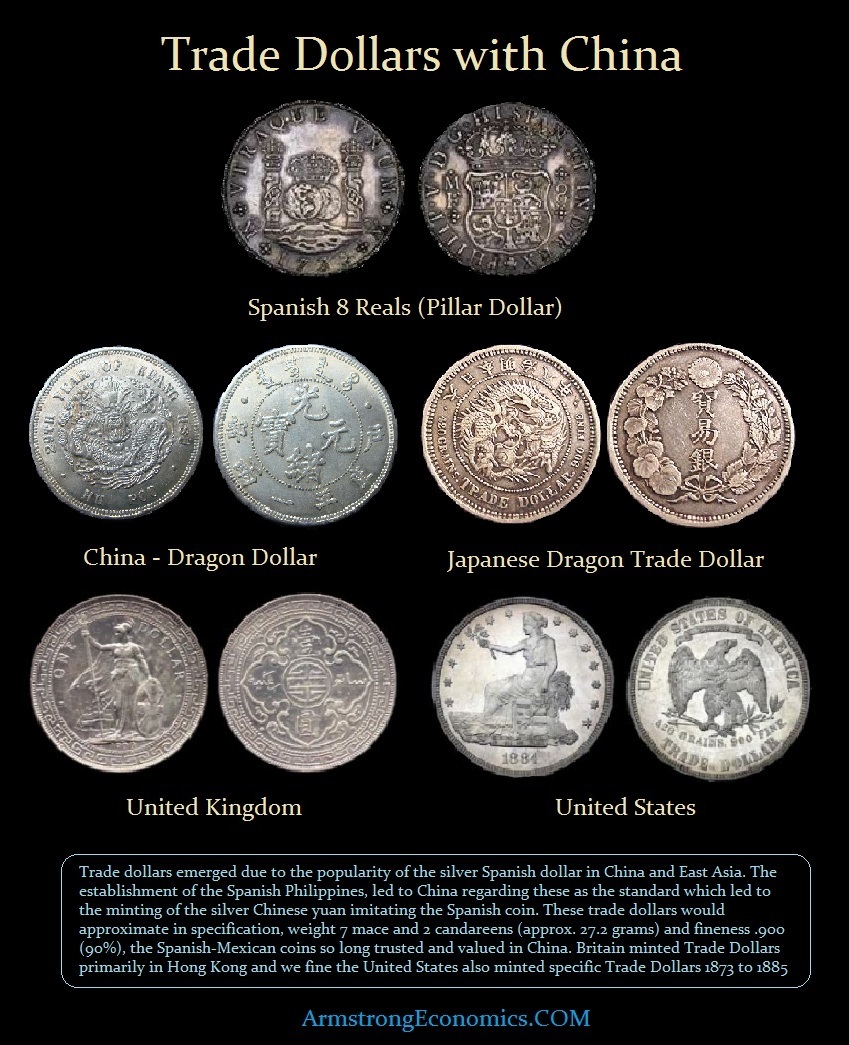
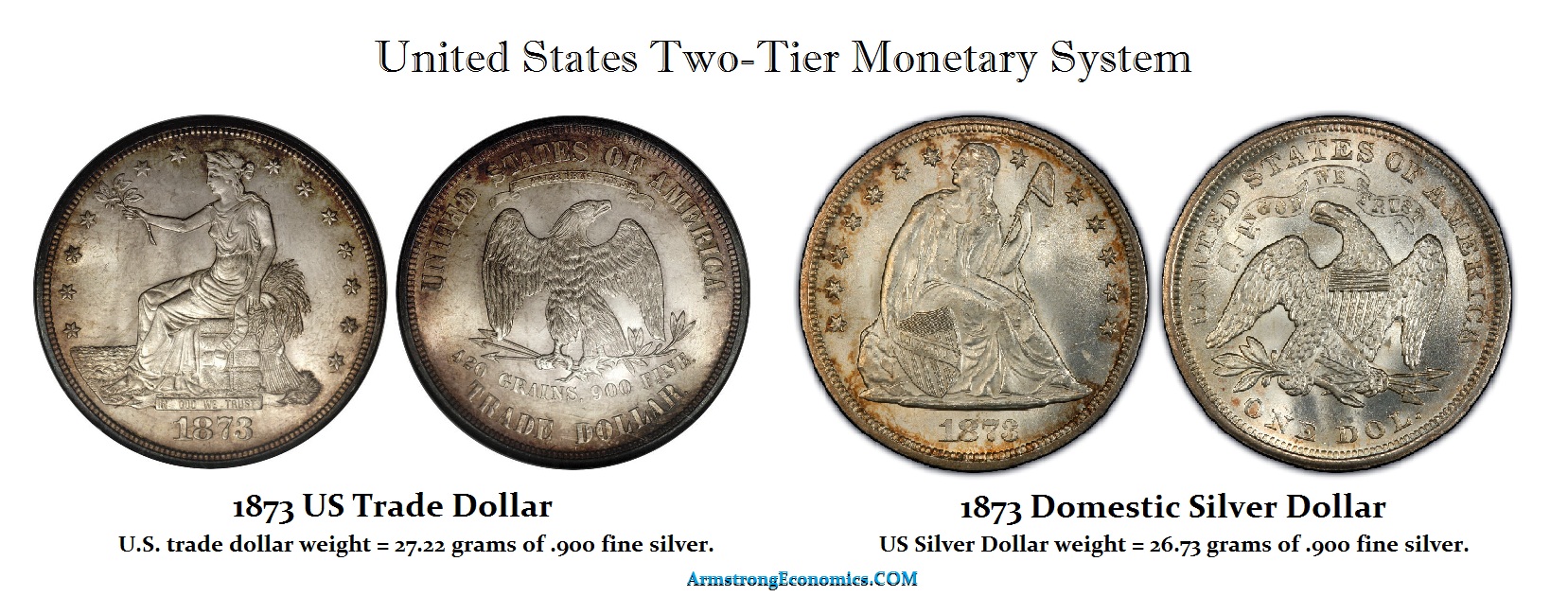
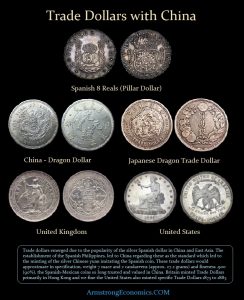
ANSWER: During the 19th century, it was common to issue a “trade dollar” with China who used the silver standard initially by using the Spanish 8 reals known also as pillar dollars. The US issued trade silver dollars and domestic silver dollars of different weight. All of these nations were issuing a two-tier currency to facilitate trade with China.
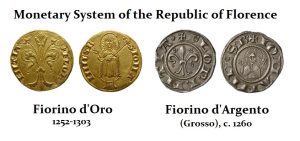
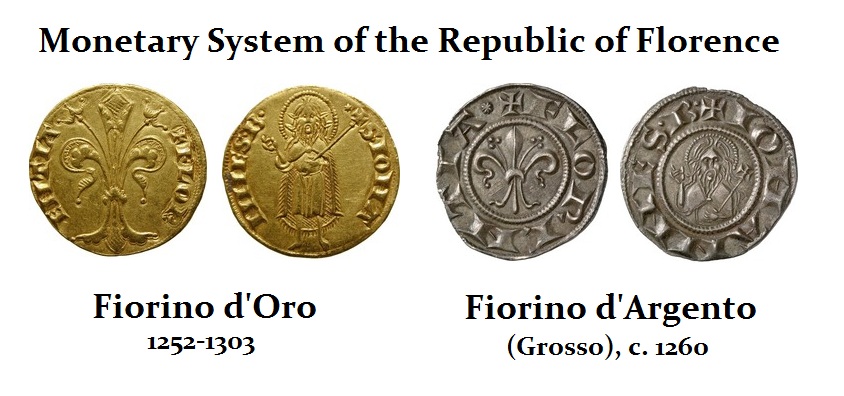
During the 14th century, there was also a two-tier monetary system. Florence used the gold florin for trade, but domestically, wages and commerce took place in silver. Companies were required to keep two sets of books by regulation.

A two-tier system can be used to isolate foreign capital inflows. Switzerland was suffering and that eventually broke the peg. The foreign capital was not looking to buy assets in Switzerland, they were just converting euro to Swiss and parking the money. Therefore, a two-tier system would have allowed the flow of capital to concentrate in what we would call the Financial Swiss Franc (FSF). This peg would have not been necessary and they could have even imposed negative interest rates or zero rates to deposits in the FSF. Any trade for produces could have then been delegated to the Swiss franc and the peg would not have been necessary.

We would not need a system where everyone had a two-tier currency and traded against each other. The new International Unit of Account (IUA) would be a basket of currencies and your local currency would then trade against that. You would need to allow contracts and debts to be contracted in this IUA freely, as takes place today in US dollars. This would by no means eliminate FOREX risk.

Insofar as a global SDR, the problem would be the calculation and then the IMF has been notorious for corruption. Would some nations put pressure to alter the formula because of a financial crisis?

I would say that the formula must be fixed and based on the total percentage of international trade a given nation wields. It should be subject to revision only once every 5 or 10 years at fixed terms.

The primary reason I would design the system in this manner is that the Federal Reserve has already become the central bank of the world. The Fed has lost the ability to manage its own economy because the IMF and others lobby it not to raise rates because that would adversely impact their currencies. There should be an IUA so that a central bank can manage its own economy without impacting others because they will be prohibited from issuing debt (public or private) in a foreign currency — only in an IUA. There would be no sovereign debt issued by the agency controlling the formula. The reserves of central banks would then be only in IUA terms.

Already, capital flows globally when it sees opportunity, and in this manner, it acts as an arbitrage tool. If real estate looks cheap in one country, the capital will flow in. Australia, New Zealand, and particularly Vancouver are fighting this trend. There will be a natural cycle to it and there is no need for changing laws to try to stop it. The Japanese were big buyers during the 1980s, even buying Rockefeller Plaza in New York. As their economy turned down, they resold it and exited.

Introduction to bonds | Stocks and bonds | Finance & Capital Markets | Khan Academy


Published on Sep 28, 2013

What it means to buy a bond. Created by Sal Khan.


BIS – The Central Bank of Central Banks


QUESTION: Could you please tell us more about the bank of the national banks (BIS) located in Swiss?
Many thanks for your information. I love to read your blog first thing in the morning!!!

JS

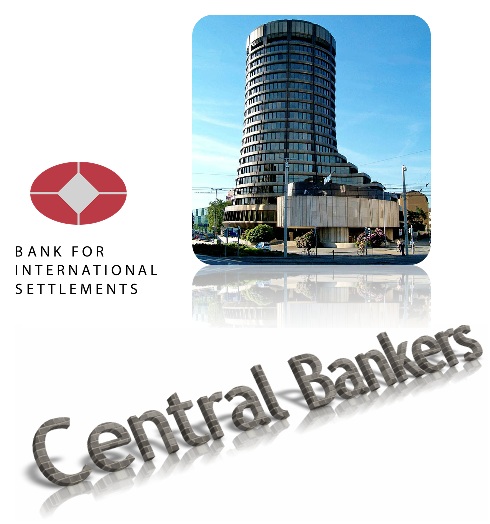
ANSWER: The Bank for International Settlements (BIS) was originally established to handle the reparation payments of Germany. It was also supposed to facilitate cooperation among the central banks. However, it had no real power to compel them to do anything, which was demonstrated by France who refused to agree with the other member concerning the reparation payments of Germany. The BIS was created in 1930 at the Hague Conference. A convention respecting the establishment of the BIS was signed between Belgium, France, Germany, Italy, Japan and the United Kingdom on the one hand, and Switzerland on the other. The BIS is owned by 60 central banks, representing countries from around the world that together account for about 95% of world GDP. It is the central bank for central banks.

The BIS does have a full range of traditional short-term instruments, denominated in reserve currencies. The BIS instruments allow customers to meet cash management objectives. They also provide tradeable instruments that are widely used by reserve managers seeking credit quality, which they will issue in major currencies along the yield curve. The paper is 1 to 5 years in maturity.


William Ackman: Everything You Need to Know About Finance and Investing in Under an Hour


Published on Nov 27, 2012

William Ackman: Everything You Need to Know About Finance and Investing in Under an Hour. WILLIAM ACKMAN, Activist Investor and Hedge-Fund Manager We all want to be financially stable and enjoy a well-funded retirement, and we don’t want to throw out our hard earned money on poor investments. But most of us don’t know the first thing about finance and investing. Acclaimed value investor William Ackman teaches you what it takes to finance and grow a successful business and how to make sound investments that will get you to a cash-comfy retirement. The Floating University Originally released September 2011. Additional Lectures: Michio Kaku: The Universe in a Nutshell http://www.youtube.com/watch?v=0NbBjN…

Introduction to the income statement | Stocks and bonds | Finance & Capital Markets | Khan Academy


Published on Aug 19, 2009

The income statement, revenue, gross profit, operating profit, net income, ROA and ROE. Created by Sal Khan. Watch the next lesson: https://www.khanacademy.org/economics… Missed the previous lesson? Watch here: https://www.khanacademy.org/economics… Finance and capital markets on Khan Academy: Life is full of people who will try to convince you that something is a good or bad idea by spouting technical jargon. Most of them have no idea what they are talking about. Don’t be one of those people or their victims when it comes to stocks. From P/E rations to EV/EBITDA, we’ve got your back! About Khan Academy: Khan Academy offers practice exercises, instructional videos, and a personalized learning dashboard that empower learners to study at their own pace in and outside of the classroom. We tackle math, science, computer programming, history, art history, economics, and more. Our math missions guide learners from kindergarten to calculus using state-of-the-art, adaptive technology that identifies strengths and learning gaps. We’ve also partnered with institutions like NASA, The Museum of Modern Art, The California Academy of Sciences, and MIT to offer specialized content. For free. For everyone. Forever. #YouCanLearnAnything

More on balance sheets and equity | Housing | Finance & Capital Markets | Khan Academy


Published on Mar 15, 2008

What happens to equity when the value of the assets increase or decrease? Created bySal Khan. Watch the next lesson: https://www.khanacademy.org/economics… Missed the previous lesson? Watch here: https://www.khanacademy.org/economics… Finance and capital markets on Khan Academy: This old and badly drawn tutorial covers a topic essential to anyone planning to not live in the woods — your personal balance sheet. Since homes are usually the biggest part of these personal balance sheets, we cover that too. About Khan Academy: Khan Academy offers practice exercises, instructional videos, and a personalized learning dashboard that empower learners to study at their own pace in and outside of the classroom. We tackle math, science, computer programming, history, art history, economics, and more. Our math missions guide learners from kindergarten to calculus using state-of-the-art, adaptive technology that identifies strengths and learning gaps. We’ve also partnered with institutions like NASA, The Museum of Modern Art, The California Academy of Sciences, and MIT to offer specialized content. For free. For everyone. Forever. #YouCanLearnAnything

When Will Interest Rates Rise?


QUESTION: In the recent past you have spoken about rising interest rates in the USA being imminent. Just wondering where we stand on that front as rates have been in a downtrend since peaking last fall?

Thanks,

Pete

ANSWER: The rise in interest rates comes with the turn in the ECM in January. However, what you have to understand is there will be a divergence between private and public rates. The central banks really cannot raise rates without creating a budget crisis. The more likely outcome is that governments are losing their ability to borrow in the real market. The public rates are more likely to become simply pegs that render them useless in all practical terms. We have already witnessed this in Europe. The central bank created negative interest rates. All they have done is to kill the viable domestic bond markets.

Millennials Saddled with Student Loans that Prevents them from Becoming Homeowners


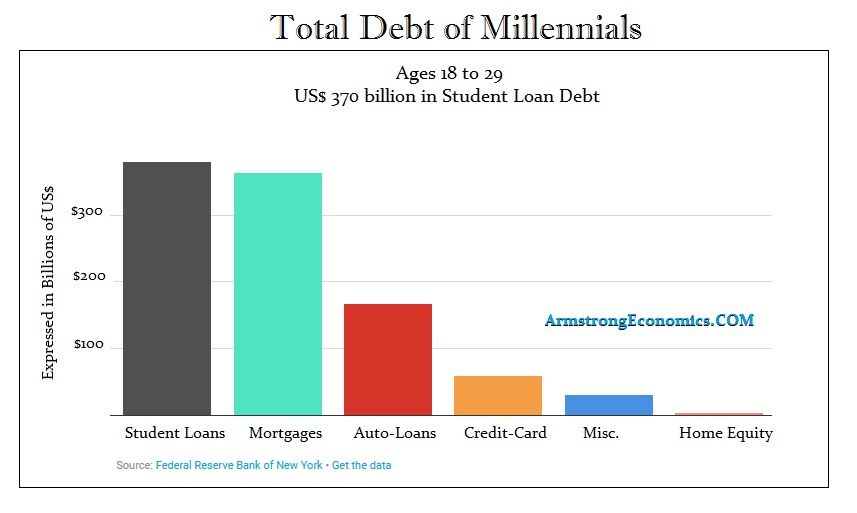
New findings are out from the New York Federal Reserve that reveal a troubling outlook for millennials who have now reached over US$1 trillion of debt, but the worst of it is student loans. This is a sharp rise of 22% over the past five years and is worse than any other generation in history. This debt crisis among millennials casts a dark cloud over the real estate market. With such high debt levels, this is a serious restraint upon obtaining home mortgages.

Ironically, millennials are much more conservative than the debt balances may indicate, but this could also be because of the student debt. In fact, in comparison to previous generations, this group is significantly more fiscally conservative with credit cards. Many into their 30’s are still living at home. With high student debt, many cannot afford a home, but another level cannot even afford an apartment. There is a new trend emerging whereby old motels are becoming housing. They lack the credit to rent an apartment with a security deposit. The new alternative is to rent per day in these old motels with rates of $50 to $80 per day.

This is not painting a very nice picture of the American Dream. To get the donations from the bankers, the Clintons served them up on a platter by making student loans non-dischargeable in bankruptcy. The Clintons signed into law economic fraud and slavery. These kids are paying for degrees and then cannot find a job in what degree they have studied.

Universities are notorious for handing out degrees for fields with no prospects of employment. So many went for degrees in Marine Biology wanting to help dolphins. The prospect of a job was never high on the list of probabilities. There are studies that show colleges are not providing jobs. They have turned higher education into just a business and buyer beware. In fact, the research has found that those jobs requiring a bachelor’s degree list more soft skills than technical skills among the set of requirements. On top of that, there is a trend of rising suicides due to student loans.

Student loan debt is now the second highest consumer debt category — second only to mortgages as a whole and higher than credit card debt. There are more than 44 million borrowers who collectively owe $1.5 trillion in student loan debt and growing. Even Zillow’s research, the big realtor, has reported that student debt has impacted the real estate market in many ways by reducing future buyers. The real shocking number is that 40% of millennials are still dependent on mom and dad. The excuses seem endless. Student loan debt can make buying a home IMPOSSIBLE! This is part of the reason real estate has been in a bear market since 2007 when we look at the average home.