Homelessness in the US at All-Time High


Armstrong Economics Blog/Real Estate Re-Posted Aug 10, 2023 by Martin Armstrong
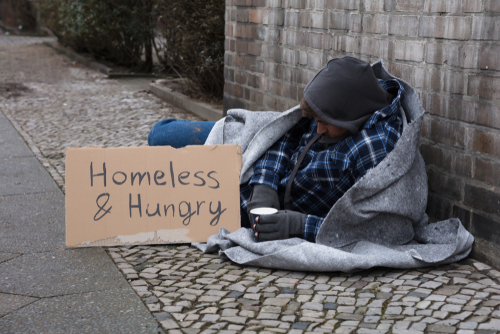
The housing crisis has become a massive issue in America. People with decent jobs are unable to afford housing, and those who were already down and out have little chance of survival. Then we poured the migrant crisis on top of the fire and have created a situation that is turning America into a second-world nation. Not so coincidentally, most of the homeless population lives in blue cities. The US spent over $51 billion on the homeless crisis last year, but where has the money gone?

Homelessness in the US has spiked by 65% since 2016! The Annual Homelessness Assessment Report said it is common for half a million people to be experiencing homelessness on any given night. The data is not in for 2023 when the migrant crisis really took hold after title 42 came to an end, so these figures I will present are nothing compared to our current reality in 2023. For every 10,000 Americans, 18 do not have a home. Around 72% are single adults, but an alarming 28% are families living with children. Five percent of the homeless population are unaccompanied youth under 25. Our veterans compose 6% of the homeless population as well.

Native Hawaiian or Pacific Islanders have the highest rate of homelessness with 121 out of every 10,000 people living in crisis. The Black community has a disproportionate amount of homeless too with 48.2 of every 10,000 experiencing homelessness. Native Americans come in at a close third with 44.9 out of every 10,000 having no place to call home. Sixty-eight percent of all homeless individuals are male.

The US Federal government spent over $51 billion to combat the homeless crisis in 2022, but then our government took measures to worsen the matter, and economic conditions have made it nearly impossible for those with nothing to find shelter. The National Alliance to End Homelessness estimates that a chronically homeless person will cost the taxpayers an average of $35,578 per year. Yet, where is this money going? When the migrants came through, we managed to find housing and convert buildings into temporary shelters until cities became overrun and it was impossible to manage — the federal bill for homelessness in FY22-23 will be astonishing.

As of March 2022, these cities saw the largest populations of unhoused individuals:

  • Los Angeles City & County 65,111
  • New York City 61,840
  • Seattle/King County 13,368
  • San Jose/Santa Clara City & County 10,028
  • Oakland, Berkeley/Alameda County 9,747
  • Sacramento City & County 9,278
  • Phoenix, Mesa/Maricopa County 9,026
  • San Diego City and County 8,427
  • San Francisco 7,754
  • Metropolitan Denver 6,884

We can see a pattern here, given that these are blue cities. Politicians touted many of these areas as “sanctuary cities” and encouraged tens of thousands of people to use the last of their resources to relocate there. And now, these people have nowhere to stay and no resources to leave. Promising sanctuary should have been a crime in itself. Criminalizing homelessness will not solve the solution and will only further burden the taxpayers. Anyone living in a major American city will tell you first-hand that the number of unhoused people has exploded in the past year. This is a SERIOUS and growing problem that is not being addressed. The government is continually throwing more money at the problem, but it is only worsening.

Freedom Flyers


Armstrong economics Blog/Real Estate Re-Posted Jul 20, 2023 by Martin Armstrong

Have you ever noticed a decorative eagle plaque above a home in America? This was once a popular symbol back in the day to symbolize freedom from mortgage payments. Homeowners would adorn their houses with this symbol to indicate that they were free from the bank and owned their home free and clear. Around 40% of owner-occupied homes have been paid off, further adding to the housing inventory crisis.

The 2022 Federal Housing Finance Agency reported in 2022 that 84% of outstanding mortgages locked in a rate below 5%, while 63% secured a rate at or below 4%. Mortgage rates surpassed 8% last week and those who own are unlikely to sell. While some point to double-digit mortgage rates in the past, it was not difficult for buyers to put down 40% upfront since housing prices were low in comparison to wages. This was also a time when the cost of living supported a traditional lifestyle where only one partner was required to work.

Although COVID and low rates created strong demand, the underlying issue is the Great Reset. Institutions are set to own 40% of all single-family rentals by 2030, precisely on time for Agenda 2030. Regular buyers have been outbid by institutions coming in with cash payments. BlackRock is now the largest landowner in America. This is all by design. They do not want people to afford a home because then there would be no need for 15-minute cities, and forever renters living in ADUs. The inventory issue will not recover because no one can outbid the institutions who do not need to borrow money.

US Housing Prices Push Higher


Armstrong Economics Blog/Real Estate Re-Posted Jul 7, 2023 by Martin Armstrong

Fannie Mae admitted their forecast of declining home prices was incorrect. They initially projected that housing would fall by 1.2% in 2023, followed by 2.2% in 2024. Housing prices remain strong because this in an inventory crisis. There are 47% less available single-family houses on the market compared to the start of the COVID crisis. Homebuilders cannot keep up with demand, and the demand for investment-bought rentals is outpacing single-family sales.

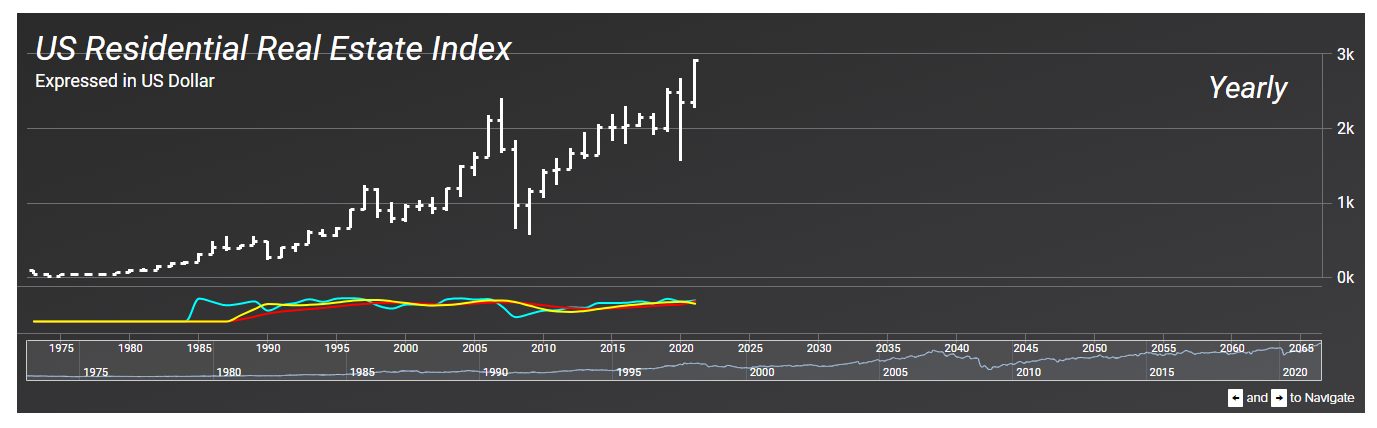
Our Residential Index elected a Yearly Bullish Reversal at the end of 2012. That confirmed the long-term trend had changed. However, urban condos and commercial properties were forming a divergence. I assumed that was being caused by the debt and rising taxes in cities. In that regard, I suppose I was only partially correct, for the rest had been the braindead response to COVID and failed QE policies. The failure of QE caused a collapse in confidence in the future. When people fear the future, they save. Increasing the money supply does nothing until the people decide to spend it.

Socrates also selected the precise target for the January 2021 directional change in US real estate. Our index began declining in January 2022, anticipating the first rate hike on March 17, 2022, by a quarter point. The claim that interest rate hikes imply that real estate will decline is very old school, and once more, it presumes everyone is buying on leverage. In 2021, cash sales represented 25% of existing home sales in the key markets, which were a level unmatched since 2016. Nationally, buyers paid cash for almost 15% of the homes in 2021 in markets that were booming from migration from other states.

Real estate is undergoing three separate trends. First, there has been mass evacuation from cities and high-taxed states thanks also to draconian COVID laws. Secondly, we have the flight of capital to flee banks, etc, which is part of just getting capital off the grid. Then thirdly, there has been a flight of international capital fleeing to the United States because of geopolitical instability in Europe.

This market has been LESS impacted by interest rate hikes than any previous booming market, all because of the migration from interstate within the US and the flood of European buyers looking for assets outside of Europe as the prospect of a global war increases. I have warned that real estate will decline in those states where people are fleeing. It has boomed in places they have been migrating to, such as Texas and Florida. Obviously, you can no longer make a blanket forecast in real estate.