Making Stuff Smaller: A look at high-powered nano-circuits and micro-robots


Published on Aug 22, 2013

SUBSCRIBE 2.4K
Making Stuff Smaller: A look at high-powered nano-circuits and micro-robots

CAN NANOBOTS ACTUALLY EXIST?


Published on Mar 7, 2019

SUBSCRIBE 13K

Preferred v Ordinary Shares


QUESTION: Hi Martin,

What are your thoughts on preferred shares? Especially the ones with good quality DBRS ratings. Will they survive the downturn or will they fail?
Thx
FS

ANSWER: Ordinary and preference shares are a claim on corporate earnings and assets. Dividends for ordinary shares may be irregular and indefinite, whereas preference shareholders will receive a fixed dividend which will accrue usually if the payments are not made in one term. Ordinary shareholders are in a riskier position than preference shareholders since they are the last to receive their share in the event of liquidation. That may not be a concern in a blue chip company. Nevertheless, they also are open to the possibility of a higher dividend during times when the firm is doing well in contrast to preferred shared with fixed income.

Preferred shares can be looked upon as a hybrid debt where you have a claim on the assets, but like a loan, it has a fixed rate. Ownership of preference shares offers advantages and disadvantages. On one hand, it provides a higher claim on earnings, assets, and fixed dividends. On the other, it limits voting rights and the possibility for growth in dividends in times when the company is financially sound.

The good companies will generally survive. This is a collapse in government – not the private sector

Fear of Inflation & Sterilization


QUESTION: Mr. Armstrong; you were friends with Milton Friedman. Do you agree with his view that the Great Depression was caused in part by the Fed refusing to expand the money supply? Isn’t Quantitative Easing expanding the money supply yet it too has failed to create inflation. Would you comment on this paradox?

Thank you for your thoughtful insight.

P

ANSWER: Yes, this certainly appears to be a paradox. This results from the outdated theory of economics which completely fails to grasp the full scope of the economy and how it functions. This same mistake is leading many down the path of MMT (Modern Monetary Theory) which assumes we can just print without end and Quantitative Easing proves there will be no inflation. They are ignoring the clash between fiscal policy carried out by the government and monetary policy in the hand of the central banks. This is a major confrontation where central banks have expanded the money supply to “stimulate” inflation. Governments are obsessed with enforcing laws against tax evasion and it is destroying the world economy and creating massive deflation.

In 1920, Britain legislated a return to the gold standard at the prewar parity to take effect at the end of a five-year period. That took place in 1925. Britain based its decision in part on the assumption that gold flows to the United States would raise price levels in Britain and limit the domestic deflation needed to reestablish the pre-war parity. In fact, the United States sterilized gold inflows to prevent a rise in domestic prices. In the 1920s, the Federal Reserve held almost twice the amount of gold required to back its note issue. Britain then had to deflate to return to gold at the pre-war parity. Milton saw that the Fed failed to monetize the gold inflows, fearing it would lead to inflation. So what we had back then was the opposite roles. This predates income tax being applied to everyone so there was no hunt for taxes on the part of the government. The scale was tipped because the Fed was imposing deflation by sterilizing the gold inflows.

Conversely, following World War I, France had counted unrealistically on German reparations to balance its budget. When they did not materialize, it used inflation as a tax to finance expenditures. In 1926, France pulled back from the brink of hyperinflation. Unlike Britain, France’s inflation had put the old parity hopelessly out of reach. Consequently, France returned to gold but at a parity which undervalued the franc. Fearing inflation, France sterilized its gold inflows to prevent a rise in prices declining to monetize the gold.

Therefore, all the theories behind MMT are once again wrong for they are only looking at one side of the equation. Today, simply stashing money in a safe deposit box is illegal and considered to be money laundering. The government can justify itself in confiscating your assets even after you paid your taxes.

Therefore, in the ’30s, Milton’s criticism of the Fed was justified because there was no massive hunt for taxes from the fiscal side. Today, we have the fiscal policies hunting capital resulting in a contraction economically (declining in investment) while you have QE just funding the government – not the private sector. It is a different set of circumstances today v 1930s.


Interplanetary Nuclear Fusion Rockets, A Mini-Documentary


Published on Jun 3, 2018

SUBSCRIBE 28K
Interplanetary Nuclear Fusion Rockets, A Mini-Documentary | AsteronX In the 40’s it was thought that humankind would move out into and conquer space, commercializing it—eventually leading to routine flights around the solar system and even beyond. The science fiction of the day portrayed such a grand and awe-inspiring future, from Buck Rodgers, to Isaac Asimov’s Galactic Empire and Foundation novels, to the German science-fiction series Perry Rhodan—stories that the creators of Star Trek and Star Wars grew up with and were inspired by. As the Star Trek and Star Wars, that we all know and love, were inspired by these stories of atomic-rocketships, if we want a future anything like these loved works of fiction—excluding the faster-than-light drives for moment—we will need atomic propulsion. Part I. The First Fusion Rocket: The Orion Part II. Robert Zubrin’s Nuclear Saltwater Rocket Part III. An Orion Improvement: Mini-Mag Orion Part IV. A Pure-Fusion Design: Project Daedalus Part V. PennState’s ICAN-II: Antimatter-Catalysed Microfission/fusion Part VI. Aneutronic Fusion: Proton-Boron Fusion Part VII. Fusion Around the Corner: Ultra-Dense Deuterium Part VIII. Return to Antimatter-Catalysed Fusion As a final note, let’s supose that a new fusion engine was developed that is capable of taking off from the ground without spraying out deadly neutron radiation. If SpaceX’s BFR were re-designed to utilize such engines, perhaps a manned Mars mission could be achieved sooner… We want to thank & give credit to the following: Our Patrons SpaceX for the use of their image Winchell Chung of Atomic Rockets (projectrho.com) for the use of his information & images Wikipedia for the use of their articles & images NASA for the use of their images & videos Audiojungle.net for the use of their music: Song – Epic Hero Song – Epic Hero version 2 Song – The Grand Fairytale Adventure Song – Michael Jorns Epic Theme 3 Aleksander Ryszka via Sounds4media.com for the use of his music: Song – Introduction-full length track Kevin MacLeod of Incompetech for the use of his music: Song – Peaceful Desolation Song – Send for the Horses


SpaceX vs. NASA: Who Will Get to Mars First? | Elon Musk | America Uncovered


Published on Apr 1, 2019

SUBSCRIBE 102K
The Space Race is on! And it’s not just between the US and Russia. Could private tech companies like Elon Musk’s SpaceX be the future of space travel? Can SpaceX rockets, like the SpaceX Dragon or Falcon make a moon landing? Or a Mars landing? Buy the MOVA flat earth “globe” before they’re confiscated by NASA: Link: http://bit.ly/amuFlatEarthMOVAGlobe (April Fool’s!) But seriously, buy the real MOVA globe here: http://bit.ly/MOVAGlobesUncovered Support America Uncovered on https://www.patreon.com/americauncovered and visit us on Facebook! https://www.facebook.com/America-Unco… or Twitter! https://twitter.com/USUncovered #nasa #spacex #elonmusk us news moon landing china space


SpaceX Starhopper Test-Fires Have Begun


Published on Apr 6, 2019

SUBSCRIBE 658K
SpaceX began test-firing their Starship prototype ‘Starhopper’ in April 2019. It is tethered to the ground for these initial hops. — SpaceX’s ‘Starhopper’ Starship Prototype Aced Its 1st Hop, Elon Musk Sayshttps://www.space.com/spacex-starhopp… Credit: Space.com / footage courtesy: SpaceX & SPadre.com / produced and edited by Steve Spaleta

Is Mathematics more powerful than articulated speech? Jordan Peterson Q & A


Published on Oct 8, 2018

SUBSCRIBE 42K
Do you want to support his channel? Please go to his website located in the link below: https://jordanbpeterson.com/donate/

Basel III – IMF – Liquidity Crisis


QUESTION: As of today, Basel III comes in effect. Rumour goes that in a couple of months, there will be a lot of turmoil on the market and it would be the start of the implementation of an SDR like thing where people would lose 20-30% of their value and get stuck with this new currency. You have mentioned before this was in the pipeline but no timing was given. Is it really this close or is it for 2020-2022?

PT’S

ANSWER: The IMF has been pitching Washington to let their SDR become the new reserve currency. They claim this would eliminate the problem of the Fed having to worry about external influence v domestic. Let me say that this will NEVER eliminate the issues of international capital flows. The fixed exchange rate of Bretton Woods never prevented that problem and it was that very issue that brought it crashing down. Until we are ready to begin teaching the meaning of a floating exchange rate system and abandon Keynesian economics, I do not see this problem ever being eliminated.

Basel III is separate from the IMF and its purpose is capitalization of banks — not the reserve currency of a dollar v SDR. Basel III was agreed upon by the members of the Basel Committee on Banking Supervision in November 2010, and was scheduled to be introduced from 2013 until 2015. However, implementation was extended repeatedly to March 31, 2019, and then again until January 1, 2022. The Committee replaced the existing Basel II floor with a floor based on the revised Basel III standardized approaches. This revised output floor is to be phased in between January 1, 2022, and year-end 2026, thereby becoming fully effective on January 1, 2027, if the banking system can survive that long to begin with.

The Basel III leverage ratio framework and disclosure requirements (“the Basel III leverage ratio framework”) was supposed to be raised to protect banks from failures. Many were required to raise more capital. The Net Stable Funding Ratio (“Basel III NSFR standards”) was to be applied to participating banks. Moreover, the committee is monitoring the overall impact of Total Loss Absorbing Capacity (TLAC) and banks’ holdings of TLAC instruments. Capital requirements for market risk as well as the committee’s finalization of post-crisis reforms were all supposed to be back-tested. Additionally, profit and loss (P&L) accounts related to the revised internal models-based approach (IMA) for calculating minimum capital requirements for market risk more specifically.

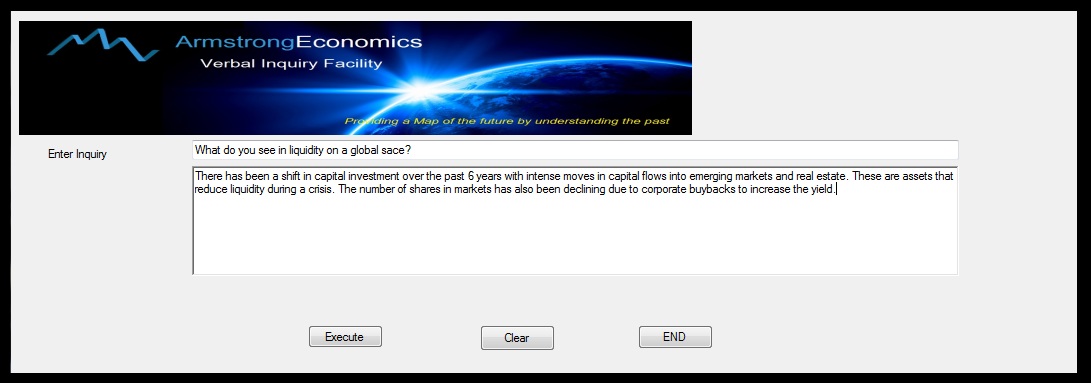
All of that said, the crisis we have is a LIQUIDITY Crisis. This time it has been created especially by the European Central Bank (ECB). By keeping interest rates negative and punishing banks for having cash, they have (1) lent into real estate to get higher yields but this type of asset cannot be sold easily, (2) buying emerging market debt to get a high-yield like Turkey. Turkey was the favorite of Spanish Banks and the capital controls that Turkey did before the election sent shivers down the spine of institutional investors. The ECB has driven banks into these markets that are notoriously illiquid. This means that under Basel III, banks will not have the liquid assets to support their capitalization requirements. It becomes more likely that the Basel III requirements will be suspended or else there will be a wholesale collapse of the banking system.

Liquidity Crisis


QUESTION: I have attended the last 2 conferences and you have said the “liquidity” in the stock market will become tighter coming into 2020 and that there will be less stocks available to buy. Does that have something to do with this inflow of capital from Europe as people become more aware? I read your article about the Emerging Market crisis with great interest and remembered what you said. Is there more information you can share with us on this topic?

CDH

ANSWER: Since Quantitative Easing has failed, capital was driven into non-traditional investments to simply try to earn income. There were institutions buying farmland just to lease it out to get 5% annual income. Others ran off into Emerging Markets. Spanish banks are heavily invested in Turkey. The problem is that this trend has caused a liquidity crisis insofar as capital has been invested in assets that are not liquid. Add to this corporate buybacks that are reducing the supply of stocks available.

All I can say is thank God for Socrates. There are so many global trends emerging that by themselves are confusing and would be impossible for a standard domestic analysts to forecast from a personal interpretation perspective. The combination of investment shifts into real estate, Emerging Markets, and corporate buybacks have created an interesting risk factor for liquidity during a financial panic.