Real Average Hourly Wages Continue to Decline as Inflation Destroys Economy and Now Hours Worked is Contracting


Posted originally on the conservative tree house on October 13, 2022 | Sundance

The Bureau of Labor and Statistics (BLS) released the September wage report [DATA HERE] delivering worse economic news for workers.

Real wages are dropping at a historic rate as inflation continues to rise and as a result wages buy less.

[BLS] “Real average hourly earnings decreased 3.0 percent, seasonally adjusted, from September 2021 to September 2022. The change in real average hourly earnings combined with a decrease of 0.9 percent in the average workweek resulted in a 3.8-percent decrease in real average weekly earnings over this period.” (link)

REAL WAGE CHART:
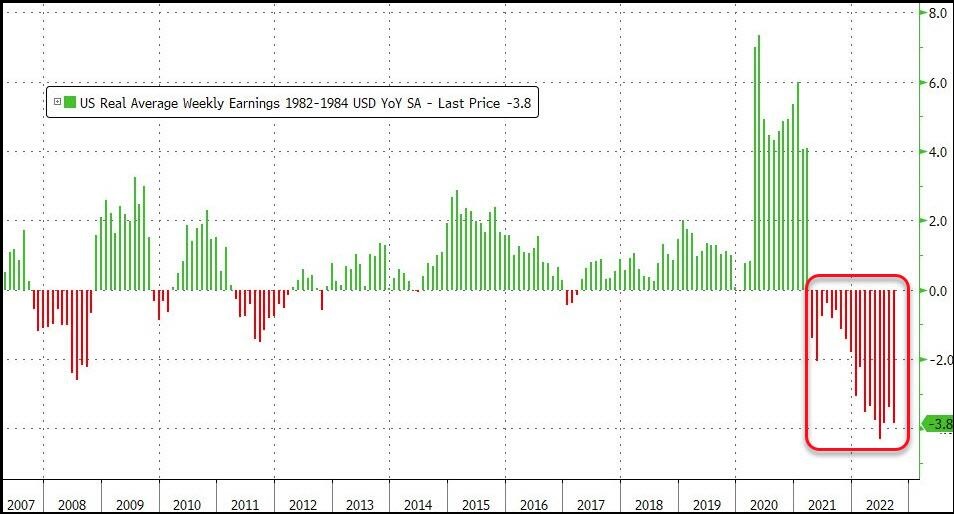
As the Biden economic/energy policy and Federal Reserve monetary policy merge together, the economy shrinks.  As the economy shrinks, fewer goods and services are purchased.  As less consumer goods are purchased, employment hours drop.  As employment hours drop, wages decline.

Declining wages combined with increased inflation forms the perfect storm against middle-class and working-class families.  This dynamic means lowered income and higher prices for essential goods and services like food, fuel, energy and housing.  It’s not difficult to see why this is happening.

The declining wage rates, and the more substantive drop in real wage rates due to massive inflation, are specifically hitting the lower tier of the working class harder.  Yet despite this, Biden is intent on importing even more economic migrants to put even more downward pressure on wages for the working class.

These are very real outcomes of policy.  Working class Blacks and Latinos will feel this even more, yet this is the special interest group that Democrats claim to support.  The reality is exactly opposite from the narrative sold by the Biden administration.

The Democrats know this. These outcomes are not accidental; they are a feature not a flaw in their policy.  This is why they need to keep spending to retain the ruse.

There’s no way around this.  Despite the pundit and financial class selling a counter-narrative, home prices will crash, and unemployment will go up.  I know this is directly against the current talking points, but the statistical reality is clear.

CTH was the first place who said a year ago that home sales will plummet, that is starting to happen right now.  There’s no way for it not to happen, the big picture tells us why.
Leading Edge of Field to Fork Inflation Starts to Arrive in September Producer Price Index


Posted originally on the conservative tree house on October 12, 2022 | Sundance 

The “Producer Price Index” (PPI) is essentially the tracking of wholesale prices at three stages: Origination (commodity), Intermediate (processing), and then Final (to wholesale). Today, the Bureau of Labor and Statistics (BLS) released September price data [Available Here] showing another 8.5% increase year-over-year in Final Demand products at the wholesale level.  However, that’s not the bad news in this data.

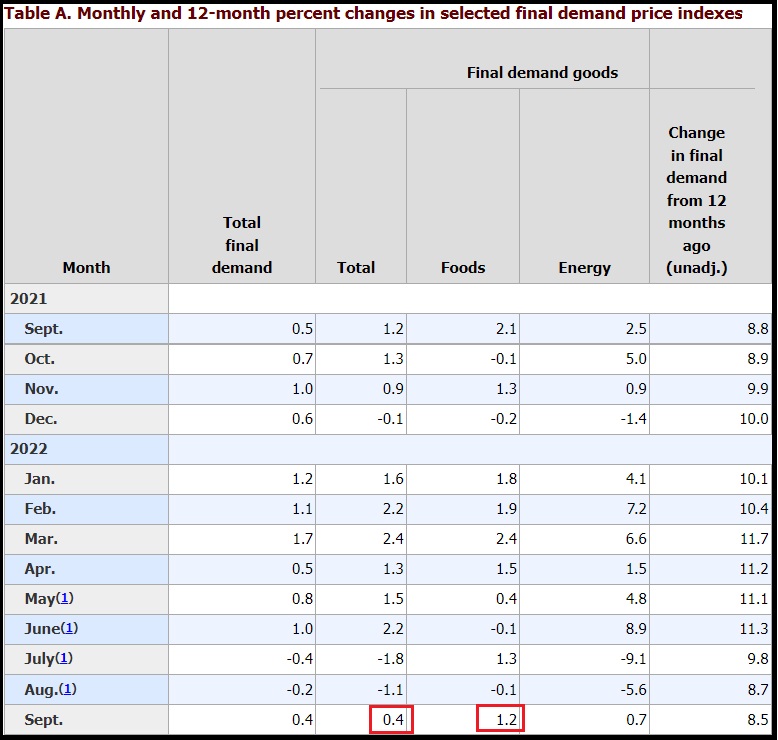
While the overall September PPI was higher than expected at 0.4%, the Final Demand Producer Price for food products in September was a whopping 1.2% (14.4% annualized).

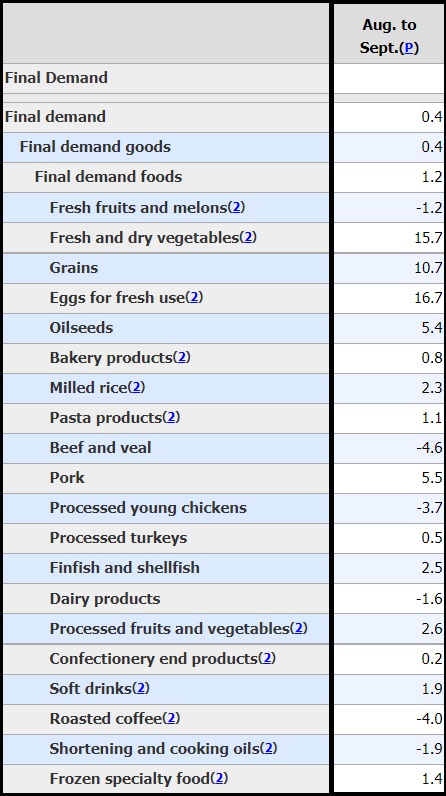
The BLS notes the driver by saying, “a major factor in the September increase in prices for final demand goods was a 15.7-percent advance in the index for fresh and dry vegetables. Prices for diesel fuel, residential natural gas, chicken eggs, home heating oil, and pork also moved higher.”

That’s a 15.7% increase in price, in one month, for fresh and dry vegetables.  Annualized that’s a rate of price increase of 188.4% for vegetables.   Remember the warning about farm costs (energy, fertilizer, fuel) driving field to fork inflation at harvest?  This is the leading edge of that third wave of food price increases.

I have modified BLS Table-2 to focus specifically on food costs.  The data is on left.

You will note that ‘row crops’ are the big drivers along with grain and seed products.  This is exactly as we predicted it would be because those specific farming costs are the ones with greatest increase from energy, fuel, fertilizer, weed and insect control, and diesel costs.

All of those higher costs have been growing in the fields and will now surface at harvest.   The higher farm costs transfer from the field to the fork via the food supply chain.  This is only the leading edge of the price increase.

In October 2021 we first warned of the food price increases coming in distinct waves.  The first was Jan, Feb and March 2022.   The second wave was May through July 2022.  This third wave will be bigger than the first two and starts arriving this month, October 2022.

People laughed at me when I said in late 2022 eggs were going to reach .50¢ EACH ($6/doz).

Well, in September the price of fresh eggs jumped 16.7% in a single month.  That’s an annualized rate of price increase for eggs over 200%.

With hindsight you can clearly see the three waves of food price increases (BLS Table A):

Get ready and shop smart.

The October, November and December price increases in the grocery store are going to make the prior fresh food increases look small, as the full increased costs of farming operations starts to arrive at the supermarket.   Unfortunately, this will coincide with a wave of gasoline price increases, and the prices of natural gas are already skyrocketing.

.

Holiday Expenses Rise in Canada


Armstrong Economics Blog/Canada Re-Posted Oct 10, 2022 by Martin Armstrong

Wishing our friends in the north a happy Thanksgiving.

Canada’s Thanksgiving is not as widely celebrated as America’s November feast. However, outside Quebec, around 90% of Canadians plan to celebrate the holiday. Everything from fuel to food is more expensive this year. Statistics Canada reported a 10.8% rise in food prices this August, marking the fastest pace of food inflation since 1981.

The Agri-food Analytics Lab (AAL) and Angus Reid conducted a survey (sample size 1,244) to see how Canadians plan to celebrate the holiday this year. Turkey prices have risen 16% per kilogram this year. In British Columbia, 29% of respondents said that they would be making changes to the meals they typically prepare due to food prices, while 25% in Alberta and 20% in Manitoba said the same. Around 19% of those celebrating in Ontario will be changing the menu due to costs, followed by 17% in the Atlantic, 10% in Quebec, and 8% in Saskatchewan.

In addition to turkey prices increasing, potatoes have spiked by 22% this year. Bread and dairy prices have gone up 13%, while cranberries have increased by 12%. Prices vary based on location, but they’re up in every province. So many are grateful for the harvest, albeit less bountiful.

Categories: Canada

Dallas Fed: Over Half of Americans Experienced Real Wage Declines This Year


Armstrong Economics Blog/Inflation Re-Posted Oct 10, 2022 by Martin Armstrong

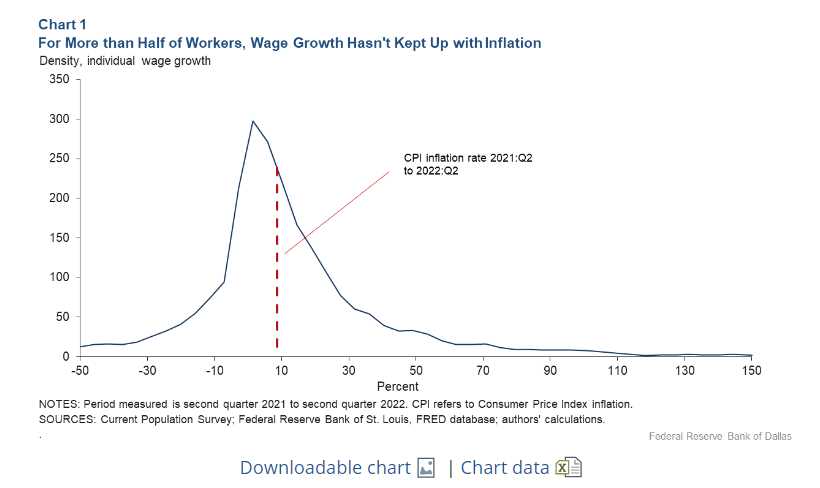
The Dallas Federal Reserve found that the decline in real wages is at a severity not seen in 25 years. Simply put, when adjusted for inflation, American’s paychecks are down despite wages going up. The median decline in real wages surpassed 8.5% this September.

"How severe are the losses for workers experiencing negative real wage growth? For the 53.4 percent of such workers in second quarter 2022, the median decline (that is, half of the declines were larger and half smaller) in real wage growth was 8.6 percent."

After examining real wages over the course of 12 months, the Dallas Fed found that 53.4% of all workers experienced real wage declines. Additional taxes under Biden have added to real wage decline as well. Peter C. Earle of the American Institute for Economic Research estimates that someone earning $70,000 annually now has $4,500 less in buying power in New York. “The bill for the Covid mitigation policies is due,” Earle said. “Record levels of fiscal and monetary policy expansion in the first half of 2020 are wrecking the purchasing power of the dollar. Thus even without a pay cut, wage earners are effectively earning less over time.”

The average median decline over the past 25 years has been 6.5% with real wage declines reaching between 5.7% to 6.8%. Inflation is simply too severe to compensate for any additional wages. The Fed continued to say:

"Despite the stronger wage growth due to the tightness of the labor market, a majority of workers are finding their wages falling even further behind inflation. For workers who experienced a decline in their real wage in second quarter 2022, the median decline was 8.6 percent.

While the past 25 years have witnessed episodes that show either a greater incidence or larger magnitude of real wage declines, the current time period is unparalleled in terms of the challenge employed workers face."