Posted originally on May 4, 2025 by Martin Armstrong
COMMENT: Marty, I just had to write to express my gratitude. What I have learned just from the November WEC, my first attendance, has been more than my MBA. Erwin’s training session, your blog posts, and Socrates even got the change in unemployment this month that nobody picked up. It is like I was blind, but now I can see all the interconnections and the fallacy of random walk theory. I know you do not want a Nobel Prize. Yet, who will change the world? One day, they will open their eyes to cyclical trends. I have to say, once I looked, I now cannot see the world any other way.
I hope the movies they are making about your career become the spark to change society.
Thank you so much. I truly mean that.
LM
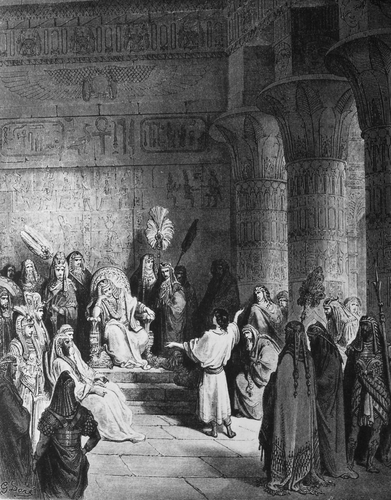
REPLY: Yes, once you see that there is a cycle, economics will change from trying to manipulate society to perhaps following the Biblical Story of Joseph, warning the Pharaoh that there will be 7 years of plenty, so save, and then 7 years of drought. Live with the cycle, understand it, and survive. We stop the insanity of Keynesian Economics, Climate Change that denies there is a cycle, and even war, which never comes when everyone is fat and happy.
Nothing exists without a cycle. Even our brain has a cycle to it. When there is no more brain waves, we are dead.
Posted originally on Apr 24, 2025 by Martin Armstrong
QUESTION: A recent analysis by Allianz economists claimed that, ordinarily, when yields on Treasuries rise, the U.S. dollar strengthens as foreign capital pursues those higher yields. However, the dollar weakened as yields rose. They said that in this instance, it “suggests major holders were not only selling Treasuries but also converting the proceeds into currencies – possibly reallocating to European markets.”
This does not seem to be correct. It looks like an opinion. Could you comment on this, please?
Thank You
Greg
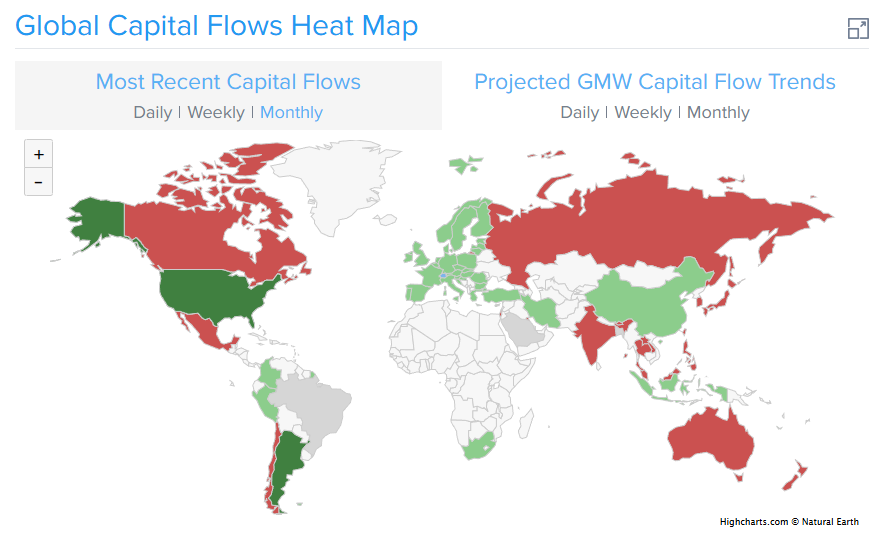
ANSWER: I think a lot of people fail to appreciate the stark difference between the US markets and Europe. The NYSE is worth MORE in total capitalization than all of Europe COMBINED! The US consumer spending on a bad day is still 25% of global consumer spending. Europe accounts for $1.20 out of every $10 spent. Europe CANNOT be a reservoir for big capital. It is so socialistic, it is a joke. We invented capital flow analysis, and we have the actual data.
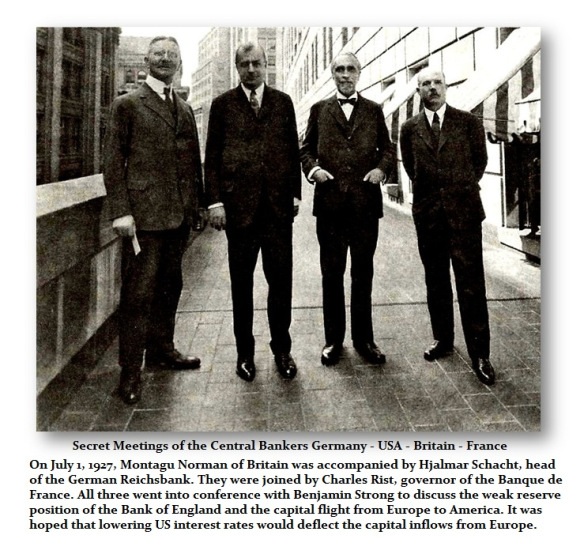
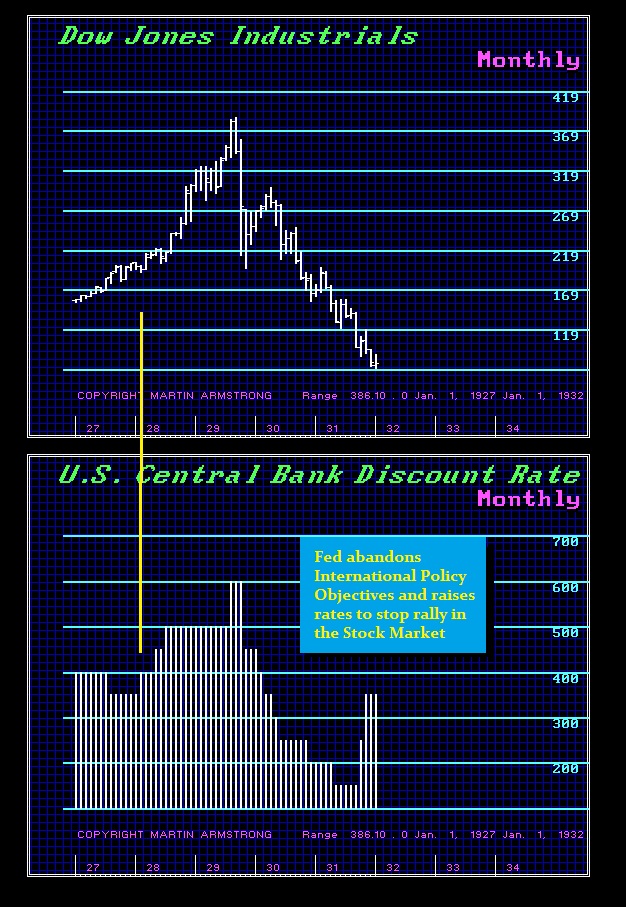
This idea is not original about interest rates and capital flows. This is the typical academic theory they still teach in schools today. In 1927, that was the FIRST G4 meeting where Britain, France, and Germany petitioned the NY Fed to lower interest rates in hopes that that would send capital back to Europe. When they did that, it CONFIRMED that there was a debt crisis, and even more money poured into the USA.
The Fed cut rates in the US to help Europe, and the markets continued to rise as capital flows into the US intensified. The money was pouring into the US equities, and the Dow more than doubled as the Federal Reserve raised rates from 3.5% to 6%.
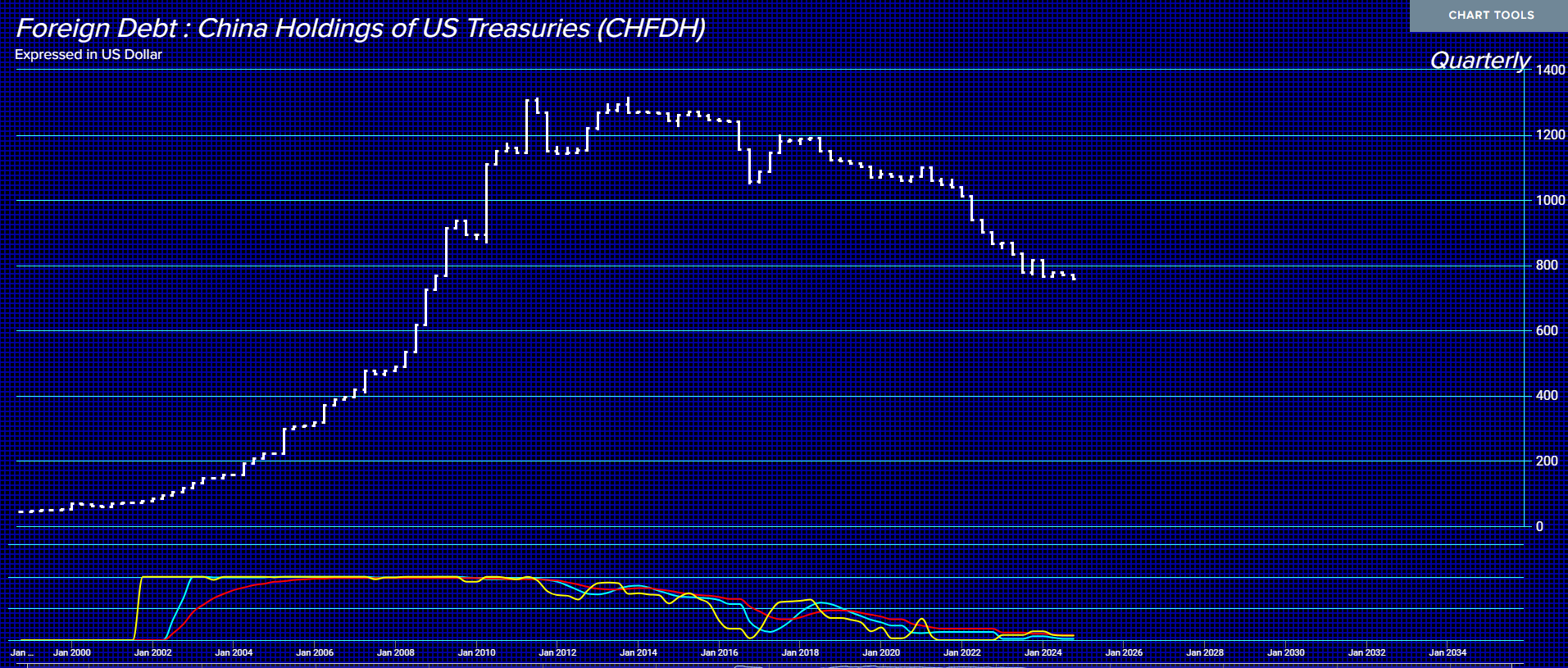
China has been reducing its holdings of US debt ever since the 2014 Ukrainian War began and the Biden Administration threatened China with sanctions if it helped Russia. This is what I have spoken about the BRICS is all about: geopolitical theater, not economics. China saw removing Russia from SWIFT as using the world financial system as a geopolitical tool. The Biden Administration was run by the Neocons, who do not care about the people or the economy, only their myopic desire to destroy Russia.
This is why FOX News or any mainstream news organization would NEVER invite me because I rain on their parade. This is all about feeding people the narrative they agree with. This is never about news.
BLOOMBERG
Bloomberg has crossed to the dark side of propaganda; They are more concerned about hating Trump than they are about reporting just the facts, ma’am. They reported:
“The rotation by investors out of American assets will go on for years if President Donald Trump persists with his global trade war.”
“The Trump administration has arguably opened the door for the country’s financial dominance to be challenged, with the dollar and Treasury bonds losing appeal in what may be a dire shift of fortunes for America. US equities also have been underperforming global peers this year amid fear that Trump’s strategy of tariff chicken will damage growth and stoke inflation.”
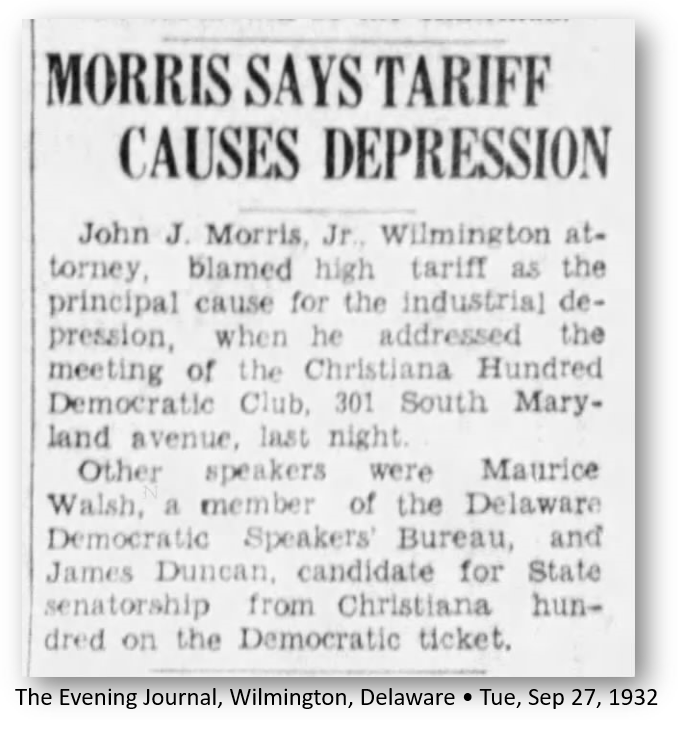
This is all based on the Democrats’ propaganda during the 1932 presidential election. As I have said, there is no serious economist I have ever heard blame the Great Depression on the tariffs, which did not come into effect until June 1930, and they were a response to Europeans raising taxes 33 times after World War I.
By the way, Japan and China have also been dumping European Debt. With Europe pushing for World War III, you have to be insane to buy European debt. European shares hold the risk of capital controls, and you will not get your money out when the first bullet is fired.
So, people are selling US shares and debt and moving to Europe as a safe haven? They must be the same people who are still driving alone in their car with a mask on to feel safe.
Posted originally on Apr 15, 2025 by Martin Armstrong
The United States has about 330 million people, and one in every $3 spent in world trade is by American Consumers. Europe has 450 million people, but it still clings to Marxism, is highly regulated, and is very anti-entrepreneurial. Trump fails to grasp here that trade wars will NOT even the score. The global consumer market seems to be ignored. As I have explained, the Current Account, which people call the trade account, also includes all interest and dividends on stocks, bonds, and investments. In theory, if China bought 100% of the US national debt, then the perceived trade deficit from interest of $1 trillion would flow to China, and this has nothing to do with jobs or manufacturing anything.
Let’s clarify trade. The United States has the largest economy in the world, so it’s the top contributor to global consumer spending. China would be next, followed by countries like Japan, Germany, the UK, India, and so on. Note that China is already the #2 consumer-based economy. Europe is far too Marxist, and it still clings to the old theories of Mercantilism. The average German has less net wealth than an Italian, yet they are the biggest economy.
In recent years, the global GDP has been around $100 trillion. Depending on the economy, consumer spending typically makes up about 60-70% of a country’s GDP. So, if we take 65% of $100 trillion, that’s about $65 trillion in global consumer spending annually in theory. Now, breaking this down by country. The US GDP is around $25 trillion. If US consumer spending is about 68% of GDP, that would be roughly $17 trillion. Therefore, the US share would be 17/65, approximately 26%. That means we have a US consumption-driven economy.
China’s GDP is around $18 trillion. However, consumer spending as a percentage of GDP is lower, maybe around 40%, because their economy is more investment—and export-driven. So 40% of $18 trillion is $7.2 trillion. That would be about 11% of the global total ($7.2T / $65T).
Let’s compare this to Japan’s GDP, which is about $4.9 trillion. Consumer spending there is higher as a percentage, maybe around 55%, so $2.7 trillion. That’s roughly 4.15% globally.
Germany’s GDP is around $4.2 trillion. With consumer spending at around 50% of GDP, that’s $2.1 trillion, so 3.2% globally.
India’s GDP is approximately $3.4 trillion. Consumer spending accounts for a larger part, maybe 60%, so the total is $2.04 trillion, which is about 3.14% of the global total.
The UK’s GDP is about $3.1 trillion. Consumer spending at 60% would be $1.86 trillion, so around 2.86%.
France’s GDP is $2.9 trillion. Consumer spending at 55% gives $1.6 trillion, about 2.46%.
Brazil’s GDP is $2.0 trillion. If consumer spending is 60%, that’s $1.2 trillion, so 1.85%.
Italy’s GDP is $2.1 trillion. Consumer spending at 60% would be $1.26 trillion, around 1.94%.
Canada’s GDP is $2.0 trillion. Consumer spending at 57% gives $1.14 trillion, which is 1.75%.
South Korea’s GDP is $1.7 trillion. Consumer spending at 50% is $0.85 trillion, so 1.3%.
Russia’s GDP is around $1.8 trillion. If consumer spending is 50%, that’s $0.9 trillion, about 1.38%.
Australia’s GDP is $1.6 trillion. Consumer spending at 55% would be $0.88 trillion, 1.35%.
Consequently, the total for these top countries is around 59.65%, leaving about 40.35% for the rest of the world. This is all based on rough estimates. Then we also have nominal GDP vs. PPP (Purchasing Power Parity). However, consumer spending in nominal terms is usually what’s used for such global comparisons, further complicating our exercise.
Another consideration: The figures I used for consumer spending as a percentage of GDP might not be accurate for each country. For example, China’s consumer spending as a percentage of GDP has been increasing but was historically lower. According to the World Bank, in 2022, China’s household final consumption expenditure was about 38% of GDP. The US was around 68%, Japan about 55%, Germany 52%, India was around 59%, UK 63%, France 54%, Brazil 64%, Italy 61%, Canada 57%, South Korea 48%. So my initial estimates were somewhat close but may need adjustment.
US: 25T GDP * 68% = 17T
China: 18T * 38% = 6.84T
Japan: 4.9T * 55% = 2.695T
Germany: 4.2T * 52% = 2.184T
India: 3.4T * 59% = 2.006T
UK: 3.1T * 63% = 1.953T
France: 2.9T * 54% = 1.566T
Brazil: 2.0T * 64% = 1.28T
Italy: 2.1T * 61% = 1.281T
Canada: 2.0T * 57% = 1.14T
South Korea: 1.7T * 48% = 0.816T
Russia: 1.8T * 52% = 0.936T (assuming 52%)
Australia: 1.6T * 55% = 0.88T
Spain: 1.4T * 58% = 0.812T
So total consumer spending from these 14 countries is approximately $41.389 trillion out of about $65 trillion globally.
Now, converting each country’s consumer spending to a percentage of global:
US: 17 / 65 = 26.15%
China: 6.84 / 65 ≈ 10.52%
Japan: 2.695 / 65 ≈ 4.15%
Germany: 2.184 / 65 ≈ 3.36%
India: 2.006 / 65 ≈ 3.09%
UK: 1.953 / 65 ≈ 3.00%
France: 1.566 / 65 ≈ 2.41%
Brazil: 1.28 / 65 ≈ 1.97%
Italy: 1.281 / 65 ≈ 1.97%
Canada: 1.14 / 65 ≈ 1.75%
South Korea: 0.816 / 65 ≈ 1.26%
Russia: 0.936 / 65 ≈ 1.44%
Australia: 0.88 / 65 ≈ 1.35%
Spain: 0.812 / 65 ≈ 1.25%
Others: 36.3%
Please remember that these percentages are estimates of global consumer spending by country based on GDP and consumption patterns. The United States is the largest consumer-based economy in the world, and about 26% of total world spending involves the American consumer. China is only 10.5%, and Japan is at 4.1%. Europe comes in at around 12%.
In summary, China is actively trying to build a more consumer-based economy, with policies and trends supporting this shift. However, structural and demographic challenges might slow this transition into 2028. The progress is evident, but it’s a work in progress. After 2032, they hold the potential to surpass the United States as the financial capital of the world. The problem in the United States is that the Democrats keep trying to oppress the economy like Europe, imposing socialistic goals that are not economically efficient.
Key Evidence of China’s Transition:
Rising Consumption Share of GDP:
Household consumption contributed 53% of GDP in 2023, up from ~35% in 2010. While still lower than the U.S. (~68-70%), this marks significant growth.
Services and high-tech industries are expanding, reflecting demand for healthcare, education, and entertainment.
Policy Shifts:
“Dual Circulation” Strategy:
Emphasizes domestic consumption (internal circulation) alongside international trade, reducing reliance on exports.
Social Reforms:
Efforts to strengthen social safety nets (pensions, healthcare) aim to lower household savings rates, freeing income for spending.
Urbanization and Middle-Class Growth:
Over 60% of China’s population now lives in cities, fostering a consumer class with higher disposable income.
E-Commerce and Digital Economy:
China leads globally in e-commerce (e.g., Alibaba, JD.com) and digital payments, facilitating consumer spending. The digital economy accounts for ~40% of GDP.
Challenges to a Consumer-Driven Model:
Structural Imbalances:
Investment and exports still dominate (e.g., state-led infrastructure, real estate). Transition requires rebalancing toward the private sector and services.
Household debt
has risen to ~62% of GDP (2023), potentially constraining spending.
Demographic and Social Factors:
Aging Population: By 2035, 30% of citizens will be over 60, likely increasing savings and reducing consumption.
Income Inequality: Rural-urban gaps and uneven wealth distribution limit broad-based consumption growth.
Geopolitical and Economic Risks:
Trade tensions and global demand volatility (e.g., post-COVID, U.S.-China decoupling) pressure China to prioritize domestic demand.
Real estate sector
Slowdowns could dampen consumer confidence.
China is deliberately building a consumer-based economy through policy reforms, urbanization, and digital innovation, rejecting the European mercantilist economic philosophy. While progress is evident, structural hurdles, such as reliance on investment aging demographics, mean the transition will be gradual but ongoing. The government’s success in addressing these challenges will determine the pace and sustainability of this shift. China’s economy remains a hybrid model, blending consumption growth with traditional drivers like state investment.
The current account is a key component of a country’s balance of payments, recording international transactions in goods, services, income, and transfers. It consists of four main components:
Trade in Goods (Visible Trade):
Exports and imports of tangible products (e.g., machinery, vehicles, electronics).
The balance of trade in goods is often referred to as the “merchandise trade balance.”
Trade in Services (Invisible Trade):
Exports and imports of intangible services (e.g., tourism, financial services, education, consulting, transportation).
Combined with trade in goods, this forms the trade balance (goods and services).
Primary Income (Income Flows):
Cross-border income from investments and employment:
Investment income: Dividends, interest, profits from foreign investments (e.g., dividends from overseas stocks).
Compensation of employees: Wages, salaries, or benefits earned by workers in a foreign country (e.g., remittances from expatriates).
Secondary Income (Current Transfers):
One-way transfers where no goods, services, or assets are exchanged in return:
Remittances: Money sent by migrants to their home country.
Foreign aid/grants: Government transfers (e.g., disaster relief, development aid).
Pensions, gifts, or donations: Transfers between individuals or organizations.
A Trade War based on just the gross of the Current Account does NOT reflect our trade deficit or surplus.
Foreign investors overall own roughly 10-20% of Manhattan’s high-end residential properties (e.g., condos), with Europeans constituting a significant but minority share of this group. For example, if Europeans account for 30-40% of foreign-owned properties, their stake might be 3-8% of Manhattan’s luxury residential market. While exact figures are elusive, Europeans likely own 3-7% of Manhattan’s total real estate, with higher concentrations in luxury residential and prime commercial sectors. This is only an estimate and not definitive. Any income, such as rents, on that property will flow out through the current account and will appear as a trade deficit when it has NOTHING to do with trade.
As of 2023, approximately 23-24% of the total U.S. national debt is held by foreign entities. This calculation is based on foreign holdings of around $7.4 trillion out of $31.4 trillion at the time. Therefore, of about $1 trillion in interest expenditures. Thus, about $230+ billion is flowing out through the current account that has nothing to do with trade. The major holders of US national debt include Japan, China, and the United Kingdom.
Understanding these components is now CRITICAL in the middle of a trade war. The sale of US debt will go through the capital account, but it will reduce the interest paid to foreigners that go through the current account, creating the illusion of a trade deficit. I disagree with Trump’s formulas, and the risk of a permanent trade war with China is now assured unless he gets on a private phone call. You cannot make public demands against China for then they cannot back down based on their culture.
Posted originally on Apr 14, 2025 by Martin Armstrong
The technology coming out of China is quite remarkable. China has unveiled the world’s first pilotless air taxi service. The Civil Aviation Administration of China (CAAC) issued Air Operator Certificates (OCs) to EHang Holdings in Guangdong Province and its subsidiary, Heyi Aviation. The companies believe this will boost China’s tourism sector and pave the way for the normalization of flying vehicles over the next five years.
EHang’s EH216-S is a two-seat electric drone that can travel at a top speed of 80 mph (130 km/h) over a range of 18.6 miles (30 km). Heyi Aviation has a similar model as well that is meant for “low-altitude economy” flights. Initial operations will be restricted to closed-loop routes that land and takeoff at the same location.
Ehang’s Vice President He Tianxing said phase one of pilotless taxis will begin this year into 2026, focusing solely on tourism travel in Zhuhai, Shenzhen, Taiyuan, Wuxi, Wenzhou and Wuhan. Flights will initially vary from three to 10 minutes as phase one is about novelty and the excitement of air travel rather than commuting or transportation. Tianxing said the experience is “just like riding in a car.”
“The human-carrying pilotless aviation and the low-altitude economy, as an emerging industry, is still in its developmental stage and remains a national strategic focus in China’s aviation sector,” EHang said. There are still many challenges to be addressed and improvements to be made, requiring industry-wide collaborations.”
Phase two will occur from 2026 to 2030 to include urban air taxis capable of traveling longer distances. These taxis will be used for actual commuting and transport purposes, creating a new “low-altitude economy.”
The US has attempted to compete with eVTOL aircrafts for “power-left” vehicles, according to the Federal Aviation Administration, and are designed to land and take off vertically to avoid the need for a runway. However, the FAA has not approved of a pilotless aircraft. Estimates stat that this business could grow into a $30 billion opportunity by 2035.
China expects the new low-altitude economy, which also includes drones and air sports, to be worth $205 billion (1.5 trillion yuan) by the end of 2025. The CCP is aggressively pushing this new niche and expects it to double in size by 2035. What was once an idea seen only in science fiction films is now a reality. It will be quite interesting to see how this technology plays out in potentially reshaping travel.
Posted originally on Mar 18, 2025 by Martin Armstrong
COMMENT: Thank you for your honest analysis of gold. Whenever someone talks about gold and inflation, they are not accurate analysts but mouth the same propaganda that has been prevalent since the fall of Bretton Woods. I discussed this with our economics department, and they said you are correct. The quantity of money theory has become irrelevant. It has rallied into March, as Socrates projected.
Well done.
Dir
REPLY: Yes, I am getting more and more requests from universities around the world that they know what they teach no longer works. It may be easier to explain how things work than it is to get people to disregard what they have been taught. I have proposals now. They want to translate the books I have written into Italian, German, and Spanish, just for starters, to be taught in schools around the world. The gold-only crowd constantly preaches the same thing. Oh, the debt is rising, and the money supply is expanding, so but gold.
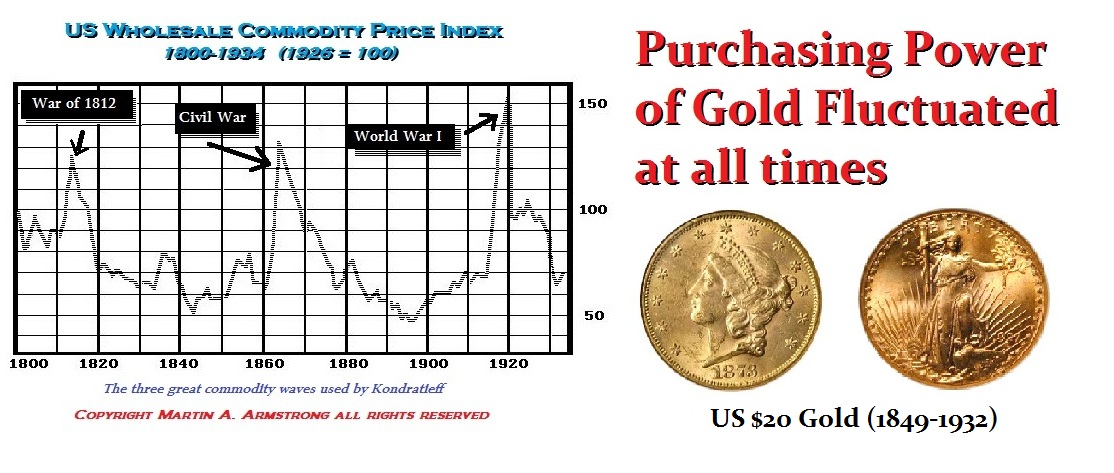
Well, gold reached #875 in 1980, and the National Debt was $1 trillion. If gold responded to debt or inflation, why is it not at $30,000 instead of testing $3,000? When will they start to report the truth behind what gold is all about? They burn so many people because what they put out is a religion, not analysis.
Nothing goes up for everyone, and nothing goes down forever. There is NO STORE OF VALUE because everything rises and falls. They do not even understand that when gold is money, it too rises and falls because it is on the opposite side of the scale with assets on the other side.
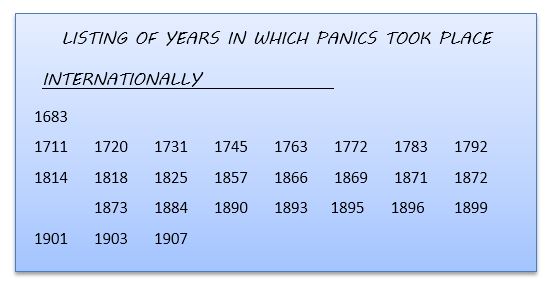
Just look at the all the panics during the 19th century. Gold declined in purchasing power into the booms and rose during the declines, just as the dollar does today. We call it cash is king.
Posted originally on Mar 14, 2025 by Martin Armstrong
COMMENT: Marty, Happy Pi Day. I think it was inevitable that you would discover the relationship between Pi and the economy and the markets. I found it to be fate since you grew up at 314 South Lippincott Avenue.
JF
REPLY: Perhaps it was fate. That was an extraordinary coincidence. I never thought about that until it was pointed out to me years later.
QUESTION: The criticism of your Economic Confidence Model has been that it oversimplifies complex economies, ignoring variables like policy changes or technological shifts. Would you address that?
DL
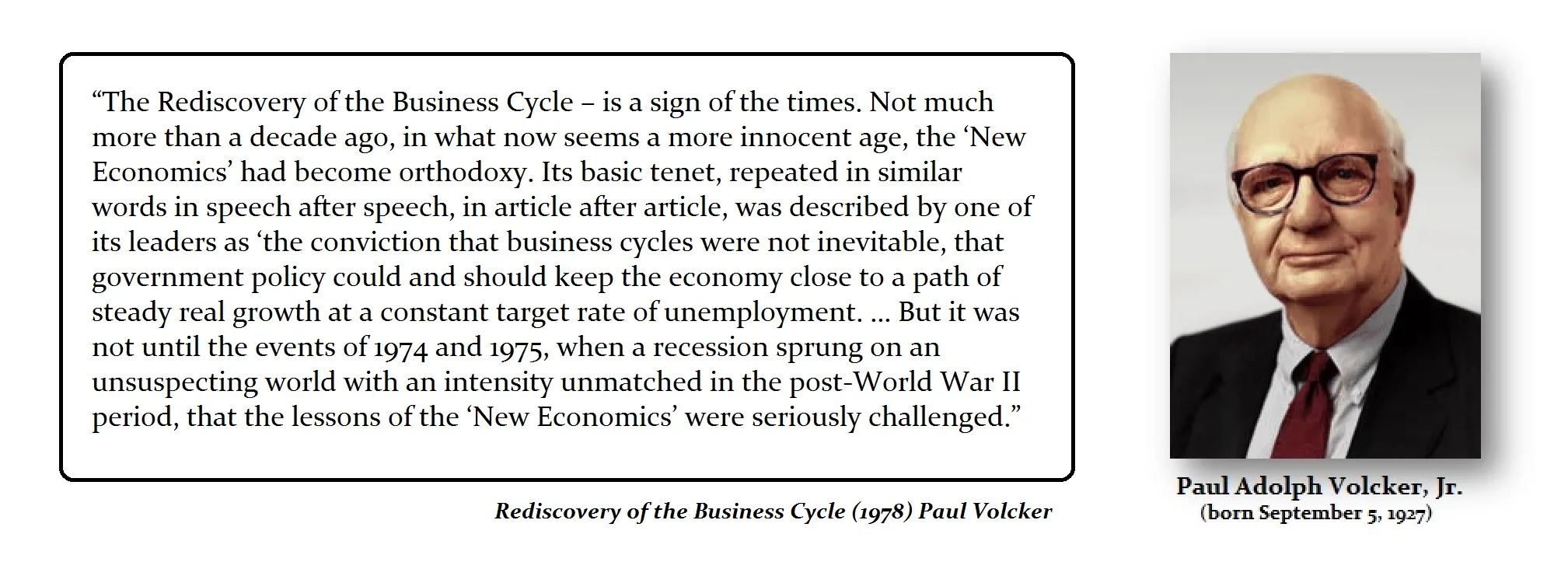
ANSWER: This emanates from the economic academic community that is Marist based that rests on the assumption that they can steer the economy through economic disturbances. I had a conversation with Paul Volcker. He told me that the business cycle can’t be defeated and agreed it was about 8 years.
I find the criticism of the ECM is always academic because they want to have theories on how to manage the economy, so hire them. Anyone I have spoken with over the years who actually has real live experience knows that the government has NEVER been able to steer the economy to eliminate booms and busts.
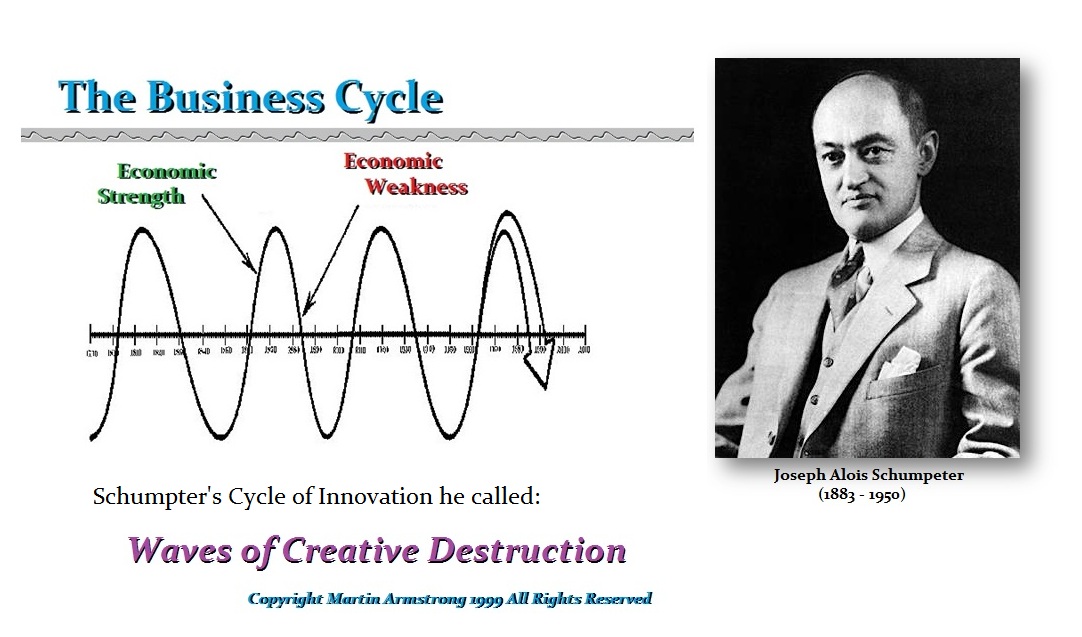
Schumpeter also tried to figure out what was behind the business cycle. He saw the human innovation and how the invention of the automobile put all the horse & buggy people out of business. The development of the internet has put a lot of small local businesses into bankruptcy. COVID-19 accomplished the deliberate climate change agenda to stop people from commuting to work and also put local businesses out of operation as you can order online. These are innovations that are part of his Waves of Creative Destruction.
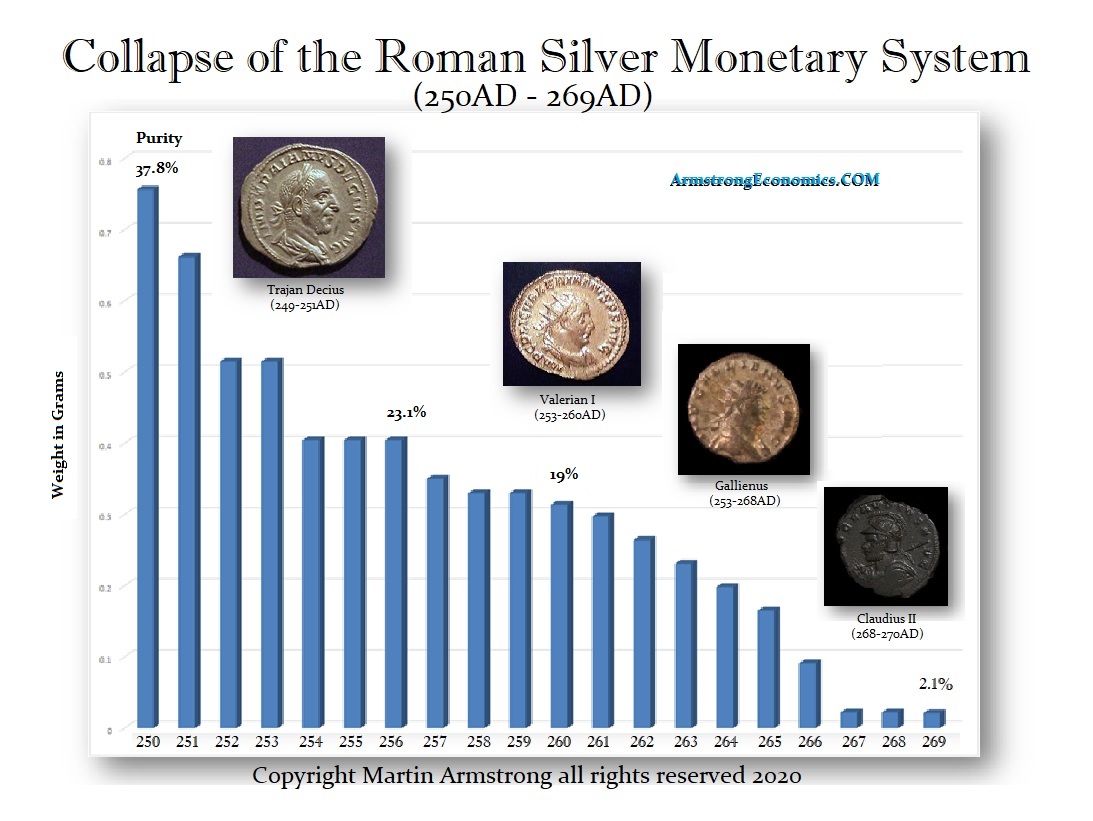
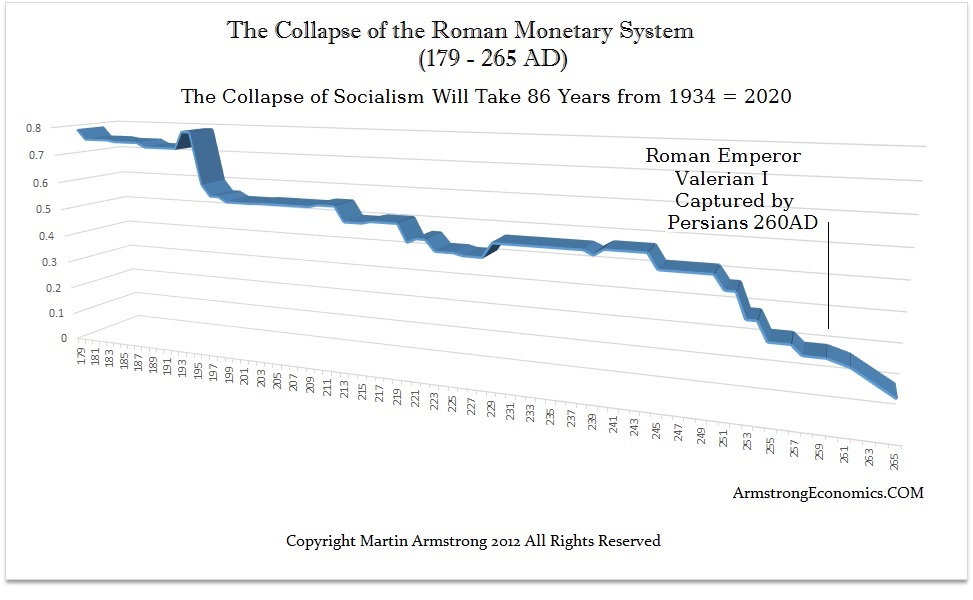
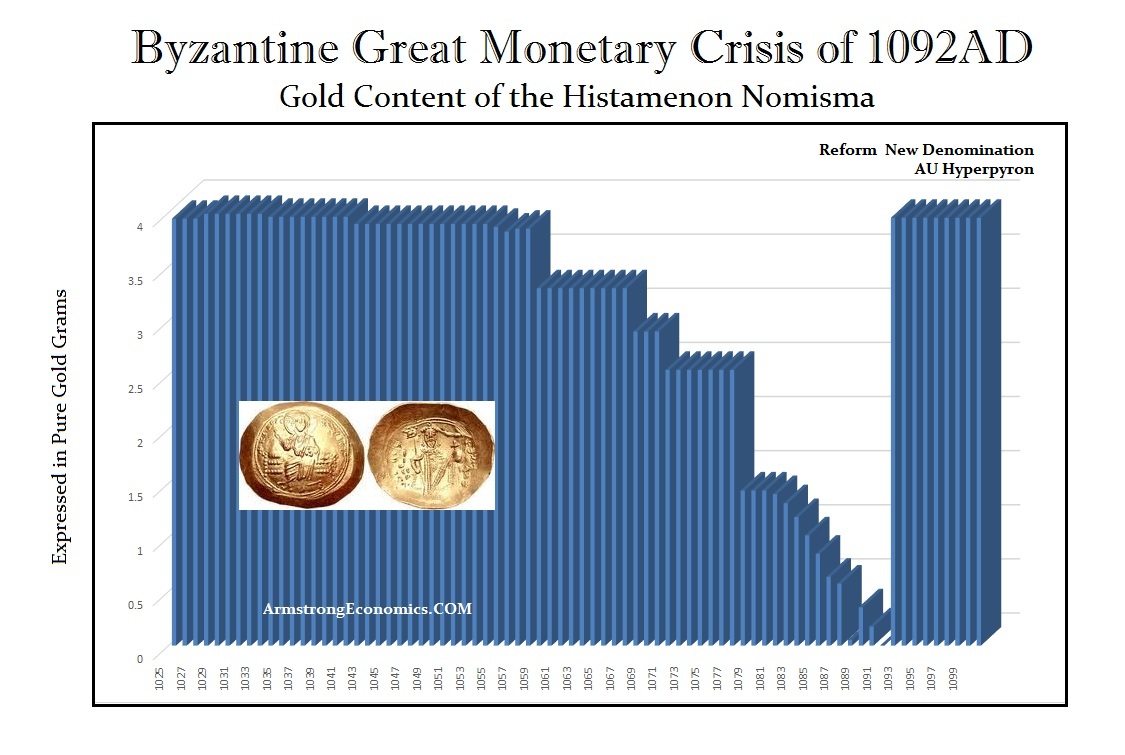
When Valerian I was captured, and Rome could not rescue him, the confidence in the Empire began to collapse. People were even suddenly skeptical about accepting Roman coins because their purchasing power was in excess of the metal content. Would they still be worth anything beyond the metal content? What is interesting is that the final collapse from 260 AD when Valerian was captured by the Persians, was just about 8.6 years.
A document from Egypt has survived, illustrating the financial crisis that was unleashed. It is from Aurelius Ptolemaeus, who is the strategus of the Oxyrhynchitenome. The public officials gathered and accused the bankers of closing their doors on account of their unwillingness to accept the divine coins of the Emperors. It became necessary that an order had to be issued to all the owners of the banks directing them to open, accept, and exchange all coins except the absolutely spurious and counterfeit. It was also directed that all who engaged in business transactions who refused to comply would be penalized. (POxy 1411 260AD, cited by Burnett 1987: p104)
This frequency has emerged for thousands of years. My critics are the typical Marxists who came up with the theory that economists can manipulate society to eliminate the business cycle, which they claim does not exist. I was told that in high school. There is no business cycle because Keynesian economics eliminated that. They have NEVER been able to achieve their goal of eliminating the business cycle but reject the ECM because they are too ignorant to even look at the world that not a single empire has ever lasted because history repeats since human nature never changes throughout the centuries.
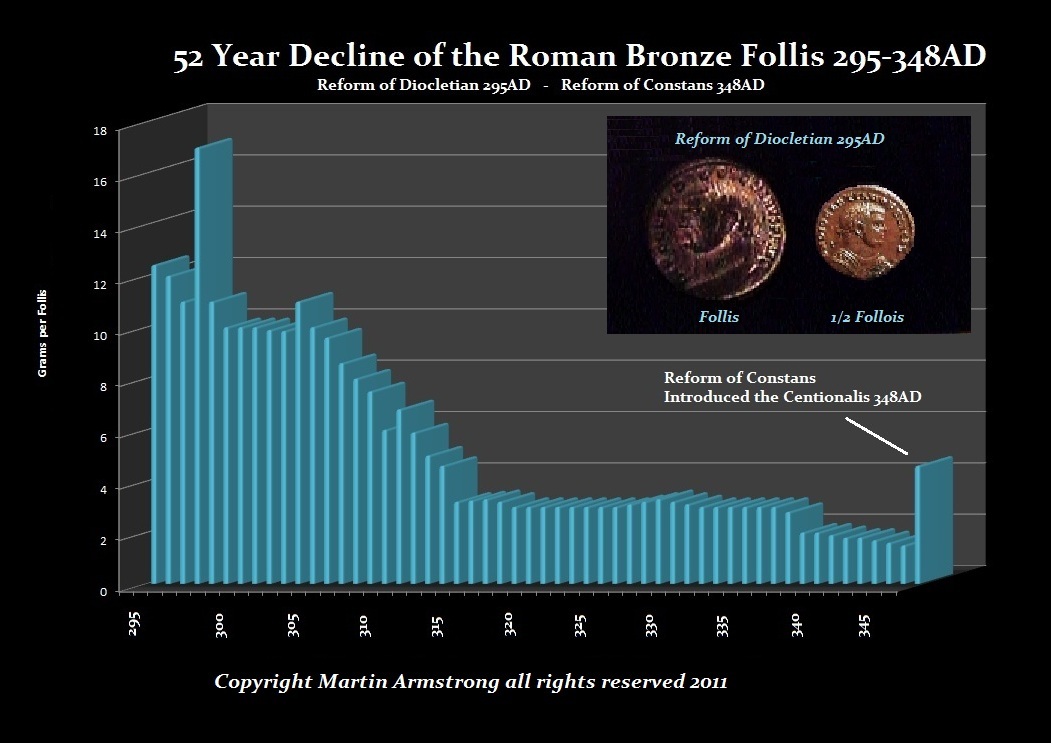
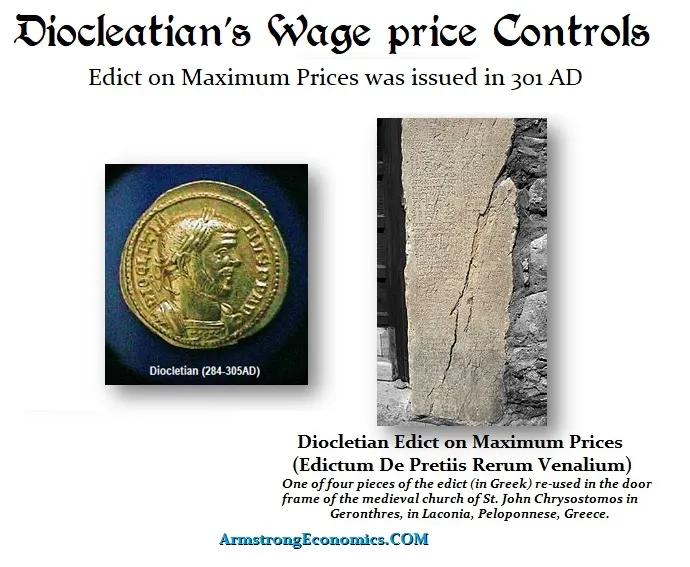
Changes in policy? Wage and price controls were incorporated into Hammurabi’s legal code. The Roman Emperor Diocletian issued a decree trying to regulate inflation and prevent the decline of the Roman monetary system. He failed. There is absolutely no historical evidence whatsoever to support their claims that they alone can steer the economy to eliminate the booms and busts they do not want to admit is a business cycle beyond their ability even to comprehend.
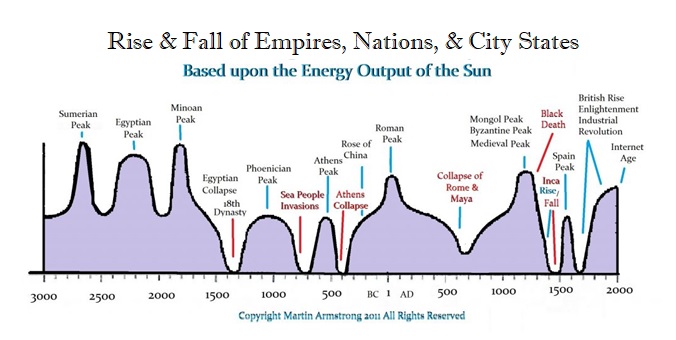
Even climate has a cycle; civilizations expand when they get warm and contract when they turn cold. Everything is part of it; things like the weather also provoke changes. The first Clean Air Act was passed in 535AD. Look, my critics are like government employees fighting against DOGE. If there is a business cycle that they cannot stop, then they have no job. They must call the ECM pseudoscience, but every major scientific innovation began with the label pseudoscience. Even Galileo was imprisoned for defending the idea that Earth and other planets revolve around the sun. His ideas were labeled pseudoscience, and a nut claiming the Earth revolved around the Sun – OMG! Even in medicine, the idea that stomach ulcers were caused by an infection was laughed at but is now accepted.
Vaccines were first considered pseudoscience. Before Edward Jenner, there were other practices like variolation used in China and the Ottoman Empire. They exposed individuals to smallpox scabs to induce immunity. It was not some academic theory. Then Jenner comes along in the late 1700s with cowpox. He noticed that milkmaids who had cowpox didn’t get smallpox. So he tested it on a boy, James Phipps. That worked, and that’s considered the first vaccine. But back then, understanding germs and the immune system was nonexistent. They didn’t know about viruses or antibodies.
The MNRA vaccine was not a vaccine. Dr. Deborah Birx, who was advocating the lockdowns, now says she ‘knew‘ COVID vaccines would not ‘protect against infection’ yet she advocated locking down the economy, causing major unemployment and loss of jobs if people refused to get vaccinated. That was pseudoscience, for there was not even observational evidence that locking down the economy would work, and she knew that this pretend “vaccine” was not a traditional vaccine created from the virus itself, as was smallpox.
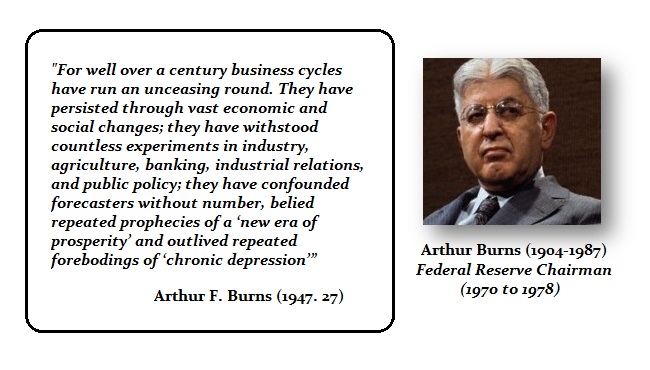
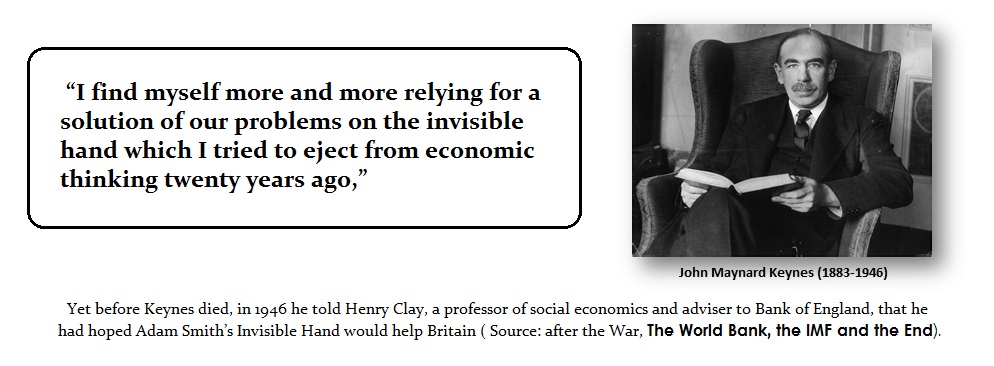
So, from our modern perspective, the method was unscientific, but they were based on empirical observation. That is what Adam Smith did. He engaged in actual observation. That is what I have done with the ECM. That is why some academics criticize me because it goes against their confined established science, which even Keynes admitted he was wrong before he died, Paul Volcker admitted their thories failed in 1979, and Arthur Burns, the Fed Chairman when Bretton Woods collapsed, also admitted that the business cycle always wins.
To them, learning from observation amounts to pseudoscience when it criticizes their beliefs. I PUBLISHED THE LIST I DISCOVERED and explained that I thought it was an average. I had no idea it would turn out to be more precise, yet because it was a list of panics internationally, it was not confined to a single cause like commodities. No trend lasts forever. Yet even with Climate Change, these people claim the temperature rose 1 degree this year, so it will continue, and we will all die in 50 years. That is like saying the stock market rose 1000 points this year, so it will continue every year for the next 50. A trader with experience understands that their stupid theories are impossible and have never worked even once.
I have created this site to help people have fun in the kitchen. I write about enjoying life both in and out of my kitchen. Life is short! Make the most of it and enjoy!
This is a library of News Events not reported by the Main Stream Media documenting & connecting the dots on How the Obama Marxist Liberal agenda is destroying America

















 Centinel2012