What Type of Government Should We Strive For?


socialist-worker

Some ask why I only criticize the left and not the right. As the Guardian wrote, the left is on the rise. There are 50 shades between left and right. If we are talking about the 1%, that is really small business, for that begins at $250,000 annual income. Everyone confuses the 1% with the “super-rich” who are Warren Buffet, Bill Gates, Wall Street Bankers, or, yes, even the Clintons. They skewed the average household income of the 1% to $1.2m back in 2008, according to federal tax data. The super-rich skew that average upwards, dramatically distorting whom most people are envisioning because they are looking not at income but net worth.

Measured by net worth, rather than income, the top 1% started at $6.9m in 2009, according to the Federal Reserve, down 23% from 2007. Contrary to the conspiracy theorists who claim the “rich” force crashes so they can buy stuff cheaper, they lose money during such declines. If the economy does not recover, they are unable to sell to make a profit. The richest man ever was Jonathan Ogden Armour (1863 – 1927), as in Armour Hot Dogs. He supplied the food for the troops in World War I. During the Crash of 1919, he lost the equivalent of $1 billion a day for 120 days straight and died penniless. He told the press before he died he knew he would be remembered for losing more money than anyone in history. So much for the conspiracy theories.

podesta-hillary-refuses-to-concede

Turning to reality, let’s look at power. How do the super-rich gain access to power? They donate to politicians, which is why Hillary threw a thank you bash in New York for ONLY those who donated more than $1 million. She filled the hotel and had to turn away the paupers who donated just $1 million because she had so many. When Hillary lost the election, she sent John Podesta to say go home. She didn’t come out and thank the average person or buy them dinner. So the woman who claimed to represent the common people threw a thank you bash only for the super-rich. A $1 million donation wouldn’t get you an invite.

If you want to point the finger at the rich, you have a serious problem. All these protests against the 1% are way off base. The 1% truly DO NOT possess any direct power — they buy politicians to gain INFLUENCE. This is like jailing a driver because he paid a cop a bribe to get out of a ticket, but not punishing the cop. Let’s get real here. The 1% cannot summon troops or roll down your street in tanks. That has never been their agenda. They make money primarily from investment rather than salary, and to keep that going they need a viable economy with a respectable middle-class to whom they will sell stuff. So what is really the issue? Do you really think the rich want to suppress everyone into poverty and destroy the very market from which they derive profits? I have never seen that now or historically. That makes no sense. Someone manufacturing something may want to keep wages of his worker down — true! But that does not translate into suppressing everyone within society. They need people to buy their stuff.

hillary-trump-weding

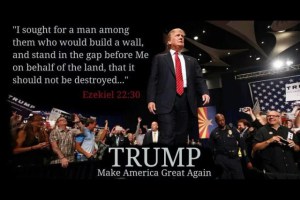
So let’s focus on who they are bribing. Trump has bluntly stated that he was a businessman. “I give to everybody. When they call, I give.” He explained, “You know what? When I need something from them, two years later, three years later, I call them, and they are there for me. . . . And that’s a broken system.” He did not say he was paying for a specific thing — you do this and I will give you that. The system does not work like that, so it’s not precisely bribery or illegal. Hillary went to Trump’s wedding because he donated to the Clinton Foundation. Trump said plainly, as reported by the Daily Beast“As a contributor, I demanded that they be there—they had no choice and that’s what’s wrong with our country. Our country is run by and for donors, special interests and lobbyists, and that is not a good formula for our country’s success. With me, there are no lobbyists and special interests. My only special interest is the United States of America.”

We have a Republic, which was based on the Roman Republic and not Greek Democracy. Therein lies the problem. For you see, there is absolutely no way we live in any democratic based system where the people really have a right to vote. We live in a Republic — nothing more — and that means we only elect “representatives” who vote and decide for us. If you want to argue that the rich are the problem, the left champions communism and just wants to hand all their assets government. But government has no imagination to create new innovations and the economic system slowly disintegrates, as what took place under socialist-communism. This is also how corporations die. Once a company typically goes public, the bean counters and lawyers take over and often push out the people with visions like Steve Jobs and Apple. They may believe they know how to run a company, but they are incapable of doing so because they lack the real understanding of innovation and imagination vital to create growth. Companies and governments die for the same reason – they become too removed from humanity.

The problem is NOT the rich, but our Republican form of government. ALL REPUBLICS, without exception, ALWAYS DEVOLVE INTO OLIGARCHIES. This is exactly what Trump explained. He donates and when he needs them, they are there.

Julius Caesar-Denarius as Pontif Max

The Roman Republic became dominated by the oligarchy. That was the Civil War with Caesar against the oligarchy (see Anatomy of a Debt Crisis). No republic form of government has ever not collapsed from internal corruption. Nobody has ever beaten this political game even once. Why was the calendar revised by Julius Caesar? The high priest who had the discretion to insert days to account for leap-year differences was constantly bribed to insert days to avoid elections. Julius Caesar became Pontifex Maximus (high priest) to revise the calendar and end the corruption of discretion. Once he fixed the calendar, it ended bribery.

The Greek Democracy was rather different. Only the head of the household votes, nobody else including sons, daughters, or the wife. The head of the household was like a Congressman and represented everyone within the household. You had direct access to your “representative” under the Greek democratic system. When Socrates was put on trial, there were 600 jurors, who were the heads of their households.

thrasymachus-quote

Thrasymachus debated Socrates as recorded by Plato. I believe he gave the best description of all forms of government. No single system will last perfectly forever. There is a cycle to everything. All forms of government will seek to exert power out of its own self-interest. That complies also with Adam Smith’s invisible hand.

genoaThe one system that proved beyond a shadow of a doubt that class warfare is the culprit behind such economic convulsions throughout history was the political system of Genoa. This was during the city state period when Genoa competed against Florence and Venice. The Venetian system had a Doge for life. Upon his death, his estate would be reviewed and any corruption he had engaged in would then be extracted from his estate before anything went to his heirs. Genoa also had a Doge (“Genoese Duke and People’s Defender”). The Doge was the ruler of the Republic of Genoa from 1339 until the state’s extinction in 1797 by the hand of Napoleon. Originally, the Doge was elected for life. The Genoese realized that this lent itself to corruption. After 1528, the Doges were elected for terms of two years only – they politically reformed.

The Doge rotated among a small group of merchant families — the rich. This actually provided the best form of government in all the systems I have reviewed. Yes, you can say it was an oligarchy. However, what was interesting was the fact that no individual family would ever pass some law to which they would be subjected to in two years that would be unfair or Draconian. Because Genoa competed against Florence and Venice, the management of the state was always directed at trade, not domestic class warfare. In fact, there were several wars between Genoa and Venice over trade. Venetian–Genoese Wars were a series of struggles for dominance in the Mediterranean Sea between 1256 and 1381.

florin

During the period post-1528, the merchant families made decisions that benefited the city-state, not individuals. By limiting terms to two-years, this defeated the sense of entitlement that we see today by career politicians. Genoa thus prospered and provided greater freedom and stability than either Florence or Venice for the whole population.

Venice really became a Marxist type system with a Doge for life. The fleet and everything was the property of the government. The main industries were not private enterprises as they were in Genoa but state owned. Florence became more of a banking and manufacturing center and built its business primarily on land. Its currency, the florin, rose to the status of the unit of account throughout Europe and others followed Florence.

edward-iii-leopards-1344

In 1344, Edward III of Britain issued his first gold coinage that was set at the standards of Florence. But the wild gyrations in the silver/gold ratio set in motion by France, unleashed civil unrest in Florence where the people stormed the palaces of the bankers and burned them to the ground after blaming the bankers for economic depression. Why? The monetary system of Florence was a two-tier system whereby gold was used only for international trade and silver was used for wages and domestic bills. Everyone was required to maintain two sets of books. The French overvalued silver relative to gold and sucked in silver much like the silver Democrats in the United States during the second half of the 19th century. A depression emerged as the price of silver rose too high causing unemployment in Florence. The same set of events unfolded as the Panic of 1893 in the United States that led to the rise of Marxism.

Right now in the USA, the share market is rallying and we have consumer confidence at new highs for the first time in 13 years because Trump was elected. People see that Trump is a businessman, and what he does will benefit the country economically. This was the same thinking process in Genoa. The key here to understand is the career politicians. The two-year term for Congress was selected by the founding fathers based on the Genoa model. Our problem, however, they failed to impose a term limit. The founding fathers  ASSUMED that since a Congressman was not paid and donated his time for a few weeks each year that it was not necessary to limit the terms. Congressmen received only $6 per day for their travel and expenses prior to 1815 when they began to pay themselves annually $1500. From then on, Congress became seriously disconnected from the people and fell into a separate political class.

The difference between the left and the right is that the left hands all power to government to suppress the right, while the right bribes a republic to maintain its influence corrupting government (i.e. Hillary). Trump is absolutely correct in identifying the problem. I doubt whether he could convince Republicans to impose term limits on themselves. Those who ask if there is any system I would recommend, I would say the Genoa system of term limits. No career politicians. Only people with real life experience from the real world, thank you.

“From Under the Rubble” – The Battle Against the Left for Humanity


from-under-the-ruble

Anyone who questions that this is a battle to the death should read “From Under the Rubble.” Alexander Solzhenitsyn and six dissident colleagues, Mikhail Agursky, Evgeny Barabanov, Vadim Borisov, F. Korsakov, A.B., and Igor Shafarevich, risked their lives to write this book while they were still living in the USSR. These brave men joined in the mid-seventies to write this book, which remains an extraordinary accomplishment in exposing the dangers that always arise from the left.

“From Under the Rubble” exposed the Soviet regime that was set in motion by Stalin. Even Lenin himself warned the members of the Communist Party not to allow Stalin to seize power. This book is really a monument to the battle we face with the left to retain our freedom and that for our posterity. This is especially true in light of their hatred that rose to the surface with the 2016 presidential election.

This book is truly a moral indictment of the liberal West that masks over the same seeds of revolution that destroyed Russia and China. The Ten Commandments interestingly warns us not to engage in this leftist mentality. Coveting what someone else has leads to a total loss of security and freedom. We certainly know that the epic battle between left and right took place in the defeat of Athens back in 404 BC by the then communist state of Sparta where personal wealth was outlawed.

checkpoint-charlie

I personally went through Checkpoint Charlie during the late 1970s. I went with a friend who wanted to visit his family and was concerned that they might find out he was born there and not let him leave even though he had become an American. I went because I wanted to see what this was all about first hand. What I saw shocked me beyond belief. His cousin would talk freely, but only when nobody was around us. They too had the policy we have today — See something, say something.

“From Under the Rubble” is Solzhenitsyn’s call to action. This book displayed, not merely their remarkable courage, but this battle against the left for humanity to survive. They explain, “One puts oneself in danger for the sake of the nation!”

Putin Mocks Democrats, Exchanges Holiday Greetings and Hopes for Successful Negotiations in 2017 with President-elect Trump


Source: Rogue Money Vladimir Putin said today about Hillary and Dems: “In my opinion, it is humiliating. One must be able to lose with dignity.” So true! — Donald J. Trump (@realDonaldT…

Source: Putin Mocks Democrats, Exchanges Holiday Greetings and Hopes for Successful Negotiations in 2017 with President-elect Trump

trump-standing-in-gap411221112112111111121111111111111211111121111112111111111111111

Indian government now confiscating private jewelry, gold during home raids


)Source: Natural News, by J.D. HeyesIf you’re an Indian citizen, it is best not to try to hoard gold, jewelry and other valuables, as the government will swoop in and seize it.As noted by Mish Talk, global financial repression is beginning to accelerate, and it is being led by the Asian giant, India. The government recently declared large denomination bills to be illegal to hold, and now it is targeting privately-held gold.But the government is not simply targeting gold bars and/or bullion; authorities are raiding homes and are even taking possession of jewelry, with no questions asked or answered.Here’s some background on what’s taking place:The global elite has determined that the surest way to control the masses is through control over their personal finances. If the masses can horde cash and valuables, then they can’t be bullied or controlled by the globalist elite. So in order to accomplish this, physical currently will have to be made illegal to possess or otherwise taken away from the masses and out of circulation completely. Natural News founder/editor Mike Adams, the Health Ranger, has a great piece explaining all of this.The next step forward by the globalists to control personal assetsMish Talk shares another piece of important background information. It essentially notes that there is “cash chaos” in India, where 86 percent of the money in circulation has been withdrawn. On Nov. 8, Indian Prime Minister Narendra Modi stunned the nation when he announced that 500-rupee ($7.30) and 1,000-rupee notes, which are about 85 percent of the money supply, would no longer be legal tender, effective immediately. “As one might imagine, chaos ensued,” the site noted. “And it continues.”Modi’s decision sparked outrage and angst, especially among the pundit class. Writing in Bloomberg View, columnist Mihir Sharma lamented the currency-pulling, noting that while the country’s gross domestic product grew at a mighty 7.3 percent, that wouldn’t translate into improved economic conditions for most Indians.What’s more, he noted that Modi could not backtrack on his decision to demonetize nearly all privately-held cash, because it remains politically popular.The government sold the demonetization policy as the best way to essentially attack the rich (sound familiar?), and to use it as a “’surgical strike on black money’—the illicit piles of cash many rich Indians have accumulated out of sight of the taxman,” Sharma wrote.But it has become clear since then the policy is anything but surgical. Rather, it appears to be just another step forward by the globalists to control personal assets, which can, of course, be instantly taken via electronic theft by government agencies if/when it becomes necessary.

Source: Indian government now confiscating private jewelry, gold during home raids

gargoille

The Radical Jesus: How Would The Baby In A Manger Fare In The American Police State?


Tyler Durden's picture

Submitted by John Whitehead via The Rutherford Institute,

 baptism_of_christ_jekel

“Jesus is too much for us. The church’s later treatment of the gospels is one long effort to rescue Jesus from ‘extremism.’”—author Gary Wills, What Jesus Meant

Jesus was good. He was caring. He had powerful, profound things to say – things that would change how we view people, alter government policies and change the world. He went around helping the poor. And when confronted by those in authority, he did not shy away from speaking truth to power.

Jesus was born into a police state not unlike the growing menace of the American police state.

But what if Jesus, the revered preacher, teacher, radical and prophet, had been born 2,000 years later? How would Jesus’ life have been different had he be born and raised in the American police state?

Consider the following if you will.

The Christmas narrative of a baby born in a manger is a familiar one.

The Roman Empire, a police state in its own right, had ordered that a census be conducted. Joseph and his pregnant wife Mary traveled to the little town of Bethlehem so that they could be counted. There being no room for the couple at any of the inns, they stayed in a stable, where Mary gave birth to a baby boy. That boy, Jesus, would grow up to undermine the political and religious establishment of his day and was eventually crucified as a warning to others not to challenge the powers-that-be.

However, had Jesus been born in the year 2016…

Rather than traveling to Bethlehem for a census, Jesus’ parents would have been mailed a 28-page American Community Survey, a mandatory government questionnaire documenting their habits, household inhabitants, work schedule, how many toilets are in your home, etc. The penalty for not responding to this invasive survey can go as high as $5,000.

Instead of being born in a manger, Jesus might have been born at home. Rather than wise men and shepherds bringing gifts, however, the baby’s parents might have been forced to ward off visits from state social workers intent on prosecuting them for the home birth. One couple in Washington had all three of their children removed after social services objected to the two youngest being birthed in an unassisted home delivery.

Had Jesus been born in a hospital, his blood and DNA would have been taken without his parents’ knowledge or consent and entered into a government biobank. While most states require newborn screening, a growing number are holding onto that genetic material long-term for research, analysis and purposes yet to be disclosed.

Then again, had his parents been undocumented immigrants, they and the newborn baby might have been shuffled to a profit-driven, private prison for illegals where they would have been turned into cheap, forced laborers for corporations such as Starbucks, Microsoft, Walmart, and Victoria’s Secret. There’s quite a lot of money to be made from imprisoning immigrants, especially when taxpayers are footing the bill.

From the time he was old enough to attend school, Jesus would have been drilled in lessons of compliance and obedience to government authorities, while learning little about his own rights. Had he been daring enough to speak out against injustice while still in school, he might have found himself tasered or beaten by a school resource officer, or at the very least suspended under a school zero tolerance policy that punishes minor infractions as harshly as more serious offenses.

Had Jesus disappeared for a few hours let alone days as a 12-year-old, his parents would have been handcuffed, arrested and jailed for parental negligence. Parents across the country have been arrested for far less “offenses” such as allowing their children to walk to the park unaccompanied and play in their front yard alone.

Rather than disappearing from the history books from his early teenaged years to adulthood, Jesus’ movements and personal data—including his biometrics—would have been documented, tracked, monitored and filed by governmental agencies and corporations such as Google and Microsoft. Incredibly, 95 percent of school districts share their student records with outside companies that are contracted to manage data, which they then use to market products to us.

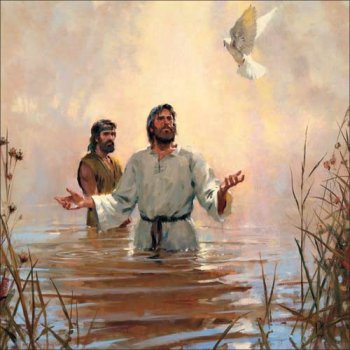
From the moment Jesus made contact with an “extremist” such as John the Baptist, he would have been flagged for surveillance because of his association with a prominent activist, peaceful or otherwise. Since 9/11, the FBI has actively carried out surveillance and intelligence-gathering operations on a broad range of activist groups, from animal rights groups to poverty relief, anti-war groups and other such “extremist” organizations.

Jesus’ anti-government views would certainly have resulted in him being labeled a domestic extremist. Law enforcement agencies are being trained to recognize signs of anti-government extremism during interactions with potential extremists who share a “belief in the approaching collapse of government and the economy.”

While traveling from community to community, Jesus might have been reported to government officials as “suspicious” under the Department of Homeland Security’s “See Something, Say Something” programs. Many states, including New York, are providing individuals with phone apps that allow them to take photos of suspicious activity and report them to their state Intelligence Center, where they are reviewed and forwarded to law-enforcement agencies.

Rather than being permitted to live as an itinerant preacher, Jesus might have found himself threatened with arrest for daring to live off the grid or sleeping outside. In fact, the number of cities that have resorted to criminalizing homelessness by enacting bans on camping, sleeping in vehicles, loitering and begging in public has doubled.

Viewed by the government as a dissident and potential threat to its power, Jesus might have had government spies planted among his followers to monitor his activities, report on his movements, and entrap him into breaking the law. Such Judases today—called informants—often receive hefty paychecks from the government for their treachery.

Had Jesus used the internet to spread his radical message of peace and love, he might have found his blog posts infiltrated by government spies attempting to undermine his integrity, discredit him or plant incriminating information online about him. At the very least, he would have had his website hacked and his email monitored.

Had Jesus attempted to feed large crowds of people, he would have been threatened with arrest for violating various ordinances prohibiting the distribution of food without a permit. Florida officials arrested a 90-year-old man for feeding the homeless on a public beach.

Had Jesus spoken publicly about his 40 days in the desert and his conversations with the devil, he might have been labeled mentally ill and detained in a psych ward against his will for a mandatory involuntary psychiatric hold with no access to family or friends. One Virginia man was arrested, strip searched, handcuffed to a table, diagnosed as having “mental health issues,” and locked up for five days in a mental health facility against his will apparently because of his slurred speech and unsteady gait.

Without a doubt, had Jesus attempted to overturn tables in a Jewish temple and rage against the materialism of religious institutions, he would have been charged with a hate crime. Currently, 45 states and the federal government have hate crime laws on the books.

Rather than having armed guards capture Jesus in a public place, government officials would have ordered that a SWAT team carry out a raid on Jesus and his followers, complete with flash-bang grenades and military equipment. There are upwards of 80,000 such SWAT team raids carried out every year, many on unsuspecting Americans who have no defense against such government invaders, even when such raids are done in error.

Instead of being detained by Roman guards, Jesus might have been made to “disappear” into a secret government detention center where he would have been interrogated, tortured and subjected to all manner of abuses. Chicago police “disappeared” more than 7,000 people into a secret, off-the-books interrogation warehouse at Homan Square.

Charged with treason and labeled a domestic terrorist, Jesus might have been sentenced to a life-term in a private prison where he would have been forced to provide slave labor for corporations or put to death by way of the electric chair or a lethal mixture of drugs.

Either way, whether Jesus had been born in our modern age or his own, he still would have died at the hands of a police state. Indeed, as I show in my book Battlefield America: The War on the American People, what Jesus and other activists suffered in their day is happening to those who choose to speak truth to power today.

Thus, we are faced with a choice: remain silent in the face of evil or speak out against it. As Nobel Prize-winning author Albert Camus proclaimed:

Perhaps we cannot prevent this world from being a world in which children are tortured. But we can reduce the number of tortured children. And if you don’t help us, who else in the world can help us do this?

Donald Trump Signals Willingness to Engage Arab Israeli Peace Effort…


This tweet from President-elect Donald Trump directly implies his willingness to lean into the problem: And President-Elect Donald Trump is not alone carrying optimism:

Source: Donald Trump Signals Willingness to Engage Arab Israeli Peace Effort…

trump-lions

Shifting Power: Visualizing The World’s Largest Cities For The Last 6000 Years


Tyler Durden's picture

In 300 B.C., Carthage was one of the world’s largest cities with up to 700,000 people living within its walls. The Carthaginian republic was a force to be reckoned with, controlling inconceivable amounts of wealth and land all around the Mediterranean.

However, just over a century later in 146 B.C., Carthage was burnt to the ground by the Romans. The destruction of Carthage was so thorough that many things are still not known about their civilization today. Carthage went from being a major power to literally being wiped off of the map.

A few decades after the annihilation of Carthage, it was Rome’s turn to become the world’s largest city for close to 500 years. Of course, Rome itself would fall by 476 A.D. for a variety of reasons.

And so the title of the world’s largest city would transfer again, this time to Constantinople across the Mediterranean.

The World’s Largest Cities Throughout History

In the grand scheme of history, things change quite fast. As Visual Capitalist’s Jeff Desjardins explains, one cataclysmic choice or event can turn even the greatest empire into a heap of rubble. Sometimes the decline of a world-class city is more gradual – and it is over time that it loses its title to another place in a far and distant land.

The following animated map from KPMG Demographics tracks the world’s largest cities from 4,000 BC to today, and it shows how temporary a city’s rise to prominence can be.

World's Largest Cities Throughout History
(Keep in mind that there is some disagreement by historians over which cities were the biggest in certain time periods.)

The power of industrialization and technology can be seen here. Up until the 1800s, it was almost unfathomable to have a city of more than a million inhabitants.

Sanitation was a major limiting factor, but other issues like transportation and a lack of density also made it a challenge. The Industrial Revolution changed that, and starting in the 1800s you see cities like London, New York, and Tokyo taking the title in an exponential fashion. It caps off with Delhi in 2050, expected to have a whopping 40 million inhabitants by that time.

The U.S. Interfered in Foreign Presidential Elections 81 Times from 1946-2000


Source: Liberty Blitzkrieg blog, by Mike Krieger Something we should all be aware of. From the LA Times: The CIA has accused Russia of interfering in the 2016 presidential election by hacking into …

Source: The U.S. Interfered in Foreign Presidential Elections 81 Times from 1946-2000

trump-drain-the-swamp12111111111111211111111111111111111111211111111111111111111111111211112111111

Governments and Corporate Media Conspire With Facebook to Censor Anti-Establishment Speech


This is the end of Free Speech in Western Civilization.

Geopolitics, Globalization, And World Order: Part 1


Tyler Durden's picture

Submitted by Federico Pieraccini via Strategic-Culture.org,

Understanding the objectives and logic that accompany the expansion of nations or empires is always of paramount importance in helping one draw lessons for the future

In this series of four articles I intend to lay a very detailed but easily understandable foundation for describing the mechanisms that drive great powers. To succeed, one must analyze the geopolitical theories that over more than a century have contributed to shaping the relationship between Washington and other world powers. Secondly, it is important to expound on how Washington’s main geopolitical opponents (China, Russia and Iran) have over the years been arranging a way to put a stop to the intrusive and overbearing actions of Washington. Finally, it is important to take note of the possibly significant changes in American foreign policy doctrine that have been occurring over the last twenty years, especially how the new Trump administration intends to change course by redefining priorities and objectives.

The first analysis will therefore focus on the international order, globalization, geopolitical theories, their translations into modern concepts, and what controlling a country’s sovereignty means.

Before examining geopolitical theories, it is important to understand the effects of globalization and the changing international order it entails, a direct consequence of US strategy that seeks to control every aspect of the economic, political and cultural decisions made by foreign countries, usually applying military means to achieve this objective.

Globalization and the International Order

It is important to first define the international order among nations before and after the collapse of the Berlin wall, especially focusing on the consequences of existing in a globalized world.

For the first half of the twentieth century the world found itself fighting two world wars, then, during the Cold War, lasting from 1945 to 1989, the balance of power maintained by the US and USSR held the prospect of a third world war at bay. With the dissolution of the USSR, the United States, the only remaining world superpower, thought it could aspire to absolute domination over the globe, as was famously expressed through the Project for A New American Century. Putting aside for a moment perpetual wars, one of the key strategies towards fulfilling this objective was the so-called experiment of globalization, applied especially in trade, economics and finance, all of course driven by American interests.

Having achieved victory in the Cold War over its socialist rival, the world went from a capitalist system to a turbo-charged capitalist system. US corporations, thanks to this model of world globalized economy, have experienced untold riches, such as Apple and other IT corporations generating amounts of cash flow equivalent to that of small countries.

Banks and US financial institutions such as Wall Street incrementally increased their already considerable influence over foreign nations thanks to the rise of computer technology, automation and accounting deceptions such as derivatives, just to give one example. The FED implemented policies that took advantage of the role of the dollar in the globalized economy (the dollar is the premier world reserve currency). Over the years this has caused economic crises of all kinds all over the world, defrauding the entire economic system, consisting of schemes such as being able to print money at will, allowing for the financing massive wars, even going so far as lowering interest rates to 0% to keep banks and big corporations from failing – all a repudiation of the most basic rules of capitalism. All this was made possible because the US being the sole world power after 1989, allowing Washington to write the rules of the game in its favor.

Since the fall of the Berlin Wall, Wall Street, Big Oil and military corporations, health-care providers, the insurance and agricultural industries slowly replaced national governments, managing to dictate agendas and priorities. A political form of globalization has led to an expropriation of national sovereignty in Europe, with the creation of the Euro and the Lisbon Treaty signed by all EU nations in 2007.

Globalization has forced the concept of sovereign states directed by their citizens to be replaced with an international superstructure led by the United States, driving away even more citizens from the decision-making process. The European Union, and in particular the European Commission (not elected, but appointed), is unpopular not only for the decisions it has taken but also for the perception that it is an imposter making important decisions without ever having been elected.

Basically, with the end of the USSR, the international order went from a relationship between states made up of citizens to a relationship between international superstructures (NATO, UN, IMF, WTO, World Bank, EU) and citizens, with the weight of the balance of power decisively in favor of the globalists with the economic burden resting on the people.

The international order and globalization are therefore to be interpreted according to the logic of Washington, always looking for new ways to dominate the globe, preserving its role of world superpower.

It is also for this reason that it is important to understand some geopolitical theories that underlie US strategic decisions in the pursuit of world domination. These theories are some of the most important with which Washington has, over the last 70 years, tried to pursue total domination of the planet.

MacKinder + Spykman + Mahan = World Domination

Heartland

The first geopolitical theory is the so-called Heartland theory, drawn up in 1904 by English geographer Sir Halford Mackinder. The basic principle was the following:

Heartland or Heartlands (literally: the Heart of the Earth) is a name that was given to the central zone of the Eurasian continent, corresponding roughly to Russia and the neighboring provinces, by Sir Halford Mackinder, the English geographer and author of Democratic Ideals and Reality; the Heartlands of the theory was submitted to the Royal Geographical Society in 1904.

The Heartland was described by Mackinder as the area bounded to the west by the Volga, the Yangtze River to the east, from the Arctic to the north and south from the western Himalayas. At the time, this area was almost entirely controlled by the Russian Empire.

For Mackinder, who based his theory on the geopolitical opposition between land and sea, Heartland was the “heart” button of all the earth civilization, because logistically unapproachable by any thalassocracy. Hence the phrase that sums up the whole concept of Mackinder’s geopolitics: ‘Who controls East Europe commands the Heartland: Who controls the Heartland commands the World-Island: Who controls the World-Island commands the world’».

In terms of countries, the Heartland consists mainly of Russia, Kazakhstan, Afghanistan, Mongolia, the Central Asian countries, and parts of Iran, China, Belarus and Ukraine.

Rimland

The second geopolitical theory, another important lodestar for US foreign policy, was developed in the 1930s by the American Nicholas J. Spykman, also a student of geography as well as a scholar of MacKinder’s theory. Spykman, thanks to advancing naval technology, added to the definition of the Heartland theory the Rimland theory. The Rimland is divided into four main areas: Europe, North Africa, Middle East and Asia.

 For ‘world island’ it means the Eurasian region, ranging from Western Europe to the Far East. If for Mackinder the Tsarist empire represents the aforesaid area-pin, Spykman instead focuses on the area around Heartland, i.e. Rimland, recognizing it as a strategic point of great importance. The Rimland is characterized by the presence of rich countries, technologically advanced, with great availability of resources and easy access to the seas. Its size at the same time makes sea and land attacked by both sides. On the other hand this means that its dual nature as a possible mediating zone between the two world powers: the United States and Russia. The greatest threat from the geopolitical point of view lies in the union between Heartland and Rimland under one power».

The Rimland essentially consists of Europe (including eastern Europe), Turkey, the Middle East, the Gulf States, India, Pakistan, Southeast Asia (Brunei, Cambodia, Laos, Malaysia, Myanmar, the Philippines*, Thailand, Vietnam) and Japan.

As one can see from observing a map, the United States is not physically close to either the Rimland or the Heartland. They are both on the other side of two 6,000-mile oceans. The US is undeniably protected in this way, almost impervious to attack, with an abundance of resources and powerful allies in Europe. These are all characteristics that have favored the rise of the American superpower throughout the twentieth century.

But world domination is a different matter and, given the geographical location of the US compared to the Heartland and Rimland, first requires a large capacity to project power. Of course with two oceans in between, it is naval power through which power has been conveyed, especially in the early part of the last century.

Mahan and Maritime Power

The third geopolitical theory is based on the importance given to maritime (or naval) power. The author of this theory, propounded towards the end of 1800, was US Admiral Alfred Thayer Mahan.

 Mahan was a ‘precursor’ to international organizations. He assumed that through a union between the United States and Britain, being two maritime powers, they could unite to share the conquest of the seas. The key concept is that ‘the maritime powers are united in opposition to those continental.’ Mahan explains the concept of naval doctrine, which is the policy that states pursue in the maritime and military arenas. In order for a state to have a naval doctrine, it must possess a substantial navy, as well as of course access to the sea, adequate projection capability, adequate means, and have strategic objectives to be protected (such as security zones exposed to risk)».

As one can easily understand, these three doctrines are central to controlling the whole world. Dominating the Heartland is possible thanks to the control of the Rimland, and in order to conquer the Rimland it is necessary to control shipping routes and dominate the seas, relying upon the Mahan theory of maritime supremacy.

In this sense, seas and oceans of great geographic importance are those that encircle the Rimland: The East and South China Seas, the Philippine Sea, the Gulf of Thailand, the Celebes Sea, the Java Sea, the Andaman Sea, the Indian Ocean, the Arabian Sea, the Gulf of Aden, the Red Sea, and finally the Mediterranean.

In particular, straits such as Malacca, between Indonesia and Malaysia, or the Suez Canal, are of strategic importance due to their role as a transit route and connection between all the seas adjacent to the so-called Rimland.

A bit of history. Route to global domination

It was Hitler’s Germany during World War II that tried to put into practice the theory of geopolitics MacKinder was describing, managing to seize the Heartland but ultimately amounting to nothing with the final victory of the Red Army, who rebuffed and destroyed the Nazis.

After the end of World War II, the United States placed the Soviet Union in its crosshairs, with the intention of conquering the Heartland and thereby dominating the world. Alternatively, Plan B was to prevent other nations from teaming together to dominate the Heartland. This explains the historical conflicts between the US and Iran and between Russia and China, the three most important nations composing the Heartland.

Russia, since Tsarist times and throughout the Soviet period to today, has always been in the crosshairs of the United States, given its geographical location central to the Heartland.

Iran also constitutes a valuable piece of the ‘Heart of the World’, which was gifted to the Anglo-Americans courtesy the Pahlavi monarchy lending itself to the American plan to conquer the heart of the land. It was only after the 1979 revolution, which ousted the Pahlavi monarchy and installed an Islamic Republic, that Tehran became an enemy of Washington.

The reason why Afghanistan was invaded and Ukraine destabilized, and why the Belarusian leadership is hated almost as much as is the Russian one, is the same, namely, the geographical positions of these countries in composing the Heartland compels the US to conquer them as part of its grand strategy to dominate the world through the control of the Heartland.

The Republic of China, another constituent part of the Heartland theory, was during the Cold War the great Asian pivot thanks to Kissinger’s policy aimed at curbing the USSR and preventing the birth of a possible alliance between Tehran, Moscow and Beijing that would dominate the Heartland, especially in the late 1980s. The United States, instead of directly attacking China, used it against the Soviet Union. Washington’s primary goal, as well as to expand its influence everywhere, was to prevent any kind of alliance that would control the Heartland, specially preventing any alliance or understanding between Moscow and Beijing; but this will be very well explained in my third analysis on how Eurasia reunited to reject the American global empire.

Control of a nation

Historically, control of a nation takes place through military power that allows for a variety of impositions. Also, culture is part of the process of conquering a nation. Today, other than militarily, it is mainly economic power that determines the national sovereignty of a nation. In the modern world, especially in the last three decades, if you control the economy of a nation, you control the rulers of that nation. The dollar and neoliberal experiments like globalization are basically the two most powerful and invasive American tools to employ against geopolitical opponents. The application of military force is no longer the sole means of conquering and occupying a country. Obligating the use of a foreign currency for trade or limiting military supplies from a single source, and impeding strategic decisions in the energy sector, are ways the globalist elites are able to dominate a foreign country, taking control over its policies. The European Union and the NATO-member countries are good examples of what artificially independent nations look like, because they are in reality fully dispossessed of strategic choices in the areas mentioned. Washington decides and the vassals obey.

It is not always possible to employ military power as in the Middle East, or to stage a color revolution as in Ukraine. Big and significant nations like Russia, India, China and Iran are virtually impossible to control militarily, leaving only the financial option available. In this sense, the role of central banks and the de-dollarization process are a core strategic interest for these countries as a way of maintaining their full sovereignty. In going in this direction, they deliver a dramatic blow to US aspirations for a global empire.

The next article will focus on how the United States has tried to implement these strategies, and how these strategies have changed over the last seventy years, especially over the last two decades.