[Unrelated, Chinese financial markets are off-the-charts tonight as the currency is dropping like a rock, Beijing is intervening to stop the bleeding…. and Hong Kong workers are going on strike. Yikes, could be trouble.]
Earlier today while departing from Morristown municipal airport, President Trump and First Lady Melania delivered remarks to the media. [Video and Transcript below]
“Hate has no place in our country”…
.
[Transcript] – THE PRESIDENT: Thank you very much. I want to extend our condolences to the people of El Paso, Texas, and Dayton, Ohio. They’re incredible people and they’ve been through a lot.
I just want to also thank the law enforcement in both places. The job they’ve done is incredible. I also want to congratulate them. I mean, nobody could have done what they’ve done. This could have been — as bad as it was, it could have been so much worse.
I just have to thank them. The job they’ve done is incredible. And they were right on the ball in El Paso; they were there so quickly. And, in Dayton, in less than a minute — think of the damage he did in just a short period of time — in less than a minute, the law enforcement acted and killed him. And it would have been unbelievable. It was — it would have been — it was horrible, but it would have been so much worse. It could have been so much worse.
I just want to say that these are two incredible places. We love the people. Hate has no place in our country. And we’re going to take care of it.
I spoke with Attorney General Bill Barr at length; I spoke to Christopher Wray, Director of the FBI; I spoke to the governors — both governors — and we’re doing a lot of work. A lot of people are working right now — a lot of law enforcement people and others. I spoke to members of Congress about whatever we can do and a lot of — a lot of things are being done right now, as we speak.
I’ll be making a statement tomorrow sometime. But just on behalf of our First Lady and myself, condolences to all. We have to get it stopped. This has been going on for years — for years and years — in our country. And we have to get it stopped.
So thank you very much. And I will be making a statement tomorrow at about 10 o’clock. And I’ll see you there. Thank you all very much.
Q What are you going to do about the problem of automatic and semiauto- —
THE PRESIDENT: You have to talk up.
Q The gun problem. What are you going to do about it? What — how are you going to address it?
THE PRESIDENT: We’re talking to a lot of people, and a lot of things are in the works, and a lot of good things. And we have done much more than most administrations. And it does — it’s not — really not talked about very much, but we’ve done, actually, a lot. But perhaps more has to be done.
But this is also a mental illness problem. If you look at both of these cases, this is mental illness. These are peop- — really, people that are very, very seriously mentally ill. So a lot of things are happening. A lot of things are happening right now.
And I will see you tomorrow at 10 o’clock. Thank you.
It has always been clear that Fox News pundit Chris Wallace is a defender of all swamp activity based on his social network within the same cocktail circuit; however, today he completely dropped all pretense and launched a full propaganda effort on behalf of Wall Street, Multinational Corporations and the Global Financial Community.
White House Trade and Manufacturing Advisor Peter Navarro appears on Fox News and Wallace literally takes the talking points of Goldman Sachs Asian Investment Division, complete with graphics, and attempts to argue -despite empirical evidence to the contrary- that tariffs have made consumer prices rise. This segment is just ridiculous:
.
To retain their export position -and offset the tariffs- China and the EU have devalued their currency; and China is directly subsiding their manufacturers. A lower ¥uan, and a lower €uro make the value of the dollar rise. That means it takes less dollars to import Chinese and European goods. That means prices do not rise. That’s just a fact.
Additionally, the graphic made by Fox News to push their propaganda is literally from Goldman Sachs, Asian Investment Division. Look:
Also notice how they use 103% index to make it appear a big number. Ridiculous. It’s 3 percent… which entirely proves the point being made by Navarro and President Trump. The 25% tariffs have been in place for over a year. The Steel and Aluminum tariffs are almost two years old…. and yet the cumulative effect of all that is 3% to consumers?
DUH !! That’s Navarro’s argument proved in Wallace’s stupid graphic.
Inflation is currently wiggling around 1.4 to 1.5 percent while the rest of the world tries to avoid higher prices to U.S. consumers because they don’t want to lose their market position in the most valuable economy, the USA.
Goldman Sachs, just like the rest of the Wall Street multinationals, have invested billions in overseas manufacturing while ignoring the impact to Main Street USA. Now they are fighting to keep the ‘rust belt’ rusty.
The IMF is now upgrading their forecast of U.S. economic growth; and admitting -in essence- that President Trump’s America-First agenda is relocating global wealth back to the primary host nation known as the U.S.A. The increase in their forecast isn’t a small increase, it is essentially adding .3 percent (from 2.3% to 2.6%) or $60 billion more.
The U.S. economy was the host for around 50 years of parasitic wealth exfiltration, or as most would say “distribution”. [Note I use the term *exfiltration* because it better highlights that American citizens paid higher prices for stuff, and paid higher taxes within the overall economic scheme, than was needed.]
President Trump is the first and only president who said: “enough”, and prior politicians who didn’t stop the process were “stupid” etc. etc. Obviously, he is 100% correct.
For the past 30 years the U.S. was a sucker to keep letting the process remain in place while we lost our manufacturing base to overseas incentives. The investment process from Wall Street (removal of Glass-Stegal) only made the process much more severe and faster. Wall Street was now investing in companies whose best bet (higher profit return) was to pour money overseas. This process created the “Rust Belt”, and damn near destroyed the aggregate manufacturing industry.
Fast forward to 2017 through today, and President Trump is now engaged in a massive and multidimensional effort to re-balance the entire global wealth dynamic. By putting tariffs on foreign imports he has counterbalanced the never-ending Marshal Plan trade program and demanded renegotiation(s). Trump’s goal is reciprocity; however, the EU and Asia, specifically China, don’t want to give up a decades-long multi-generational advantage. This is part of the fight.
One could argue that China’s rise happened inside this period, and as a consequence they have no comprehension of an economic history without the institutional advantages. They’ve never competed with the U.S. under any terms of equivelence or fairness; they’ve only ever known the advantages. Combine that with the Chinese communist mindset and you get the extreme severity of their position.
So yeah, there’s going to be pain – for them; massive economic pain – as the process of reestablishing a fair trading system is rebuilt. This dynamic is the essence of reciprocity that benefits Main Street USA. Unfortunately, putting ‘America First’ is now also against the interests of the multinationals on Wall Street; so President Trump has to fight adverse economic opponents on multiple fronts…. and their purchased mercenary army we know as DC politicians.
No-one, ever, could take on all these interests. Think about it… The EU, Asia, World Bank, International Monetary Fund, China, Russia, U.S. Chamber of Commerce, Iran, U.S. Congress, Democrats, U.S. Senate, Wall Street, the Big Club, Lobbyists, Hollywood, Corporate Media (foreign and domestic), and the ankle-biters in Never Trump…. All of these financial interests are aligned against Main Street USA and against President Trump.
Lawrence H. White is Professor of Economics at George Mason University. Ludwig von Mises (1881–1973) and Friedrich A. Hayek (1899–1992) were leading founders of the Austrian School of economics, and are counted among the twentieth century’s foremost champions of free markets and critics of socialism. This second CCA of the 2016-2017 academic year will consider the history and principles of the Austrian School, as well as Mises’ and Hayek’s major works and continuing influence.
Chopper pressers are the best pressers. Earlier today President Trump was departing the White House for Bedminister, NJ, when he stopped to talk to the assembled press pool about a variety of topics. [Video and Transcript below]
.
[Transcript] Q Mr. President, why did you throw the towel in on Ratcliffe? Why didn’t you want to wait a little bit longer and see how that process went?
THE PRESIDENT: Which process are you talking about?
Q The confirmation process. The confirmation process with Congressman Ratcliffe.
THE PRESIDENT: Because I felt that Congressman Ratcliffe was being treated very unfairly. I was reading the press. And I think I am a student of the press. And I could see that the press was treating him, I thought, very unfairly. He’s an outstanding man.
And I asked him — I said, “Do you want to go through this for two or three months or would you want me to, maybe, do something else?” And he thought about it. I said, “It’s going to be rough.” I could see exactly where the press was going and fake news. He’s a fine man. He’s a fine man. And so we hadn’t started the process and I thought it’s easier before we start.
But I read things that were just unfair. And he’s just too good. He doesn’t deserve it.
Q Mr. President, what issue do you have with Sue Gordon in the Acting role?
THE PRESIDENT: A little louder. What?
Q Sue Gordon, as Acting DNI — what issue do you have with her?
THE PRESIDENT: Well, that might be — I like Sue Gordon. And Sue Gordon is there now, and I like her very much. I’ve always liked Sue Gordon.
Q Would you name her Acting?
THE PRESIDENT: Could be. Yeah. It could be. We’ll make another choice. And Sue will be — she’s there now, and certainly she will be considered for the Acting, and that could happen. We’ll probably be talking about it either later today or next week.
Do you like Sue Gordon?
Q Did Ratcliffe get cold feet, Mr. President?
THE PRESIDENT: No, I think he was just treated very badly, very harshly by the press. And he really had a decision to make. “Do you want to go through this for — it could be months.” And I said, “I think I see exactly what they’re trying to do.” Nobody understands the press, but I think I understand them as well as anybody. And I didn’t think it was fair.
Q Did Republican lawmakers reach out to you to express concern about Ratcliffe?
THE PRESIDENT: No, they didn’t. I think he would have had support. But again, we were very early in the process. We hadn’t even started. So we were very early in the process. And I think he would have had good support, certainly from the Republicans.
Q They were pretty chilly.
THE PRESIDENT: What?
Q They were pretty chilly at first.
THE PRESIDENT: I haven’t seen that. I could tell you, the Democrats were chilly. That’s for sure.
Q Chairman Burr, Mitch McConnell —
THE PRESIDENT: But the Republican, I think, would have been very good. But a lot of the Republicans didn’t know John. But I think he would have had good receptivity, and he was getting that. But I believe he made the right decision.
Q Thank you, Mr. President. U.N. security (inaudible) resolution and the North Koreans’ missile launch is in violation of U.N. (inaudible). How did you (inaudible) this?
THE PRESIDENT: I don’t — do you understand?
Q I’m sorry, I did not.
Q U.N. security —
Q Mr. President, what does this say about the White House’s vetting? What does it say about the White House’s vetting process? This is the second nominee —
THE PRESIDENT: Well, no. You vet for me. I like when you vet. No, no, you vet.
Q This is the second time a head of an agency has had to withdraw.
THE PRESIDENT: I think the White House has a great vetting process. You vet for me. When I give a name, I give it out to the press and you vet for me. A lot of times, you do a very good job — not always.
Q What does that say about the White House’s process of vetting?
THE PRESIDENT: I think that the White — well, if you look at it, I mean, if you take a look at it, the vetting process for the White House is very good. But you’re part of the vetting process, you know? I give out a name to the press, and they vet for me. We save a lot of money that way.
But, in the case of John, I really believe that he was being treated very harshly and very unfairly.
Q President Trump, Republicans did express concern about Ratcliffe’s experience. Was that a deciding factor?
THE PRESIDENT: No. I tell you what: I think he would’ve had very good support. Republicans love John Ratcliffe, and I think he would’ve had very good support.
Now, he wasn’t in that world that much. I think he would’ve picked it up very quickly. But I think he would’ve had great Republican support. Probably would’ve had no Democrat support, which would’ve been nice to get some. But I think he would’ve done fine. But it would’ve been a long — it would’ve been a long, hard slog.
Q Another question, if you don’t mind, sir. The tweet that you put out about Elijah Cummings and that attempted burglary on his home, Nikki Haley is saying it was so unnecessary. What do you say to Nikki Haley?
THE PRESIDENT: Well, that’s okay. I don’t mind that. The tweet itself was just, really, a repeat of what I heard over the news. I know his house was robbed, and I thought that was too bad. That was really just — that was really not meant as a wise-guy tweet. I mean, his house was robbed and it came over the news at a certain moment last night. And I had just mentioned it.
Q What does China need to do to avoid those tariffs going into force on September 1st?
THE PRESIDENT: Well, I think China — number one, you have to understand, we are so far behind. We have been treated so badly. And I don’t blame China; I blame our past leaders, our past Presidents, our past trade representatives. They’ve done a terrible job.
China — we can’t just go and make an even deal with China. We have to make a much better deal with China. Because, right now, they have a very unfair playing field, and I’m turning it around. So we’re getting 25 percent of $250 billion, and now we’ll be getting 10 percent of probably close to $350 billion. It’s a lot of money.
China has to do a lot of things to turn it around. But you’ll be seeing. They’ve got to do a lot of things. It goes on on September 1st. And, frankly, if they don’t do them, I can always increase it very substantially. In other words, I could increase it — if I wanted to, I could increase it to a very much higher number.
Q On Eric Garner, sir. On Eric Garner — the judge apparently recommended today the officer involved in that chokehold should be fired. Do you agree with that decision?
THE PRESIDENT: Well, it’s in a process right now. I know the case very well. It’s a very sad situation. It really — it’s heartbreaking. But that’s in a process right now, so I’m not going to get involved in the process.
As you know, they’re going to be making a final decision, I guess, over the next 10 days. So I won’t interfere with the process.
Q Mr. President, sir, are you withdrawing the troops from Afghanistan? And how many troops are you withdrawing from Afghanistan?
THE PRESIDENT: Say it?
Q How many troops are you withdrawing from Afghanistan?
THE PRESIDENT: Well, we’ve been moving it down. We’ve been moving it down from Syria. We defeated the ISIS caliphate, and we have now 100 percent of that. We have 2,500 prisoners, and Europe is going to have to take them, or somebody is going to have to take them. But we have 2,500 ISIS prisoners. And we’ve told Europe, “Hey, some come from France. Some come from Germany.” They’re going to have to take them. So we’ll see what happens.
But we’ve pretty much reduced. We’ve taken it way down in Syria. Ultimately, it’ll be down to a very few people, if any.
With respect to Afghanistan, we’ve made a lot of progress. We’re talking, but we’ve also made a lot of progress. We’re reducing it. We’ve been there for 19 years. We’re really serving as policemen. We could win Afghanistan in two days or three days or four days, if we wanted. But I’m not looking to kill 10 million people.
Q Can you trust the Taliban?
THE PRESIDENT: What about it?
Q Mr. President, can you trust the Taliban in these negotiations?
THE PRESIDENT: We could win that war very easily. I could win that war in a week, if I wanted to. But I’m not looking to kill 10 million people, okay? Many of them would be innocent people. I’m not looking to do. And I’m not talking nuclear, by the way; I’m talking totally conventional. But I’m not looking to kill millions of people in Afghanistan.
Q But on the trust factor, can you actually come to an agreement with them?
THE PRESIDENT: That I can’t tell you. I mean, you know, we’ll find out.
Q Mr. President, Republican Congressman Will Hurd announced he’s not running for reelection — the eighth Republican to say that. (Inaudible) critical of you and your tweets about the Squad. What’s your reaction to him not going to run again?
THE PRESIDENT: Well, I hear he’s done a good job. I don’t know Congressman Hurd, but I’ve heard he’s done a good job. We differ on certain subjects, but I’ve heard he’s actually done a good job. It’s too bad he’s leaving. But I really don’t know him.
Q Mr. President, who’s on your shortlist to replace Coats?
THE PRESIDENT: So I do have a shortlist. I have a list of a few people we’re looking at — very well-known people. People where the vetting would go very easily because that’s what they’ve been doing; they’re in the intelligence world.
So we do. I have a list of three people that I’m going to be working on over the weekend. We’re going to Bedminster. I’ll be working on that over the weekend. And probably, on Monday, I’ll give you an answer.
And I do like Sue Gordon very much as Acting, as your — as per your question.
Q Who are the other two Mr. President?
Q Who would you like us to vet?
THE PRESIDENT: Say it again.
Q Who would you like us to vet? You said you relied on us to vet.
THE PRESIDENT: Well, I think we really — I think we have a lot of good people. We have three people, specifically — I mean, I could tell you.
Q Yes, tell us the names.
THE PRESIDENT: They’re — I could tell you. They’re right here. (The President gestures to his jacket pocket.)
Q Who are they?
THE PRESIDENT: Right there. But it’s too — it’s too early. Do you want a piece of the list?
Go ahead.
Q As far as peace negotiations with the Taliban, can the Taliban be trusted? Do you trust the Taliban?
THE PRESIDENT: Well, I don’t want to say if they can be trusted or not. Look, history, I would say, is not so good, but they don’t like us much either. But we’ve brought them down; we’ve brought the number of soldiers down very substantially. They’re coming down. We are talking to them. We have a lot of advantages making a deal with us.
We’re doing very well, as you know, with Pakistan. I met a gentleman who I liked a lot — as you know — last week, from Pakistan. I have a lot of respect for him. We have a good friendship — a good feeling, good chemistry. And I think Pakistan will help us, and I think others will get involved.
But we’ve been there 19 years. We’re not really — let’s put it this way: We’re more police than anything else, and that’s not for our soldiers.
And I’ve said — I’ve said it a lot: We could win the war in Pak- — we could win the war, if you look at it — and you can look at it any way you want — we can win the war in Afghanistan in less than a week. But I’m not looking to kill 10 million people. And I’m not talking nuclear. I’m not talking nuclear. But we’d win that war in less than a week, and I have that as an option, always. But that’s what we’re not looking to do.
Q Mr. President, how do you avoid a nuclear arms race now that you’ve decided to withdraw from the INF nuclear treaty?
THE PRESIDENT: So, Russia — we have been speaking to Russia about that — about a pact for nuclear — so that they get rid of some, we get rid of some. We’d probably have to put China in there.
But right now, we’re number one, Russia is number two, and China is number three. But China is quite a bit down, in terms of nuclear. China is much lower. But we would certainly want to include China at some point.
But I would think that the relationship is good. We’re trying to have a good relationship. It’s very hard, in light of the phony witch hunt, which is now dead.
But I will say this: With Russia, if we could get a pact where they reduce and we reduce nuclear, that would be a great thing for the world.
And I do believe — I do believe that will happen. We’ve — we have discussed it. I’ve also discussed it with China. I’ve discussed it with President Putin. I’ve also discussed it with China. And I will tell you, China was very, very excited about talking about it, and so is Russia. So I think we’ll have a deal at some point.
Q When?
THE PRESIDENT: But the particular pact you’re talking about that expired as of today, they weren’t living up to their commitment. And I said, if they’re not going to live up to their commitment, then we have to — we always have to be in the lead.
You know, I’ve redone our nuclear. We have new nuclear coming. I hate to tell that to people. I hate to say it because it’s devastating, but we’ve always got to be in the lead.
Hopefully — and hope to God — you never have to use it.
Q But you’re now going to test the new cruise missiles? You’re now going to test the new cruise missiles, correct?
THE PRESIDENT: Say it.
Q You’re now going to test new cruise missiles that were previously banned under this agreement?
THE PRESIDENT: We have new everything.
Q Would that be provocative?
THE PRESIDENT: We have the — we have the finest military in the world. We make the finest equipment in the world by far, whether it’s fighters, whether it’s — whether it’s missiles, whether it’s the ships, whether it’s submarines. There’s nobody to compete with us. But if we could hold off spending by getting a pact with Russia and with China, that would be very good for —
Q Do you believe that would provocative?
THE PRESIDENT: — that would be very good for all three countries.
Q On the trade deal that you signed today — that was signed today between the U.S. and EU —
THE PRESIDENT: You’re talking about the trade with the — on beef?
Q Yeah, exactly. Can you now resolve, quickly, all of the trade disputes with the EU?
THE PRESIDENT: EU is very tough to deal with. They’re — you know, they’re very difficult. They have barriers. They had barriers on beef. We broke that barrier today. I appreciate it. It’s a group of countries, as you know. We love those countries, but, for dealing with them, they’re very, very difficult.
But we did a very big deal today — beef. And we’re going to be selling them a big percentage of their beef. And that’s great for our ranchers and farmers, so we were happy to do it.
Q Are auto tariffs off the table? Or do you still think it’s (inaudible)?
THE PRESIDENT: Auto — auto tariffs are never off the table. If they would not treat us fairly — which they’re not. I mean, you know, it’s, right now —
Look, the EU has tremendous barriers to us, but we just broke the first barrier. And maybe we broke it because of the fact that if I don’t get what we want, I’ll put auto tariffs. Because it’s all about the automobile, and it’s all about the tariffs. If I don’t get what I want, I’ll have no choice but maybe to do that. But so far, they’ve been very good.
And I want to thank Mexico. The numbers are way, way down — apprehensions. The numbers are way down. Mexico — they have about 21,000. They actually now have maybe more than that on our border. They have another 6,000 on their northern border. Okay? If you view it that way — their northern border, near Guatemala. And, I will tell you, Mexico is doing a great job.
Q Speaking, Mr. President, of the southern border, any progress on a permanent DHS Secretary?
THE PRESIDENT: Well, I would love to see — before we talk about Secretary, I will tell you, I would love to see the Democrats sit down and work out the loopholes in 20 minutes — because that’s what it would take — and work out asylum. But we’re moving along with an asylum fix and asylum bill. Lindsey Graham is heading it up very capably, and we’ll see what happens.
Q Mr. President, do you anticipate that if the trade war with China continues that there will be further bailouts for farmers in the U.S.?
THE PRESIDENT: I’ll always help our farmers. Our farmers were targeted by China. And our farmers — frankly, these are great patriots. I’ll always help our farmers.
There’ll be a time when the biggest beneficiary of what I’m doing, with respect to China and trade, generally — you’re seeing it with the EU. They couldn’t do the cattle thing at all — beef. They couldn’t do it at all. And now, all of a sudden, this came out of nowhere. Our farmers will ultimately be the biggest beneficiaries, and they know that. But our farmers are great patriots.
Q Mr. President, can you assure Americans they won’t pay more for their Christmas presents this year due to new tariffs on Chinese products?
THE PRESIDENT: No, what happens is China devalues their currency and China also is pouring money out, and that will pay for the tariffs. It’s a total misnomer.
Now, I don’t say that with all countries, but with China, they’re very highly sophisticated, but so are we — more than anybody would understand. All you have to do is ask China. All you have to do is ask China.
But let me just explain. So, China is devaluing their currency and they’re also pouring money in. Their currency is going to hell, but they’re also pouring money in. And that will totally pay for the tariffs. The tariffs are not being paid for by our people; it’s being paid for by China because of devaluation and because they’re pumping money in.
Thank you. Thank you, everybody.
Q (Inaudible) I had talked with a farmer last night, a soy bean farmer. And he said tariffs are causing crisis after crisis for him, and this will kill him even more.
THE PRESIDENT: Well, you interviewed the wrong farmer, number one.
Number two: Any amount that China sucks out, we’re making up out of the billions of dollars that we’re taking in.
Remember this: Our country is taking in billions and billions of dollars from China. We never took in ten cents from China. And out of that many billions of dollars, we’re taking a part of it, and we’re giving it to the farmers because they’ve been targeted by China. The farmers — they come out totally whole. So you interviewed the wrong farmer, but that’s all right.
Earlier today President Trump and U.S. Trade Representative Robert Lighthizer announced a new U.S. trade deal with Europe for the duty-free export of U.S. beef.
Joining President Trump and U.S.T.R. Lighthizer is Stavros Lambrinidis, the EU ambassador to the US, and Jani Raappana, deputy head of mission for the Finnish presidency of the Council of the EU. [Video and Transcript Below]
.
[Transcript] – THE PRESIDENT: Well, thank you very much everybody. We appreciate it. A wonderful day, and a wonderful deal for a lot of people. Today, we’re signing a breakthrough agreement that will make it easier to export American beef into the European Union. We’ve been under negotiation for quite a while. And our beef farmers, we didn’t think were being treated fair, but the European Union stepped up and we appreciate it. And we have great representatives here with us today.
This is a tremendous victory for American farmers, ranchers, and, of course, European consumers because American beef is considered the best in the world.
We are delighted to be joined today by Ambassador Robert Lighthizer, Deputy Secretary of Agriculture Censky, the European Union’s Ambassador to the United States Stavros Lambrinidis, and Representative of the Presidency of the Council of the EU Jani Raappana.
I also want to thank Senator John Hoeven, my friend, for being here, along — where’s John? John. Good job, John. Along with the President of the National Cattlemen’s Beef Association, Jennifer Houston. Thank you, Jennifer. And the President and CEO of the United States Meat Export Federation, Dan Halstrom. Thank you, Dan, very much. Congratulations.
The agreement we sign today will lower trade barriers in Europe and expand access for American farmers and ranchers. In year one, duty-free American beef exports to the EU will increase by 46 percent. Over seven years, they will increase by another 90 percent. In total, the duty-free exports will rise from $150 million to $420 million, an increase of over 180 percent.
My administration is standing up for our farmers and ranchers like never before. We’re protecting our farmers. We’re doing it in many ways, including with China. You may have read a little bit about China lately.
Agricultural products and exports have increased by more than $10 billion, and beef exports have increased by more than 31 percent. In another major win, we fully opened the Japanese market to U.S. beef. We also opened markets in Tunisia, Morocco, and Australia. I think you’re pretty happy about all of that, right? You’ve never seen anything like that happen before, have you? Huh?
MS. HOUSTON: We have not.
THE PRESIDENT: Not with your other Presidents, you haven’t. (Laughter.)
And we’re reducing burdensome regulations that unfairly impact agricultural producers. When our farmers became victims of unjustified retaliatory tariffs from China and other countries, we provided $28 billion, over a two-year period, in relief. They were targeted, and we took care of our farmers and ranchers. And I signed a historic farm bill, which provides our farmers with certainty and the kind of certainty that they need while supporting increased agricultural exports.
The agreement that we are about to sign keeps one more promise to the great patriots of American agriculture. These are indeed patriots. They’re always targeted first by other countries to try and take advantage of the United States. They’re the first to be targeted, but we take that target off their back.
Opening markets for our farmers is about more than just an industry, it’s about a way of life. Generations of hard work, passion, and dedication have gone into making America the largest producer of high quality beef anywhere in the world, by far. We’re proud of our farmers and ranchers. We love our farmers and ranchers. And with this announcement, we take one more step in giving them the level playing field that they have — looking — they’ve really been looking forward to this for many, many years. You folks know that. They want a level playing field. That’s all they want. And nobody can beat them. So I want to thank you all for being here.
And now I’d like to invite a very great gentleman, a friend of mine, and somebody that’s done a fantastic job for our country, Ambassador Lighthizer, to say a few words. And we’ll follow that up with some of the very high officials from the European Union. Thank you very much. Bob? Thank you.
AMBASSADOR LIGHTHIZER: Thank you, Mr. President, for being here today and for your leadership in making trade policy work better for all Americans, but particularly our farmers and ranchers.
I’m pleased to be joined today here by Mr. Jani Raappana, the Deputy Chief of Mission at the Embassy of Finland — the EU member state that currently holds the Presidency of the Council of EU — and Ambassador Stavros Lambrinidis, the Ambassador from the EU.
This agreement will nearly triple the duty-free access of American ranchers to high quality beef in Europe. Initial estimates indicate that U.S. beef will grow by over $270 million a year once the agreement is fully implemented.
With this new, exclusive country-specific quota, American ranchers have a guaranteed market share in Europe. We look forward to the European Union approving this agreement expeditiously.
AMBASSADOR RAAPPANA: Good morning. Mr. President, Ambassador Lighthizer, ladies and gentlemen, I’m honored to be one of the signatories of this EU-U.S. hormone-free beef agreement.
Thanks to this new arrangement, a very substantial amount of existing quota will be ring-fenced for the USA. This provides a solution to our longstanding dispute in the WTO.
Let me underline that the negotiations for this agreement we are conducting is good spirit and it’s a great example of how the multilateral trading system can work for settling trade disputes.
With this agreement, the EU reaffirms its commitment to a positive transatlantic trade agenda and a new phase in the EU-U.S. relationship.
The agreement will be announced to the European Parliament, and we hope to obtain soon — obtain the consent as soon as possible.
I would also like to highlight that strengthening the EU trade relations with the U.S. is a priority of the Finnish presidency.
Finally, I wish to thank all the negotiators on both sides for their efforts. Thank you very much. Thank you, Mr. President.
THE PRESIDENT: Thank you very much. Very much. Thank you. Thank you very much.
Please.
AMBASSADOR LAMBRINIDIS: Mr. President, Ambassador Lighthizer, dear friends from the American farming community, ladies and gentlemen: Today is about delivering real, positive, tangible results in the transatlantic trade relationship — the strongest, biggest relationship in the world.
Our companies, our farmers, make more money investing trading with each other than we do with anyone else in the world.
But, Mr. President, last year in the Rose Garden with President Juncker, you said you wanted more. You wanted to strengthen this relationship for the benefit of all Americans and all Europeans. And, in this spirit, we’re here today signing this agreement.
Indeed, it can more than double the hormone-free beef exports of U.S. farmers to the EU. This is a great day for American farmers. It’s a great day for European consumers.
And, of course, we’re working on so many other areas of progress. In soybeans, exports to the European Union have seen a massive increase over the past year. LNG exports have seen a significant boost, as well, in shipments, fortifying security of supply and diversity.
And we’re working on many other things: fortifying the WTO, negotiating on regulatory matters, including standards. Mr. President, I mention standards because, for us, it’s a highlight of the fact that trade is not just about money, it is also about values. It’s about making sure that high standards are used and upheld to deal with unfair competition.
And as we are dealing with fair competition here today, there are countries around the world that are not simply exporting cheap, subsidized products; they’re also trying to export cheap labor standards, weak governance, poor environmental standards.
And the agreement that we signed today shows us, as partners, we can solve problems. And as partners, together in the spirit of this partnership, we can also try to shape a world that is based on strong, open values and strong, open rules.
Thank you very much. It’s a great honor for the European Union to be here.
THE PRESIDENT: Thank you very much.
AMBASSADOR LAMBRINIDIS: Oh, may I say, I asked for a hat. (Laughter.)
THE PRESIDENT: I like those hats.
AMBASSADOR LAMBRINIDIS: And they told me —
MS. HOUSTON: We’ll make that happen.
AMBASSADOR LAMBRINIDIS: They told me I don’t deserve it.
THE PRESIDENT: We’ll get you one. (Laughter.)
MS. HOUSTON: Yeah, we can make that happen.
AMBASSADOR LAMBRINIDIS: I have not earned it yet, they say. (Laughter.)
THE PRESIDENT: Thank you very much. John, please.
SENATOR HOEVEN: Well, thank you, Mr. President. This is what our ranchers and our farmers, our producers across this great country, are after. These are the kind of agreements that really make a difference. And that’s what this is about. This is about access to markets. We produce the highest-quality beef anywhere in the world. They have great hats, but they have great cattle. They do a great job. Our ranchers across this country are absolutely the best in the world. So when we get access to markets, then they can really go to town and outcompete really anybody, anywhere.
So whether it’s the ranchers or farmers, whether it’s livestock, whether it’s crops, this is the kind of agreement we need. Again, I want to express appreciation to the President and to his whole team — to Ag Secretary Sonny Perdue, certainly to USTR Lighthizer, to Ambassador Doud, to the whole team. They’re working very hard on behalf of agriculture.
You know about the assistance they’re providing, but that assistance is because our farmers and our ranchers have been targeted by China and other countries. So the administration and USDA is standing up for our farmers while they’re negotiating these kinds of agreements. And I’m anxious to see what they can do with Japan.
And we’ve got to get the USMCA through the Congress. We need the House to bring it up. The Senate is ready to go. We’re ready to pass it with a big, bipartisan vote.
But each of these steps are critically important for our farmers. And again, on behalf of all of us in the Senate that work in agriculture, this is what we want — these kind of agreements — tripling what we can put into the beef that we can export to Europe under this agreement between the United States and Europe.
So again, congratulations. And on behalf of agriculture, thank you.
THE PRESIDENT: Great, John. Thank you very much.
MS. HOUSTON: Yes, this is a great day for — (the President lowers the microphone) — thank you — (laughter) — for America’s cattlemen and cattlewomen. And thank you, Mr. President, to you and all of your trade team for your diligence. Because, for years, it’s been difficult for us to get access to the European Union because of some non-tariff and restricted tariff trade practices.
And we want them to be able to enjoy the high-quality beef that our American farmers and ranchers produce everywhere, that’s enjoyed by the rest of the world. And we’re so excited that our European families — and thank you to all that — are going to be able to enjoy that high-quality beef.
Thanks again, Mr. President, for your support of America’s farmers and ranchers and all to your trade team. And to you all, thank you.
THE PRESIDENT: Thank you. Thank you very much.
Please.
MR. KESTER: Well, that was unexpected, but — (laughter).
Thank you, Mr. President. I’ll — my name is Kevin Kester. I’m immediate past president for National Cattlemen’s Beef Association, and I’m a rancher from California. I’ll just briefly say that I’m a fifth generation. I have a seventh-generation family on the ranch. And we will directly benefit from this new agreement with the European Union. And so we’re very thankful to that.
So thank you to the EU, and thank you, Mr. President.
THE PRESIDENT: Thank you very much. Congratulations. Very Good.
Please.
MR. HALSTROM: Thank you, Mr. President. I’m Dan Halstrom, President and CEO of the U.S. Meat Export Federation. And on behalf of all of our members in agriculture throughout the United States, and our beef producers especially, we’d like to say thank you. This is an honor and a great day for us, with our European Union friends, for expanded access. And we really do appreciate everything that the President and the administration is doing on behalf of the farmers of America. So, thank you.
THE PRESIDENT: Thank you very much.
Steve, please.
DEPUTY SECRETARY CENSKY: Thank you. Steve Censky, Deputy Secretary of Agriculture. And I again wanted to express my appreciation and our appreciation on behalf of all of U.S. farmers and ranchers for the leadership of you, Mr. President, for making it a priority to stand up and fight for market access for U.S. producers. This is a great day to celebrate, and we look forward to more wins like this.
So thank you very much, Mr. President.
THE PRESIDENT: Thank you. Great job, Steve.
(The agreement is signed.) (Applause.)
THE PRESIDENT: Thank you. Congratulations. And we’re working on deal where the European Union will agree to pay a 25 percent tariff on all Mercedes-Benz’s, BMWs, coming into our nation. So, we appreciate that. I’m only kidding. (Laughter.) They started to get a little bit worried. They started — thank you.
Congratulations. Best beef in the world. Thank you very much.
“We’re working on a deal where the European Union will agree to pay a 25 percent tariff on all Mercedes-Benzes, BMWs coming into our nation. … I’m only kidding. They started to get a little bit worried.”
National Economic Council Director Larry Kudlow on trade negotiations with China, and how the EU is positioning to off-set global economic contraction. Additionally, Kudlow discusses the aspects of the July jobs report overlooked by Wall Street pundits.
.
Do not overlook or underestimate the importance of the bigger picture behind the global economic forecasts and the collective alignment against U.S. President Donald Trump. The ‘America First’ program is against their interests. There are trillions at stake.
Asia, primarily China, and the EU rely on common alignment with the multinationals who control Wall Street and have influenced U.S. trade and economic policy for 35 years.
The June figures show surpluses, in billions of dollars, with South and Central America ($4.8), Hong Kong ($2.3), Brazil ($1.3), and United Kingdom ($0.1).
Deficits were recorded, in billions of dollars, with China ($30.2), European Union ($15.9), Mexico ($9.2), Japan ($6.2), Germany ($5.2), Canada ($3.3), Italy ($2.6), France ($1.9), Taiwan ($1.7), India ($1.6), South Korea ($1.4), OPEC ($0.3), Saudi Arabia ($0.3), and Singapore ($0.1). (BEA Release)
The IMF is now upgrading their forecast of U.S. economic growth; and admitting -in essence- that President Trump’s America-First agenda is relocating global wealth back to the primary host nation known as the U.S.A. The increase in their forecast isn’t a small increase, it is essentially adding .3 percent (from 2.3% to 2.6%) or $60 billion more.
In the bigger picture this is why President Trump is the most transformative economic President in the last 75 years. The post-WWII Marshall Plan was set up to allow Europe and Asia to place tariffs on exported American industrial products. Those tariffs were used by the EU and Japan to rebuild their infrastructure after a devastating war. However, there was never a built in mechanism to end the tariffs…. until President Trump came along and said: “it’s over”!
After about 20 years (+/-), say 1970 to be fair, the EU and Japan received enough money to rebuild. But instead of ending the one-way payment system, Asia and the EU sought to keep going and build their economies larger than the U.S. Additionally, the U.S. was carrying the cost of protecting the EU (via NATO) and Japan with our military. The EU and Japan didn’t need to spend a dime on defense because the U.S. essentially took over that role. But that military role, just like the tariffs, never ended. Again, until Trump.
The U.S. economy was the host for around 50 years of parasitic wealth exfiltration, or as most would say “distribution”. [Note I use the term *exfiltration* because it better highlights that American citizens paid higher prices for stuff, and paid higher taxes within the overall economic scheme, than was needed.]
President Trump is the first and only president who said: “enough”, and prior politicians who didn’t stop the process were “stupid” etc. etc. Obviously, he is 100% correct.
For the past 30 years the U.S. was a sucker to keep letting the process remain in place while we lost our manufacturing base to overseas incentives. The investment process from Wall Street (removal of Glass-Stegal) only made the process much more severe and faster. Wall Street was now investing in companies whose best bet (higher profit return) was to pour money overseas. This process created the “Rust Belt”, and damn near destroyed the aggregate manufacturing industry.
Fast forward to 2017 through today, and President Trump is now engaged in a massive and multidimensional effort to re-balance the entire global wealth dynamic. By putting tariffs on foreign imports he has counterbalanced the never-ending Marshal Plan trade program and demanded renegotiation(s). Trump’s goal is reciprocity; however, the EU and Asia, specifically China, don’t want to give up a decades-long multi-generational advantage. This is part of the fight.
One could argue that China’s rise happened inside this period, and as a consequence they have no comprehension of an economic history without the institutional advantages. They’ve never competed with the U.S. under any terms of equivelence or fairness; they’ve only ever known the advantages. Combine that with the Chinese communist mindset and you get the extreme severity of their position.
So yeah, there’s going to be pain – for them; massive economic pain – as the process of reestablishing a fair trading system is rebuilt. This dynamic is the essence of reciprocity that benefits Main Street USA. Unfortunately, putting ‘America First’ is now also against the interests of the multinationals on Wall Street; so President Trump has to fight adverse economic opponents on multiple fronts…. and their purchased mercenary army we know as DC politicians.
No-one, ever, could take on all these interests. Think about it… The EU, Asia, World Bank, International Monetary Fund, China, Russia, U.S. Chamber of Commerce, Iran, U.S. Congress, Democrats, U.S. Senate, Wall Street, the Big Club, Lobbyists, Hollywood, Corporate Media (foreign and domestic), and the ankle-biters in Never Trump…. All of these financial interests are aligned against Main Street USA and against President Trump.
Name one individual who could take them on simultaneously and still be winning, bigly.
They say he’s one man. They say they have him outnumbered. Yet somehow, as unreal as it seems, he’s the one who appears to have them surrounded.
The Bureau of Labor Statistics (BLS) releases the jobs data for July. Overall employment rose by 164,000 new jobs; that’s great. Average hourly wages grew by 8 cents to $27.98, a year-over-year growth of 3.2 percent; again great. 163.4 million people working is the highest number of people working in history; more good news. [Data release link]
However, there’s an even better result in a very important data-point. 363,000 people moved from part-time to full-time employment. The move from PT to FT employment is a key indicator of a very strong economy and workers are benefiting in benefits, wages, and total compensation which now exceeds 5.5 percent growth.
[CNBC NEWS] Economists had expected the unemployment rate to drop to 3.6%, which would have tied a 50-year low, but an influx of 370,000 new workers to the labor force brought the participation rate up to 63%, its highest since March. The total labor force of 163.4 million set a record high.
The report “illustrates that, for all the concern over weak global growth and trade policy, the domestic economy is still holding up reasonably well,” said Andrew Hunter, senior U.S. economist at Capital Economics. (read more)
QUESTION: Mr. Armstrong; I figured there is nobody more qualified to answer the question of where and when did markets first begin to trade? Did markets have anything to do with the rise of nations you write about?
KD
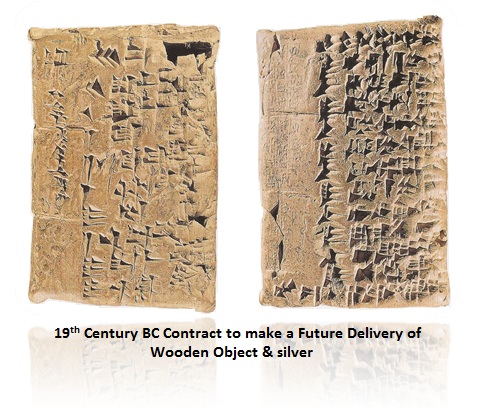
ANSWER: Only those societies that developed financial markets ever rose to greatness. Those who bash markets fail to understand that without them, most people would still be digging for potatoes. The evidence supports the first markets were futures markets which traded in Babylon, at least during the 19th century, since we have futures contracts from that period which have survived. All of the research I have conducted clearly demonstrates that economic growth is linked directly to the expansion of financial markets. Once there is a marketplace, then people will invest and economic growth will expand provided they know that if they needed to raise capital, they can sell their investments. Therefore, my research reveals that it takes CONFIDENCE in order to expand an economy and that translates into liquidity. Just look at this from your own perspective. You will buy a share in some company ONLY because you think you can make a profit. But how is that profit even attainable? The potential for a profit exists ONLY if there is a liquid market.
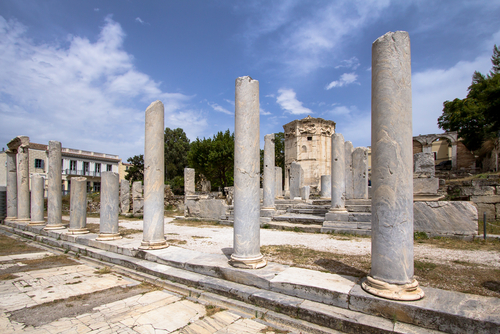
Agora, Athens
The Athenian economy had a financial marketplace in the Agora. There were bankers as well as insurance companies. Aristotle wrote about the people who made money from money. As the Athenian economy began to expand because of the introduction of financial markets, there was a transition of which Aristotle wrote about in his “Politics.” Aristotle believed that the Athenian economy was changing from what I call the Villa Model (Agricultural) of self-sufficient enclaves to an economy of market-driven incentives which encourage the production of excess for the purpose of trade giving rise to a Market Economy Model. Similarly, this was the same transition period emerging from feudalism. Once a financial marketplace emerges, then people will produce more if there is a marketplace where it can be sold.
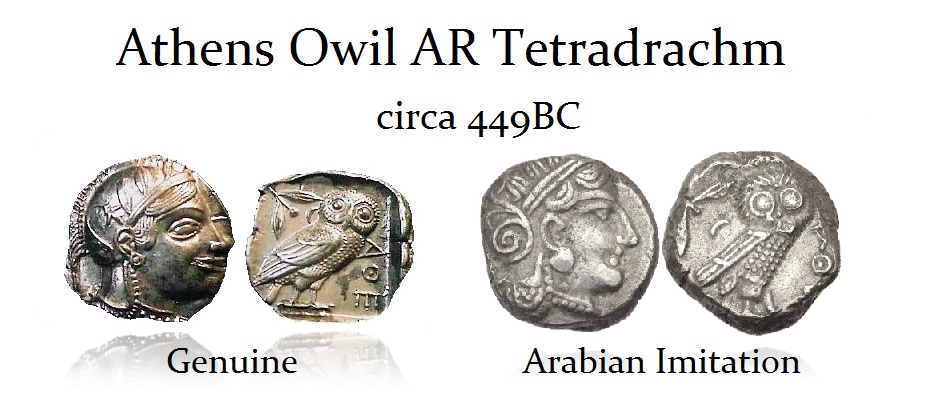
There are academics who have tried to breakdown the Athenian economy with such detail that they could not see the forest while focusing on the bark of just one tree. They read Aristotle’s “Politics” but missed the whole point of his concern — the transformation of Athens into the financial capital of the ancient world which even predated China. Some have argued that the ancient Greek word oikonomiais the root of our modern English word “economy,” but it is not synonymous with our definition of “economy” as we perceive it today. They argue that today “economy” refers to a distinct sphere of human interactions involving the production, distribution, and consumption of goods and services; oikonomia meant “household management” because it was guide written by Xenophon — how to manage your Villa Economy. They then mix in the political system of Greek Democracy and claim family activity was subsumed into traditional social and political institutions. They then go as far as to degrade the Greek monetary system, admitting that they produced and consumed goods, engaged in various forms of exchanges including long-distance trade among nations, and developed monetary systems employing coinage. This is all discounted by many academics arguing that they did not see such activities as being part of a distinct institution which we call the “economy.” I really see these arguments as gibberish where they have had way too much time to think and produce nothing. Instead, they get lost in their own thoughts. They lack a complete knowledge of the monetary history and fail to comprehend that Athens’ coinage was so dominant in the ancient world it was imitated in the north by the Celts, Slavic people, Asians, and even down in Arabia. That would never have taken place if it was so de minimis as they have tried to portray.
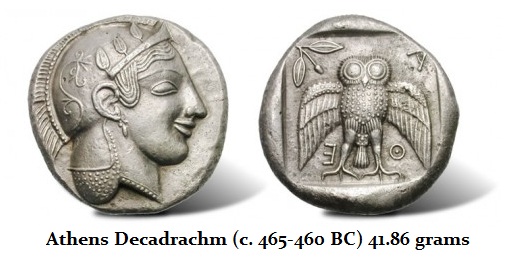
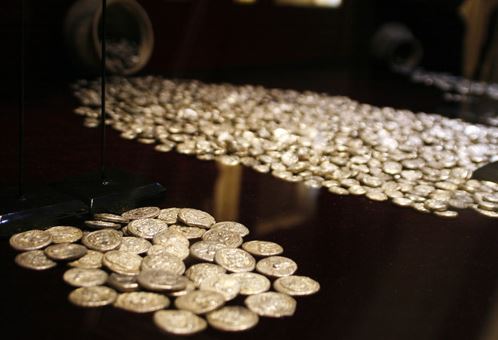
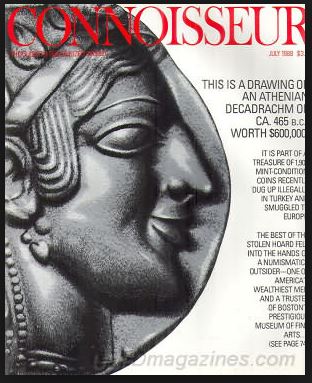
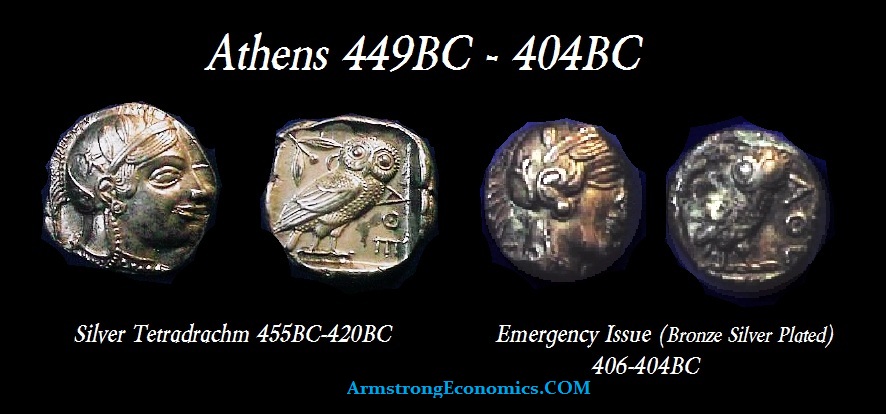
Athens produced the Decadrachm (10 drachmas) with a weight of nearly 42 grams. These coins would have been like 10,000 bills. They are very rare. Again, some academics tried to claim these were merely commemorative issues. They lack sufficient understanding of the world monetary system for these coins have rarely ever been discovered in Greece. Treasure hunters near the village of Elmali in southern Turkey unearthed a trove of ancient coins that included the rarest and most valuable Greek coins ever found. The coins, it said, were smuggled out of Turkey and sold to William I. Koch and two partners. It was the hoard of the century.
The Elmali Hoard was discovered around April 1984 containing nearly two thousand ancient Greek and Lycian silver coins. Turkish authorities contacted Interpol seeking international assistance to find and arrest the traffickers. In 1984, the consortium OKS Partners, which included Koch, purchased almost 1,700 of these coins for about $3.2 million. They began to sell the coins in 1987 and that is when the lawsuit was filed. The hoard was eventually returned to Turkey.
The significance of this hoard establishes that the Athenian Decadrachms were high denomination coins used in international trade. They are not found in Athens, but in ancient port cities around the Mediterranean coast. Some scholars claimed that the Athenian decadrachm is comparable to the more abundantly produced Syracusan decadrachm, which was minted around the same time. However, the Syracuse decadrachm was also minted for celebratory and practical purposes. The Syracuse minted their decadrachms in response to their defeat of the Carthaginians and they attempted to try to argue this was the same reason behind the Athenian decadrachms.
Numismatists have identified 24 separate reverse dies used for one issue of Syracusan decadrachms by created by the artist Euaenetus. This suggests that a minimum original circulation of just this issue would have been between 240,000 and 360,000 coins with a modern survival rate ranging between .08% and .25%. The Athenian decadrachm was used in international trade when they were attaining timber and metals from the Near East. The majority of Athens was composed of farmers who would never have a need for a decadrachm. The decadrachm became obsolete by the time of Pericles and Democracy for Athens was losing its supremacy and lost in war to Sparta. In fact, during the Peloponnesian War (431–404 BC), Athens lost its silver resources and began to issue its coins merely silver plated.
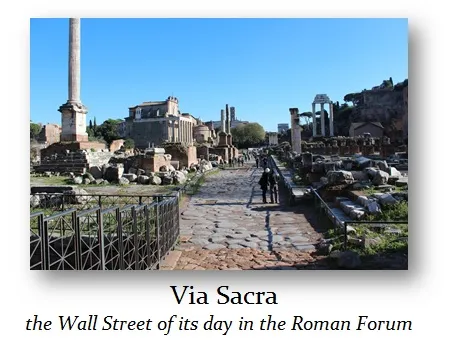
Therefore, both the Athenian and Roman economies began to expand into sophisticated agricultural-based economies only with financial markets. This is how the economies emerged from a Villa Model of self-sufficient enclaves as was also the case in feudal times into a integrated market economy which led to international trade and the birth of Mercantilism. Rome did not have a national debt nor did it possess a central bank. Consequently, there was a deep financial market which would also take place in the Roman forum along the Via Sacra — the Roman version of Wall Street.
Most people assume that the invention of corporations really began with the East India Company since it was the first share to begin trading in the 1500s. However, there were plenty of early examples of markets which were similar to stock markets. Even during the 1100s, France had a system where courretiers de change managed agricultural debts throughout the country on behalf of banks. This can be seen as the first major example of financial exchange because the men effectively traded debts — bonds. Later, the merchants of Venice were credited with trading government securities as early as the 13th century. Post-Dark Age, the first trading in any type of financial marketplace was confined to debt instruments rather than corporate shares.
What is typically overlooked is that the first public corporation concept is truly attributed to also the same man who gave us the word “economics” from the title of his book, “Oikonomikos” meaning actually how to regulate the household – Xenophon (431 – 350 BC). Xenophon was a student of Socrates. He became a mercenary and was the leader of the famous “Ten Thousand” (of recent movie epic). He was opposed to extreme democracy that sentenced Socrates to death. His last writing in 355 BC was his “Ways and Means” that advocated peace rather than war that destroyed the economy (yes, Congress’ committee is named after his work – Ways & Means Committee). Xenophon was not a philosophic intellectual, but rather a practical man of action who wrote from experience.
Xenophon proposed a public corporation for a bank that would be formed by shares subscribed to by all the Athenian people. Commerce was seen as more important than even agriculture. Xenophon proposed a public bank that would lend at interest to expand the economy. He proposed that the profits would be used to pay for public works. During the reign of Augustus (27 BC-14 AD) in Rome, there was such a public loan bank, but not subscribed to by individual members of society. This public bank provided loans to the poor without interest and it was funded by the confiscation of property from those alleged to be criminals, which would include political dissents as well. Collateral was required at twice the amount being borrowed. These types-of public banks aided the purchases of land.
The word “corporation” derives from corpus, the Latin word for body, or a “body of people.” By the time of Justinian (527–565 AD), Roman law recognized a range of corporate entities under the names universitas, corpus or collegium. These included the state itself (the Populus Romanus), municipalities, and such private associations as sponsors of a religious cult, burial clubs, political groups, and guilds of craftsmen or traders. Therefore, these bodies of people commonly had the right to own property and make contracts. They could also receive gifts and legacies, to sue and be sued. They could perform legal acts through representatives as well. Private associations were granted designated privileges and liberties by the emperor and these are the origins of corporations.
Roman knights of the republic did invest in small business and they would receive a share of the profits. These were contracts which could be resold to someone else, but they did not trade on an open exchange. Likewise, senators would also invest in land and gain a portion of the harvest as their return on investment. Trading in shares of corporations really materialized in the 1500s, but the Roman and Greek systems would be more like venture capital and private placements.
By Dinah Wisenberg Brin
The Associated Press Philadelphia
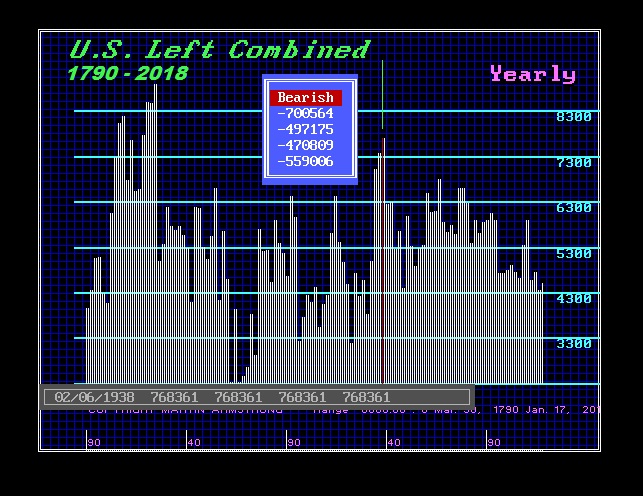
The political upheaval of 1994? They saw it coming two years ahead of time. The devastating Japanese earthquake? They’d been expecting it, albeit a year earlier….President Herbert Hoover … might be pleased with board Chairman Martin Armstrong’s prediction of the extinction of the Democratic Party after 2020.
In late 1992, Armstrong accurately predicted either “a sweeping Republican victory on Capitol Hill” or a victory for a independent party in 1994.
QUESTION: Mr. Armstrong, I found an article from February 21, 1995, in the Associated Press that you had also correctly forecast the elections back in 1994 which became known as the Republican Revolution and warned that the Democratic Party could ride off into the sunset. Your forecast on Trump and BREXIT also show your computer is on to something. Will you be doing the elections in 2020 at the Orlando WEC?
CM
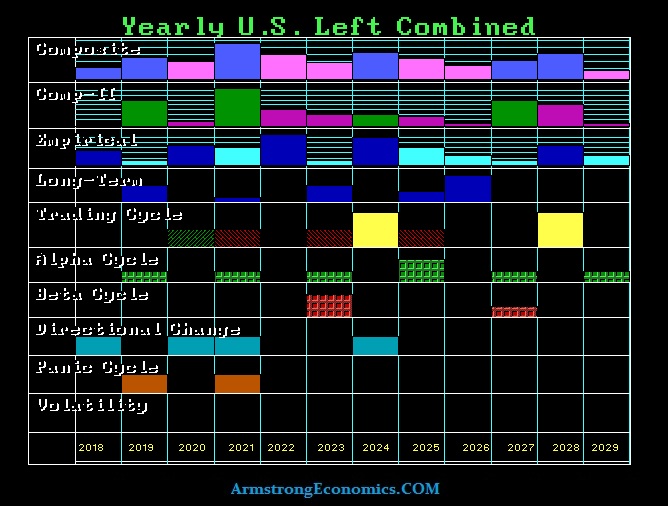
ANSWER: People do not understand that it is not the cycle by itself; it is a reflection of the trend of the whole. The crisis in the Democratic Party is reflected in the turmoil from the Squad of Four who are receiving all the press and painting the Democratic Party as the extreme left. Then you have Bernie Sanders and Elizabeth Warren. They are just not in the center, to say the least. This raises the potential for a major shift in the political system as we saw with Trump wiping out career politicians in the Republic Party. You can see the Array on the Democrats (Combined Senate/House) showed a Panic Cycle in 2019 which gave them the House, but the big turning point will be the 2020 elections with a Panic Cycle due there as the result in 2021.
Yes, we will be doing political forecasts at the WEC.
Rally Time! Tonight President Trump travels to Cincinnati, Ohio, for a MAGA rally at U.S. Bank Arena. The President is expected to deliver remarks at 7:00pm EDT with pre-rally events and speakers ongoing.
I have created this site to help people have fun in the kitchen. I write about enjoying life both in and out of my kitchen. Life is short! Make the most of it and enjoy!
This is a library of News Events not reported by the Main Stream Media documenting & connecting the dots on How the Obama Marxist Liberal agenda is destroying America



 Centinel2012