The Broken Bond Market – All Noise, No Signal


Tyler Durden's picture

Via Global Macro Monitor blog,

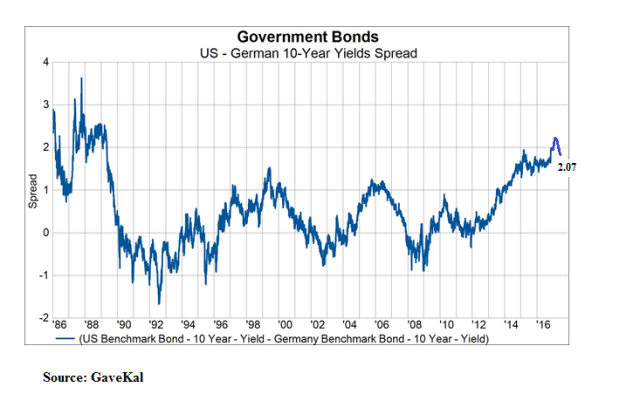
The Fed tightens on Wednesday and bonds rally.  What the hay?

GaveKal, Jeff Gundlach,  and Jim Bianco nailed it in that every spec and their mother are/were short 10-year Treasuries.
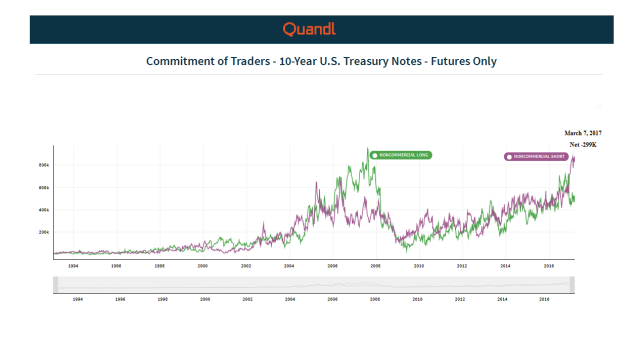
Source: Quandl (see here for interactive chart)

But this is only a small part of the story:  The global bond markets are broken.

There are no signals, there is no noise.  Trying to infer any sense of economic or financial information from bond yields is futile.

QE Distortion

The intervention into the bond markets by central banks through quantitative easing (QE) in the big four sovereign bond markets – U.S., Japan, Eurozone, and UK – has created a structural shortage of risk-free instruments and distorted the most important price in the world — the yield on 10-year hard currency sovereign bonds.

Furthermore, past QE in the U.S, coupled with the recycling of foreign capital flows back into the U.S. bond market, has, in particular, created an acute structural shortage of longer-term Treasury securities.  The totality of short positions of the fast money in both the cash and derivatives market are probably a much larger proportion of the effective float of longer-term marketable Treasury securities than what the market currently perceives.  Hence the stickiness of U.S. bond yields.

Fed and Foreign Ownership of the U.S. Yield Curve

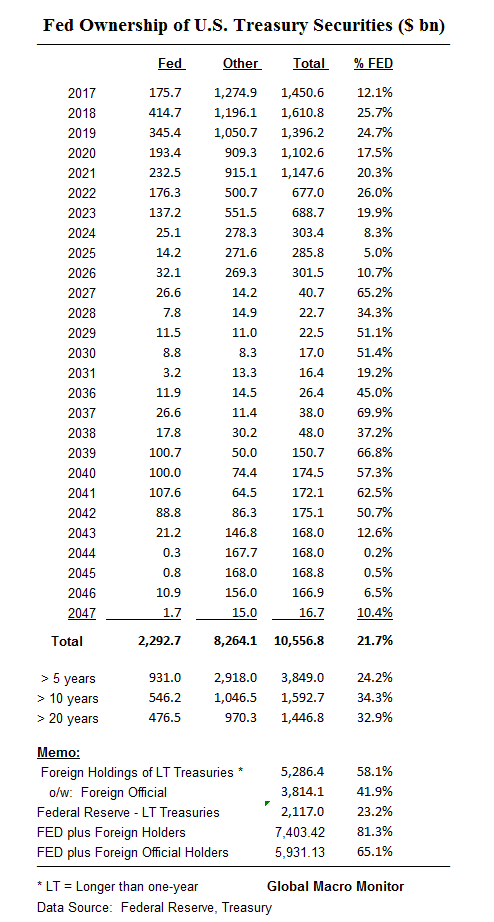
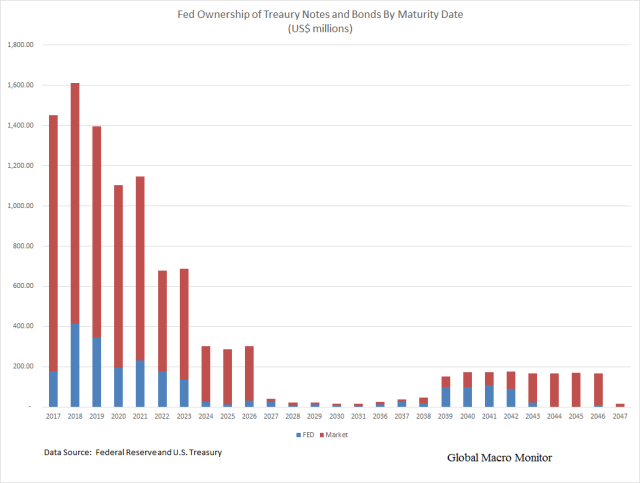
The table and chart below illustrate just how small the actual float of longer-term marketable U.S. Treasury securities is available to traders and investors.  The data show the Fed owns about 35 percent of Treasury securities with maturities 10-years or longer.  Note the data only include notes and bonds and excludes T-Bills.

The Fed’s holdings combined with foreign ownership of longer maturities — more than 1-year — exceeds 80 percent of marketable Treasuries outstanding.   The Fed combined with just foreign official holdings, mainly, foreign central banks,  is 65 percent of maturities longer than 1-year.  Thus, almost 2/3rds of tradeable Treasuries longer than 1-year are held by entities with no sensitivity to market forces.

Note, the Treasury International Capital  (TIC) data does not break down foreign holdings by year of maturity, only by short-term and long-term – that is, greater than 1-year.
.

.
Foreign Holding of Treasuries

We hear a lot these days about a 1994 bond market debacle.  We lived through that bond bear and it wasn’t fun.   However, the microstructure of the Treasury market  is entirely different today than it was back then.

First,  the Fed did not hold long-term Treasuries.   Second,  foreign holdings of Treasuries were only about 15 percent of the outstanding debt versus around 50 percent today and everybody, including, Ross Perot, who said the trade was “a no brainer”,  were levered long riding the yield curve – short short-term, long long-term.

Foreign inflows,  mainly the result of the recycling of U.S. current account deficits,  resulted in Alan Greenspan’s bond market conundrum and the Fed losing control of the yield curve just prior to the 2007-08 financial crisis.

In this environment, long-term interest rates have trended lower in recent months even as the Federal Reserve has raised the level of the target federal funds rate by 150 basis points. This development contrasts with most experience, which suggests that, other things being equal, increasing short-term interest rates are normally accompanied by a rise in longer-term yields.

…In the current episode, however, the more-distant forward rates declined at the same time that short-term rates were rising. Indeed, the tenth-year tranche, which yielded 6-1/2 percent last June, is now at about 5-1/4 percent. During the same period, comparable real forward rates derived from quotes on Treasury inflation-indexed debt fell significantly as well, suggesting that only a portion of the decline in nominal forward rates in distant tranches is attributable to a drop in long-term inflation expectations.

Alan Greenspan,  Feb 2005

A paper published by the Federal Reserve Board (FRB) in 2012 estimated the impact on interest rates of the capital flow recycling into the U.S. bond market,

We find that a $100 billion increase in foreign official inflows into U.S. Treasury notes and bonds lowers the 5-year yield by roughly 40 to 60 basis points in the short run. However, our VAR analysis shows that in the long-run, when we allow foreign private investors to react to the effects induced by a shock to foreign official holdings, the estimated effect is roughly -20 basis points per $100 billion. Putting these results into context, between 1995 and 2010 China acquired roughly $1.1 trillion in U.S. Treasury notes and bonds. A literal interpretation of our long-run estimates suggests that if China had not accumulated any foreign exchange reserves during this period, and therefore not acquired these $1.1 trillion in Treasuries, all else equal, the 5-year Treasury yield would have been roughly 2 percentage points higher by 2010. This effect is large enough to have implications for the effectiveness of monetary policy. – FRB

Extrapolating the above analysis to the current stock of foreign official Treasury holdings of around $4 trillion leads to nonsensical results, such as the 5-year yield should be 800 basis points higher than it is today.   Obviously, the analysis should truncate the dependent variable – 5-year note yield — and ceteris paribus (other things being equal) does not hold in the real world.

But we should not miss the article’s main point that market interest rates would be much higher if not for foreign central bank interventions into their FX markets and the recycling of those reserves back into the Treasury market.    We take the above analysis seriously but not literally and wonder if the Trump Administration considers it when they rail on “so-called” currency manipulators.

The Yield Curve During Monetary Tightening

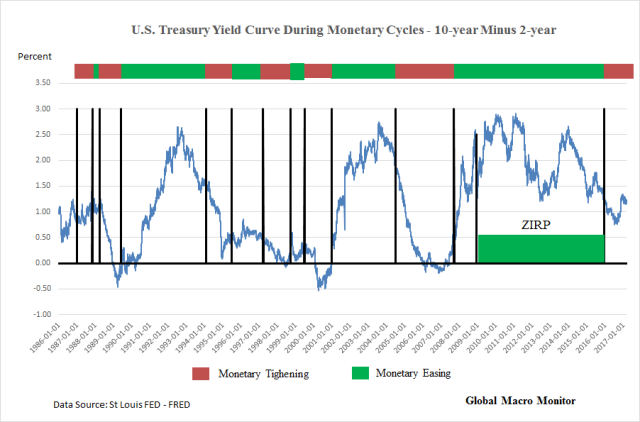
We have looked at the data and constructed some charts that show that in monetary tightening cycles in the U.S. the yield curve (10-2 years) usually flattens.
.

In only two of the past six prior tightenings did the 10-year bond rise in yield from the day of the first tightening to the day of the first easing.  This is entirely possible due to the fact the Fed often “tightens until something breaks” and the bond market front runs the expected easing cycle.

During the 2004-07 tightening cycle,  the era of the Greenspan bond market conundrum,  for example, the 10-year yield managed to rise only a maximum of 64 bps during the entire cycle from a beginning yield of 4.62 percent to a cycle high yield of 5.26 percent.   This as Greenspan raised the fed funds rate by 4.25 percent, from 1.0 percent to 5.25 percent.

Was the market forecasting the coming financial crisis?   Hardly.

Alan Greenspan blames the Fed’s loss of control of the yield curve, mainly due to the recycling of capital flows by foreign central banks,  as a major cause of the housing bubble.  Notice the importance of the 10-year yield on the allocation of resources and on how its distortion can be at the root of financial and economic bubbles.

This Time Is Different

Those dreaded words, “this time is different.”   We should warn readers that this time is truly different, however.   When the Fed first raised interest rates in December 2015, for example, the 10-year yield was at 2.24 percent and more than 50-75 percent lower than at the beginning of any other monetary tightening cycle over the past 30 years.  There are many “unprecedents” in this cycle and therefore more uncertainty.

.

Forecasting With The Yield Curve

Given the technical distortion of the bond market, we find it kind of silly with statements such as “what is the bond market telling us?”   Nothing!

There is no price discovery.  Given the intervention and distortion to bond yields caused by the Fed and foreign central banks, who knows what the right interest rate is for longer-term Treasury securities.

We will never forget the words of a prominent market strategist when rates were super depressed.

“ We’re in a depression. That is what the bond market is telling us.”

Even at the Friday close,  we hear equity traders are worried about why the 10-year yield is so low and fell after Wednesday’s Fed tightening.

Information Feedback Loops

One of just many dangers of the lack of price discovery in the bond market is the potential formation of positive feedback loops, where other markets fail to discount these distortions and act accordingly.   That is, for example, the equity markets sell off because they freak out interest rates are declining when they should be rising.  Or the private sector fails to invest in CapX as they wrongly anticipate an economic downturn because of falling or excessively low bond yields.   Their actions thus become a self-fulfilling prophecy.

A flatter than normal yield curve could also adversely affect bank lendingLook at how financial stocks have been underperforming recently as the yield curve has flattened about 7 bps this year.

Conclusion

Welcome to Bond Market Conundrum 2.0.

Asset prices are artificially elevated and foreign exchange rates are distorted due to the repression of the risk-free interest rates because of lack of supply.   Capital has been misallocated and the Fed has once again lost control of the yield curve simply by the very fact it owns the yield curve.

Monetary policymakers probably won’t regain control of the yield curve until they begin to reduce their balance sheets and the supply/demand balance moves closer to equilibrium.

That’s when we suspect everybody and their mother will front run the central bank selling and we will have the real bond market debacle some in the market have been expecting. Will or can that day ever come?  We don’t know.

Of course,  governments could go on a tax cut/spending binge and increase the primary supply of government bonds.   Possible but doubtful and a longer term story,  if any.

Until then?   We still believe bonds are in a slow bleed bear market, which will see fits of massive nutcracking short covering, as interest rates slowly drift higher.

Remember,  there are no signals, there is no noise.   Here’s to hoping the markets understand that.

A Few Caveats

The data points presented above should be taken as rough, but good, approximations.  The dates of each source of data may differ and the same is true for the different data sources.

Furthermore, we may be entirely wrong in our conclusions.

Abraham Lincoln used to tell a story as a young Illinois circuit court lawyer when trying to convince the jury to render a verdict in his favor.

The story goes that Lawyer Lincoln was worried he had not convinced the jury during the closing argument of a civil case against a railroad.   The jurors had gone to lunch to deliberate.  Lincoln followed them and interrupted their dessert with a story about a farmer’s son gripped by panic,

“Pa, Pa, the hired man and sis are in the hay mow and she’s lifting up her skirt and he’s letting down his pants and they’re afixin’ to pee on the hay.” “Son, you got your facts absolutely right, but you’re drawing the wrong conclusion.”

The jury ruled in Lincoln’s favor.

Similarly, when looking at data and charts — the facts —  we often draw the wrong conclusion about future direction.

Stay tuned.

Data Appendix
Morgan Stanley: “Only One Thing Will Allow Central Banks To Keep The Party Going”


Tyler Durden's picture

Last week, we presented readers with the latest note from SocGen strategist. Albert Edwards, who explained why after so many years of false rate hike starts, the market not only responded to last week’s hike in a dovish manner – interpreting last Wednesday’s 0.25% hike as a 0.25% rate cut- but as Goldman Sachs showed previously, the dovish reaction was one of the strongest ones since the financial crisis, in other words: “the market no longer believes the Fed.” This is what Edwards said, citing his FX colleague Kit Juckes:

[T]he Fed’s reluctance to send an aggressive tightening signal, instead preferring to again shuffle upwards its dots just slightly, has disappointed markets. But to be fair, the problem isn’t really with the famous dots. It’s with the market, which just doesn’t believe the Fed will tighten as fast as they say they plan to (see left-hand chart below). If the market took the FOMC at their word and discounted a 3% Fed Funds rate at the end of 2019 and beyond, then we’d probably have a 3% nominal 10-year Treasury yield by now.”

That said, a 3% Fed Funds rate would also lead to steep selloff in risk assets as the dividend yield on the S&P, currently at about 2%, would be about 1% below the risk free rate, leading to a wholesale “great rotation” out of stocks.

And while the market may not believe the Fed is ready – and willing – to push rates that high, the relationship also cuts both ways.

As RBC also noted last week, explaining that while the Yellen put is alive and well, the market will simply not tighten financial conditions on its own, forcing Yellen to aggressively hike further… which the Fed may be reluctant to do.

That is the argument in a note released late last week by Morgan Stanley’s credit strategists, who note that while the party is still going strong, some 93 months into the current cycle, it may not continue should the Fed engage in an aggressive rate hike scenario. This is what they say:

At 93 months, the current cycle is already longer than all but two post-war recoveries (out of 12 total). We could certainly debate why this expansion is already longer than normal, but strong growth is clearly not the reason. In fact, quite the opposite – a lackluster economic backdrop for years, leading to massive central bank support,has likely kept the cycle going more than anything else. Last year is a good example. As we show below, early in the year, with oil collapsing and the economic data rolling over, recession risks were seemingly rising. As Exhibit 3 shows, central banks across the globe responded. Even the Fed provided stimulus (verbally) by allowing the market to go from pricing in almost three rate hikes at the end of 2015 to almost zero rate hikes in summer 2016. Markets recovered, and the economic data followed.

What is Morgan Stanley’s conclusion? Simple: for the party to continue, not only must the Fed revert back to its quasi-dovish mode, but for that to happen the recent economic “rebound” has to end (the sooner the better), extinguishing any reflationary impulse, removing the impetus for Yellen to hike aggressively further, and allowing the Fed to remain on hold for an indefinite period of time.  In short: “In our view, for the cycle to last another several years, we want to see more of the same – a continued environment of ‘ok’ growth and low inflation, which allows central banks to keep the party going.”

Hopefully Trump, whose policies threaten to upstage this delicate balance benefitting the 1%, has read the memo.

KOMMONSENTSJANE – FEAR, HOPE AND DEPORTATIONS


This is going to be a tough battle to fix the mess the Democrats have made and who refuse to help fix that disaster.

kommonsentsjane's avatarkommonsentsjane

Fear, hope and deportations

Rosa Maria Ortega near her home in Grand Prairie, Tex., outside Fort Worth. “I voted like a U.S. citizen,” she said. “The only thing is, I didn’t know I couldn’t vote.”

A Texas woman ‘voted like a U.S. citizen.’…

This is a joke – this women is playing dumb – why didn’t she ask at the voting table?

It is time to have a cut off date for “anchor” babies.
The Washington Post

Mary Jordan, Kevin Sullivan

VALLEY VIEW, Tex. — At 4:30 a.m. on a windy Monday, Tamara Estes swallows vitamin B12 for energy and krill oil for her arthritic fingers. Even with her nightly Ambien, she is always up before the sun, getting ready for a job that reminds her of what infuriates her about America.

She drives a school bus on a route that winds through a North Texas neighborhood filled with undocumented…

View original post 2,828 more words

KOMMONSENTSJANE – The ILLUMINATI: REVISITED — Arlin Report


Kommonsentsjane is 100% right

kommonsentsjane's avatarkommonsentsjane

http://www.bibliotecapleyades.net/sumer_anunnaki/reptiles/reptiles115.htm Not an anyone can join membership. They pull new members from around the globe. Global is a popular word for the Illuminati; it’s what they are about; and achieving one ruling class globalization is their goal. They really love celebrities, The Madonnas, Beyoncé, Clooney, Gaga Yes they go gaga over Hollywood […]

via The ILLUMINATI: REVISITED — Arlin Report

Reblogged on kommonsentsjane/blogkommonsents.

It is time for America to put them in their place – they are not elected for any position.  It is of their own making in which they consider themselves so important.  The money they are using for this globalization has been stolen somewhere down the line – one hint is they cheated on their taxes or if they worked for the government – it was through corruption and money gained illegally.

We have to learn to dismiss them, especially the Hollyweeds!

kommonsentsjane

View original post

Sunday Talks: Press Secretary Sean Spicer Interview With Howard Kurtz…


Source: Sunday Talks: Press Secretary Sean Spicer Interview With Howard Kurtz…

Sunday Talks: OMB Director Mick Mulvaney…


Source: Sunday Talks: OMB Director Mick Mulvaney…

Melting Snowflakes?


Its going to be hard but the budget does need to be cut down.

KOMMONSENTSJANE – IS JUDGE AND OBAMA IN THE SAME HAYSTACK #2


It is strange how things work out with Obama isn’t it.

kommonsentsjane's avatarkommonsentsjane

OBAMA WENT JUDGE SHOPPING AND IS STILL WORKING TO HURT THE AMERICAN PEOPLE.

Obama and his shadow government rushes to Hawaii and guess what – his judge roommate at Harvard –  who lives in Hawaii –  rules against the American people’s order by President Trump to keep our country safe.  He did not rule by the Constitution but by Obama, the shadow government, and the judge’s ideology and working against the American people.

Again, as I stated –  we have found that Obama and this judge in Hawaii were friends and room mates at Harvard.  This judge and the judge in Maryland need to be impeached.  Their ruling WAS NOT based on the four corners of President Trump’s order but HEARSAY FROM THE CAMPAIGN AND on Obama’s urging and complicit backing to hurt the American people.

It is time for Congress to do their job and impeach these to two…

View original post 708 more words

Ann Coulter on The Mark Simone Show (3/17/2017) – YouTube


The Long Run Economics Of Debt Based Stimulus


Tyler Durden's picture


Onward vs. Upward

Something both unwanted and unexpected has tormented western economies in the 21st century.  Gross domestic product (GDP) has moderated onward while government debt has spiked upward.  Orthodox economists continue to be flummoxed by what has transpired.

What happened to the miracle? The Keynesian wet dream of an unfettered fiat debt money system has been realized, and debt has been duly expanded at every opportunity.  Although the fat lady has so far only cleared her throat (if quite audibly, in 2008) and hasn’t really sung yet, it is already clear that calling this system careening toward a catastrophic failure.

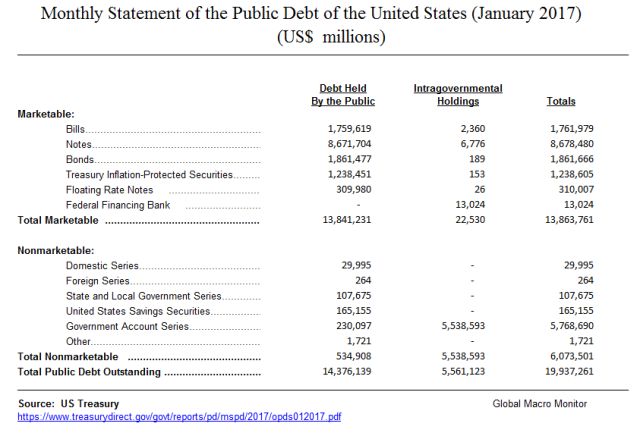
Here is the United States, since the turn of the new millennium (starting January 1, 2001) real GDP has increased from roughly $10.5 trillion to $18.6 trillion, or 77 percent.  Over this same time government debt has spiked nearly 250 percent from about $5.7 trillion to $19.9 trillion.  Obviously, some sort of reckoning’s in order to bring the books back into balance.

Throughout this extended episode of economic and financial discontinuity, the government’s solution to jump-starting the economy has been to borrow money and spend it.  Thus far, these efforts have succeeded in digging a massive hole that the economy will somehow have to climb out of.  We’re doubtful such a feat will ever be attained.

In short, additions of government debt over this time have been at a diminishing return.  Specifically, at the start of the new millennium the debt to GDP ratio was about 54 percent.  Today, it’s well over 100 percent.

US GDP and US federal debt, indexed (1984 = 100). Mises noted back in the late 1940s already that “it is obvious that sooner or later all these debts will be liquidated in some way or other, but certainly not by payment of interest and principal according to the terms of the contract.”  If it was obvious then, it is glaringly obvious today. Greece and Cyprus demonstrated what happens when modern socialist welfare states have no independent access to a printing press and are thus unable to extend and pretend in the traditional Keynesian way. The Potemkin village disintegrates on the spot at the first whiff of suspicion. All the nations that have postponed the reckoning by printing money and the flight forward mechanism of amassing even more debt have simply made the eventual denouement more profound – click to enlarge.

The idea that the government could spend borrowed money to grow the economy out of debt has become patently ridiculous.  Nonetheless, government economists continue to advocate these policies because, academically, they have no other alternatives.  At the same time, politics may now conspire to push the U.S. government into debt default.

Arrested Development

This week the Obama administration’s debt ceiling suspension expired, and a debt ceiling of $20.1 trillion was triggered.  This reestablished debt ceiling is just a horse’s hair above the U.S. government’s current debt level.  Furthermore, getting the debt ceiling lifted will likely require an epic Congressional battle, including elaborate displays of Kabuki theater.

There’s a possibility a new debt ceiling agreement won’t be reached before the Treasury’s money runs out sometime in late-summer or early-fall.  This would put the U.S. government in a position of not being able to pay its debts.  At a minimum, even if some Congressional deal’s worked out at the 11th hour, the full faith and credit of the U.S. government will be tarnished.

Best case, a timely debt ceiling resolution will cut into President Trump’s plans to boost the economy by borrowing money and spending it on infrastructure and defense.  This will also cut into his plans to reduce taxes.  A stumble in either of these areas could prompt a long overdue stock market panic.

The debt ceiling could become a real problem this time, as the treasury has massively drawn down the cash balance it amassed by issuing humongous amounts of debt to US money market funds in 2016. In the final quarter of 2016, i.e., the dying days of the Obama administration, the federal deficit exploded by a stunning 208 billion dollars – click to enlarge.

The fact is, perpetual economic growth is required to sustain life as we know it in today’s debt-driven economic social order.  Any slight blip, such as 2008, massively disrupts the lives of hundreds of millions of people.  What’s more, economic growth must be at a level where the plebs believe they’re adequately reaping the fruits of their labors.

What that rate of economic growth happens to be is uncertain.  But so far the U.S. economy of the 21st century has failed to attain it.  What is known is that an economy that expands at 3 percent annually, will double the average living standard every 24 years.  In contrast, an economy that expands at an annual rate of 2 percent, will take 36 years to double the average living standard.

The average annual rate of real GDP growth of the U.S. economy in the 21st century has been at a 1.78 percent state of arrested development.  The average annual rate of real GDP growth of the U.S. economy for the 16 preceding years was 3.43 percent – nearly double.  Alas, it has been 12 years since the U.S. economy’s eked out a single year of 3 percent GDP growth.

In spite of statistical distortions reaching fresh heights of absurdity year after year (their goal is generally to make “inflation” look smaller and GDP larger than they really are), economic output as measured by GDP is seemingly on a permanent downward trajectory. Many European countries look even worse. For instance, France had strong growth for more than two decades after WW2, but it collapsed thereafter. Today, government spending in France accounts for 58% of GDP and the country’s microscopic growth rates have become downright embarrassing. But don’t worry, Europe’s political elites and bureaucrats continue to prosper! – click to enlarge.

The Long Run Economics of Debt Based Stimulus

“In the long run, we are all dead,” said 20th Century economist, John Maynard Keynes.  This, in a nut shell, was Keynes’ rationale for why governments should borrow from the future to fund economic growth today.  Why wait for recessions to do the work of equilibrating the economy when a little counter-cyclical stimulus can push growth onward and upward?

J.M. Keynes is certainly dead, but we are still alive and can rightly be referred to as his victims. Keynes is often depicted reading a book, but evidently he must have read the wrong book. And all those who assert that he “didn’t really mean it this way or that way”  should perhaps take the time to read what he wrote. Keynes really was a Keynesian!

Of course, attempting to spend a nation to prosperity using borrowed money is not without consequences.  In the short run, an illusion of wealth can be erected.  In the long run, that illusion slips into decay and disrepair.

Over the past week we’ve been roaming the streets of Mexico City, visiting family and conducting  field research on your behalf.  In particular, we’ve been investigating the chronic effects of what happens when a government spends too much borrowed money, and then attempts to lighten its debt burden by inflating its currency. 

What follows a brief summation of our findings.

On surface, what happens is what you’d expect.  The currency gets utterly destroyed.  This has the effect of blowing the price of just about everything – especially imports – through the roof.  But it’s what happens after which is less obvious.  For the ill-effects of a debased currency express themselves in asymmetric ways.

On a Saturday afternoon walk through the historic city center along Avenida Francisco I. Madero between El Zócalo and the Palacio de Bellas Artes we were greeted with the appearance of consumer prosperity.  Bustling crowds of shoppers made their way through the chic fashion stores that are interspersed between historic 17th and 18th century colonial mansions and buildings.  Modern skyscrapers were in the distance.

Similarly, during a Friday night visit to El Moro, the famous churro and chocolate restaurant that has been in operation since 1935, we encountered a line extending out the door and down the street.  Customers were dressed to impress.  There was hardly a hint of economic hardship about the place.

The original El Moro outlet in Mexico City.

But venture outside the most inner streets of the city’s center and the conditions quickly deteriorate.  An endless sea of multilevel residential dwellings mixed with commercial and industrial properties in varying degrees of decay extend for miles and miles across the high altitude Valley of Mexico.  It appears that, perhaps 50 or 60 years ago, these structures were clean and well-kept.  However, that was before crumbled concrete and exposed rebar became the norm for these vast residential dwellings.

Contrary to what Keynes posited, counter-cyclical debt based stimulus didn’t produce the nirvana of rising long run living standards.  Rather it produced the disparity of stagnating GDP and rapidly rising government debt.  Later it produced the hell of declining living standards over the long run.

The truth is, in the long run we’re not all dead.  Actually, some of us are still here, living with the consequences of shortsighted economic policies.

Residents of Mexico know this all too well.  In the United States, the scope and magnitude of debt has been able to support an illusion of prosperity.  Still, as far as we can tell, many residents are experiencing the transformation of small pockets of slums into vast expansive ghettos.

Storing up a small hoard of gold and silver bullion may’ve never been more critical than the present, in the off chance the inevitable dollar debasement comes sooner rather than later.  So, too, one would be well advised to develop a side hustle now.  From our observation, everyone in Mexico City was working… though many didn’t have jobs.

On Monday we traveled north of the city limits to the ruins of the ancient pre-Aztec city of Teotihuacán.  There we climbed up the Pyramid of the Sun and into the open areas of the Pyramid of the Feathered Serpent.  We walked the Avenue of the Dead toward the Pyramid of the Moon.

Teotihuacán – view from the pyramid of the moon. Aztec priests once ripped out the hearts of sacrificial victims to appease their gods (among those in need of appeasing were Huiztilopochtli, the god of war and the sun, Tlaloc the rain god and not to forget, good old Xipe, a.k.a. “Our Lord, the Flayed One”, god of sacrificial pain and suffering. And you should see their mama… (wait for it). The Aztecs had a god for everything, so there was a lot of sacrificing to do.

At its peak, around 450 AD, Teotihuacán was the largest city in the pre-Columbian Americas, with a population estimated at 150,000.  Yet by the 6th century the population began to decline and the city ceased to exist sometime in the 7th or 8th century.  No one quite knows what happened.

Well, here she is… Coatlicue, the primordial earth goddess, mother of the gods, the sun, the moon and the stars. Judging from her teeth, this multi-tasker was a carnivore.

One theory is that the city’s decline coincided with an extended drought.  Another is that there was an internal uprising.  Maybe a 99 percent situation developed. We kicked a few rocks.  We put our ears to the ground.  We looked.  We listened.

The spirits didn’t answer.  They didn’t have to.  We’d already seen and heard enough.