Birth of a Black Hole 4K


Premiered 16 hours ago

This show was converted to 4K/UHD using an AI program. What do you think? For the best collection of 4k Space-Science content, go to…

The Riddle of AntiMatter


Published on Aug 19, 2011

This SpaceRip video is brought to you by MagellanTV https://magellan.tv/spacerip

There’s No Such Thing As An Unregulated Market


Published on Nov 16, 2017

We all want the safety and dependable quality that “regulation” is supposed to provide. Government can provide it to some extent, but markets can do it better, if we let them. Howard Baetjer of Towson University explains.

The International Unit of Account


QUESTION: I only recently learned of your material and am still digesting it. I appreciate that you encourage critical thinking. I hope you find my questions of the same spirit.

In your recent article “Are Two-Tier Monetary Systems a Possible Tool?”, you illustrated how South Africa’s experience could provide an example for nations wanting to untangle their domestic currency from global obligations (i.e., US dollar, presumably others too).
Would you mind elaborating on this concept in relation to the following questions?

My questions:
1) For this 2-tier approach to work, must every nation have a 2-tier money system, or would it suffice to have only the major players do so (i.e., USA, EU, etc)?
2) If every nation had a 2-tier money system, then how would that compare and contrast to a “global SDR” or some other global, non-national currency acting the reserve currency?

I suppose what I am really asking is: Imagine a collection of nations and each nation has a 2-tier system. The nations agree to use each other’s “external” tier when dealing with each other and keep the “internal” tier for solely domestic purposes. Instead, now imagine that same collection of nations decided they would each use a global, non-national currency (SDR or otherwise) as the global reserve currency.

What similarities and differences would these 2 different approaches yield? Are there certain conditions where 1 approach would be desirable over the other approach?

I find this subject both intriguing and very relevant, so I would like to hear your insight.

Thank you for the new (to me) material.

C
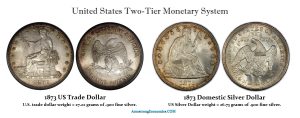
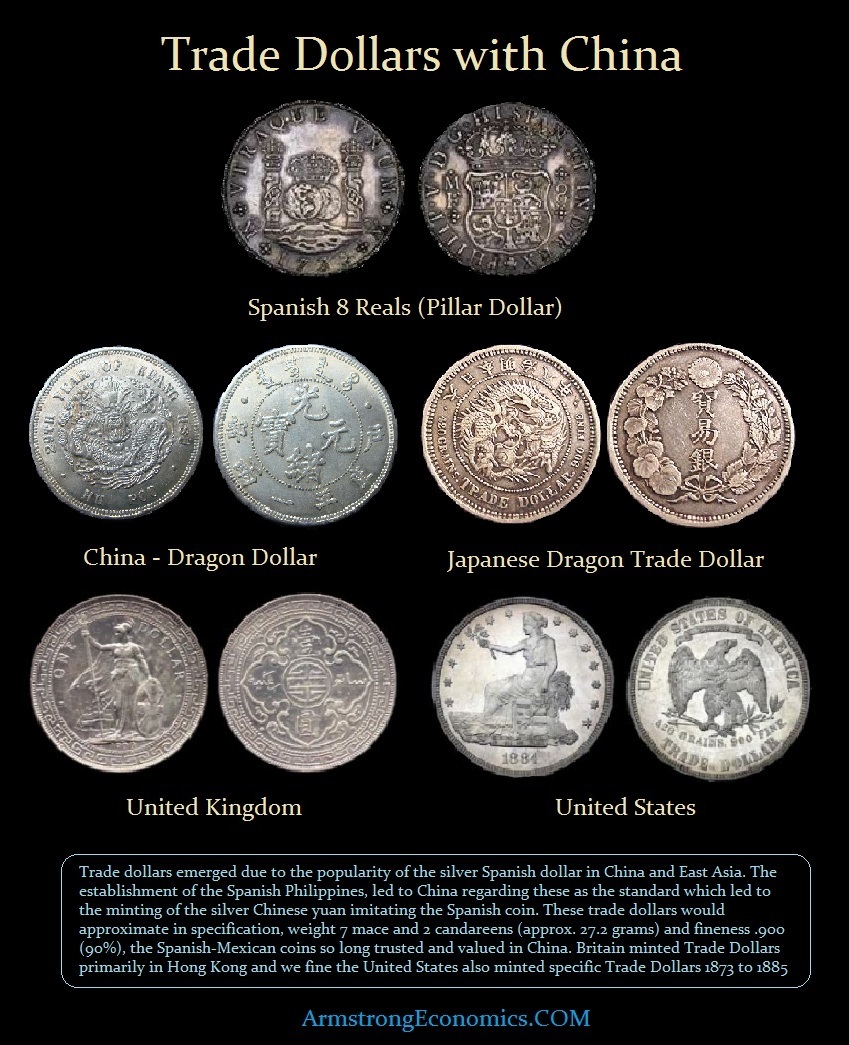
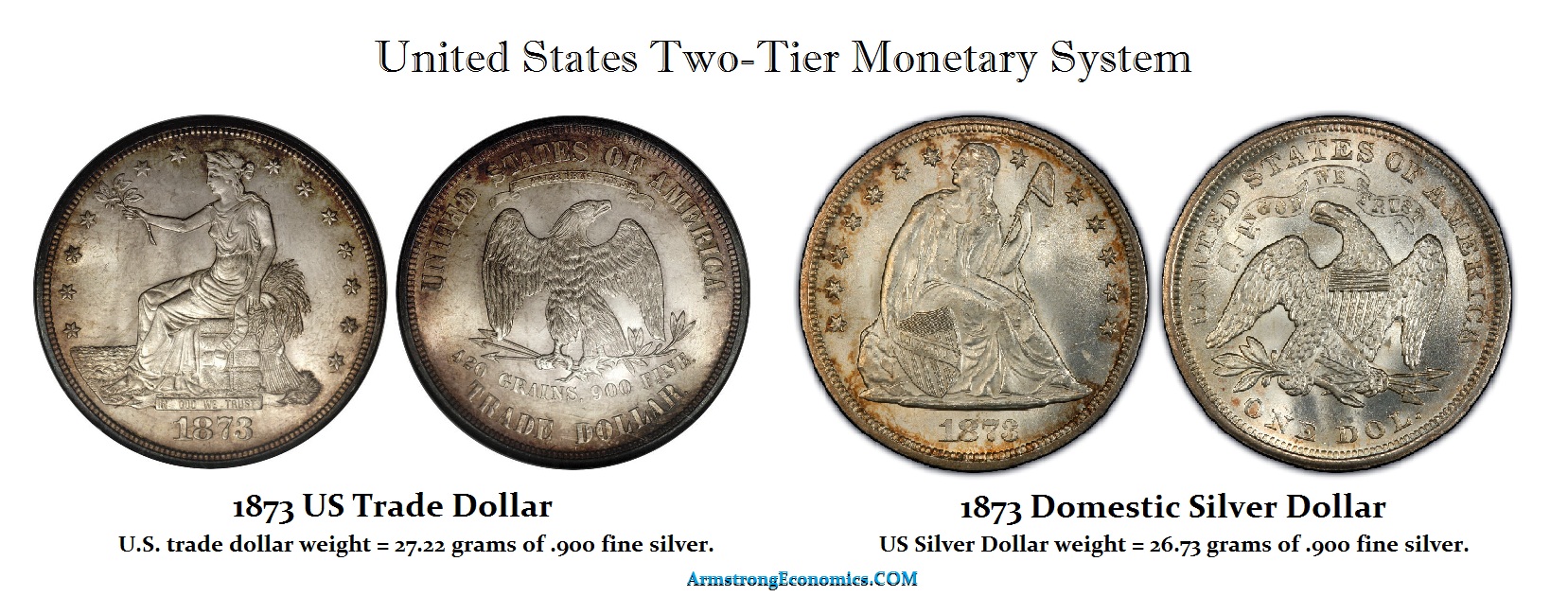
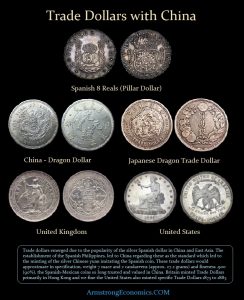
ANSWER: During the 19th century, it was common to issue a “trade dollar” with China who used the silver standard initially by using the Spanish 8 reals known also as pillar dollars. The US issued trade silver dollars and domestic silver dollars of different weight. All of these nations were issuing a two-tier currency to facilitate trade with China.
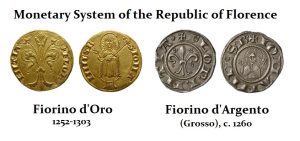
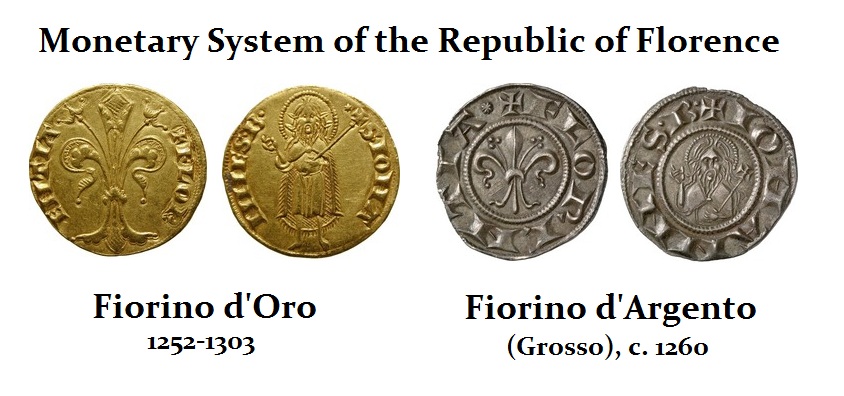
During the 14th century, there was also a two-tier monetary system. Florence used the gold florin for trade, but domestically, wages and commerce took place in silver. Companies were required to keep two sets of books by regulation.

A two-tier system can be used to isolate foreign capital inflows. Switzerland was suffering and that eventually broke the peg. The foreign capital was not looking to buy assets in Switzerland, they were just converting euro to Swiss and parking the money. Therefore, a two-tier system would have allowed the flow of capital to concentrate in what we would call the Financial Swiss Franc (FSF). This peg would have not been necessary and they could have even imposed negative interest rates or zero rates to deposits in the FSF. Any trade for produces could have then been delegated to the Swiss franc and the peg would not have been necessary.

We would not need a system where everyone had a two-tier currency and traded against each other. The new International Unit of Account (IUA) would be a basket of currencies and your local currency would then trade against that. You would need to allow contracts and debts to be contracted in this IUA freely, as takes place today in US dollars. This would by no means eliminate FOREX risk.

Insofar as a global SDR, the problem would be the calculation and then the IMF has been notorious for corruption. Would some nations put pressure to alter the formula because of a financial crisis?

I would say that the formula must be fixed and based on the total percentage of international trade a given nation wields. It should be subject to revision only once every 5 or 10 years at fixed terms.

The primary reason I would design the system in this manner is that the Federal Reserve has already become the central bank of the world. The Fed has lost the ability to manage its own economy because the IMF and others lobby it not to raise rates because that would adversely impact their currencies. There should be an IUA so that a central bank can manage its own economy without impacting others because they will be prohibited from issuing debt (public or private) in a foreign currency — only in an IUA. There would be no sovereign debt issued by the agency controlling the formula. The reserves of central banks would then be only in IUA terms.

Already, capital flows globally when it sees opportunity, and in this manner, it acts as an arbitrage tool. If real estate looks cheap in one country, the capital will flow in. Australia, New Zealand, and particularly Vancouver are fighting this trend. There will be a natural cycle to it and there is no need for changing laws to try to stop it. The Japanese were big buyers during the 1980s, even buying Rockefeller Plaza in New York. As their economy turned down, they resold it and exited.

Which Roman Emperor was Really “the Great”


QUESTION: Why Constantine the Great?

Mr Armstrong,

Of the 170 or so Roman emperors from 27BC to 476AD only one carries the title “the Great” and that is Constantine(r.306-337AD).
Would you have chosen another Roman emperor for this distinction in preference to Constantine?

JR

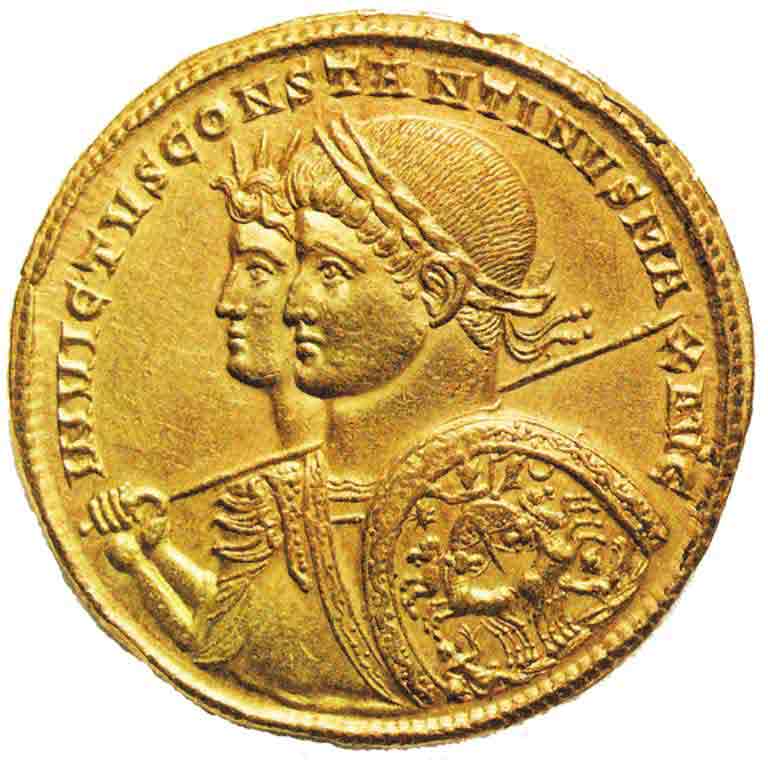
ANSWER: Constantine was given the title “the Great” because of his use of Christianity as his means to power. His mother Helena was a devout Christian. However, Constantine did not accept baptism until he was on his deathbed. He claimed that he had a vision where God showed him the sign of the cross and to put that on the shields of his army when they were outnumbered 2 to 1. It was a great tale. The truth was that the opposing army was mostly Christian and it was a great strategy. This gold medallion shows Constantine with the sun god Sol.

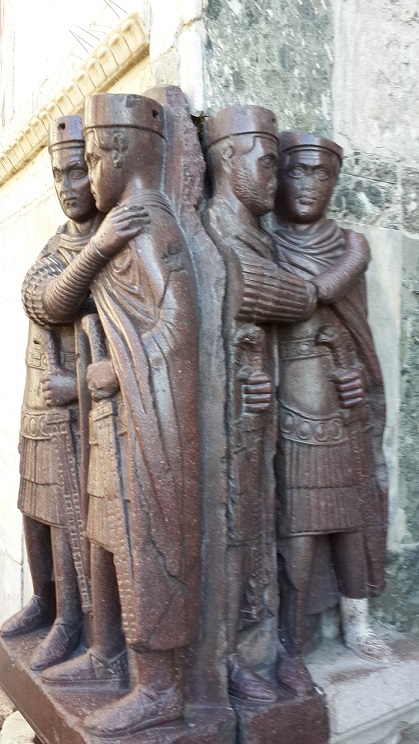
Constantine used Sol because he began to emerge as the supreme pagan god known as Sol Invictus (invincible sun which appeared every day). There was a tetrarchy set up by Diocletian (284-305 AD) where there were two emperors and two vice presidents, so to speak, named Caesars. Constantine used Sol and then Jesus Christ to justify his civil war in both instances by saying there was but one god above and there should be but one emperor on earth.

As far as who I would say was truly the best emperor, it would have been Marcus Aurelius (161-180 AD). You must understand that the title “the Great” or “Magnus” was often used for those who waged major wars and won. It did not mean that they did some magnanimous act. Pompey (106-38BC) was called “Magnus” for his victory in the civil war and not for his humanity. His success as a military commander in Sulla’s second civil war resulted in Sulla bestowing the cognomen Magnus, “the Great,” upon him.

Public Choice Theory: Why Government Often Fails


Published on Oct 9, 2017

Governments don’t work the way most people think they do. Public choice theory explores how voters, politicians, and bureaucrats actually make decisions. Prof. Antony Davies explains. SUBSCRIBE: http://bit.ly/2dUx6wg LEARN MORE: Behavioral Economics Ep. 5: What You Need to Know About Public Choice (video): Erika Davies and Prof. Antony Davies give an introduction to public choice economics and describe how insights on human behavior in the private sector can be applied to predict human behavior in the public sector. https://www.youtube.com/watch?v=FcLGU… Public Choice: Why Politicians Don’t Cut Spending (video): Prof. Ben Powell uses insights from public choice theory to explain why politicians, despite what they may promise to voters, rarely cut government spending. https://www.youtube.com/watch?v=6uR4l… Schools of Thought in Classical Liberalism, Part 3: Public Choice (video): Dr. Nigel Ashford gives a brief overview of the intellectual figures and ideas associated with public choice theory; part of a larger series on schools of thought in the classical liberal tradition. https://www.youtube.com/watch?v=ffJFN…


MiG-31: The Near-Space Plane. Russia’s super-fast interceptor


Published on Sep 30, 2018

Watch Combat Approved series: https://rtd.rt.com/series/combat-appr… Imagine flying a plane so high that the world looks spherical and the sky is pitch-black. The Mikoyan Mig-31 fighter is the only jet plane in the world to make it possible to fly on the very edge of space. With an incredible speed of 3,000 km/h, the Soviet-designed interceptor is the world’s fastest serving aircraft, and it can fly twice as high as a commercial flight. Travelling at more than twice the speed of sound, the MiG-31 can touch the stratosphere and breach what’s known as the Armstrong limit. beyond which a pilot’s tears and saliva would boil without a pressure suit. Even at such incredible heights, the MiG-31 can still deal with its enemies. The fighter is armed with long and short-range missiles that can be launched against high-speed targets. At Khotilovo air base, RTD attempts to give viewers a first-hand experience of near-space travel aboard this unique aircraft by mounting cameras on the airframe and inside the cockpit. See what breaking the sound barrier looks like and why, despite being designed in the 1970s, the MiG-31remains at the top of its game and unrivalled to this day. SUBSCRIBE TO RTD Channel to get documentaries firsthand! http://bit.ly/1MgFbVy FOLLOW US RTD WEBSITE: https://RTD.rt.com/ RTD ON TWITTER: http://twitter.com/RT_DOC RTD ON FACEBOOK: http://www.facebook.com/RTDocumentary RTD ON DAILYMOTION http://www.dailymotion.com/rt_doc RTD ON INSTAGRAM https://www.instagram.com/rtd_documen… RTD LIVE https://rtd.rt.com/on-air/


Satellite Shootdown (2008) Military Channel


Published on Nov 15, 2013

©2008 – Discovery Communications


Is SpaceX’s Raptor engine the king of rocket engines?


Published on May 25, 2019

2:55 – Basic physics of rocket engines 6:10 – Rocket engine cycles 20:30 – Rocket fuel comparison 30:40 – Raptor vs other rocket engines 44:05 – Summary Article version – https://everydayastronaut.com/?p=9823… SpaceX’s new raptor engine is a methane fueled full flow staged combustion cycle engine and its so hard to develop, no engine like this has ever flown before! Now this topic can be really intimidating so in order to bring the Raptor engine into context, we’re going to do an overview of a few common types of rocket engine cycles then compare the Raptor to a few other common rocket engines, like SpaceX’s current work horse, the Merlin, The Space Shuttle’s RS-25, the RD-180, Blue Origin’s BE-4 and the F-1 engine. And if that’s not enough, not only is SpaceX using a crazy engine cycle, they’re also going to be using Liquid Methane as their fuel, again something that no orbital rocket has ever used! So we’ll also go over the unique characteristics of liquid methane as a rocket fuel and see if we can figure out why SpaceX went with Methane for the Raptor engine. We’ll also break down and explain all the different engine cycle types so you know what the full flow staged combustion cycle is, how it works, and how it compares to the other cycles. So by the end of this video hopefully we’ll have the context to know why the raptor engine is special, how it compares to other rocket engines, why it’s using methane and hopefully find out if the Raptor engine will be the new king of rocket engines… ———————————————– Rocket engine renders by @MartianDays https://twitter.com/MartianDays HUGE thanks to my Moon Walker Patreon supporters! Blake Jacobs, Eli Burton, Jethro, Mac Malkawi, Neurostream, Ole Mathias Heggem Want to support what I do? Consider becoming a Patreon supporter for access to exclusive livestreams, our discord channel and subreddit! – http://patreon.com/everydayastronaut The best place for all your space merch needs! https://everydayastronaut.com/shop/ All music is original! Check out my album “Maximum Aerodynamic Pressure” anywhere you listen to music (Spotify, iTunes, Google Play, Amazon, etc) or click here for easy links – http://everydayastronaut.com/music I’m the cohost of an awesome podcast where we talk all about current technologies and how they shape our future! http://ourludicrousfuture.com or here on YouTube https://www.youtube.com/ourludicrousf…

Introduction to bonds | Stocks and bonds | Finance & Capital Markets | Khan Academy


Published on Sep 28, 2013

What it means to buy a bond. Created by Sal Khan.