Yield v Reason


QUESTION: I see all of these people calling for a major crash of 50%+. With interest rates so low and the dividends on the Dow twice that of interest rates, does anyone look at yield anymore?

PH

ANSWER: I fully agree. The yield on the Dow Jones is 5.34%, which is about double the 10-year rate. Back in 1983, I presented these two charts that show the earnings and book value of the Dow Jones Industrials. The majority were calling for a crash and our computer warned of a Phase Transition and a 600% rise in the Dow. I was blamed for creating the takeover boom, but it was clear that the earnings were at least 5% and the stocks were trading out of a major historical low on price v book value. So earnings do come into the mix

Capital Controls v Protectionism


QUESTION: Marty; You mentioned at the cocktail party in Rome, which was spectacular BTW, that your concern would be capital controls emerging when the euro starts to break hard. Do you have a time frame for that?

WJ

ANSWER: Yes, the view from the cocktail party was spectacular. A bit cold; we could have used that global warming.

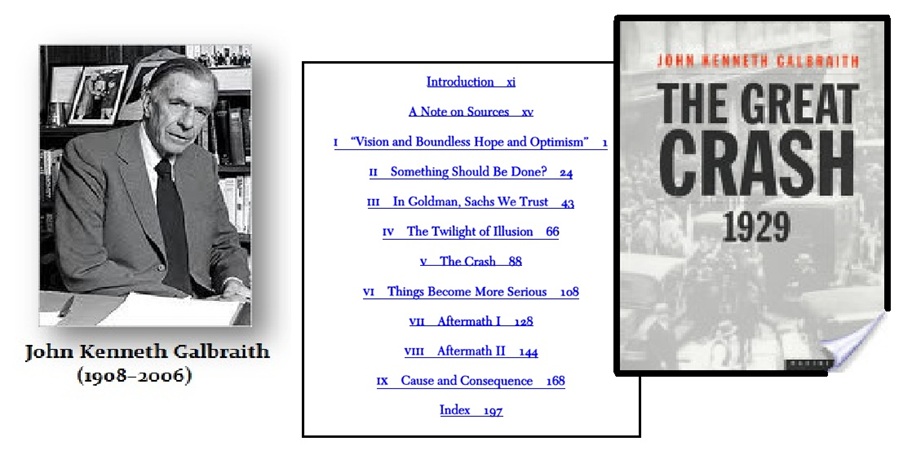
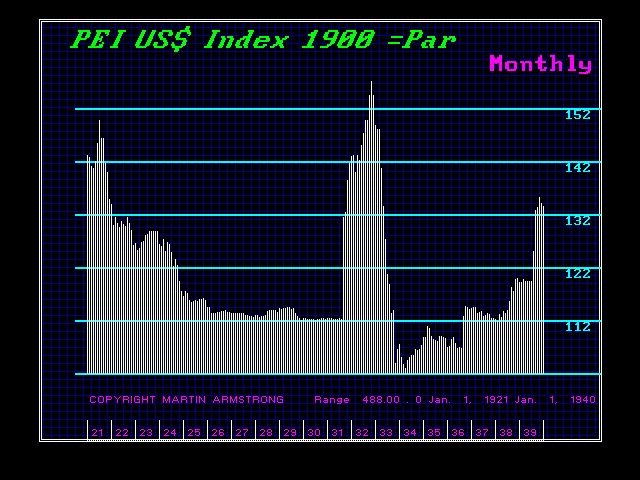
We saw Turkey move to entertain that which set off the contagion in emerging markets overnight. While the history books tend to put the blame for the Great Depression at the feet of corporation, as did Galbraith, they never mention the Sovereign Defaults of 1931 or the fact that there were capital controls imposed.

The flight of capital to the dollar was met by imposing capital controls. These capital controls may have solved the flight of capital immediately, but at the cost of a complete collapse in confidence in Europe as a whole. The lesson from 1931 was not that of PROTECTIONISM, which killed trade, but it was the imposition of capital controls that brought international trade to a halt. If capital could not be exported, then commerce could not buy any goods. This was far more drastic than protectionism with tariffs. There just seems to be very questionable analysis applied which was either by true idiots, or more likely, the analysis deliberately hid the actions of government to justify the takeover by Marxist Socialism.

The time frame where we may see governments resort to capital controls may arrive in 2021-2022. We MUST be realistic that capital controls are far worse that trade disputes.

QE & Its Failure


QUESTION: Dear Martin,
During WEC in Rome I came to understand that the issue with QE is that it did not create any inflation in the USA. On the other hand, as you mentioned the inflation is being calculated in a different way that it used to be in the future. How come then the US does not just change the way of calculating the inflation in a way which would show it’s there? Wouldn’t that be an easier way than to do more QEs?
Thank you,

MK

ANSWER: The primary reason QE fails is because the economy is global. Central banks can no longer manage the economy, for the money does not remain in isolation. Additionally, as I pointed out in Rome, they may have negative interest rates, but that does not pass through. You cannot borrow money from a bank at negative rates.

The Threat of Protectionism


QUESTION: Marty:

I read you every day and I am one of the fortunate people to have a financial advisor that attends your Conference every year in the US.

I am wondering how Airbus will be affected in the future as the Euro further declines.

Thanks, RM

ANSWER: This is one of the aspects that caused the protectionism during the 1930s. As the turmoil in Europe unfolded, capital fled to the dollar pushing it higher. This invoked protectionism also propelled by the decline in commodity prices. The protectionism began with the agricultural sector and then spread to other areas.

As the dollar is pushed higher, we will see protectionism rise again probably 2021-2022. European companies that do not have professional hedging departments will suffer greatly.

Malcolm Gladwell: The strange tale of the Norden bombsight


Published on Oct 26, 2011

http://www.ted.com Master storyteller Malcolm Gladwell tells the tale of the Norden bombsight, a groundbreaking piece of World War II technology with a deeply unexpected result. TEDTalks is a daily video podcast of the best talks and performances from the TED Conference, where the world’s leading thinkers and doers give the talk of their lives in 18 minutes. Featured speakers have included Al Gore on climate change, Philippe Starck on design, Jill Bolte Taylor on observing her own stroke, Nicholas Negroponte on One Laptop per Child, Jane Goodall on chimpanzees, Bill Gates on malaria and mosquitoes, Pattie Maes on the “Sixth Sense” wearable tech, and “Lost” producer JJ Abrams on the allure of mystery. TED stands for Technology, Entertainment, Design, and TEDTalks cover these topics as well as science, business, development and the arts. Closed captions and translated subtitles in a variety of languages are now available on TED.com, at http://www.ted.com/translat

Moving from QE to Just Monetizing Government


QUESTION: Mr, Armstrong; Why the push for lower interest rates again in developed markets? You have stated the QE has been a total failure. Are they incapable of doing anything else?

KE

ANSWER: We are switching from QE to a new reality of budget management. If interest rates rise on government bonds, the budget blows out. At this stage, the Fed is toying with the idea of setting benchmark rates for 2 to 10-year instruments. This will be different than QE. It will be the collapse of government bond markets on a global scale.

The Moment in Time: The Manhattan Project


SUBSCRIBE 434K
The Moment in Time documents the uncertain days of the beginning of World War II when it was feared the Nazis were developing the atomic bomb. The history of the bomb’s development is traced through recollections of those who worked on what was known as “the gadget”. [6/2000] [Science] [Show ID: 5090]

4th Generation Nuclear Weapons


Published on Dec 16, 2013

SUBSCRIBE 10K
This is an overview of the 4th generation of nuclear weapons outlined in the report, Fourth Generation Nuclear Weapons: Military effectiveness and collateral effects, condensed into an easy to digest video. Full report click here, http://arxiv.org/abs/physics/0510071v5 FAQ:
Q: In a nutshell what is a Fourth Generation Nuclear Weapon (FGNW)? A: It is a nuclear fusion weapon that doesn’t use a fission trigger. The most feasible method to trigger fusion in a FGNW is to use microscopic amounts of anti-matter.
Q: What advantages do FGNWs have over conventional nukes? A: They are “clean” (radioactive fallout negligible, about on par with conventional depleted uranium weapons that are already in use), they are very small (potentially can fit in your pocket), and fill in the “yield gap” between the most powerful conventional weapons and the lowest yield conventional nukes.
Q: Will FGNWs really be more politically acceptable to use in actual combat? A: Who knows? Only time can tell for certain, but their “radioactive cleanness” is a compelling argument in favor for it.
Q: What would be the TNT equivalent of a FGNW be? A: A 3 gram pellet of fusion fuel would release around 302 gigajoules of energy (about 72 tons of TNT), so around that.
Q: How much antimatter is needed to catalyze a single FGNW? A: A 3 gram pellet of fusion fuel would need 1×10^11 antiprotons to catalyze nuclear fusion
Q: Isn’t carrying antimatter dangerous? What would happen if containment failed? A: The quantity of antimatter is extremely small. 1×10^11 antiprotons would release the equivalent of about 6 milligrams of TNT, that’s less than a firecracker. However the energy would be released in the form of ionizing radiation so it would be a radiological hazard if containment failed.
Q: Wouldn’t failure of antimatter containment result in the FGNW detonating? A: No, nuclear fusion requires very precise injection of antimatter to catalyze fusion. Failure of containment would not result in the precise injection of antimatter to the fusion fuel. Added safety measures can be taken by separating the fusion fuel from the antimatter containment until the weapon is ready to be armed.
Q: If you accidentally drop it, wouldn’t containment fail? A: These weapons are intended to be incredibly rugged with one of their applications being bunker busters. They contain little to no moving parts and are “full like eggs”. The FGNW report indicates that the overall ruggedness would be far superior over conventional nuclear bunker busters so no, simply dropping it wouldn’t cause containment to fail.
Q: Wouldn’t FGNWs be attractive for nuclear terrorism? A: No, it’s easier to build conventional nuclear weapons. FGNWs require extremely large particle accelerators to manufacture the antimatter necessary for the FGNW. A terrorist who wants a suitcase nuke is better off with something like the M-388 Davy Crockett.
Q: Are FGNW a proliferation concern? A: No, see above.
Q: Why not make pure anti-matter weapons instead? A: A couple of reasons. It’s prohibitively expensive. It’s single handedly the most expensive substance in the world and incredibly difficult to make. Right now, if we took all the antimatter we produced and annihilate it, it would only be enough to power a lightbulb for a few hours. On the other hand, fusion fuel is incredibly cheap and abundant, you can literally make it from sea water as all it is are isotopes of hydrogen. But even if we had large quantities of antimatter, it’s questionable how useful it would be as a weapon on its own. It’s incredibly difficult to contain as if it touches any normal matter, it will annihilate. Containing microscopic quantities is not a problem, but macroscopic quantities are. Even if you could contain it, it would be incredibly unstable. Fusion and fission weapons fail safely, if you damage a nuclear weapon the nuclear weapon doesn’t detonate. An antimatter weapon would detonate as soon as containment fails. From a cost-benefit point of view, pure antimatter weapons do not make sense.
Q: Can you use conventional explosives to catalyze nuclear fusion? A: No. https://en.wikipedia.org/wiki/Lawson_…


ETF v Mutual Fund


QUESTION: Are ETFs really better than a mutual fund for tax purposes?

HS

ANSWER: The primary difference between mutual funds and ETFs (exchange-traded funds) is that while an open-end mutual fund is priced once based upon the market closing, ETFs as well as a closed-end mutual funds trade all day. This actually goes back to the Panic of 1966 when mutual funds were open-ended but traded on the exchange and were bid up and down based on emotion rather than net asset value. The crash took place because mutual funds were at times selling well above net asset value.

If we look at the reforms post-1966, investors in mutual funds buy or sell them directly from the mutual-fund companies themselves. That creates a different tax structure than an ETF in which purchases go to the market and the ETF is simply created by purchasing the underlying basket.

Mutual funds and most ETFs are governed by the Investment Company Act of 1940. Therefore, this legislation treats them like a pass-through company. When a mutual-fund investor wants to sell, the fund sells shares of appreciated stock to generate cash which creates a taxable capital gain. Since most funds operate as simple pass-through vehicles, those tax liabilities from the gains accrue to all investors in the fund including those who have not sold any holding.

ETFs actually do avoid that type of tax issue. ETFs are not direct buyers or sellers of shares as a mutual fund. The ETF is created by a market maker with a special contract with the ETF provider. The investor has the newly created ETF share which is created by purchasing all of the holdings in the underlying ETF. This basket of shares is given to the ETF issuer thereby creating the ETF shares.

Because an ETF is not a direct buyer of the underlying shares as in a mutual fund, the ETF itself is not a buyer or seller. The basket of shares are swapped and are therefore in-kind transactions, thus there is no pass-through capital-gains tax bill. This is the tax advantage of an ETF over a mutual fund.

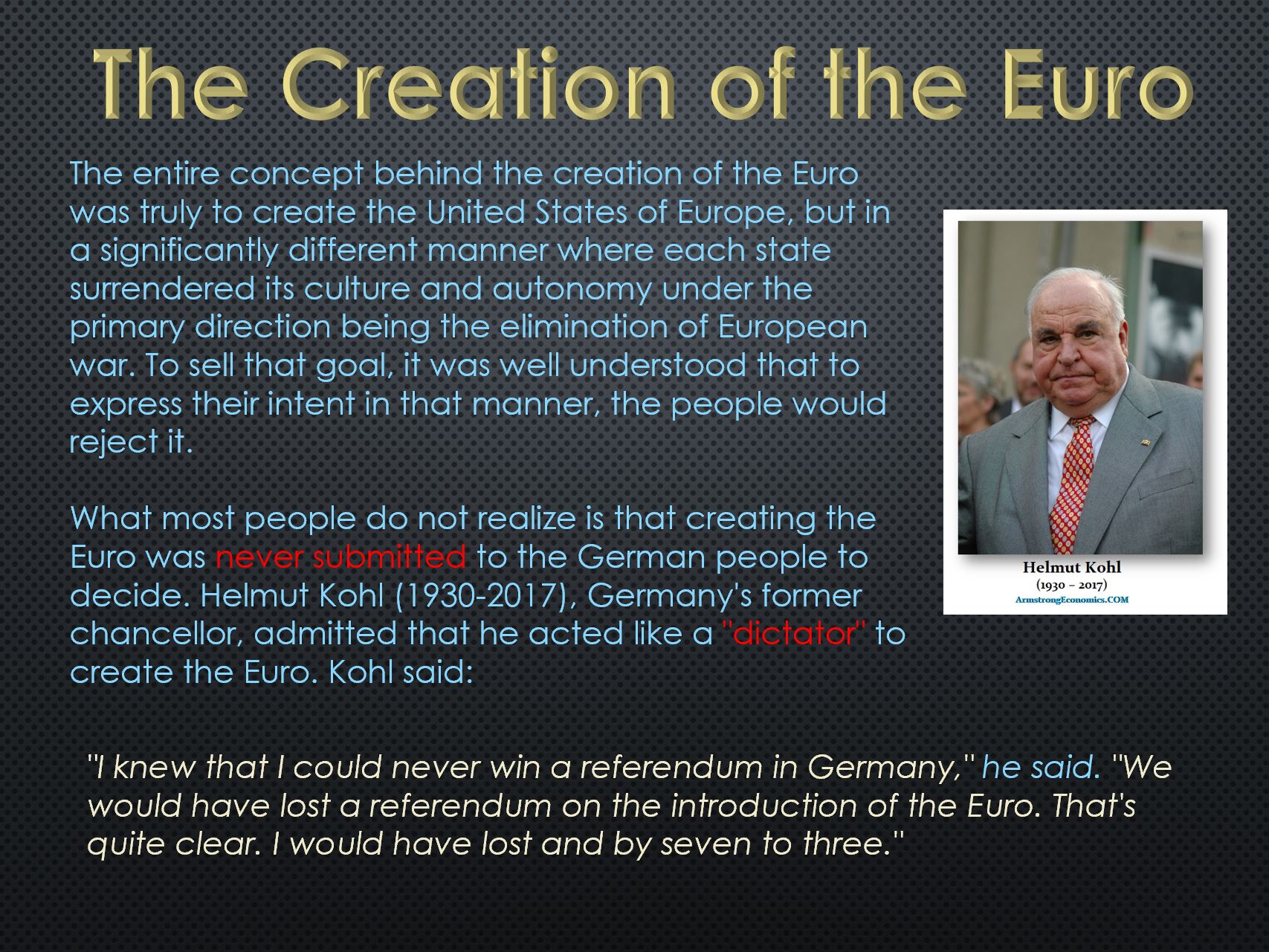
Creating the Euro & Germany Was Denied the Right to Ever Vote to join the Euro


COMMENT: Marty; I just wanted to say that this WEC in Rome was one of your best, NOt that Nigel Farage was there calling you the alternative to Davos, but you really do your research and your contacts behind the curtain become self-evident. Nobody in the audience every knew that the German people were denied the right to vote on joining the euro. The most important economy was denied any democratic process.

See you in Orlando

PG

ANSWER: Yes, I was amazed at how even the central bankers who attended were unaware of that fact. This is part of the reason for the rise in the AfD in Germany. From the outset, the theory has been to federalize Europe to prevent a world war. They assumed the people would never vote for it so they hide the real agenda. The people are not those who create wars – it is always those in power.

What they have done is to fuel the flames of history that remind people of the differences that are culturally embodied within the languages.