How Did Rome Put Money into Circulation with no Central Bank?


QUESTION: How were ancient coins placed into circulation?

DR JB

ANSWER: That is actually a very interesting question. As the legend goes, the Gauls (French) attempted to invade the city of Rome quietly, but had frightened the sacred flock of geese that made a lot of noise. This alerted the Romans to the surprise attack giving us the word “monere” meaning in Latin to warn. The Temple of Juno then became popularly known as the Temple of Juno Moneta. Since this is where the coins were minted, we now arrive at the word “money” that springs from the origin of this legend and place that was an ancient mint.

Our term such as capital flow is also derived from the Latin word “currere” meaning “to run” or “to flow” and this is where the money flowed from giving us the word “currency” meaning the flow of money. This is why Juno Moneta is pictured on Roman coins as holding the balance scales in one hand and a cornucopia in the other symbolizing endless bounty or wealth. This is the birth of the term money and currency.

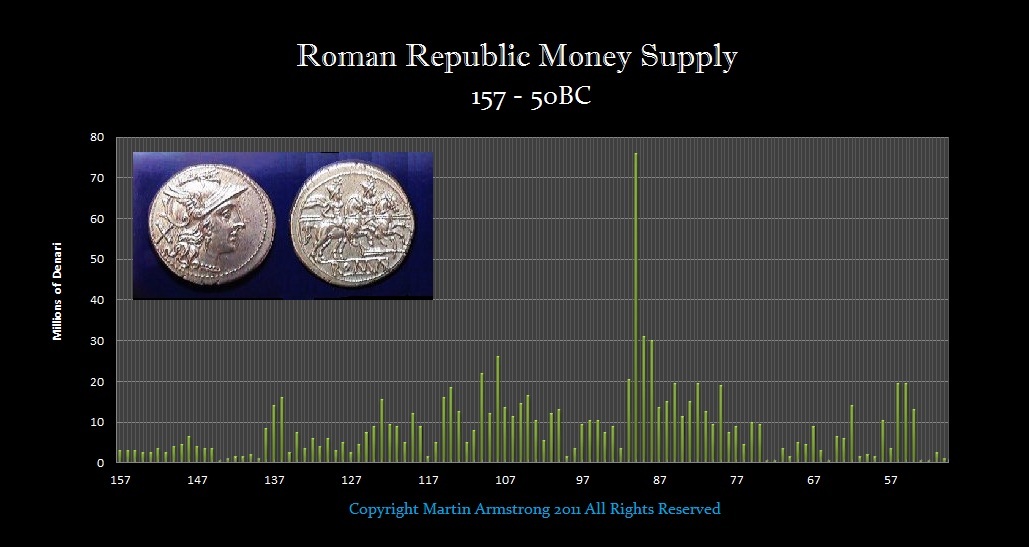
Now, since Rome had no national debt and no central bank, we immediately wonder how on earth did this function? The government-owned the mines and thus they coined money to meet their expenses.  Unlike our modern governments, they did not have a huge welfare state. They did subsidize food. But the coinage was used to pay the troops and government expenses and thus this is how the money was put into circulation. They would increase the output in times of war and decreased it in times of peace for the most part.

The Saturn V Story (Space Race Documentary) | Spark


Published on May 2, 2018

SUBSCRIBE 178K
In 1961 when President Kennedy pledged to put a man on the moon by the end of the decade, no rocket existed with the power or capability to rise to the challenge. In order to win the race to space, the United States would need to establish a multi-billion dollar space program. One man, Werner Von Braun believed he had the knowledge and vision to make Kennedy’s dream a reality. With the American public galvanised and the expertise of over 200,000 scientists and engineers, Von Braun masterminded the development of the Saturn V; the rocket that flew 24 men to the moon and launched the greatest adventure in the history of exploration. Using visual effects, stunning NASA footage and expert interviews with Apollo Space Scientists, this inspirational film tells the story of the colossal challenges NASA faced to fulfill Kennedy’s pledge. With the accolade of flying 24 men safely to the moon, the mighty Saturn V will always be considered one of mankind’s greatest technological achievements. This is the story of the most powerful machine ever built, and the men and women who believed it could fly. Subscribe to Spark for more amazing science, tech and engineering videos – https://goo.gl/LIrlur Follow us on Facebook: https://www.facebook.com/SparkDocs/ Follow us on Instagram: https://www.instagram.com/spark_chann… Content licensed by Espresso Media to Little Dot Studios. #Space #saturn #apollo11 #NASA #science #rockets #spacetravel #manonthemoon #Engineering #technology #spacerace #SaturnV #Saturn5

“APOLLO 13: To The Edge And Back” – (1994 Documentary)


Published on Mar 3, 2018

SUBSCRIBE 767
CHECK OUT THESE OTHER CHANNELS: CLASSIC COMEDY CLIPS: http://www.dailymotion.com/ClassicCom… WSCVIDEOS: http://www.dailymotion.com/WSCvideos I SAW IT ON TV: http://www.dailymotion.com/SawItOnTV I SAW IT AT THE MOVIES: http://www.dailymotion.com/SawItAtThe… FUNNY FILM FEATURES: http://www.dailymotion.com/FunnyFilmF… PAST BLAST MUSIC (50s & 60s): http://www.dailymotion.com/PastBlastM… PAST BLAST MUSIC (70s & Beyond): http://www.dailymotion.com/PastBlastM… THE HISTORY OF ROCK: https://www.youtube.com/channel/UCQTc… FUNNYFILMFEATURES: https://www.youtube.com/channel/UClJS… Apollo 13 was the seventh manned mission in the Apollo space program and the third intended to land on the Moon. The craft was launched on April 11, 1970, at 14:13 EST (19:13 UTC) from the Kennedy Space Center, Florida, but the lunar landing was aborted after an oxygen tank exploded two days later, crippling the Service Module (SM) upon which the Command Module (CM) had depended. Despite great hardship caused by limited power, loss of cabin heat, shortage of potable water, and the critical need to make makeshift repairs to the carbon dioxide removal system, the crew returned safely to Earth on April 17, 1970, six days after launch. The flight passed the far side of the Moon at an altitude of 254 kilometers (137 nautical miles) above the lunar surface, and 400,171 km (248,655 mi) from Earth, a spaceflight record marking the farthest humans have ever traveled from Earth. The mission was commanded by James A. Lovell with John L. “Jack” Swigert as Command Module Pilot and Fred W. Haise as Lunar Module Pilot. Swigert was a late replacement for the original CM pilot Ken Mattingly, who was grounded by the flight surgeon after exposure to German measles. The story of the Apollo 13 mission has been dramatized multiple times, most notably in the 1995 film Apollo 13.

World War 2 Top 10 Tanks (Videos)


Published on May 11, 2016

SUBSCRIBE 19K
Tiger II is the common name of a German heavy tank of the Second World War. The final official German designation was Panzerkampfwagen Tiger Ausf. B, often shortened to Tiger B. The ordnance inventory designation was Sd.Kfz. 182. It is also known under the informal name Königstiger[6] (the German name for the Bengal tiger), often translated literally as Royal Tiger, or somewhat incorrectly as King Tiger by Allied soldiers, especially by American forces. The Tiger II was the successor to the Tiger I, combining the latter’s thick armour with the armour sloping used on the Panther medium tank. The tank weighed almost 70 tonnes, and was protected by 100 to 185 mm (3.9 to 7.3 in) of armour to the front.[9] It was armed with the long barrelled 8.8 cm KwK 43 L/71 anti-tank cannon.The chassis was also the basis for the Jagdtiger turretless tank destroyer. The Tiger II was issued to heavy tank battalions of the Army (Schwere Heerespanzerabteilung – abbreviated s.H.Pz.Abt) and the Waffen-SS (s.SS.Pz.Abt). It was first used in combat with s.H.Pz.Abt. 503 during the Normandy campaign on 11 July 1944; on the Eastern Front, the first unit to be outfitted with Tiger IIs was the s.H.Pz.Abt. 501, which by 1 September 1944 listed 25 Tiger IIs operational.


World war 2 Top 10 Fighter Planes (Videos)


Published on Aug 14, 2016

SUBSCRIBE 19K
World War II featured fighter combat on a larger scale than any other conflict to date. German Field Marshal Erwin Rommel noted the effect of airpower: “Anyone who has to fight, even with the most modern weapons, against an enemy in complete command of the air, fights like a savage against modern European troops, under the same handicaps and with the same chances of success.” Throughout the war, fighters performed their conventional role in establishing air superiority through combat with other fighters and through bomber interception, and also often performed roles such as tactical air support and reconnaissance. Fighter design varied widely among combatants. The Japanese and Italians favored lightly armed and armored but highly maneuverable designs such as the Japanese Nakajima Ki-27, Nakajima Ki-43 and Mitsubishi A6M Zero and Italy’s Fiat G.50 and Macchi MC.200. In contrast, designers in Great Britain, Germany, the Soviet Union, and the United States believed that the increased speed of fighter aircraft would create g-forces unbearable to pilots who attempted maneuvering dogfights typical of the First World War, and their fighters were instead optimized for speed and firepower. In practice, while light, highly maneuverable aircraft did possess some advantages in fighter-versus-fighter combat, those could usually be overcome by sound tactical doctrine, and the design approach of the Italians and Japanese made their fighters ill-suited as interceptors or attack aircraft.During the invasion of Poland and the Battle of France, Luftwaffe fighters—primarily the Messerschmitt Bf 109—held air superiority, and the Luftwaffe played a major role in German victories in these campaigns. During the Battle of Britain, however, British Hurricanes and Spitfires proved roughly equal to Luftwaffe fighters. Additionally Britain’s use of radar and the advantages of fighting above Britain’s home territory allowed the RAF to deny Germany air superiority, saving Britain from possible German invasion and dealing the Axis a major defeat early in the Second World War.On the Eastern Front, Soviet fighter forces were overwhelmed during the opening phases of Operation Barbarossa. This was a result of the tactical surprise at the outset of the campaign, the leadership vacuum within the Soviet military left by the Great Purge, and the general inferiority of Soviet designs at the time, such as the obsolescent I-15 biplane and the I-16. More modern Soviet designs, including the MiG-3, LaGG-3 and Yak-1, had not yet arrived in numbers and in any case were still inferior to the Messerschmitt Bf 109. As a result, during the early months of these campaigns, Axis air forces destroyed large numbers of Red Air Force aircraft on the ground and in one-sided dogfights. In the later stages on the Eastern Front, Soviet training and leadership improved, as did their equipment. Late-war Soviet designs such as the Yakovlev Yak-3 and Lavochkin La-7 had performance comparable to the German Bf-109 and Focke-Wulf Fw 190. Also, significant numbers of British, and later U.S., fighter aircraft were supplied to aid the Soviet war effort as part of Lend-Lease, with the Bell P-39 Airacobra proving particularly effective in the lower-altitude combat typical of the Eastern Front. The Soviets were also helped indirectly by the American and British bombing campaigns, which forced the Luftwaffe to shift many of its fighters away from the Eastern Front in defense against these raids. The Soviets increasingly were able to challenge the Luftwaffe, and while the Luftwaffe maintained a qualitative edge over the Red Air Force for much of the war, the increasing numbers and efficacy of the Soviet Air Force were critical to the Red Army’s efforts at turning back and eventually annihilating the Wehrmacht. Meanwhile, air combat on the Western Front had a much different character. Much of this combat was centered around the strategic bombing campaigns of the RAF and the USAAF. Axis fighter aircraft focused on defending against Allied bombers while Allied fighters’ main role was as bomber escorts. The RAF raided German cities at night, and both sides developed radar-equipped night fighters for these battles. The Americans, in contrast, flew daylight bombing raids into Germany. Unescorted Consolidated B-24 Liberators and Boeing B-17 Flying Fortress bombers, however, proved unable to fend off German interceptors (primarily Bf-109s and FW-190s). With the later arrival of long range fighters, particularly the North American P-51 Mustang, American fighters were able to escort daylight raids far into Germany and establish control of the skies over Western Europe.

Remanufacturing a Packard V12 engine


Published on Mar 31, 2017

SUBSCRIBE 10K
Restore Cars remanufactures all types of senior classic car engines of the 1930’s era. I have received many questions about the dyno numbers. Here are the numbers. The torque curve starts out at 436 and bottoms out at 320. HP starts out at 124 and steadily raises up to 197. All pulls were on a same line and very smooth throughout the RPM range. These are corrected numbers. Book value is stated at 175 HP peak. Sometime I will post all the runs on my website so you can see all the pulls. I’m not website say, so it may take a little while to get this done. Mark

SHOW MORE

The End of Keynesian-Monetarist Theory


QUESTION: Thank you for your great work. I have read this article where Kudlow says: White House economic adviser Larry Kudlow predicted that it is possible the Federal Reserve won’t hike interest rates again during his lifetime: My question is do you think he is right? And what will the consequence be if the interest rate remains where it is – For example, the next 10 or 20 years?
P.S. Of natural causes, we do not know how long time Kudlow lives.
Best regards
L/Sweden

ANSWER: Perhaps he got bad news from his doctor or it is a political statement that is just absurd. What he is really saying is that Quantitative Easing has so destroyed the Keynesian model that there is now no other alternative for central banks to control the economy. If they raise rates, the budget explodes. We are witnessing the end of Keynesian.Monetarist theory.

Will Social Security Exist in 2021?


QUESTION: Hi Martin,
You mentioned in a 2016 blog post that “We will probably see the end of this Social Security program by 2021.772 (October 9, 2021)”. Does this forecast still have a high probability of occurring? If so, won’t this be devastating to retirees, especially those with little or no retirement savings? My employer no longer offers a pension plan to employees, only a 401K plan.
Ref. “Negative Interest Rates Destroying the World Economy”, Apr 17, 2016.
Kind Regards,
DA

ANSWER: I do not see this unfolding as a default. They will have to revise the system one way or another. There is more likely to be a huge split in interest rates from the private sector compared to the public at the federal level. As I have stated before, I tried to would with Congress back in the ’90s in reforming Social Security transforming it into a wealth fund that was allocated out among managers. The Democrats would not vote for it so this is why Social Security today cannot survive. It invests 100% in government bonds. That means it does not even earn a fair interest rate.


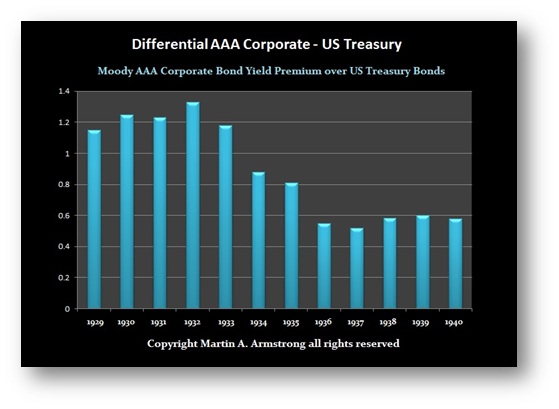
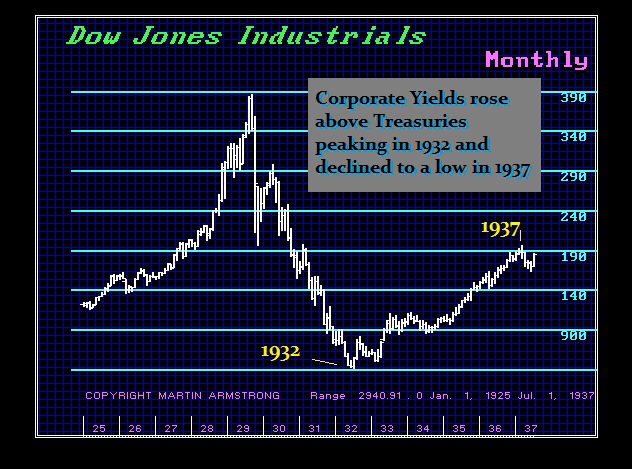
When people feared the private sector, AAA corporate rates soared peaking with the bottom of the stock market in 1932 and then declined to bottom with the rally into 1937. What we face now is the collapse of Social Security because it is restricted to buying only government debt where the interest rates are artificially maintained at absurdly low levels. Therefore, Social Security is already constantly being reduced in benefits. It cannot continue in this manner. It will have to be reformed and changed entirely. I do not believe that they will stop paying people. The way they default is reducing payments and the payments will not be enough to sustain themselves. Look at Venezuela. They honor their pensions, but what you get today will buy only a cup of coffee.

The likelihood of Social Security remaining as it is today is ZERO. Private sector rates will rise v manipulated government rates. We have entered into the Great Unknown economically. The Quantitative Easing of the Bank of Japan and the Europeans Central Bank have wiped out the free markets and ended government borrowing as a viable free market. The far more interesting aspect of interest rates will become the spread between corporate and public at the federal level.


What Will the Fed do in a Contagion?


QUESTION: I have been following your blog for a number of years, public and private. I read the blog concerning “European Politics.” In it you state the capital flight will be a contagion. I understand what the influx of European capital will have on the DOW and S&P, but much less certain of the duration of the impact and contagion. My question is two part; 1) what impact will the contagion have on the US Dollar and how do you expect the US Fed to react interest rate wise and 2) duration of equities move up – short-lived or longer-term trend is your friend.

Thanks

CF

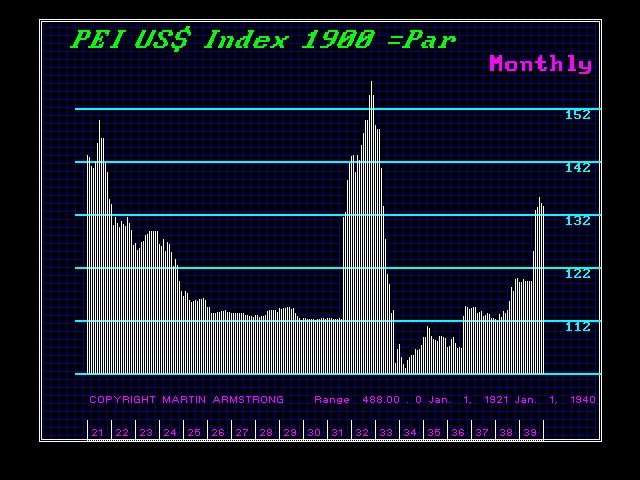
ANSWER: The contagion will last probably 2 years at best. There was such a contagion during the Great Depression. That is what Milton Friedman used to criticize the Fed. All this gold came to the USA pushing the dollar higher, but the Fed refused to monetize it. The backing of gold behind the dollar doubled between 1929 and 1931.

This time we are on a floating exchange rates system so the Fed cannot sterilize the capital inflows as it did during the Great Depression imposing austerity as Germany demand today. Today, the capital inflows are targeting the equities because the interest rates are artificially low. If the stock market explodes, the Fed will be criticized by Congress for creating asset inflation and creating a bubble with low-interest rates.

Unlike the Bank of Japan and the European Central Bank, the US bond market is the only thing trading. The Fed is not trapped as are the other central banks. At some point, the Fed will be obligated to raise rates to fight against the asset bubble, but that will then attract even more capital and push the BoJ and ECB over the edge.

Keep in mind that ONLY a rising dollar compel monetary reform in the USA. During 1934 Roosevelt devalued the dollar and in 1985 they created the G5 to stage an organized group to manipulate the dollar lower. All those people touting gold will rally and the dollar will crumble are clueless. A lower dollar will increase corporate profits and reduce trade deficits. ONLY a higher dollar will break the monetary system.

Modern Monetary Theory & Why Central Banks are lost in the Wilderness without a Map


QUESTION: Dear Martin,
Would you like to enlighten me on your stance on the Modern Market Theory that is being touted by some in finance and politics please?

VV

ANSWER: The basis upon which MMT has emerged is actually logical for those who lack the understanding of how to conduct research. Since QE has lasted in Europe for 10 years+ without success in creating inflation, they take this as proof that the government can just print without concern of inflation. Money has value only because it is legal tender. I have written about this subject before – MMT.

I will address this in a detailed report because all economic models have now failed. This is part of the Great Unknown we have entered in Economic Theory. Central Banks are without a map and are now lost in the wilderness.