What Gives Value to a Currency?


Armstrong Economics Blog/Economics Re-Posted Apr 7, 2021 by Martin Armstrong

QUESTION: Hello Martin, can you explain to me how a currency would sustain value for international trade if a country, like Canada (where I live), did what you suggested and stopped issuing debt and just printed money to level that was 5% – 10% of national GDP? would it depend on the attractiveness of what a country exports eg: Canada exports oil, lumber, crops like wheat/soy/canola, minerals – both precious and functional? What would happen to a country that didn’t have exports as a significant portion of it’s GDP? I am curious about how currencies would react to your restructuring plan that eliminated the need for a country to issue debt. Thanks for all your insights and theories. Very helpful.

Trapped in Canada with an egoistic misguided Prime Minister who doesn’t appear to like Canada (he keeps telling us how awful we are) or Canadians, he prefers spending time with global elites and is following their plan even though it damages Canada pretty significantly.
MB

ANSWER: Right now, every country spends more than it takes in. The deficits are funded by selling debt, which then competes against the private sector. The interest rates rise and fall on sovereign debt based upon the confidence from one week to the next. If they stopped borrowing, then the capital investment would turn to the private sector, creating more economic growth. If income taxes were eliminated, the economy would grow based upon innovation which is what it should be driven by.

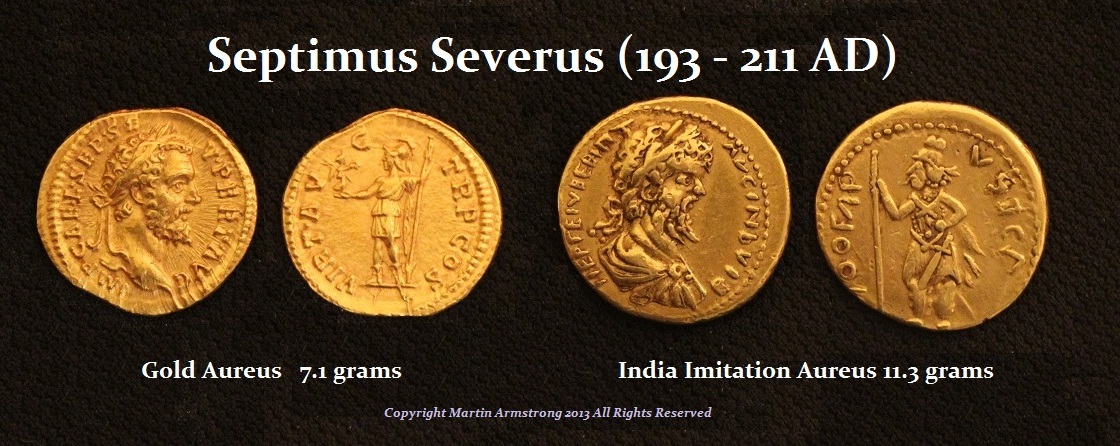
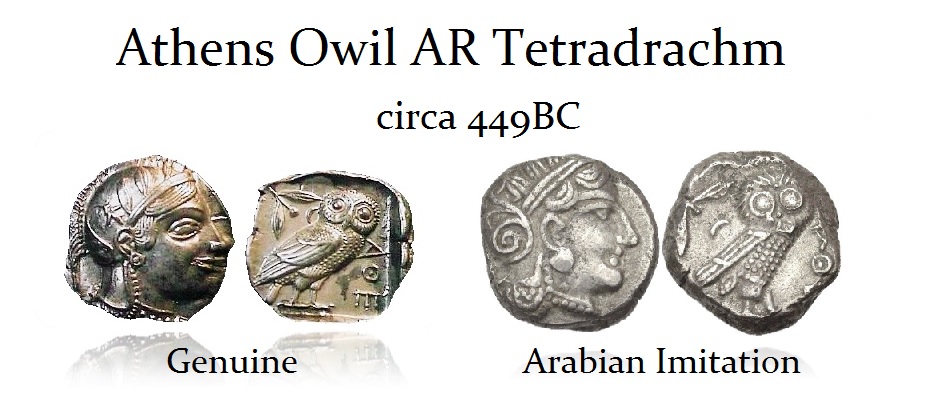
The confidence in the currency would simply depend upon the strength of the economy, as was the case for Athens and Rome in ancient times. Their coinage was imitated because they were the dominant economies of their time. The value of a currency is the strength of its economy. It has NEVER been about its backing, which is purely a theory that arrived with paper money. Rome had no national debt. The value of the currency was more than its metal content. Here we have a gold aureus of Septimus Severus (193-211 AD) and the imitation in gold made in India. The imitation weighed more than the original. Imitations were made in the same quality of metal, so it proves that it was not a counterfeit but that a coin from the core economy possessed a greater value than the raw metal.

Just compare Russia, which has tremendous resources, against China, Japan, and Germany that had really no gold reserves. Russia did not expand its economy while the others boomed because of its people. The value of a currency is the TOTAL productive capacity of its economy — the work ethic of its people. Russia has not been able to rise substantially because it never fully embraced the idea of capitalism. They moved from communism to an oligarchy.

Understanding the Persecution of John Law


Armstrong Economics Blog/Corruption Re-Posted Apr 7, 2021 by Martin Armstrong

COMMENT: Hi Mr. Armstrong…..this is a surprising (to me) summary, on John Law. Every piece I ever read about him, cast him as a complete scoundrel, yet you obviously write with admiration. Just another example of history depending on someone’s perspective. You never cease to surprise. And that’s good.

HS

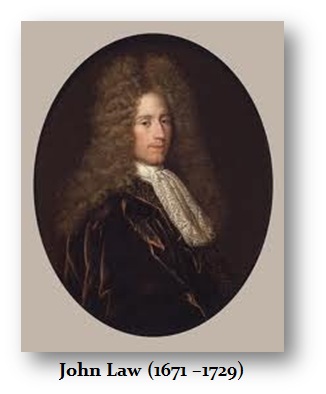
REPLY: John Law was actually a brilliant man. His legacy is not so different from John Maynard Keynes. He advocated deficit spending ONLY in times of recession, but governments have spent relentlessly with deficits that never end. We call this “Keynesian economics” when in fact he never advocated such a system. Likewise, John Law never advocated what the French government did in creating the Mississippi Bubble.

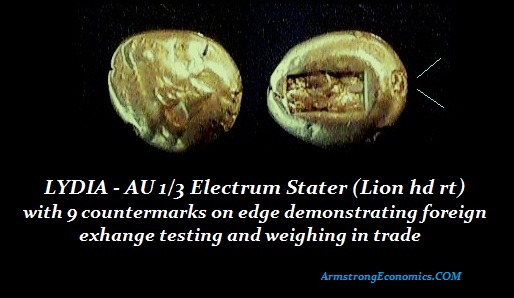
It is true that John Law fled to Amsterdam, but this is when he studied real banking operations and saw that money was actually virtual. Because coins were counterfeited or their edges shaved, bank money was more valuable than coins. Once the coins were deposited, each had to be inspected. So the bank became a sort of guarantor of the validity of the coins. Here is an ancient coin from Lydia with numerous banking marks applied, verifying that the coin had been inspected by them before for the same reasons.

It was this first-hand observation that led John Law to see that money was actually virtual, whereby people preferred bank money to actual coins. John then returned to Scotland, where he published in 1705 his Money and Trade Considered, with a Proposal for Supplying the Nation with Money. Law would later publish a second edition in 1720. He attempted to use his writing to convince the Scottish Parliament to adopt his ideas about money, but they declined, giving rise to the adage that a genius is never acknowledged in his native land (i.e. Columbus, Einstein to just mention two). Law had captured a glimpse of the virtual money supply as he was fascinated with the development of “bank money” that was displacing bullion in circulation.

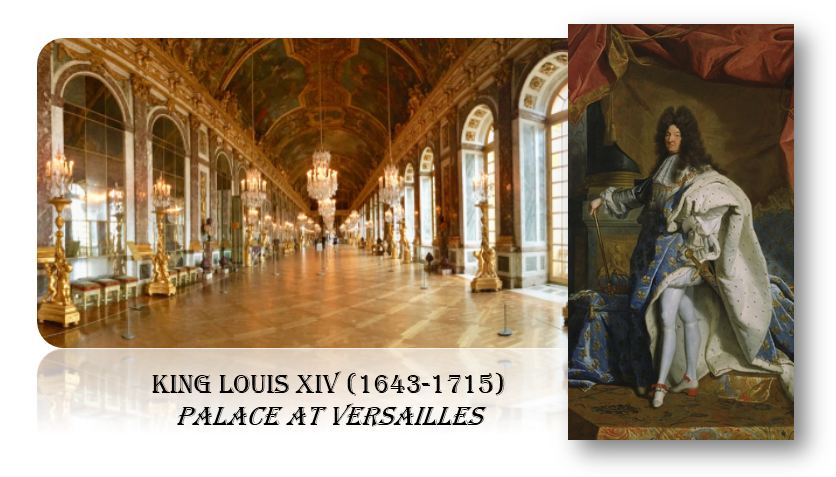
Therefore, John Law has been hated by hard money people because they fail to understand that coins became second-best to actual paper money, for it relieved the problem of having to test every coin in a large transaction. Where Scotland refused to listen to John Law, France took him up on his observations. In 1716, John Law was invited by France to give it a shot. King Louis XIV (1643-1715) had squandered France’s resources on numerous wars and the construction of the Palace at Versailles. The idea of borrowing to fund wars and expansion had ruined the governments of men. Louis XIV had also adopted the theory that it was a divine right of kings to act as a dictator. This idea has persisted behind the curtain for centuries and dominates even American politics where you cannot sue the government without its permission.

For 54 years, Louis XIV worked daily for 8 hours, where he concerned himself with the very smallest of all details of state. He controlled everything from troop movements, infrastructure construction, court etiquette, and even theological disputes. He subordinated the nobles who had often instigated civil wars. Over the previous 40 years, there had been about 11 such civil wars.

The cost of this construction of his Palace at Versailles was far beyond the imagination. He effectively ran the country from Versailles and distanced himself from the people and Paris. Yet for all his extravagance, through the assistance of Jean-Baptiste Colbert (1619-1683), he was responsible more than anyone else for forging France into a more modern country.

John Law has been blamed for the Mississippi Bubble when, in fact, France was on the brink of its third bankruptcy when it contacted him. The government entered a partial default by consolidating its debt and changing its terms. Its new issue of billets d’etat was still required for more funding. The shortage of gold and silver coinage was plunging the economy into a depression. Law’s first proposal for a national bank issuing bank money was rejected. The second proposal to create a private bank was accepted and thus Banque Generale was established in May 1716.

The bank began to lend on its own shares, and the government intervened to support the price of its share by decree. Like the US government ordering the Federal Reserve to provide a floor to US bonds during World War II, likewise, the French government tried to maintain the value of the shares at 9,000 liver. Law begged the government to reduce the floor to 5,000, but they refused. They ended up blaming Law and arresting him no so unlike how the Democrats charged owners of S&Ls which failed when it was Congress who was changing the laws and creating a one-way market where everyone tried to sell.

Food Crisis of 2021 in Europe


Armstrong Economics Blog/Agriculture Re-Posted Apr 1, 2021 by Martin Armstrong

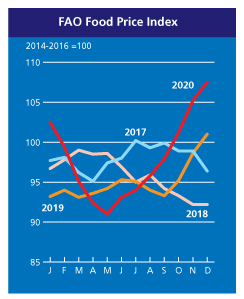
We are staring in the face of a serious food crisis in Europe as food prices rise continuously, and with further draconian COVID measures within the EU, they are bringing the food supply chains to a standstill. Our models have been warned that this 8.6-year cyclical wave into 2024 will be one of commodity inflation due to SHORTAGES rather than speculative demand. All the indications that the world is heading for a serious food price crisis are in play. The Food Price Index (FFPI) of the Food and Agriculture Organization of the United Nations (FAO) averaged 107.5 points in December 2020, an increase of 2.3 points (2.2%) compared to November 2020, which represents an increase for the seventh consecutive month.

With the exception of sugar, all sub-indices of the FFPI recorded slight gains in December, with the sub-index for vegetable oil again rising the most, followed by that for dairy products, meat, and cereals. For 2020 as a whole, the FFPI averaged 97.9 points, a three-year high, 2.9 points (3.1%) higher than in 2019, but still well below its 2011 high of 131.9 points. It is also interesting that the FFPI in 2002 was still 53.1 points. It only increased significantly from the financial crisis of 2007/08, only to then level off in the 90-point range. Since May 2020 it has increased by 18%.

Our models project that the upward trend in the FFPI will intensify going into 2024. With the coronavirus mutating, as we warned ALL viruses do, as such, we have these various strains from Africa, Brazil, UK, and even California, are inspiring politicians to use this as an opportunity to restrict the population even further. These corona measures have extended to the food supply chains, disrupting them just as we see in electronics. For example, the German Fruit Trade Association sees the supply of fruit and vegetables from abroad is at a substantial risk whereby imports are suspended. The reason is the tightening of the corona entry regulation by the federal government. The tightening of the lockdown in Europe is beginning to restrict the supply chains reducing the food supply

Collectibles Going Crazy?


Armstrong Economics Blog/Collectibles Re-Posted Apr 1, 2021 by Martin Armstrong

This June, Sotheby’s will be auctioning off three of the greatest rarities in the stamp and coin field. The 1933 Double Eagle $20 gold coin, the unique British Guiana One-Cent Black on Magenta, and the unique Inverted Jenny 1918 Plate Block. This is truly an incredible offering from a single collector to have captured three of the rarest and most unique collectibles in history.

It is a bit unusual that a unique stamp from a less than the mainstream region has emerged as the rarest and sole-surviving example of the British Guiana One-Cent Magenta from 1856. It was last sold in 2014 at Sotheby’s for $9.48 million. While it was rediscovered by a 12-year-old schoolboy living in South America in 1873, perhaps due to fantastic marketing, it has emerged as one of the most important stamps in famous collections that have ever assembled. In 1873 L. Vernon Vaughan, a 12-year-old schoolboy living with his family in British Guiana found the stamp among a group of family papers bearing many British Guiana issues. The young philatelist would later sell the stamp for several shillings to another local collector. The British Guiana then entered the UK in 1878, and shortly after, it was purchased in Paris by Count Philippe la Renotière von Ferrary who many considered to be perhaps the greatest stamp collector in history. Then following the war, France seized Ferrary’s collection, which had been donated to the Postmuseum in Berlin, as part of war reparations due from Germany following World War I. The stamp was then sold in 1922 at auction when it was purchased by Arthur Hind, a textile magnate from New York, for its first auction-record price of $35,000. The stamp changed hands moving from the collections of the Australian engineer Frederick T. Small; then a consortium headed by Irwin Weinberg; then by John du Pont of the famous chemical company. Du Pont paid $935,000 for the stamp in a 1980 auction, before it was last sold at auction to Weitzman for the record-setting price of $9.48 million.

Interestingly, a tradition emerged where previous owners of the British Guiana signed the back of the stamp. Weitzman added his own personal mark to the reverse of the stamp inscribing his initials “SW” along with a line drawing of a stiletto shoe as a nod to his legacy in fashion.

This 1933 Double Eagle ($20 gold coin) is the only example that may be legally owned by an individual. It was the coin acquired by King Farouk of Egypt. Stuart Weitzman purchased the coin at a Sotheby’s/Stack’s auction in 2002 for a world record price of US$7.59 million, nearly doubling the previous record. The Director of the United States Mint signed a Certificate of Monetization that, in return for twenty dollars, authorized the issuance of this single example.

In August 2005, the US Mint announced the recovery of ten additional stolen 1933 double eagle gold coins from the family of Philadelphia jeweler/coin dealer Israel Switt, who was the illicit coin dealer identified by the Secret Service as a party to the theft who admitted selling the first nine double eagles that were recovered. Israel Switt had many contacts and friends within the Philadelphia Mint. As the story goes, the Secret Service found that only one man, George McCann, had access to the coins at the time and served prison time for similar embezzlement in 1940. Israel Switt somehow obtained the stolen 1933 double eagles. One theory is that McCann swapped the previous year’s Double Eagles for the 1933 specimens prior to melting, thereby making sure the count was correct. The US mint began striking Double Eagles on March 15, 1933. Roosevelt’s executive order to ban gold was not finalized until April 5. Therefore, on March 6, 1933, the Secretary of the Treasury ordered the Director of the Mint to pay gold only under a license issued by the Secretary, and the United States Mint cashier’s daily statements do not reflect that any 1933 Double Eagles were paid out.

In September 2004, the claimed owner, Joan Switt Langbord, heir to Israel Swift, tried to sell the 10 coins and they had to be surrendered to the Secret Service. In July 2005, the coins were authenticated by the United States Mint after working with the Smithsonian Institution, as being genuine 1933 double eagles. Joan Switt Langbord claimed to have found them in a box and she went to court to have them returned. On October 28, 2010, US court ruled and the issue went to trial in July 2011. On July 20, 2011, after a ten-day trial, a jury ruled unanimously in favor of the United States government and Lanford appealed. At first, the Court of Appeals overruled the jury, but then it went En Banc and the Court of Appeals ruled in favor of the government. The Langbords appealed to the U.S. Supreme Court, which on April 17th, 2017 denied certiorari.

Hetty Green’s son, Edward Howland Robinson Green (1868-1936), was not so frugal and spent $3  million on coins and stamps. He was an avid collector and bought the famous sheet of 100 inverted airmail stamps in 1918, paying $20,000. The last time this Plate Block appeared on the market was 16 years ago when it sold at auction for $2.97 million.

Meanwhile, the classic Ferraris from the 1980s have nearly doubled in price over the past year.

Revealing History


Armstrong Economics Blog/Ancient History Re-Posted Mar 31, 2021 by Martin Armstrong

COMMENT: I find it interesting how two people the general consensus has said were scoundrels, John Law and Julius Caesar, you have shown were actually people against the establishment. I read your Anatomy of a Debt Crisis and you have put together the contemporary historians where everyone else just seems to rely on the fake news of the day.

Thank you for digging up the facts.

HY

REPLY: When I was in high school, I had to read Galbraith’s “Great Crash.” Nowhere in his book did he ever mention defaults on national debts by any country. When I came across Herbert Hoover’s memoirs in an old book store in London, this was probably the second thing that changed my life, with the first being the movie  “The Toast of New York” about the Panic of 1869 when gold hit $162.50, which I had to watch in history class. I learned not to trust the history books, and the best way to find out the truth was always to return to the contemporary reports of history and/or the newspapers of the time.

The coinage has been a major factor in identifying the history and accurately dating events. Here is an extremely rare coin of Julius Caesar. Note that there is no portrait of him. He is announcing his victory in Gaul. His Gallic campaign was initially a piecemeal affair, but within six years, he had expanded Roman rule over the whole of Gaul. Following years of relative success, mainly thanks to the disconnected nature of the tribes allowing him to take them on separately (divide and conquer), Caesar was faced with the chief of the Arverni tribe, Vercingetorix, who too late had built a confederation to stand against Caesar. In 52 BC, despite formidable resistance, Caesar finally defeated Vercingetorix at the Battle (or Siege) of Alesia. This illegal war which by Caesar’s own account had left a million dead, was instrumental in elevating him to a position of supreme power among the statesmen of the late Republic, making him incredibly wealthy through war booty and also making him dangerously popular with the plebs — the common people.

This coin was struck in the course of Caesar’s war against the Senatorial faction led by Pompey and later Metellus Scipio. Caesar’s triumphant coinage trumpets his military achievements and conquest in Gaul while reminding the bearer also of his claimed descent from Venus through Aeneas. Interestingly, behind the bust is how old he is IIL or 48 years old. The reverse figure tied below the trophy of arms is popularly believed to depict the defeated Vercingetorix. The figure is carefully rendered in detail of how the Gauls appeared unshaven often with tattoos in blue to frighten their opponents.

In order to consolidate his power when he returned, Caesar produced triumphant coinage to spread the news of his military capability. The reverse of this coin is popularly believed to depict Vercingetorix himself. In 48-47 BC, the defeated Gallic chieftain still languished in the Tullianum, the underground prison beneath the Comitium. He would be hauled out for Caesar’s triumph in 46 BC, then returned to his cell and strangled.

This example of Julius Caesar AR Denarius was struck by a military mint moving with Caesar to pay the troops on a regular basis between 48-47 BC.

This is a Roman silver denarius struck by Brutus announcing he killed Caesar on the Ides of March 15, 44 BC (EID MAR). As you can see, the coinage can actually be used to confirm history to the year and sometimes to even the very day.

What is 2032?


Armstrong Economics Blog/ECM Re-Posted Mar 30, 2021 by Martin Armstrong

Many people have asked, “Why is 2032 going to be such a major change in the world’s political economy and society as a whole?”

We are confronted by the end of the Sixth Wave come 2032, which will be a profound economic and political change. It appears these world leaders are pushing us toward fulfilling the vision of Kalus Schwab and his distorted view of how society functions. While the first wave marked the collapse of Rome, 794 marked the collapse of the Nara period in Japan as the capital then moved to Kyoto. That would last until 1185 AD when government was overthrown, marking the birth of the Shogun Period (military general authority). The Great Seljuk Turkish Empire had its origins, with its first capital in 1037. By 1092, the Seljuk Empire was at its greatest upon Malik Shah I’s death and had captured most of the Byzantine Empire, creating the Great Monetary Crisis of 1092 in Constantinople. Alexius I (1081-1118AD) of Byzantium saw his empire carved up.

It was 1075 when the Investiture Dispute began, where the Pope opposed kings appointing bishops to control. He had to threaten the ex-communication of kings, which only concluded in 1103. This was the start of the separation of church and state. In 1084, Emperor Henry IV deposed Pope Gregory VII and installed the first Anti-Pope Clement III who then crowned Henry Holy Roman Emperor. A revolution in 1094 resulted in Pope Urban II overthrowing the Anti-Pope and Henry lost power over Italy. But by 1111, Henry V captured the Pope, forced his settlement, and then crowned Henry V as Holy Roman Emperor. By 1112, the Church splits between Papal and Imperial supporters.

The Balkans had been overrun by the Patzinaks who were a nomadic people of the Turkic family. Their original home is unknown, but during the 8th and 9th centuries, they inhabited the region between the lower Volga and the Urals. They then laid siege to Constantinople itself in 1090 AD. They led Alexius to ask for help from Venice, which began the First Crusade (1096–1099) where they took Jerusalem. But the Venetians were more interested in plundering Constantinople. Thus, 1104 marked the peak in the Byzantine Empire and by the Latin rulers who seized Byzantium taking control 1204-1261 AD. It wasn’t until 1298 when the reign of Osman I, founder of the Ottoman Empire, began.

The financial crisis in France led to the default on loans to Italian bankers and the seizure of the Papacy itself moving it to Avignon in France known as the Avignon Papacy, also known as the Babylonian Captivity, which was period from 1309 to 1376. The French Anti-Pope seized the Knights Templars on Friday, October 13, 1307, to confiscate all their wealth and that of their clients. The Knights Templars had become the first real international banking system as they evolved following their founding around 1117/1118 AD, lasting for 22 waves of 8.6 years. This next wave also saw the Black Plague (1347-1351) wipe out 50% of the population, which then changed the economy by shifting it from serfdom in Europe to capitalism as wages began to take place because of the shortage of labor.

The next peak in the cycle 1413.75 marked the start of the religious revolution. In England, the Oldcastle Revolt was a Lollard uprising against both the Catholic Church and the English King Henry V. Oldcastle was influenced by Lollard cleric William Swynderby, who preached in Almeley during his youth. Lollardy was a politico-religious movement initiated by prominent theologian John Wycliffe during the 1370s. The Lollard beliefs dealt with their opposition to capital punishment, rejection of religious celibacy, and belief that members of the Clergy should be held accountable to civil laws. In addition, it was the rise of the iconoclasty, which took place in the Byzantine Empire, where they rejected ornamentation of churches, religious images, and pilgrimages. They objected to war, violence, and abortion. John Oldcastle led the revolt, and it took place on the night of 9/10 January 1414. The rebellion was absolutely crushed at the battle on St. Giles’s Fields. There was rising discontent in religion that manifested on October 31, 1517, when Martin Luther nailed his 95 Theses to the door of the Wittenberg Castle church in Germany.

This next wave peaked in 1723.35, not merely saw the Protestant Reformation impact region, but with the fall of Constantinople in 1453, scholars fled to Europe and Russia, taking the wealth of knowledge with them. By 1492, Christopher Columbus convinced others that the world was round and not flat based upon maps that came from Constantinople. While it would slowly expand the knowledge in Europe, the Age of Enlightenment is formally classified as being between 1715-1789, which really became the foundation for the next wave into 2032.

But this wave was the beginning of the crisis with a monarchy. Columbus was backed by Spain, which then became the new financial capital of Europe. But the mismanagement by the monarchy led to Spain becoming a serial defaulter beginning in 1557, followed by 1570, 1575, 1596, 1607, and 1647, ending in a third world status by the end of this wave. King Philip V of Spain abdicated the throne in 1724 to go to a monastery.

In England, on October 17, 1722, the Habeas Corpus Act was suspended because of a Jacobite plot to take the thrown by a Catholic James III they called the Old Pretender, and Parliament prohibited journalists from reporting on political debates. From here on out, the tone for the next wave was set in motion. The rise against the monarchy. This was the wave of human rights and it moves into its culmination come 2032 with the rise against human rights and the attempt once more to suppress the people with the rise of authoritarianism. This is once more a major turning point, and we will face a dramatic change both economically and politically on a global scale.

The forthcoming “The Discovery of the Business Cycle” goes into the details of these waves throughout history with not merely political facts but also the rise and fall of the world’s monetary system.