The President Overtaking the Federal Reserve – BAD IDEA


Posted originally on May 1, 2024 By Martin Armstrong 
Federal Reserve Eagle

I do not agree with Donald Trump’s view of the Federal Reserve. I speak on behalf of sound economic policies that benefit the people. I do not blindly support a political candidate for the sake of being on the right side. Now, I criticized Trump during his presidency for constantly pressuring the central bank to lower interest rates. There are rumors swirling that Trump, if elected, would set the price of interest rates himself without the advice of the Federal Reserve. While this may be an extreme side of the rumor, Trump and every other president would like more power over the Federal Reserve — BAD IDEA!

What we must keep in mind is that the Federal Reserve’s original design, which lasted for about one year, was brilliant. The classic banking model involved borrowing from depositors on a demand basis and lending long-term, making a profit on the spread in interest rates, such as for business loans and mortgages. This was relationship banking, not today’s transactional banking model.

This was fractional banking insofar as about 8% of the money needed to remain free to service demand requirements. The crisis comes during an economic contraction when people run to the bank for a loss of confidence and demand to withdraw their funds. This results in the value of cash rising in purchasing power compared to assets, so asset values collapse.
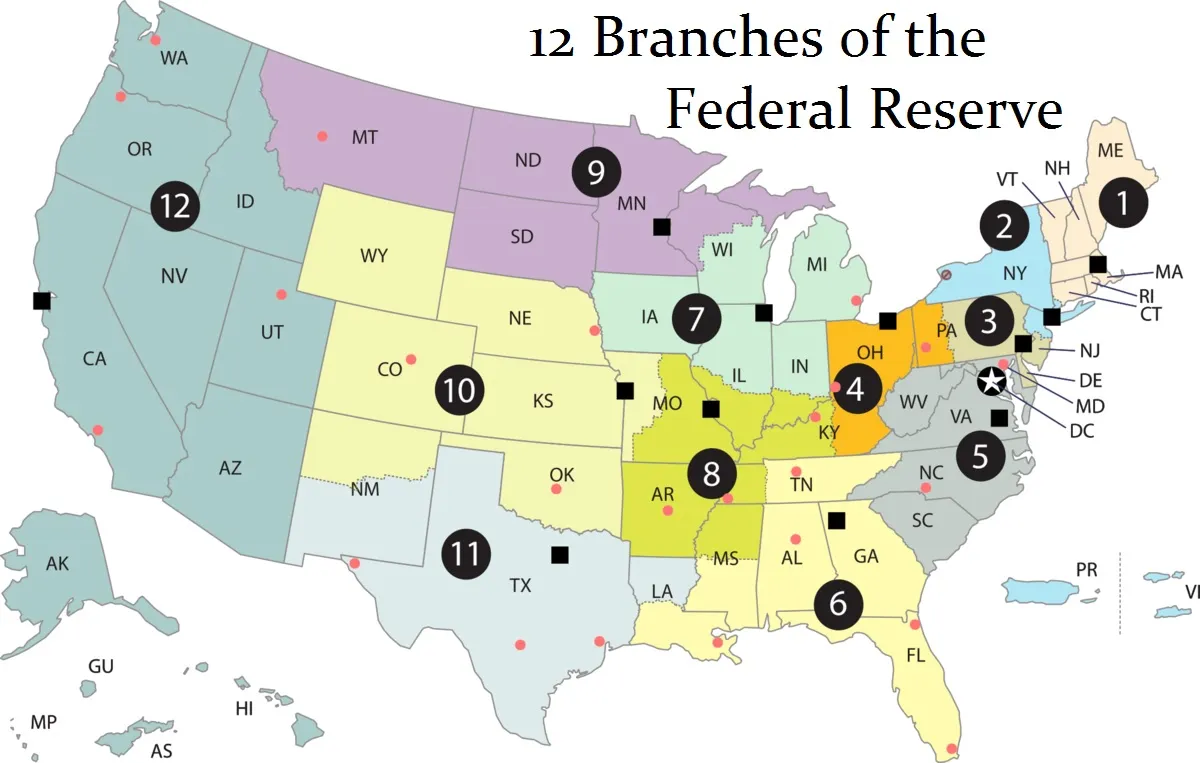
Federal Reserve 12 Branches

The idea of “elastic money” was to increase the supply of cash during such a crisis to meet the demand for withdrawals and that would offset the need to sell assets by calling in long-term debts. By increasing the money supply on a temporary basis, the Fed could offset the contraction in theory smoothing out the business cycle.

This was a brilliant scheme. However, it has been Congress, and not the Fed, that corrupted that mechanism. The banks technically owned the Fed as this was supposed to save the taxpayer money. The banks should contribute to their own bailout fund. Furthermore, the Fed’s design was also about buying in corporate paper when banks would not lend money. This was a mechanism used to offset rising unemployment if corporations could not fund their operations. They supplemented this by the management of regional interest rates to balance the domestic economy. Each branch of the Fed could raise or lower their local interest rate autonomously to attract capital when there was a local shortage or deflect capital when there was too much.

Congress began to manipulate the Federal Reserve for their own self-interest when World War I broke out on April 6, 1917. The alteration to the design of the Fed was to direct it to buy government bonds, not corporate. In this first step, they never reverse this decree after the war. They removed the brilliant design to stimulate the economy directly by purchasing corporate paper during a recession. In the last 2007-2009 crisis, the government wrote a check to TARP and hoped that the banks would lend money, but they did not. Removing this first pillar of the independent Fed distorted the entire system. It then made little sense for bankers to own shares in an entity that was no longer privately controlled.
DowIntRates 1929

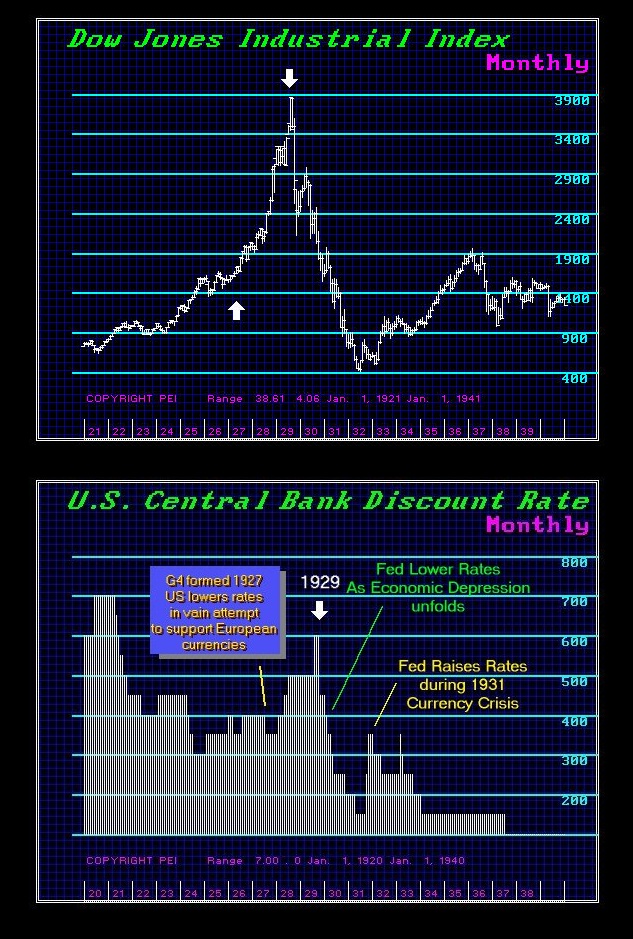
Banks became traders during the 1929 Boom-Bust Cycle. Goldman Sachs became deeply involved in the bull market, establishing numerous trusts and mergers. Goldman Sachs expanded the leverage going right into the eye of the storm that was about to hit starting on September 3, 1929. The crash wipes our 70% of Goldman’s entire market.

The Glass-Steagall Act, also known as the Banking Act of 1933 (48 Stat. 162), was passed by Congress in 1933 and prohibited commercial banks from engaging in the investment business. Around 5,000 banks failed during the Great Depression largely because banks sold trusts and foreign sovereign government bonds to the public in small denominations. Bill Clinton later repealed Glass-Steagall and handed the power back over to the bankers. Disaster strikes every time the government tries to manipulate the free market.

People believe the Fed has the power to create money out of thin air, yet never explain why the Fed was given that power. You cannot have a fixed money supply as the population increases, then you end up with DEFLATION, which is the rise in the value of money. You can double the money supply, but if the people hoard it, as they tend to do during private waves when the public loses all trust in government, you will never create inflation. There was a huge contraction in the velocity of money during the Great Depression for this very reason.

The Biden Administration, as has the Trump Administration, has come after the Fed. Politicians merely want the economy to appear strong under their reign and fail to see the long-term impact of policies. Politicians have no knowledge of economics or the insight to run the Fed. Not to mention that law does not permit Washington to bark orders at the Fed, although Washington does oversee the Fed and can force the central bank to change its policies to align with government spending or repel debt buyers.
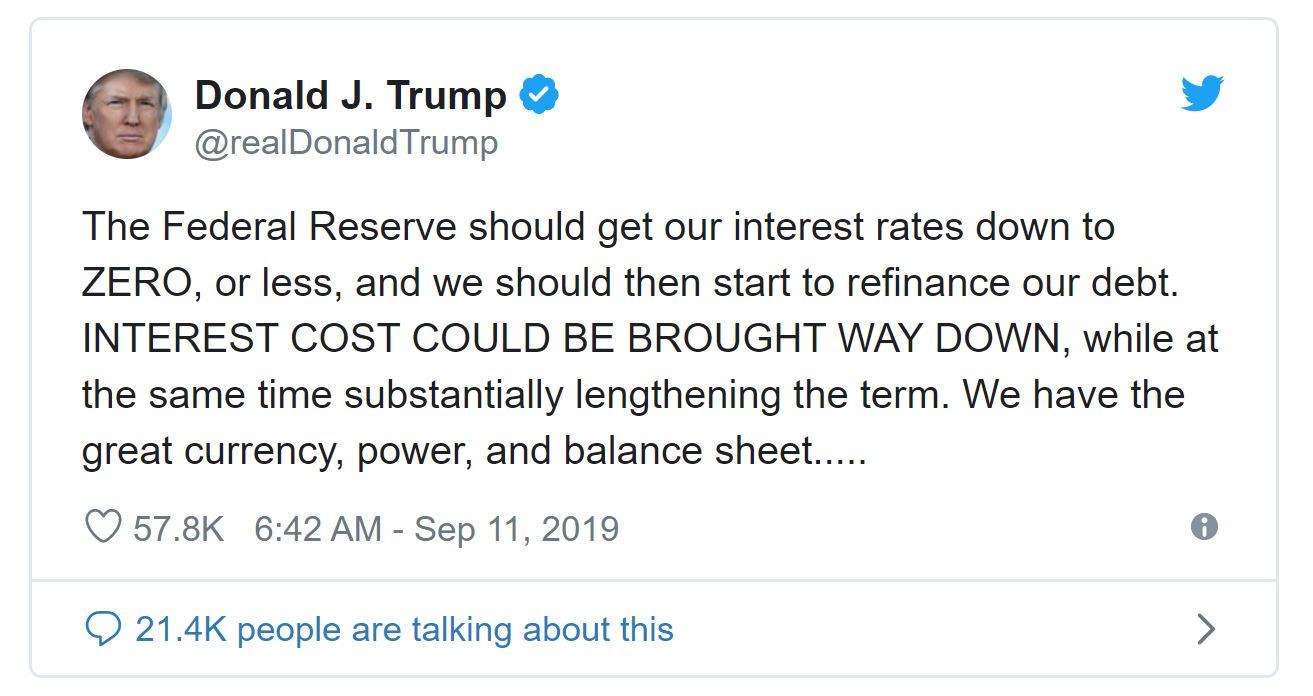
Trump on Interest Rates

Trump is a borrower, not a lender. His bankruptcies were the result of the business cycle and he leverages himself to the hilt so when the recession comes, he gets in trouble and when it is booming he claims to be a fantastic investor. But he is no trader. He could have hedged the business cycle but did not.

Chairman Jerome Powell and Trump clashed repeatedly. Not so coincidentally, Powell and numerous Fed bank presidents have their terms expiring in 2028 – a key year, as indicated by our models. The Biden Administration has already driven the economy off a cliff. The central bank is merely trying to heal an already injured economy with a limited medical kit.

The Fed is INDEPENDENT and will not be bullied by Biden or Trump. The Fed understands that it has become the world’s central bank and its actions in raising rates have had a far greater impact externally particularly in emerging markets because so many other nations issue their debt in US dollars.

The Western Sanctions Against Russia and U.S. CBDC


Posted originally on the CTH on February 11, 2024 | Sundance 

I made the notation during the Tucker Carlson interview that Russian President Vladimir Putin knows everything below in this article about Russian Sanctions and the formation around a dollar-based U.S. CBDC. Unfortunately, Tucker Carlson does not know the specifics of how it is being constructed.

As I continue deep meetings and very granular discussions about the lessons within the EU that can be applied to the USA, it is worth revisiting this previously password protected post.

I went to the EU, because deep inside all of my research on Russia, things did not make sense.  I was very prepared and organized to expect everything sketchy, and what I found surprised me.  Putting boots on the ground, I now have a completely clear and different view.

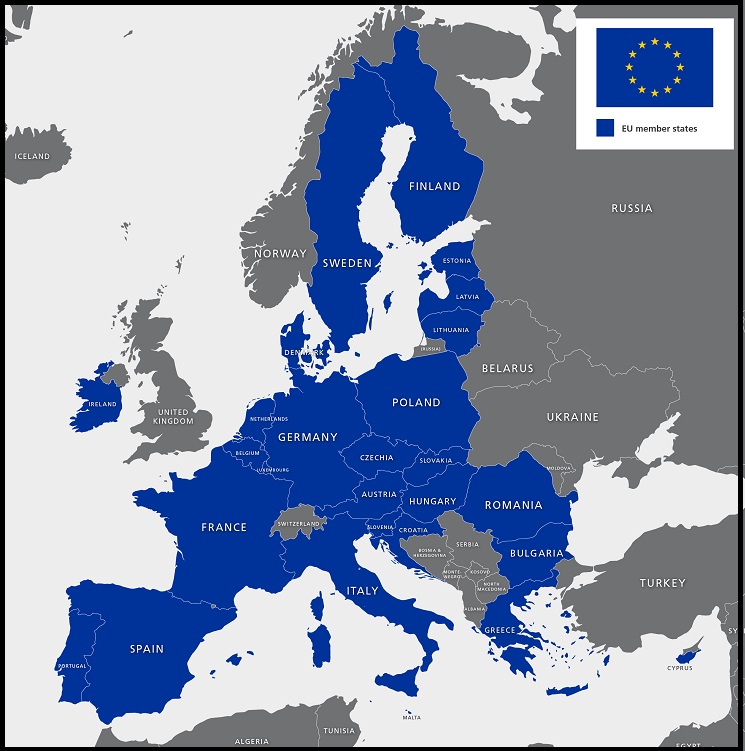
Let me start by saying everything we have read about the Western sanctions against Russia is false.  What sanctions might exist do not have any impact, and Eastern Europe has no intention to anger Putin.  When Brussels threatens to kick Hungary out of the EU/NATO, I can almost hear Viktor Orban saying, “Don’t threaten me with a good time.”  Hungary doesn’t even use or rely on the €uro for domestic financial transactions; they still retain their own national currency, the Hungarian forint or HUF.

First things first with the Western financial sanctions- specifically the SWIFT exchange.  It is true you cannot use VISA, Mastercard or any mainstream Western financial tools to conduct business in Russia; however, the number of workarounds for this issue are numerous.  One of those tools is the use of a cryptocurrency like Bitcoin; and within that reality, you find something very ominous about the USA motive.

Crypto users are likely familiar with stories like Binance and the US regulatory control therein.  Factually, outside the USA Binance is being used to purchase and trade crypto without issue, but inside the USA it is regulated.  That brings me to the MEXC crypto exchange, a Mexican version, again available globally but not allowed in the USA.  The same applies to Metamask, used all over Europe but not permitted in the USA.  Start to ask yourself, why all these crypto exchanges are available to the rest of the world but not the USA, and you start to suspect the Russian sanctions, just like the Patriot Act, are something else entirely.

Then there’s app wallets.  You might be familiar with Apple Pay as a process to handle transactions from your iPhone.  Apple Pay is linked to your bank account.  Well, the “wallet feature” exists on other apps also, like Telegram; however, you can find the wallet feature, but if you try to use it from a USA cell phone… “This feature is not allowed in your region.”  Why are digital wallets available for the rest of the world but blocked by the U.S. government?

This brings me to several crypto conversations in the EU at various cafes with people who have a deep understanding.  The commonly accepted bottom line, the Western sanctions, organized by the Biden administration and US Treasury, were not intended to put financial walls around Russia; they were designed to put control walls around the USA.  Russia was the useful justification.

Here’s how it really looks from the outside looking at the USA.  The same way the Patriot Act was not designed to stop terrorism but rather to create a domestic surveillance system. So too were the “Russian Sanctions” not designed to sanction Russia, but rather to create the financial control system that will lead to a USA digital currency.

Now, does the exploding debt and seeming govt ambivalence take on a new perspective?  It should, because that unspoken motive explains everything.  This is not accidental folks.

Again, the western sanctions against Russia are not having an impact against Russia; they are having a quiet impact in the USA that no one is permitted to talk about.

♦LOGISTICS – Despite popular opinion to the contrary, it is entirely possible to travel all over Europe without being tracked.  If you pick an entry point into the EU (Schengen Area), once inside, you can travel without any national checkpoints or passport checks.  It is also entirely possible to fly all over the EU without ever giving a passport number when you book the flight.  The trick is to know which airline.  You are a name on a passenger manifest, nothing more.

Bottom line, travel around the EU is less controlled, tracked and monitored, than travel inside the USA.  Yes, let me emphasize; freedom of travel is greater in the EU than it is in the USA.  This was completely unexpected.

♦GROUND REPORT – You might ask how I know the Russian sanctions are ineffective – here’s an example.  After doing advanced research, I went to three separate banks as a random and innocuous customer.  I put my reason in the kiosk at each bank, got my ticket number and sat down to listen to the conversations. When my ticket number came up on the digital board, I just ignored it and sat for hours listening to conversations.  No one ever noticed or questioned me – not once.

At every one of the banks, the majority of the customers, at the “new account” desk, were foreign nationals asking about setting up business accounts to trade with Russia. In every bank the conversations were friendly and helpful, with the bank staff telling the customers exactly how to set up their account to accomplish the transactions.  No one was saying no; instead they were explaining how to do it in very helpful detail.

Within Russia, there are now 3rd party brokers with international accounts, an entirely new industry, which creates a layer of transactional capability for the outside company to sell goods into Russia.  A Samsung TV travels from South Korea to the destination in the RU with the financial transaction between manufacturer and retailer now passing through the new ‘broker’ intermediary. Essentially, that process is what was happening in the banks for small to medium sized companies.

♦ Back to the crypto and digital wallet angle.  In addition to financial/transactional brokers for durable goods into Russia, there is now an entire industry of selling telephone id’s with EU phone numbers to process the transactions that are blocked by the USA sanction regime.

Meaning, a person could buy a phone and register a phone number from within the EU, and then go back to the USA and access all the blocked/restricted financial processes [Binance (non-US), Metamask, MexC, Telegram digital wallet etc].  This would permit them to do untracked financial transactions into and out of Russia from the USA without the USG knowing about them (sanction workaround).

[DISCLAIMER: in the interest of my own legal risk, I did not do this; I’m just explaining.]

I am not smarter than the U.S. intelligence community, so what does this mean?

This means the U.S. government knows exactly why the Russian economy is thriving, the Ruble is stronger against the dollar, and there is nothing -not one thing- visible or different on the ground in Russia that an ordinary Russian citizen would notice.  In fact, the Russian economy is doing fine, better than before the Ukraine conflict initiated, albeit with new financial industries created by the sanctions.

If the US government knows this, then why the sanctions?

Asked and answered.  The Western sanctions created a financial wall around the USA, not to keep Russia out, but to keep us in.  The Western sanction regime, the financial mechanisms they created and authorized, creates the control gate that leads to a U.S. digital currency.

In essence, the Ukraine war response justified a system that creates a digital dollar.

I will have more, but for now just think about this aspect.

Mark Pittman & the Bankers


Posted originally on Jan 6, 2024 By Martin Armstrong 

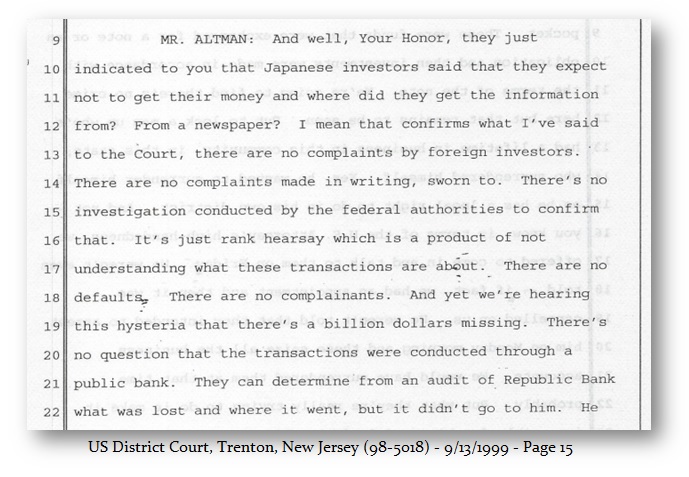
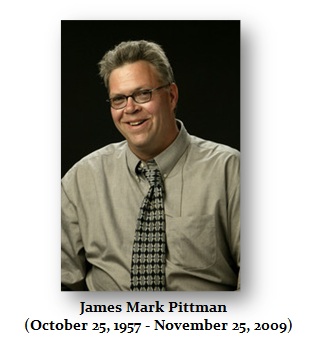
The late Mark Pittman was a journalist for Bloomberg when, once upon a time, there were still a few actual investigative reporters. Mark did a piece on my operation in Japan. He knew what we were doing, that the accounts were mine, not clients, and that I was buying distressed portfolios. Not one client ever signed a complaint, and there was NO DEFAULT. When they charged me. I met Mark at the Hyatt in NYC across from the Train Station. He knew it was a setup and said: “Marty, we are not going to allow them to do this to you.”

Trenton no Defaults 9 13 1999
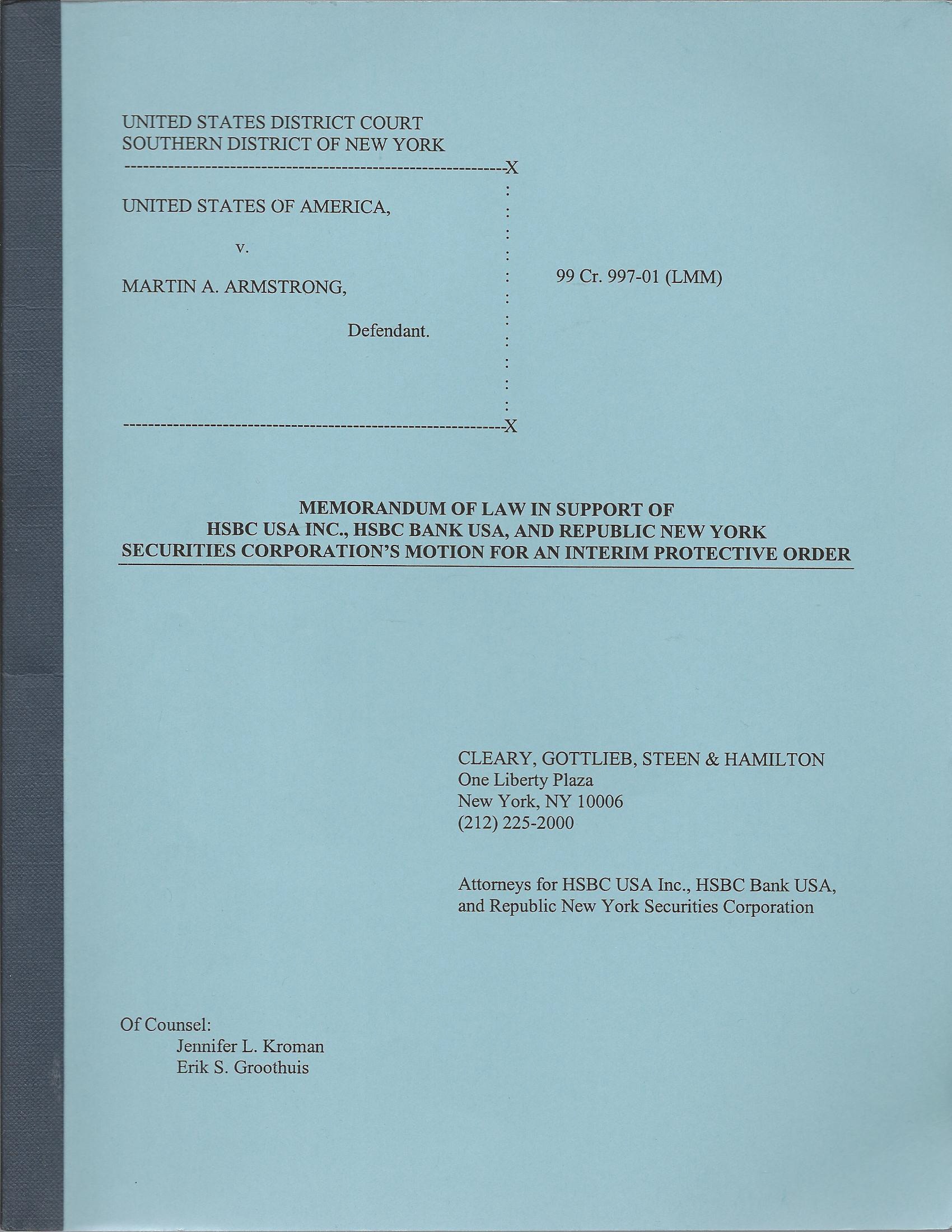
HSBC Gag Cover

The law says that if you commit fraud, you MUST help the victims get their money back. Further proof of how New York City is a cesspool of corruption: when they realized I was helping my clients go after the bankers, they put a gag order on me to stop me from helping my clients against HSBC/Republic. They have been doing the same to Trump. The Special Prosecutor went as far as to demand a gag order on Trump so that he could not even criticize Biden while campaigning. You cannot make up this stuff. If you wrote a fiction novel with these maneuvers, they would say it is too far-fetched.

I think it is absolutely critical as Trump is put on trial in New York City. I was granted bail in New Jersey. Not a single NY journalist ever reported the Truth no less the courts. I was interviewed by a journalist who asked about the bank illegally trading in my accounts. She asked if they were using my accounts to “launder money for the Russian Mafia as they were doing in Madof?” The banks claimed in Madoff’s case not to have known. That is absolutely IMPOSSIBLE, for you have to know your client rules. They verified every account and the corporate documents behind each one. Madoff pled guilty to an information quickly. He was not indicted and could have defended for a few years. The only reason he did so was clearly to protect his family. Just as in my case, the bank claimed it had no idea where the money was. It is impossible to get $1 billion out of a bank, and nobody knows where it went. There is NO SUCH thing as a fair trial in New York City. Trump is doomed there, and this is all about interfering in the 2024 election.

Pittman Mark

Mark understood the bankers very well. Bloomberg removed Mark from covering my case and replaced him with David Glovin, who could never praise the government more. It was Mark at Bloomberg who battled in court for years to get the details of those bailouts released to the public. Mark was probably the most professional journalist I ever met. I was told after my case began that Bloomberg purged all the reports Mark had previously written about our firm from their terminals and certainly Japan. It was as if Bloomberg was in on the whole scam.

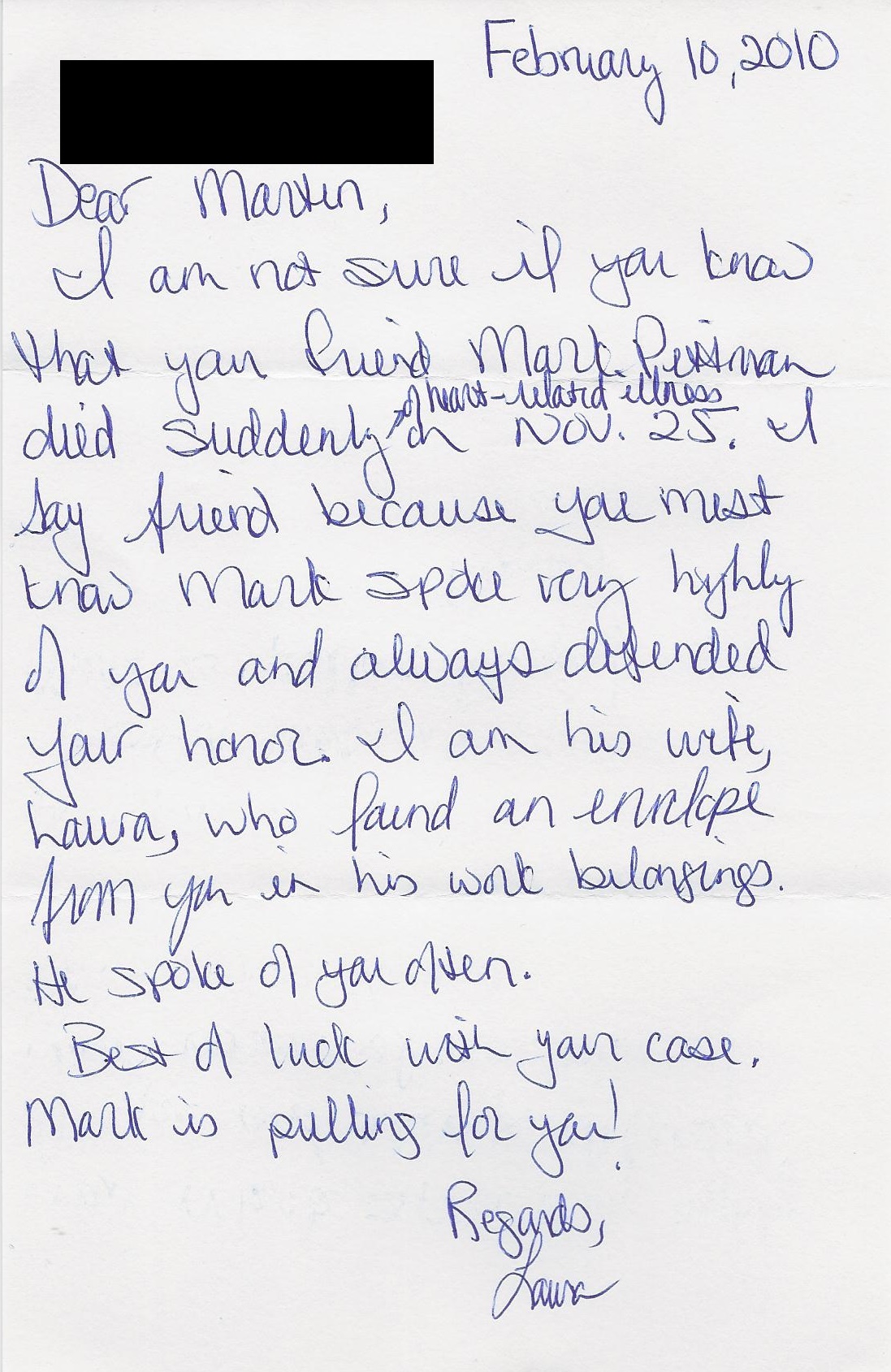
Mark’s wife, Laura, wrote to me about Mark’s death. It was a sad day, for there was NEVER anyone at Bloomberg I ever met who had the integrity of Mark Pittman.

Pittman lAURA lETTER

A Feature, Not Flaw – REPORT: Western Banks Drop 60,000 Employees in 2023


Posted originally on the CTH on December 27, 2023 | Sundance

If you followed my research on banking and the reality of the Russian sanction regime, this report takes on an entirely new dimension.  The article is from ZeroHedge, and the topline is not the real story.

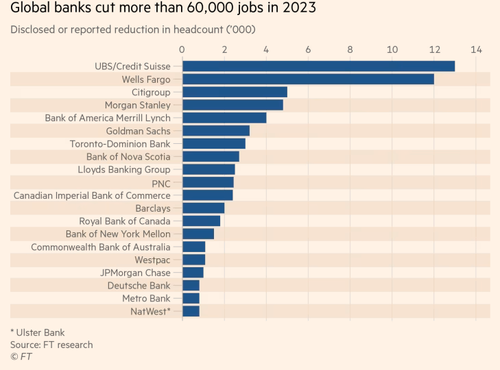
ZEROHEDGE – The collapse of three US regional banks – First Republic Bank, Silicon Valley Bank, and Signature Bank – marked some of the largest failures in the banking system since 2008. Central banks contained the “mini-crisis” earlier this year with forced interventions and the mega-merger of Credit Suisse and UBS. Despite the interventions, global banks still axed the most jobs since the global financial crisis. 

A new report from the Financial Times shows twenty of the world’s largest banks slashed 61,905 jobs in 2023, a move to protect profit margins in a period of high interest rates amid a slump in dealmaking and equity and debt sales. This compared with the 140,000 lost during the GFC of 2007-08. (more

Look carefully at the graphic labeled “global banks.”  What do they all have in common?

These are not global banks, they are all “western banks.”  Do you remember a key component of my trip to eastern EU {Password Protected}.   That part of my research trip was specifically to understand the contradiction between what the west says about the Russian financial sanctions, and the reality of the irrelevance of those sanctions in Russia.

I didn’t talk, I watched; I listened.

Here’s how it really looks from the outside looking at the USA.  The same way the Patriot Act was not designed to stop terrorism but rather to create a domestic surveillance system. So too were the “Russian Sanctions” not designed to sanction Russia, but rather to create the financial control system that will lead to a dollar-based western digital currency.

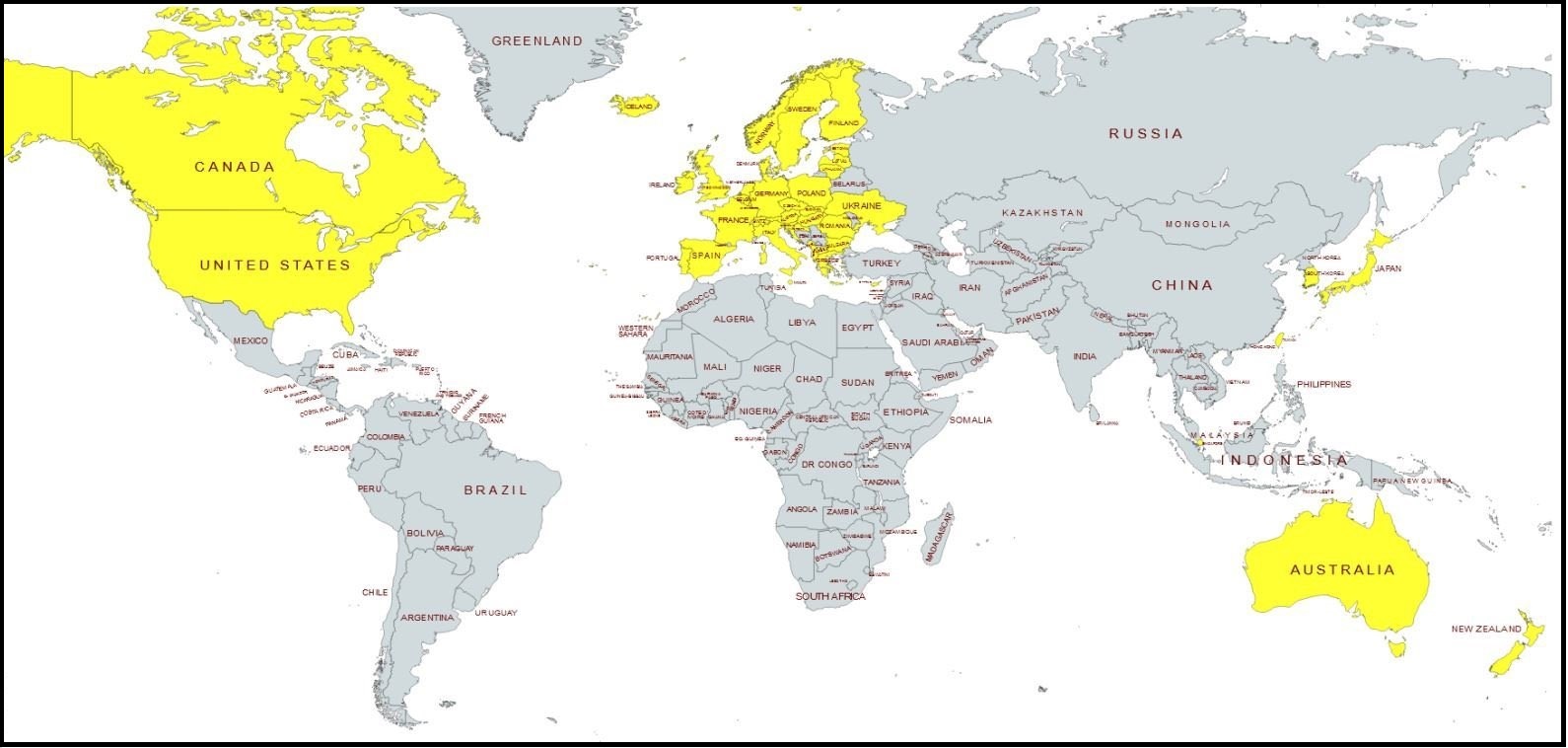
BRICS+ was creating a non-dollar-based currency alternative for trade. Then comes the western financial sanctions, under the auspices of punishment for the Ukraine conflict. However, think “stopgap.” The sanctions didn’t block Russia, they walled-in the WEST.

The sanctions were not designed to keep Russia out of western banking, they were designed to keep us in.  Start thinking from that perspective, and all of the downstream activity, including the aggressive USA govt/banking response to crypto markets, makes total sense.

♦GROUND REPORT – You might ask how I know the Russian sanctions are ineffective – here’s an example.  After doing advanced research, I went to three separate banks as a random and innocuous customer.  I put my reason in the kiosk at each bank, got my ticket number and sat down to listen to the conversations. When my ticket number came up on the digital board, I just ignored it and sat for hours listening to conversations.  No one ever noticed or questioned me – not once.

At every one of the banks, the majority of the customers, at the “new account” desk, were foreign nationals asking about setting up business accounts to trade with Russia. In every bank the conversations were friendly and helpful, with the bank staff telling the customers exactly how to set up their account to accomplish the transactions.  No one was saying no; instead, they were explaining how to do it in very helpful detail.

Within Russia, there are now 3rd party brokers with international accounts, an entirely new industry, which creates a layer of transactional capability for the outside company to sell goods into Russia.  A Samsung TV travels from South Korea to the destination in the RU with the financial transaction between manufacturer and retailer now passing through the new ‘broker’ intermediary. Essentially, that process is what was happening in the banks for small to medium sized companies.

The USA led “western” sanctions against Russian interests were not designed to keep Russia isolated financially, they were designed to keep USA and Western banking customers walled in.  The end goal?  To create a dollar based CBDC for western finance.

In order to accomplish that goal, WESTERN govt/banking needs full control.  Any alternative (BRICS+ currency/trade) is a threat.

The Western sanctions created a financial wall around the USA, not to keep Russia out, but to keep us in.  The Western sanction regime, the financial mechanisms they created and authorized, creates the control gate that leads to a “dollar based” digital currency.

In essence, the Ukraine war response justified a system that creates a digital dollar.

The loss in “western banking” jobs, the downsizing within the banking system, is a feature – not a flaw.

Bank Acquisitions Coming 


Posted Originally on Dec 1, 2023 By Martin Armstrong 

Bank Broken

A recent report by KBW Regional Banking Index (KBW) suggests that Comerica, Zions, and First Horizon are at risk of being acquired by greater competitors. Larger banks with strong returns, such as Huntington, Fifth Third, M&T, and Regions Financial, are positioned to grow by acquiring smaller lenders. Additionally, KBW analysts noted that Western Alliance and Webster Financial could also consider selling themselves. The report highlights that regional banks with assets between $80 billion and $120 billion are facing increasing pressure on returns and profitability, making them potential targets for acquisition by larger rivals.

This analysis underscores the challenges faced by banks in this asset range, as they have the lowest structural returns among banks with at least $10 billion in assets, necessitating growth to help pay for upcoming regulations. The report also mentions that banks with higher returns, such as East West Bank, Popular Bank, and New York Community Bank, could end up as acquirers rather than targets. This analysis reflects the evolving landscape of the banking industry and the potential for consolidation among regional banks.

Three banks have already collapsed in the US this year. New proposed regulations would require banks with over $100 billion in assets to hold onto long-term debt equal to 3.5% of total assets or 6% of risk-weighted assets. Now banks just below the $100 billion mark will potentially face the burden of adhering to these new regulations. Regional bank shares have fallen by over 20% this year. Smaller banks are already struggling to remain profitable, while midsized banks will be forced to join a larger banking organization to stay afloat.

Burger King Accepts Credit Cards (1993)


Armstrong Economics Blog/Humor Re-Posted Sep 24, 2023 by Martin Armstrong

Moody’s Slashes Bank Ratings


Aemstrong Economics Blog/Banking Crisis Re-Posted Aug 10, 2023 by Martin Armstrong

Moody’s has cut the credit ratings of ten small and mid-sized banks. The agency cited higher funding costs, rising interest rates, and increased risked due to the failing commercial real estate sector. M&T Bank, BOK Financial, Webster Financial, Pinnacle Financial, Old National Bancorp, and Fulton Financial were among the banks that received downgraded ratings.

But it does not stop there. Moody’s is also reviewing six giant banks, including Trist Financial, Bank of New York, Cullen/Frost Bankers, State Street, Northern Trust, and US Bancorp, as they may also be downgraded. Eleven other banks such as Capital One, Citizens Financial, and Fifth Third Bancorp has their ratings changed to negative. Moody’s predicts a “mild recession” on the horizon for 2024. They believe the quality of assets will decline with certain banks facing increased risks due to their commercial real estate (CRE) portfolios.

“U.S. banks continue to contend with interest rate and asset-liability management (ALM) risks with implications for liquidity and capital, as the wind-down of unconventional monetary policy drains systemwide deposits and higher interest rates depress the value of fixed-rate assets,” Moody’s analysts wrote in an accompanying research note explaining the decision. The agency also noted that investors are vulnerable “to a loss of confidence.”

The US banking system is failing. Moody’s noted that rising interest rates would “exacerbate” the ongoing banking crisis, and they foresee the Federal Reserve continuing with hikes for longer than anticipated since inflation was never transitory. The Fed maintained artificially low rates for too long, and their attempts to ease inflation by hiking rates are failing, as is the ECB’s. We will see the behemoths like JPMorgan Chase sypher in failing banks, making it easier for agencies to switch to CBDC. European banks will be the first to fail, so keep an eye on Europe.

Powell on Bank Acquisitions


Armstrong Economics Blog/Banking Crisis Re-Posted May 9, 2023 by Martin Armstrong

After the FOMC decision, Jerome Powell stated during his Q&A that the Federal Reserve does not have a plan to consolidate banks. “I personally felt that having small, medium, and large were a great part of our banking system,” Powell stated, noting that they all serve different customers. Powell said it could have been a good outcome had one of the regional banks bought failed First Republic instead of JPMorgan Chase. However, the chairman noted that the FDIC mandates that banks be acquired using the least costly resolution option.

The FDIC says it does not give preference to bidders. How can a bank qualify? According to the FDIC website: “Bid lists are created for each acquisition opportunity based on potential acquirer’s qualifications and interests and characteristics of the failing bank such as capital ratios, regulatory ratings, assets and core deposits as reported on the most recent Call Report and geographic location of the bank. Each bid list is developed using several criteria sets to identify approved potential bidders for an acquisition opportunity, while considering factors that match likely approved bidders to an acquisition opportunity.”

Due to the recent banking failures, the FDIC has also created guidelines specifically for failed bank acquisitions:

“The FDIC markets troubled institutions to healthy insured depository institutions. The FDIC is statutorily required to resolve failed institutions using the least costly resolution option minimizing losses to the Deposit Insurance Fund. The FDIC's primary objective is to maintain financial system stability and public confidence. Returning assets to the private sector in an orderly manner at the best price is another key objective. The FDIC also tries to reduce the impact on the community.

Recapitalization before failure is the preferred method to resolve open troubled financial institutions. FDIC markets institutions in case a failing institution is not able to resolve its issues on its own. If an insured depository institution is unable to resolve its issues, the FDIC will implement its resolution process by which qualified bidders may seek to acquire the assets and assume the liabilities of the failing institution.”

Obviously, smaller banks will not have the ability to compete. All banks are struggling with liquidity issues, and mid-sized institutions will likely be unable to offer the “least costly resolution option.” Ideally, they want failing banks to be attained prior to failure, and only large institutions can provide that cushion. Nothing in the FDIC guidelines at the time of this writing currently limits what a large institution could acquire. The computer states that we will see more banking failures across the globe. Based on these guidelines in the US, it is reasonable to assume that large banks like JPMorgan Chase will benefit from future acquisitions and continue to grow. It is unclear whether banking monopolies are permitted under the 1890 Sherman Antitrust Act, but it remains to be seen what alternatives the system will have as more banks go under.

CBDC – The Real Target


Armstrong Economics Blog/Central Banks Re-Posted May 8, 2023 by Martin Armstrong

A lot of people somehow think that the move to Digital Currency is a completely new monetary system, It is targeted to eliminate cash transactions so everything is taxable and nothing can be hidden from our overlords. If we look at commerce in the United States during 2022, 82% of all transactions were digital – Debit cards (20 percent), credit cards (30 percent), and digital wallets 32 percent. That was e-commerce.

They are hunting down what they believe is 30% of all commerce and cash and lick their lips at the thought of having their hand in your pocket. Make no mistake about it. They know major upheaval threatens their power. Like Trudeau seizing accounts of anyone who donated to the Truckers, that is the agenda. Control all transactions and turn off anyone who they see as a threat.