C-Level Executives Sold Shares Weeks Before SVB Failed


Armstrong Economics Blog/Corruption Re-Posted Mar 13, 2023 by Martin Armstrong

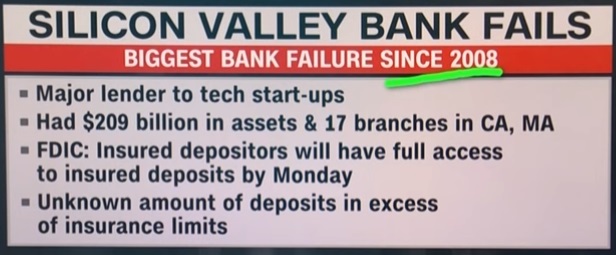
A bank failure of this proportion has not been seen since 2008 when Washington Mutual failed. The majority of deposits in Silicon Valley Bank (SVB) are uninsured, meaning the FDIC’s $250,000 protection does not apply. Uninsured depositors will be provided receivership certificates and should receive an advanced dividend this week. The FDIC must sell off the remaining assets of SVC to determine how much it can provide to those uninsured depositors. The FDIC is encouraging borrowers to continue paying their existing loans. The bank was said to host $209 billion in assets and $175.4 billion in deposits as of December 2022. Washington Mutual held around $307 billion in assets when it went down.

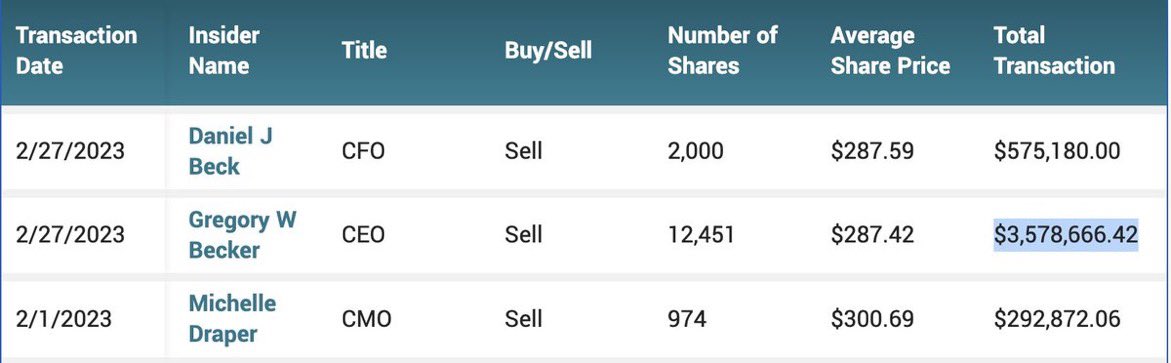
Tons of people and businesses will be completely screwed over. Who could have seen it coming? Silicon Valley Bank CEO, CFO, and CMO sold off millions in stock over the past two weeks. President and CEO Greg Becker sold 12,451 shares on February 27 for $3.6 million at $287.42 per share. Later that day, he purchased options for the same amount of shares at $105.18 a piece. He did the same thing in December 2021, as this is not an uncommon albeit unethical practice. Banks commonly trade against their own clients. Becker sold about $3.57 million worth of SVB stock over the past two weeks and is now making TV appearances saying he did not see this coming.

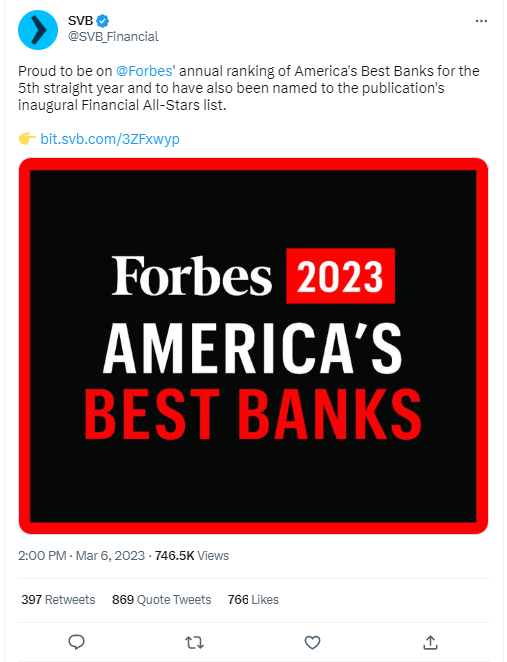
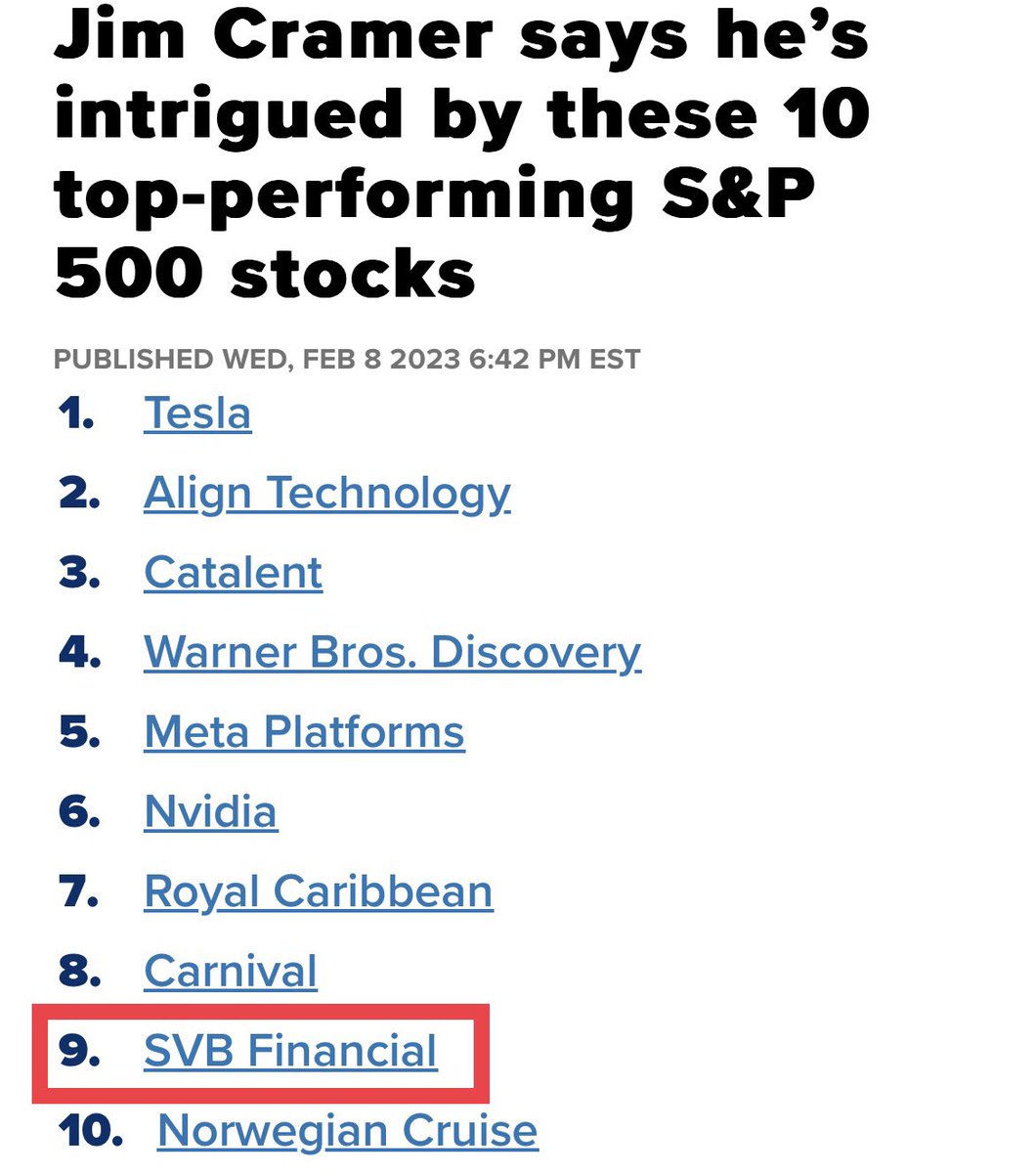
There were signs of trouble, but the talking heads said otherwise. Forbes even listed SVB Financial Group as #20 on its list of America’s Best Banks in an article published on February 14, 2023. Talking/screaming head Jim Cramer came out last month to say that SVB Financial would become one of the top performers on the S&P. This is why you cannot listen to information based on biased opinions. I hesitate to call this negligence technical analysis.

Companies are now at a complete loss, many cannot make payroll, and this situation will only worsen once the uninsured depositors realize their IOUs are worthless.

BREAKING – U.S. Treasury Steps In – All SVB Depositors Will Have Access to Their Money on Monday


Posted originally on the CTH on March 12, 2023 | Sundance 

BREAKING NEWS – The U.S. Treasury, Federal Reserve Board, FDIC and Joe Biden collectively announce that *all* depositors with Silicon Valley Bank (SVB) will have access to their funds – regardless of amount deposited.  Also, all senior bank management has been terminated.

This announced action appears to cover those under FDIC protection ($250k or less) and those above FDIC protection (deposits greater than $250k).  The only vulnerability is that SVB “shareholders and certain unsecured debtholders will not be protected.”

WASHINGTON DC – The following statement was released by Secretary of the Treasury Janet L. Yellen, Federal Reserve Board Chair Jerome H. Powell, and FDIC Chairman Martin J. Gruenberg:

Today we are taking decisive actions to protect the U.S. economy by strengthening public confidence in our banking system. This step will ensure that the U.S. banking system continues to perform its vital roles of protecting deposits and providing access to credit to households and businesses in a manner that promotes strong and sustainable economic growth.

After receiving a recommendation from the boards of the FDIC and the Federal Reserve, and consulting with the President, Secretary Yellen approved actions enabling the FDIC to complete its resolution of Silicon Valley Bank, Santa Clara, California, in a manner that fully protects all depositors. Depositors will have access to all of their money starting Monday, March 13. No losses associated with the resolution of Silicon Valley Bank will be borne by the taxpayer.

We are also announcing a similar systemic risk exception for Signature Bank, New York, New York, which was closed today by its state chartering authority. All depositors of this institution will be made whole. As with the resolution of Silicon Valley Bank, no losses will be borne by the taxpayer.

Shareholders and certain unsecured debtholders will not be protected. Senior management has also been removed. Any losses to the Deposit Insurance Fund to support uninsured depositors will be recovered by a special assessment on banks, as required by law.

Finally, the Federal Reserve Board on Sunday announced it will make available additional funding to eligible depository institutions to help assure banks have the ability to meet the needs of all their depositors.

The U.S. banking system remains resilient and on a solid foundation, in large part due to reforms that were made after the financial crisis that ensured better safeguards for the banking industry. Those reforms combined with today’s actions demonstrate our commitment to take the necessary steps to ensure that depositors’ savings remain safe. (LINK)

Will this action help stop any contagion related to California’s largest bank?

…The odds are, yes.

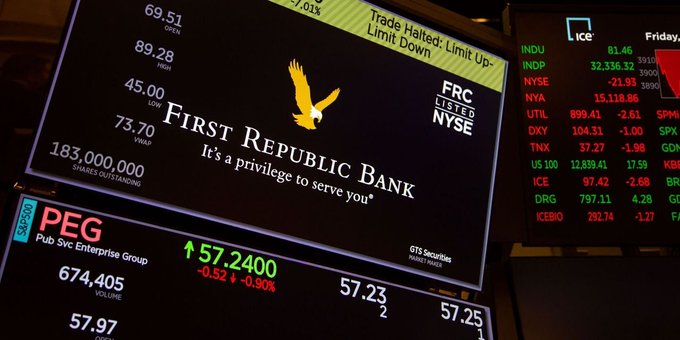
Despite Friday’s action to stop trading of FRB, with this action, I doubt First Republic Bank (FRB) is now at risk.

Fallout from SVB Collapse Begins Sending Twitches Through Tech Sector, While Congress Meets With Treasury


Posted originally on the CTH on March 11, 2023 | Sundance

The 44-hour collapse of Silicon Valley Bank (SVB) is having some reverberations amid the tech sector as companies who carried unsecured deposits with the bank are facing an uncertain future.

Tech company Roku streaming services holds $487 million in cash reserves at SVB representing 26% of their liquid holdings. Those unsecured funds are now tenuous, depending on what steps are taken next.  Additionally, Etsy an online brokering retailer for mostly independent sellers, has also run into a snag with processing disbursement payments to those same sellers.  Etsy used SVB as a depository and payment transfer provider to the merchant accounts.

According to Axios, “Circle’s usd coin (USDC), the second largest stablecoin in the world” is also in a tough position “because a portion of its cash reserves were held at SVB, which the U.S. government took control of on Friday.”  These and other ancillary issues are now part of a larger conversation about whether SVB is representative of a weakness that may impact other banks.   However, current consensus is that a contagion effect is not expected.

SVB was exclusively a tech sector bank.  Small to mid-size tech companies who relied on SVB may have some immediate issues; but the larger banking sector seems much more solid and less exposed to the long-term treasuries that SVB was holding. “People are used to having zero interest rates and easy money, and it’s gone. And there are people who will manage that well and people who will not,” former Congressional Budget Office Director Doug Holtz-Eakin said during an interview on “Cavuto Coast-to-Coast” Friday. {link}

Meanwhile, congress is meeting with treasury and FDIC officials to discuss if taxpayer intervention is needed.  {insert eyeroll here}:

March 11 (Reuters) – U.S. lawmakers met with the Federal Reserve and Federal Deposit Insurance Corporation on Friday to discuss the collapse of SVB Financial Group (SIVB.O), Coindesk reported on Saturday citing a source.

Democratic U.S. Representative Maxine Waters held briefings with officials from the two regulators and the Treasury Department, hours after the startup-focused SVB’s collapse, the report said.

[…] Separately, Representative Ro Khanna said in a tweet on Friday that he reached out to both the White House and the Treasury Department to discuss the situation with the bank.

U.S. Treasury Secretary Janet Yellen on Friday met with banking regulators on the collapse of SVB, as she and the White House expressed confidence in their abilities to respond to the bank failure. (more)

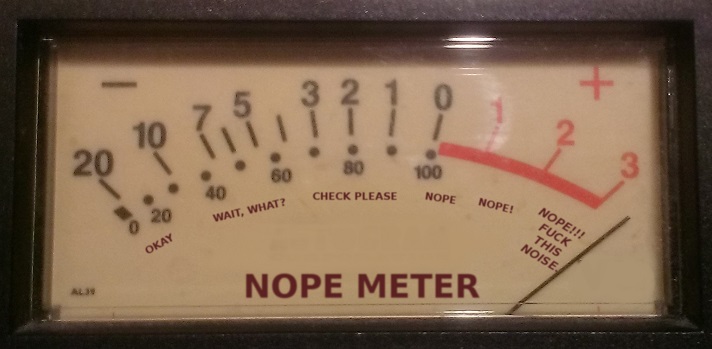
Nothing makes the Nope Meter peg with greater emphasis than hearing the name Maxine Waters and bank bailout in the same sentence.

I already made my position pretty clear yesterday.  NO BAILOUTS!

The tech sector has a tremendous amount of capital at hand.  Let the tech companies who used SVB as a launch vehicle sell some of their own stock holdings and backstop the bank as an investment mechanism.  There is no need for the U.S. taxpayer to get involved.

I am more concerned about this failure being used as a tool to initiate a conversation about digital currencies.  The ‘never let a crisis go to waste‘ team, are likely chomping at the proverbial bit….

Tucker Carlson Outlines SVB Collapse and Ponders Impact of Cultural Marxism on Outcome


Posted originally on the CTH on March 10, 2023 

For his opening monologue Friday night, Fox News host Tucker Carlson outlined the collapse of Silicon Valley Bank and ponders the deeper story that lay underneath the sudden failure. WATCH:

.

Silicon Valley Bank (SVB) Fails, Now the Idiots Are Considering a Taxpayer Bailout


Posted originally on the CTH on March 10, 2023 | Sundance

SVB is Silicon Valley Bank, the almost exclusive banking network for Venture Capitalists (VC), tech sector start-ups and tech industry holding accounts.  48 hours ago, SVB was a “grade A” Moodys rating. As of tonight, they are insolvent.

“All told, customers withdrew a staggering $42 billion of deposits by the end of Thursday, according to a California regulatory filing. […] “The precipitous deposit withdrawal has caused the Bank to be incapable of paying its obligations as they come due,” the California financial regulator stated. “The bank is now insolvent.” (link)

Now, as ridiculous as this sounds outside Silicon Valley, the powers that be are concerned about a ‘contagion‘ effect, and openly discussing the need for a taxpayer funded bailout.  Blood-boiling doesn’t even begin to describe the sensation.

Let the Silicon Valley companies who started with the funds from the bank sell some of their capitalization on the market and finance the bailout themselves.  After all, this is one interconnected system of lenders, borrowers and investors.  This is not a crisis for the guy making their catered lunches, mowing their lawns, or washing their clothes.

♦The system.  A tech guy/gal has an idea or product.  Venture Capitalists (VC) organize the funding for the idea/product and go to SVB for money to start the company.  The bank funds the startup and takes an equity position in the company.  The VC brokers the deal, takes payment and also takes an equity position.  The company launches and if successful builds a multi-billion enterprise.  If they IPO (most do) then shares of the company are sold and the value of the company rises with the increased stock purchasing.

The shares of the company are capital. The shares can be sold to create funds that can support SVB.  If SVB needs funds, let the networked companies sell some of their capital and fund the bank that generated their venture.  They do not need outside ‘bailouts’.   That’s just the way I look at it.

Listening to some voices saying the guy who mows the lawn of the tech company executive has a responsibility to ‘bailout’ the bank that created the wealth for the tech company executive, is just, well, another absurd example of how corrupt this entire financial system has become.  Sorry, but this beyond annoys me.

CALIFORNIA – Regulators shuttered SVB Friday and seized its deposits in the largest U.S. banking failure since the 2008 financial crisis and the second-largest ever. The company’s downward spiral began late Wednesday, when it surprised investors with news that it needed to raise $2.25 billion to shore up its balance sheet. What followed was the rapid collapse of a highly-respected bank that had grown alongside its technology clients.

Even now, as the dust begins to settle on the second bank wind-down announced this week, members of the VC community are lamenting the role that other investors played in SVB’s demise.

“This was a hysteria-induced bank run caused by VCs,” Ryan Falvey, a fintech investor at Restive Ventures, told CNBC. “This is going to go down as one of the ultimate cases of an industry cutting its nose off to spite its face.”

The episode is the latest fallout from the Federal Reserve’s actions to stem inflation with its most aggressive rate hiking campaign in four decades. The ramifications could be far-reaching, with concerns that startups may be unable to pay employees in coming days, venture investors may struggle to raise funds, and an already-battered sector could face a deeper malaise.

The roots of SVB’s collapse stem from dislocations spurred by higher rates. As startup clients withdrew deposits to keep their companies afloat in a chilly environment for IPOs and private fundraising, SVB found itself short on capital. It had been forced to sell all of its available-for-sale bonds at a $1.8 billion loss, the bank said late Wednesday.

The sudden need for fresh capital, coming on the heels of the collapse of crypto-focused Silvergate bank, sparked another wave of deposit withdrawals Thursday as VCs instructed their portfolio companies to move funds, according to people with knowledge of the matter. The concern: a bank run at SVB could pose an existential threat to startups who couldn’t tap their deposits. (read more)

.