Moving from QE to Just Monetizing Government


QUESTION: Mr, Armstrong; Why the push for lower interest rates again in developed markets? You have stated the QE has been a total failure. Are they incapable of doing anything else?

KE

ANSWER: We are switching from QE to a new reality of budget management. If interest rates rise on government bonds, the budget blows out. At this stage, the Fed is toying with the idea of setting benchmark rates for 2 to 10-year instruments. This will be different than QE. It will be the collapse of government bond markets on a global scale.

A Strong US Dollar is the Only Way to Create Change


COMMENT: It is interesting how these people take your interviews and inject headlines like you say the dollar will collapse in April 2019 when you have said exactly the opposite. Just unbelievable how these people use your name to promote their BS.

JD

REPLY: I know. They keep preaching the dollar will collapse when it is exactly the opposite. They are trying to sell their biased view which is always based upon the idea of the quantity theory of money – the same exact philosophy used by the central banks in Quantitative Easing.

The ONLY way the monetary system will break is with a STRONG dollar – not a weak dollar.The monetary system has broke ONLY when the dollar rises as in 1934 and 1985. The US always wants a weak dollar to increase corporate profits and and create a trade surplus. It is really quite amazing how these people keep preaching the same nonsense for decades and have never been right for more than 30 years.

Cycles & Turning Points


QUESTION:

Hello Mr. Armstrong;

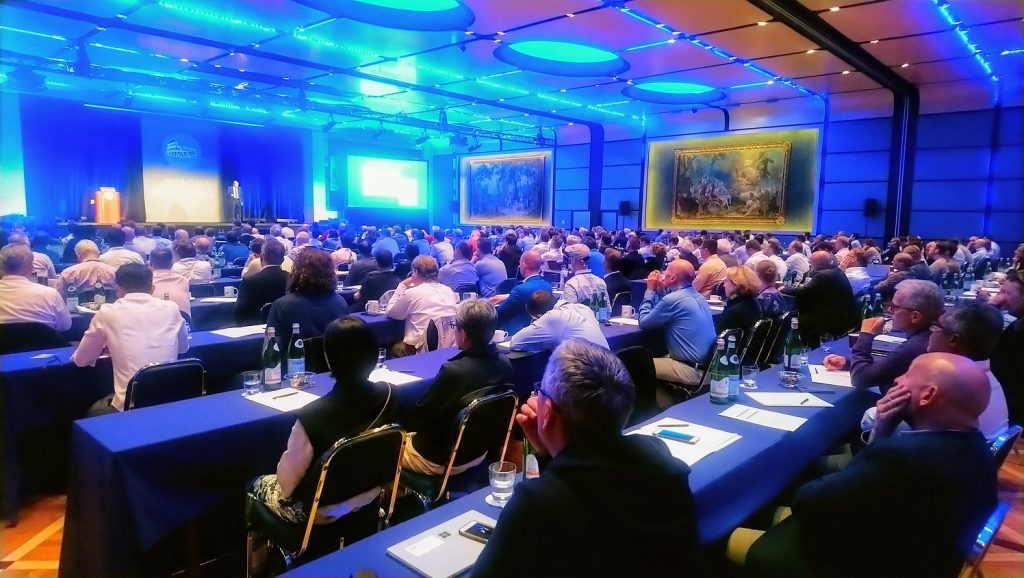
Rome was fantastic!. I find it very interesting that you hold the conference on the dates when the markets hit their peak and I come back and Monday we start the decline that you cautioned us that we could see at the conference. Was this planned:)?

Cycles are amazing and now i have to live and invest only based on the cycles.

Thank you again for Rome and bringing Nigel!!

BB

ANSWER: Yes, I do time the conferences around the cycles. That gives us something to talk about. They are simply points where the human emotions shift. This pull back is necessary for we are treading water (i.e. time) until the consolidation is complete in order to produce the next phase.

Just for the record for those who did not attend the Rome WEC, Nigel came because, as he put it, we are the “alternative to Davos.” He was not paid a fee. He had agreed to come and wanted to attend the conference and be at our famous networking cocktail party.

As things turned out, Nigel started his new BREXIT Party after he agreed to come to the WEC. I was concerned he would be too busy to attend with the change in plans. Nevertheless, he flew in for a few hours to make his appearance and then sadly had to leave because of a rally back in the UK the next morning.

The May Turning Point


COMMENT: It is interesting how your model picks the timing for a turn in the market as of May yet it leaves us guessing as to what the fundamental will be. Very interesting to say the least.

Fantastic event in Rome. The cocktail party was the best view of Rome ever!

Cheers

HKD

REPLY: The fundamentals really do not matter. What I have come to understand is TIME is everything. The market will turn on these targets regardless of the fundamental. It is simply a turning point in human emotion for maintaining a given trend. They will exit a trend regardless of the news. How many times have we seen bearish news ignored in a bull run or bullish news ignored during a bearish decline? It is only a matter of the length of a rally or decline.

ETF v Mutual Fund


QUESTION: Are ETFs really better than a mutual fund for tax purposes?

HS

ANSWER: The primary difference between mutual funds and ETFs (exchange-traded funds) is that while an open-end mutual fund is priced once based upon the market closing, ETFs as well as a closed-end mutual funds trade all day. This actually goes back to the Panic of 1966 when mutual funds were open-ended but traded on the exchange and were bid up and down based on emotion rather than net asset value. The crash took place because mutual funds were at times selling well above net asset value.

If we look at the reforms post-1966, investors in mutual funds buy or sell them directly from the mutual-fund companies themselves. That creates a different tax structure than an ETF in which purchases go to the market and the ETF is simply created by purchasing the underlying basket.

Mutual funds and most ETFs are governed by the Investment Company Act of 1940. Therefore, this legislation treats them like a pass-through company. When a mutual-fund investor wants to sell, the fund sells shares of appreciated stock to generate cash which creates a taxable capital gain. Since most funds operate as simple pass-through vehicles, those tax liabilities from the gains accrue to all investors in the fund including those who have not sold any holding.

ETFs actually do avoid that type of tax issue. ETFs are not direct buyers or sellers of shares as a mutual fund. The ETF is created by a market maker with a special contract with the ETF provider. The investor has the newly created ETF share which is created by purchasing all of the holdings in the underlying ETF. This basket of shares is given to the ETF issuer thereby creating the ETF shares.

Because an ETF is not a direct buyer of the underlying shares as in a mutual fund, the ETF itself is not a buyer or seller. The basket of shares are swapped and are therefore in-kind transactions, thus there is no pass-through capital-gains tax bill. This is the tax advantage of an ETF over a mutual fund.

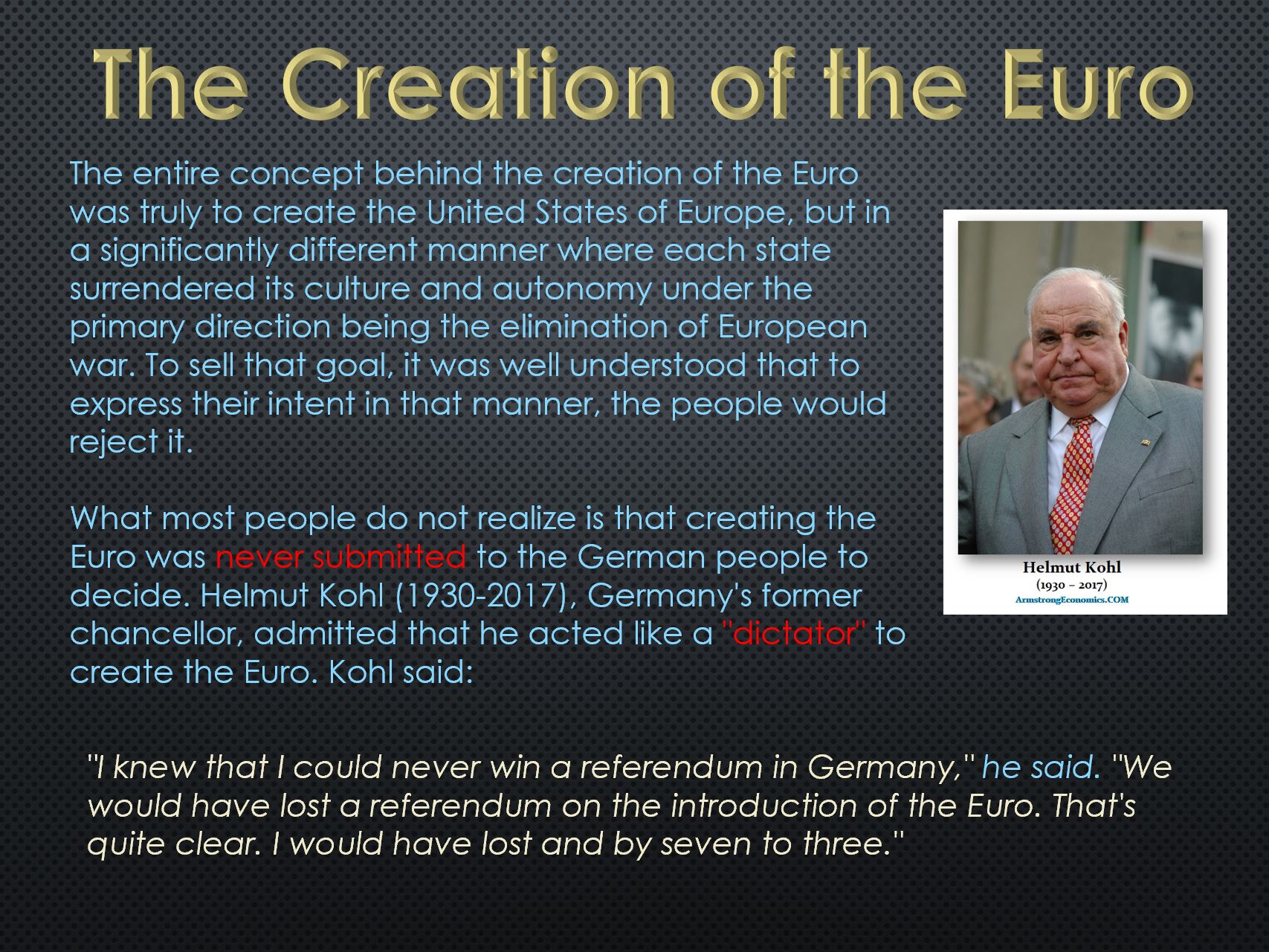
Creating the Euro & Germany Was Denied the Right to Ever Vote to join the Euro


COMMENT: Marty; I just wanted to say that this WEC in Rome was one of your best, NOt that Nigel Farage was there calling you the alternative to Davos, but you really do your research and your contacts behind the curtain become self-evident. Nobody in the audience every knew that the German people were denied the right to vote on joining the euro. The most important economy was denied any democratic process.

See you in Orlando

PG

ANSWER: Yes, I was amazed at how even the central bankers who attended were unaware of that fact. This is part of the reason for the rise in the AfD in Germany. From the outset, the theory has been to federalize Europe to prevent a world war. They assumed the people would never vote for it so they hide the real agenda. The people are not those who create wars – it is always those in power.

What they have done is to fuel the flames of history that remind people of the differences that are culturally embodied within the languages.

Robo Trading v Human Trading


QUESTION: So is there any difference between a Robot and a person trading if they just follow the same system on a single market?

ANSWER: Any system that is created which claims to be some robo-trading system is vulnerable to a contagion that impacts a given market from external sources. We are entering a highly correlated global capital flow era which events external to a domestic market can overwhelm a domestic economy and any market.

The only difference between a robo-trading system and a human is that the human can get all emotion and panic. The computer would not do that, but it would be vulnerable to external forces and would not be able to make a judgment call.

The only possible way to overcome this is a complete global model which is monitoring everything and will pick up the external contagions. You can visually see this using the Global Market Watch. You can glance at the trends in all world stock markets for example on one page.

The End of Diversification?


Recent years there has been a shift in how various assets classes are trading. There is emerging a high degree of positive correlation among various financial asset classes that have many concerned since it is not conforming with the perceived historic norms. Many are reading into this as a warning of what is to come. When different asset classes move in the same direction simultaneously, this obviously eliminates the theory of diversification is asset allocation.

Asset allocation over the years has been the way portfolios are arranged because they lack the ability to forecast the major trends. The belief has been that the possible benefits of diversification across classes reduces risk and offers a management tool knowing that you will lose on one side but win on another class.

When there is a high correlation between classes, these asset allocation models fail. The concerns become that this injects a negative development because they fear if one asset class falls, it will take all of the others with it.

What is being overlooked here is the fact that there is a major shift underway which is not understood and this creates the risk of a LIQUIDITY CONTAGION whereby a loss in one asset class causes liquidation in all others to raise cash to cover the losses in one particular asset class. Welcome to the new age of international contagion which is far more serious and cannot be reduced by simply diversification.

We will be looking at establishing a Webinar for Institutional Clients on this subject matte

How Did Rome Put Money into Circulation with no Central Bank?


QUESTION: How were ancient coins placed into circulation?

DR JB

ANSWER: That is actually a very interesting question. As the legend goes, the Gauls (French) attempted to invade the city of Rome quietly, but had frightened the sacred flock of geese that made a lot of noise. This alerted the Romans to the surprise attack giving us the word “monere” meaning in Latin to warn. The Temple of Juno then became popularly known as the Temple of Juno Moneta. Since this is where the coins were minted, we now arrive at the word “money” that springs from the origin of this legend and place that was an ancient mint.

Our term such as capital flow is also derived from the Latin word “currere” meaning “to run” or “to flow” and this is where the money flowed from giving us the word “currency” meaning the flow of money. This is why Juno Moneta is pictured on Roman coins as holding the balance scales in one hand and a cornucopia in the other symbolizing endless bounty or wealth. This is the birth of the term money and currency.

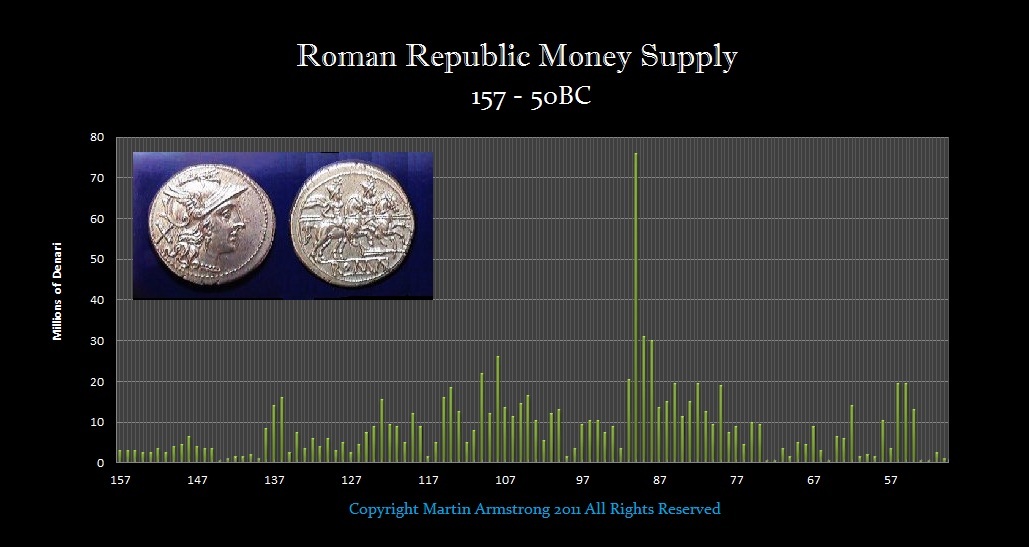
Now, since Rome had no national debt and no central bank, we immediately wonder how on earth did this function? The government-owned the mines and thus they coined money to meet their expenses.  Unlike our modern governments, they did not have a huge welfare state. They did subsidize food. But the coinage was used to pay the troops and government expenses and thus this is how the money was put into circulation. They would increase the output in times of war and decreased it in times of peace for the most part.

WEC 2019 Rome The Great Unknown


24,26,367,391.603394

This year’s World Economic Conference was most interesting. We really had to put our thinking caps on because we have entered the Great Unknown where Keynesian Economics has crumbled to dust. We have to reassess the future and how this will unfold as the central banks are beside themselves in many countries and the contagion of Quantitative Easing combined with Negative Interest rates has completely altered the economy and have driven a huge wave of disparity between Public v Private sectors of the economy. This is clearly the times that will test the best skills of what traders are made of.