Leading presidential candidates and major media outlets are claiming that school districts with high concentrations of minorities and poor children generally receive less funding per student than other districts. That hasn’t been true for at least half a century, but people are spreading this myth through deceptive studies that exclude federal funds.
In reality, a broad range of credible studies that include all funding sources show that such school districts are as well-financed as others.
The Claims
According to Democrat presidential hopeful and U.S. Senator Elizabeth Warren, “our current approach to school funding at the federal, state, and local level underfunds our schools and results in many students from low-income backgrounds receiving less funding than other students on a per-student basis.”
Along the same lines:
Sarah Mervosh of the New York Timesreported in early 2019 that “on average, nonwhite districts received about $2,200 less per student than districts that were predominantly white….”
Maria Danilova of the Associated Press (AP) reported in 2018 that “the highest-poverty” school districts “receive an average of $1,200 less per child than the least-poor districts, while districts serving the largest numbers of minority students get about $2,000 less than those serving the fewest students of color….”
Democrat presidential contender and U.S. Senator Bernie Sanders claims that “less is invested in the education of children from low-income families compared with their more affluent peers” because “school districts are funded out of local property taxes.”
Clare Lombardo of National Public Radio (NPR) reported in 2019 that “high-poverty districts serving mostly students of color receive about $1,600 less per student than the national average.”
With the exception of Sanders—who provides no evidence to support his claim—all of the others misrepresent their sources by failing to reveal that they ignore federal funds. Moreover, their sources obscure this fact in the following ways:
Warren cites a study by the Education Law Center, which refers to federal funding on page 2 but then never accounts for any of it. Instead, the study mentions on page 5 that it uses “actual state and local revenues” for its analysis.
The New York Times and NPR cite a report from EdBuild, which doesn’t say a word about the exclusion of federal revenues. Instead, it tacitly slips this into a separate webpage of “research methods“ that references “revenues from state and local sources” while ignoring federal revenues except when subtracting out charter school funding.
The AP cites a report from the U.S. Commission on Civil Rights that repeatedly mentions federal funding, but when it presents the $1,200 and $2,000 underfunding figures quoted by the AP, it cites a study from the Education Trust that explicitly excludes “federal sources.” The Commission on Civil Rights doesn’t even allude to this fact—and to discover it, readers must go to the footnote and then locate the study from a citation with an unclickable link.
In short, these politicians and journalists never hint that their statistics exclude federal funds, and the sources they appeal to bury this crucial caveat. This ensures that only diligent readers with time to investigate will learn the truth.
Moreover, those who propagate this falsehood often call for more federal funds to fix this contrived disparity. But since they ignore federal funding, their proposals to increase it will not change the statistics they present.
Warren’s K–12 education plan, for instance, makes the false claim quoted above and then calls for “quadrupling Title I funding—an additional $450 billion over the next 10 years—to help ensure that all children get a high-quality public education.” Title I is the largest source of federal K–12 education funding, but because Warren doesn’t count this money in her statistics, her plan won’t affect her own measure of school funding.
The Reality
Wide-ranging studies that include all education funding—like those conducted by the U.S. Department of Education (1996), Ph.D. economist Derek Neal (2006), the left-leaning Urban Institute (2008), and the conservative Heritage Foundation (2011)—have all found that school districts with higher portions of minority students spend about the same amount per student as districts with smaller portions of minorities.
The Urban Institute study, which looks the furthest back in time, found that “differences in spending per pupil in districts serving nonwhite and white students are very small” since at least 1972.
Likewise, a study published by the journal Education Next in 2017 found that “per-student K–12 education funding from all sources (local, state, and federal) is similar, on average, at the districts attended by poor students ($12,961) and non-poor students ($12,640), a difference of 2.5 percent in favor of poor students.” The study also found that “this difference has not changed much since 1994–95,” the earliest data in the study.
Within school districts, research published by the Brookings Institution in 2017 found that “on average, poor and minority students receive between 1-2 percent more resources than non-poor or white students in their districts, equivalent to about $65 per pupil.”
The Property Tax Charade
Warren alleges that “school systems rely heavily on local property taxes, shortchanging students in low-income areas.” This was previously the case, but it hasn’t been so for decades. As explained by the Urban Institute:
In the past, because public schools were funded largely by local property taxes, property-rich and -poor school districts differed greatly in expenditures per pupil. Since the early 1970s, however, state legislatures have, on their own initiative or at the behest of state courts, implemented school finance equalization programs to reduce the disparity in within-state education spending.
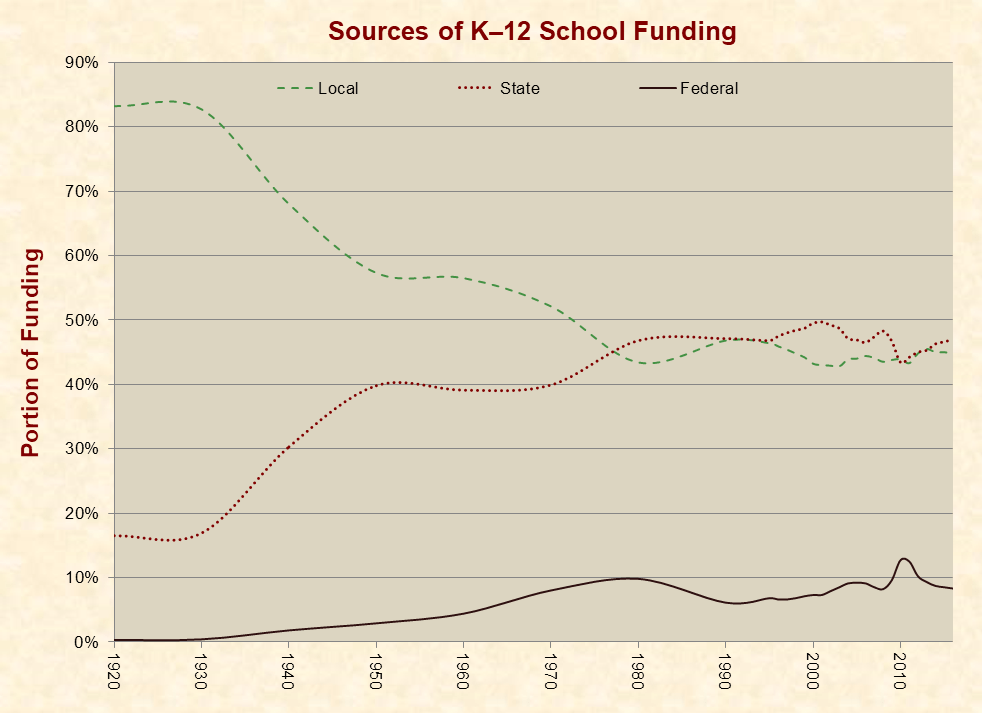
Consequently, data from the U.S. Department of Education show that local revenues have declined from 83% of all school funding in 1920 to 45% in 2016:
Furthermore, the chart above only shows national averages. These don’t reveal the fact that school districts in low-income areas typically receive greater portions of their budgets from state and federal funds. For example, the U.S. Government Accountability Office reported in 2011 that some school districts receive no federal Title I education funding, while others receive as much as 36% of their budget from it.
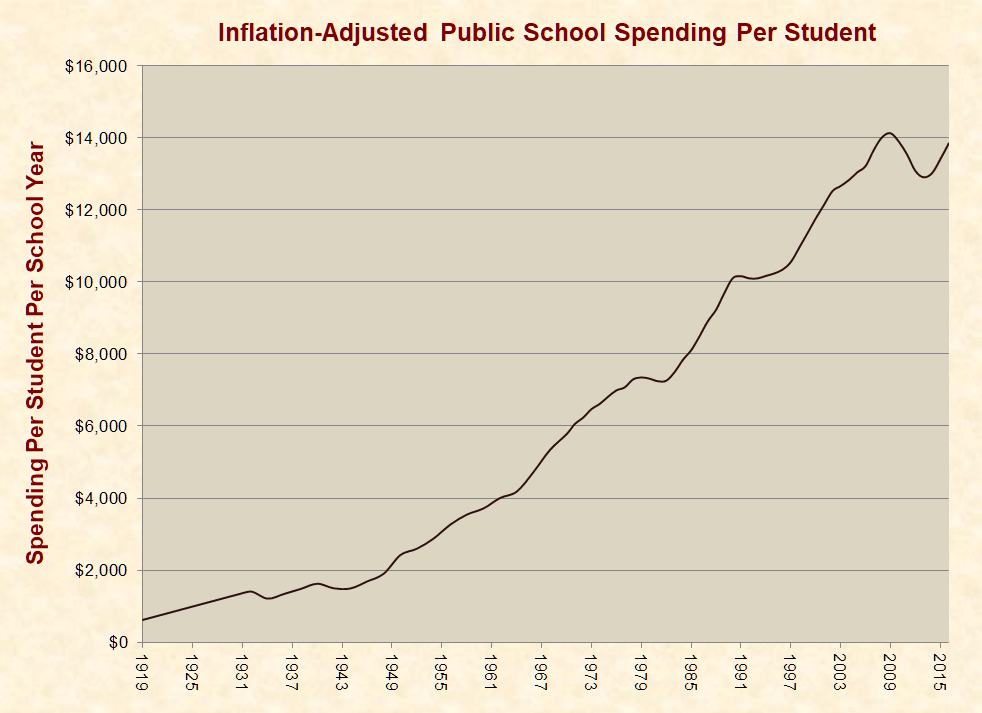
Along with increasing shares of school funding paid by state and federal taxpayers, the inflation-adjusted average spending per student grew by 22 times in the same era:
False Justifications
Some people openly argue that federal funding should be ignored when comparing schools, because this money is meant to help disadvantaged students. However, federal law is at odds with such logic.
The Education Trust, for example, writes that it excludes such funds from its analysis because “federal dollars are intended—and targeted—to provide supplemental services to such specific groups of students as those in poverty, English learners, and students with disabilities.”
In accord with that view, the Obama administration published an issue paper stating that federal education funding “is intended to provide the extra help low-income students need to succeed, but it cannot do that if state and local funds are not evenly distributed to start with.” The administration also drafted regulations to impose this requirement on school districts.
In contrast, the applicable federal law explicitly states that “nothing in this subchapter shall be construed to mandate equalized spending per pupil for a state, local educational agency, or school.” Thus, the Congressional Research Service determined that the Obama administration’s proposed regulations “appear to directly conflict” with the law.
Federal law does require that states and localities not reduce their funding to schools when they receive federal funds. This provision says that states and localities can only use federal funds “to supplement the funds that would, in the absence of such federal funds, be made available from state and local sources,” “not to supplant such funds.” This does not require that funding be equal before or even after federal funding. It simply requires that states and localities don’t cut other funding just because they receive federal funds.
The law also requires that local school districts provide services that “are at least comparable” to all schools within their district before they receive federal funds. New York City, for example, cannot provide unequal services to schools and then use federal funds to equalize them. To meet this requirement, districts must provide similar staff-to-student ratios, “curriculum materials,” and “instructional supplies” to schools in their district in order to receive federal funds.
Nevertheless, politicians and unions sometimes create funding disparities within local school districts by agreeing to contracts that give senior teachers more pay and discretion to choose the schools where they work. These higher-paid teachers tend to avoid inner-city schools with high rates of crime and student discipline problems, resulting in lower spending-per student in poor neighborhoods. Federal law permits this practice by excluding “staff salary differentials for years of employment” from its compliance provisions.
Conclusion
Regardless of any rationale for excluding federal funds from school funding comparisons, it is deceitful to omit such money without even a hint. Yet, Elizabeth Warren, Bernie Sanders, the New York Times, National Public Radio, and the Associated Press are doing just that.
Such disinformation is enabled by advocacy groups like EdBuild and the Education Law Center, which publish reports that exclude federal funds while burying this vital fact.
Warren takes the deception even further by leading people to believe that she actually accounts for federal funds. She does this by claiming that “the current investment in Title I—$15.8 billion—is not nearly enough to make up for state-level funding inequities,” but her supposed evidence for this is a study that excludes all of this money. This provides false grounds to continually demand more from taxpayers and to portray the U.S. education system as systemically racist.
We can all fight for a cause, but “The function of wisdom is to discriminate between good and evil. – Marcus Tullius Cicero
They began as idealists, working to save the French-Jewish army Captain Alfred Dreyfus who’d been falsely accused of conspiring with the Prussian army. The Dreyfus Affair of the mid-1890s and early 1900s was the impulsion for people to unite in support of the rights of the individual before a military authority that was rightly seen to be draconian and dismissive. A worthy cause, yet the case divided France into the anti-Dreyfusards, fascist, Jew-hating ultranationalists, and the “Dreyfusards,” the anti-fascists who formed associations and humanitarian consensus to gain his exoneration.
Today’s anti-fascists, “Antifa,” miss the point if they see themselves as successors to the Dreyfusards. The latter were inspired by love of the individual, a positive inspiration, whereas Antifa is motivated by negative hatred for the establishment and the abuse of the individual who happens to disagree with them
Defining the term fascism has proven notoriously difficult. There were German antifascists in the early 1900s who joined the Jewish working class to fight for dignity and better wages, and Italian antifascists who fought against Benito Mussolini’s Fascist Party and Hitler’s growing influence. There were also Spanish antifascists both before and during Spain’s civil war, with writers Orwell and Hemingway among their ranks.
But there are sufficient differences between the various fascist regimes that make it virtually impossible to identify a commonality. However, most leading scholars agree that all fascists support the violent revolutionary overthrow of the state’s entire government to be replaced with a totalitarian system that diminishes the value of the individual to a mere component of the whole. Any difference of opinion is seen as fair game to be silenced.
Antifa are a burgeoning collection of discontented militant-leftist groups who, convinced that white supremacism was responsible for chattel slavery and the Holocaust, are allied in their attempt to overthrow “white” western government by any means available, including violence.
British political theorist Roger Griffin, author of “The Nature of Fascism,” wrote, “Fascism is a genus of political ideology whose mythic core in its various permutations is … palingenetic,” which means that a “rebirth” would follow the demolition of the existing political order. By this scholarly definition, Antifa’s own methods and goals fulfill the criteria – not of anti-fascism – but of Fascism!
After interviewing 61 current members in 17 countries, Mark Bray, author of “Antifa: The Anti-Fascist Handbook,” asserts that militant antifascism is a “reasonable, historically informed response to the fascist threat that persisted” after World War II and into recent years. They argue that every fascist or white-supremacist group has the potential of being the start of Mussolini’s original hundred or Hitler’s first fifty-four members of the German Workers’ Party. Hence, they believe they have a righteous obligation to stop what they regard as fascist “violence, incivility, discrimination, and speeches that stimulate further white supremacy, oppression and genocide.”
And fascism, real fascism, must be opposed. Edmund Burke’s statement was never more apposite, “The only thing necessary for the triumph of evil is for good men to do nothing.”
In “The View from My Window: The Ethics of Using Violence to Fight Fascism,” Elie Wiesel recalled familiar riots while he was watching one play out below his fifth-floor window in Berkeley. It brought to mind the millions of people who fought fascism throughout Europe and he suitably wondered at what point resistance to fascism may be justifiable.
A very sobering question! And whatever the “point” is at which action is justified, one thing is certain: we must be able to define fascism and be convinced that the group we oppose is truly fascistic.
Not only had Wiesel witnessed real fascism at work, but had suffered from it, and lost both parents and a sister to the Nazis. He recalled the brave month-long resistance of the Jews in the Warsaw Ghetto when the Nazis came to liquidate it, April 19, 1943. Move than fifty-six thousand Jews were killed, very few escaping. This is the face of real fascism.
America is not Warsaw; neither is it remotely similar. We are not ruled by an authoritarian power, and our laws are not for the subjugation of the individual but for his/her protection. Antifa must ask themselves if they are even capable of actually recognizing true Fascism.
Columnist Mark Thiessen wrote in The Washington Times (6.30.17) that Antifa was the “moral equivalent of neo-Nazis.” The statement may or may not be prescient, but it will not be the first time in history that a movement that began as an ideological liberator abandoned reason and descended into violence and incoherent rage. In the famous words of Goya, “The sleep of reason produces monsters.”
If Antifa truly aspire to being worthy successors to the antifascist groups of history, they must urgently learn the meaning and methods of fascism and be prepared to come to some very disturbing conclusions.
The Patriot Post is America’s News Digest. Find out why: http://bit.ly/2RztXJh —— A Journal of Medical Ethics study, written by a consultant to Planned Parenthood, now says that a fetus in the womb can experience pain much earlier than 24 weeks of gestation — as early as 13 weeks. Does this change the moral calculation of the pro-choice message, and third-trimester abortion? Here’s a link to the article Scott Ott mentions, by Amy Hall at Stand to Reason: http://bit.ly/FetalPain Bill Whittle Now with Scott Ott is a production of our Members. Join them today https://BillWhittle.com/register/
Earlier today President Trump hosted a business luncheon with U.S. governors to discuss economic expansion and administration policy efforts to assist the states.
[Video and Transcript Below]
.
[Transcript] – THE PRESIDENT: Wow. Thank you. Thank you. (Applause.) Thank you very much. Thank you very much. Thank you. Thank you. It’s a great honor to have you at the White House, a very special place. Beautiful and so meaningful in so many ways. And our country has never done better. You’re all doing really well. Every state is doing well. I can say most every state in the room today is setting records. And we’d like to think that the federal government has been helping you a lot.
But it is wonderful being with you. And we had a great evening last night. And the talent of those musicians — they could be anywhere in the world. Many of them could work in the great opera houses, but they love the military.
When you heard the violins and the talent, the great talent — I don’t know if anybody has an ear for music. Believe it or not, a long time ago, I was told I have a great ear for music by somebody. (Laughter.) I took a test. They said, “He has a wonderful aptitude for music.” I said, “I do?” (Laughter.)
But when you listen to that, it’s really incredible, the talent. They’re great people. They want to be in the military; they don’t want to be anywhere else. So it’s really — really something.
As I said in my State of the Union last week, we’re in the midst of a great American comeback. With the help of many of the people in this room — and you’ve done, really, a fantastic job — I think I can say that just about everybody — I’ll say “just about,” just in case. Someday, somebody is going to run or do something that I won’t like, and I can have a little bit of an out when I say “just about.” (Laughter.) I said, “No, he was included in the ‘just about.’” But we’re creating the most prosperous economy and the most inclusive society ever to exist, actually.
Since my election, America has gained 7 million new jobs. We added 225,000 jobs in January alone, crushing expectations. The unemployment rate reached the lowest level in 50 years. And a statistic that’s incredible to me is: The average unemployment that we’ve had during this three-year period is the lowest in the history of our country. Compared to any other administration, the lowest in the history of our country. The unemployment rate for African American, Hispanic American, and Asian Americans have reached the lowest level ever recorded.
Low-income workers have seen a 16 percent pay increase since my election — something that’s so great to see. When I campaigned, they hadn’t had rate increases, pay increases for 20 years, 21 years. They were working three jobs and two jobs, and making less money than they made 20 years ago.
Median household income, as you all know very well, is the highest ever recorded, by far. Since 2016, 28 states have reached or matched their lowest unemployment rate on record. So we have 28 and you — I think, soon, we’re going to have just about everybody. And at the end of last year, a record 39 states had unemployment below 4 percent. Again, another record.
Just as I promised during my campaign, we’re fighting every day to expand opportunity for African American communities all across our country. African American youth — we have such great news on African American youth — unemployment has reached its lowest level ever recorded. It’s a great statistic. African American poverty rates have plummeted to their lowest rate ever in history. And wages for African American workers have increased $2,400 a year. That’s also a record.
At the center of our economic agenda are Opportunity Zones. I hope you’re embracing them. I think many of you are. My administration has worked with the governors in this room to create nearly 9,000 Opportunity Zones in our most vulnerable communities. Jobs and money are pouring into these areas that have never seen investment. I mean, they haven’t seen them in decades and decades and decades. And hundreds of millions of dollars are pouring into certain communities — individual communities. Hundreds of millions of dollars. And there’s never been anything like it: Opportunity Zones. Tim Scott did a great job on that. Senator Tim Scott.
I urge all governors to create a state-level version of our White House Opportunity and Revitalization Council to coordinate the efforts of state government to provide maximum support for the Opportunity Zones. And we’re there to help you. If you have a problem, call me. Literally, call me and we’ll work it out. But the Opportunity Zones — and that’s Democrat or Republican, by the way. Opportunities have been fantastic.
We must not stop until we have delivered equal and abundant opportunity for every community in our land. And that’s what’s happening.
To give former prisoners a second chance — this has worked better than any program ever — I was proud to sign the landmark criminal justice reform into law. And since that time, 10 states have passed legislation following our lead. And there were numerous states. I know Texas was there, Governor, with criminal justice reform. Amazing. And Kentucky and a few others that were thought of as being very strict states and yet they had criminal justice reform. We looked at a lot of what Texas did and some of the other states where it worked so well.
And Alice Johnson, as an example, she was in for 22 years and she had another 20 years to serve on something that — everything is bad, but to be in jail for 40 and 50 years for what Alice did on a telephone was crazy.
Thanks to our roaring economy, former inmates are now finding jobs. And the employers are so happy. Now, the economy is really helping, but it’s the first time ever where prisoners coming out of jail are finding jobs, loving it. And the employers — the feedback we’re getting from so many people, so many employers are: These are among the best people they have. And they were, in a way, forced by the economy, the good economy, because it’s hard to get people. Down to 3.5 [percent] and actually, it went to 3.6 [percent] because we’re opening up the valve. They’re hiring more and more people. That was a positive. Two hundred and twenty-five thousand, as I said.
But the prisoners are now working and they’re doing a phenomenal job, for the most part.
Our booming prosperity is being fueled by our historic regulatory reduction campaign. In my first month in office, I imposed a “two-for-one” rule, requiring for every one new regulation, two old ones must be eliminated.
Well, that turned out to be — we went to four, we went to six, we went to eight. We had a period where we were at 22 to 1. Twenty-two to one. And we’re eliminating, on average, $3,100 in regulation costs per family a year. Nobody has ever even heard of such a thing.
And we’re getting housing built too. We have rules and regulations — made it impossible. I hope California gets their act together because the cost of regulation is almost the cost of a house. And they need housing, and they can’t — they can’t build it. They don’t know what they’re doing.
The Governors’ Initiative on Regulatory Innovation is designed to continue our unprecedented progress through straight — state-level deregulation.
Governor Doug Ducey has achieved 3 for 1 on cuts. Where’s Doug? Good job, Doug. (Laughter.) Well, you only won by about 17 percent, so, you know. He should be — in fact, at 17 percent, you should be at 4 to 1, I think. Right? (Laughter.) That was a big win. A big win. That was a great win.
And Governor Kevin Stitt of Oklahoma has reached 2 for 1 and going to 3 for 1. Where’s Kevin? Hi, Kevin. Good job. Great.
We’re also working together — and many of you in the room have done much better than 1 for 1. Some of you, you’re up to four.
We’re also working together to reform occupational licensing. Just this year, at least 12 governors have taken action to reduce burdensome occupational licensing requirements. That means licensing, where either it’s unnecessary or where you actually can do it very quickly. There are some licensing requirements that takes years to get approved, and it could take a matter of days. Could take a matter of days.
Governors understand the need to get infrastructure projects quickly approved. To speed up permitting and reduce traffic conjection — congestion, last month, we issued a proposed new rule to reduce permitting and the permitting time for new infrastructure by more than 70 percent. Highways that were taking 12 years to get approved, 14, 15, 17, 21 years, we’re trying to get it down to one year. That means you may get rejected if you have an environmental problem or a safety problem. In many cases, these highways became much more unsafe and they took a long time because they’d try and get away from certain problems, including nesting. But they’d try and get away, and instead of having a straight run, they’d create curves in the highway, which obviously make it much more dangerous. And they had problems with some of those highways. And they’re much more expensive to build — not only the time — the design but the time. I mean, by the time they get it approved.
So we have highways that would take 21 years. We have roads that took 10 years, 11 years, 12 years to get approved. And Elaine Chao has been fantastic. Elaine, thank you very much. The job you’re doing at transportation, we appreciate it very much.
And, Jeff, you were over there for a long while, I will tell you, so I have to give you at least partial credit. Right now you’re at a different location. (Laughter.)
But you really did — you did a great job on that. And — so we have it down to two years now, but we — I think we’re going to get it down to one. And very good chance you’ll be rejected if it doesn’t meet environmental standards and tests.
And we are rescuing students from failing government schools by introducing the Education Freedom Scholarships and Opportunity Act, which will replicate the great success of tax-credit scholarships available in 18 states. We believe very strongly, or at least many of the people in this room — not all of them — but believe very strongly in school choice.
We’re also working closely with the states to improve public safety. This includes the incredible work being done by our nation’s heroic ICE officers. We’ve moved thousands of MS-13 out of the country, back to where they came from — whether it’s Guatemala, Honduras, El Salvador, Mexico.
And, as you know, we reached agreements with those countries so that we can do that. And the past administration, they wouldn’t accept them. They’d come from one of the countries, tough countries, and we would send them back and they wouldn’t take them. Not me. They take them now. Now they say, “Thank you so much for sending them back. We were looking for this killer. Thank you very much. We appreciate it.” But they all take them now. They take them very quickly.
Before, they used to say, “Don’t ever even think about landing that airplane. We don’t want those people.” So they take them back rapidly. Someday they’ll tell the real story as to why, but that’s the way it has to be. We have thousands and thousands of killers and gang members that we’re bringing back to countries that now accept them. They were not taking them back.
Last year alone, ICE officers arrested 120,000 criminal aliens charged with nearly 10,000 burglaries, 5,000 sexual assaults, 45,000 violent assaults, and 2,000 murders. You know, some of them we keep here when they — it’s very egregious. We don’t necessarily trust other people to take care of justice, so we keep them here. But, you know, we don’t like having people in our prisons for 50 years, 60 years. And we have to pay for it. And so, for the most part, we bring them back to their countries and give them a very bad recommendation.
State and local cooperation is the backbone of this effort. We have a tremendous relationship with many of the states and governments, cities. It’s essential that all of our states and cities honor ICE detainer requests to ensure that safe transfer of criminal aliens into federal custody takes place.
Jurisdictions that adopt sanctuary policies that instead release these criminals put all of Americans in harm’s way. A very, very, serious problem. I mean, we’re all here for the same thing. I know we have different policies, different feelings, different everything, but sanctuary cities are causing us a tremendous problem in this country.
We have stone-cold killers that they don’t want to hand over to us, and then they escape into communities and they cause, in some cases, tremendous havoc.
Another vital element of federal and state cooperation is the relentless fight against opioids and the drug epidemic. We’ve had great progress. We’re down 18, 19, 20 percent in some of the communities. The First Lady has been very much involved in that. Kellyanne has been very much involved in that. A lot of the people in this room — almost everybody in this room has been involved in it.
So — and I want to thank you for that. We’re making progress. Very tough. All over the world — this is a problem all over the world. This is a big problem here, but it’s a big problem almost everywhere.
For the first time in three decades, we’ve achieved a decline in drug overdose deaths, including, as an example, Ohio. Mike is around here someplace. Mike? Mike? Mike?
AIDE: He left, sir.
THE PRESIDENT: Twenty-three percent in Ohio. Nineteen percent in Pennsylvania. Ten percent in Wisconsin. And we’re averaging probably about 16, 17 percent. So it’s been — it’s not enough, but we’re making a lot of progress. And if we had more help in Congress, we could get it even lower.
My administration is truly grateful for the leadership, cooperation, partnership, and friendship of the governors in this room. No matter our party, we must work together and really do the job. And I think that’s what’s happening. Our country is now receiving thousands and thousands of companies that are coming into the United States. Some had left and some had never been here before, but they all want to be where the action is.
We lost 60,000 plants and factories over the years. Sixty thousand. It’s hard to even conceive. And we’ve got many of them back, and many are coming back. And they’re moving to a lot of your states. I know a lot of them are coming into Texas and Florida and a lot of different locations — South Carolina, North Carolina, Pennsylvania. It’s incredible what’s happening. Ohio is a big beneficiary. Michigan is a tremendous beneficiary, with the car companies. Tremendous. Somebody was saying they’re so happy in Michigan.
And I meet with Prime Minister Abe of Japan. I say, “You have to — Shinzo, you have to get more car companies here. We have a deficit with you. You have to get them in.” And they are — they’re sending a lot of companies. We hadn’t built a plant in years and years and decades, frankly. And now we have car plants being built all over the United States. And we have expansions — a lot of expansions of existing plants.
So it’s been, really, an incredible thing. We’re doing incredible work. And we’re the number-one country in the world right now, in terms of the economy.
When I was running, and long before I was running, I’d always heard that China — I have great respect for President Xi and great respect for China, frankly — but that China was going to be the number-one economy in the world during 2019. Actually, it was 2018, 2019. You all heard it, that we were going to go to number two.
And I will tell you, we had our battle. And we took in hundreds of billions of dollars in tariffs and other things. And you saw the — it was just announced the trade deficit was the lowest it’s been in years with China. It just happened two days ago. They just announced.
But we are now so far ahead of China, in terms of the size of our economy, that if somebody is smart that’s at this position for times into the future — hopefully, after five years — I won’t joke by saying “nine, thirteen, fifteen.” (Laughter.) It drives them crazy — for the governors. It drives them crazy. (Laughter.) Even when I joke, it drives them crazy, so I won’t say that. But if somebody smart is in this position, it’ll never happen where China overtakes us. It’ll never happen.
So we, right now, have — we’re so far ahead of them. They’re not catching us for a long time. If the wrong person stands here or sits in the White House — that beautiful chair in the White House, in the Oval Office — sure, they’re going to — you know, they’re going to catch. They have 1.5 billion people; we have 350 million people. But we have a very special place and a very special country, and nobody is going to catch us if we have great leadership. And you have been great leaders for your states, and we appreciate very much that you’re at the White House. Thank you very much.
So what we’re going to do is — I thought maybe we could take a few questions. If you want, we could leave the press there. The press would love that, I’m sure. Or we could have them leave and we could talk in a different fashion. You won’t have to showboat. (Laughter.)
So would anybody prefer — we’ll leave them here for a little while, and then we’ll go a different route perhaps. Any questions, please? Please.
GOVERNOR PARSON: Mr. President, (inaudible) do you feel like your infrastructure? You’ve got a budget coming out, I think, today. Where are you going to be on infrastructure?
THE PRESIDENT: We’re doing a big infrastructure potential deal. We need — obviously, we need help from — we need the votes of Democrats. They’ve been so focused on something else and wasting a lot of people’s time, although my poll numbers have been driven way the hell up, so that’s one way to do it, I guess.
But they have been so focused on the impeachment hoax that they haven’t had time to do anything else. But we’re ready to go with a big infrastructure bill if they’re ready to approve it. We’re also ready to lower drug prices very substantially. We did — last year was the first time in 51 years that drug prices — prescription drug prices — went down. First time in 51 years.
But to get them really down, we have to do exactly what we’re doing. We’re — we have — we need the votes of the Democrats, and they just didn’t have the time to do anything. So maybe they will now have the time.
But we’re all ready to go on infrastructure, on reducing drug prices very substantially. We can reduce drug prices unbelievably easily and substantially, but we have to get Democrat votes. Okay?
Thank you. Thank you, Governor. Please.
GOVERNOR RICKETTS: Mr. President, you’ve had a lot of successes on trade — USMCA, China, and Japan. What’s next on your agenda for trade?
THE PRESIDENT: So, Europe has been treating us very badly. European Union. It was really formed so they could treat us badly. So they’ve done their job. That was one of the primary reasons. But they treat us badly there and they treat us badly, frankly, on NATO. But NATO, I’ve gotten, as you know, $130 billion more they will pay.
Because NATO was going down like a rocket ship. Our past leaders would go over, make a speech, and leave. I went over, made a speech, and said, “You got to pay more.” Because the United States was paying everything. Essentially, they were paying close to 100 percent. And I let them know: “You have no choice.” And they are paying more. They paid $130 billion.
I think my biggest fan in the whole world is Secretary General Stoltenberg, head of NATO. And he said he can’t believe it, because for 20 years it went down. It’s like a roller coaster dip. No — none of this; just down. They paid less and less and less. And it got more expensive and more expensive with time.
But I raised $130 billion my first meeting, and I raised $400 billion the second meeting. So now it’s in good shape. But, you know, we were taken advantage of by a lot of countries — a lot of allies, frankly. Sometimes allies do a better job on you than the enemy, because the enemies you watch out for, right?
So, Pete, I think that the next thing could be Europe where we talk to them very seriously and they have to do it because they’ve — there’s been a — over the last 10, 12 years, there’s been a tremendous deficit with Europe. They have barriers that are incredible. I didn’t do — I didn’t want to do them while we were doing China, Japan, South Korea. You know, I didn’t want to do the whole world at one time. Does that make sense? (Laughter.) People have learned that doesn’t work out too well, even on trade.
So we’re going to be starting that. They know that. They know that. They’re ready for it. You know, we made a good deal with Japan. We’re going to do a bigger, much more comprehensive deal. But we’re taking in $40 billion from Japan, which they didn’t expect. Nobody expected. We’ve done great on the trade. It’s going to have a tremendous impact.
Now, the virus that we’re talking about having to do — you know, a lot of people think that goes away in April with the heat — as the heat comes in. Typically, that will go away in April. We’re in great shape though. We have 12 cases — 11 cases, and many of them are in good shape now. So — but a very good question.
Yes, please. Colorado.
GOVERNOR POLIS: Yeah. You mentioned deporting criminal aliens. What about also — what are your ideas for fixing it for the — for the, kind of, for the DREAMers and the folks who are here that are hardworking? And, you know, it’s really tough out there, and they work on our farms, and the kids who grew up here. And how do we do that, and at the same time you’re also, kind of, enforcing the other side for those who violate our laws?
THE PRESIDENT: Well, we almost had a deal on that with the Democrats, as you know. It was done. And then we lost the decision, and the Democrats said, “Trump? Who’s that? Trump? Who’s that?” But we were very close to having a deal on the DREAMers with the House and with the Senate. It would’ve been a very good deal for everybody.
So we’re looking at that, but now we’re before the Supreme Court. I think we’re going to win, because if we don’t win, that gives the President of the United States unbelievable powers.
You know, President Obama signed that bill. It was an executive order. And when he signed it, he said — essentially, he said, “I don’t have the right to do this, but I’m going to do it anyway.” And he was upheld by a judge. And anyway, it will be before the Supreme Court pretty soon. And at some point, I think we’ll probably make a deal on that. I do feel that way. Okay? Good question.
A question? Yes, please, Gary.
How’s Mitt Romney?
GOVERNOR HERBERT: I haven’t talked to him.
THE PRESIDENT: You keep him. (Laughter.) We don’t want him. Go ahead.
GOVERNOR HERBERT: States are used to —
THE PRESIDENT: Doing a great job in Utah, by the way. Go ahead, Gary.
GOVERNOR HERBERT: States are used to balancing the budget. So I think, by and large, we don’t spend more than we take in. And I know you’ve unveiled your budget today, and I know there’s — a concern for you is the growing debt.
THE PRESIDENT: Yeah.
GOVERNOR HERBERT: I know we’ve had nonpartisan economists talk to us as governors saying this is going to come back to bite us in the future if we don’t do something about it.
THE PRESIDENT: Yeah, I agree.
GOVERNOR HERBERT: What are we doing, and how can we get to a more balanced budget — certainly reduce the debt as opposed to continuing to grow the debt?
THE PRESIDENT: So we’re putting out a plan today that, over a period of — not that long a period of time, brings our budget and our deficit down to what it should be, which is close to zero. And I think people are going to be very impressed by it.
We’re not touching Medicare. We want to keep Medicare. We’re not touching Social Security. We’re making our country stronger again. We’re not decreasing Medicaid. But we’re doing a lot of things that are very good, including waste and fraud — tremendous waste and tremendous fraud.
So we’re doing that, in terms of certain programs. And we’re taking good care of our military. We’re increasing spending on our nuclear program because we have no choice — because of what China is doing, what Russia is doing in particular. And so we have a very big number in for that.
Now, at the same time, Russia and China both want to negotiate with us to stop this craziness of spending billions and billions of dollars on nuclear weapons. But the only way, until we have that agreement — the only thing I can do is create, by far, the strongest nuclear force anywhere in the world, which, as you know, over the last three years, we very much upgraded our nuclear.
But we’re buying new. We have the super-fast missiles — tremendous number of the super-fast. We call them “super-fast,” where they’re four, five, six, and even seven times faster than an ordinary missile. We need that because, again, Russia has some. I won’t tell you how they got it. They got it, supposedly, from plans from the Obama administration when we weren’t doing it. And that’s too bad. That’s not good. But that’s how it happened. And China, as you know, is doing it.
So we have a tremendous $740 billion for military. But again, it’s also jobs in the United States. So it’s — you know, everything is made in the United States, proudly. And we have the best in the world. We have the best equipment in the world. The best missiles, planes, rockets. Everybody wants our equipment. We have to be very selective, obviously.
But we’re — we’re going to have a very good budget with a very powerful military budget because we have no choice — okay? — about that.
Ron, do you have something about, for instance, your plan of buying and cutting prescription drugs? You want to tell them what we’re doing?
GOVERNOR DESANTIS: Well, so we had a panel about the — your administration’s approval under an old 2003 law that prior administrations did not utilize to allow safe and affordable drugs to be imported from Canada. So that’s going through the regulatory process.
We, in Florida, are working our own parallel track. As soon as your rules are done and in place, you know, we’re looking to buy. And, you know, we can save a lot of money just for things like our prison system —
THE PRESIDENT: Right.
GOVERNOR DESANTIS: — because the drugs are a lot cheaper.
So we think there’ll be good savings here. But I think it opens up a larger conversation, which I know you want to have, about: Why are we funding the drugs for everyone in the world?
THE PRESIDENT: Right.
GOVERNOR DESANTIS: You know, Americans want relief and I know you’ve fought hard for that. But thanks for approving the Florida program.
THE PRESIDENT: You can go — and Colorado is doing that also — you can go to certain countries, and the exact same pill, made in the exact same plant, factory — wherever it may be — from one of the big companies will sell for 50, 60, 70 percent less than the United States is paying, because it’s broken; it’s a broken system.
And so one of the things I’ve authorized is that certain states have requested — probably after this, everybody in this room will go back — (laughter) — but if we buy from Canada, you’ll save 50 percent at this moment.
Now, that may go up or everything may come down. One thing is going to happen or another. Either the drug companies are going to raise it and not make it possible to buy. They’re going to raise it in Canada, meaning so you won’t be able to do it, or everyone is going to go down. Because you have a middleman in the middle that are making a fortune. Nobody knows who these people are, but they’re getting rich. Because we had a broken system and it’s about time it gets fixed. So a lot of — a lot of shakeup is going to take place.
But if we had Democrats helping us, we could solve this problem in one day, but they don’t want to vote again. They don’t have any time to vote. They don’t have any time to do anything other than what they do. So they seem to be freed up a lot now. They’re freed up a lot, actually, I hear.
How about a couple of more and then we’ll let the press go and relax and take it easy? (Laughter.)
Please, Governor.
GOVERNOR ABBOTT: Your administration has done a — your administration has done a great job with regard to addressing the opioid crisis.
THE PRESIDENT: Thank you.
GOVERNOR ABBOTT: An aspect about that is the growing problem of fentanyl, especially fentanyl coming across the southern border.
THE PRESIDENT: Right.
GOVERNOR ABBOTT: And it is my understanding that there’s some information about a lot of that coming from China.
THE PRESIDENT: Yes.
GOVERNOR ABBOTT: What I’m curious about is what the status is with regard to the reduction of fentanyl coming from China and our ability to corral that and to reduce that.
THE PRESIDENT: So, as you know, it’s gone down. I met with President Xi on the trade deal. And I said, “You have to stop fentanyl coming into our country. You have to do me a favor and stop it. You have to get it stopped.” It has to end — because it’s a favor for our country. And we’re losing thousands and thousands of people to fentanyl. I mean, the size of a pinhead can kill a lot of people. It’s unbelievably bad. And they send it direct and they send it through Mexico and through the border. And we would catch a lot of it, but even if a little bit got through, it’s a very deadly drug.
And they have cut it way back. And they’ve also criminalized — it wasn’t a criminal. They considered a corporate kind of a thing. It was a drug of a different nature. And now, they’ve put it into their criminal statutes. And criminal, in China, for drugs, by the way, means that’s serious; they’re getting a maximum penalty. And you know what the maximum penalty is in China for that. And it goes very quickly.
It’s interesting: Where you have Singapore, they have very little drug problem; where you have China, they have very little drug problem. States with a very powerful death penalty on drug dealers don’t have a drug problem. I don’t know that our country is ready for that. But if you look throughout the world, the countries with a powerful death penalty — death penalty — with a fair but quick trial, they have very little, if any, drug problem. That includes China.
But they’ve put fentanyl now into their — he’s working on that, and we’ve — it’s gone down a lot, as you know. They’ve put it into their penalty system, and people will be getting the death penalty in China now for fentanyl. That was a big thing. It’s not — it’s not part of the trade agreement, but it is part of the trade agreement. And they have acted on it.
Now, of course, they’re working on something else. And I think they’re doing a good job on that, on the virus. I had a long talk with President Xi — for the people in this room — two nights ago, and he feels very confident. He feels very confident. And he feels that, again, as I mentioned, by April or during the month of April, the heat, generally speaking, kills this kind of virus. So that would be a good thing.
But we’re in great shape in our country. We have 11, and the 11 are getting better. Okay?
It’s a great question. I think that fentanyl is a huge problem. It’s almost, at this moment, 100 percent made in China. And they are starting to enforce it on our behalf. We have a good relationship with China now. Probably the best we’ve ever had. Okay.
Okay, so I think what we’ll do — any other questions from the governors? Yes, please.
GOVERNOR HUTCHINSON: Mr. President, I want to thank you for giving the states more flexibility in healthcare, particularly. Last week, your Health and Human Services announced the Medicaid block grant —
THE PRESIDENT: Right.
GOVERNOR HUTCHINSON: — waiver authority for the states. Arkansas will be pursuing that. But I wanted to thank you for that and also ask you: In terms of your State of the Union Address, you talked about healthcare. Is there anything that we can expect this year in Congress, with an election year — is there anything that we can get done that you’re going to be a priority in Congress this year?
THE PRESIDENT: So we did a big thing on healthcare. We got rid of the individual mandate on Obamacare, which basically made Obamacare not Obamacare anymore. It was the most unpopular thing in Obamacare, and basically, you paid a lot of money for the privilege of not paying to have bad healthcare. And nobody wanted that. And we got rid of it. Big, big move.
And I had a choice: I can make — so it really isn’t Obamacare anymore, but I can — and we do — as you know, we left preexisting conditions and everything. We left it. Because preexisting will always have — and I think I can speak for Democrats too. But we are all going to have preexisting conditions. We are always going to make sure that that’s taken care of, the preexisting condition situation.
I think I can speak — I know I can speak for Republicans. I think I can speak for Democrats. It’s a — it’s a part of our society right now, and nobody is going to change it. If a law is overturned, that’s okay because the new law is going to have it in. The new law would replace the old law that was overturned. It would have preexisting conditions. So I think that’s important to say.
But one thing that we will be doing is, at least from a Republican standpoint — you have 180 million people out there that have great health insurance. They love it. Private health insurance. And we’re going to save it. Other people are thinking about terminating it, which is brutal for unions and others. So I don’t know how they’re going to get around that, but we’re going to be saving that.
But when I took over, I had a choice. We got rid of the most unpopular thing in Obamacare, almost got rid of Obamacare, but essentially we did. But now I said: Do we run it really well, or do we run it really poorly? Do we make everybody unhappy and blame the Democrats, or do we make people relatively happy with a bad law? It’s a bad law. Bad — it’s a bad policy. But do we make people relatively happy? And I chose — I felt I had an obligation to do the latter.
So it’s been working out pretty well, and it goes along, and we’ve done block grants. We’ve done a lot of different things with different states. And we’re tailor-made — really, it’s tailor-made for different states. We are doing thing for states. Some people want block grants, some people want something else. And we’re working with individual states, and I think governors are really happy and really surprised that we’re doing that.
I could’ve just cold-lined it and just said, “We’re not doing anything,” and everybody would be happy, everybody would be complaining. But I think the best thing for our country to do is the way we’re doing it, until we get a replacement for Obamacare, a full replacement, that’s going to be great.
And I would say this: If we change the House — if we get the House, the Republicans get the House back, we will have that; otherwise, we’ll just have to negotiate with the Democrats. And I think at some point they will come around and start negotiating these things, because they really are good.
So, media, thank you very much. We appreciate it and we’ll have a little more discussion. Thank you very much. (Applause.)
If we elect as president either Elizabeth Warren or Bernie Sanders, they promise to forgive almost all student loan debt, a move guaranteed to make college unaffordable, . Warren takes her brilliant education policy a step further by promising to allow a 9-year-old transgender student to vet her nominees for Secretary of Education. Right Angle — with Scott Ott, Bill Whittle and Stephen Green — is a production of our Members, who enjoy backstage content, the power to post to our Member blog, a vibrant comments system, Member directory and private messaging. Join us today, and find your people at https://BillWhittle.com/register If you’d like to get to know the hosts of Right Angle up close and personal, come with us on a Caribbean cruise May 15-18, sailing from the port of Miami to the Bahamas. We’ll stage live versions of our shows, engage in lots of Q&A and casual conversation over meals and drinks, among the Members and fans. Learn more and book your cruise today [TIME IS ALMOST UP TO REGISTER] at http://bit.ly/StratoCruise2020 Listen to audio versions of our shows on your favorite podcast app: http://bit.ly/BWN-Podcasts Tell Alexa: “Play Bill Whittle Network on TuneIn Radio” Watch us on Amazon’s Fire TV: https://amzn.to/2Pa1mI3
In a clear sign of desperation; as President Trump approval numbers jump significantly while the impeachment effort fails; and seeming to accept that Democrat 2020 ambitions are evaporating in front of her eyes; Speaker of the House Nancy Pelosi tears up the printed copy of President Trump’s State of the Union remarks at the conclusion of the speech.
.
Quite a remarkable display of pettiness and partisan hate. Meanwhile, it creates a strong contrast as President Trump presents an optimistic outlook for a bright future…
This loser stunt by Pelosi is such an act of desperation it looks ridiculous. Trump Winning easily.
This is terrible. For unknown reasons a car crossed the median on a highway in Kentucky and drove directly into a bus carrying students from Covington High School. The driver of the car was killed, some of the bus passengers were injured including the bus driver.
The students were returning home after the March for Life rally in Washington DC.
CALIFORNIA, Ky. — One person is dead and several are injured following a head-on crash involving a charter bus carrying Covington Catholic students, Campbell County police said.
The crash happened around 7:20 a.m. Saturday in the northbound lanes of the AA Highway at California Crossroads in Campbell County.
According to witnesses on the scene, a southbound car somehow entered the northbound lanes of the highway, striking the charter bus head-on.
“I saw a car come across the median and head toward me,” said Ricky Lynn, a witness who was also driving north. “I was able to get out of the way.”
The driver of the wrong-way car was pronounced dead at the scene. That driver’s name has not been released.
Two people on the bus were taken to area hospitals for treatment, and others suffered minor injuries. The motor coach driver suffered a minor knee injury, the bus company said.
The bus was full of Covington Catholic High School students and several parent chaperones, who were returning from the March for Life rally in Washington. The bus was one of four in a caravan, carrying a total of about 200 passengers. (read more)
COMMENT #1: HILARIOUS!! A simple FOOL wanting to shoot the messenger.
“A closed mind gathers NO facts.”
Old Texas bumper sticker. “To hell with them, let them freeze to death in the dark.”
UD
COMMENT #2: Hi Mr. Armstrong….yes I agree, you are dangerous, but the real issue is “dangerous to whom ?” Certainly not to citizens who search for truth in their government.
HS
COMMENT #3: Hey Marty,
Not to worry you have many who value your counsel and experiences as a trader, history buff, visionary, lawyer and computer programmer. As a recovering social parasite that still works for the Federal government, it not easy sometimes to recognize the errors of your past thoughts and actions. I hope that you can continue to tip at the windmills of our linear thinking patterns with your work. Please don’t let your critics and enemies get under your skin too much. We always look forward to your next post.
Grace and peace to you,
JD
REPLY: No worries. I find these people just a joke myself. I refrain from publishing them because sometimes they are just so off the wall it is hilarious. They claim I make up the questions because I publish ones that are at least valid. So once in a while I will post some of these crazy ones just to show how nuts they can be.
I was in Philadelphia during the Occupy Wall Street Movement when they camped out by city hall. I was in the building across the street and came out wearing a suit and tie. One yelled at me calling me a “Corporate Liberal” and I just had to stop and ask just what the hell was a Corporate Liberal? He was stringing together two opposing concepts of evil big corporations and conservatives who called opponents liberal. I just had to laugh. Some of these are just beyond even trying to figure out what they are so angry about. Just life I suppose.
I really think we need to split the country and all the left should move left to California and the right should move to the right. Where you draw the line down the middle would be interesting. I am more Libertarian, so perhaps I should just leave. Maybe we should colonize Mars and just start all over.
The case against Julian Assange is all about exposing the truth that goes on behind the curtain. There has NEVER been any allegation that the information he has released was false. Even the emails from the Democrats that they blame on hacking by Russians have NEVER been denied as fake. All of the information that has been released is REAL.
So where is the crime? The crime is that the people have no right to know what the government is doing illegally. It is why Snowden is in Russia. These people are threats to the government — not the people. The Democrats protect a whistleblower when the leaked info supports a faction in the government. The government is NOT the sovereign of the nation, and that is clearly stated in the Constitution — We the People.
I have created this site to help people have fun in the kitchen. I write about enjoying life both in and out of my kitchen. Life is short! Make the most of it and enjoy!
This is a library of News Events not reported by the Main Stream Media documenting & connecting the dots on How the Obama Marxist Liberal agenda is destroying America







 Centinel2012