The Real Adam Smith: Ideas That Changed The World – Full Video


Published on Mar 28, 2016

The Real Adam Smith: A Personal Exploration by Johan Norberg, takes an intriguing, two-part look at Smith and the evolution and relevance of his ideas today, both economic and ethical. It’s difficult to imagine that a man who lived with horse drawn carriages and sailing ships would foresee our massive 21st century global market exchange, much less the relationship between markets and morality. But Adam Smith was no ordinary 18th century figure. Considered the “father of modern economics,” Smith was first and foremost a moral philosopher. The revolutionary ideas he penned in The Wealth of Nations and The Theory of Moral Sentiments, changed the world. Norberg explores Smith’s insights regarding free trade and the nature of wealth to the present, where they are thriving and driving the world’s economy. In the second hour, Ideas That Changed The World, Norberg traces Smith’s insights regarding the benefits of free trade and the nature of wealth to the present, where they are currently in operation. He talks with some of the most distinguished Adam Smith scholars, as well as leaders of some of the world’s most admired companies to discover how Smith’s ideas continue to be relevant and drive the global economy today.

Milton Friedman Speaks – Myths That Conceal Reality


Published on Jul 31, 2012

Five myths cloud our perception of both the past and the present. (1) The “robber baron” myth, which holds that in late nineteenth-century America there were powerful men who became rich at the expense of the poor. The reality is that they became wealthy by being productive, and that there is no other period in history which saw such a rapid and widespread improvement in the well-being of the average individual; (2) The myth that the Great Depression was caused by a failure of business, when it was, in fact, produced by a failure of government and specifically by the Federal Reserve System; (3) The myth that government in the economy has expanded in response to public demand, when, actually, the public has had to be sold “hard” for politicians to enact every major social program; (4) The “free lunch” myth, which forces the individual to pay more, no matter how the government raises money – by taxing individuals, by taxing businesses, or by printing more money; and (5) The myth that government, like Robin Hood, transfers wealth from the rich to the poor, when the reality is that the government usually transfers wealth and income from both the very rich and the very poor to those in the middle. Check out our Facebook page here: https://www.facebook.com/FreeToChoose…

Why Hedge Funds Have Missed the Moves


COMMENT: Well, Ray Dalio was short the market, missed the rally, and lost almost 5% for the first half of the year. Obviously, they don’t use Socrates – lol.

LB

REPLY: I do not advise Bridgewater and I have no idea if they even subscribe to Socrates. But what you have to realize is that a lot of these hedge funds form their strategy based upon opinion for the broader view. When you have a portfolio of that size, you cannot simply trade it back and forth for each move. The question becomes critical as to where to draw the line to realize your broadview strategy is wrong.

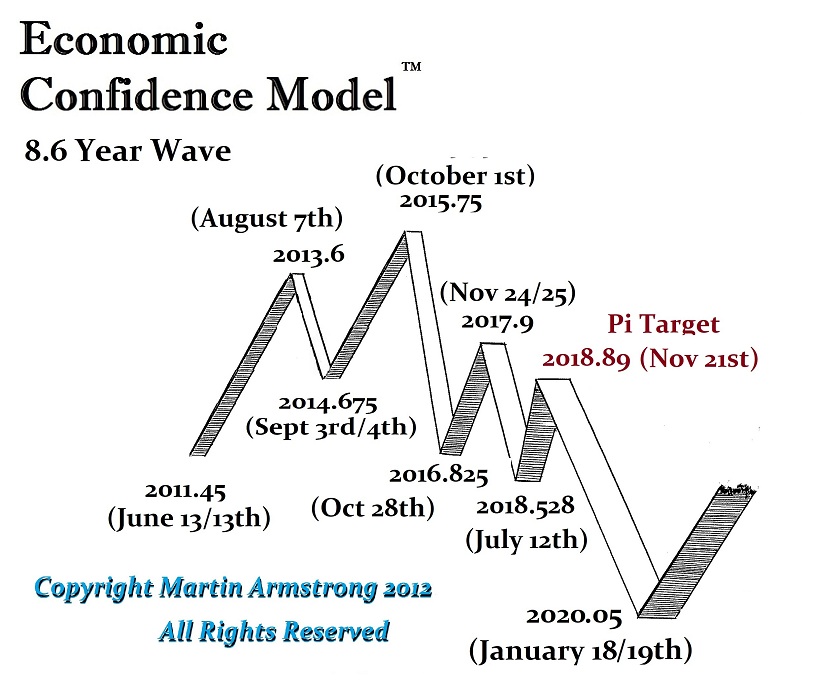
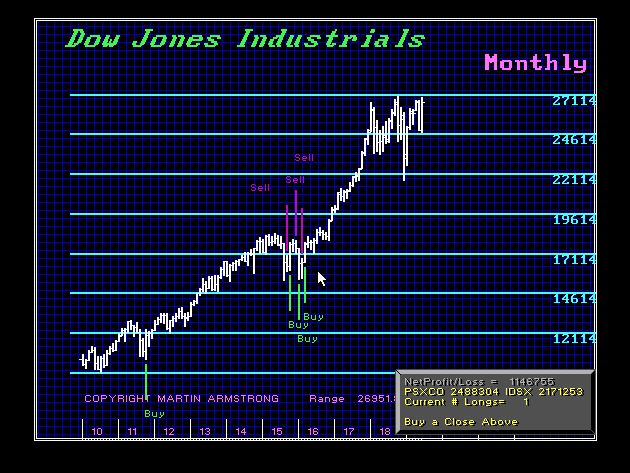
I have stated many times that the trend does NOT begin to shift until you reach the Monthly Level. We saw that in Gold when it finally got through 1362.50 after nearly four years of bouncing off that number. In the case of the Dow Jones Industrials, our hedging models for institutions were long one month from the low and has remained in that position. This is just a hedging model which is either long or short. It at least tends to keep institutions on the right side of the trend for long periods of time.

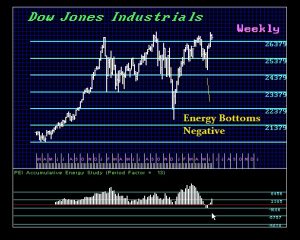
Aside from the Reversal System, the Energy Model is extremely helpful in identifying the position of the market and if there is a risk of a crash or a rally. The Energy Model turned negative, demonstrating that there was no possibility of a crash as most analysts were forecasting from a gut perspective. A crash would have been possible ONLY if the Energy Model was at a peak. When it is testing the lows or a negative, it is warning that the energy in the market has already dissipated.

We are simply headed into a Monetary Crisis Cycle where the majority of people will never be able to forecast what will unfold from a personal gut perspective. This is not a time for lucky calls. We need objective time-tested analysis that is not clouded by human bias. This is when we need the global approach to let Socrates simply correlate the world to enable us to see the real trends that are in motion. The worst thing you can do is ASSUME you have missed something, as that is typically the kiss of death for investors where they inevitably buy the high or sell the low.

Vice President Mike Pence and NASA Astronaut Buzz Aldrin Celebrate 50th Anniversary of Apollo Moon Landing…


The United States and NASA celebrate 50 years since the Apollo 11 moon landing.  On this incredible anniversary Vice-President Mike Pence and historic astronaut Buzz Aldrin discuss the past (Apollo) and future (Artemis) of space exploration.

Agricultural Loans Declining Right on Target


One of the most fascinating observations I have made over my career has been that the banks always lend at the top and contract lending at the bottom in every market. Going into 1980, banks were calling me to ask if I wanted to borrow money. Recently, I got a phone call from my bank asking, once again, if I would be interested in a loan. This to me is merely a confirmation that we are approaching a major turning point.

When I look at lending into the agricultural sector, the big Wall Street banks are once again perfectly in line with the cycle. They peaked in loans to farmers back in 2015, and have been declining ever since going into 2020. Bank lending to the agricultural sector peaked with the ECM and we will see it bottom in 2020. Our model will be correct in forecasting the next wave, which will be a cost-push inflationary wave. As the agricultural sectors come back to life, thanks to shortages, then the bankers will be willing to lend once again. The banks are the PERFECT indicator of how not to run a business. They make decisions emotionally and always get the economy dead wrong (i.e mortgage-backed securities peaked in 2007)

Back to the Moon: Trump Appointee Fires NASA Veteran to Speed Lunar Mission


Published on Jul 15, 2019

President Trump wants NASA to get Americans back to the moon in five years. To heighten the urgency, NASA administrator Jim Bridenstine — a Trump political appointee — fires William Gerstenmaier, a well-respected 42-year NASA veteran in charge of human space exploration. Will this sudden move light a fire under the bureaucracy, or did we just lose four decades of institutional knowledge jeopardizing our safe return to the lunar surface? Should NASA get our of the business of human space transportation? Bill Whittle Now, with Scott Ott, comes to you free because a growing group of committed conservatives pays for its production. If you’d like to step up as a producer and join them, visit https://BillWhittle.com/register/


The US Treasury Does Have the Constitutional Right to Mint Coins


QUESTION: Marty, You are wrong. The US Treasury can create the money as the Constitution says it can. Article I, Section 8, Clause 5. The Congress shall have the Power to coin Money, regulate the Value thereof, and of foreign Coin, and fix the Standard of Weights and Measures.

To coin is used as a verb. At the time the Constitution was written, to coin money meant to create or to make money. Today’s Dictionary defines to coin as a verb meaning to make or to invent.
Why did you fail to mention this in your Blog today?
TD

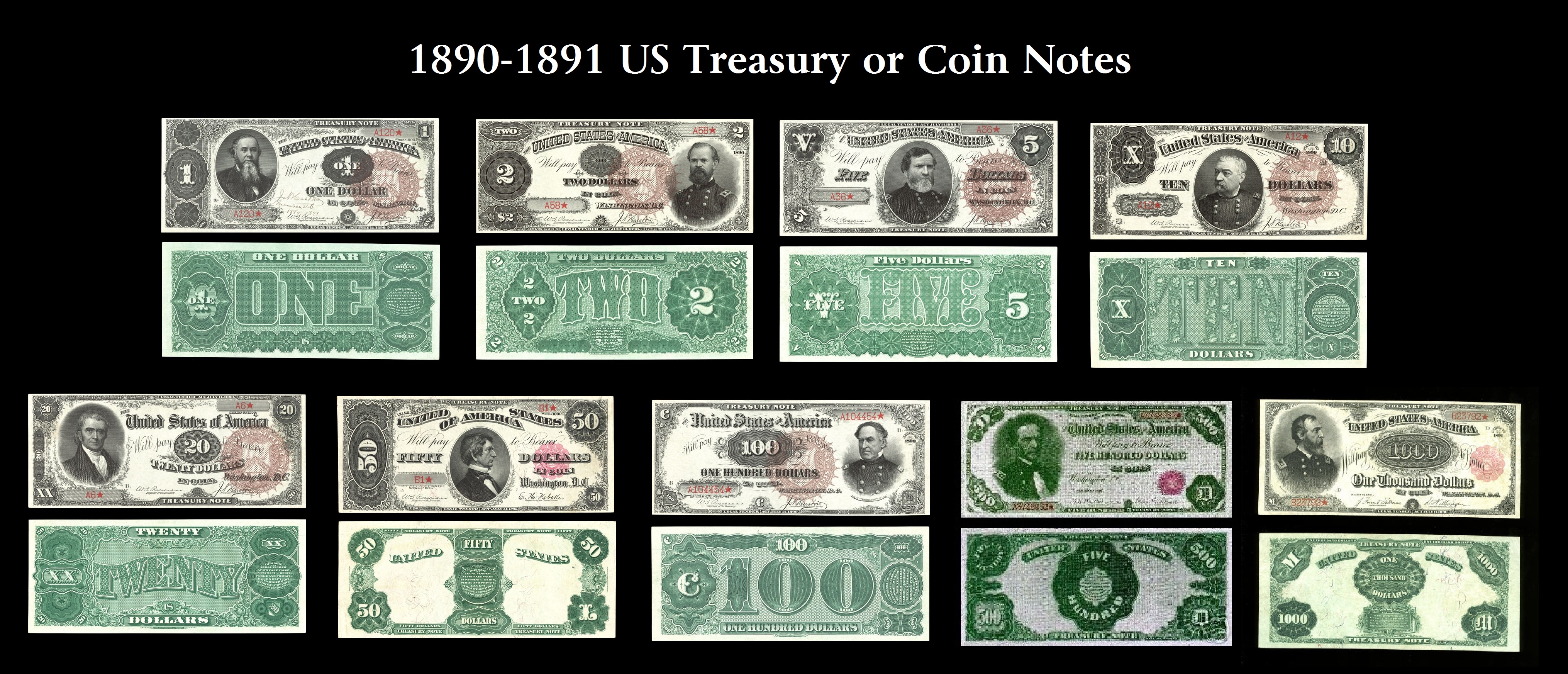
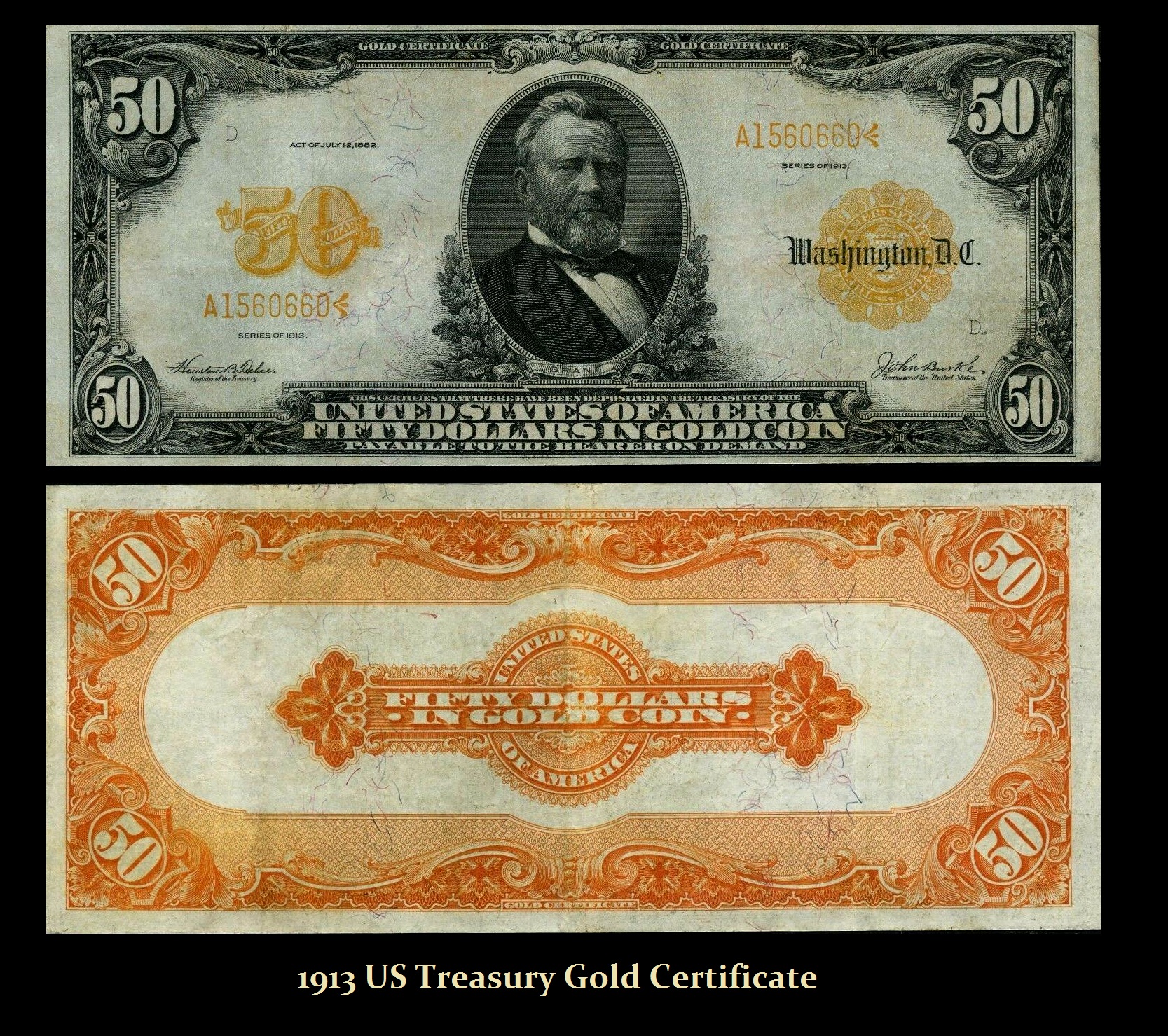
ANSWER: Yes, you are correct. I suppose I was referring to the 99.99% of the money supply rather than the coins put into circulation by the US Treasury. President Nixon only closed the gold window in 1971. He did not demonetize “gold” as money under the Constitution. Yes, technically the US Treasury can coin money, but it coins today’s coins. The Fed does not do that. The coinage it creates is minimal in comparison to the overall scheme of things. Since 1913, the printing of currency has been delegated to the Federal Reserve. Prior to 1913, the Treasury issued the paper currency which was backed by coins.

This was the last issue of paper currency issued by the United States Treasury in 1913, the year that the Federal Reserve Act was passed.

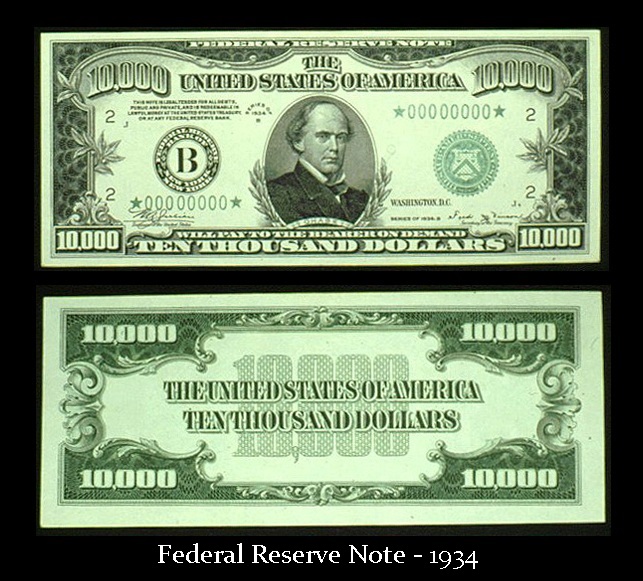
Note that in 1934, the Fed actually issued $10,000 bills

Watch SpaceX launch 60 Starlink satellites in ONE launch!


Everyday Astronaut

Streamed live on May 23, 2019
SUBSCRIBE 348K
SpaceX will be launching 60 demonstration satellites for their Starlink Internet constellation. The Falcon 9 will launch from Space Launch Complex 40 (SLC-40) at the Cape Canaveral Air Force Station (CCAFS). The first stage booster for this mission is B0149. It is flying its third mission, it previous launched the Telstar 18V satellite in September of 2018 and flew the Iridium 8 mission in January of this year. It will be landing approximately 621 km (385 miles) downrange on the Autonomous Spaceport Drone Ship (ASDS), Of Course I Still Love You (OCISLY). This will be one of the farthest downrange landing locations for a Falcon 9 so far. Want more info? We’ve got you covered! Check out our Prelaunch Preview for this (and upcoming) mission(s)! – https://everydayastronaut.com/prelaun…

Artificial Intelligence: it will kill us | Jay Tuck | TEDxHamburgSalon


Published on Jan 31, 2017

SUBSCRIBE 19M
For more information on Jay Tuck, please visit our website http://www.tedxhamburg.de US defense expert Jay Tuck was news director of the daily news program ARD-Tagesthemen and combat correspondent for GermanTelevision in two Gulf Wars. He has produced over 500 segments for the network. His investigative reports on security policy, espionage activities and weapons technology appear in leading newspapers, television networks and magazines throughout Europe, including Cicero, Focus, PC-Welt, Playboy, Stern, Welt am Sonntag and ZEITmagazin. He is author of a widely acclaimed book on electronic intelligence activities, “High-Tech Espionage” (St. Martin’s Press), published in fourteen countries. He is Executive Producer for a weekly technology magazine on international television in the Arab world. For his latest book “Evolution without us – Will AI kill us?” he researched at US drone bases, the Pentagon, intelligence agencies and AI research institutions. His lively talks are accompanied by exclusive video and photographs. This talk was given at a TEDx event using the TED conference format but independently organized by a local community. Learn more at http://ted.com/tedx

How to defend yourself against misleading statistics in the news | Sanne Blauw | TEDxMaastricht


Published on Nov 3, 2016

Numbers are being used every day. In the news, in politics, in our jobs, and even in our social interactions. They are used to convince, explain, but also to deflect from what is truly happening. Too often, numbers appear as abstract, objective and difficult. Sanne Blauw’s mission is to make the world of numbers accessible to all. Sanne has broken most stereotypes about someone interested in mathematics throughout her life. From working at the OECD, to being a member of her University Council, to becoming a journalist. Sanne is far more than what most people would expect from a person with a PhD in econometrics. She strives to convince all of us to second-guess the numbers that shape our worldview. This talk is a must for all who work in journalism. Sanne Blauw is journalist for De Correspondent. She obtained a PhD degree in econometrics at the Tinbergen Institute and the Econometric Institute of the Erasmus University Rotterdam. Using various quantitative methods, she combined applied micro-econometrics, psychology and development economics. Sanne is convinced that a better understanding of statistics would make the world a better place. This talk was given at a TEDx event using the TED conference format but independently organized by a local community. Learn more at http://ted.com/tedx