Posted originally on Jun 10, 2024 By Martin Armstrong
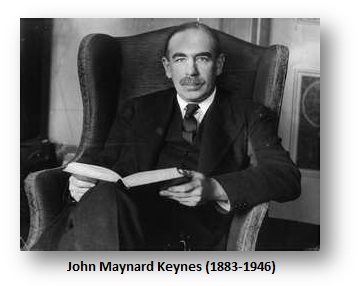
John Maynard Keynes in his 1936 book, ‘The General Theory of Employment, Interest and Money,” argued aggregate demand was too volatile to be stable and would lead to inflation or recessions. His theory honed in on spending as a means of price control. Low aggregate demand, Keynes argues, would lead to high unemployment and stagflation. Government could intervene through fiscal policies to increase aggregate demand, as an example, increased government spending could tame inflation. Interest rates, according to Keynes, could also be modified to encourage spending and stimulate demand. So why are these theories failing miserably today?
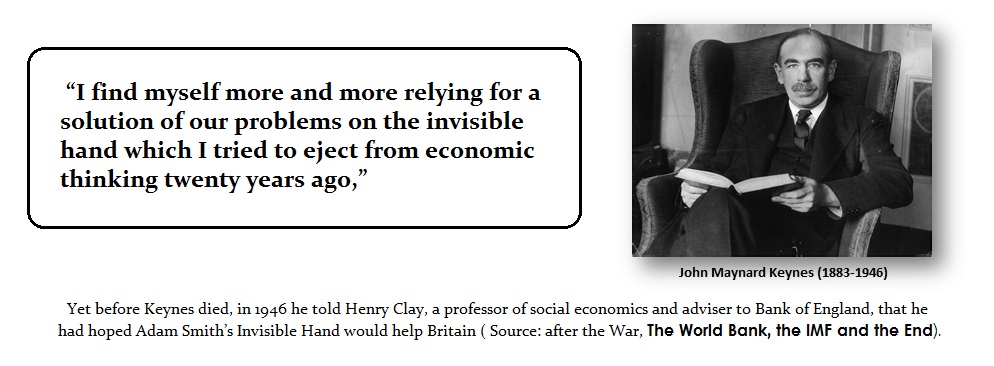
To begin, the United States had a balanced budget when Keynes presented his theory. The government is now the biggest borrower, acting in its own self interest under Adam Smith’s theory of the invisible hand that Keynes spent his career attempting to deny. According to Keynes, “there is no self-correcting mechanism in a free market economy that automatically restores full employment.” He believed that the government could change the business cycle but arguably regretted this notion on his deathbed.
Keynesian economics gave the government the green light to manipulate the economy, or at least make numerous failed attempted to do so. There is that old joke about communism that you can vote your way in but must shoot your way out, seemingly fitting to the utter disaster governments have created in regards to our economic situation.
The government is by far the biggest borrower. Raising interest rates can have no impact on demand, as the government will simply borrow more, and the central banks simply have no say. During the Great Depression, for example, Washington forced the Federal Reserve to implement QE policies to artificially lower rates to increase demand. Yet, when Washington ordered the Federal Reserve to do the same during the Korean War in 1951, the central bank first broke with Washinton and refused to comply as it knew it would hurt the economy as America’s budget was no longer balanced.
Quantitative Easing destroyed the Keynesian model, and there is now no other alternative for central banks to control the economy. If they raise rates, the budget explodes. The Keynesians advocate manipulating demand and advocate fiscal spending that the central bank cannot control. However, the other part of Keynesianism is the manipulation of taxes. Keynes argued that to stimulate demand, you lower taxes. He saw this correctly, but again, it does not fit with government agendas.
There is no limit to what the government will spend with “money” that simply does not exist. Governments continue to borrow perpetually with no real intention of paying back their debts. This is one piece of the Sovereign Debt Crisis that will implode like a nuclear bomb the likes of which we have never witnessed. The business cycle cannot be manipulated, and what’s more, the Keynesian model cannot account for declining confidence in both government and the economy.
Posted originally on Jun 6, 2024 By Martin Armstrong
COMMENT: Marty, I attended your Toronto Institutional session when the Bank of Canada had a table of 10 people. People would ask you what the central banks were looking at, and you would respond. Everyone then turned to see if they flinched. They were the best of times, as they say.
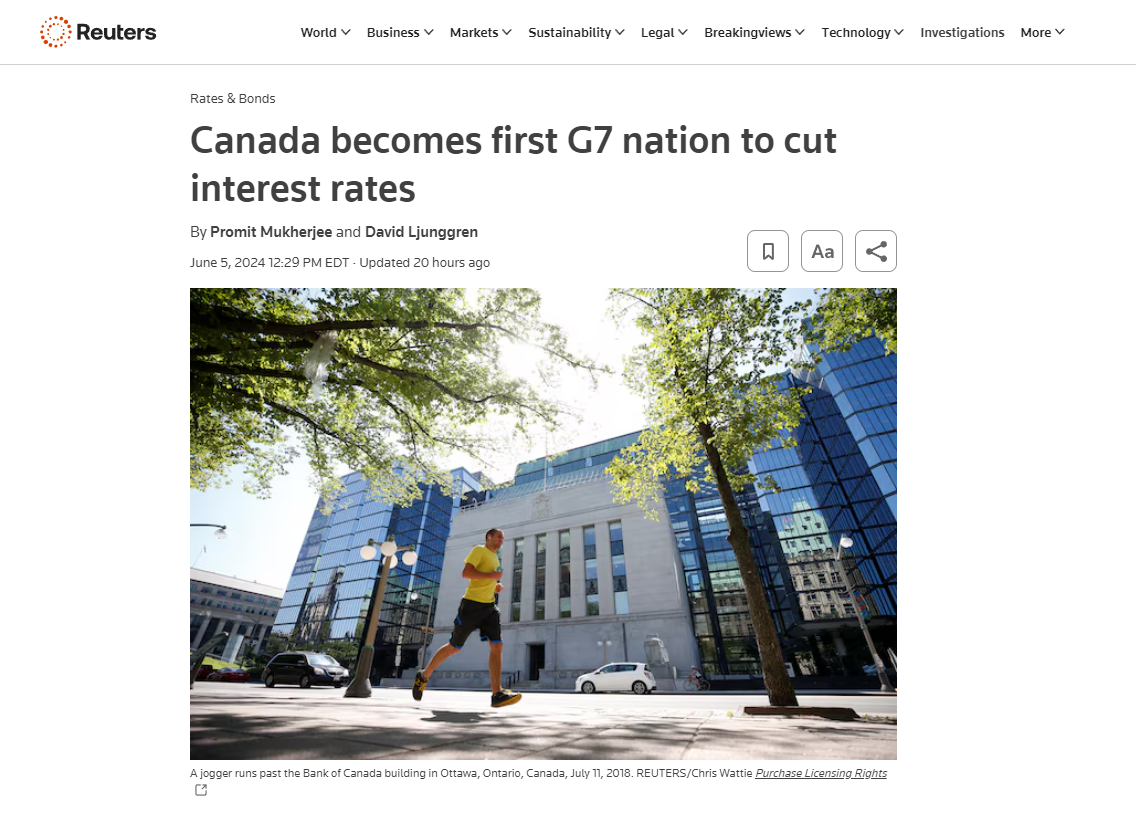
For us long-timers, it was no surprise that the Bank of Canada was the first to cut rates in turn with the ECM. I know you do not like to court the mainstream press, but one of these days, somebody has to have the guts to stand up and say that there is a business cycle.
Your legacy has made a difference. I share your goal to purge our governments of political manipulation that causes more harm to the people and the economy than anything else.
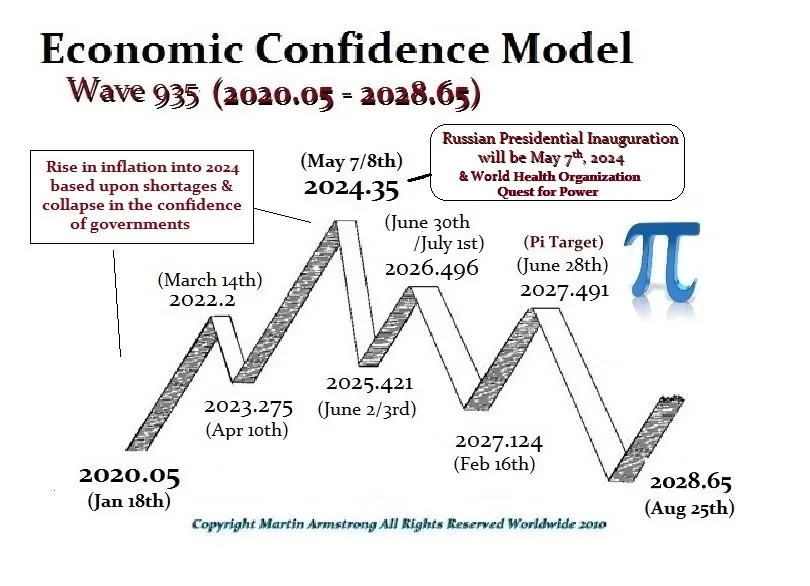
It was refreshing to see the Bank of Canada act with the ECM. You even put on the blog that June would be the opportunity for the central banks to cut rates. Well done, as always.
KW
REPLY: Yes, they were simpler days. It’s nice to see you are still active. Most of the major central banks know the Economic Confidence Model. It was good to see that the Bank of Canada acted in advance for the first time until waiting for the crash. It would be better if they could purge the fiscal side of these insane pretend experts like Janet Yellen and the Neocons. Then there will be a future worth leaving our grandchildren.
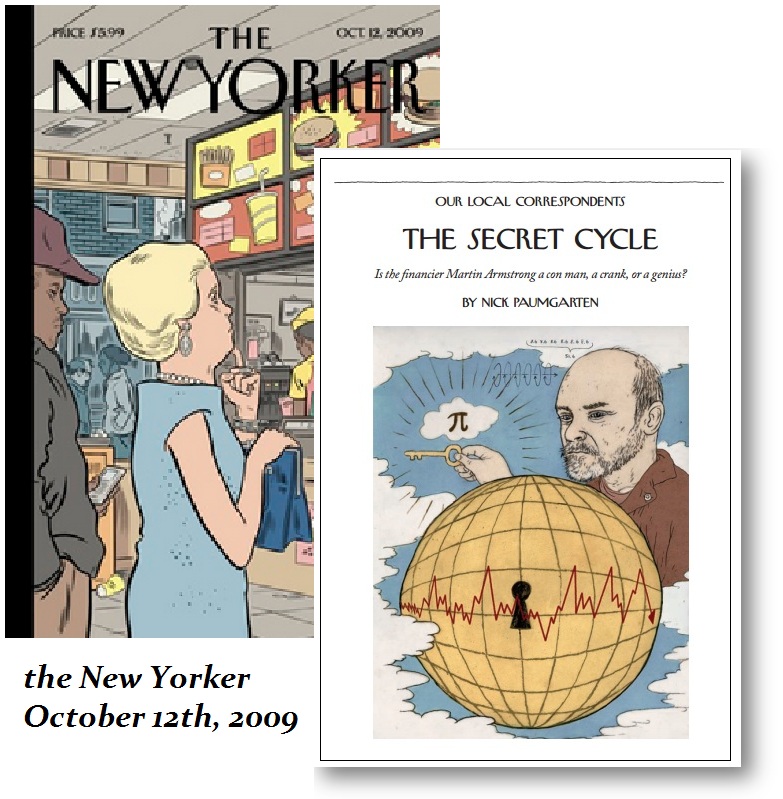
We now have universities inquiring about buying quantities of the books I have been publishing. It is great news that they are starting to introduce students to reality. I am working hard to finish the major book on the Economic Confidence Model, the New Yorker Magazine, called The Secret Cycle.
Posted originally on Jun 5, 2024 By Martin Armstrong
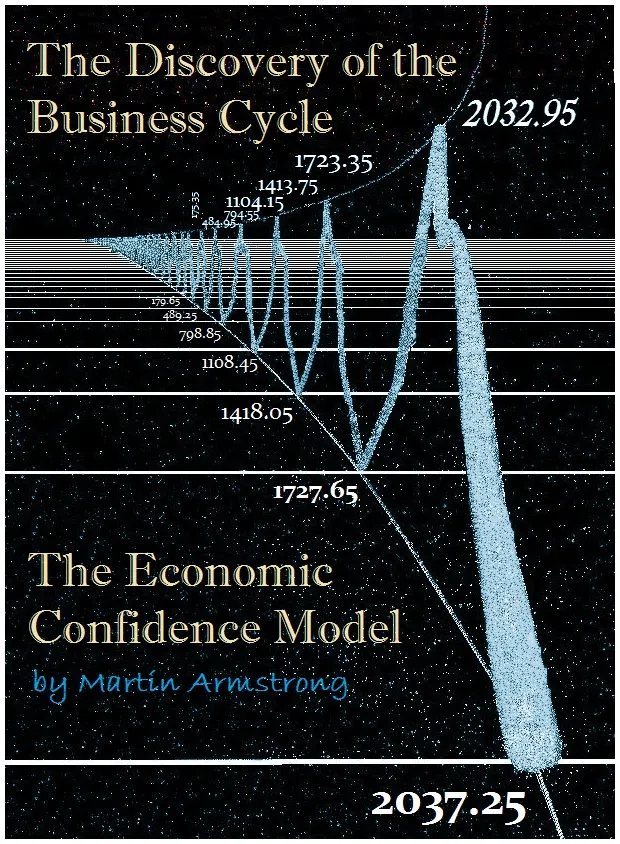
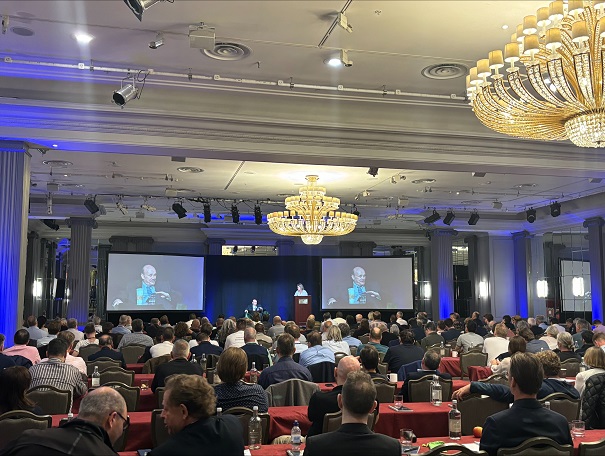
We would like to thank our invaluable AE community for gathering together in London for the Economic Confidence Model seminar. I heard some say that the annual event has become akin to a reunion of friends. It is indeed a distinct congregation of concurring intellects seeking truth.
If you missed the seminar, there is still an opportunity to purchase a virtual ticket. This option will provide you with a complete video of the event, as well as the slides displayed during the presentation and special reports.
Posted originally on Jun 5, 2024 By Martin Armstrong
Federal Reserve Bank of Minneapolis President Neel Kashkari has advised against anticipating near-term rate cuts. While speaking to the Financial Times, the Fed president stated that people would simply prefer a recession to continued inflation.
“I have learned that the American people—and maybe people in Europe equally—really hate high inflation. I mean, really viscerally hate high inflation,” he told the Financial Times’ The Economics Show podcast. Kashkari is speaking as if we are not already in a recession. It is not difficult to understand the “visceral” hatred people around the world feel toward rising prices. The effects of inflation are felt with every purchase, causing the average person to adjust their entire lifestyle.
Vague issues such as rising unemployment or declining wages do not impact everyone. “I lose my job, I lean on my sister or my parents or my friends, and they help me through it. But high inflation affects everybody. There’s no one I can lean on for help because everyone in my network is experiencing the same thing I’m experiencing,” Kashkari explained. Mass layoffs, for example, would only impact a fragment of the overall population, and people would feel lucky simply to keep their jobs.
“In the US, GDP has been remarkably strong, very strong,” he noted. “The labor market has been resilient. Wage growth has been mostly resilient. And we’re seeing even the housing market has shown signs of resilience. So if I look at this resilience and economic activity, that does not look like an economy that is under pressure of very high, very tight monetary policy.” Yet, inflation is outpacing wage increases and people are watching their savings dwindle while spending less. The average person cares not of the health of the overall economy as they simply want to be able to continue maintaining or improving their standard of living. Most Americans, for example, do not invest and live paycheck to paycheck.
Real prices have far surpassed anything they calculate in CPI. Everyone understands that prices have risen far more than the arbitrary number the Fed provides us. Taxes are continually increasing for everyone in every tax bracket. The government not only adds to inflationary issues with their spending but then expects their citizens to foot a portion of the bill with taxes, which will simply never be enough.
Then we have Washington telling the masses to blame corporations for price gouging while raising their taxes and making it increasingly difficult to conduct business and maintain a large workforce. It is not that the people would prefer to be in a recession, the real issue is that countless people are entering survival mode. People everywhere want to hold onto whatever they may have out of fear for the future, but they are unable even to hoard as real prices now demand they hand over whatever they have to maintain their lives.
Posted originally on May 29, 2024 By Martin Armstrong
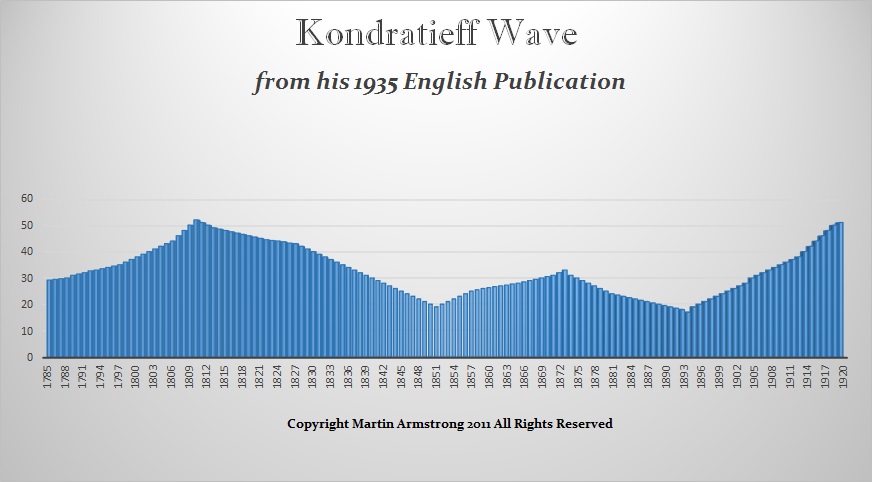
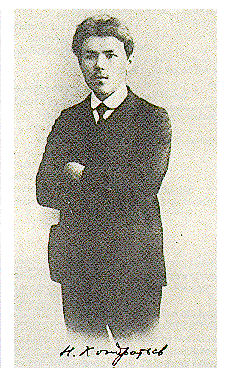
All those investigating cycles within the economy made a simple mistake. Kondratieff followed agriculture/commodity prices when agriculture accounted for 70% of the GDP pre-19th century. That only began to decline from 1850 forward, dropping to 40% by 1900 as the Industrial Revolution emerged with the invention of the steam engine. Moreover, aside from climate impacting the food supply, there were also wars. So the Kondratieff Wave failed to take into account all of the external forces.
If we extend the K-Wave 54 years from the commodity high in 1919, that brings us to 1973, which was close to the end of Bretton Woods in 1971 and the OPEC Oil crisis. Another 54 years from there will bring us to 2027. Therefore, this may be based entirely on commodities, but they were impacted by weather and war. Note that 2027 is the ideal target on our model for war derived from entirely different sources.
There is a cycle of industrialization as well. Rome began as an agrarian society and moved toward trade, which brought them into conflict with Carthage. Rome itself became more like New York and grain was imported from Egypt. As agriculture became more of an import, Rome blossomed like New York into the arts and culture. The shift toward industrialization also resulted in a decline in birth rates for children. Large families were needed in an agrarian society but not so much in a developed society – hence the family laws of Augustus.
The first known Clean Air Act occurred in 535 AD by Emperor Justinian in Constantinople. He proclaimed the importance of clean air as a birthright. “By the law of nature these things are common to mankind—the air, running water, the sea.” Even Cicero wrote about pollution in the ancient city of Rome. This went hand and hand with developed societies and urbanization.
Consequently, when looking at long-term cycles, a few hundred years is not enough data. If Kondratieff were alive today and based his study on the current system, he would focus on services rather than commodity-based economies. Agriculture has fallen to just 1.2% of the civil workforce, so we cannot follow K-Waves as the innovator intended.
Posted originally on May 29, 2024 By Martin Armstrong
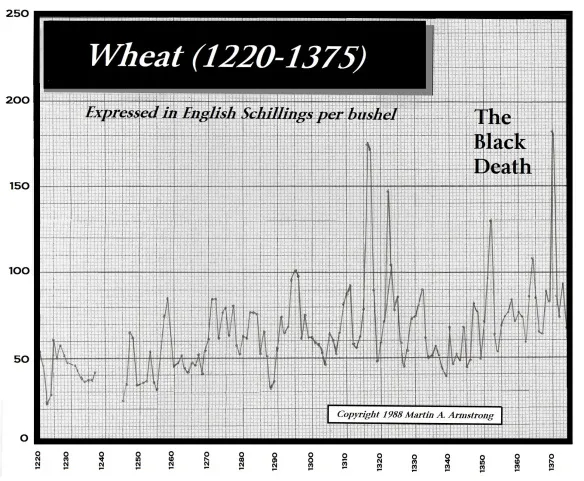
All commodities, including gold, trade substantially differently than stocks or real estate. Pictured here is wheat back to 1200. Note that you see what appears to be a brain wave. Commodities trade differently because they are subject to nature. Manufactured items can be produced on a more regular basis. However, commodities are subject to weather, and even mining is subject to discovering supply.
Look at energy. The US was dependent on imports and was virtually self-sufficient from foreign production until Biden was appointed.
Here is wheat impacted during the Black Death. Two trends were clashing. There was a 50% drop in population, so demand dropped, but also there was a collapse in labor, so production declined. Prices rose because there was still a shortage of supply because land went vacant and that forced landlords to begin paying wages. There are always far more complicated trends involved in commodities.
War has also impacted commodities. But when gold was MONEY, it declined in purchasing power WITH inflation. When gold is a free market as present, it moves opposite to inflation because, yes, it too is then a commodity. Making gold money will NEVER prevent the cycles as illustrated above and it will decline in purchasing power with inflation that is in part driven by nature.
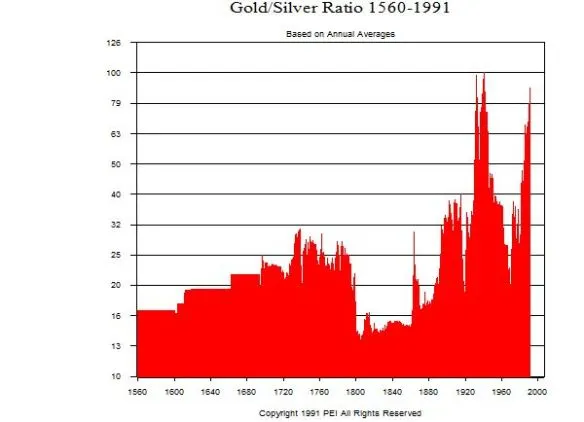
Consequently, even gold makes runs to the upside (bursts) that are largely catch-ups. It does not remain constant even against silver. Gold is the worst investment from an inflationary standpoint if you expect it to track inflation, for it does not and will not. Right now, we are in a cycle where CONFIDENCE has waned, and we will see gold rise with the stock market, but it trades far differently from stocks.
Cyclical analysis is all about defining WHEN such events will take place. Price is entirely a different aspect. The burst is just that – a rally that appears to come from nowhere playing catch-up because EVERYTHING has an international value.
Posted originally on May 29, 2024 By Martin Armstrong
The old idea that inflation is created by an increase in money supply has distorted the minds of many people. Inflation is caused by numerous factors for it is not a one-dimensional aspect. For example, say a bird flu has rendered half of the egg production to be worthless, which would send egg prices soaring. This would have nothing to do with the quantity of money. So, obviously, a decline in the supply of some service or commodity can also lead to rising prices. Supply and demand.
Then there can be cost-push inflation as we saw during the 1970s due to OPEC. The first OPEC price shock was October 1973 from where we should see the next low in 2016 (43 years later). The sudden rise in oil sent a shockwave through the economy, driving up prices because the entire economy had to readjust to higher energy. This was not the result of an increase in demand nor an increase in the money supply.
When gold was used for money during the 19th century, it fell sharply in value with each new discovery from California, Australia, and Alaska. Inflation rose because of a dramatic increase in the money supply, which is exactly what took place in Europe when Spain brought back ship after ship of gold from the New World. The sudden dramatic rise in the supply of money unleashed inflation, and during both periods, money (gold) failed to provide a store of value.
Steady, slow growth in the supply of money does not lead to inflationary waves. We find that major waves of inflation are often tied to waves of speculation, which differ with each wave moving from real estate, commodities, stocks, or bonds, constantly rotating over decades within a domestic economy and then this movement of capital takes place internationally.
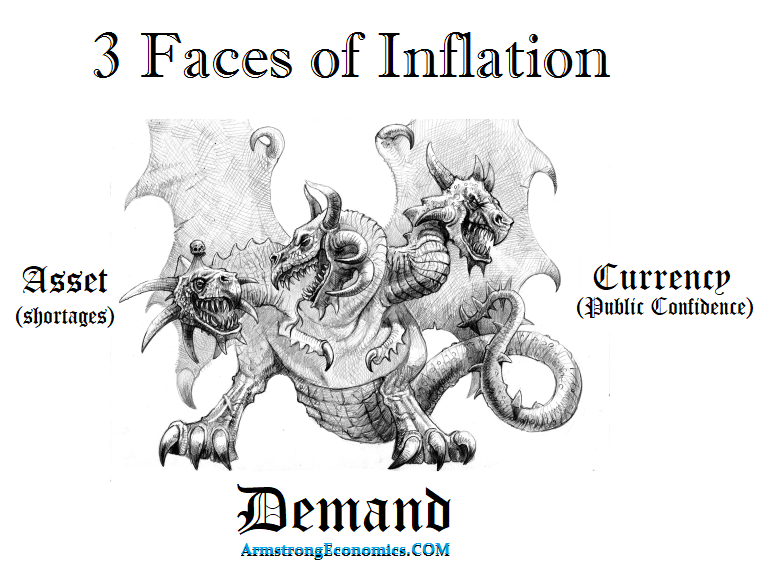
Inflation is not a single one-dimensional aspect. It moves up and down between the rise and fall in the demand for private assets vs. hoarding and uncertainty.
Posted originally on May 28, 2024 By Martin Armstrong
Economics is well known for rather unrealistic theories based upon fundamentally unsound principles, such as the assumption that all things remain equal. Reality parts with academics whenever such assumptions are drawn to a foregone conclusion. However, greater false assumptions, which go unnoticed, lie at the foundation of so many theories in economics – primarily the assumption of linearity.
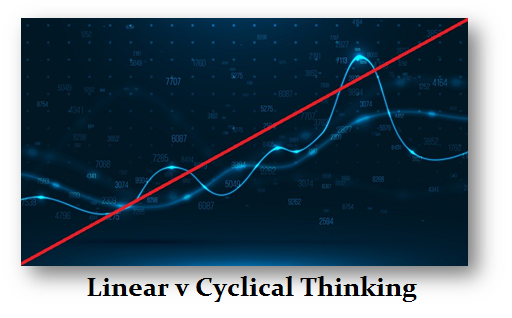
In our thinking process, we all are trapped by the Aristotelian sequence of logic – if X takes place, then Y must follow. Unfortunately, we think linearly and, as such, most theories seek to embellish this very basic assumption. The financial world honestly wants to believe in simplistic notions. Raising interest rates and demand will subside along with inflation is one false linear assumption. Man prefers to believe in linear relationships and systems because anything beyond two variables becomes far too complex for rational thought processes.
Man’s natural tendency toward linear thinking has indeed created many heated battles. The arguments between supply and demand-side economics is one such example. Given the assumption of a linear economy, demand-side economists argue that the economy can be controlled through the manipulation of government spending and interest rates. In effect, demand-side economics seeks to use the consumer (demand) as a club to beat capital over the head. Yet these same demand-side economists claim that supply-side economics benefits the rich at the expense of the poor. Strangely enough, throwing the consumer out of work and causing higher unemployment to affect lower demand is the core of demand-side economics. It is hard to see how the demand side benefits the poor at the expense of the rich. The supply-side economist argues that there should be less government intervention in demand. Instead, the government should stimulate the economy by encouraging greater output through supply stimulation.
Both sides have identified two extremes within a non-linear system, even though their arguments, based upon a linear assumption, assume that the other is totally wrong. If we look at just the last 10 years of economic activity, we can clearly see changes within the infrastructure that provide a period when each form of economic management would indeed be appropriate.
Looking at the period 1976–1980, it would be difficult to label this period as anything other than an inflationary spiral led by demand. Raising interest rates would be appropriate under such conditions when demand flourishes wildly beyond its normal capacity. Hoarding and speculation were in full bloom. Therefore, one should employ “demand-side” economics when demand is, in fact, out of control.
Nevertheless, in the post-1986 era and particularly since the ’87 crash, speculation is hardly the issue. We do not find excessive demand leading to the hoarding of commodities, as was the case leading into 1980. Yet, governments around the world are still employing demand-side economics to curb inflation, which is being caused by real shortages in labor and commodities. Clearly, in this case at least, supply-side economics makes much more sense. If interest rates continue to rise, the world economy will be threatened by a sharp and severe recession. However, the shortages on the supply side in energy, agricultural, and base metals will not be corrected by raising interest rates. Higher interest rates will not cause the weather to return to normal. Higher interest rates will certainly not encourage miners to open new mines. Higher interest rates will also not cause a reversal in trend within the energy sector where exploration has been cut by more than 50% in the last two years.
Supply-side economics is as valid as demand-side economics. Everything within the system has a time and place because the system itself is non-linear. The chart provided illustrates our Theory of Non-Linear Intervention. This theory is very simple and based upon actual observation.
The standard economic assumption under demand-side economics is that raising interest rates will lower demand and inflation. Continually raising interest rates does not prevent inflation. At some point in the system, confidence breaks down, and higher costs in interest rates only add to the costs of production and doing business. Eventually, this spurs inflation instead of reducing it. They attempted to go to negative interest rates, trying to stimulate inflation by punishing people if they failed to spend their money. This attempt failed because they overlooked the simple fact that people will hoard when worried about the future.
The evidence of this is all the hoards of ancient Roman and Greek coins that reveal in times of uncertainty, people simply buried their money for a rainy day. The very basic assumption that the system is linear is obviously incorrect. The business cycle exists throughout all times and portrays the system as non-linear. If any effect is taken to extremes, the exact opposite effect emerges. This is the result of non-linear intervention. Each economy possesses a different infrastructure. Consequently, the threshold where interest rates will cease being anti-inflationary and transform itself into the catalyst of inflation resides at different levels in each economic system. Differences in the value of labor, taxation, political systems, and market mechanisms must be taken into account.
In conclusion, government intervention, which seeks to manage the economy in an efficient manner, always fails because they are conflicted with self-interest. They are the biggest debtor within society. Attempts to only manage the economy by demand-side economics ignore the free market entirely. Intervention cannot possibly work when government remains in the dark about how the economy even functions. They fail to comprehend the direction and cause of inflation or deflation. The first step is recognizing that there is a business cycle, the second is to accept that a cycle exists, and third, we merely try to prepare for the downturns exactly as David advised the Pharaoh – seven years of plenty v seven years of drought.
“I named my computer model after Socrates because the oracle of Delphi had said that he was the smartest man in Greece. He tried to prove the oracle wrong and the process proved it to be correct. He was put on trial and sentenced to death because he knew too much. My computer has taught me a lot in geopolitics, we had a major bank in Lebanon in the 1980’s and they asked if I could create a model on the Lebanese pound. I put the data in the computer and it came out and said their country would fall apart in 8 days. I thought something was wrong with the data. When I told the client, they asked me what currency would be best, and I said the Swiss Franc. Eight days later the civil war begn. Obviously they saw the movement of money themselves and came to me for the timing. The same thing happened with a client in Saudi Arabia who was a big shipper. He called me asking me what gold would do tomorrow because Iran was going to begin attacking shipping in the gulf. So once again, there was advanced information about war. By 1998, I understood how the computer was forcasting such events. I warned in June at our London conference that Russia was about to collapse. The London financial Times had snuck into the back of the room and reported that forecast on the front of their newspaper on June 27th 1998. Russia collapsed about 6 weeks later.”
Posted originally on May 25, 2024 By Martin Armstrong
Like to thank everyone for attending the London ECM Conference. We apologize that we were only able to accommodate a small audience. The venues in London are much smaller than what we can do in Orlando, It was so nice to be back in London after so many years.
I have created this site to help people have fun in the kitchen. I write about enjoying life both in and out of my kitchen. Life is short! Make the most of it and enjoy!
This is a library of News Events not reported by the Main Stream Media documenting & connecting the dots on How the Obama Marxist Liberal agenda is destroying America








 Centinel2012