Violence and calls for “revolution” have engulfed Portland, Oregon and other major U.S. cities. Rioters have attacked police officers with rocks, bottles, bricks, and fireworks. Authorities have responded with tear gas, rubber bullets, pepper balls, and arrests. How did we get here? And what is really at stake? In this episode, we sit down with Colorado Congressman Ken Buck to discuss his new book “Capitol of Freedom: Restoring American Greatness,” which takes readers on a journey through the halls of the U.S. Capitol to understand the principles that make America exceptional and that are now under siege. We also explore foreign threats to America, and Congressman Buck’s push to ban government employees from using the Chinese-owned TikTok app on their phones. This is American Thought Leaders 🇺🇸, and I’m Jan Jekielek. Note: This interview was filmed on July 27, 2020.
Credit the Turkish poet Rumi (1207-1273) as the origin for an expression in one of his poems: “Fish begin to stink at the head, not the tail.”
The pinnacle of American jurisprudence is the United States Department of Justice. The Supreme Court of the United States adjudicates when, where and how justice should, and has been, exercised.
The Department of Justice in America is dying from the head. Essentially, it may already be dead. It appears so on the streets of Portland and Seattle, and in the political halls of Washington, D.C. and the Big Blue State governments.
Today, a handful of noteworthy voices is delivering this message in necessarily even-tempered tones. Here are three.
The President
Here is a summary of a FOX Business News reporter’s recent interview with President Trump, whose comments concerned both US Attorney Durham and Attorney General Barr. Maria Bartiromo asked about the Durham probe which Barr claimed could [the operative word] yield some results by next month. Quoting from her interview with the President, Trump said:
“‘I hope he’s doing a great job, and I hope they’re not going to be politically correct,’ Trump said. ‘Obama knew everything. Vice President Biden, as dumb as he may be, knew everything, and everybody else knew. And [former FBI Director James] Comey, and [former CIA Director John] Brennan, and [former Director of National Intelligence James] Clapper, they were all terrible, they lied to Congress,’ the president added.
‘They spied on my campaign, which is treason,’ he continued. ‘They spied, both before and after I won, using the intelligence apparatus of the United States to take down a president, a legally elected president, a duly elected president of the United States. It is the single biggest political crime in the history of our country.’”
Continuing, Trump added that he “hopes Durham is ‘doing a job,” and that his team “is not going to be politically correct and just get a couple of the lower guys. Bill Barr can go down as the greatest attorney general in the history of our country, or he can go down as an average guy. We’ll see what happens.”
Sidney Powell, General Flynn’s Lead Defense Attorney
In an interview posted on YouTube, Sidney Powell, who took over the defense of General Flynn after his deep state lawyers bled him dry of funds with bad results, said this, beginning at 53:05:
“It’s absolutely imperative that the Department of Justice return to the time when it would self-correct. It’s huge. When I was an assistant U.S. attorney, I was raised to tell the judge the truth, whatever it was. The good, the bad, the ugly. Somewhere in the last twenty years we came to this time when these people think the end justifies the means. They’re using the law as a weapon to destroy people, innocent people, to destroy peoples’ lives and that’s not what the system is about. So, the Department of Justice has got to start standing up for the right thing. The only politics in this prosecution [of Flynn] was from the very beginning. On the side of prosecuting General Flynn at all… It[righting the ship that’s the Department of Justice] has to be done if we’re to survive as a constitutional republic built on the rule of law.”
Sidney Powell: Inside the Michael Flynn Case and DOJ Reform
Tom Fitton, President of Judicial Watch
Beginning with the Russiagate Hoax, through the Kavanaugh Hearing, into the Impeachment ordeal, and continuing today, Judicial Watch (JD) has been led by Tom Fitton in its intrepid search for the truth. Throughout that process, JD has been blocked, to the point of being stonewalled, by the Department of Justice (DoJ), its Federal Bureau of Investigation (FBI), and the Department of State (DoS).
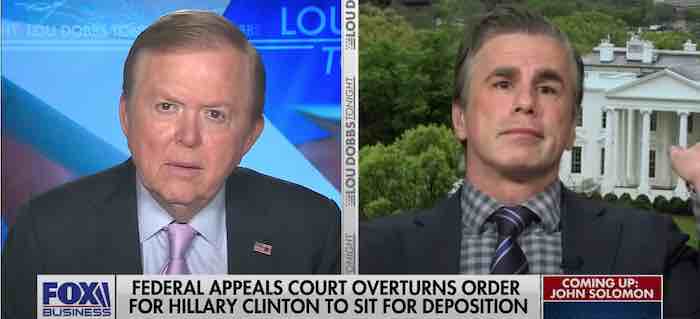
On August 14, Fitton was interviewed by the host of FOX’s Lou Dobbs Tonight show after a three-judge panel of the D.C. Court of Appeals ruled against JD and overturned a lower court order requiring Hillary Clinton to sit for a deposition concerning her use of a personal server while at the Department of State, and events surrounding Benghazi. Two of the judges were appointed by Obama, the third by Bush, Jr.
Into the interview (2:58), Fitton explains how resistance to JW continues to come both from the DoJ, FBI and the DoS:
Tom Fitton reacts to appeals court overturning Hillary Clinton deposition order
“It’s still happening. The attorneys at the State Department are colluding with the Clinton attorneys. They’re fighting us together. It’s incredible, and it’s a betrayal of everyone who expected law and order from this new Justice Department. [Dobbs asks] ‘What is William Barr doing?’ [Fitton silently holds up both arms, then says…] Nothin’.”
Late last week the DoJ announced that FBI Attorney Kevin Clinesmith – hardly a household name in the Russiagate Hoax – pled guilty to illegally altering a FISA document. While it may evolve into an important development, he could become merely one of a very few low-level persons held accountable for a multi-year lie.
Tom Fitton reacts to appeals court overturning Hillary Clinton deposition order
Sacrificial lambs.
One thing is certain. If Biden becomes the next POTUS, any and all efforts to surface the truth of a litany of corruption from the highest level of the Federal Government, through the Big Blue State Governors’ mansions, down to the Mayors and City Councils of the Big Blue Cities that aim to defund their Police Departments, will vanish.
Should that happen, many Americans will have been as Estragon and Vladimir who waited for Godot to come on a country road. Pozzo and his slave “Lucky” come by, and Lucky delivers a speech about God and hell.
Then comes a goatherder who delivers the message that Godot has promised to come soon. Later, the goatherder comes again to say that Godot will come the next day. Then, on a different day, the goatherder brings a message of Godot’s imminent arrival. After multiple false starts, Estragon and Vladimir decide they’ll hang themselves if Godot doesn’t come.
There the play, “Waiting for Godot,” ends.
If the Justice Fish dies, so will the Constitutional Republic of America – until the Second American Revolution brings freedom again.
QUESTION: Do you think that cryptocurrencies will be sustainable as governments become pressed for money? What is your view of the dollar? Will it really crash when things are so bad here in Europe?
Thank you in advance
GH
ANSWER: I think it is really naive to believe that cryptocurrencies will survive when we face a sovereign debt crisis, and nobody is interested in buying government debt for the long-haul. Punters believe that rates will go negative, even in Britain, so they are buying bonds at 0.9%, expecting to make a play. Europe, as you know, already ruled that all cryptocurrencies are to be regulated like banks starting January 10, 2020. So there is no hiding money, and by regulating them, these governments can simply seize them at any time and convert them to their own cryptocurrency.
Insofar as China is concerned, cryptocurrencies have not been tolerated by the Chinese government. Initial coin offerings (ICO) were outright banned in China back in September 2017. Many exchange platforms were ordered to be closed. Many exchanges tried to relocate to other jurisdictions. However, China followed the lead from the United States and adopted a long-arm approach to its criminal laws. In other words, organizers and promoters of overseas ICO and exchanges are not free from the jurisdiction of Chinese criminal laws. If the principles are Chinese citizens or if Chinese investors invested in overseas ICO or traded cryptocurrencies on overseas exchanges, they can be subject to criminal laws in Japan just as Americans are prohibited from investing in offshore funds. It is not outright illegal to hold cryptocurrencies or even to buy or sell them in China. But once again, they must regulate all transactions, which leave them vulnerable to a change in policy.
In the United States, the Treasury classified bitcoin as a convertible decentralized virtual currency in 2013, while the Commodity Futures Trading Commission, CFTC, classified bitcoin as a commodity in September 2015. Under the IRS, bitcoin is taxed as a property. Meanwhile, cryptocurrencies must comply with the registration requirement of the U.S. FinCEN as a money services business and, of course, the anti-money laundering (AML) rules. They must also keep records and make reports to FinCEN.
The idea that cryptocurrencies are somehow outside the central banking system is really an old sales pitch. They are not really a store of wealth, for they too rise and fall in value based upon the current events and global trends. It is no different than anything else trading on exchanges. What has to be realized is that this sales pitch that it is somehow the exception to everything is rather strange. The promotion that it will rise with the decline of the dollar you can say for most other commodities, stocks, and gold. The real question is simply its performance relative to other mediums.
Are cryptocurrencies a better hedge against what is coming? No! There are cycles to everything. You have to look at the potential for each market and look for those that will trend together to determine which will outperform the others like the NASDAQ v Dow & S&P 500.
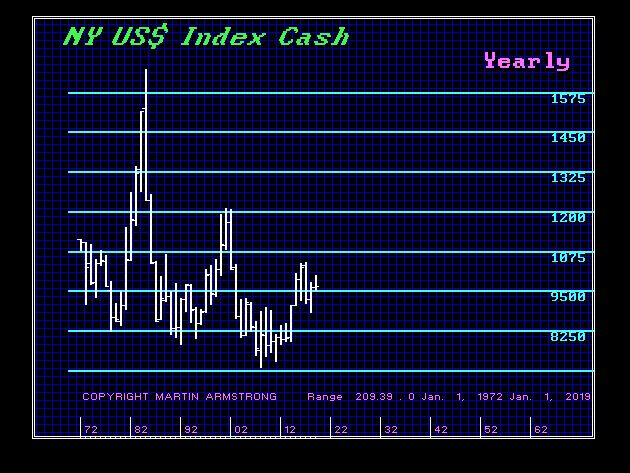
QUESTION: You said the Dollar Index is not valid because it was based on trade 30 years ago. I seem to recall you had your own index. Would you explain the difference and how has this performed lately?
Thank you
GF
ANSWER: The index we use is based, not on trade, but capital flows. To reflect the world rather than just a microcosm, we include 14 currencies compared to the trade-skewed Dollar Index that was crafted back in March 1973, which includes:
Euro (EUR), 57.6% weight
Japanese yen (JPY) 13.6% weight
Pound sterling (GBP), 11.9% weight
Canadian dollar (CAD), 9.1% weight
Swedish krona (SEK), 4.2% weight
Swiss franc (CHF) 3.6% weight
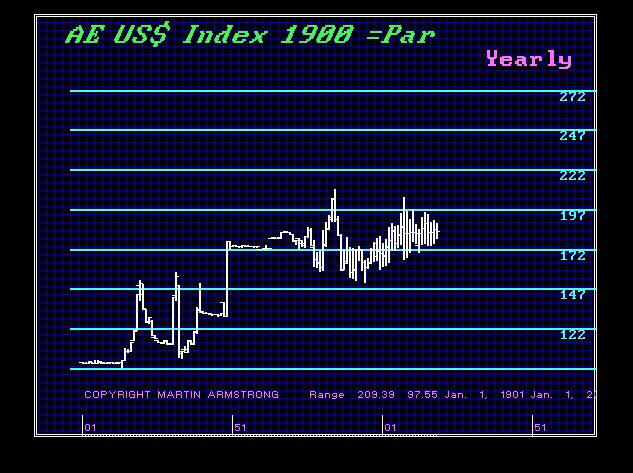
The Dollar Index we created is based on capital flows rather than trade. Our base year of 1900 equals 100. The countries included:
Australia Dollar
Brazil Real
British Pound
Canadian Dollar
China Yuan
Europe Euro
Japanese Yen
Mexico Peso
Norway Krone
Russia Ruble
Singapore Dollar
South Korea Won
Swiss Franc
Thailand Baht
We can see that the dollar is consolidating. When we look at the dollar from a broader perspective, the trend becomes much clearer.
Re-posted from Just The Facts By James D. Agresti June 10, 2020
Overview
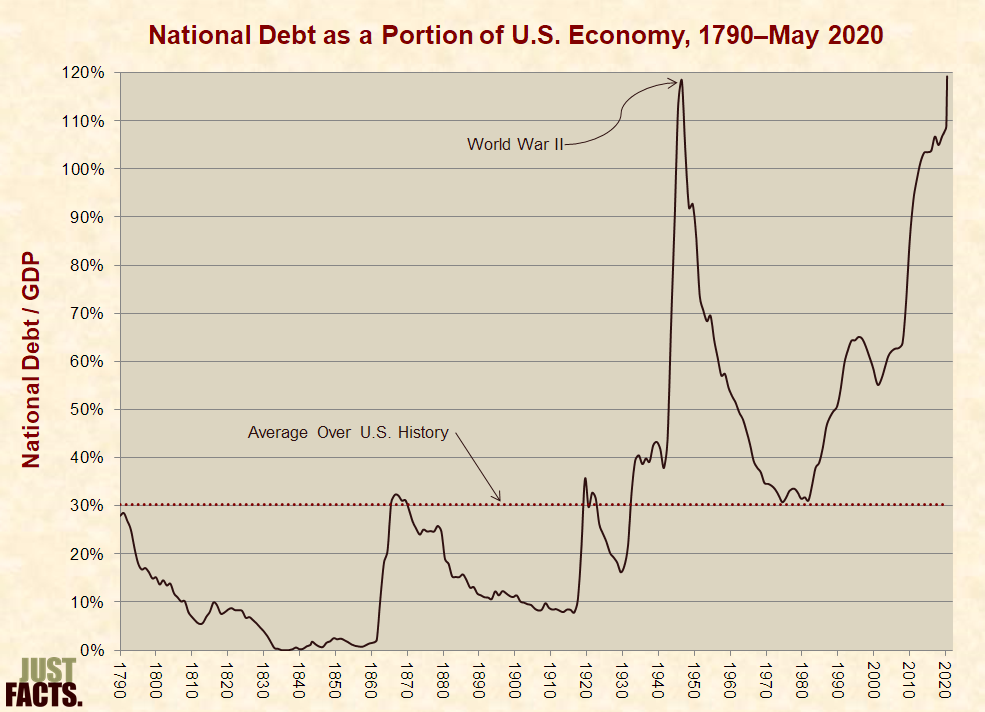
The U.S. national debt has just reached 120.5% of the nation’s annual economic output, breaking a record set in 1946 for the highest debt level in the history of the United States. The previous extreme of 118.4% stemmed from World War II, the deadliest and most widespread conflict in world history.
Today’s unprecedented debt-to-economy ratio—which is economists’ primary measure of government debt—includes $2.5 trillion in new debt since the outset of the Covid-19 pandemic. However, it doesn’t account for the vast bulk of economic damage inflicted by government-mandated business shutdowns, which will soon make the debt ratio significantly larger by decreasing its denominator. Although this decline has already begun, most of it is not yet reflected in the official data on the size of the U.S. economy.
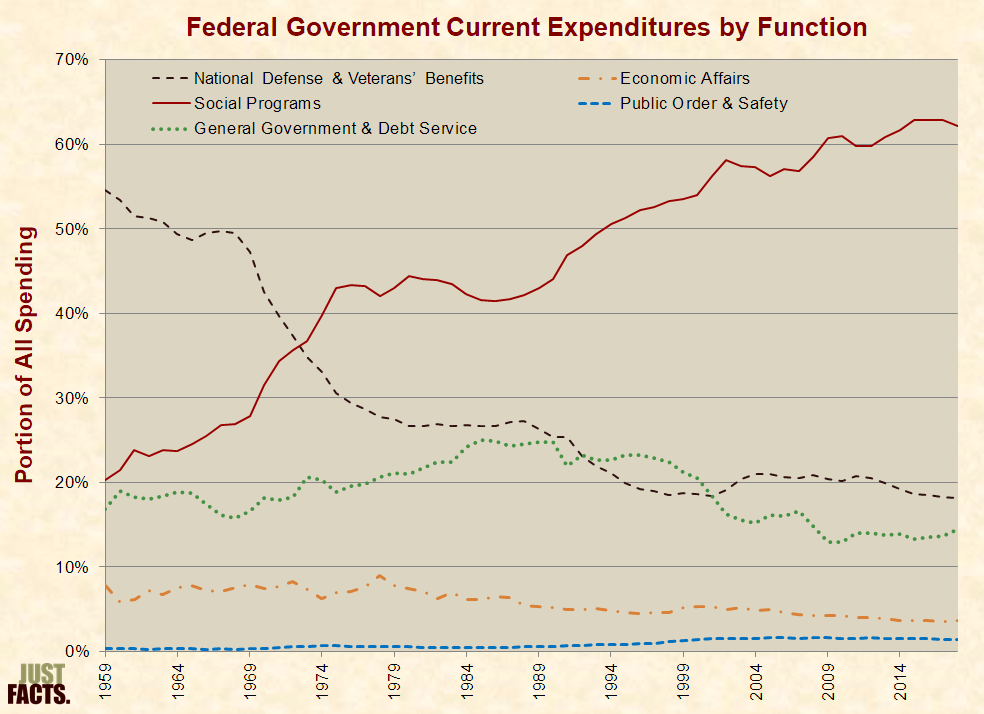
Unlike the debt from World War II—which rapidly fell once the war ended—the modern national debt has been on a steep upward path for decades. The main driver of this has been increased government spending on social programs, which grew from 20% of federal expenses in 1959 to 62% in 2018. Without substantial reforms, social spending will increase further and drive the debt to levels that dwarf the debt from World War II.
Contrary to claims that government debt isn’t a major problem, a broad range of facts show that it can have serious negative consequences, such as lower wages, weak economic growth, increased inflation, higher taxes, reduced government benefits, or combinations of such results. These, in turn, impair people’s quality of life and can reduce their life expectancy. Some of these impacts may have already begun.
Measuring the National Debt
The U.S. Treasury’s official figure for the debt of the federal government on June 8, 2020 is $25,960,547,920,986. This measure of raw debt has grown through most of the nation’s history, but it overstates the scale of debt over time because it doesn’t account for inflation, population increases, or economic growth. These factors allow governments to carry more debt with less harm than if their economies were smaller.
To adjust for such factors across nations and over time, economists and government agencies commonly measure government debt as a portion of each nation’s annual economic output, or gross domestic product (GDP). This accounts for varying population sizes, some effects of inflation, and the capacity of governments to service their debts.
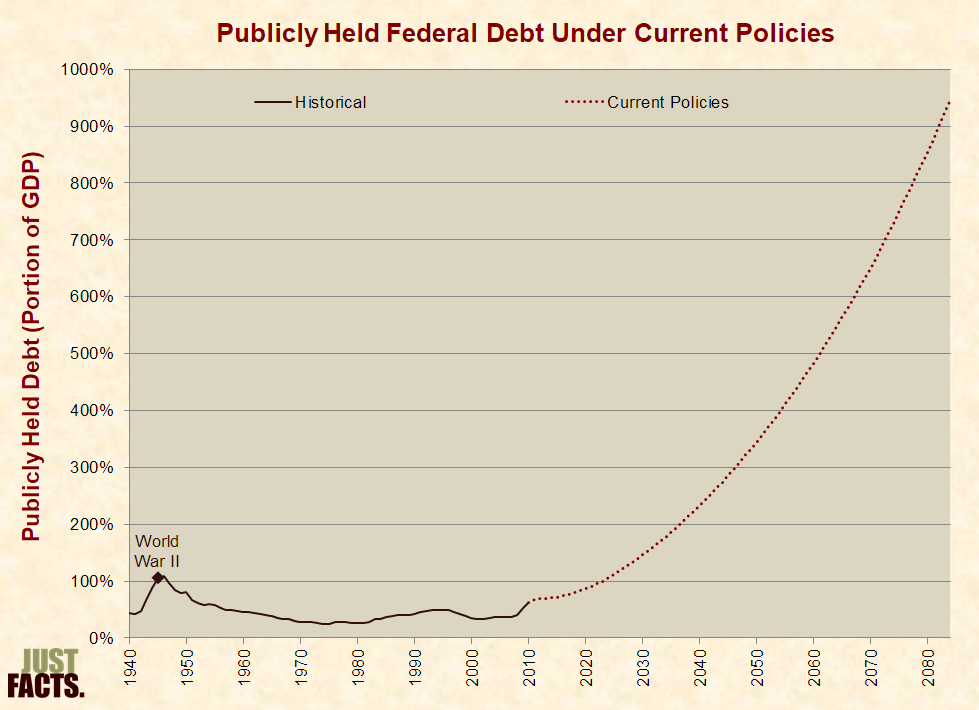
Over the course of U.S. history, the government’s debt-to-GDP ratio has averaged 30.3% and has stayed around or below this level except for a massive spike from World War II and during the modern era. The WWII record of 118.4% held for the past 74 years but was toppled on May 22, 2020 when it reached 118.5%. By the end of May, it had reached 119.5%, or four times its average over the nation’s history:
The debt continued growing in early June and reached 120.5% by the 8th day of the month. These debt-to-GDP figures are based on the latest available yearly data from the U.S. Treasury and the U.S. Bureau of Economic Analysis, the federal agency that calculates official GDP figures.
Covid-19 Responses & Impacts
From the day that the World Health Organization declared Covid-19 a pandemic (March 11) through June 8th, the U.S. national debt rose by $2.5 trillion or 11.5 percentage points of GDP. This was mainly due to:
fourfederalbillspassed to address the pandemic and buffer the economic fallouts of business shutdowns imposed by state governments. These will cost about $2.5 trillion, or an average of $19,000 for every household in the nation.
lost tax revenue from business shutdowns.
debt increases that were already baked into the federal budget for 2020.
Because the latest available GDP data is for the first quarter of 2020, and the business shutdowns didn’t begin until mid-March, they affect only half a month out of a year of data. Thus, the shutdowns have a relatively small effect on the latest annual GDP figure, reducing it by about 0.4%.
Also in response to Covid-19 and the shutdowns, the Federal Reserve created trillions of dollars in new money to purchase federal government debt and other financial assets. The effects of such policies don’t necessarily manifest in the national debt but can impact people in other ways.
Systemic Drivers
As with the recent debt increases from the Covid-19-related laws, the national debt has been mainly driven for the past 60 years by social spending, or government programs that provide healthcare, income security, education, nutrition, housing, and cultural services. These programs have grown from 20% of all federal spending in 1959 to 62% in 2018:
Under current laws and policies, the Congressional Budget Office projects that almost all future growth in debt will be due to increased spending on social programs and interest on the national debt.
Nonetheless, many media outlets and politicians have blamed the skyrocketing debt on military spending. In reality, however, military spending has plummeted from 55% of all federal expenses in 1959 to 18% in 2018. These are comprehensive figures that include standard military expenses, supplemental appropriations like those enacted for the wars in Iraq and Afghanistan, and veteran’s benefits.
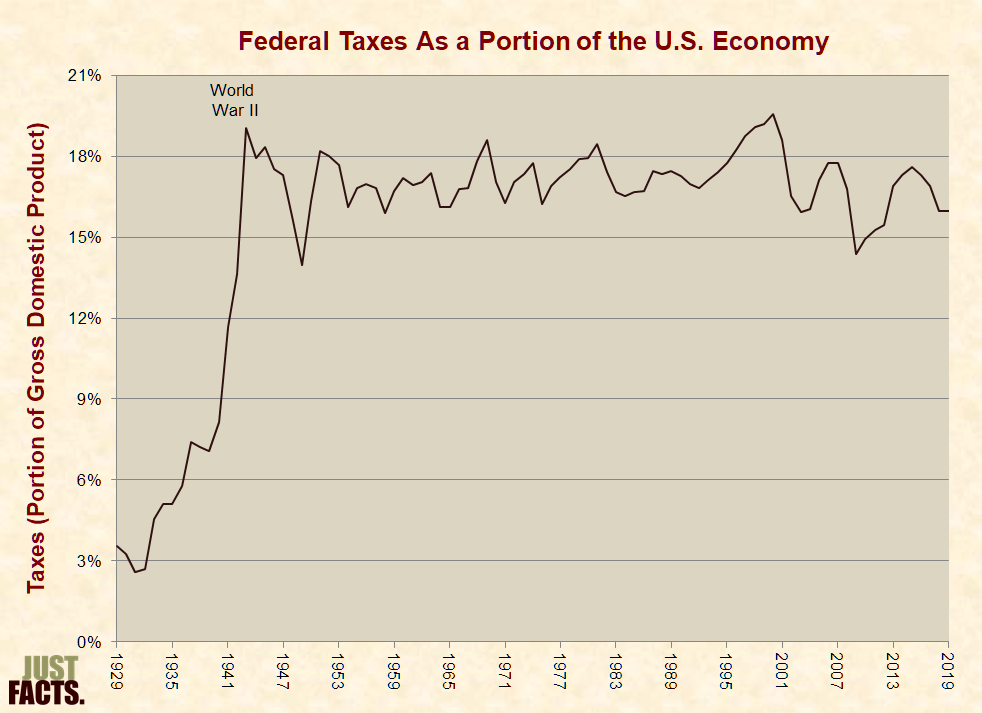
Another commonly blamed cause of debt increases is tax cuts, but the fact is that federal tax revenues have stayed roughly level as a portion of GDP for the past 80 years. They commonly declined during recessions and rebounded during recoveries, but the long-term trend has been flat since the 1940s. Before that, tax levels rose dramatically during the Great Depression/New Deal and World War II:
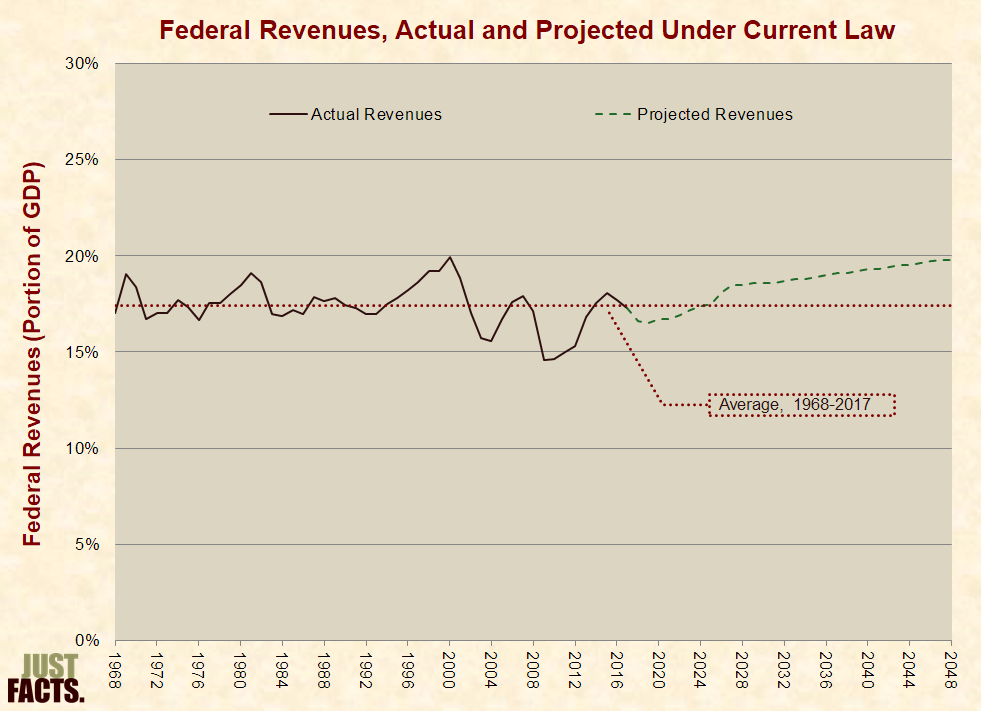
From the era of John F. Kennedy in the 1960s up through Donald Trump, various Congresses and Presidents have enacted a range of tax cuts. However, tax levels have stayed generally stable due to tax increases and a phenomenon called “bracket creep.” This automatically raises people’s tax rates over time because many tax laws are not indexed for income growth and/or inflation. Thus, if tax cuts are not periodically implemented, taxes consume a continually greater share of people’s incomes and the nation’s economy.
For instance, after the Trump tax cuts of 2017 took effect, the Congressional Budget Office projected in 2018 that the portion of the nation’s economy consumed by taxes would rise above its long-term average in several years and then continue on an upward trajectory. Part of this increase is due to the certain expiring provisions of the tax cut in 2026, but the general trend is due to bracket creep:
This comprehensive data reveals that many “tax cuts” were actually “tax evens” because they kept taxes on a relatively flat trend for more than half a century.
Failures to Consider Trajectories
Given that the debt from World War II was by a large margin the highest U.S. debt for more than 220 years, many people have pointed to it as evidence that large national debts don’t harm economies. For example, Douglas J. Amy, professor of politics at Mount Holyoke College, wrote in 2011:
“Conservatives are also wrong when they argue that deficit spending and a large national debt will inevitably undermine economic growth.”
“The best example is World War II when the national debt soared to 120% of GDP—nearly twice the size of today’s debt.”
“This spending not only got us out of the Great Depression but set the stage for a prolonged period of sustained economic growth in the 50s and 60s.”
Forebodingly, the debt exceeded that of WWII in less than a decade, but even before the Covid-19 pandemic, it was on track to grow to more than double the WWII level in the coming three decades. These facts expose the fatal flaw in Amy’s argument—the failure to consider that the WWII debt was a passing spike that plunged after the war, while the modern debt is growing rapidly due to structural issues.
The primary difference between the post-WWII era and today is again, spending. After WWII, federal spending as a portion of GDP fell by 50% within two years and averaged 41% lower than the last year of the war over the next four decades. In contrast, when Amy wrote the above, the Congressional Budget Office was projecting that under current policies and a sustained economic recovery over the next four decades:
federal spending would average 72% higher than in the four decades that followed WWII.
the publicly held debt—a partial measure of the national debt often used by the Congressional Budget Office—would rise by 277 percentage points and grow thereafter to about nine times the peak of WWII:
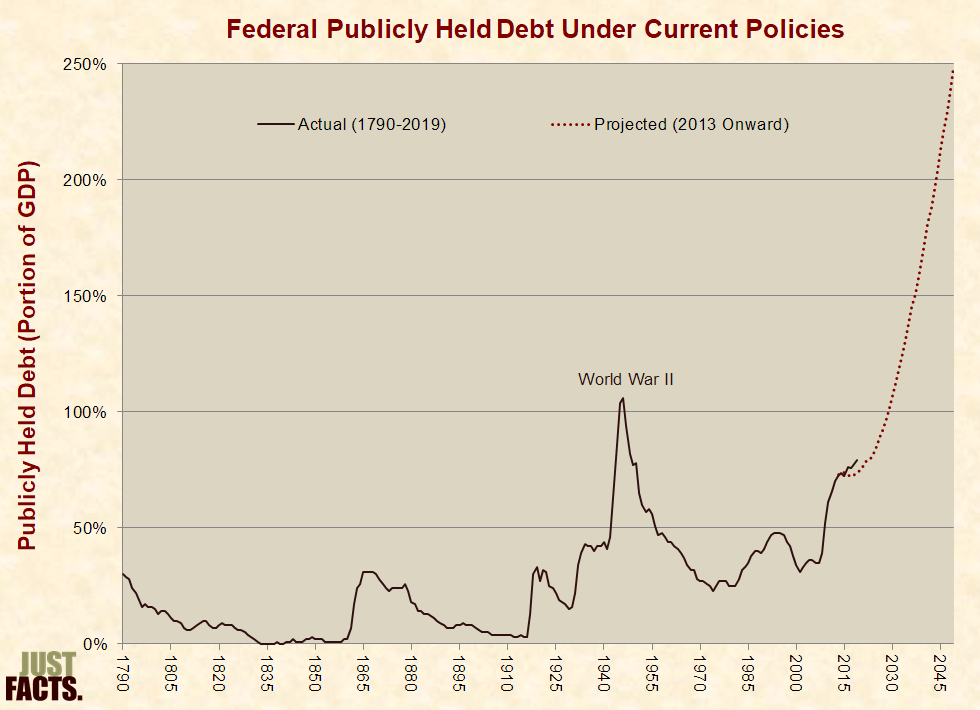
In the years following that projection, both debt and GDP outcomes were worse than predicted, and the Congressional Budget Office released a more dire projection in 2013. At that time, Barack Obama and Paul Krugman were dismissing concerns about the national debt, and David Lauter and Michael Hiltzik of the Los Angeles Times were falsely reporting that debt was falling. Six years later in 2019, the outcome was even worse than projected:
Since 2019, the debt from government responses to Covid-19 has been adding to this, thus steepening its upward trajectory.
All of this has placed the U.S. in a debt situation that is far more critical than at any time in its history. Unlike the WWII era, this is not a passing anomaly but a systemic, escalating problem driven by ongoing federal policies.
Consequences
Contrary to those who downplay the dangers of government debt, a broad range of scholarly research has documented the harm it can do:
Writing for the Brookings Institution, Alan J. Auerbach and William G. Gale explain that “sustained large deficits will reduce future national income and living standards.”
The U.S. Government Accountability Office warns that “the costs of federal borrowing will be borne by tomorrow’s workers and taxpayers,” which “may reduce or slow the growth of the living standards of future generations.”
The Congressional Budget Office reports: “Large budget deficits would reduce national saving, leading to higher interest rates, more borrowing from abroad, and less domestic investment—which in turn would lower income growth in the United States.”
In a book published by Princeton University Press, Carmen Reinhart and Kenneth Rogoff explain: “Governments can also default on domestic public debt through high and unanticipated inflation, as the United States and many European countries famously did in the 1970s.”
A 2012 paper in the Journal of Economic Perspectives documents a strong association and a likely cause-and-effect relationship between high levels of government debt and poor economic growth.
Misinforming people about those matters, numerous media outlets publicized a study said to disprove the connection between high debt and weak economic growth, but the study actually shows what previous studies had found: GDP growth decreases by an average of about 30% when government debt exceeds 90% of GDP. The authors of the study, however, buried this data on the 10th page of their paper and wrote a deceitful overview, which the media parroted.
The consequences of government debt are not merely potential dangers that might occur at some point in the future. They may, in fact, have already begun. Although association does not prove causation, the national debt has risen dramatically over past decades, and with this, the U.S. has experienced episodes of historically poor growth in GDP, productivity, and household income. These could cause a host of negative impacts on human welfare in areas like education, nutrition, healthcare, and life expectancy.
Some people point to Japan, which has a debt-to-GDP ratio of around 200%, as evidence that high national debts are harmless. They claim that Japan has not suffered like Greece (which underwent a debt crisis in 2009) because Japan and other nations that have their own currencies “can never run out of money to pay back what they owe, since they can always print what they need as a last resort.”
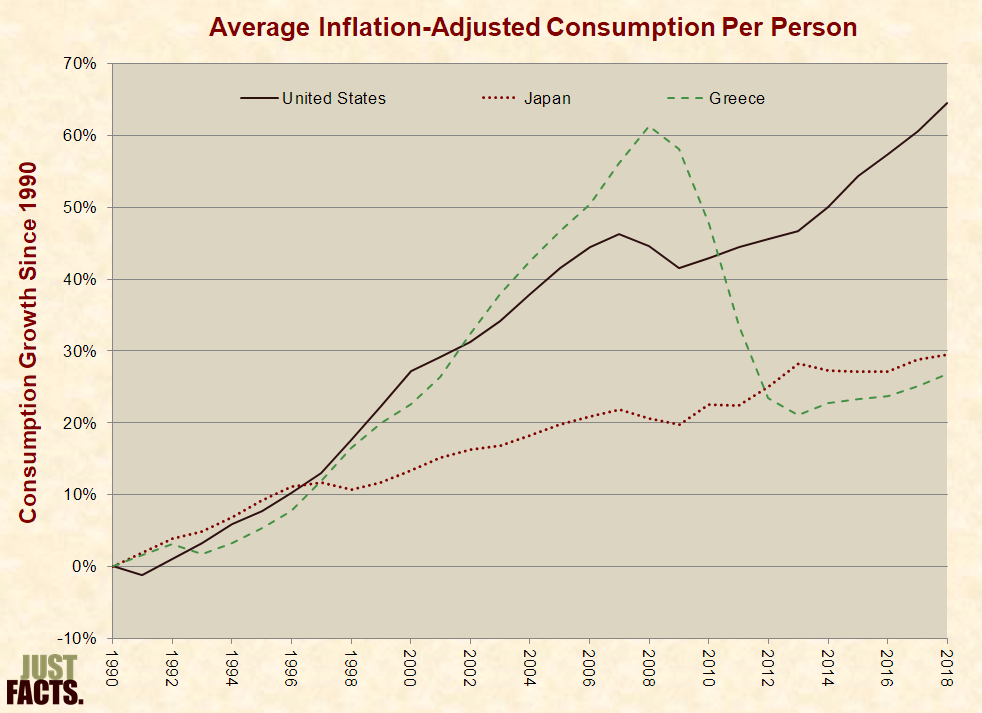
In reality, Japan has fared as poorly as Greece when measured by the World Bank’s “preferred“ indicator of human welfare, which is people’s consumption of goods and services. The difference is that Japan has experienced long-term sluggish growth in its living standards as its debt has surged, while Greece endured a sudden collapse in living standards when its debt bubble burst. Ultimately, they ended up in about the same place:
Again, association does not prove causation, so these data don’t prove that Japan’s or Greece’s economic woes were caused by debt, but they do debunk the notion that Japan hasn’t suffered like Greece. Japan’s situation may even be worse than Greece’s, for if debt has played a role in Japan’s long-running slump, it is more difficult for citizens to understand this and hold politicians accountable for their actions. Hence, the harmful effects continue.
While some people imagine that governments can borrow with abandon without hurting people, one of the most established laws of economics is that there is no such thing as a free lunch. The prolific economist William A. McEachern explains why this is so:
There is no free lunch because all goods and services involve a cost to someone. The lunch may seem free to you, but it draws scarce resources away from the production of other goods and services, and whoever provides a free lunch often expects something in return. A Russian proverb makes a similar point but with a bit more bite: “The only place you find free cheese is in a mousetrap.”
If this unpatriotic conduct continues, millions of Americans will not support such “great disrespect for our Country and our Flag” and these “woke” leagues will get their just deserts
It might be time for patriotic Americans to discover a new favorite sport, professional hockey. Unlike other professional athletes, hockey players have refused to show disrespect toward the National Anthem. At exhibition games this week, all players with the New York Rangers, New York Islanders, Pittsburgh Penguins and Philadelphia Flyers stood for the National Anthem.
Likewise, for Thursday night’s start of the season, all the players with the Dallas Stars and the Nashville Predators stood for the National Anthem. After the game, a few of the Dallas players displayed their clothing featuring the slogan, #WeSkateforEquality.
The NHL is allowing players to support whatever cause they want for the upcoming season
The NHL is allowing players to support whatever cause they want for the upcoming season. Such advocacy is fine, part of our 1st Amendment rights of free speech. However, it is respectful for NHL players to advocate their causes on their own time and not during the playing of the National Anthem.
Unfortunately, such a message is anathema to the National Basketball Association. This league has won the title for being the most “woke.” In their Orlando “bubble,” the NBA painted “Black Lives Matter” next to the basketball court.
At Thursday night’s opening game between the Utah Jazz and the New Orleans Pelicans, every single player, coach, and referee knelt during the National Anthem. For good measure, all the players wore a “Black Lives Matter” shirt. Some raised their fist in a “Black Power” salute. Almost all the players wore social justice messages on their jerseys.
The NBA is fully onboard with the organization Black Lives Matter, despite the well-known Marxist training of the group’s founders. The leaders of the organization have also expressed support for policies which are both anti-family and anti-Semitic. Clearly, it does not matter to the NBA.
In the first three games of the NBA’s renewed season, only one player, Jonathan Isaac of the Orlando Magic, refused to kneel during the playing of the National Anthem. In addition, he did not wear a “Black Lives Matter” shirt. According to Isaac, “I felt like I wanted to take a stand. I feel like we all make mistakes but I think that the Gospel of Jesus Christ is grace for us and that Jesus came and died for our sins…and that when we understand this, we can get past skin color.”
The NBA considers itself to be an international league and is not concerned if it affiliates with the country posing the greatest threat to the national security and health of the United States
Isaac should be commended for his courageous stand. Unfortunately, he plays basketball for a league that is complicit with human rights abuses occurring in communist China. Why would the NBA care about the radical ideology of Black Lives Matter when it refuses to condemn the brutal communist regime in China?
A new ESPN report asserts that players as young as 13 are being physically abused and denied adequate education by coaches at NBA training academies in China. The anonymous coaches who were interviewed for the report claim that the NBA told them to cover-up the abusive behavior.
This communist dictatorship is very influential within the NBA, which profits handsomely from the relationship. Thus, no criticism of communist China is allowed. In October, when Houston Rockets General Manager Daryl Morey tweeted a message of support to the young people fighting oppression in Hong Kong, the NBA forced him to apologize.
The leading star of the NBA, LeBron James, stated that Morey was “misinformed or not really educated on the situation.” Of course, Morey knows much more about “the situation” than James, who has never issued one negative comment toward China, a country that represses ethnic and religious minorities and is engaged in outright hostile and belligerent behavior toward the United States.
The NBA considers itself to be an international league and is not concerned if it affiliates with the country posing the greatest threat to the national security and health of the United States. It is well known that communist China lied about the origins and spread of Covid-19, which has become a worldwide pandemic.
While other professional sports leagues do not share the NBA’s disgusting position toward communist China, they do share a commitment to showcasing their social justice credentials
While other professional sports leagues do not share the NBA’s disgusting position toward communist China, they do share a commitment to showcasing their social justice credentials. In the opening games of the new Major League Baseball season, players knelt before and during the playing of the National Anthem. In addition, when the NFL starts their season in September, fans can expect almost all the players to kneel during the National Anthem as well.
This type of behavior certainly upsets traditional Americans. In a recent CBS News poll, a majority of Americans over the age of 65 opposed kneeling during the National Anthem. Nonetheless, in other age groups, there was more approval of the controversial gesture. Overall, 58% of Americans supported the right of athletes to kneel during the National Anthem.
This behavior is not acceptable to President Trump. Last week, he tweeted, “Looking forward to live sports, but any time I witness a player kneeling during the National Anthem, a sign of great disrespect for our Country and our Flag, the game is over for me!” This view was also expressed by Mike Ditka, former NFL broadcaster, coach, and Hall of Fame player with the Chicago Bears. He said that players who kneel during the National Anthem should “get the hell out of the country.”
Trump and Ditka might not speak for a majority of Americans, but if the 42% who are disgusted by kneeling decide to no longer watch the NFL and other professional sports with such protests, it will negatively impact ratings, which will ultimately devastate the financial bottom line for the leagues. If this unpatriotic conduct continues, millions of Americans will not support such “great disrespect for our Country and our Flag” and these “woke” leagues will get their just deserts.
Chopper pressers are the best pressers. On his way to Texas, President Trump stopped for a brief press conference with the media prior to departure. [Video and Transcript]
[Transcript] THE PRESIDENT: Good morning. We have a lot of things going on. As you know, we’re heading out to Texas right now.
But Portland — I’ll give you a little report on Portland: We have the courthouse very well secured. Our people have done a fantastic job. You hear all sorts of reports about us leaving. We’re not leaving until they’ve secured their city. We told the governor, we told the mayor: “Secure your city.” If they don’t secure their city soon, we have no choice — we’re going to have to go in and clean it out. We’ll do it very easily. We’re all prepared to do it.
So, in Portland, they either clean out their city and do the job and get rid of the anarchists and agitators, which is what they are. They’re not protesters; they’re anarchists and agitators. We have many in jail. Many of them have been put in jail. It’s going to be a long sentence. They either clean out their city and do it right, or we’re going to have to do it for them.
On CARES, I think — maybe, Steve, would you like to say something on that?
SECRETARY MNUCHIN: Well, as of now, we’re very far apart. And because of that, the President and we have discussed a short-term extension to UI and the evictions so that we have some period to negotiate before this runs out. And the President is very (inaudible).
THE PRESIDENT: We want to work on the evictions so that people don’t get evicted. We’ll work on the payments for the people. And the rest of it, we’re so far apart, we don’t care. We really don’t care. We want to take care of the people. The Democrats aren’t taking care of the people. The payments aren’t enough. The payments aren’t enough. You understand that. They’re not making the payments; they’re not making them high enough. The Democrats are not taking care of the people. Nancy Pelosi takes care of herself, but she doesn’t take care of anyone else.
If you look at what’s going on with Schumer: So when Schumer and Pelosi can get together and take care of the people, we’ll do something. In the meantime, we ought to stop evictions because that expires very soon. So we want to stop the evictions.
Q How do you rate Kamala Harris as a VP? There’s a rumor it’s going to be her.
THE PRESIDENT: I think she’d be a fine choice, Kamala Harris. She’d be a fine choice.
Q Sir, you said you want to pass a short-term bill? A short-term bill. Are you saying you want to pass a short-term bill?
THE PRESIDENT: I don’t hear a word you’re saying.
Q Mr. President, are you saying you want to pass a short-term bill?
SECRETARY MNUCHIN: Well, we’re looking at a deadline, obviously, of this Friday. The President is very focused on evictions and unemployment. And if we can’t reach an agreement by then, the President wants to look at giving us more time to negotiate this.
THE PRESIDENT: We’re focused on those two things. We want to take care of them now. The rest, we can discuss later. They want big bailout money for Democrats that ran cities terribly. Their cities are going down the tubes. If you look at Portland, if you look at what’s going in Seattle — Democrat-run cities, whether you like it or not, they’re terribly run, and they’re always over-taxed. So they’ve taxed them too much and they run them poorly. And we don’t like that.
And what the Democrats want are bailout funds, and what we want is we want to take care of people. And we should reward most of this country that’s well run. You know, most of the country is very well run. You’re watching a Portland and you’re watching Seattle. You’re watching New York, where they had a 400 percent increase in crime. Four hundred percent. My city that I love, that I left to do this job, and they had a 400 percent increase, and it’s unacceptable.
But most of the country is very well run, and Republican cities are very well run. And it’s a shame to reward badly run, radical-left Democrats, with all of this money that they’re looking for, for cities — to throw it away on cities that are poorly run.
Q Are you confident that Russia did not place bounties on U.S. troops?
THE PRESIDENT: I don’t — I told you, I certainly read about it, and since then, I’ve talked about it. Colin Powell says it’s not true. Colin Powell is not exactly somebody that I’m a big fan of. Colin Powell says it’s not true. Other people say it’s not true.
If it were true, I’d be very angry about it. But if you look at Russia, Russia became Russia from the Soviet Union because of Afghanistan. They lost a fortune and a lot of people — a lot of people.
So I don’t know why they’d be doing it. But if you tell me they’re doing it, I will certainly take that under consideration.
Q How would you respond if Russia did turn out to have done that? How would you respond? Would you do sanctions?
THE PRESIDENT: I would respond appropriately. Nobody has been tougher on Russia. Nobody has been tougher on China. Nobody has been tougher on Iran than me, and it’s not even close. And everybody knows this. Nobody has been tougher on Russia, China, or anybody else than me, including our allies — NATO, who I got to pay $140 billion more money — $140 billion. You know what that is?
Q A lot of money.
THE PRESIDENT: And you know why? That’s to hold Russia in check, all right? I did Russia no favor. Nobody has been tougher on Russia than I am.
Q Mr. President, on NATO, you just gave the order to remove U.S. troops from Germany. How does that keep Russia in check?
THE PRESIDENT: Well, Germany is delinquent. They haven’t paid their fees. They haven’t paid their NATO fees. And they’re way off, and they’ve been off for years, and they have no intention of paying it. And the United States has been taken advantage of on trade and on military and on everything else for many years, and I’m here and I’ve been straightening it out.
But Germany owes billions and billions of dollars to NATO. And why would we keep all of those troops there? And now Germany is saying it’s bad for their economy. Well, it’s good for our economy. Germany is delinquent. They’re at 1 percent. They should be at 2 percent. And actually, everybody should be at 4 percent, not 2 percent, because 2 percent is too low. But they’re at 1 percent, and they’ve take advantage of us for many years.
And you think that’s bad? They take worse advantage on trade. And I was all set to fix that, and then we got hit with the China plague. But we’ll be fixing it.
And a guy like Biden — this country wouldn’t have a chance. With Biden, our country wouldn’t have a chance.
Go ahead.
Q In terms of China, they closed our consulate in Chengdu. Are you planning a response for that move by China?
THE PRESIDENT: No, we’ll see what happens. That’s all right. We’ll see what happens.
Q Are you dropping the demand for FBI money — the FBI building?
THE PRESIDENT: So the FBI building — they’ve been trying to build a new building for many years — many, many years. They were thinking about going very far away, but you have to be near the Justice Department. You don’t want to be too far away, where they have to drive for an hour, hour and a half — because they had a site way out in Virginia, way out in Maryland. And I said, “The best place is right where it is. It’s the best piece of property in Washington.” I’m very good at real estate.
So I said, “We’ll build a new FBI building.” Let’s build a new FBI building — either a renovation of the existing, or even better would be a new building. So we have that in the bill. It should stay. People have wanted a new FBI building now for 15 or 20 years.
Q But Republicans don’t want it in the bill.
THE PRESIDENT: Then Republicans should go back to school and learn. They need a new building. It’s a bad building. It’s a dangerous building. You have slabs falling off. It’s not a good building from the inside, and it’s a very expensive building. They need a new building, and we can do it very easily. To me, it would be very — super (inaudible). I would make sure you build a great building at a fraction of the cost, and they can have it done quickly. So the FBI building is not new; this is something they’ve been talking about for many, many years, for decades.
Q Mr. President, on TikTok, how close are you to making a decision about banning TikTok?
THE PRESIDENT: We’re looking at TikTok. We’re thinking about making a decision. We’re going to be watching the hearings today very closely, because there is no question that what the big tech companies are doing is very bad.
SECRETARY MNUCHIN: Let me just also add on that: CFIUS — TikTok is under CFIUS review, and we’ll be making a recommendation to the President on it this week. So we have lots of alternatives.
Q Do you regret tweeting about that doctor, Mr. President? Do you regret tweeting about that doctor yesterday?
THE PRESIDENT: Regret what?
Q Stella Immanuel, the doctor — do you wish you had not retweeted that?
THE PRESIDENT: I was very impressed with her and other doctors that stood with her. I think she made sense, but I know nothing about her. I just saw her on — you know, making a statement with very respected doctors. She was not alone. She was making a statement about hydroxychloroquine with other doctors that swear by it. They think it’s great. So she was not alone.
Fake news CNN made it like, “Oh, I said this, I said that.” She was with a whole group of people. And you ought to tell your network the reason their ratings are so bad is because the coverage is so false. If CNN would be honest — and that goes for MSDNC also. But your network is so dishonest in its coverage on just about everything, and there’s an example.
I was very impressed by her. Know nothing about her; I had never seen her before. But certainly you can put her up and let her have a voice. So what they did is they took down their voice. Now, they seem to never take down the other side. They only take down conservative voices. It’s a shame.
And with hydroxy, all I want to do is save lives. I don’t care if it’s hydroxy or anything else. All I want to do is save lives. If we can save lives, that’s great.
Now, one thing: We’re doing very well on vaccines and very well on therapeutics. So that’s very important. But I happen to be a believer in hydroxy. I used it. I had no problem. I happen to be a believer. Many, many people agree with me. A great test just came out from the Ford clinic in Michigan — very respected. We’ll see how it is.
Q Mr. President, have you decided how you’re going to give your convention acceptance speech yet?
THE PRESIDENT: Well, I’m thinking about it, but we’re picking a location. Fairly soon we’ll let you know.
Q It won’t be here at the White House? It’ll be somewhere in —
THE PRESIDENT: Might be. It’s something we’re thinking about.
Q Back to Germany: Are those troops — what signal does it send to Russia? Those troops were always there to defend Europe against Russia.
THE PRESIDENT: You’re right. They’re there to protect Europe; they’re there to protect Germany. Right? And Germany is supposed to pay for it. Germany is not paying for it. So why should we leave them if they were not — we don’t want to be the suckers anymore.
The United States has been taken advantage of for 25 years, both on trade and on the military. We are protecting Germany. So we’re reducing the force because they’re not paying their bill. It’s very simple: They’re delinquent. Very simple. And there are other NATO countries also.
Right now, you have 8 out of the 28 countries that have paid up. I got them to pay $130 billion a year more, going up to $400 [billion]. Most of them will be up to date. It wasn’t easy. But most of them will be up to date. The one that won’t be up to date is Germany. And we spend a lot of money on Germany. They take advantage of us on trade, and they take advantage on the military, so we’re reducing the force. Now, if they start paying their bills, I could rethink about — I would think about it.
Yeah.
Q Did you talk to Russia about a coronavirus vaccine?
THE PRESIDENT: We talked to Putin about a lot of different things, mostly —
Q About a vaccine?
THE PRESIDENT: — arms control. We’re working on a vaccine. I think we’ll have one. Oxford is doing very well. Pfizer is doing very well. We have a lot of good options.
Q They said Russia was trying to steal information about a vaccine from researchers. Did you talk to them about that?
THE PRESIDENT: You’re going to have to talk up. I can hear everybody but you.
Q Can you come right here?
THE PRESIDENT: I can hear everybody but you.
Q Can you come right here?
Q On arms control, did you make progress? Are there going to be formal negotiations?
THE PRESIDENT: Yeah. There already are. We’re — we’re in formal negotiations with Russia on arms control — meaning, on nuclear arms control.
Q What about bringing China in?
THE PRESIDENT: We’ll talk about that later. We’re going to work this first and we’ll see. China right now is a much lesser nuclear power — you understand that — than Russia. Right now, we are the great nuclear power. We’ve upgraded our nuclear tremendously since. We have the most power. Russia is second and China is third. China is surging; they’ll be there at some point. And, yeah, we would want to talk to China eventually. Yes. Okay?
Q Why not as part of a trilateral negotiation? Does China not want to be involved?
THE PRESIDENT: We thought that we would do it first. I don’t know if it’s going to work out. But we would do it first and then we go to China together. Okay? Which, I think, works out probably better.
Q Did you talk to O’Brien? Did you talk to Robert O’Brien?
THE PRESIDENT: I did. I wished him well. I haven’t seen him in a while —
Q Why not?
THE PRESIDENT: — but he went on vacation. He came back, he wasn’t well. He tested positive. He’s doing very, very well.
Q Why haven’t you seen him lately?
THE PRESIDENT: He said he’s doing very well. I spoke to him yesterday.
Q Mr. President, are you concerned about reports that a lot of Americans wouldn’t accept a vaccine? And what could the administration do —
THE PRESIDENT: No, I’m not — I’m not concerned. Well, I’m a therapeutic person, too, you know, to be honest. I love the idea of therapeutics, where you go in, you give somebody a transfusion or a shot, and they get better. I am a big therapeutic person. But we’re doing very well on vaccines and therapeutics. Okay?
And as far as Portland is concerned, we’ve taken a very strong stand. They are anarchists. They’re radical, crazy people. And they’re either going to straighten it out for themselves — Portland, the police — and maybe if the state gets involved; that means the governor and the mayor. But they’re very weak people. They’re very weak people. These radicals, these anarchists are controlling the governor and this mayor.
The mayor went into a rally — it wasn’t accurately reported by CNN, by NBC. The mayor went into a rally. He thought he’d be their buddy. They excoriated him. They excor- — what they did to him was incredible. Lucky he had five bodyguards. But they excoriated him.
NBC — I didn’t see CNN because I don’t watch CNN. NBC absolutely covered it like he was their big buddy. No, he was in great danger of dying. He would have been dead if he didn’t have his bodyguards.
These are bad people. These are anarchists. They’re agitators. And either they do something or we’re going to do it.
In the meantime, our purpose there is only to protect our federal buildings, which we’re doing with no problem. I mean, they’re nasty and they’re vicious people, but our people are very powerful people. Very powerful.
And either they’re going to clean up Portland soon or the federal government is going up and we’re going to do it for them. So either they clean out Portland — the governor and the mayor, who are weak — either they clean out Portland or we’re going in to do it for them.
In the two months since George Floyd was killed by a white Minneapolis police officer, the world has changed significantly. For example, major businesses in America are fully onboard with the Black Lives Matter (BLM) movement as almost 300 top corporations have pledged support for the cause. These corporate leaders have been joined by all the professional sports franchises and political leaders of both parties have expressed solidarity with BLM.
Any expression of “All Lives Matter” has been deemed to be racist. For example, a Sacramento Kings broadcaster lost his job for tweeting “All Lives Matter.” In New Orleans, a Mardi Gras krewe captain faced intense criticism and the defection of members and bands from her parade for issuing a similar message online. A New Orleans area teacher was fired because her husband admitted to painting “We All Matter” and other non-racist slogans on his fence. It seems clear that in the politically correct climate today, everyone must express support for BLM or face a withering backlash.
The problem is that the BLM organization was founded by individuals who admitted to being “trained Marxists”
The problem is that the BLM organization was founded by individuals who admitted to being “trained Marxists.” Of course, all Americans should oppose individuals advocating an ideology that threatens our constitutional republic and our capitalist economic system.
Karl Marx is the founder of communism, a system of government that survives by fully destroying the freedom of its citizens. People living in communist countries have no human rights and exist only to serve the all-powerful state. Today, communist governments endure in North Korea, Vietnam, Laos, Cuba, and China.
All these countries repress their people and deprive them of basic freedoms such as the right to speak, assemble, petition, and practice their religious faith. These barbaric practices have existed in all communist nations since the overthrow of the Czar in Russia in 1917 and the eventual formation of the Soviet Union. Since that time, communist dictators have killed at least 100 million innocent people throughout the world.
Unfortunately, the media does not allow any mention of the Marxist origins of BLM or any criticism of the organization. Any courageous critics will be labeled a racist. Understandably, most people fear being given such a label, so they will refuse to give their honest opinion and just appease the mob to protect their job and their family.
The stampede to support BLM has been seen in every sports league over the last few months. Americans used to be able to enjoy sporting events without being lectured about their political beliefs. It used to be a nice diversion from the pressures of everyday life. Unfortunately, those days are long gone. Today, sports are just one more area of life that has been overtaken by social justice warriors.
The NBA has painted Black Lives Matter next to their court in the “bubble” in Orlando. The NFL has expressed support and will play the “Black National Anthem” prior to the National Anthem during the first week of games this season. In Major League Soccer, players raised their fist and knelt in support of BLM at the opening of their season.
The acceptance of this Marxist group has been especially apparent in Major League Baseball. Members of the Cincinnati Reds and San Francisco Giants knelt during exhibition games. In Boston, the Red Sox just unveiled a massive Black Lives Matter billboard right outside of Fenway Park.
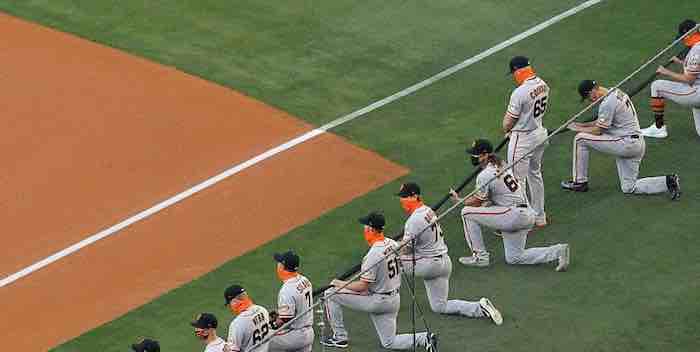
On Thursday night, before the opening game of the season, all the players with the New York Yankees and Washington Nationals knelt before and during the National Anthem. However, in the San Francisco Giants game against the Los Angeles Dodgers, all the players knelt prior to the National Anthem, except one lonely “Christian.”
The player who refused to kneel was Giants relief pitcher Sam Coonrod, a true hero. In an interview after the game, Coonrod explained his refusal to join his teammates by claiming that he “can’t kneel before anything besides God.”
Such a courageous stand needs to be applauded. Usually, a player, such as Saints Quarterback Drew Brees, who expresses support for standing for the National Anthem, will cave after strong criticism. Eventually, Brees and his wife apologized multiple times.
Coonrod took the road less traveled. He explained his opposition to BLM by noting “I’m a Christian, like I said, and I just can’t get on board with a couple of things that I have read about Black Lives Matter. How they lean towards Marxism and they have said some negative things about the nuclear family. I just can’t get on board with that.”
Fortunately, Gabe Kapler, the manager of the Giants, supported Coonrod’s decision. He said that players were going to be able to “express themselves.” He also noted “We were going to give them the choice on whether they were going to stand, kneel, or do something else. That was a personal decision for Sam.”
This “personal decision” is quite exceptional in the environment we live in today. Congratulations to a rare breed indeed, a player who truly stands alone.
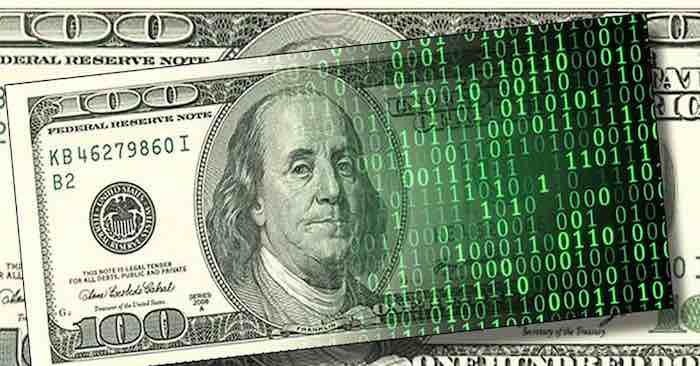
Money greases the wheels of exchange, and thus makes the whole economy more productive. The idea that everything should be cashless is problematic for so many reasons. Bartering is a good under certain circumstances and societies, but it relies on what Keynesian economists call a “double coincidence of wants,” making it less desirable than cash.
Cash is easier because it is a convenient medium of exchange, sometimes free from government prying eyes, a unit of account for quoting prices, and a store of value as long as the trust in government is not eroded and inflation is low.
From the people’s perspective, cash is freedom
Cash is lightweight, can have large denominational value, does not spoil, and is thus better than commodity money, i.e., cigarettes, bullets, chocolate, jewelry, gold coins, pelts, furs, soap, etc.
From the government’s perspective, it is easy to see why they would want a cashless society. Banning cash under the guise of it being infected by disease, of controlling money laundering of criminals and drug lords, and routing all of our income, every last penny through the banking system helps them better control everything we do, freezing accounts at will, while taxation becomes so much easier, including payments to Obamacare insurance and any financial penalties an individual is required to pay. It enables governments to track with 100 percent accuracy everything we buy and sell, everything we own, and everything we do.
From the people’s perspective, cash is freedom, but the leftist mainstream media is attacking it with pathetic excuses such as cash is physically dirty, expensive, potentially criminal, and obsolete 19th century technology, happily promoting the “war on cash.”
The media’s opposition sees the “war on cash” as another form of population control when people’s accounts can be raided and their owners classified as potential domestic terrorists, or denied healthcare, travel, education, and other services if they are marked with a “digital star.”
The issues with a cashless society are too many to mention them all:
Cashless Global Currency
Total control by the state or its proxy
Savings could result from not using special paper, printing, ink, labor, and metal alloys but then those in the trade would become unemployed
If an attack occurs on the Smart Grid and there is no power, there are no financial transactions possible without some cash, a substitute, or barter
In the event of a national disaster, i.e., earthquake, tsunami, hurricane, tornado, power outages, transactions can be made by cash, commodity money, or barter
An EMP attack or intense solar flares would make cash or one world currency worthless and people will resort to theft
A cashless or global currency would give banks extraordinary power with no cap on interest rates or their control
Cashless transaction will always be traceable and thus the person’s location
One world currency in a cashless market would eliminate exchange rates, currency trading futures, eliminate a substantial sector of the job market and thus revenues
Black markets and illegal activities would be eliminated, and everyone will be forced to pay taxes on every penny
Children under 18 would be excluded from holding credit cards and thus excluded from financial transactions without cash; no more grandma cash gifts, lawn mowing money, or rainy-day cash savings in a jar
Prostitution will have to be legalized and client’s names become public record
Billions of Muslims would lose hawala transactions which are based on cash
Conducting monetary policy about money stock will be altered as cash disappears and one world government such as the U.N. would have to do it
Labor will be purchased and sold with electronic credits and debits
How would the value of one world currency be decided? Will it be tied to gold, silver, platinum, or some other precious metal or decided arbitrarily by the United Nations?
The destabilization of economies via counterfeit currency between countries would be eliminated as a tactic of war if only one currency exists
What would cyber attacks do to a single grid of digital money?
What would happen to third world nations that are not so electronically wired and depend heavily on cash and barter? How could they possibly make transactions in digital money?
I have created this site to help people have fun in the kitchen. I write about enjoying life both in and out of my kitchen. Life is short! Make the most of it and enjoy!
This is a library of News Events not reported by the Main Stream Media documenting & connecting the dots on How the Obama Marxist Liberal agenda is destroying America










 Centinel2012
