Secretary Rex Tillerson Discusses North Korea and Pending U.S. Talks Between President Trump and Kim Jong-Un…


During a press availability with Djiboutian Foreign Minister Mahamoud Ali Youssouf U.S. Secretary of State Rex Tillerson was asked about the recent stunning developments between the U.S. and North Korea. The Q&A segment is outlined below:

QUESTION: Thank you so much. Mr. Secretary, for months you’ve been saying that conditions are not yet right for talks with North Korea, and that you would know it when you saw it. Less than 24 hours ago, that was still your position. What changed in the last 24 hours that gave the Trump administration confidence that now is the right time? Can you explain the logic behind starting this process, talks about talks, as you’ve described it at the level of the leaders of the country? And did you know when you made those comments yesterday that this meeting was in the works?

SECRETARY TILLERSON: With respect to talks with North Korea versus negotiations – and I think this seems to be something that people continue to struggle with the difference. My comments have been that we’re – the conditions are not right for negotiations, but we’ve been saying for some time we are open to talks.

President Trump has said for some time that he was open to talks and he would willingly meet with Kim Jong-un when conditions were right and the time was right. And I think in the President’s judgment, that time has arrived now. So there’s no – in my comments yesterday, I was indicating comments about negotiations, but we’ve been open for talks for some time.

In terms of the decision to engage between President Trump and Kim Jong-un, that’s a decision the President took himself. I spoke to him very early this morning about that decision and we had a good conversation. This is something that he’s had on his mind for quite some time, so it was not a surprise in any way, because I think this has long been something. He’s expressed it openly before about his willingness to meet with Kim Jong-un.

So now, I think it’s a question of agreeing on a timing of that first meeting between the two of them and a location, and that will take some weeks before we get all that worked out. So no surprise.

We know that there’s been a lot of discussion, and you’ve been reading about it too through the intra-Korean dialogue. We also had been having contacts back and forth with them, as you’re well aware, through channels that we have had open for some time. And I think this was the most forward-leaning report that we’ve have had in terms of Kim Jong-un’s, not just willingness, but his strong desire for talks.

So I think it was really – what changed was his posture in a fairly dramatic way that, in all honesty, was a – came as a little bit of a surprise to us as well that he was so forward-leaning in his conversations with the delegation from South Korea. (LINK)

Victor D Hanson; (NEW) A Thorough Explanation of California’s Failing Utopian Vision


Welcome to California….! It is a state of a perfect set of laws – at least in the minds of those wedded to the legislative pursuit of social justice. Under the one-party Democrat rules, spending on fairness tops $100 billion every year. Meanwhile, the basic infrastructure of the state, so necessary for the economy long and short term, is collapsing.

Hating God


You know something’s wrong when people are publicly villified for offering prayers. Do we really want a godless America?

Crossing the Rural/Urban Divide


American cities are seeing a massive influx of renters and a decline in home ownership. What does this mean for the traditionally suburban Republican party?

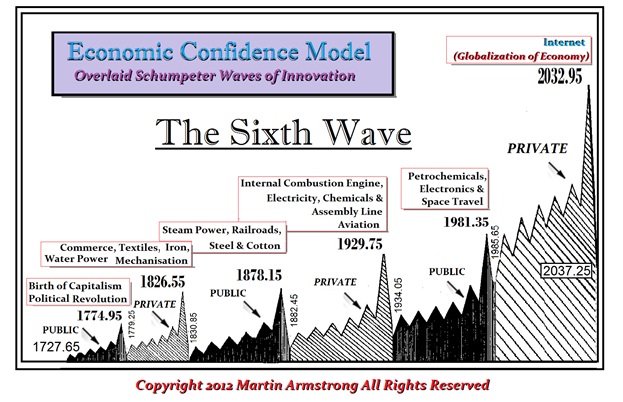
The Economic Confidence Model & Why there are 6 waves


QUESTION: Dear Mr. Armstrong,

Firstly – sorry to hear about the passing of your mother.
Secondly – thank you very much for reading and answering questions.
My question – what is the significance of the six repetitions in the ECM? Six 8.6 years make a cycle and six of these make a larger cycle and then six of these make a super-cycle. Why six? Why not five or seven? Can you explain the significance?
Thank you
g
ANSWER: The Economic Confidence Model is actually a three-dimensional wave structure. The volatility is a different frequency and that is what determines the number of 8.6-year waves for this is building in intensity. What you get at the end of these 51.6-year waves is very profound. After the 1774.95 peak, we end up with a revolution against the monarchy. The next wave peak in 1826.55 Russo-Persian War, 1826-1828, Greek War of Independence, Battle of Monte Santiago between Brazil and Argentina, Mexican Constitution is formed, the Maryland Democratic Party begins creating the confrontation between the Democrats and Republicans (South v North), and even Thomas Jefferson and John Adams both died on the 4th of July 1826 (1826.50) whereas the peak of the wave was July 19th. The next wave 1878 saw the Long Depression which was called the “Great Depression” until 1929-1932. Then the next wave was 1981.35 which marked the peak in interest rates even to the day. The next one will be 2032 and this will be followed by the shift from the West to the East in economic power.

Super-MAGA-Nomics: A Trade and Policy Discussion With Secretary Wilbur Ross….


It’s always a superMAGAnomic day when we get to hear Commerce Secretary Wilbur Ross talk shop.  Two interviews today means extra doses of winnamins are needed to help digest all the winning.

Wilburine begins with Fox Business Charles Payne talking trade and NAFTA:

.

Secretary Ross also appeared on Bloomberg to talk with the pearl-clutching Brits:

U.S. Commerce Secretary Wilbur Ross discusses possible negotiations with several countries over exclusions to President Donald Trump’s tariffs on steel and aluminum, the effect of the tariffs on the U.S. economy, and the exit of Gary Cohn from the White House. He speaks to Bloomberg’s Julia Chatterley on “Bloomberg Markets.”

.

Republic Steel Announces Recommission of Lorain Ohio Steelworks – Hundreds of Jobs Scheduled To Return….


Excellent news for the community of Lorain, Ohio, where it was announced today that Republic Steel has plans to recommission at least one blast furnace by the end of this year. They are also estimating the possibility of putting a second blast furnace back on-line due to production forecasts as a result of President Trump’s steel and aluminum tariffs.

Lorain Pig Iron is beginning the process to start the mill’s Blast Furnace 4,  by working with contract service providers to submit proposals for the recommissioning.  Since 2015 over 1,000 workers in Lorain were laid off.  BF4 has been dormant since 2016 when the remaining 200 steelworkers were laid off.

If Republic Steel fires up two blast furnaces (BF3 and BF4) at this ironworks, over 1,000 jobs could be created depending on the number of shifts each day.  100 to 200 jobs per shift, per furnace, equals 300 – 600 jobs per furnace/24 hrs.  That’s a tremendous economic lift to the people living in/around Lorain, Ohio. Great news.

LORAIN, OHIO — Two of the blast furnaces at Republic Steel on East 28th Street could be up and running by the end of this year.

According to a news release, Lorain Pig Iron LLC, or LPI, is beginning the process to start the mill’s Blast Furnace 4, or BF4, by working with technical service providers to review and submit proposals for the recommissioning.

In restarting BF4, the company would be able to produce and distribute 1 million tons of pig iron annually.

LPI, which is jointly owned and operated by Republic and Minnesota-based ERP Iron Ore LLC, also is evaluating starting up the mill’s Blast Furnace 3, or BF3, which would double pig iron production in Lorain to 2 million tons annually. (read more)

…Jobs, Jobs, Jobs

Treasury Secretary Steven Mnuchin Discusses Trade, Employment, Tariffs, China, Taxes, Debt, and “Territorial” MAGAnomics…


A very confident Treasury Secretary Steven Mnuchin appears on CNBC for a wide-ranging interview on current economic subjects. Within the discussion [14:00] Secretary Mnuchin affirms the U.S. economy is nowhere near “full employment”; an economic reality which highlights how much labor statistics were manipulated by political ideologues the prior administration(s).

Additionally, Secretary Mnuchin discusses the administrations’ focus on ‘reciprocal trade deals’ as the cornerstone of new trade constructs. This is a seismic shift in U.S. trade position. The secretary replaces the word “globalism” with a more nuanced “world-wide”; and “economic patriotism/nationalism” is replace with the word “territorial”.

Also worth noting is the larger dynamic of “intellectual property” (vis-a-vis China) and how the inherent Trump policies therein overlay trade positions between the U.S. and China. As we have previously mentioned the USTR Lighthizer 301 investigation into China could be exponentially more significant than Steel and Aluminum tariffs. Secretary Mnuchin confirms this aspect albeit with a measure of necessary opaqueness.

President of United Steelworkers Union: “Members Won’t Forget What Trump Did, He Stopped Wealth Transfer”…


Leo Gerard, the President of the United Steelworkers Union, talks to a very frustrated Chuck Todd about the effect of President Trump’s new tariffs and his appreciation therein.

Chuck Todd has all his Media Matters talking points prepared to outline his narrative; however, unfortunately for the toad, he came up against a very knowledgeable union leader with a solid grasp of the details and important specifics.  WATCH:

.

As you can see from President Leo Gerard’s comments he well understands the value of Commerce Secretary Wilbur Ross, U.S. Trade Ambassador Robert Lighthizer and administration trade strategist Peter Navarro. The next phase of MAGAnomic Main Street trade initiatives involves global “trade reciprocity” advancement.