Sunday Talks – Maria Bartiromo Trade and Tariff Discussion With Peter Navarro…


Maria Bartiromo talks about the steel and aluminum tariffs recently announced by the Trump administration along with the shifted trade perspectives of the Trump administration with White House Trade Policy Adviser Peter Navarro.

While the current trade focus centers around steel and aluminum tariffs, Mr. Navarro expands the discussion when asked about China as a trade target specifically.  Within the expanded discussion Navarro highlights U.S.T.R Robert Lighthizer’s pending 301 review of intellectual property theft by the Chinese government.

.

Regarding ‘European Union (EU) retaliation’, forget it; they won’t.

The protectionist EU hypocrites simply cannot afford to go toe-to-toe with the U.S. on trade.  The UK is in the process of formalizing their Brexit terms; the EU (essentially ‘Germany’) needs to find a way to make up for the lost revenue (billions in taxes) from the UK economy.  Currently the UK pays Brussels approximately a billion per month on a $2.5 trillion economy; that will stop.

Brexit reduces the overall EU GDP by $2.5 trillion.  German Chancellor Angela Merkel cannot -and will not- challenge President Trump.  In addition to being politically weak, Merkel has attached her economy to expansive environmental regulations (Paris treaty), though she is now attempting to pale down those regulations.  Chancellor Merkel cannot afford to run the risk of losing any access to the U.S. market.

A 25% decrease within the German auto sector alone would be enough to throw the entire nation of Germany into a recession; and functionally Germany is the EU.   President Trump holds all the leverage within the trade discussions with the EU…

…. WE ARE THE CUSTOMER in this equation.


Reality of Being a Chief Economic Advisor


QUESTION: I thank God that your are here in my lifetime. The information you freely impart is priceless and I can’t wait to read your daily Posts. I believe that it would be incredibly wise if President Trump were to invite you to replace Gary Cohen as his Chief Economic Advisor. My question is regarding the end of the Private Cycle that you are forecasting will occur in 2032. Will the change result as a demise of the US economy or the rise of the eastern economies? Do you see President Trump as a facilitator to that end or will his policies server to mitigate the process.

Thank you

Sir.

ANSWER: Well thank you very much. But you should understand what goes on behind the curtain and why I prefer this side. I was offered that job back in 1999 to be Bush Jr’s Chief Economic Advisor. I laughed and turned it down. Why? People like Gary Cohn take these jobs because they get to sell all their stock TAX-FREE. Since this would be a conflict of interest to own Goldman Sachs stock, he must sell it to take that job. Since it is something he MUST do, taxes are exempt. Plus all the politicians do not want to get Goldman Sachs angry since they donate to both sides. Therefore, Cohn gets an easy pass by the Senate.

First, we are private, not public, and I have no interest in selling the company to get a tax-free deal. Second, they would NEVER give me a pass in the Senate. I have advised the major car companies outside the USA in Japan and Germany. The Democrats would paint me as a traitor who helped foreign companies beat General Motors. The list can go on and on. So there is no way I would ever be interested in a such a job. Someone like Cohn now gets all the benefits and all he had to do is work one single day and then resign.

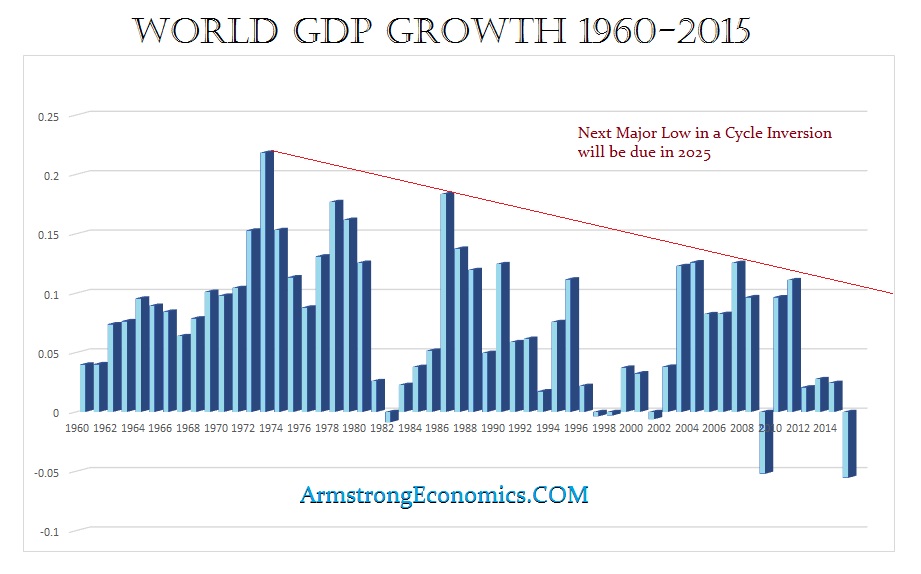
Trump is the counter-trend reaction. Reagan was the same reaction to hard economic times. You can see here that world GDP peaked in 1973. I remember the recession into 1976 very clearly. People were openly talking about another Great Depression. You get these counter-trend reactions which slow the decline down. Even Diocletian (284-305AD) instituted monetary reforms, wage, and price controls, and revised the political system creating the Tetrarchy whereby he was the first Emperor to actually retire and pass on the reigns of power. Trump will not reverse the trend. He will at best mitigate the fall during his term.

The Monetary Reform of 1857 Ends Legal Tender Foreign Coins


QUESTION: Mr. Armstrong, I found in my grandmother’s belongings a penny from 1855 and one from 1857 which was much smaller and silver in appearance. Was there also a monetary reform that changed the coinage during the 1850s?

PK

ANSWER: Oh yes. But it is far more interesting than meets the eye. Foreign coins were actually legal tender in the United States until 1857. You could pay taxes with Spanish or English coins. Everything was legal tender under the Coinage Act of 1857.

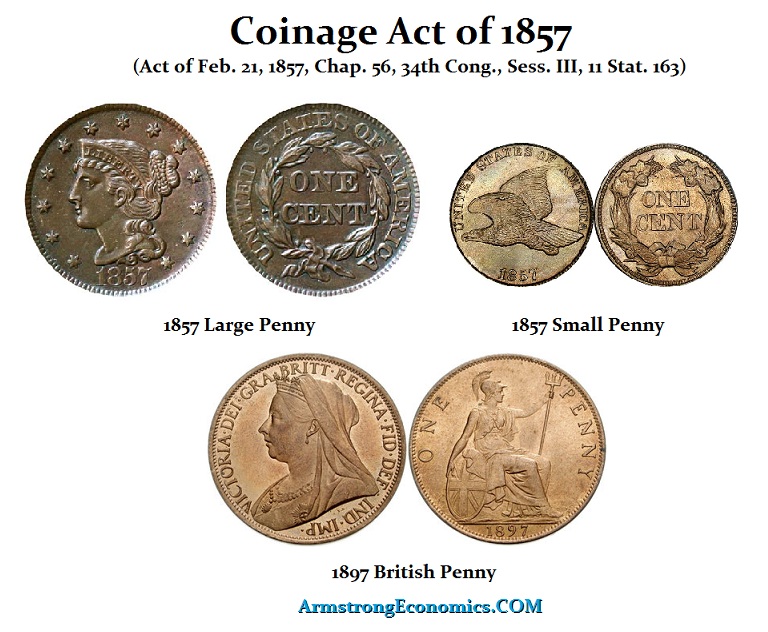
The government first proposed the penny in the Coinage Act of 1792. Pennies and half-pennies went into production for the first time in 1793 with a composition of 100% copper which weighed 13.48 grams (0.475 ounces). From 1795 to 1857, the government reduced the copper penny in size with a new weight of 10.89 grams (0.384 ounces). It was the Coinage Act of 1857 (Act of Feb. 21, 1857, Chap. 56, 34th Cong., Sess. III, 11 Stat. 163) that the coinage was radically reduced with the composition of the penny being  88% copper and included 12% nickel, which produced a silver-like appearance. The weight was reduced to 4.67 grams (0.164 ounces). By changing the metal content, they justified that this was intrinsically worth more by adding nickel to pure copper.
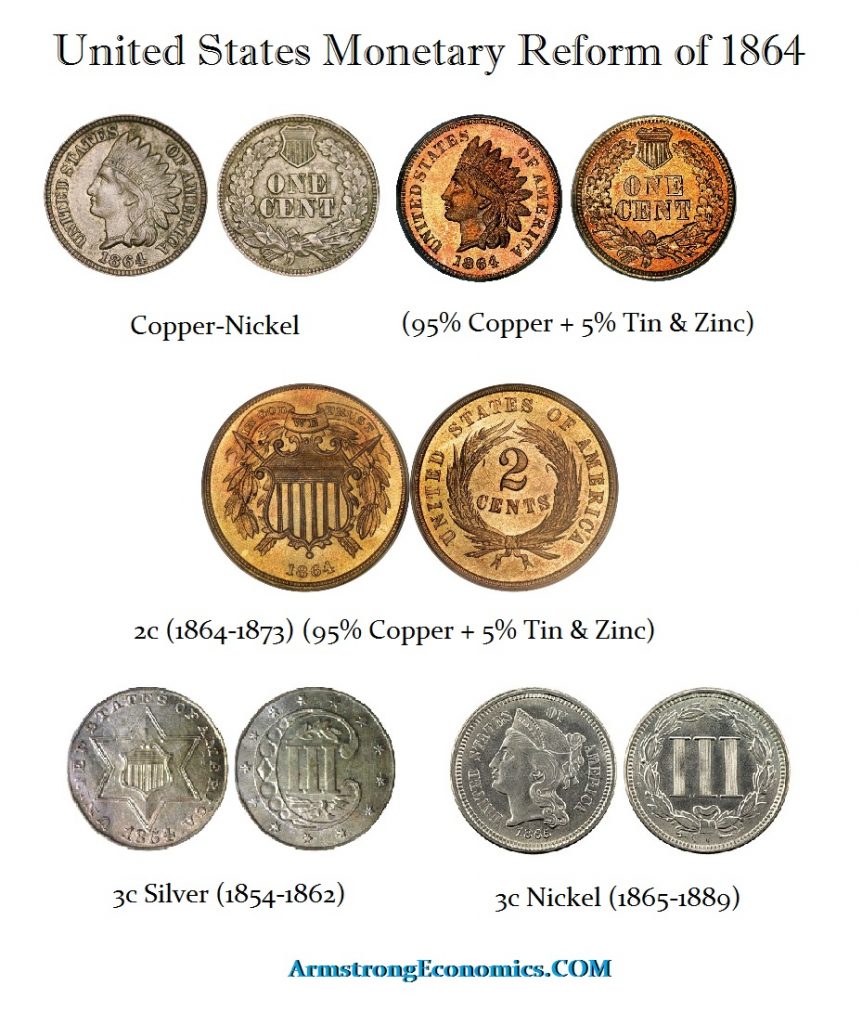
In 1864, there was another Monetary Reform following the war as inflation set in and drove the value of metals higher. The silver was really removed from the 3 cent coins were now being produced in nickel starting in 1865 and most silver coins were being melted down given the silver was worth more than the face value. It was 1864 that they introduced the two-cent coinage as well reflecting inflation. The design of the penny was the Indian Head until 1909 when they change to the portrait of Abraham Lincoln. From 1864 to 1942, the penny was redesigned penny and it now weighed 3.11 grams (0.109 ounces) and nickel was removed leaving the composition primarily of bronze (95% copper, 5% zinc and tin). In 1943, due to the war, copper rose in value so then struck pennies composed of steel zinc-coated for just one year. The steel penny weighed 2.72 grams (0.095 ounces). From 1944 to 1981, the penny was composed primarily of copper (95%) and zinc (5%), with a weight of 3.11 grams (0.109 ounces). After 1982, copper was eliminated from the penny. The composition was changed because the value of the copper in the coin was greater than one cent. From 1982, the penny became 97.5% zinc composition, which was copper plated. With the commodity boom into 2011, the cost to mint a penny became 2.41 cents. The crash in commodities reduced the cost to 1.83 cents by 2013.
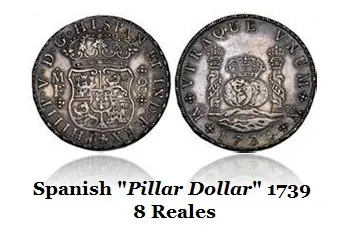
The Coinage Act of 1857 was an act of the United States Congress which ended the status of foreign coins as legal tender, repealing all acts “authorizing the currency of foreign gold or silver coins”. Specific coins would be exchanged at the Treasury and re-coined. Up until 1857, foreign coins circulated as legal tender. The Spanish 8 reals were known as a Pillar Dollar. This was the primary money supply during the Colonial period rather than British coins. In fact, the Spanish dollar was officially declared legal tender (accepted for taxes) by the Act of April 10, 1806.
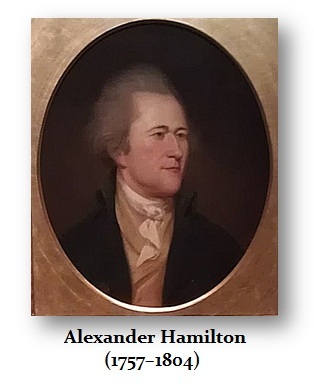
The United States following the Revolutionary War had no gold reserves. Therefore, in 1792 when the establishment of the US mint came into play, the sole medium of exchange in terms of specie was the foreign coin. Alexander Hamilton proposed that foreign coin should be allowed to circulate freely for a period of three years until the new mint in Philadelphia was running at full capacity. This clause allowing the foreign coin to circulate was renewed several times before it was formally authorized by the Act of April 10, 1806. By 1830, about 25% of all circulating coins were of Spanish origin.

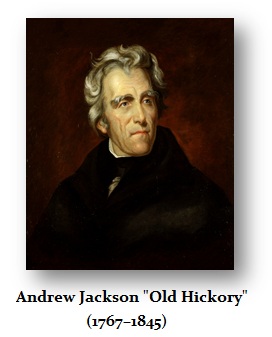
President Andrew Jackson supported foreign coin as legal tender in his famous war with the Bank of the United States in the Gold Bill. Jackson set in motion a major financial crisis as every bank began to issue their own currency. Jackson’s support of foreign coin ended up making it difficult for the US to retain its overvalued worn Spanish silver in the 1840s as they vanished from circulation and private issues appeared known as Hard Times Tokens. It was not until the early 1850s that the US mint had finally been able to match demand for the foreign coin with the production of American issues.
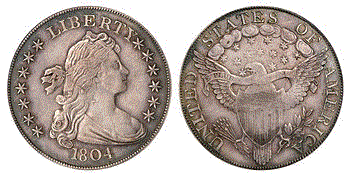
The Act of April 10, 1806, was passed because of the fact that there were no silver dollars minted by the United States at all between 1805 and 1840. In 1792, Congress adopted a bimetallic standard and the 15 to 1 ratio of silver to gold. The precious metal content of a US dollar was fixed at 371¼ grains of silver or 24¾ grains of gold. By 1795, the 15:1 ratio was under pressure because of the revolution in Paris as Gold rose against silver pushing the ratio to 15½ ounces of silver to one ounce of gold. By 1799, the ratio continued to expand reaching 15¾ ounces. This presented a huge arbitrage opportunity, so bullion dealers bought United States gold coins using Spanish silver coins and they shipped them to Europe to be melted and re-sold profiting almost 1oz of silver. The net gold capital outflow was huge and American coin was vanishing rapidly. Finally, in 1804, when Napoléon Bonaparte became emperor,  President Thomas Jefferson was forced to order the suspension of minting gold $10 eagles and silver coins. All we see are copper coins being produced at this point in time. This was the backdrop to the Act of 1806 which made all foreign coins legal tender.
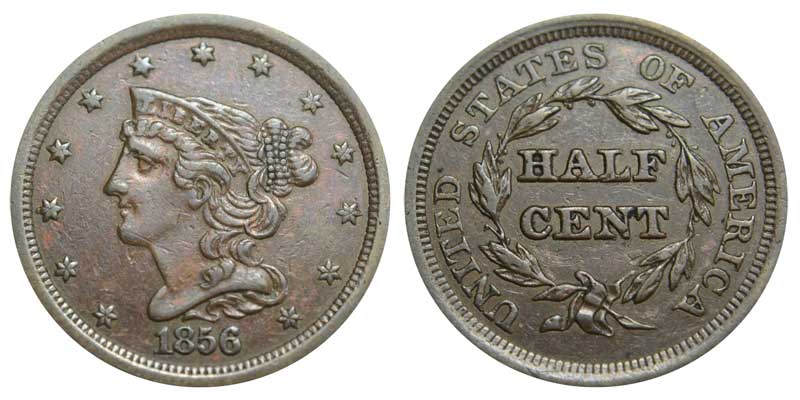
In addition to demonetizing foreign coins, the Coinage Act of 1857 also discontinued the half cent. Furthermore, the penny was reduced in size. The large cent was discontinued and regular coinage of the Flying Eagle cent began. The Act fixed the weight and measure of US one-cent pieces at 4.655 grams, which was composed of 88% copper and 12% nickel. It also mandated that this new copper/nickel alloy be received as payment for the worn gold and silver coins turned in at the mint. The effective aim was to limit the domestic money supply by crushing European competition. This was the first major step towards the government essentially having a monopoly over the money supply.

The Coinage Act of 1857 significantly altered the way American business was conducted. Since the beginning of the Colonies, businesses accepted any form of payment as long as it was made of specie. Following this Act of 1857, American business no longer accepted foreign coins and only US coins were accepted. Throughout this period, there was fierce competition among foreign exchange dealers in the United States. The ability of the US Mint to finally produce enough coinage made much of the foreign silver coinage obsolete.

White House Legislative Affairs Director Marc Short Discusses Steel and Aluminum Trade Tariffs…


White House Legislative Affairs Director Marc Short appears on Fox News to discuss the Steel and Aluminum tariffs being implemented by President Trump to protect the U.S. steel and aluminum manufacturing industry.

The Wall Street antagonists together with politicians purchased by the U.S. Chamber of Commerce and K-Street lobbyists (working on behalf of Wall Street),  have vowed to fight President Trump’s trade initiatives.   The steel and aluminum tariffs are the first in a series of trade actions by President Trump that he outlined during his candidacy.

Wall Street politicians (globalists) are now engaged in a fight against Main Street economic and trade policy (nationalists). There are trillions at stake. The anger against the President over the steel/aluminum tariffs is nothing in comparison to what lies ahead; with a likely NAFTA withdrawal and other MAGAnomic trade initiatives looming on the horizon.

Kristian Saucier Talks To Media After Receiving President Trump Pardon…


Kristian Saucier was a former Navy submariner who was arrested (age 22) for taking a photograph of his work station while on duty. He was prosecuted for the photograph as distribution of classified information. Mr. Saucier spent a year in prison for his photograph. Yesterday President Trump pardoned Mr. Saucier.

Secretary Rex Tillerson Discusses North Korea and Pending U.S. Talks Between President Trump and Kim Jong-Un…


During a press availability with Djiboutian Foreign Minister Mahamoud Ali Youssouf U.S. Secretary of State Rex Tillerson was asked about the recent stunning developments between the U.S. and North Korea. The Q&A segment is outlined below:

QUESTION: Thank you so much. Mr. Secretary, for months you’ve been saying that conditions are not yet right for talks with North Korea, and that you would know it when you saw it. Less than 24 hours ago, that was still your position. What changed in the last 24 hours that gave the Trump administration confidence that now is the right time? Can you explain the logic behind starting this process, talks about talks, as you’ve described it at the level of the leaders of the country? And did you know when you made those comments yesterday that this meeting was in the works?

SECRETARY TILLERSON: With respect to talks with North Korea versus negotiations – and I think this seems to be something that people continue to struggle with the difference. My comments have been that we’re – the conditions are not right for negotiations, but we’ve been saying for some time we are open to talks.

President Trump has said for some time that he was open to talks and he would willingly meet with Kim Jong-un when conditions were right and the time was right. And I think in the President’s judgment, that time has arrived now. So there’s no – in my comments yesterday, I was indicating comments about negotiations, but we’ve been open for talks for some time.

In terms of the decision to engage between President Trump and Kim Jong-un, that’s a decision the President took himself. I spoke to him very early this morning about that decision and we had a good conversation. This is something that he’s had on his mind for quite some time, so it was not a surprise in any way, because I think this has long been something. He’s expressed it openly before about his willingness to meet with Kim Jong-un.

So now, I think it’s a question of agreeing on a timing of that first meeting between the two of them and a location, and that will take some weeks before we get all that worked out. So no surprise.

We know that there’s been a lot of discussion, and you’ve been reading about it too through the intra-Korean dialogue. We also had been having contacts back and forth with them, as you’re well aware, through channels that we have had open for some time. And I think this was the most forward-leaning report that we’ve have had in terms of Kim Jong-un’s, not just willingness, but his strong desire for talks.

So I think it was really – what changed was his posture in a fairly dramatic way that, in all honesty, was a – came as a little bit of a surprise to us as well that he was so forward-leaning in his conversations with the delegation from South Korea. (LINK)

Victor D Hanson; (NEW) A Thorough Explanation of California’s Failing Utopian Vision


Welcome to California….! It is a state of a perfect set of laws – at least in the minds of those wedded to the legislative pursuit of social justice. Under the one-party Democrat rules, spending on fairness tops $100 billion every year. Meanwhile, the basic infrastructure of the state, so necessary for the economy long and short term, is collapsing.

Hating God


You know something’s wrong when people are publicly villified for offering prayers. Do we really want a godless America?

Crossing the Rural/Urban Divide


American cities are seeing a massive influx of renters and a decline in home ownership. What does this mean for the traditionally suburban Republican party?