Posted originally on Mar 29, 2024 By Martin Armstrong
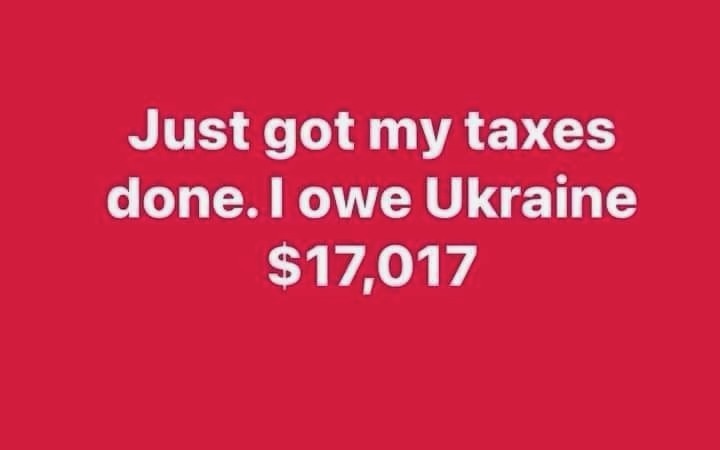
According to leaked sources, Biden’s new simplified income-tax form to fund World War III and his Proposed $7.5 trillion budget will be revised, containing only four lines:
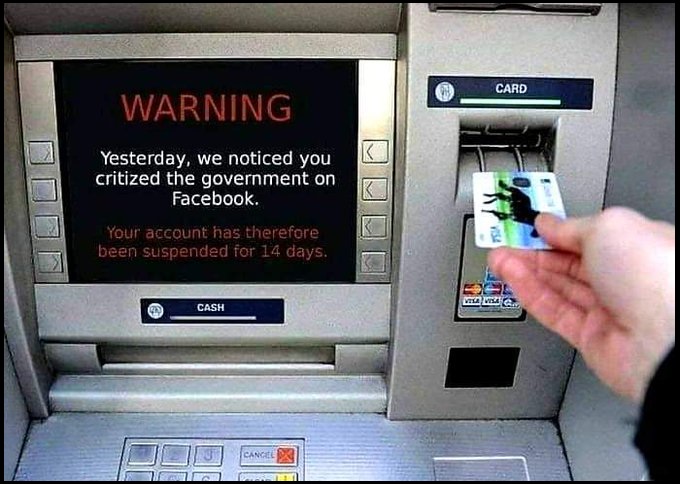
The quoted banker does not specifically talk about the Central Bank Digital Currency that lays at the end of the promoted rainbow; the author does. However, the banker does outline a familiar step in the current process. As a result, it is worth drawing attention to the continuum.
MAINE – “According to Hannigan, the COVID-19 pandemic forced businesses to implement “paper-free and virtual processes” to handle their finances while “adapting to the new reality.
“For years, Americans had been slowly moving away from cash and paper checks, but the pandemic supercharged the trend,” Hannigan wrote. “By last year, 41% said they never use cash for purchases, up from 24% in 2015, according to the Pew Research Center. Only 14% still exclusively use cash and checks.” (Read More)
There is a BIG difference between electronic funds (current), and a digital dollar (future).
Posted originally on Mar 27, 2024 By Martin Armstrong
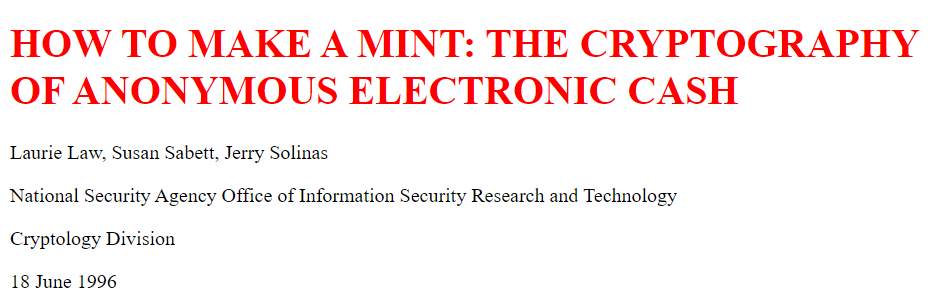
In 1996, the US government released a white paper entitled, “How to make a mint: the cryptography of anonymous electronic cash.” Released by the National Security Agency Office of Information Security Research and Technology, this document basically explains how a government agency could create something like Bitcoin or another cryptocurrency.
I encourage those interested to read the contents of the link above. This document was released during the dawn of the dot.com bubble before the technology existed to create such a currency. The NSA quickly realized that it could weaponize this technology to create a cashless society.
As explained in the introduction:
“Among the most important uses of this technology is electronic commerce: performing financial transactions via electronic information exchanged over telecommunications lines. A key requirement for electronic commerce is the development of secure and efficient electronic payment systems. The need for security is highlighted by the rise of the Internet, which promises to be a leading medium for future electronic commerce.

Electronic payment systems come in many forms including digital checks, debit cards, credit cards, and stored value cards. The usual security features for such systems are privacy (protection from eavesdropping), authenticity (provides user identification and message integrity), and nonrepudiation (prevention of later denying having performed a transaction) .

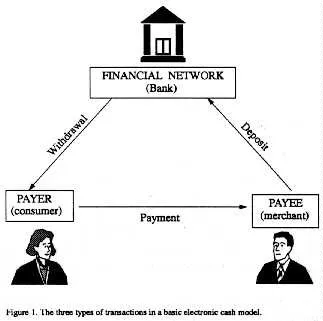
The type of electronic payment system focused on in this paper is electronic cash. As the name implies, electronic cash is an attempt to construct an electronic payment system modelled after our paper cash system. Paper cash has such features as being: portable (easily carried), recognizable (as legal tender) hence readily acceptable, transferable (without involvement of the financial network), untraceable (no record of where money is spent), anonymous (no record of who spent the money) and has the ability to make "change." The designers of electronic cash focused on preserving the features of untraceability and anonymity. Thus, electronic cash is defined to be an electronic payment system that provides, in addition to the above security features, the properties of user anonymity and payment untraceability..

In general, electronic cash schemes achieve these security goals via digital signatures. They can be considered the digital analog to a handwritten signature. Digital signatures are based on public key cryptography. In such a cryptosystem, each user has a secret key and a public key. The secret key is used to create a digital signature and the public key is needed to verify the digital signature. To tell who has signed the information (also called the message), one must be certain one knows who owns a given public key. This is the problem of key management, and its solution requires some kind of authentication infrastructure. In addition, the system must have adequate network and physical security to safeguard the secrecy of the secret keys.”
The introduction goes on to discuss the reasons they could present to the public to switch to a cashless society, including money laundering, convenience, and security. “The term electronic commerce refers to any financial transaction involving the electronic transmission of information. The packets of information being transmitted are commonly called electronic tokens,” the paper continues.
The NSA states that it would like to use “user identification” and “message integrity” to protect privacy in “nonrepudiation” transactions. “Eavesdropping” concerns appear numerous times throughout the document, which could be prevented by “not just privacy but anonymity” in the form of “payer anonymity” and “payment untraceability.” The government clearly states that hard currency, cash, provided these luxuries but could not be traced by the banks and, therefore, the government.
Again, this was released in 1996 before basic online banking. The document outlines basic online banking but takes it a step further by explaining how they could seemingly make payments seem “untraceable” to the public using “blind signatures” that allegedly cannot be seen by the bank. “This step is called “blinding” the coin, and the random quantity is called the blinding factor. The Bank signs this random-looking text, and the user removes the blinding factor.”
Alice sends the blinded coin to the Bank with a withdrawal request.
Bank digitally signs the blinded coin.
Bank sends the signed blinded coin to Alice and debits her account.
Alice unblinds the signed coin.
Payment/Deposit:
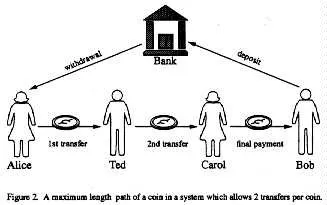
Alice gives Bob the coin.
Bob contacts Bank and sends coin.
Bank verifies the Bank’s digital signature.
Bank verifies that coin has not already been spent.
Bank enters coin in spent-coin database.
Bank credits Bob’s account and informs Bob.
Bob gives Alice the merchandise.
“This makes remote transactions using electronic cash totally anonymous: no one knows where Alice spends her money and who pays her.” Full “payment anonymity” would be “too much to ask”, thus, “we are forced to settle for payer anonymity.” In other words, the illusion that no one knows who is making the transaction.
PROTOCOL 5:Off-line cash.
Withdrawal:
Alice creates an electronic coin, including identifying information.
Alice blinds the coin.
Alice sends the blinded coin to the Bank with a withdrawal request.
Bank verifies that the identifying information is present.
Bank digitally signs the blinded coin.
Bank sends the signed blinded coin to Alice and debits her account.
Alice unblinds the signed coin.
Payment:
Alice gives Bob the coin.
Bob verifies the Bank’s digital signature.
Bob sends Alice a challenge.
Alice sends Bob a response (revealing one piece of identifying info).
Bob verifies the response.
Bob gives Alice the merchandise.
Deposit:
Bob sends coin, challenge, and response to the Bank.
Bank verifies the Bank’s digital signature.
Bank verifies that coin has not already been spent.
Bank enters coin, challenge, and response in spent-coin database.
Bank credits Bob’s account.
Note that, in this protocol, Bob must verify the Bank’s signature before giving Alice the merchandise. In this way, Bob can be sure that either he will be paid or he will learn Alice’s identity as a multiple spender.
The government begins to explain basic blockchain concepts, or at least how they’d like them to occur.
“When Alice spends her coins with Bob, his challenge to her is a string of K random bits. For each bit, Alice sends the appropriate piece of the corresponding pair. For example, if the bit string starts 0110. . ., then Alice sends the first piece of the first pair, the second piece of the second pair, the second piece of the third pair, the first piece of the fourth pair, etc. When Bob deposits the coin at the Bank, he sends on these K pieces.

If Alice re-spends her coin, she is challenged a second time. Since each challenge is a random bit string, the new challenge is bound to disagree with the old one in at least one bit. Thus Alice will have to reveal the other piece of the corresponding pair. When the Bank receives the coin a second time, it takes the two pieces and combines them to reveal Alice's identity…

Zero-Knowledge Proofs. The term zero-knowledge proof refers to any protocol in public-key cryptography that proves knowledge of some quantity without revealing it (or making it any easier to find it). In this case, Alice creates a key pair such that the secret key points to her identity. (This is done in such a way the Bank can check via the public key that the secret key in fact reveals her identity, despite the blinding.) In the payment protocol, she gives Bob the public key as part of the electronic coin. She then proves to Bob via a zero-knowledge proof that she possesses the corresponding secret key. If she responds to two distinct challenges, the identifying information can be put together to reveal the secret key and so her identity.”

The document then discusses ways to blind the signature, so that the payee may remain anonymous. Now, why would the government allow that to occur? “Even in anonymous, untraceable payment schemes, the identity of the multiple-spender can be revealed when the abuse is detected. Detection after the fact may be enough to discourage multiple spending in most cases, but it will not solve the problem. If someone were able to obtain an account under a false identity, or were willing to disappear after re-spending a large sum of money, they could successfully cheat the system.”
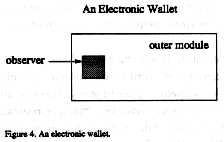
The document even discusses what we now would refer to as a crypto wallet. A seemingly safe offline method to store these electronic coins. They explain that at least one party must always reveal their hand. “When a coin is spent, the spender uses his secret to create a valid response to a challenge from the payee. The payee will verify the response before accepting the payment. In Brands’ scheme with wallet observers, this user secret is shared between the user and his observer. The combined secret is a modular sum of the two shares, so one share of the secret reveals no information about the combined secret.”
Who is the “observer” in this scenario? “An observer could also be used to trace the user’s transactions at a later time, since it can keep a record of all transactions in which it participates. However, this requires that the Bank (or whoever is doing the tracing) must be able to obtain the observer and analyze it. Also, not all types of observers can be used to trace transactions.”
In the event that a transaction was compromised, the bank would have to change its secret key and “INVALIDATE ALL COINS.”
The authors explain that tax evasion, per usual, is the key concern. They mention money laundering and “old crimes such as kidnapping and blackmail” as reasons to allow backdoor entry. Restoring traceability was a proposed solution, and if they could restore traceability in the first place, one must question if the payments were ever truly anonymous. Using Alice as their example, they explain that they could simply issue a warrant and track all her payment history. “Back~ard traceability is the ability to identify a withdrawal record (and hence the payer), given a deposit record (and hence the identity of the payee). Backward tracing will reveal who Alice has been receiving payments from.”
So, while the bank only sees the deposit in encrypted form, the public key must be used for withdrawal. “The ability to trace transactions in either direction can help law enforcement officials catch tax evaders and money launderers by revealing who has paid or has been paid by the suspected criminal. Electronic blackmailers can be caught because the deposit numbers of the victim’s ill-gotten coins could be decrypted, identifying the blackmailer when the money is deposited.”
“In conclusion, the potential risks in electronic commerce are magnified when anonymity is present. Anonymity creates the potential for large sums of counterfeit money to go undetected by preventing the identification of forged coins. Anonymity also provides an avenue for laundering money and evading taxes that is difficult to combat without resorting to escrow mechanisms. Anonymity can be provided at varying levels, but increasing the level of anonymity also increases the potential damages. It is necessary to weigh the need for anonymity with these concerns. It may well be concluded that these problems are best avoided by using a secure electronic payment system that provides privacy, but not anonymity.”
The US government released this document in 1996, 27 years ago. Bitcoin was allegedly anonymously created in 2009, and numerous other blockchain-based payment coins have followed. This, paired with the push for CBDC, where the government simply does not need to pretend payments are anonymous, should make one question the security and longevity of cryptocurrencies.
Posted originally on Mar 26, 2024 By Martin Armstrong
When questioned about the future of Social Security by the Senate Finance Committee, Treasury Secretary Janet Yellen admitted that Biden “doesn’t have a plan.” There could be no possible plan for an ongoing Ponzi scheme that will fail once the fund runs out of money.
Estimates believe Social Security will reach insolvency before 2034. “I don’t have that computation to offer you,” before saying, “The president doesn’t have a plan. He has principles.” Principles do not put food on the table.
Of course, lawmakers immediately look at raising our taxes. “I’ll note that there’s already been $4.9 trillion in new taxes proposed for those making over $400,000 a year. It seems to be the go-to place, fill in the blank, we’re going to tax those over $400,000 a year for whatever,” Sen. Bill Cassidy, R-La., told Yellen. “Of that $4.9 trillion, none of that has been dedicated to Social Security.” We are raising taxes to fund extravagant climate change packages and wars. None of the money we give to our government goes back into the community.
The likelihood of Social Security remaining as it is today is ZERO. There is more likely to be a huge split in interest rates from the private sector compared to the public at the federal level.
As I have stated before, I donated my time to work with Congress back in the ’90s in an attempt to reform Social Security, transforming it into a wealth fund that was allocated out among managers. I was even shuttling between the Chairman of the House Ways & Means Committee, Bill Archer, and the House Majority Leader Dick Army. I argued for the privatization of Social Security to allow it to become a wealth fund and allow it to invest in equities. The Democrats would not vote for it, so this is why Social Security today cannot survive. Social Security invests 100% in government bonds, meaning it does not even earn a fair interest rate.
The Democrats painted this private investment as “risky,” and they voted against it. So, Social Security invests 100% in government bonds. Let’s see. The Fed lowered the interest rates to “stimulate” the economy. The net effect is that Social Security is simply a slush fund with no possible economic growth. The loss has come at the “opportunity risk” of leaving the money in bonds.
I laid out the structure for allocating money according to the track record of the manager. I was doing this because I had no interest in managing money of this nature. The Democrats wanted to replace the fund managers at will when they retook the majority. I explained that this decision should not be political. I did not care if the fund manager voted Democrat or Republican. That just never sunk in. Had Social Security simply become a wealth fund as so many nations around the world have adopted, it would NOT be in danger of a financial crisis today.
Now, I do not believe they will stop paying Social Security, but they could reduce payments and continue raising the age at which recipients may receive benefits, especially since the average life expectancy for Americans is on the decline. Take Venezuela for example. They honor their pensions, but what you get today will buy only a cup of coffee. Yet another major government-created crisis that could have been avoided.
Posted originally on the CTH on March 24, 2024 | Sundance
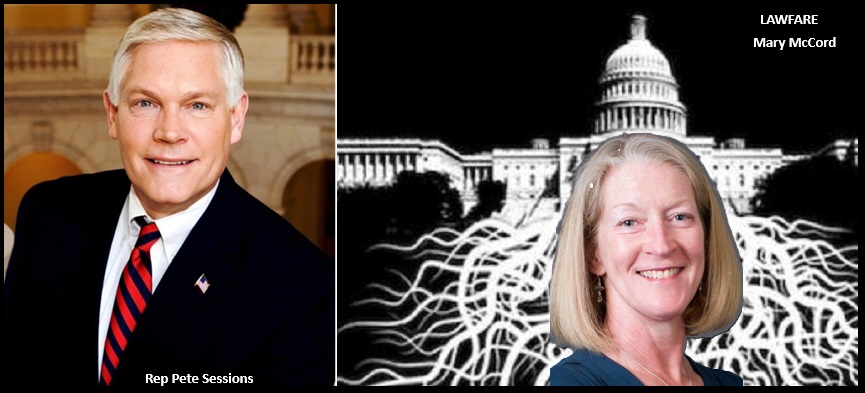
Representative Pete Sessions is Chairman of the Subcommittee for Govt Operations and the Federal Workforce within the House Oversight and Government Accountability Committee. The subcommittee has a few key Republican representatives, including Clay Higgins and Byron Donalds, who are aligned with MAGA, Donald Trump, pushback against the weaponization of our modern UniParty government – and they appear as allies in the effort to stimulate a larger awakening amid the American electorate.
As readers here are very aware, I am exceptionally frustrated with the willful blindness that permeates most of our Republican representatives. The GOP reps ignore the root causes of the problems and choose to focus on the politics of narratives. As a result, congressional hearings, soundbites, letters written etc. generate nothing that stops the weaponization of govt. Quite simply, there are specific people within the administrative state that are the core of the corrupt activity.
These deep DC embeds, bureaucrats within a system behind the politicians, are never identified, called out or held accountable by the politicians or political staff who assist the elected representatives. This is a big problem, and their willful blindness creates an outcome where the corrupt status quo continues despite grand pontifications and sternly worded letters intended to satiate the victims – We The People.
The current status is as if the politicians are afraid of the IC-assisted bureaucrats within it. This reality creates the frustration that most people feel, yet few can accurately identify. However, if we can get a few politicians to accurately identify and target some very specific and corrupt people within the deep state, then we begin a process where the weeds of corruption begin getting pulled out by their roots.
Chairman Pete Sessions (TX-CD17) appears to have taken the first step in what could be a very lengthy process of sunlight. Chairman Sessions has sent a preservation letter to Georgetown University School of Law, identifying a couple of people at the root of the problem, Rosa Brooks and Mary McCord. {SEE HERE}
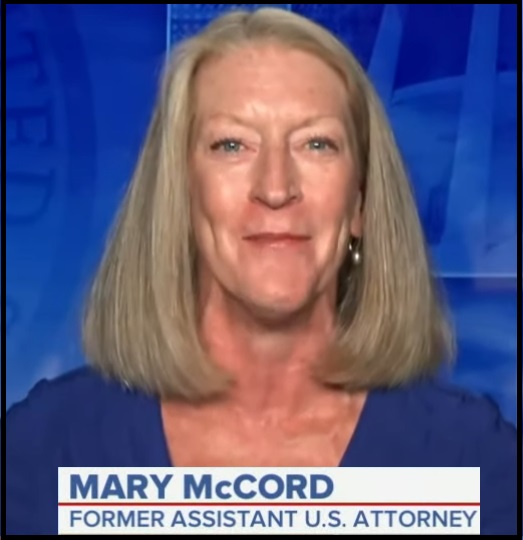
RED STATE – […] Sessions specifically singled out Professor Mary B. McCord for Brooks’ attention. McCord is now the executive director of the Georgetown University School of Law’s Institute for Constitutional Advocacy and Protections, or ICAP.
Just as Brooks is no utility player, neither is McCord.
Before McCord joined Brooks’ team at Georgetown, she was a holdover from President Barack Obama, serving in the early months of the Trump administration.
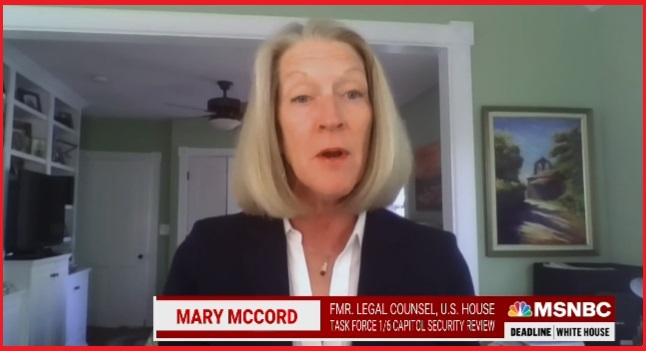
The subcommittee chairman quoted McCord in the letter from an interview she gave to NBC News, in its Jan. 14 web article, “Fears grow that Trump will use the military in ‘dictatorial ways’ if he returns to the White House.”
McCord told NBC: “We’re already starting to put together a team to think through the most damaging types of things that he [Trump] might do so that we’re ready to bring lawsuits if we have to.”
The congressman then made a request:
Please define if Professor McCord and her colleagues are conducting this hyperpartisan activity under the auspices of ICAP—an entity which is described as a ‘non-partisan institute within Georgetown University Law Center.
While both Brooks and McCord are key players within a corrupt network, it is Mary McCord who can be directly traced to the origin of every attack against President Donald Trump and his administration.
There is not a single element of the Lawfare construct targeting Donald Trump that does not trace in origination back to Mary McCord.
To give you an idea of the scope of influence of Mary McCord as a key functionary, consider what we can document.
♦ McCord submitted the fraudulent FISA application to spy on Trump campaign (2016).
♦ McCord created the “Logan Act” claim used against Michael Flynn and then went with Sally Yates to confront the White House (2017).
♦ McCord then left the DOJ and went to work for Adam Schiff and Jerry Nadler on their impeachment teams (2018).
♦ McCord organized the CIA rule changes with Intelligence Community Inspector General Michael Atkinson. [Atkinson was McCord’s general counsel when she was acting head of the DOJ-National Security Division.] That 2019 coordination, with her former colleague, created the baseline for the false claims of National Security Council member Alexander Vindman and the Ukraine-narrative impeachment effort.
♦ McCord led and organized the House joint committee impeachment effort, in the background, using the evidence she helped create (2019).
♦ McCord joined the FISA Court to protect against DOJ IG Michael Horowitz’s newly gained NSD oversight and his review of the Title-1 surveillance warrant – the FISA that targeted Carter Page. A FISA warrant McCord originally constructed and submitted to the FISA court a few years earlier (2019).
♦ McCord then joined the J6 Committee helping to create all the Lawfare angles they deployed (2021).
November 3, 2021 – In Washington DC – “Rep. Bennie Thompson (D-Miss.) and the House Jan. 6 Select Committee has tapped Mary McCord, who once ran the Justice Department’s National Security Division, for representation in its fight to obtain former President Donald Trump’s White House records. (read more)
♦ McCord then coordinated with DA Fani Willis in Georgia (2022).
January 10, 2024 – Georgia prosecutors probing Donald Trump’s effort to subvert the 2020 election got an early boost in the spring of 2022. It came from another set of investigators who were way ahead of them: the House Jan. 6 select committee.
Committee staff quietly met with lawyers and agents working for Fulton County District Attorney Fani Willis in mid-April 2022, just as she prepared to convene a special grand jury investigation. In the previously unreported meeting, the Jan. 6 committee aides let the district attorney’s team review — but not keep — a limited set of evidence they had gathered. (read more)
♦ McCord is working with Special Counsel Jack Smith to prosecute Trump (2023 through today).
In short, Mary McCord is the Lawfare string that winds through every legal ‘stop Trump’ effort; yet, until now no one has ever called her out!
January 2024 – […] “We’re already starting to put together a team to think through the most damaging types of things that he [Trump] might do so that we’re ready to bring lawsuits if we have to,” said Mary McCord, executive director of the Institution for Constitutional Advocacy and Protection at Georgetown Law.
Part of the aim is to identify like-minded organizations and create a coalition to challenge Trump from day one, those taking part in the discussions said. Some participants are combing through policy papers being craftedfor a future conservative administration. They’re also watching the interviews that Trump allies are giving to the press for clues to how a Trump sequel would look. (more)
Posted originally on Mar 20, 2024 By Martin Armstrong |
The video above is an accurate depiction of how Millennials and Gen Z are operating in today’s economy. They were told that working hard and obtaining a higher education could afford the American Dream. Instead, they are unable to access home ownership, begin families, and are crippled by debt. Analysts now seem perplexed at the birthrate crisis and why the younger generations are not having families. Those unfamiliar with stark differences in the cost of living over the last few decades do not understand that the promises made to the younger generations were built on lies.
The ad above was put forth by Coinbase, and while I have explained that crypto is NOT the solution, I do believe the solution will begin when the younger generations rise up. Those in Congress will not live to see the implications of the bills they pass. Once upon a time, a family could live comfortably on a salary of one. The head of the household need not have an extravagant job to support a family, as a worker at a factory could manage to supply his family with all they needed.
Even in 1985, when the average person in the Baby Boomer generation turned 30, the average home in America was $82,800. In 2019, when Millennials turned 30, the average home price soared to $313,000. Gen Z is looking at a home price over $400,000. Now, the average income in the 1980s was around $23,464, meaning it would only take a few years to pay off a home that continued to appreciate in value. Yet we must factor in everything such as the price of tuition, inflation (goods, food, energy), the need for dual income and childcare services. There are endless variables but it all leads to a dead-end American dream for the youth.
This year, 2024, begins a sharp change in sentiments and a directional change followed by a major turning point in 2025. I have not seen the computer project something like this since 1985. Four of six models show a Trump victory, but the establishment simply will not let him win. Neither side will accept defeat, and we are looking at massive civil unrest paired with a war that will likely escalate over the summer months prior to the election that may be the last election held in the US. The computer shows real GDP in the US will decline into 2028, and inflation will rise due to international wars that produce absolutely nothing.
The Great Reset set for 2030 is NOT the solution, and their plan will fail. The world will change by 2032, but not due to the Great Reset. We are looking at the collapse of republican forms of government. By the time we get to 2032, that will be the light at the end of the tunnel. The USA will eventually break into three primary regions: 2) the South & Midwest Bible Belt will join together against, 2) the Northeast, and 3) the Pacific States will be their own la-la-land. The volatility will begin in 2024, but by 2032, the United States of America will not exist as it does today. The dollar will no longer be the reserve currency, as the yen will take its place. This does not mean that the world is ending, but rather, revolution is coming as the current system is collapsing before our eyes.
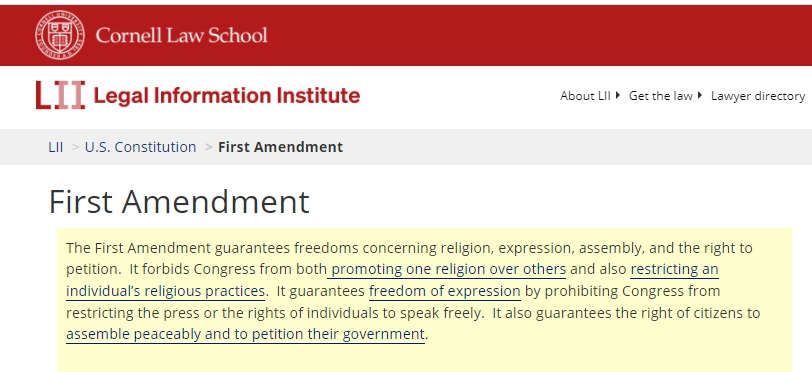
Congress cannot agree on anything other than dismantling the First Amendment. There is no greater threat to the establishment than the uncensored sharing of ideas. This week, 353 members of Congress voted to ban TikTok to “protect our data.” Unlike any major issue facing the country, it took Congress a mere eight days to implement this ban, with an astounding 81% in favor of removing the platform.
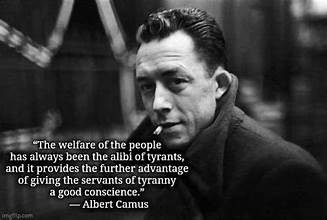
As Robert F. Kennedy Jr. accurately states, NATIONAL SECURITY is the ruse they use every single time when the government permanently removes one of our freedoms and usurps more power. They never give us back the freedoms we relinquish. Kennedy quoted his father’s favorite author, Albert Camus, “The welfare of the people is always the alibi of tyrants, and it provides the further advantage of giving the servants of tyranny a clear conscience.”
Hippocrit Joe Biden himself recently signed up for the TikTok platform but received minimal following due to his waning support with Gen Z and Millennials. “It’s the digital public square,” Kennedy explained, as people have gravitated toward the platform in recent years as it was one of the last frontiers of free speech.
There is absolutely no reason that Congress cannot address security concerns on the backend. I can assure you that the majority of voting members have NEVER utilized the platform and likely cannot attach a PDF to an email. They all agreed to ban free speech and did not need any additional information. Remember the last TikTokCongressional hearing? The questions were completely asinine and showed that the voting members had no understanding of the platform.
Small businesses have been using TikTok to grow their companies. De-platformed individuals have used it as a way to share their ideas, mere ideas, as thoughts alone threaten government. Politicians like RFK have been using TikTok to speak out against the establishment as the mainstream news refuses to cover the majority of what he and others have to say, as their donors would never allow it. There are restrictions in place on the app for material that does actually present a danger to the public, but Congress refused to look into the matter.
A local Christian radio station constantly runs ads saying that they need private donations to avoid large advertisers who will control what they can and cannot air. That is yet another reason why I offer this complimentary blog, free of advertisements or third-party interference. I have turned down countless offers over the years because I will not risk my voice, and I am not motivated by money.
I commend Kennedy for always making clear arguments without bashing his political opponents. This man deserves more coverage than he receives, and he does have quite a large following on social media platforms such as TikTok, where he is permitted to speak freely. RFK is honest and does not play partisan political games.
The First Amendment should not be prohibited for ANY reason. How many times has major American-owned corporations leaked your data in recent years? Every month there seems to be a new leak from a major corporation followed by a class action lawsuit where the victims are paid a few dollars and perhaps receive free credit monitoring. The people should own their data NOT the government.
When has 81% of our Congress agreed on anything? They see the people speaking to one another and collaborating without government intervention. Our elected officials have not made progress on any measure in years and routinely shutdown because they simply cannot have bipartisan debates. The Senate couldn’t even pass a measure as neutral as the Daylight’s Savings bill for crying out loud. These leeches on society sit in office until the day they die, receiving a hefty salary paid for by the American people which is a mere fraction of what they receive from insider trading and lobbyists who influence the policies they implement on the entire nation.
Government tyranny is rising because they see that they are losing control of the narrative. The First Amendment and our ability to freely communicate with one another is swiftly vanishing.
We are looking at options outside the Socrates private blog to avoid these tyrannical censorship bills and will likely make an announcing in the coming weeks.
I have created this site to help people have fun in the kitchen. I write about enjoying life both in and out of my kitchen. Life is short! Make the most of it and enjoy!
This is a library of News Events not reported by the Main Stream Media documenting & connecting the dots on How the Obama Marxist Liberal agenda is destroying America



 Centinel2012