The entire feud between Britain and Brussels has been over the border in Ireland between north and south. Brussels fears that there will be a free-flow of goods which will circumvent their taxes. The election of Borris Johnson has created a giant nightmare for Brussels. Trump and Johnson will enter a free trade agreement. A hard BREXIT will be the best thing for Britain for it will be free to cut its own trade dealers with the US, China, Japan, and the rest of the non-EU world.
The restrictions on trade imposed by Brussels are impossible to manage because all 28 members have a say in any trade deal. This is why the deal with the USA took so long to start with and it became unworkable. Trump offered a free trade deal and France was the one screaming the loudest. Germany cannot cut a deal with the USA because of France and neither could Britain.
A hard BREXIT will change the trade landscape in Europe which will put pressure on Brussels. The more they try to punish Britain, the more they will isolate the European economy for pure power.
QUESTION: Mr. Armstrong is there any way we can not have inflation. If so how? If not what would you say 5% or more?
S
ANSWER: It all depends on your definition. The type of inflation coming is more STAGFLATIONwhere prices rise due to cost-push (shortages) but there is a declining economic growth. The more familiar inflation is a DEMAND lead event because the economy is booming. Because governments are desperate for money, they keep raising taxes and are increasing enforcement. This trend is DELATIONARY for it reduces disposable income. The INFLATIONARY pressure comes from the rising costs which are set in motion by raising taxes.
Then we add the impact of the climate chaos creating shortages in food and that furthers cost-push inflation. The end result will be the shift from PUBLIC to PRIVATE where people will run away from government debt on all levels and move to tangible assets to survive.
The collapse in property values in London has created a crisis in property funds. M&G Investments blocked withdrawals from its UK property fund as it seeks to distance itself from the troubled manager. Back on June 3, 2019, the asset manager wrote to clients of the M&G UK Property fund to inform them it had placed a temporary restriction on customers from taking out their money for up to six months. Restrictions were also placed on certain withdrawals from the Prudential UK Property fund, which feeds into the M&G fund affected about 65% of customers in the fund. Both funds were only available for long-term institutional investors such as pension funds and the total under management was around £636m in assets while the Prudential Fund had about £50m.
The real estate funds are going to be the worst since they tend to be illiquid.
Something’s rotten in Denmark…or rather, in Greece. And they’re not the only ones facing problems – big debt problems! How does Europe’s Debt Crisis relate to the U.S. economy? What can we learn from their cautionary tale? Visit Greece, Brussels, California, and Washington, D.C. as we dig into Europe’s plight, and investigate if the United States can avoid making the same mistakes.
This evening President Trump delivered remarks during the swearing-in ceremony for newly appointed Defense Secretary Mark T. Esper. [Video and Transcript] The Senate voted 90-to-8 easily confirming Secretary Esper.
.
[Transcript] – THE PRESIDENT: Well, thank you very much everybody. We have a very important moment in our country’s history, actually. And we had a lot of our great Republican senators in the White House, and I invited them over and many of them wanted to be here. And as you probably heard, the vote just took place, and it was 90 to 8. That’s a vote that we’re not accustomed to, Mark, I have to say that. So congratulations, that’s great.
But I’m honored to be here today for the swearing-in of our new Secretary of Defense, Mark T. Esper. I especially want to thank Justice Samuel Alito — highly respected and a great gentleman, a great man — for joining us to administer the Oath of Office. Thank you very much. Thank you, Sam.
We’re also delighted to welcome several of Secretary Esper’s family members and friends to the White House today, including his mother, Polly. Hi, Polly. (Laughter.) Boy, are you proud of him, Polly? You better believe it. Yeah. (Laughter.) His wife, Leah. Thank you, Leah, very much. And his three children — Luke, John, and Kathryn. Thank you very much. Congratulations, too, most importantly. Congratulations. That’s an incredible thing.
There is no one more qualified to lead the Department of Defense than Mark Esper. A West Point graduate — great student, actually — Secretary Esper served our military for 21 years, including in the Gulf War. He also advanced U.S. national security in government and in private sector, most recently as Secretary of the Army, where he played a critical role training and equipping our armed forces. That’s where I got to know Mark. And there was nobody that did a better job than Mark and there’s nobody that loves it more than Mark. And thank you very much.
He is a recipient of the Bronze Star and Combat Infantryman Badge. He holds a doctorate in public policy from George Washington University and a master of public administration degree from the John F. Kennedy School of Government at Harvard University.
I am confident that he will be an outstanding Secretary of Defense. I have absolutely no doubt about it. He is outstanding in every way. And we’re honored to have you aboard. And I would ask Justice Alito, please, to administer the Oath of Office. Thank you. Thank you, Judge.
(The oath is administered.) (Applause.)
THE PRESIDENT: Would you like to say something?
SECRETARY ESPER: Yes, sir, if I may.
THE PRESIDENT: Please.
SECRETARY ESPER: Well, thank you, Mr. President, for your kind words, for your confidence in me, and for this incredible opportunity. And thank you, Justice Alito, for administering the Oath of Office. I really appreciate you being here this afternoon.
I’d also like to Senate — to thank the Senate Armed Services Committee for its quick action on my nomination and for the strong bipartisan support that I received today from the entire United States Senate.
It is an honor of a lifetime to be appointed Secretary of Defense and to lead the greatest military in history. And I will do so with that same energy and commitment to duty, honor, and country that I have for nearly four decades since my early days at West Point.
Mr. President, it is a privilege for me and for my family to be here with you today. Thank you for your leadership and for your commitment to a strong national defense and to all of our service members. Our military has made tremendous gains in recent years thanks to your leadership and we stand ready today to take on any challenge.
And while our soldiers, sailors, airmen, and Marines stand guard each and every day, we will ensure their families are well taken care of.
On a personal note, I would like to thank my wife, Leah, who has been by my side now for 30 years as a military spouse herself; my children, Luke, John, and Kate; my mother, Polly; my in-laws, Tom and Von; and my sisters who join me here today. And everybody else who has been a steadfast supporter of me over the years.
Again, thank you, Mr. President, for allowing me to serve our great country once again, as Secretary of Defense. Thank you, sir. (Applause.)
THE PRESIDENT: Thank you, Mark. Congratulations.
SECRETARY ESPER: Thank you.
THE PRESIDENT: Fantastic. Proud of you. Come on over here.
SECRETARY ESPER: Okay. Leah?
(A certificate is presented.)
THE PRESIDENT: He’s going to be a great one. Thank you very much.
The Real Adam Smith: A Personal Exploration by Johan Norberg, takes an intriguing, two-part look at Smith and the evolution and relevance of his ideas today, both economic and ethical. It’s difficult to imagine that a man who lived with horse drawn carriages and sailing ships would foresee our massive 21st century global market exchange, much less the relationship between markets and morality. But Adam Smith was no ordinary 18th century figure. Considered the “father of modern economics,” Smith was first and foremost a moral philosopher. The revolutionary ideas he penned in The Wealth of Nations and The Theory of Moral Sentiments, changed the world. Norberg explores Smith’s insights regarding free trade and the nature of wealth to the present, where they are thriving and driving the world’s economy. In the second hour, Ideas That Changed The World, Norberg traces Smith’s insights regarding the benefits of free trade and the nature of wealth to the present, where they are currently in operation. He talks with some of the most distinguished Adam Smith scholars, as well as leaders of some of the world’s most admired companies to discover how Smith’s ideas continue to be relevant and drive the global economy today.
Five myths cloud our perception of both the past and the present. (1) The “robber baron” myth, which holds that in late nineteenth-century America there were powerful men who became rich at the expense of the poor. The reality is that they became wealthy by being productive, and that there is no other period in history which saw such a rapid and widespread improvement in the well-being of the average individual; (2) The myth that the Great Depression was caused by a failure of business, when it was, in fact, produced by a failure of government and specifically by the Federal Reserve System; (3) The myth that government in the economy has expanded in response to public demand, when, actually, the public has had to be sold “hard” for politicians to enact every major social program; (4) The “free lunch” myth, which forces the individual to pay more, no matter how the government raises money – by taxing individuals, by taxing businesses, or by printing more money; and (5) The myth that government, like Robin Hood, transfers wealth from the rich to the poor, when the reality is that the government usually transfers wealth and income from both the very rich and the very poor to those in the middle. Check out our Facebook page here: https://www.facebook.com/FreeToChoose…
COMMENT: Well, Ray Dalio was short the market, missed the rally, and lost almost 5% for the first half of the year. Obviously, they don’t use Socrates – lol.
LB
REPLY: I do not advise Bridgewater and I have no idea if they even subscribe to Socrates. But what you have to realize is that a lot of these hedge funds form their strategy based upon opinion for the broader view. When you have a portfolio of that size, you cannot simply trade it back and forth for each move. The question becomes critical as to where to draw the line to realize your broadview strategy is wrong.
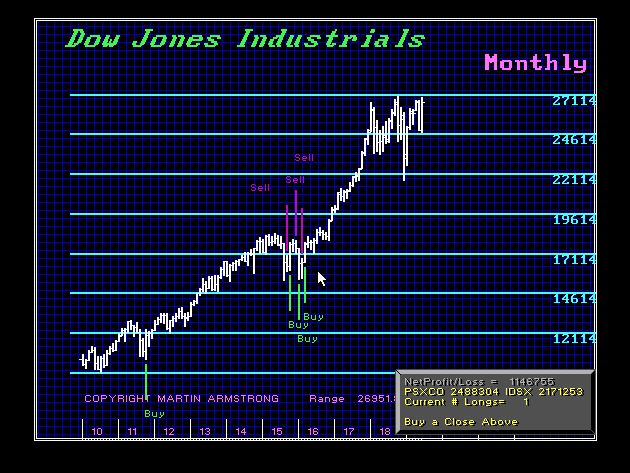
I have stated many times that the trend does NOT begin to shift until you reach the Monthly Level. We saw that in Gold when it finally got through 1362.50 after nearly four years of bouncing off that number. In the case of the Dow Jones Industrials, our hedging models for institutions were long one month from the low and has remained in that position. This is just a hedging model which is either long or short. It at least tends to keep institutions on the right side of the trend for long periods of time.
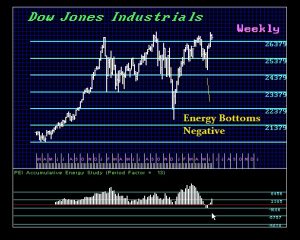
Aside from the Reversal System, the Energy Model is extremely helpful in identifying the position of the market and if there is a risk of a crash or a rally. The Energy Model turned negative, demonstrating that there was no possibility of a crash as most analysts were forecasting from a gut perspective. A crash would have been possible ONLY if the Energy Model was at a peak. When it is testing the lows or a negative, it is warning that the energy in the market has already dissipated.
We are simply headed into a Monetary Crisis Cycle where the majority of people will never be able to forecast what will unfold from a personal gut perspective. This is not a time for lucky calls. We need objective time-tested analysis that is not clouded by human bias. This is when we need the global approach to let Socrates simply correlate the world to enable us to see the real trends that are in motion. The worst thing you can do is ASSUME you have missed something, as that is typically the kiss of death for investors where they inevitably buy the high or sell the low.
The French GAFA tax in an acronym for Google, Apple, Facebook and Amazon which the French government has just passed. They are imposing a 3% tax on all business in France. The US has promised retaliation. This is part of the entire problem the world faces with trade. A lot of people talk about trade wars, but they live in the past. There is something far more serious at stake and that is the digital world and how governments are hungry for taxes to the point that they are threatening the viability of the world economy going forward.
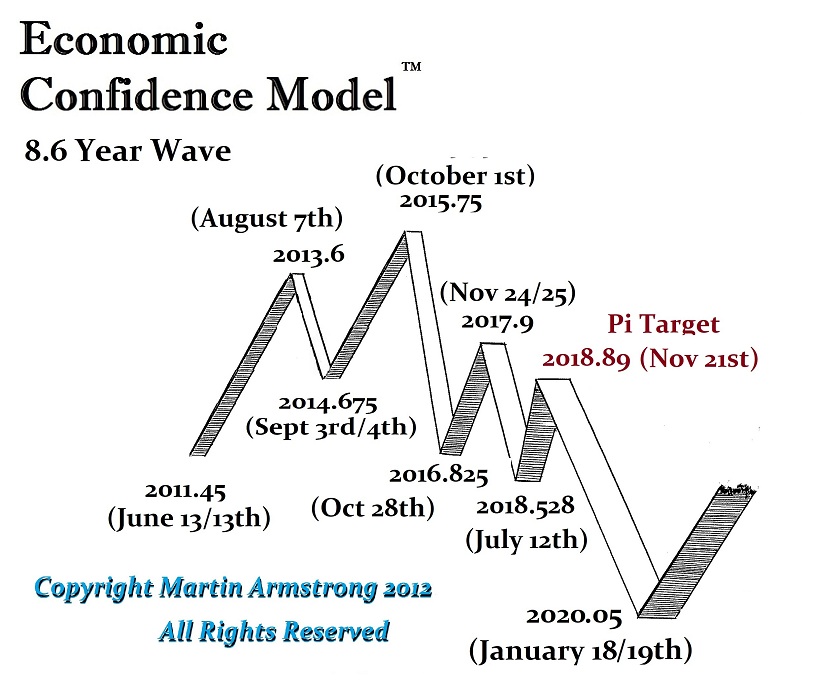
They are calling it an unexpected contraction in Singapore’s economy which is in line with our Economic Confidence Model which bottoms in January 2020. In addition, China’s exports have also declined by 1.3% during June. Gross domestic product in export-reliant Singapore declined by a shocking 3.4% in the second quarter from the previous three months. This was the biggest decline since 2012. Everywhere we look, the world economy is following the Economic Confidence Model perfectly. As stated before, the decline would be felt OUTSIDE the USA far more so than within the domestic economy.
Of course, the blame is being laid on Trump citing his US-China trade war is having an impact on Asia, and that includes Singapore’s latest export figures. Singapore saw exports fallfor a second month in a row, this time by 17.3% in the month of June compared to a year ago. The economic growth in Singapore declined by 3.4% from the previous quarter. However, the world economy has been turning down before Trump’s trade war as they are calling it. More than 10 years of Quantitative Easing has been unable to restore economic growth, but why look at trends when you can just bash Trump?
The global economy is still headed down into January 2020. Even if there was no trade war, the trend was set in motion from 2015.75. Within weeks of that turn at the peak of this cycle, Merkel began the refugee crisis which has undermined the confidence in Europe and her unilateral actions impacted all of the EU and has led to much discord. Costs of the refugee crisis have lowered economic growth and these people have not contributed to economic growth to any extent to offset the contraction. The negative interest rates have wiped out savers and force retired people back into the workforce just to stay alive. Meanwhile, governments have increased their taxation and nobody respects the fact that retired people are being forced out of their homes as taxes rise. There is no coordination and nobody will look at the whole.
I have created this site to help people have fun in the kitchen. I write about enjoying life both in and out of my kitchen. Life is short! Make the most of it and enjoy!
This is a library of News Events not reported by the Main Stream Media documenting & connecting the dots on How the Obama Marxist Liberal agenda is destroying America


 The entire feud between Britain and Brussels has been over the border in Ireland between north and south. Brussels fears that there will be a free-flow of goods which will circumvent their taxes. The election of Borris Johnson has created a giant nightmare for Brussels. Trump and Johnson will enter a free trade agreement. A hard BREXIT will be the best thing for Britain for it will be free to cut its own trade dealers with the US, China, Japan, and the rest of the non-EU world.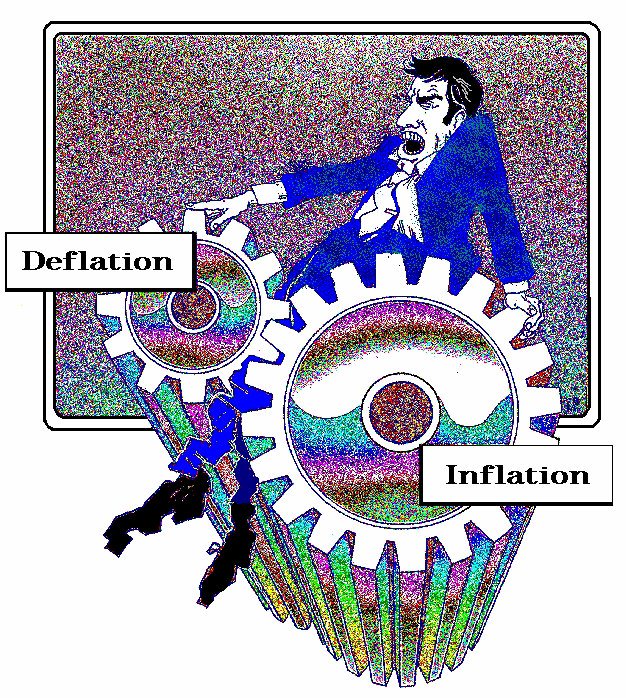



 REPLY: I do not advise Bridgewater and I have no idea if they even subscribe to Socrates. But what you have to realize is that a lot of these hedge funds form their strategy based upon opinion for the broader view. When you have a portfolio of that size, you cannot simply trade it back and forth for each move. The question becomes critical as to where to draw the line to realize your broadview strategy is wrong.

 Centinel2012