
The catholic church is heavily involved in the Muslim migration/invasion and a continuance of this insanity with bring down the church itself!
Tag Archives: Radical Islam
The Truth About Russia ‘Hacking the Election’ – YouTube
A CIA-led Coup Against American Democracy Is Unfolding Before Our Eyes
This article by Moon of Alabama is not conspiracy theory: http://www.informationclearinghouse.info/46056.htm Read it carefully. Check out the links.
The article is a documented and accurate description of a coup that is underway. The extraordinary lies that are being perpetrated by the media and by members of the US government have as their obvious purpose the prevention of a Donald Trump presidency. There is no other reason for the extraordinary blatant lies for which there is not a shred of evidence. Indeed, there is massive real evidence to the contrary. Yet the coup proceeds and gathers steam.
President Eisenhower warned us more than a half century ago of the danger that the military/security complex presents to US democracy. In the decades since Eisenhower’s warning, the military/security complex has become more powerful than the American people and is demonstrating its power by overturning a presidential election.
Will the coup succeed?
In my opinion, former and present members of the US government and the media would not dare to so obviously and openly participate in a coup against democracy and an elected president unless they expect the coup to succeed.
It is an easy matter for the ruling interests to bribe electors to vote differently than their states. The cost of the bribes is miniscule compared to the wealth and income streams that a trillion dollar annual budget provides to the military/security complex. The fake news of a Putin/Trump election-stealing plot generated by unsupported allegations of present and former members of US intelligence, the lame-duck President Obama, and the presstitute media provide the cover for electors to break with precedent “in order to save America from a Russian stooge.”
The CIA-controlled European media, the politicians in Washington’s European vassal states, NATO officials, and the brainwashed European peoples will support the coup against Trump.
The only ones speaking against the coup are the voters who elected Trump—all of whom are alleged to have been deceived by Russian fake news— the Russian government, and the 200 websites falsely described by the Washington Post and the secret organization PropOrNot as Russian agents.
In other words, those objecting to the coup are the ones described by the coup leaders as those who made the coup necessary.
I do not know that the coup will succeed, but looking at the commitment so many high level people have made to the coup, I conclude that those bringing the coup expect it to succeed.
Therefore, we should take very seriously the expectation of success that those who control levers of power are demonstrating.
Brilliant – Congressman King Calls for Investigation of CIA Head John Brennan…
It is remarkable how disingenuous, and hypocritical, partisan democrats (and media) become with the issue of manipulation and intents of CIA Chief John Brennan… Everyone reading here is old e…
Source: Brilliant – Congressman King Calls for Investigation of CIA Head John Brennan…
Obama Contradicts Clapper & Hillary – OOPS!
Armstrong Economics Blog
Re-Posted Dec 19, 2016 by Martin Armstrong

Hillary told her donor base at Manhattan’s Plaza Hotel last Thursday that Russian cyber attacks were both “a personal beef against me” and meant to undermine “the integrity of our democracy.” Of course, absent from the speech was anything realistic acknowledging that there is a global trend against corruption that is unfolding worldwide. Hillary will blame everyone and everybody but herself.
Obama in his press conference is trying to address the contradictions surfacing when Clapper told Congress there was no evidence of a Russian hack on November 17th. Obama now says when he saw Russian President Vladimir Putin in China in early September, he told him to “cut it out” and that there would be some serious retaliation if he didn’t.” Obama now says that after of that meeting, the government did not see further tampering of the election process. The Wall Street Journal says Obama goes off the Hillary script.
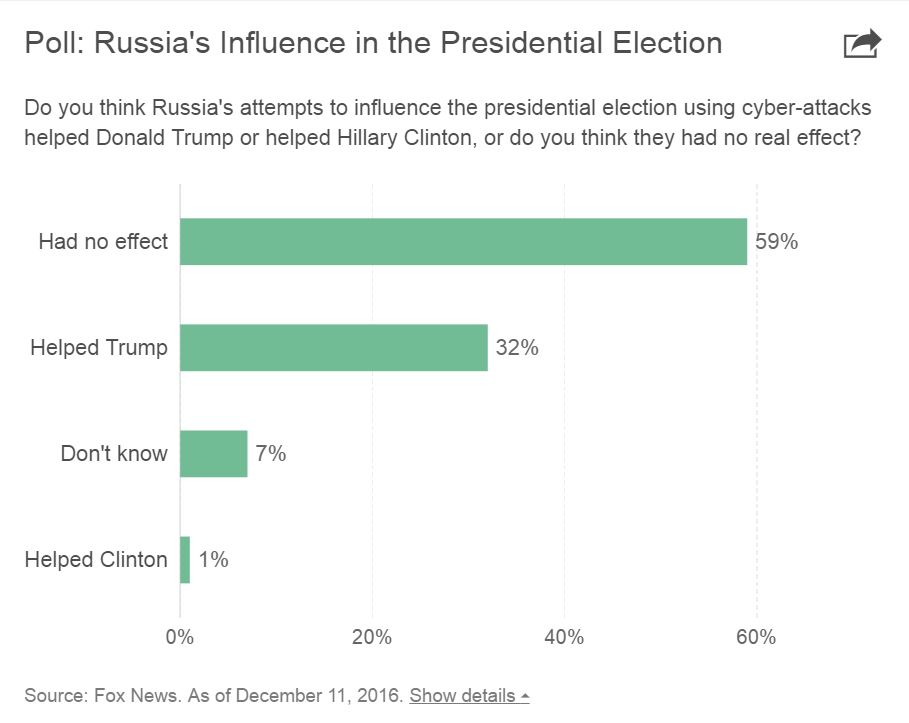
Yahoo reported the Fox Poll showing that 59% of Americans did not think the claimed Russian Hack had any effect. The remarkable aspect of this is that the entire story is simply about the DNC files, not voting machines. So I really do not get this saying Hillary would have won but for the Russian Hack. Well if Russian even did the “hack” (of which there is no evidence at all), then well done, for it exposed the internal corruption of the Democrats right on time with our model – 2015.75. The Real Clinton Conspiracy Backfired where she conspired with the Press to elevate Trump as the nominee and then tear him down so she could win. This demonstrates that her own supporters should be MAD AS HELL with her and her corrupt ways. Saying she would have won if that was not exposed is like saying a thief should get to keep all your stuff robbing you home even if caught. It is really brilliant how Hillary has manipulated this whole criminal act of trying to manipulate the Republicans and the press are so corrupt as well, nobody will report this issue.
Guess she proved the saying valid, which is usually attributed to Abraham Lincoln, but predates him to Jacques Abbadie who was a French Protestant:
You can fool all the people some of the time and some of the people all the time, but you cannot fool all the people all the time.
As Obama Plans Retaliation Against “Russian Hacking”, A Problem Emerges

by Tyler Durden
In a fiery press conference on Friday, shortly before departing for his last Hawaiian vacation, president Obama accused the press of being responsible for Hillary Clinton’s loss, slammed “domestic propagandists” who he said were responsible for the risk of “fake news” and assisting foreign counter-US propaganda, but more importantly Obama vowed to “send a clear message to Russia” in retaliation for its election hacking – of which the CIA still has to demonstrate evidence – as both a punishment and a deterrent. However, a problem has emerged as the outgoing president plans how to “punish or deter” Russia – according to the NYT, some of the options were rejected as ineffective, others as too risky.
If the choices had been better, one of the aides involved in the debate noted recently, the president would have acted by now, although the fact that he hasn’t demonstrates just how ineffective US counter-cyberwar planning has been despite spending billions of dollars in preparation for just this eventuality.
In its latest expose on US-Russian cyberrelations, the NYT writes that over the past four months, American intelligence agencies and aides to Obama had assembled a menu of options to respond to Russia’s hacking during the election, ranging from the obvious — exposing President Vladimir V. Putin’s financial ties to oligarchs, and something which has already been done on various occasions in the past — to the innovative, including manipulating the computer code that Russia uses in designing its cyberweapons.
Obama has refused to effect any of the options, however, because, as the NYT adds, “in his last weeks in office, that Situation Room debate has confronted a naturally cautious president with a complex calculus that President-elect Donald J. Trump will soon inherit: how to use the world’s most powerful cyberarsenal at a moment when the United States, as the election showed, remains highly vulnerable.”
The underlying concern is that, in a time when cyberwarfare is the modern equivalent of the “nuclear arms race” (even as the old, familiar “nuclear” cold war has been quietly reignited in Europe between Russia and NATO), all the legacy “game theory” caveats have emerged, including “tit-for-tat” escalation, and – in the most extreme – mutual assured destruction. David H. Petraeus, the former CIA director captured much of that sentiment on Friday, at a conference here sponsored by Harvard’s Belfer Center for Science and International Affairs: “Is there something we can do to them, that they would see, they would realize 98 percent that we did it, but that wouldn’t be so obvious that they would then have to respond for their own honor? The question is how subtle do you want it, how damaging do you want it, how do you try to end it here rather than just ratchet it up?“
It is, according to the NYT, this fear of retaliation to various escalating response that has paralyzed Obama from moving forward. Furthermore, the options provided to the US president appear to be insufficient for the task at stake.
On one hand, the idea of exposing Putin’s links to oligarchs was set aside after some aides argued that it “would not come as a shock to Russians.” Still, there are proposals to cut off leaders in Putin’s inner circle from their hidden bank accounts in Europe and Asia. There is an option to use sanctions under a year-old executive order to ban international travel for senior officials in the G.R.U., the Russian military intelligence unit that American spy agencies say stole emails from the Democratic National Committee and Hillary Clinton’s campaign chairman, then doled them out to WikiLeaks, betting that media outlets eager for insider details would amplify them, doing the Kremlin’s work for it.
There have been other options proposed by the NSA and its military cousin, the United States Cyber Command, which is responsible for computer-network warfare, though many have been rejected by the Pentagon.
Those plans could deploy the world-class arsenal of cyberweapons assembled at a cost of billions of dollars during Mr. Obama’s tenure to expose or neutralize some of the hacking tools favored by Russia’s spies — the digital equivalent of a pre-emptive strike. But the selection of targets by Americans and the accuracy of that retaliation could also expose software “implants” that the United States has patiently inserted and nurtured in Russian networks, in case of future cyberconflicts.
However, using the extreme approach presents a new host of challenges: the revelation in August about some of the N.S.A.’s own tools for breaking into foreign computer networks has raised the possibility that the Russians are already inside American networks and are sending a warning that they can respond in kind.
Which leads to the troubling conclusion that, when it comes to retaliating against the Kremlin, Obama is stuck.
“All of this has led Mr. Obama to ask how the Russians might escalate the confrontation, and whether the United States in the end may have more to lose than Russia. “He doesn’t have great options,” said Michael D. McFaul, formerly one of Mr. Obama’s top national security aides and then his ambassador to Moscow.”
Which, according to the NYT, means that the president has reached two conclusions:
The only thing worse than not using a weapon is using it ineffectively. And if he does choose to retaliate, he has insisted on maintaining what is known as “escalation dominance,” the ability to ensure you can end a conflict on your terms.Mr. Obama hinted as much at his news conference on Friday, as he was set to leave for his annual Hawaii vacation, his last as president.
“Our goal continues to be to send a clear message to Russia or others not to do this to us because we can do stuff to you,” he said. “But it is also important to us to do that in a thoughtful, methodical way. Some of it, we will do publicly. Some of it we will do in a way that they know, but not everybody will.”
Continuing to justify Obama’s paralysis, the paper of record adds that the president “rejected calls for a big, symbolic show of power, dismissing the idea that if the United States “thumped our chests about a bunch of stuff, that somehow that would potentially spook the Russians.” The goal, Mr. Obama said, was to come up with a response “that increases costs for them for behavior like this in the future but does not create problems for us.”
In other words, the damage has already been done, so there is little point in escalating it further, however – the thinking in the administration goes – the US hopes to “teach the Kremlin a lesson” and prevent it from interfering again in the future. That is, assuming of course, that it was Russian authorities that interfered in the first place, something they vehemently deny, and an allegation the CIA has failed to convince the general public by not presenting credible, conclusive evidence so far that it was indeed Putin directly orchestrating it (as the WaPo claimed). Indeed, many allusions to the fake allegation of Iraq’s Weapons of Mass Destruction have emerged in response to the latest CIA accusations, suggesting that the public refuses to be swayed purely on the basis of emotion appeals to “listen to experts and sources.”
* * *
Meanwhile, and perhaps most ironically, it is the NYT itself that admits that there is not much new in tampering with elections, except for the technical sophistication of the tools, and further writes that “for all the outrage voiced by Democrats and Republicans in the past week about the Russian action… it is worth remembering that trying to manipulate elections is a well-honed American art form,” something we noted last week in “The CIA Is Accusing Russia Of Doing Exactly What The CIA Does.”
In short, America is furious that someone has allegedly finally done something to it that it, itself, has been doing to others for decades. Some examples:
The C.I.A. got its start trying to influence the outcome of Italy’s elections in 1948, as the author Tim Weiner documented in his book “Legacy of Ashes,” in an effort to keep Communists from taking power. Five years later, the C.I.A. engineered a coup against Mohammad Mossadegh, Iran’s democratically elected leader, when the United States and Britain installed the Shah.“The military coup that overthrew Mosaddeq and his National Front cabinet was carried out under CIA direction as an act of U.S. foreign policy, conceived and approved at the highest levels of government,” the agency concluded in one of its own reports, declassified around the 60th anniversary of those events, which were engineered in large part by Kermit Roosevelt Jr., a grandson of President Theodore Roosevelt.
There were similar interferences over the years in Guatemala, Chile and even in Japan, hailed as a model of post-World War II democracy, where the Liberal Democratic Party owes its early grip on power in the 1950s and 1960s to millions of dollars in covert C.I.A. support.
The only differences this year are that the effort was directed at the United States, and that it was cyberenabled, giving Moscow a tool to amplify its efforts through the echo chamber of social media and news organizations that quoted from the leaked emails.
The bottom line, embarrassing as it may be, is that “over the past few months, an administration that prided itself on its work on cyberoffense and cyberdefense has learned a hard lesson: When it came to the 2016 election, an economically failing Russia, dismissed by Mr. Obama on Friday for its inability to grow or to innovate, exploited giant holes in the American system.”
Even more embarrassing, is how the Democratic Party, and John Podesta, confident in their security, allowed themselves to be hacked, whether by the Russiansor some hacker operating in New Jersey.
As a detailed account in The New York Times last Wednesday revealed, the D.N.C. had virtually no protections for its electronic systems, and Mrs. Clinton’s campaign chairman, John D. Podesta, had failed to sign up for the “two-factor authentication” on his Gmail account. Doing so probably would have foiled what Mr. Obama called a fairly primitive attack.
Then there the delays within the chain of command:
Mr. Obama conceded that he first heard about the attack on the Democratic National Committee “early last summer,” or nine months after the F.B.I. first alerted low-level D.N.C. officials about what had happened. That now appears to be critical lost time.If Mr. Obama had confronted the Russians immediately, in public or in the kind of private warning he said he delivered to Mr. Putin only three months ago during a meeting in China, the United States might have derailed the hacking campaign before it harvested and revealed thousands of emails.
Obama’s failure and reticence has sparked anger within his own rank and file, further putting pressure on the president to act lest he appears weak.
Obama’s comments on Friday have led Democrats to demand further action. Representative Adam B. Schiff of California, the ranking Democrat on the House Intelligence Committee, said the response should mix “additional economic sanctions along with our allies, and clandestine means of exacting a cost on the Russians for their flagrant meddling in our election.” “I have little confidence,” he continued, “that the incoming president will take the actions necessary to make the Russians pay any price for the most consequential ‘active measures’ campaign against us in history.”
Others, like republican neocon John, accused Obama of having “no strategy and no policy” of how to deal with the Russian hacking.
So what happens now? The biggest question facing Obama, the NYT concludes, is how public a retaliation to execute (if any, of course).
In his press conference, Obama laid out a case on Friday for acting with subtlety, so as not to start a tit-for-tat conflict. But as Joseph Nye, a strategist on so-called soft power, noted on Friday, “The reason to make some of this public is not just to deter the Russians, it is to deter others as well,” in future elections. It is possible, said Mr. McFaul, the former ambassador to Russia, that Mr. Obama’s most lasting contribution may be to get the details of the Russian hack declassified and to publish a report he has instructed the intelligence community to assemble before he leaves office.
“Given that Obama only has a few more weeks in office, I think he needs to focus his remaining time on attribution — that is declassification of intelligence so that there is no ambiguity about the Russian actions,” Mr. McFaul said. That “is completely within his powers,” he added, and would spur more congressional investigations regardless of the stance taken by Mr. Trump on the hack.
In the end, however, the simplest solution may also be the correct one: the US has so far not retaliated (and will not retaliate) against Russia, because despite the constant populist pandering and the jawboning, it was never the Russian government that was responsible for the attack (something a Spiegel report from Saturday hinted at), something which the US government would be aware of – despite the media onslaught to deflect attention to Russia as the cause for Hillary’s loss.
If this is indeed the case, the consequence of launching a cyberwar with Russia, one which Moscow did not start, would be constant escalation leading to adverse consequences for both countries, much more “dirty laundry” emerging a la the Podesta emails, complicated by its timing. A cyberwar would come at a time of a historic shift within the US administration, one in which a regime that has doggedly tried to suppress Putin and waged a long-running PR campaign against the Kremlin, will soon be replaced with a Trump administration whose stated foreign intentions are to restore friendly relations with the Kremlin.
Ultimately, despite all the bluster and posturing, Obama will most likely do nothing.
Chinese Interbank Lending Freezes, Forcing Massive Intervention By China’s Central Bank
by Tyler Durden
China is finding itself in an increasingly more untenable situation, trapped on one hand by its sliding currency (and declining reserves), which as noted earlier it has manipulated higher by forcing overnight unsecured rates to spike, in the process punishing “speculators” and other shorts…


… and on the other, by a banking sector that finds itself desperately in need of liquidity, unable to endure the PBOC’s monetary interventions, and on the verge of a liquidity crisis comparable to what Chinese banks suffered in the summer of 2013 when overnight rates briefly shot up above 20% as China pushed aggressively with a failed deleveraging campaign.
All this came to a head late last week when as Caixin reported late on Thursday, interbank lending froze on Thursday after many commercial banks suspended interbank operations amid tight liquidity conditions. Caixin adds that major institutions such as securities firms and fund managers, suddenly found themselves in a liquidity vacuum after banks, including the big four state-owned banks, became reluctant to make loans.
The magazine added that liquidity had become a major factor affecting the market after the central bank increased the cost of capital through open market operations in the past month, something we highlights three weeks ago in “The Market’s Next Headache: China’s (Not So) Stealth Tightening.”
The latest liquidity freeze forced China’s central bank to immediately extend hundreds of billions of yuan in emergency loans to financial firms on Friday and “ordered” some of the country’s biggest lenders to extend credit as well, as it moved to ease a liquidity crunch and continuing debt selloff.
On Friday, the PBOC tapped an emergency lending facility it created in 2014 to extend 394 billion yuan ($56.7 billion) in six-month and one-year loans to 19 banks. That pushes the net amount extended through the facility to 721.5 billion yuan so far in December, a monthly record, according to Beijing-based research firm NSBO. The central bank also injected a net 45 billion yuan into the money market on Friday, following a net 145 billion yuan cash infusion on Thursday.
The PBOC also ordered a few large banks to extend longer-term loans to nonbank financial institutions, while China’s securities regulator asked brokers tasked with making a market in bonds to continue trading and not shut any companies out of the market, according to Mr. Zheng of Dongxing Securities.
“The whole market is scrambling for liquidity and the PBOC is ready to do more to calm the market,” said Arthur Lau, head of Asia ex-Japan fixed income at PineBridge Investments in Hong Kong.
According to the WSJ, Investors and analysts said that the PBOC’s moves—which ended up pumping around 600 billion yuan ($86.3 billion) into the markets and financial system in two days—have helped calm some of the jitters.
“These policy interventions have helped tremendously in pacifying the mood,” said Zheng Lianghai, fixed-income analyst at Dongxing Securities in Shanghai.
It is unclear if the “pacified mood” will last: as a reminder, last Thursday, China briefly halted trading in bond futures after a record bond market crash send China’s 10Y yield plunging by the most on record, wiping out over a year of gains.

One day later, China suffered its first failed Bill auction since introducing a Primary Dealer system, which theoretically should have made “failed auctions” a thing of the past, over investor concerns of spiking short-term rates. On Friday, the yield on China’s 10-year government bond jumped about 0.1 percentage point to 3.33%, while yields on the interest-rate sensitive two-year government bond and the 30-year bond, which responds to inflation expectations, rose even more.
According to the WSJ, year-end factors are exacerbating liquidity concerns, among them banks storing up cash to prepare for an expected rush to move money abroad in the new year, when Chinese foreign-exchange quotas for individuals reset. Banks are also preparing for an early Lunar New Year in 2017, when Chinese traditionally give gifts of cash.
Yet some market-watchers say that a host of factors—from rising global rates to the central bank’s attempts to deflate China’s asset bubbles—could hit the country’s $9 trillion bond market, where yields hit record lows this year. If the bond selloff accelerates, some analysts fear China could see a market crash like the one that hit stocks last year.
Indeed, the jitters go deeper than seasonal factors. Increased prospects for inflation—and a more hawkish Fed—come as Chinese regulators have already started to tighten short-term borrowing conditions in recent weeks to cool overheating Chinese markets. Over the past year, speculators have borrowed from money markets to fund investments in bonds and other financial products.
So while the PBOC can easily pump liquidity, it could come at the expense of further devaluation in the Yuan, which last week saw its lowest print on record, just shy of the key 7.00 level. A weakening Chinese currency, which has fallen 7.2% against the U.S. dollar this year, has also kept the pressure on officials to tighten monetary policy and stem capital outflows, however it is these same tight conditions that have led to the banking freeze, putting the PBOC in a quandary: does it focus on the banks, or the Yuan.
Meanwhile, the country’s foreign-exchange reserves plummeted by $69 billion in November to $3.052 trillion, putting reserves at their lowest level since March 2011. Officials are ramping up their capital controls to keep the yuan from fleeing overseas by cracking down on overseas acquisitions by mainland companies and limiting how much money multinational companies can move out of the country and into their global operations.
As the following table lays out, while China still has a substantial liquidity buffer left, a worst case scenario could see China running out of liquid US holdings in just around 15 months.

Chinese banks are also being pushed by new domestic regulations to bolster capital levels, and some are rushing to boost their cash positions by selling bonds before the year-end deadline, analysts say.
Further complicating matters, was the announcement by a top economic official on Saturday that China must do more to deflate a property bubble that expanded this year by “strictly” controlling speculation while also stepping up the fight to rein in excessive corporate borrowing, suggesting further monetary tightening is on deck.
“We need to give a higher priority to preventing and controlling financial risks,” Yang Weimin, deputy director of the Office of the Central Leading Group on Finance and Economic Affairs, said Saturday at a forum in Beijing. “We need to defuse a flurry of risks, contain asset bubbles, and improve oversight to ensure there won’t be a systemic financial risk.”
Yang spoke a day after China’s top policy makers said they plan prudent and neutral monetary policy next year to sustain a steady expansion with breathing room for reforms. Preventing and controlling financial risk to avoid asset bubbles will be a priority, officials said in a statement Friday after the three-day Central Economic Work Conference.
“Houses are built to be inhabited, not for speculation,” the post-meeting statement said. It proposed using finance, land, taxation, investment and other instruments “to establish a fundamental and long-term system to curb real-estate bubbles and market volatilities,” according to a report Saturday from the official Xinhua News Agency. Yang, who helped draft Friday’s statement, sits on the Communist Party’s elite financial and economic panel led by Xi that is shaping policies to help support growth. The director of the panel’s general office is Liu He, one of Xi’s top advisers which likely means that China’s top priority at this point will be withdrawing further excess liquidity from the market in a gradual attempt to restore affordability to China’s housing market.
The question is whether China can do that while avoiding a hard landing for the banking sector, which once again finds itself desperate for liquidity, yet while can also ill afford further capital outflows, which would result from additional liquidity injections by the central bank.
As stated earlier, this suggests that the PBOC will soon have to make an unpleasant choice: deflate the housing bubble, and avoid an acceleration in capital outflows, or preserve the viability of China’s creaking banking sector and continue with massive “emergency” liquidity injections.
Were Democrats Beaten By Their Own “War Of Narratives”?
by Tyler Durden
Authored by Davide Battistella,
I read a quote somewhere last week that went something like, “JFK put a man on the moon, Obama put a man in the ladies room”. This got me thinking about President Obama’s oft cited, “war of narratives”.
Who says something like this? Well, it’s people who believe that as long as they control the narrative, as long as they control the story, then they are winning. The facts don’t matter, the actual events, the situations, the way things unfold, these are also the things that do not matter.
What matters most to a person who believes that the world is based on a “war of narratives” is that their ideas and world view are the only possible alternative. Isn’t this what doomed the Democrats in the Election? Did they not just believe that they had a superior narrative to the one that was being proposed by Donald Trump? So much so that they practically hid their candidate while waiting for her pronouncement as president.
With a president and leader, who holds a belief that the “war of narratives” is all that matters, Democrats have slipped into a very narrow (albeit progressive) world view. Is this starting to make some sense now?

From this perch, you ignore what is going on around you and it is your job and the job of your party to push any given issue through the filter of a given narrative. So take any issue and run it into the ground to convince people your narrative is the only acceptable one. You can blame people for falling down this slippery slope because it usually involves, at some point, the absence of using common sense.
Sure, Republicans push narratives as well, but they don’t seem to do it with such zeal and with the world view that whichever particular narrative du jour is the only plausible, logical story that exists. One thing that emerges is that being “locked in” to a position can quickly and often turn into a small corner you have painted yourself into.
This tends to result in slinging your final arrows from the last square meter you are standing in. A war of narratives Alamo as it were. Generally, you then have to fire your narrative in all directions. But that is not enough, dems tend to push to the point that everyone in the world (outside their square) is “wrong” (more often labeled racists, sexists, or any list of “ists”) and that the logical Democratic conclusion is correct.
When you fight this kind of “war of narratives” you inevitably end up in an extreme position, this usually involves fighting for the survival of your “narrative” or point of view over what, to most people, might seem like common sense. Issues are made more complex and solutions move further away from the real problems.
This is where Obama now finds himself on the eve of leaving office on Obamacare, Benghazi, Aleppo, the economy and many other issues where he placed the importance on the narrative rather getting to the core of whether the position serves America and American interests. His legacy is just another narrative that needs to be defended at all costs. How many times have we heard recently that unemployment is at it’s lowest while out of work people are at the highest levels in recent history.
This whole narrative issue and infatuation with it created a situation where democrats have become out of touch with TROA (the rest of America). This does not mean I don’t agree with some of the the narratives I have seen touted, I’m just pointing out that when you are seemingly unwilling to shift from a narrative, or a series of narratives you can end up right where the democrats are now.
Apply this logic to just about any issue and you can quickly figure out that by not being nimble in their narrative, democrats over the last eight years have become everything they always claim to stand against. Take big major issues like abortion, same sex marriage, immigration, jobs, the economy. These are complicated issues with plenty of grey area and plenty of points of view to service. You can’t afford to paint yourself into a corner and the complexity requires an ability to view the problem through more than one lens.
Most reasonable Americans would agree with both the rights and needs of individuals associated with any of these issues, until the point they are tilted a bit to far to the left, a bit to far toward special interest groups and until those people fire back and begin attacking anyone who is not delivering the most extreme version of the message.
Things begin being defined as absolute and in black and white terms leaving for very little grey (or what I like to call the place where actual change can happen). This is the problem with being glued to one narrative. This is where TROA fought back. Not all Americans share the view of the East and West coast Americans and they let that voice be heard. Now the arrows are being fired in all directions from that corner they have painted themselves into and the narrative they are one hundred percent invested in.
An example of this came up between now President elect Trump (then Mr. Trump) and Hillary Clinton in the last debate. It came down to a tough question on abortion where Secretary Clinton could not move off of her previous position/narrative and Mr. Trump could make a statement like, “You can take the baby and rip the baby out of the womb as late as one or two or three days prior to birth,”
That is an image that is very uncomfortable to many people and hard to defend, but it is an extreme example of why things can not be defined in black and white terms. Secretary Clinton had no real response or perhaps did not respond in the moment but my point is to illustrate why you can’t win by sticking to a prescribed narrative. At it’s core it comes off as dishonest as well because folks see you are defending a position instead of taking one. It might legally be ever woman’s right to end a pregnancy with two days remaining but it might not sit well with your average person/voter.
These types of narratives become tough to sell. Even when a given narrative is being touted, pushed, repeated and exploited through what we learned is the vast echo chamber known as the mainstream media. Case in point; election 2016. People were actually so tired, and one might even argue perceptibly fed up, with having a single narrative shoveled down their throats that they naturally sought out other voices.
To understand this one only has to view a video like this one, where talking points are being voiced, verbatim, on show after show.
Remember how Hillary tried to “power through” pneumonia…
What this kind of “instant narrative” produces in people (in me at least) is a sort of, “OK, now-I’m-being-bullshited-to”, effect and what might may have started out as a good message is rejected with all the disappointment you feel when a record or CD skips at your favourite part of the song. In other words, you can do your job too well. You can push the message out to the right people in such a strategic way that they begin to understand that it is just another narrative, to them it too slick, too polished and when you cross into that territory the bullshit meter goes off and they reject you, they see “a candidate” as disingenuous. This seemed to go both ways in the is election.
In a post election time of reflection, perhaps we’ve come to understand that the war of narratives is less important that just plain listening to people and getting back to basics.
Maybe Eugene Ionesco was on to something with this exchange between two characters in his play The Bald Soprano.
Mr. Smith: The heart is ageless [Silence]
Mr. Martin: That’s true. [Silence]
Mrs. Smith: So they say. [Silence]
Mrs. Martin: They also say the opposite. [Silence]
Mr. Smith: The truth lies somewhere between the two. [Silence]
Mr. Martin: That’s true. [Silence]
Whatever the narrative America, the truth does lies somewhere between the two. At the time of this writing, the weekend before the electoral college vote, the president is touting a narrative about Russian election interference, and how talk radio and “fake news” were the deciding factors in how about 120 million people voted.
Really, you want people to buy that narrative when they already now know, it’s just the next in a long list of convenient narratives with a list of talking points attached to it. Last time I checked, they didn’t replay the Superbowl when Russell Wilson dropped back to attempt a pass on the one yard line with Marshawn Lynch in the backfield. That was what they term, “a bad call”. The Seahawks took it on the chin and everyone claimed their share of responsibility and nobody threw anyone under the bus. They did not blame the Patriots either. This is the sort of fair play decorum we come to expect from Americans in their politics as well.
The democrats rode with the narrative that Hillary Clinton somehow was the best democratic candidate even after a Bernie Sanders showed he was not push over and had a lot of grassroots support. That was also a bad call. Funding Jill Stein to run a recount effort, pushing electoral college voters to change their vote, these are the kind of narratives that turn people off.

