IMPORTANT – Michael Pillsbury: China Has “New Respect” For U.S. Trade Strategy…


Sad Panda increasingly frustrated as disruptor Trump heaps vociferous praise on Chairman Xi, while simultaneously out maneuvering Beijing’s geopolitical economic strategy.

China expert Michael Pillsbury discusses the current environment around the Beijing leadership with Fox host Tucker Carlson.  This is really important. WATCH:

.

What Pillsbury outlines is exactly what CTH predicted last year when we shared how the Red Dragon would be caught entirely off-guard.  They’ve never seen this approach before.

NOTE: The upcoming Chinese trade delegation is not showing up at the end of this month as a matter of scheduling happenstance.  What no-one in the financial/trade/economic media is connecting is the timing of their visit with USTR Lighthizers’ Section 301 Tariff hearings –SEE HERE.  August 20th through August 27th, you can guarantee the Chinese delegations will be all over those hearings; including dispatching their paid lobbyists to provide input on their behalf.

Each time China takes aggressive action (red dragon) China projects a panda face through silence and non-response to opinion of that action;…. and the action continues. The red dragon has a tendency to say one necessary thing publicly, while manipulating another necessary thing privately.  The Art of War.

President Trump is the first U.S. President to understand how the red dragon hides behind the panda mask.

It is specifically because he understands that Panda is a mask that President Trump messages warmth toward the Chinese people, and pours vociferous praise upon Chairman Xi Jinping, while simultaneously confronting the geopolitical doctrine of the Xi regime.

In essence Trump is mirroring the behavior of China while confronting their economic duplicity.

President Trump is putting on a MASSIVE economic squeeze.

Squeeze #1. President Trump and Treasury Secretary Mnuchin sanctioned Venezuela and cut off their access to expanded state owned oil revenue. Venezuela needs more money. China and Russia are already leveraged to the gills in Venezuela and hold 49% of Citgo as collateral for loans outstanding.  China and Russia now need to loan more, directly.

However, China cannot engage in economic commerce with Venezuela or they risk losing access to the U.S. banking system.  Therefore all current Chinese aid to Maduro comes in the form of IOU’s.  These ongoing loans are likely impossible to be repaid.

Squeeze #2. China’s geopolitical ally, Russia, is already squeezed with losses in energy revenue because of President Trump’s approach toward oil, LNG and coal. Trump, through allies including Saudi Arabia, EU, France (North Africa energy), and domestic production has influenced global energy prices.  Additionally, President Trump is demanding NATO countries, specifically Germany, stop supporting financial dependence on Russia.

Meanwhile, and directly connected, Russia is bleeding out financially in Syria. Iran is the financial reserve, but they too are energy price dependent and President Trump is now putting pressure on Iran vis-a-vis new sanctions and new demands on allies.

Squeeze #3. In 2017 Trump and Secretary Tillerson, now Secretary Pompeo, put Pakistan on notice they need to get involved in bringing their enabled tribal “extremists” (Taliban) to the table in Afghanistan. Pakistan’s primary investor and economic partner is China. The U.S. removed $900 million in financial support to pressure Pakistan toward a political solution in Afghanistan, China has to fill void.  [NOTE: Last month the World Bank began discussions about a financial bailout for Pakistan.]  Again, more one-way bleed for China.

Squeeze #4. China’s primary economic threat (competition) is next door in India. President Trump has embraced India as leverage over China in trade and pledged ongoing favorable trade deals. The key play is MFN (Most Favored Nation) trade status might flip from China to India. That’s a big play.  It would have massive ramifications.

Squeeze #5. President Trump launched a USTR Section 301 Trade Investigation into China’s theft of intellectual property. This encompasses every U.S. entity that does manufacturing business with China, particularly aeronautics and technology, and also reaches into the financial services sector.

In March of 2018 U.S. Trade Representative Robert Lighthizer completed a section 301 review of China’s trade practices.  [SEE HERE] Section 301 of the U.S. Trade Act of 1974 authorizes the President to take all appropriate action, including retaliation, to obtain the removal of any act, policy, or practice of a foreign government that violates an international trade agreement or is unjustified, unreasonable, or discriminatory, and that burdens or restricts U.S. commerce.  However, as talks with China progressed, President Trump shelved the 301 action to see where negotiations would end-up. The May and June, 2018, negotiations between the U.S. and China provided no progress.  The 301 review of China is now pulled back off the shelf, and President Trump assembles his trade-war strategy.  The 301 tariffs/sanctions are currently being worked out with U.S.T.R Robert Lighthizer.

Squeeze #6. President Trump, Secretary Ross, Secretary Mnuchin and USTR Robert Lighthizer are dissolving NAFTA in favor of two bilateral agreements; one with Mexico and one with Canada.  One of the primary objectives of team U.S.A. is to close the 3rd party loopholes, including dumping and origination, that China uses to gain backdoor access to the U.S. market and avoid trade/tariff restrictions. [China sends parts to Mexico and Canada for assembly and then back-door entry into the U.S. via NAFTA.]

Squeeze #7. President Trump has been open, visible and vocal about his intention to shift to bilateral trade renegotiation with China and Southeast Asia immediately after Team U.S.A. conclude with NAFTA. [Current discussions with Japan are ongoing]

Squeeze #8. President Trump positioned the U.S. relationship with the E.U. as a massive potential loss for Europe (via Steel, Aluminum, and Auto tariffs) if they did not: (A) shift their trade relationship toward greater reciprocity; and (B) reconsider the size of their trade relationship with China.  After initially trying to push-back, Europe acquiesced.

Squeeze #9. President Trump has positioned ASEAN (Association of Southeast Asian Nations) as trade benefactors for assistance with North Korea. Last year the KORUS (South Korea and U.S.) trade deal was renegotiated, and announced in March. The relationship between ASEAN nations and the Trump administration is very strong, and getting stronger. Which leads to…

Squeeze #10. President Trump has formed an economic and national security alliance with Shinzo Abe of Japan. It is not accidental that North Korea’s Kim Jong-un fired his last missile over the Northern part of Japan. Quite simply, Beijing told him to.  However…

Squeeze #11. President Trump cut-off the duplicitous Beijing influence over North Korea by engaging directly with Kim Jong-un.  The open exchange and ongoing dialogue has removed much of the ability of Beijing to leverage the DPRK nuclear threat for their own economic benefit.  This dialogue was as much, if not more, about dismantling the Beijing geopolitical influence as it was about denuclearizing the Korean peninsular.  However, no-one caught on to that part of the strategy.

Add all of this up and you can see the cumulative impact of President Trump’s geopolitical economic strategy toward China. The best part of all of it –as we previously stated– is the likelihood China never saw it, meaning the sum totality of “all of it”, coming…. at first.

Now they do, and, as Mr. Pillsbury notes from his travel and engagement, China is not quite sure how to respond.

Only President Trump could use economic leverage with such incredible insight and strategy toward achieving dual results benefiting the U.S. economy and U.S. national security position.  It really is stunning when you stand back and look at how it has all played out…. in the open…. and yet seemingly no-one saw what he was doing.

Just brilliant.

Ho-Lee-Cats: Freight Haulers Order 450,000 New MAGAnomic Big Rigs in 2018 – Backlog for Delivery Extends into 2019….


Freight hauling trucks are like the lymphatic system within a healthy economy.  As the economy writ large needs to move stuff around, it’s the truckers who git-r-done; and no time in U.S. economic history has there been such a demand for haulers.

In a stunning Wall Street Journal Report they note Analyst group ACT Research says manufacturers are on track for 450,000 orders for heavy-duty trucks this year, easily breaking a 14-year-old record. In July alone, North American fleets ordered more than 52,000 trucks, the largest order in history.   Whoot, Whoot !!

(Via WSJ) An unprecedented run of orders for big rigs has pushed the backlog at truck factories to nine months, according to industry analysts, the largest since early 2006, when truckers stocked up to get vehicles in place before tougher environmental restrictions would take effect. Typically the backlog is about five months for the truck industry’s manufacturers, analysts said.

“It is longer than it should be,” said Magnus Koeck, vice president of marketing for Volvo AB’s North America operation, where Class 8 truck orders this year soared to 25,000 from 11,000 during the first six months of 2017. “Of course we are not alone in this situation,” he said. “Everyone is in the same boat.”

North American freight-haulers ordered more than 300,000 Class 8 trucks in the first seven months of this year and are on track to order a record 450,000 of the heavy-duty vehicles for the full year, according to ACT Research. That would be the largest book since 2004, when orders reached 390,000, according to analysts.

[…] Freight-hauling fleets are trying to keep up with swelling demand in a robust U.S. economy even as they say they face difficulty finding drivers. New trucks are one recruiting tool, and the new vehicles also get better fuel mileage—an attractive feature for fleets as other costs are rising. (read more)

Fleet companies making this scale of an investment is one of the more visible performance indicators that we haven’t seen anything yet.  The Main Street economy is only just beginning to get started.   This is the beginning, of the beginning, of the most massive middle-class economic expansion in the history of our United States.

This KPI also aligns with the sector seeing the largest initial wage and benefit increases:

  (More Data)

Will Inflation Return to the Eurozone?


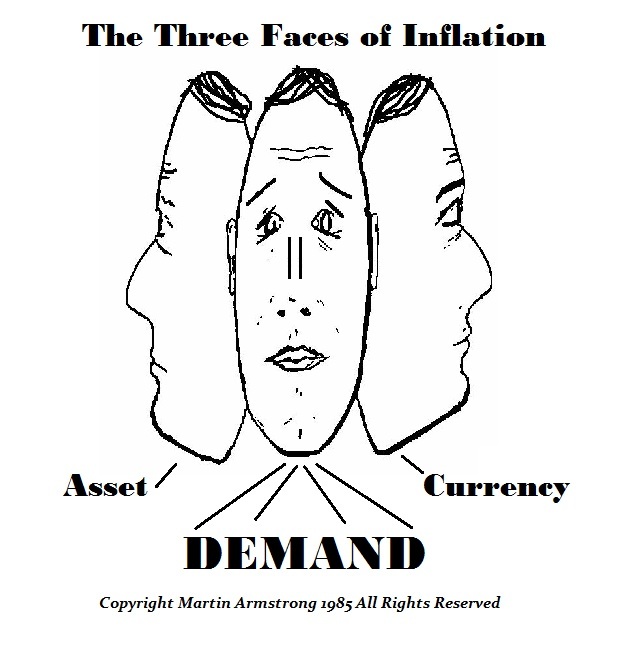
There are three distinct types of inflation – Demand, Asset & Currency. The major type of inflation that everyone assumes is DEMAND. This unfolds when there is actually an economic boom and people have confidence in the economy. Asset Inflation is when there is no real demand from the consumer but the asset values rise primarily from foreign investment. This is normally witnessed in real estate, stocks, and bonds. There is a subdivision of Asset Inflation that is concentrated to a single area such a food that is driven by a collapse in supply due to perhaps a drought or flooding. The third type is Currency Inflation. This is when the actual nominal value of assets do not change, but the currency fluctuation will attract or detract foreign investors because of the large fluctuation in the value of the currency on world markets.

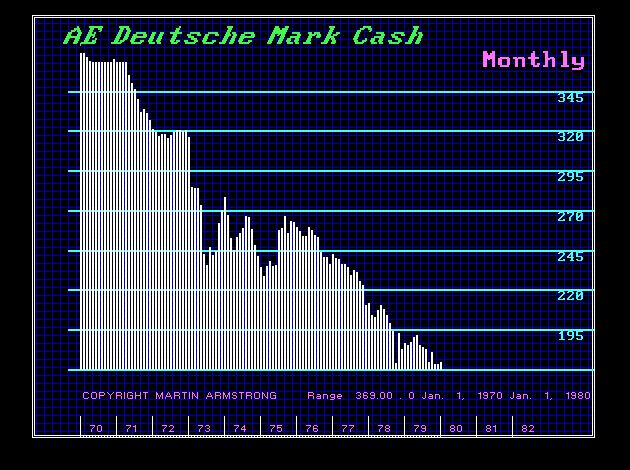
During the 1970s, I always bought German cars. A Porsche in 1970 was about $12,000 and by 1980 it was $50,000. The rise was really created by the decline in the dollar which created the perception that German cars would so well built, they would appreciate. I would drive one for 2-years and sell it used for a profit. This was the net result of CURRENCY INFLATION. As the Euro declines, we will see inflation in the Eurozone rise sharply. The ECB will proclaim victory after 10 years, but this has nothing to do with Quantitative Easing.

BLS Report: Productivity Increases 2.9% in Second Quarter…


Economic analysis can get weedy…. so a simple way to look at productivity is to think about baking bread in your kitchen.

If you were going to bake 4 loaves of bread it might take you 2 hrs start to finish. However, if you were going to bake 8 loaves of bread it would not take you twice as long because most of the tasks can be accomplished with simple increases in batch size, and only minor increases in labor time.  Your productivity measured in the last four loaves is higher.

Economic Productivity is measured much the same way, within what’s called a production probability equation.  Additionally, if two hours of your time are worth $40, each of four loaves of bread costs $10; but if you make 8 loaves in the same amount of time the labor cost is only $5/per loaf.

From 2007 through 2017 the average rate of productivity increase was 1.3%.  However, in the second quarter of 2018 productivity jumped to 2.9%.  That means total business output increased significantly as more product was demanded from within the business operation.  Throughout the economy people just wanted more stuff.

Improved gains in efficiency/productivity (more bread needed) supports faster economic growth without generating higher inflation; no need to raise prices because your cost to make each loaf of bread decreases the more you make.  Higher sales and lower per unit cost means more profit for the bread-maker.  No need to raise prices.  Without inflation, there’s no motive for the Fed to raise interest-rates.

Increases in productivity generally means the economy is generating more stuff.  The more stuff generated the higher the value of all economic activity; this increases GDP growth.

When we see higher productivity in direct alignment with GDP increases, the increased production indicates sustainable GDP growth.

BLS Report: “Nonfarm business sector labor productivity increased 2.9 percent during the second quarter of 2018, the U.S. Bureau of Labor Statistics reported today, as output increased 4.8 percent and hours worked increased 1.9 percent.” (link)

We made 4.8 percent more stuff, and only worked 1.9 percent longer.  The net is a 2.9 percent productivity increase.

.

MAGAnomic Status Report…


.

The future’s so bright…

…he’s gotta wear shades!

President Trump Impromptu Presser Departing White House…


Departing the White House for New York and New Jersey, President Trump delivers impromptu remarks and holds a brief unscheduled presser prior to climbing aboard Marine-One.

Real Estate – Leverage – Transition to the Reset


QUESTION: Hi Mr. Armstrong,

Thank you for the daily blogs on world events with an independent analysis that makes sense. I find them better than investment bank reports that just make up the pages.
Could you please elaborate on what happens to properties when the monetary reset comes? If people lose confidence in fiat money and hoard real assets, wouldn’t that be a positive thing for properties? Or only if they are bought out in full (i.e. no mortgage)?
Thank you.
Regards,
S
ANSWER: The problem with real estate is the LEVERAGE. The value of a house has been escalated due to the fact that in the USA you can borrow using 30 years of future income. The crisis that unfolds is the collapse in the mortgage market. Then we will see a deleveraging of real estate. However, that said, real estate makes the transition as a hedge during a reset.  For example, during the German hyperinflation that led to a currency reset, that new currency that was issued was backed by real estate – not gold. Keep in mind that as the currency declines, then the repayment cost of a mortgage declines. On the one hand, mortgages will be unavailable but those who hold the mortgage lose the most. Therefore, you should be able to pay off your mortgage with cheap currency assuming you have hedged and make it through the transition.

California Real Estate Peaks and Begin a Crash


California has joined the states with not just the highest taxes in America, but it has become one of those states that people are just leaving resulting i9n a net outward-migration. There is a logical consequence when a state becomes a place people are trying to flee from – real estate MUST decline in value. Already, sales of both new and existing houses and condominiums in Southern California has declined 11.8% year over year. Prices rallied and reached a record high in 2018. The median price paid for all Southern California homes that were sold in June 2018 was a record high reaching $536,250, according to CoreLogic. This was reported as a 7.3% increase compared to June of 2017. When you see such short-term surges in a market, that is often the sign of how every market peaks. Real estate is no exception.

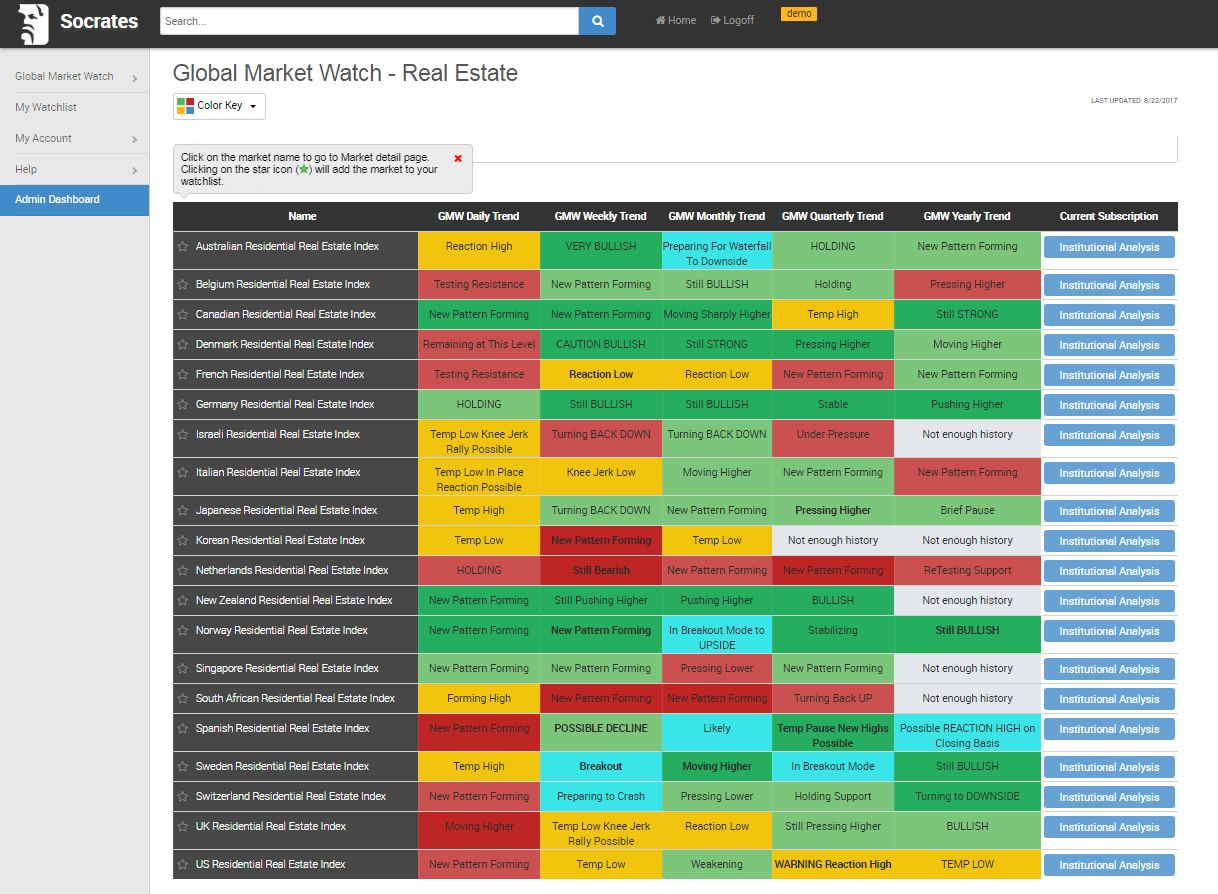
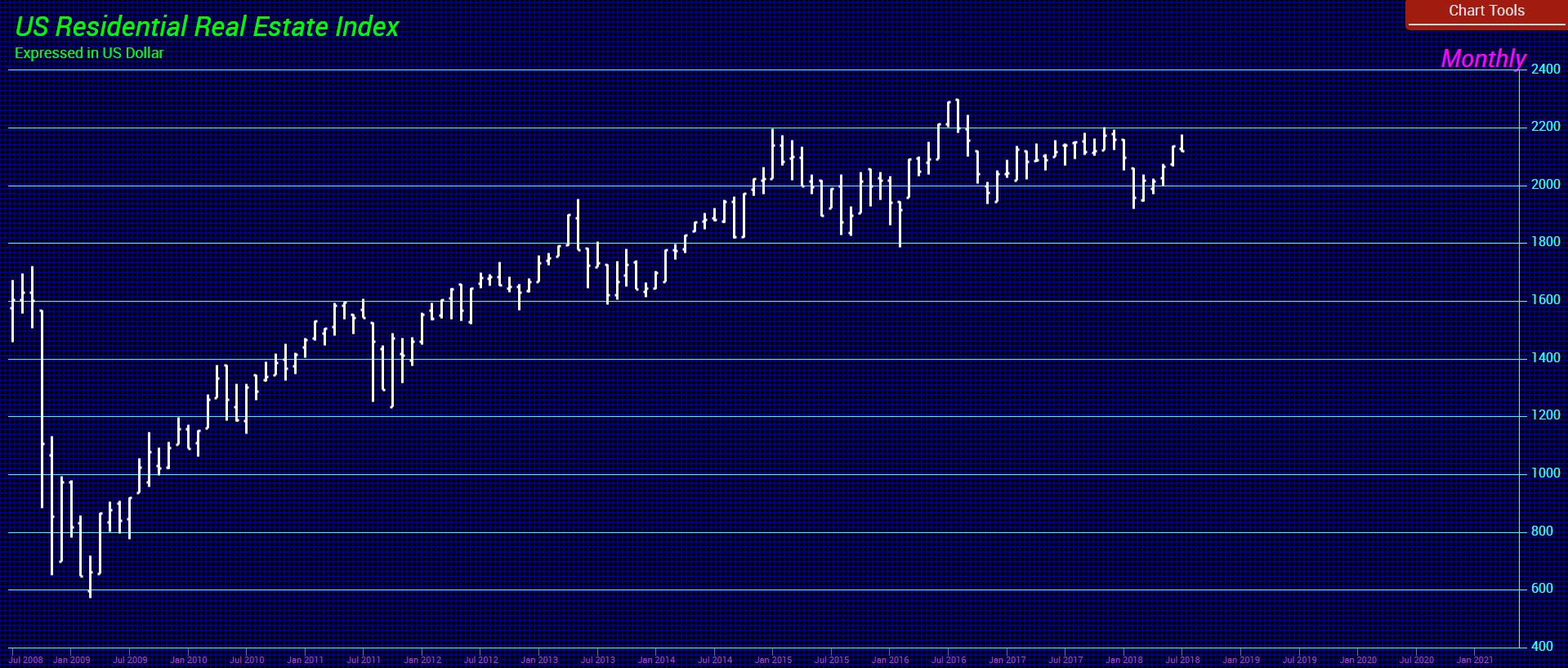
Many have touted for years that California property leads the nation. Therefore, whatever trend appears they will spread to the rest of the nation. While we do not necessarily agree with that statement, nonetheless, real estate will be on the decline in most states where taxes are rising. Property is still going to rise in the 7 states without income tax. For those who are unfamiliar with Socrates, we have created indexes for real estate on a worldwide basis. Here is the page you can view what is available.

California may seem to be a leading indicator, but this appears to be with respect to direction only. While Southern California reached record highs in property values in 2018, this appears NOT to be a leading factor, but a lagging one. Our index for the nation as a whole with a limited focus to Residential peaked in August 2016. We have NOT yet elected a Monthly Bearish Reversal. Trump has clearly made a major economic difference. Capital has been returning home and this has helped to create jobs and soften the economic decline in the USA compared to Europe and Asia. This will also have a fundamental backdrop to the dollar.