Multinational Wall Street -vs- Main Street U.S.A…


Originally outlined a year ago. Reposted by request. At the heart of the professional/political opposition the issue is money; there are trillions at stake.

President Trump’s MAGAnomic trade and foreign policy agenda is jaw-dropping in scale, scope and consequence. There are multiple simultaneous aspects to each policy objective; however, many have been visible for a long time – some even before the election victory in November ’16.

If we get too far in the weeds the larger picture is lost. CTH objective is to continue pointing focus toward the larger horizon, and then at specific inflection points to dive into the topic and explain how each moment is connected to the larger strategy.

Today we repost an earlier dive into how MAGAnomic policy interacts with multinational Wall Street, the stock market, the U.S. financial system and perhaps your personal financial value. Again, reference and source material is included at the end of the outline.

If you understand the basic elements behind the new dimension in American economics, you already understand how three decades of DC legislative and regulatory policy was structured to benefit Wall Street and not Main Street. The intentional shift in fiscal policy is what created the distance between two entirely divergent economic engines.

REMEMBER […] there had to be a point where the value of the second economy (Wall Street) surpassed the value of the first economy (Main Street).

Investments, and the bets therein, needed to expand outside of the USA. hence, globalist investing.

However, a second more consequential aspect happened simultaneously. The politicians became more valuable to the Wall Street team than the Main Street team; and Wall Street had deeper pockets because their economy was now larger.

As a consequence Wall Street started funding political candidates and asking for legislation that benefited their interests.

When Main Street was purchasing the legislative influence the outcomes were -generally speaking- beneficial to Main Street, and by direct attachment those outcomes also benefited the average American inside the real economy.

When Wall Street began purchasing the legislative influence, the outcomes therein became beneficial to Wall Street. Those benefits are detached from improving the livelihoods of main street Americans because the benefits are “global”. Global financial interests, multinational investment interests -and corporations therein- became the primary filter through which the DC legislative outcomes were considered.

There is a natural disconnect. (more)

As an outcome of national financial policy blending commercial banking with institutional investment banking something happened on Wall Street that few understand. If we take the time to understand what happened we can understand why the Stock Market grew and what risks exist today as the financial policy is reversed to benefit Main Street.

President Trump and Treasury Secretary Mnuchin have already begun assembling and delivering a new banking system.

Instead of attempting to put Glass-Stegal regulations back into massive banking systems, the Trump administration is creating a parallel financial system of less-regulated small commercial banks, credit unions and traditional lenders who can operate to the benefit of Main Street without the burdensome regulation of the mega-banks and multinationals. This really is one of the more brilliant solutions to work around a uniquely American economic problem.

♦ When U.S. banks were allowed to merge their investment divisions with their commercial banking operations (the removal of Glass Stegal) something changed on Wall Street.

Companies who are evaluated based on their financial results, profits and losses, remained in their traditional role as traded stocks on the U.S. Stock Market and were evaluated accordingly. However, over time investment instruments -which are secondary to actual company results- created a sub-set within Wall Street that detached from actual bottom line company results.

The resulting secondary financial market system was essentially ‘investment markets’. Both ordinary company stocks and the investment market stocks operate on the same stock exchanges. But the underlying valuation is tied to entirely different metrics.

Financial products were developed (as investment instruments) that are essentially wagers or bets on the outcomes of actual companies traded on Wall Street. Those bets/wagers form the hedge markets and are [essentially] people trading on expectations of performance. The “derivatives market” is the ‘betting system’.

♦Ford Motor Company (only chosen as a commonly known entity) has a stock valuation based on their actual company performance in the market of manufacturing and consumer purchasing of their product. However, there can be thousands of financial instruments wagering on the actual outcome of their performance.

There are two initial bets on these outcomes that form the basis for Hedge-fund activity. Bet ‘A’ that Ford hits a profit number, or bet ‘B’ that they don’t. There are financial instruments created to place each wager. [The wagers form the derivatives] But it doesn’t stop there.

Additionally, more financial products are created that bet on the outcomes of the A/B bets. A secondary financial product might find two sides betting on both A outcome and B outcome.

Party C bets the “A” bet is accurate, and party D bets against the A bet. Party E bets the “B” bet is accurate, and party F bets against the B. If it stopped there we would only have six total participants. But it doesn’t stop there, it goes on and on and on…

The outcome of the bets forms the basis for the tenuous investment markets. The important part to understand is that the investment funds are not necessarily attached to the original company stock, they are now attached to the outcome of bet(s). Hence an inherent disconnect is created.

Subsequently, if the actual stock doesn’t meet it’s expected P-n-L outcome (if the company actually doesn’t do well), and if the financial investment was betting against the outcome, the value of the investment actually goes up. The company performance and the investment bets on the outcome of that performance are two entirely different aspects of the stock market. [Hence two metrics.]

♦Understanding the disconnect between an actual company on the stock market, and the bets for and against that company stock, helps to understand what can happen when fiscal policy is geared toward the underlying company (Main Street MAGAnomics), and not toward the bets therein (Investment Class).

The U.S. stock markets’ overall value can increase with Main Street policy, and yet the investment class can simultaneously decrease in value even though the company(ies) in the stock market is/are doing better. This detachment is critical to understand because the ‘real economy’ is based on the company, the ‘paper economy’ is based on the financial investment instruments betting on the company.

Trillions can be lost in investment instruments, and yet the overall stock market -as valued by company operations/profits- can increase.

Conversely, there are now classes of companies on the U.S. stock exchange that never make a dime in profit, yet the value of the company increases. This dynamic is possible because the financial investment bets are not connected to the bottom line profit. (Examples include Tesla Motors, Amazon and a host of internet stocks like Facebook and Twitter.) It is this investment group of companies that stands to lose the most if/when the underlying system of betting on them stops or slows.

Specifically due to most recent U.S. fiscal policy, modern multinational banks, including all of the investment products therein, are more closely attached to this investment system on Wall Street. It stands to reason they are at greater risk of financial losses overall with a shift in fiscal policy.

That financial and economic risk is the basic reason behind Trump and Mnuchin putting a protective, secondary and parallel, banking system in place for Main Street.

Big multinational banks can suffer big losses from their investments, and yet the Main Street economy can continue growing, and have access to capital, uninterrupted.

Bottom Line: U.S. companies who have actual connection to a growing U.S. economy can succeed; based on the advantages of the new economic environment and MAGA policy, specifically in the areas of manufacturing, trade and the ancillary benefactors.

Meanwhile U.S. investment assets (multinational investment portfolios) that are disconnected from the actual results of those benefiting U.S. companies, and as a consequence also disconnected from the U.S. economic expansion, can simultaneously drop in value even though the U.S. economy is thriving.

♦The Modern Third Dimension in American Economics – HERE

♦How Multinationals have Exported U.S. Wealth – HERE

♦The “Fed” Can’t Figure out the New Economics – HERE

The FED Begins to Question the Economic Assumptions – HERE

♦Treasury Secretary Mnuchin begins creating a Parallel Banking System – HERE

♦Proof “America-First” has disconnected Main Street from Wall Street – HER

Breaking: Jeff Colyer Concedes To Kris Kobach in Kansas GOP Primary…


Delivering a very classy and uniting concession speech current Kansas Republican Governor Jeff Colyer concedes the GOP primary race to Kansas Secretary of State Kris Kobach.

TOPEKA, Kan. — A week after the highly contested vote for the Kansas GOP gubernatorial primary, Gov. Jeff Colyer has conceded the race to Secretary of State Kris Kobach.

In a statement Thursday night Colyer said he believed he was doing the right thing by conceding, and hoped to see Kansas remain in republican hands. At the time of the announcement, Kobach led Colyer by 345 votes after Sedgewick and Johnson Counties certified their votes Thursday. A total of 91 out 105 counties had certified their results.

Colyer went on to say he would endorse Kris Kobach in the run. Kobach will now face Democratic Sen. Laura Kelly in the general election in November. (watch video concession statement here)

It really is a very classy concession speech.  Top shelf.  Well done.

Nervous Pandas Get Twitchy Watching Shrinking Bamboo Forest…


It’s not a bluff; it’s never a bluff…. He doesn’t bluff.  I’ve looked through the interviews, writing and granules of opponents describing hundreds of deals, and I cannot find a single person who ever said that Donald Trump was bluffing during any negotiations.

NYT cont. […] In recent days, officials from the Commerce Ministry, the police and other agencies have summoned exporters to ask about plans to lay off workers or shift supply chains to other countries.

With stocks slumping and the currency dropping 9 percent against the dollar since mid-April, censors have been deleting a torrent of criticism online, some of it directed at President Xi Jinping’s leadership.  State news outlets, by contrast, have sought to promote the official line, with the authorities restricting the use of the phrase “trade war.”

[…] If the trade war escalates — and Mr. Trump has shown no sign of backing down — some worry that the public’s faith in the economy could be shaken, exposing the nation to much more serious problems than a drop in exports. New economic data on Tuesday showed slower growth in investment and consumer spending, and there are fears that the financial crisis in Turkey could spread.

China’s leaders have argued that they can outlast Mr. Trump in a trade standoff. Their authoritarian system can stifle dissent and quickly redirect resources, and they expect Washington to be gridlocked and come under pressure from voters feeling the pain of trade disruptions.

But the Communist Party is vulnerable in its own way. It needs growth to justify its monopoly on power and is obsessed with preventing social instability. Mr. Xi’s strongman grip may be hindering effective policymaking, as officials fail to pass on bad news, defer decisions to him and rigidly carry out his orders, for better or worse.  (read more)

It would appear that Chairman Xi, like Justin from Canada, is rolling the economic dice based on advice from those close to him, and betting the 2018 mid-term elections will block President Trump from carrying out the America-First, pro-middle-class, U.S. trade reset.

In a typical Beijing maneuver Chairman Xi appears to be counting on the stupidity of the American voter to help China create leverage in the aftermath of POTUS Trump destroying all former dragon trade strategies.

If the MAGA movement can hold the 2018 mid-term elections, and if we can deliver Trump the victory he/we need, there is going to be a seismic shift in the entire global trade system the likes of which have never been contemplated.  A massive shift so economically consequential it is simply too incredible to even quantify.

Trillions will pour into the U.S.

Sarah Sanders White House Press Briefing – 2:30pm EST Livestream


Press Secretary Sarah Huckabee Sanders delivers the White House press briefing for Tuesday August 14, 2018.  Anticipated start time 2:30pm EST:

UPDATE: Video Added

WH Livestream LinkFox News Livestream LinkGST Livestream Link

Stunning MAGAnomic Sentiment: Small Business Optimism Survey Second Highest Reading in History….


The National Federation of Independent Businesses (NFIB) is an assembly and survey of small business owners throughout the U.S.  In the latest survey (full pdf here) overall optimism is the second highest ever recorded at 107.9 (the highest reading was 108 in 1983).

The full press release is available here.  The full pdf of the survey is available here. The executive summary outlines the overall content and highlights the sentiment amid Main Street U.S.A.:

[…] Although some panned any celebration of the 4.1 percent second quarter GDP growth, small business owners beg to disagree. At least in the small business sector of the economy, Main Street’s performance over the last 21 months is unprecedented based on reports for the past 45 years by hundreds of thousands of NFIB’s member firms. Owners have never been so optimistic for so long. This has translated to improved employment and investment spending that buoys GDP growth, even at the end of what will be the longest expansion in modern history.

Consumer sentiment is at record high levels. Consumer spending, which accounts for 70 percent of our economy, posted 4 percent growth in Q2. Historically revised data show that consumers have been saving much more than thought, and income gains in recent months have been solid, providing support for spending in the second half. The record levels of firms reporting higher compensation is a clear indication that wages will be rising further in the second half.

COMPENSATION ANALYSIS: Reports of higher worker compensation gained a point from June to a net 32 percent of all firms, 3 points below May’s record reading of 35 percent. Plans to raise compensation rose 1 point to a net 22 percent, historically strong.

Government measures of wage and compensation gains follow movements in NFIB plans to raise compensation but with a 3 quarter lag, so government reports of rising compensation will increase even more in the second half of the year.

Owners complain at record rates about labor quality issues, with 88 percent of those hiring or trying to hire in June reporting few or no qualified applicants for their open positions. The frequency of reports of positive profit trends was unchanged at a net negative 1 percent, one of the very best readings in the survey’s 45 year history.  (report)

♦ 35% of all businesses have raised wages; 22% more plan to raise wages.  As CTH continues to note, the Bureau of Labor Statistics report on wage growth lags behind the actual NFIB survey results direct from the employers.

♦ 70% of all U.S. workers work in small businesses.

Again for emphasis: This is MAGAnomics in action.  Main Street is benefiting.  Blue and White collar Main Street is benefiting.  The Middle-Class is the primary beneficiary.

For more than 30 years the Main Street economic engine has been intentionally stalled by U.S. economic policy that has favored Wall Street and pushed a service-driven-economy narrative on the U.S. workers.   Using targeted MAGAnomic Main Street policy President Trump has reversed the trend.

Main Street, and the U.S. Middle Class, is growing again.

Enjoy this.

President Trump really is “a blue-collar billionaire“.

Hoards of Ancient Coins Including Biblical Widow Mites


QUESTION: Do you have any more Roman coin you will offer for Christmas? I would really like to buy a few to give to my grandchildren.

WJ

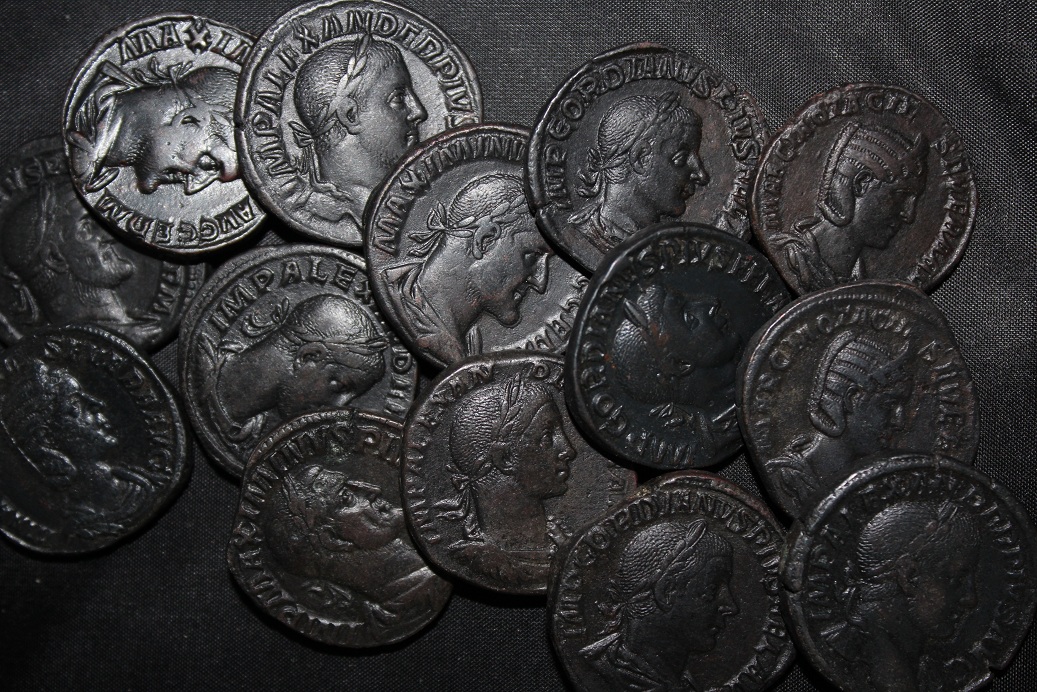
ANSWER: Yes. I have several hoards I will make available some that I bought probably back in the 1970s. There are no major quantities. Generally less than 100 of various types. I do have a very nice lot of bronze Sestertius, which is the main Roman coin used as the unit of account pictured above.

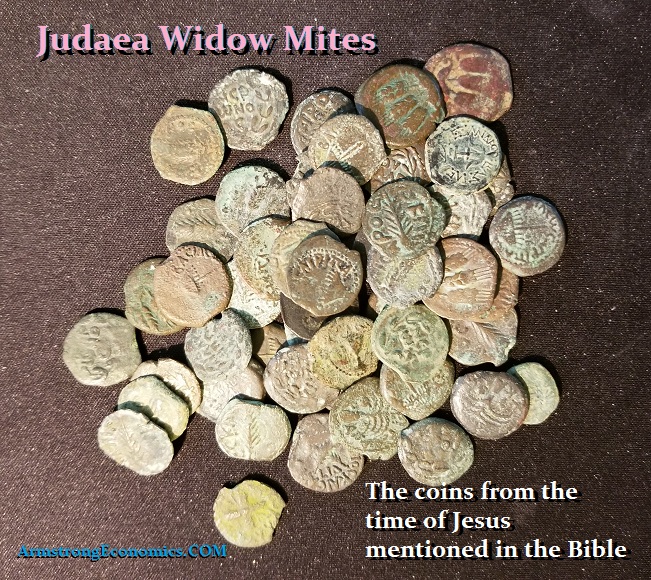
I have only perhaps 50 Judaea widow’s mites which were the coin that was presented in the Synoptic Gospels (Mark 12:41-44, Luke 21:1-4), in which Jesus is teaching at the Temple in Jerusalem. The Gospel of Mark specifies that two mites (Greek lepta) are together worth a quadrans, the smallest Roman coin. I know everyone will want these really bad. I just do not have a sufficient quantity for everyone.


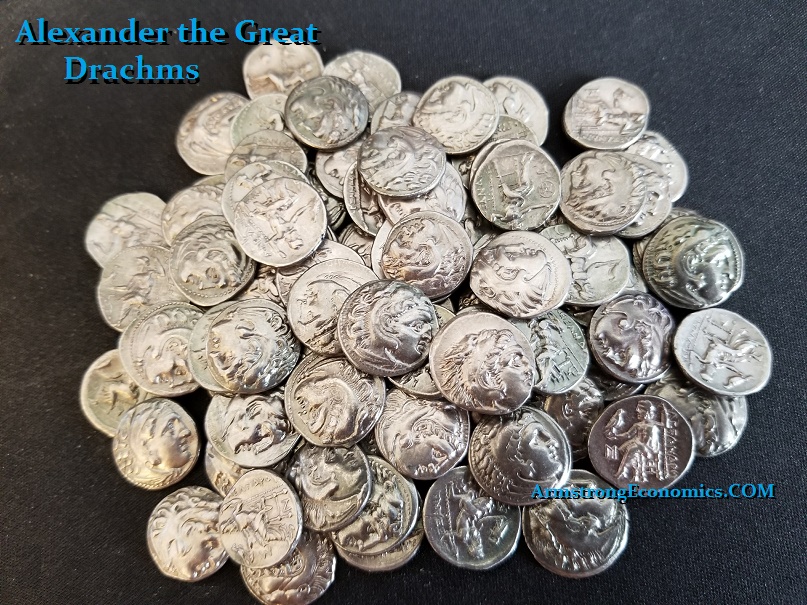
I still have a limited number of Alexander the Great drachms and the Victoritai. I also have a small hoard of silver denari and 3rd-century bronze Antoniniani. We really cannot mail them outside the USA anymore. Those from overseas we can hold then if you are attending the WEC. We can probably ship to Asia, not Australia. Europe seems to be just a no go.

I will put everything together and let everyone have a shot online

Precious Metals were Worth Less than the Coinage


QUESTION: Mr. Armstrong; I do not understand your statement that even when coins were silver and gold, they were still a form of fiat money. Could you explain that please?

BB

ANSWER: The evidence that supports that statement is abundant. We find coins of the immediate financial capital be it Greece or Rome, were IMITATED by the surrounding peripheral regions. Here are four Celtic imitations of a silver Tetradrachm of Thasos, an island in Thrace. Because of its proximity to the Celtic world, they were engaged in trade. However, the Celts minted imitation coinage copying the designs as best they could to satisfy their own internal commerce.  You can see a genuine coin at the top with a weight of 16.91 grams and four imitations that were very close to the same metal content. Obviously, the raw silver was worth more when it was in coin form or they would never have bothered to imitate the Greek coinage.

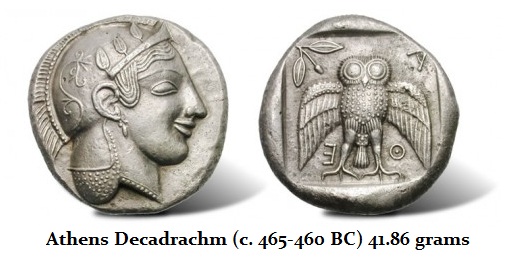
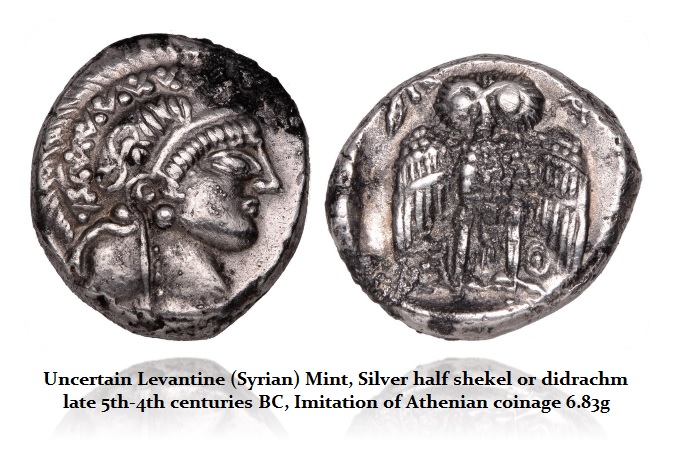
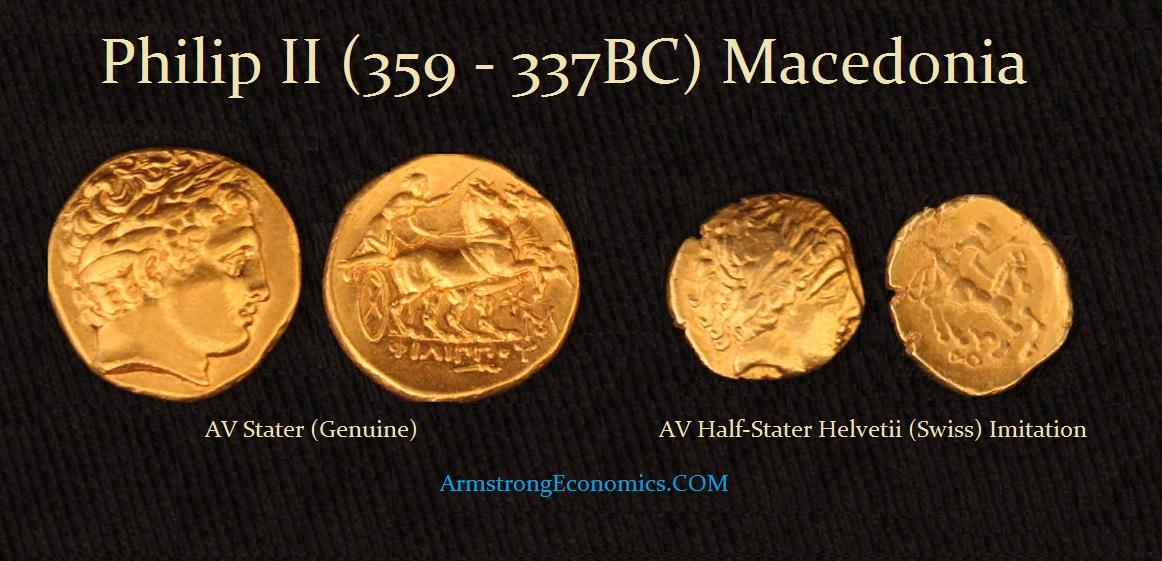
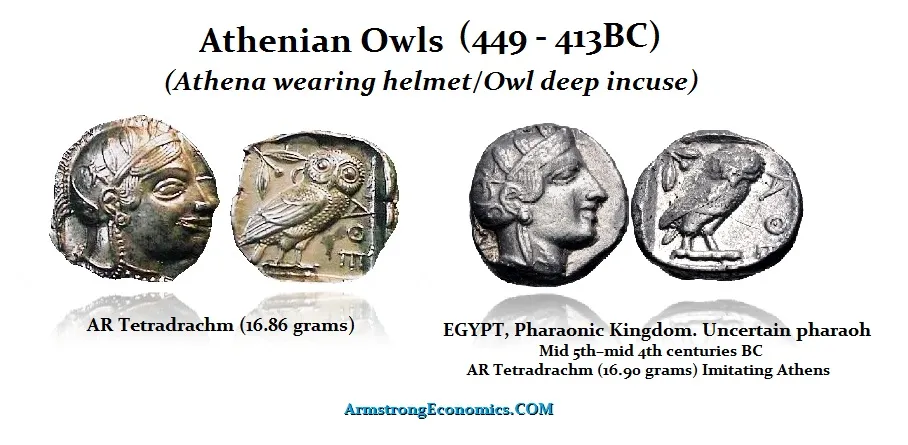
There are imitations by the Swiss of gold coins of Macedonia made by the Helvetii tribe. In this case, they appear to be half denominations. We find imitations of the famous Athen’s Owls. These type of imitations are dominant in North Africa. Here is a SILVER DIDRACHM which is style off of the main trade coin being the Dekadram. This design of the facing owl with open wings only appeared on the large Dekadrachms and not on smaller denominations.

Interestingly, the Egyptians never minted their own coins under they were conquered by Alexander the Great. Nevertheless, we have Egyptian imitations of Athenian owls as well. Here the metal is good and the designs are properly performed as well as the denominations. Obviously, we have raw metal being shaped into coins that imitate the Greek world when they were the Financial Capital of the World.

The numismatic record is abundantly clear. The peripheral economies routinely imitated the coinage of the dominant economy which I refer to as the Financial Capital of the World at that moment in time. So here we have even Egypt which imitates the coinage of Athens so that they can make use of silver in trade. The produced no coinage for domestic circulation and instead used a receipt monetary system based upon grain.


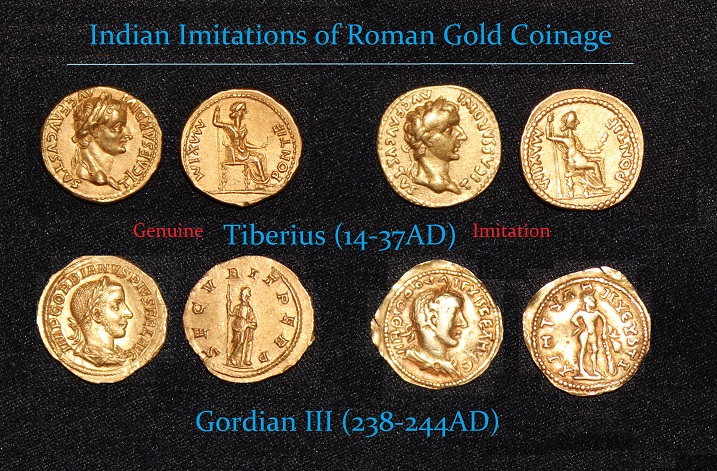
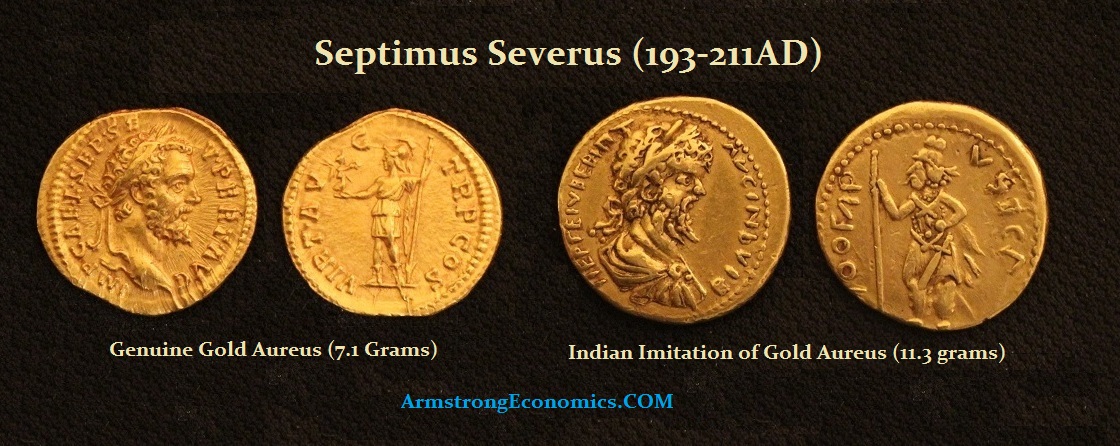
Here we have India imitating the gold coinage of Rome. They appear to have imitated the coinage even changing the design with the current emperor from the time of Tiberius onward. Once again, we do not see that these were counterfeits, but imitations. They were struck generally with the same quality of gold and at the proper weight. There is an over-weight gold aureus of Septimus Severus (193-211AD). These Indian imitations extend into the 3rd century at least until the monetary crisis begins with the capture of the Roman Emperor Valerian I in 260AD.

Here we have a Double Aureus (Bino) of a rare Emperor Pupienus who reigned only between April 22nd and July 29th, 238AD. We have an Indian imitation of a coin that has not survived in its genuine form. All we have is a single Indian imitation to suggest it existed.


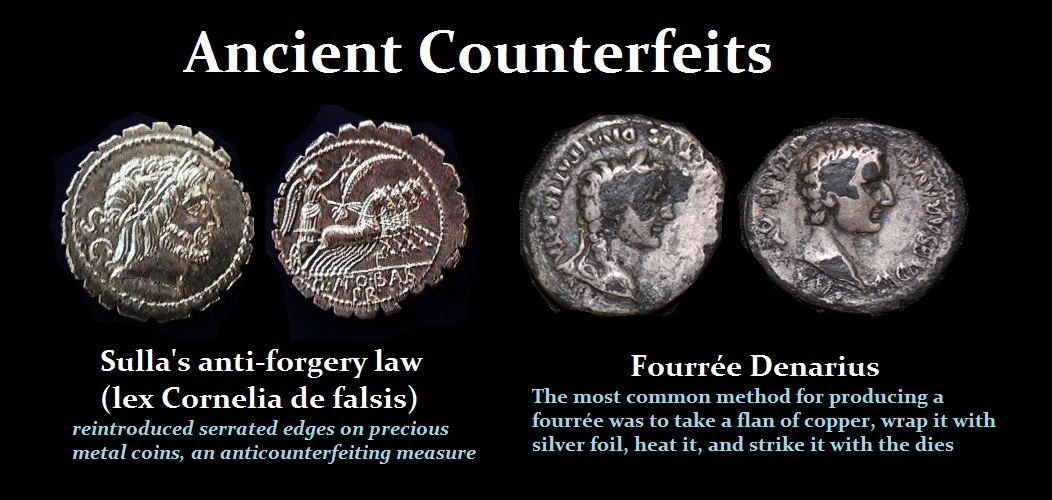
The mere existence of “imitations” establishes that statement as contrasted with counterfeits.  Throughout the Roman coinage, there exist  Fourrée Denarius. These appear to be struck generally with official dies but on bronze based coinage silver plated. One theory is that people from the mint produced these forgeries and pocketed the profit.

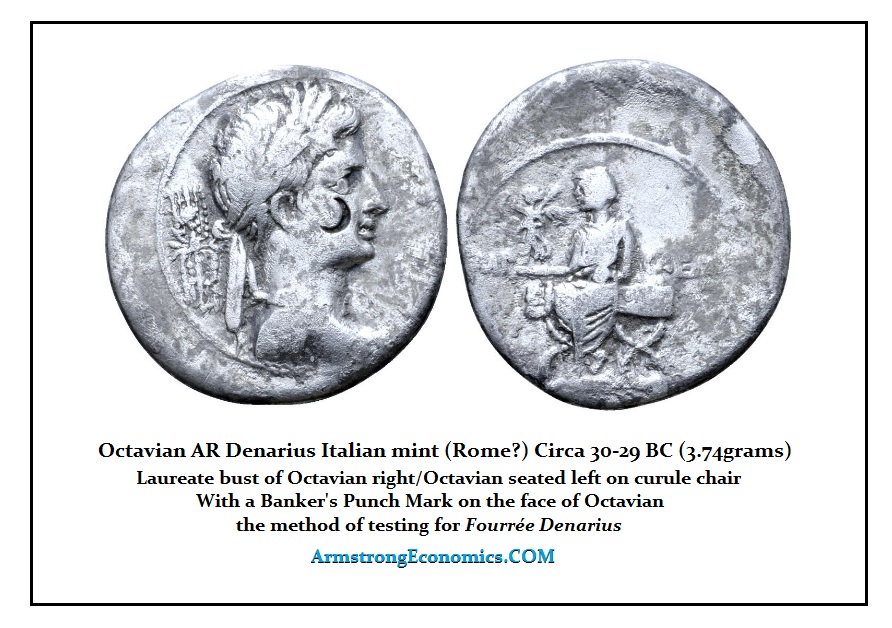
Here is a genuine silver denarius of Octavian (circa 30-29BC). Note that on the cheek of Octavian there is a crescent-shaped punch mark. This is an ancient banker’s mark that is rather common demonstrating that the coin was tested to see if it was a forgery.

You can easily see that there are counterfeits and then there are imitations. The raw metal was worth LESS in trade than a coin. This is why I take issue with those who think that merely minting a coin from gold or silver means it is NOT fiat. That is simply not true. The coinage was worth MORE than the raw metal involved

Italy Warn that Stopping QE will Lead to Collapse of Eurozone


Italy has called on the ECB to guarantee the bond yields warning that if they END quantitative easing the Eurozone will break apart. On this score, they are not wrong. The economic spokesman for the Italian governing party Lega has warned of a collapse of the Eurozone. The ECB should ensure that the yield spreads of government bonds of the euro countries are contained and not allowed to soar. This is what Claudio Borghi told Reuters. “Either the ECB offers a guarantee or the euro will break apart.” Interest on Italian, Spanish and Portuguese bonds rose in response to the currency crisis in Turkey. Borghi warned that this situation cannot be solved and will explode in everyone’s face. This is the Sovereign Debt Crisis coming into play. We are no looking at the risk premium for ten-year Italian government bonds has risen to 2.7% above Germany. The promise that a single currency would produce a single interest rate has been a complete failure