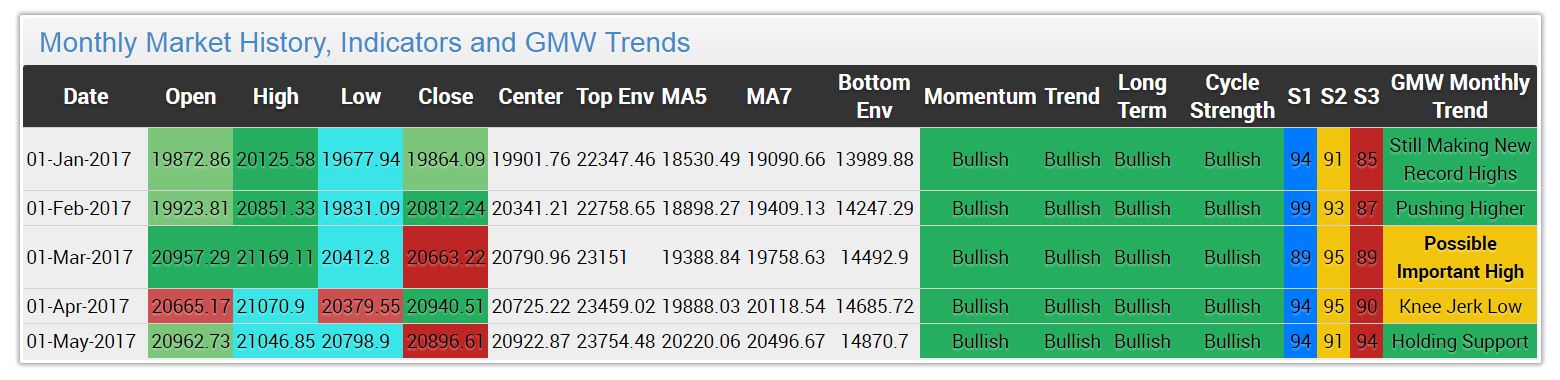
COMMENT: Mr. Armstrong, I have been on Socrates for about one year now on what you now call your standard edition. I have to say, you have done an amazing job of programming. To have a computer simply provide a comment that is short and to the point that you can look at the whole whole at your finer tips, is the most fantastic tool I have ever encountered. Its calls just on the Dow Jones have saved me countless multiples of the cost of service and I am a small investor. This is what you are expanding to over 5,000 instruments worldwide?
REPLY: Yes. The Global Market Watch was originally designed for hedge fund use and was inspired by one of our major institutional clients back in 1995. They did not have the time to read a written report on everything in their portfolio. They wanted a quick cheat-sheet that was visually a view of their portfolio. We use to sell this for $250,000 annually. However, since we are looking to simply open up Socrates to the world in hopes that it will ultimately help politically manage the economy rather than constantly shooting from the hip, the best way to prove the world is interconnected is to let everyone see for themselves.
Analysis is also changing. You still have the huxtsers who make up flashy headlines to sell stuff that is just opinion. Those days are fading. Under new EU Rules, investment banks charged fees for doing business and they gave you the research free if you did business with them. Indeed, that is how I started. The research was free as long as you were a client back in the days when I was a market-maker. When I retired, the clients still wanted the research. That was the beginning of our firm. Bit reports were delivered by telex so the communication costs would often reach $250,000 annually. That is why we were institutional only. Then came fax. The cost to deliver dropped from $50 to $3. Now we have the internet and the cost to deliver is basically zero.
We have institutions buying access per 100 for employees. For you see, research is changing. Under the new rules, research must be paid for separately. The London FT reported:
“Under draft rules published by the commission, the EU’s executive arm, last month, the fund industry’s decades-long practice of lumping together the fees they pay investment banks and brokers for research and trading will come to an end. Instead, for the first time, asset managers in Europe will have to make it clear to investors exactly what they are paying for.”
We have more people and institutions signing up than anyone would imagine. One bank just took 250 subscriptions for employees. Research has to be separate and accountable. It cannot be lumped in any more. Major institutions do not read the huxtsers who offer just opinion and all sorts of claims for they do not cover markets every day of a major scale. They also do not tell the press what they are doing until AFTER the fact. This is the only product like this in the world.
The Global Market Watch was designed as a wind into the inter-connectivity of the world. It does not matter if you are investing in India or Singapore and Greece. Being able to cover the world in a consistent manner that is completely computer driven so there is no human interaction and opinion is the key to the future. All other analysis will eventually die out and become obsolete. We live in a global economy and this domestic restricted view is primitive to say the least no much different from those who refused the believe that the Earth was not the center of the universe or the the Earth was no fla
QUESTION: Martin; it seems the Emerging Markets are back in favor just as interest rates are on the rise and their dollar borrowings have exploded. Is this the final bubble that is unfolding? When the WSJ writes about a trend it is usually the end. They are noting that significant flows of funds are now going out of the US and into Europe. Is this time to sell the emerging markets and Europe? Picking up the rug here in Berlin, nothing seems to have really changed. Any comment?
ANSWER: Yes, the move back to Europe after the French election seems to be the relief rally that is always the case for hot money. The Emerging Market debt bubble is what I wrote about a few days ago that the rush to emerging markets has seen an explosion in new debt offerings. This is very alarming. People act like you should short the US stock market and buy Emerging Markets. You really have to wonder if they understand the global economy at all. The willingness of investors to buy debt securities is rooted in these bearish forecasts for U.S. equities. But the bulk of this is really desperate pensions funds who are in search of higher yields. This is by no means the start of some new Emerging Market boom of prosperity. It reminds me of Andrew Melon’s comment when the stock market began to decline in 1929 before the bond meltdown in emerging markets back then: “Gentlemen buy bonds!”
The fool will jump in with both feet as always. You need people to buy the highs. The US equities have been in a sideways consolidation since February and their greatest vulnerability is Trump’s stupid firing of Comey that the Democrats are calling a Constitutional Crisis. Trump should have been wiser than this. The danger is this distraction holds off any tax reform for that has been the underpinning to the US equities.
A friend of mine was Chief of Staff in the White House years ago. We went to dinner after he won the position. He was so optimistic that he would be able to accomplish a lot. He knew my view he would never get to anything by the end of the day. After he left the White House we went to dinner. I said nothing. He burst out and said alright you SOB, I never got to a single thing I wanted to change. That is Washington for you. Trump’s greatest flaw is he fails to understand that. Stupid moves like firing Comey are costly. They will eat up time and delay everything if not block tax reform. Congress loves to investigate every leaf that falls to the ground and assign blame even in the middle of a wind storm. That’s just the way it goes in that city. Trump handed them a controversy on a gold platter.
As far as money rushing back to Europe, yes, there was the parking of money here for fear of the French election. But this is nothing more than a short-term knee-jerk reaction. European growth has nothing to offer long-term but higher taxes.
The US share market has been unable to make a significant correction and the numbers remains the same. The surge into emerging markets has been taking place over the past year and this has been the desperate search for higher yields. This is a bubble that is very dangerous and smells like the Russian one back in 1998.
The only way to bring about real economic change remains a rising dollar – not a lower one. That will kill the emerging markets. The US share market remains flat-to-lower and only a breakout to new highs will signal the next leg up. The main area to watch is the 20000 level in the Dow on a weekly closing basis.
Not a single European bank parking money at the Fed through their US branches have reversed that trade. Not a single major player among our clients has been a buyer of Emerging Market debt in this bubble. So the flows written about by the WSJ are indeed the tail-end and not some major brand new trend emerging
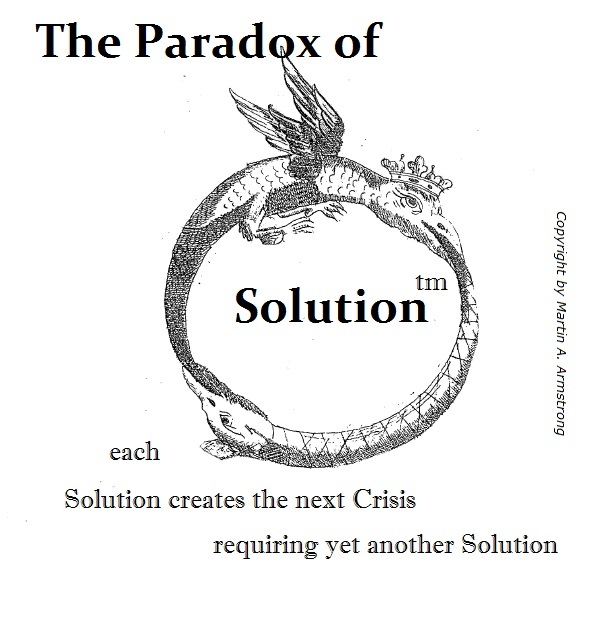
I have warned that whenever a government creates a solution to any crisis, that solution becomes the next crisis. This is what I have called the Paradox of Solution.The unfolding of the exit of the central banks from the Quantitative Easing monetary policy will become a much more serious threat to the financial markets than anyone suspects. The Federal Reserve has already exited and begun to raise rates while also announcing it will NOT be reinvesting the money when the government debt they bought expires. The Federal Reserve is already shortening their balance sheet. Bills of $426 billion will be due at the Fed in 2018, and again about $357 billion a year later. So the Fed will not repurchase that debt. The US economy is absorbing this because US dollars are effectively the only real reserve currency in the world right now.
The real problem lies with the European Central Bank (ECB) and the Japanese central bank and when they exit their Quantitative Easing programs, their economies are not the reserve currency and lack a solid bid from international capital. The end of QE will lead to a sharp increase in yields on the bond markets, and thus the financing costs for the states will explode far more rapidly today than at any time in past history. It is also possible that other sectors of the financial system, such as the stock markets and the foreign exchange markets in peripheral economies to the USA, will be cast into turmoil experiencing great difficulties without the financial support of the central banks.
Since 2008, the Bank of Japan recorded an increase of 107 trillion yen. The ECB has more than doubled its balance sheet from EUR 2 trillion to EUR 4.1 trillion and holds 40% of member state debt while tensions rise against the EU. The crisis emerges when governments, who are the ones who have been subsidized since 2008, find no bid for their paper. This will really send rates upward at a rapid pace.
As central banks appeared as omnipotent purchasers of government bonds to the un-savvy trader, the yields of the debt by no means reflect the risk of a default in the country’s payments. The decline in yields masked the rising risks from fiscal mismanagement that has been widespread.
While the Federal Reserve had recently announced that it would no longer reinvest its gains on government bonds that had matured into new US securities, the US bond market will need to find new buyers to absorb the additional supply. That may not be a problem right now, but as other government debt moves into crisis, we will see the capital flight from bonds to equities unfold.
The balance sheets of both the Japanese central bank and the ECB are unlikely to follow the Fed just yet. A withdrawal of the ECB’s purchases of securities could produced the most widespread damage in Europe since the Dark Ages.
Do you remember the ABC radio commentator Paul Harvey? Millions of Americans listened to his programs which were broadcast over 1,200 radio stations nationwide.
When you listen to this amazing prediction, remember the commentary was broadcast 52 years ago on April 3, 1965.
Good grief. NBC’s Chuck Toad spent two-thirds of his interview opportunity with Secretary of State Rex Tillerson asking repeated questions about the preferred Democrat narrative known as the ‘Muh Russian conspiracy’.
However, Tillerson did have the opportunity to push back against Senator John McCain’s ridiculous attacks against Secretary T-Rex. Anyone who watched the T-Rex talk to the State Department on May 3rd can fully understand the context of Tillerson’s outline of distinction between “U.S. policies” and “U.S. Values”. If you haven’t watched or read the speech you should, SEE HERE.
Senator John McCain was furious that Secretary Tillerson would not accept the McCain/Powers “Responsibility to Protect” doctrine which mandates U.S. foreign policy as interventionist around the globe. Senator McCain wrote an op-ed opposing Tillerson and demanding that U.S. policy must include creating more wars around the world.
.
Here is Secretary Tillerson’s actual words in context, that Senator McCain finds so fundamentally abhorrent:
T-Rex talks about the ongoing State Dept. mission and how values and policies intersect with the larger ‘America-First’ strategy.
Specifically T-Rex explains how the distinction between U.S. ‘values’ relates to U.S. ‘policy’ but determinations of influence and our best interests cannot necessarily be contingent upon foreign governments accepting values that are inherently different to their culture.
These remarks delivered to State Dept personnel are exceptionally well presented and intensely interesting.
.
[Transcript] SECRETARY TILLERSON: Good morning. (Applause.) Thank you. Thank you. Are we on? Can you all hear me back there in the back? Can you hear me now? (Laughter.) Can you hear me now?
AUDIENCE: Yes.
SECRETARY TILLERSON: All right. I told them I have to walk around. My wife has always said if you tied my hands down to my side, I would be a complete mute. (Laughter.) So I’m not great at podiums. I do know how to read a speech, but I thought today we’d just have a chat.
So I’ve been here about three months now, we’ve been working alongside one another, and so I thought it’d be worthwhile to just share a few of my perspectives with you on where I think we are and some things that are coming that I know are of interest to you.
But before I do that, I would be remiss if I did not thank all of those who have stepped into acting roles during these past three months to help me, and starting with acting Deputy Secretary Tom Shannon, who’s just been stellar. (Applause.) But I also want to acknowledge the large number of people who are – stepped into under secretary, assistant secretary roles, director roles, and a number of chief of missions around the world as well.
Your willingness to step up and not just fill that role, but to take responsibility for the role and to lead the organization through some pretty challenging first 90 days – it’s not like we haven’t had some things to work on. And so I want to express my appreciation to all of you for helping me and helping my team as we came on board. And I’ve just been really gratified at the work that everyone’s undertaken in that regard.
So I thought we’d talk about a couple of things. I want to share my perspective as to how does this administration’s policies of “America first” fit into our foreign policy and foreign affairs. And so I want to touch on that. And then I’ll take a quick walk around the world.
Most of you have some familiarity of what’s going on around the world, but I thought just regionally I’d hit each one of them very quickly, to share with you my perspective on kind of where I feel we are, and then in some areas where we’ve not yet had time to devote the attention to we would like, and I don’t want that to be in any way considered that we don’t think those are important. It’s kind of a – what’s the hottest fire that we’ve got to deal with?
So I want to talk about that a little bit, and then spend some time at the end talking about where we’re going in the future of the department, USAID, and, as you know, we just kicked off this listening exercise.
So let’s talk first about my view of how you translate “America first” into our foreign policy. And I think I approach it really that it’s America first for national security and economic prosperity, and that doesn’t mean it comes at the expense of others.
Our partnerships and our alliances are critical to our success in both of those areas. But as we have progressed over the last 20 years – and some of you could tie it back to the post-Cold War era as the world has changed, some of you can tie it back to the evolution of China since the post-Nixon era and China’s rise as an economic power, and now as a growing military power – that as we participated in those changes, we were promoting relations, we were promoting economic activity, we were promoting trade with a lot of these emerging economies, and we just kind of lost track of how we were doing. And as a result, things got a little bit out of balance.
And I think that’s – as you hear the President talk about it, that’s what he really speaks about, is: Look, things have gotten out of balance, and these are really important relationships to us and they’re really important alliances, but we’ve got to bring them back into balance.
So whether it’s our asking of NATO members to really meet their obligations, even though those were notional obligations, we understand – and aspirational obligation, we think it’s important that those become concrete. And when we deal with our trading partners – that things have gotten a little out of bounds here, they’ve gotten a little off balance – we’ve got to bring that back into balance because it’s not serving the interests of the American people well.
So it doesn’t have to come at the expense of others, but it does have to come at an engagement with others. And so as we’re building our policies around those notions, that’s what we want to support. But at the end of it, it is strengthening our national security and promoting economic prosperity for the American people, and we do that, again, with a lot of partners.
Now, I think it’s important to also remember that guiding all of our foreign policy actions are our fundamental values: our values around freedom, human dignity, the way people are treated. Those are our values. Those are not our policies; they’re values. And the reason it’s important, I think, to keep that well understood is policies can change. They do change. They should change. Policies change to adapt to the – our values never change. They’re constant throughout all of this.
And so I think the real challenge many of us have as we think about constructing our policies and carrying out our policies is: How do we represent our values? And in some circumstances, if you condition our national security efforts on someone adopting our values, we probably can’t achieve our national security goals or our national security interests.
If we condition too heavily that others must adopt this value that we’ve come to over a long history of our own, it really creates obstacles to our ability to advance our national security interests, our economic interests. It doesn’t mean that we leave those values on the sidelines. It doesn’t mean that we don’t advocate for and aspire to freedom, human dignity, and the treatment of people the world over. We do. And we will always have that on our shoulder everywhere we go.
But I think it is – I think it’s really important that all of us understand the difference between policy and values, and in some circumstances, we should and do condition our policy engagements on people adopting certain actions as to how they treat people. They should. We should demand that. But that doesn’t mean that’s the case in every situation. And so we really have to understand, in each country or each region of the world that we’re dealing with, what are our national security interests, what are our economic prosperity interests, and then as we can advocate and advance our values, we should – but the policies can do this; the values never change.
And so I would ask you to just – to the extent you could think about that a little bit, I think it’s useful, because I know this is probably, for me, it’s one of the most difficult areas as I’ve thought about how to formulate policy to advance all of these things simultaneously. It’s a real challenge. And I hear from government leaders all over the world: You just can’t demand that of us, we can’t move that quickly, we can’t adapt that quickly, okay?
So it’s how do we advance our national security and economic interests on this hand, our values are constant over here.
So I give you that as kind of an overarching view of how I think about the President’s approach of “America first.” We must secure the nation. We must protect our people. We must protect our borders. We must protect our ability to be that voice of our values now and forevermore. And we can only do that with economic prosperity.
So it’s foreign policy projected with a strong ability to enforce the protection of our freedoms with a strong military. And all of you that have been at this a long time understand the value of speaking with a posture of strength – not a threatening posture, but a posture of strength. People know we can back it up.
So with that in mind, let me just quickly walk around the world and give you my assessment of where we are in some of the early stages of policy that’s underway and some that’s yet to be developed.
So as all of you clearly understand, when we came in to the State Department, the administration came in, was sworn in, immediately confronted with a serious situation in North Korea. Now, the prior administration, as all of you know, President Obama told President Trump this was going to be your greatest threat that you’re going to have to manage, and he was right.
♦ So it was – it’s right on the doorstep. And so it got immediate attention. It was the first policy area that we began to develop in terms of what is our overarching strategic approach and how do we want to execute against that. In evaluating that, what was important to us and to me to understand was, first, where are our allies? And so engaging with our allies and ensuring that our allies and we see the situation the same – our allies in South Korea, our allies in Japan.
And then, secondly, it was to engage with the other regional powers as to how do they see it. And so it was useful and helpful to have the Chinese and now the Russians articulate clearly that their policy is unchanged; they – their policy is a denuclearized Korean Peninsula. And of course we did our part many years ago. We took all the nuclear weapons out of South Korea. So now we have a shared objective, and that’s very useful, from which you then build out your policy approaches and your strategies.
So many people are saying, well, gee, this is just the same thing we’ve tried over and over – we’re going to put pressure on the regime in Pyongyang, they’re not going to do anything, and then in the end we’ll all cave. Well, the difference, I think, in our approach this time is we’re going to test this assumption, and when the – when folks came in to review the situation with me, the assumption was that China has limited influence on the regime in Pyongyang, or they have a limited willingness to assert their influence. And so I told the President we’ve got to test that, and we’re going to test it by leaning hard into them, and this is a good place to start our engagement with China.
And so that’s what we’ve been doing, is leaning hard into China to test their willingness to use their influence, their engagement with the regime in North Korea. All of it backed up by very strong resolve on our part to have a denuclearized peninsula with a commitment to our security alliances on the peninsula and in the region to our important allies Japan and South Korea.
So it’s a pressure campaign that has a knob on it. I’d say we’re at about dial setting 5 or 6 right now, with a strong call of countries all over the world to fully implement the UN Security Council resolutions regarding sanctions, because no one has ever fully implemented those. So we’re going to lean into people to fully implement them. We’ve told them we’re watching what you’re doing. When we see you not implementing, we see companies or we see individuals that are violating these sanctions, we’re going to contact you and we’re going to ask you to take care of it. If you can’t take care of it or you simply don’t want to take care of it for your own internal political reasons, we will. We’ll sanction them through third-country sanctions.
So we are being very open and transparent about our intentions, and we’re asking our partners around the world to please take actions on your own. We want you to control how that happens. We’re not trying to control it for you, but we have an expectation of what you will do. So we’re putting that pressure on. We are preparing additional sanctions, if it turns out North Korea’s actions warrant additional sanctions. We’re hopeful that the regime in North Korea will think about this and come to a conclusion that there’s another way to the future. We know they have – they’re – they aspire to nuclear weapons because it’s the regime’s belief it’s the only way they can secure their future.
We are clear – we’ve been clear to them this is not about regime change, this is not about regime collapse, this is not about an accelerated reunification of the peninsula, this is not about us looking for an excuse to come north of the 38th Parallel. So we’re trying to be very, very clear and resolute in our message to them that your future security and economic prosperity can only be achieved through your following your commitments to denuclearize.
So this is where we are. We’re at – I would say we’re at about the 20 to 25 percent stage of this strategy. Thus far, our assessment is it is going like we had hoped for in terms of the response we’re getting from others, but we’ve got a lot of work left to do to keep that pressure on. And so that’s what the folks that are in the bureaus and out in the missions are doing to help us right now, is to continue this steady, resolute message and continue to talk out here to the North Koreans, but not here, yet, about what our intentions are and what we want. We are ready and prepared to engage in talks when conditions are right.
But as you’ve heard me say, we are not going to negotiate our way to the negotiating table. That is what Pyongyang has done for the last 20 years, is cause us to have to negotiate to get them to sit down. We’ll sit down when they’re ready to sit down under the right terms. So that’s North Korea.
♦ And then if I pivoted over to China, because it really took us directly to our China foreign policy, we really had to assess China’s situation, as I said, from the Nixon era up to where we find things today, and we saw a bit of an inflection point with the Sochi – with the Beijing Olympics. Those were enormously successful for China. They kind of put China on the map, and China really began to feel its oats about that time, and rightfully.
They have achieved a lot. They moved 500 million Chinese people out of poverty into middle class status. They’ve still got a billion more they need to move.
So China has its own challenges, and we want to work with them and be mindful of what they’re dealing with in the context of our relationship. And our relationship has to be one of understanding that we have security interests throughout northeast Asia and security interests throughout the Pacific, and we need to work with them on how those are addressed. So that gets to the island building in the South China Sea, the militarization of those islands, and obviously, we have huge trading issues to talk with them about.
So we are using the entree of the visit in Mar-a-Lago, which was heavy on some issues with North Korea but also heavy on a broader range of issues. And what we’ve asked the Chinese to do is we’re – we want to take a fresh look at where’s this relationship going to be 50 years from now, because I think we have an opportunity to define that. And so I know there have been a lot of dialogue areas that have been underway for the last several years with China. We have asked China to narrow the dialogue areas and elevate the participants to the decision-making level.
So we outlined four major dialogue areas with China, and we’ve asked them to bring people who report directly to the decision-maker, which is President Xi. So for the first time, we are seeking and we – so far it appears we will get people at the politburo level and at much higher levels of the government within China to participate in these dialogues so we can reframe what we want the relationship to be and begin to deal with some of the problems and issues that have just been sitting out there kind of stuck in neutral for a while. So it is a – it’s a much narrower – as we make progress, those things will result in working groups where we can get after solving these things.
So we’re going to have the first meeting of the Diplomatic and Security Dialogue, which is chaired by myself and Secretary Mattis, with our counterparts here in Washington in June, and we’ve put it up as a kind of top priority. The second one is economic and trade, which is chaired by Treasury Secretary Mnuchin and Commerce Secretary Ross, and it’s well underway also.
So that’s kind of the new approach we’re taking with China, is elevate, let’s kind of revisit this relationship, and what is it going to be over the next half century. I think it’s a tremendous opportunity we have to define that, and there seems to be a great interest on the part of the Chinese leadership to do that as well. They feel we’re at a point of inflection also. So that’s China.
Obviously, throughout Asia we’ve got a lot of work do with ASEAN nations and re-solidifying our leadership with ASEAN on a number of security issues but also trade issues and the South China Sea, strengthen relations with Australia and New Zealand – really important partners with us on a number of counterterrorism fronts.
And so throughout the region those engagements are underway. And the President has committed to make the trip to Vietnam and to the Philippines for those meetings this fall, and I think that’s going to be very important that he is going, and we’ll be going in advance, obviously, to prepare for all of that.
♦ So if we walk around to the next hot spot that we worked on, pretty quickly it was the Middle East around the campaign to defeat ISIS and instability that that’s created in, obviously, Syria, Iraq, the issues in Afghanistan.
And as those of you who work that region well know, you can just kind of draw the concentric circles out all the way into North Africa, parts of Africa, all of the Middle East, parts of Central Asia, and this is really a D-ISIS and a counterterrorism effort, is what it really boils down to. And so how do we develop policies and bring regional players together to address these threats of ISIS and counterterrorism?
And we hosted I think what was a very successful coalition to defeat ISIS ministerial here at the State Department. I think there is a real renewed sense of energy and commitment to win this war against ISIS. We will; we are defeating ISIS in their caliphate in Syria and Iraq, but we know that ISIS exists more broadly than that. And so, as we said in that coalition effort, we’ve got to move beyond the battlefield, we’ve got to move into the cyberspace, we’ve got to move into the social communications space, and get inside of the messaging that allows them to recruit people around the world to their terrorism efforts.
So there is a big effort underway with players in the region, most notably the Kingdom of Saudi Arabia, and working with other partners to get inside of this conversation that’s going on within the Muslim community around what this is doing to the way the Muslim faith is understood by others in the world. And I would say it’s a very open conversation we’re having and a renewed commitment on the part of leaders in the Muslim world that want to take this on. So we’re going to be leveraging on that as well.
So as you’re seeing this play out in the Middle East, still a lot of hard work to do to get coalition partners together around ceasefires and peace processes in Syria. How do we advance our interest in Afghanistan to a legitimate peace process is what we’re pursuing in Afghanistan, and then keeping this terrorism network confined as it wants to spread itself through North Africa and Central Africa. So a lot of work ahead of us, and many of you are directly engaged in it already; many more of you are going to become engaged in it, I think you can expect.
♦ The next kind of area of priority is our re-engagement with Russia. Obviously, they are part of the engagement in Syria, but we have other issues with Russia, as you all well know, in Europe, and the situation in Ukraine.
As I know many of you heard from my trip to Moscow, characterized to President Putin that the relationship between our two nations was the lowest it’s been since the Cold War. He did not disagree. He shrugged his shoulders and nodded in agreement. And I said it’s spiraling down, it’s getting worse. And my comment to him was you – we cannot have, the two greatest nuclear powers in the world cannot have this kind of relationship. We have to change it.
And so we have a number of efforts underway to first stabilize the relationship. And Deputy Secretary – acting Deputy Secretary Shannon is leading a working group effort to see if we can address some of the things that are just irritating the relationship, that make it hard for us to talk to one another even in civil tones.
So we’re working hard on that and we’re hoping to begin to solve some of that, while Foreign Minister Lavrov and I, under the direction of President Putin and now President Trump, coming out of the call yesterday are going to continue to see if we can work together on the first big area of cooperation, which would be Syria, and can we achieve a ceasefire that will hold long enough for us to get a peace process underway.
I don’t want to say we’re off to a great start on this, because it’s very early stages. I don’t know where it will go. So I’ve got a bilateral with Foreign Minister Lavrov in Alaska next week on the margins of the Arctic Council. Both our presidents have charged us to take this further and see where we can go with it.
So obviously, close coordination with the Department of Defense, with our intelligence agencies, and importantly our allies in the region, because we want them to always know what we’re doing, because we’re going to need their support as well.
So a lot of work ahead of us on the Russia engagement – work some small things, can we work one big thing together. If we can find space for something we feel we can begin to rebuild some level of trust, because today there is almost no trust between us. Can we build some level of trust?
We’ve got a long list of things to work on from our arms agreements and issues we have with our nuclear arms agreements, to obviously, getting to Ukraine, Crimea, and other places where Russia is not being particularly helpful today.
So that’s what we’re hoping, is that we can begin to build a way in which we can learn how to work with one another. I don’t know whether we can or not. We’ll – we’re going to find out.
♦ So quickly to other parts of the world that are really important to us as well – the continent of Africa is so important from the standpoint that first, from a national security view, we cannot let Africa become the next breeding ground for a re-emergence of a caliphate for ISIS. We also cannot allow the terrorist networks that weave their way through Africa to continue unabated.
You can connect the dots between countries throughout the central part of Africa and northern part of Africa where the terrorist networks are connected. We’ve got to get into the middle of that and disrupt that to save those countries.
But Africa is also a continent of enormous opportunity, and needs and will get and will continue to receive our attention to support stabilizing governments as they are emerging and continuing to develop their own institutional capacity, but also looking at Africa for potential economic and trading opportunities. It’s a huge, I think, potential sitting out there, waiting for us to capture it, and then, obviously, a big focus of our health initiatives, because Africa still struggles with huge health challenges. And those are important to us and they’re going to continue to get our attention.
So we’re going to – we’re working – today we have some things we’re working in North Africa relative to its relationship to the Middle East challenges and our ISIS challenges. We’ve got to step back and take a more comprehensive look at our approach to the entire continent, and that’s out in front of us as well.
♦ And then lastly, I want to go to the Western Hemisphere. And in the Western Hemisphere, obviously, our neighbors are vitally important to us, Canada and Mexico. It’s not as rocky as it looks sometimes, and I think, in fact, the relationships are quite good. Both of our neighbors understand we have to refresh some of the agreements that have governed our relationship, particularly in the areas of trade, and both countries are ready to engage in a good-faith effort with us as well.
In particular, we’re investing a lot of effort into Mexico because of the transmigration issues and organized crime. And so we have an initiative underway where the senior members of the Mexican Government will be coming up here on May the 18th to participate in an interagency process with us to see if we can get at transnational organized crime and begin to break these organized crime units up.
Not only are they a threat to us and to Mexico’s stability and the scourge of drugs that just flow into this country, they also are part of the integrated terrorist financing networks as well. So this is vital to us for a number of reasons and we look forward to making some progress there.
South of Mexico, we’ve got some initiatives underway to work with the Latin American countries, which are where a lot of the people are trying to leave to come up to the U.S., to continue economic development, security investments in Latin America, and working with the Department of Homeland Security.
We’re actually hosting an event in Miami to bring those leaders up so we can talk with them about how we get better organized to address these issues and how we can bring more private capital into investment opportunities in Central and Latin America.
Southern cone, we have a lot of opportunity and some challenges down there. What we want to do is step back and develop a Western Hemisphere strategy that thinks about South America in its entirety and its relationship to Central America, but Cuba and the Caribbean as well.
There are terrorist financing issues. There are terrorist networks that are beginning to emerge in parts of South America that have our attention. There are governance issues in certain countries – certainly all of you are following the situation in Venezuela; a real tragedy, but we’re hopeful that working with others, including interventions by others in Europe, that we may be able to gain some traction in Venezuela. So we have a number of things in front of us yet to develop clear policies on how we want to go forward.
So my view is that we want to look at these regions almost in their entirety first, because everything is interconnected. We can take a country and develop something, but if we don’t have the perspective regionally, we’re probably not going to be as effective. So we’re trying to start out here, and then we’ll bring it down to a country-by-country level so we can execute. So that’s just to give you a little perspective on how we’re approaching these things in policy planning, and then we try to get a big-picture view and then we bring the bureau people in, the experts in, and help us start developing, now, how do you execute something like this? How do you implement it?
So for those of you that have participated in these early efforts, thank you. I feel quite good about the one – the pieces that have been completed and are in execution, I feel good about those. I can tell you the White House feels good about it.
The National Security Council really values the work that we provide in the interagency process. And I would share with you I hear that from them all the time, that the stuff that comes over from the State Department, we’ve done our homework. It’s a complete piece of work, it’s useful, we can use it, and that’s not always the case from all of the other agencies. So thank you for the efforts you’re putting into that in that regard.
♦ So let me turn now quickly to the last thing I wanted to talk about, which is the future and where we’re going. And I alluded to this a little bit when I was commenting about the post-Cold War era. And during the Cold War – and I’ve had this conversation with some of you in this room before in our interactions – in many respects the Cold War was a lot easier.
Things were pretty clear, the Soviet Union had a lot of things contained, and I had a conversation with Secretary-General Guterres at the UN. He described it as during the Cold War, we froze history. History just stopped in its tracks because so many of the dynamics that existed for centuries were contained. They were contained with heavy authoritarianism. And when the Cold War ended and the Soviet Union broke up, we took all of that off and history regained its march. And the world got a whole lot more complicated. And I think that’s what we see. It has become much more complicated in terms of old conflicts have renewed themselves because they’re not contained now. So that’s the world as it is and that’s the world we have to engage with.
And so I’m going to – I’m saying this as a preface to as we get into thinking about how we should deliver on mission is to be thinking about how the way we have been delivering was in many ways shaped and as a residual of the Cold War era. And in many respects, we’ve not yet transitioned ourselves to this new reality either. And I don’t say that just about the State Department, I say that about institutions globally.
In fact, this is the – this – I had this same conversation with Secretary Guterres about the United Nations, that there are many institutions – and you can see when we have our conversations with NATO, another example, but there are many institutions around the world that were created during a different era.
And so they were set up to deal with certain conditions and their processes and their organizations were set up, and as things have changed, we’ve not really fully adapted those. It’s not that we’ve not recognized, but we’ve not fully adapted how we deliver on mission.
So one of the things, as we get into this opportunity to look at how we get our work done, is to think about the world as it is today and to leave behind – we’ve been – well, we do it this way because we’ve been doing it this way for the last 30 years or 40 years or 50 years, because all of that was created in a different environment.
And so I think – I guess what I’m inviting all of you to do is to approach this effort that we’re going to undertake with no constraints to your thinking – with none.
One of the great honors for me serving in this department, the Department of State, and all of you know, the Department of State, first cabinet created and chartered under the Constitution. Secretary of State, first cabinet position chartered and created under the Constitution. So we are part of a living history and we’re going to get to carve our little piece of it, our increment, in that clock of time. We’re going to carve our piece into that history.
And I think the question is how we will do that; and how effectively we will do that. And history is moving around us as we just spoke. And how do we adapt to that? And so I want to ask all of you to be very free in your thinking.
So the process going forward, as you know we’ve just kicked off this listening exercise and I really encourage all of you to please go online and participate in the survey online. This is vital to how we understand where we want to go and I think we have about 300 individuals that we’ve selected to sit down face-to-face and do some interviews so we have a more fulsome understanding.
We want to collect all of these – all this input and your thoughts and ideas, both here and at USAID, and that is going to guide how we approach both our organizational structure, but more importantly, our work process design: How do we actually deliver on mission? That’s the real key. How do you deliver on mission?
And really, the way I have found these things to be the most successful is I understand how to deliver on mission first, I understand how the work processes work, and then I’ll put the boxes around it to make all that work. Most people like to start with the boxes and then try to design it. I’m – I do it the other way around. How do we get the work done? We’ll then put the organization structure in place to support that.
So we need a lot of creative thinking. We need to hear from you. This is going to inform how this turns out. I want to emphasize to you we have no preconceived notions on the outcome. I didn’t come with a solution in a box when I showed up. I came with a commitment to look at it and see if we can’t improve it.
And I know change like this is really stressful for a lot of people. There’s nothing easy about it, and I don’t want to diminish in any way the challenges I know this presents for individuals, it presents to families, it presents to organizations. I’m very well aware of all of that.
All I can offer you on the other side of that equation is an opportunity to shape the future way in which we will deliver on mission, and I can almost promise you – because I have never been through one of these exercises where it wasn’t true – that I can promise you that when this is all done, you’re going to have a much more satisfying, fulfilling career, because you’re going to feel better about what you’re doing because of the impact of what you are doing.
You will know exactly how what you do every day contributes to our delivery on mission, and that is when I find people are most satisfied with their professional careers. And you’re going to have clear line of sight about what do you want for yourself in the future.
So this is a – it’s a big undertaking. This is a big department, between this and USAID, and we are including all of our missions, all of our embassies, all of our consular offices, because we all are part of how we deliver on mission. So we want to look at it in its entirety as to how we do that.
So I appreciate your participating openly in this listening exercise, but importantly, I want to condition you to be ready to participate in the next phase, because that’s when it’ll become more challenging.
But we’re all on this boat, on this voyage – I’m not going to call it a cruise; it’s not – may not be that much fun. (Laughter.) But we’re on all this ship, on this voyage together. And so we’re going to get on the ship and we’re going to take this voyage, and when we get there, we’re all going to get off the ship at wherever we arrive. But we’re all going to get on and we’re going to get off together. We don’t intend to leave anybody out.
So I appreciate your participation. I hope you will approach this with a level of excitement as to what it may hold for this State Department first and then for you as an individual and what it means for you. So we’re asking all of you to do that.
Let me lastly say that I do appreciate all of the work that you do. Believe it or not, I do read all these memos that come to me from – all the way from missions to the various bureaus. I appreciate those of you that get them on one page, because I’m not a fast reader. But they’re extraordinarily helpful to me, and so keep sending me insights as to what you’re doing, how you’re doing it, and in particular the perspective on how we got to where we are. It is very valuable to me.
I had the opportunity to address a group of young people yesterday – about 700 middle school, high school people – that were here participating in the model UN conference. We were hosting it here at the State Department. One of the – there’s a few fun things you get to do in this job, and talking to young people is one of them. So I had a Q&A time, and a young lady – I think she was in middle school – asked a question. She said, “What inspires you as Secretary of State when you come to work every day?” And I told her it’s quite easy. I said the men and women of the State Department inspire me, my colleagues – their professionalism, their commitment, their patriotism.
And I said, then our partners over at the Department of Defense, the men and women in uniform, because it’s really the State Department and the Defense Department that deliver our national security. I’m inspired by you, and I thank you for that, and I’m honored to serve alongside of you.
This post was written in 2012. I have made some additions, but left the bulk of the post intact. For clarity, since my changes involve people and time, the additions are in italics.
This has been a very special year in our family, this past year since Mother’s Day 2011. First, we had a beloved addition to our family in May 2011, Sarah Isabella. She arrived several months early, and many of you Treepers prayed for her and her mother after her birth. Then, in March of this year, the arrival of Sadie made me a grandmother for the first time. These two births, as well as some challenges other friends and family members have faced being mothers has made me think a great deal about motherhood, and the unique challenges it brings. A recent conversation with another mother whose children are now adults added more perspective. Last year, I did a post about the history of Mother’s Day. Most people think about their mother or grandmother, or perhaps a favorite aunt, when the topic is Mother’s Day. We adults tend to think of our mature mothers, or perhaps even an elderly mom. Because two young mothers have been in my thoughts and prayers this year, as well as my heart, I thought about writing something to honor those young women, the mothers who struggle so hard with the demands only a young family faces. A recent conversation inspired me to take it a little further. So, I would like to write about the stages of motherhood, and perhaps, for the sake of coherence and the story, I will make assumptions about families that may not match everyone’s experience. That does not mean I value your experience less.
With the first baby comes overwhelming love, awe, fear, joy, and the gushing happiness specific to motherhood. You have had 9 long months to prepare for this precious little miracle God is entrusting to you, and yet you are not ready, you can never really be prepared. How can you be prepared for that first embrace, the soft, sweet skin, the way your heart just stops at the first cry? How can you anticipate the perfection of the unfocused stare of your baby? The completion of your family, the way your love for your husband, and his for you, is multiplied and increased, the way that three people have become a little universe of love? How can you possibly imagine the utter weariness of night upon night without sleep? The fear at the first cough or hiccup? The inner warrior woman you never knew existed who is ready to leap into action at any threat to that child? The hopes, the dreams, the plans you and your husband share as you hold that little part of you?
And so a family grows, and so does a mother. She learns that a cry is not a notice of imminent harm to her child, that a sneeze does not require a call to the doctor, that she can indeed care for a family, go to work, pick up the laundry, and live with spots on her clothes, all on four hours of sleep on a good day. Perhaps a year or two down the road, she is blessed with another child, and the cycle of life and love continues. The little family again finds that love’s multiplicative power is infinite. The second child arrives with a little less fear, but just as much love. This time, Mom knows what she is in for, and she knows that she also has this first little one to care for, as well as the new baby. Now she has gained confidence, emotionally, and physically. She is able to carry a toddler in one arm and a baby in the other, with a diaper bag, purse, and a bag of groceries, all while using a foot to block the dog and open the door. Home life has a routine, and things are not perfect, but very good…and that is fine. Each additional child is a perfect blessing, adding much to the family, each special and needed and loved.
The school years start, and the real juggle begins. School clothes, homework, lunches, field trips, friends, hurt feelings, report cards. Mom learns to be a tutor, a defender, a referee, and an advocate. She must stand strong, proud and often alone, in defense of what is right, which often differs from what is wanted. All of these demands are like Mom boot camp. Hopefully, they have partially prepared her for the teen age years. Nothing short of direct intervention by God could actually prepare a mother for those years, never mind that she herself actually once was a teenager, in a time and land far, far away. And so, with the years and experiences, the mother has grown, matured, become someone who is so strong, so powerful, she can withstand the whine of a young lady who is sure she is the only one who doesn’t have a snakeskin belly ring, and the indignant glare of the young man who doesn’t get to take the family car out on Saturday night. She sleeps lightly, if at all, when her children are out, knowing the dangers that await them, the terrible choices she can prepare them for, but never make for them. She rejoices at their triumphs, and agonizes at their pain. She knows she must let them pull away, make mistakes, fall and hurt themselves, just as they did when they took their first steps. But, oh, how that hurts.
One fine day, she sits at the front of the church with tears in her eyes as her child makes the vows that will found a new family. This child of hers is now grown, and she thought she would sigh in relief at the easing of responsibility, the freedom she now has. But she has learned a new lesson, a very hard lesson getting to this point. Her sons and daughters must make their own way in a sometimes cruel world, and she knows that now, the less she does for them, the stronger they are. She must let them take the hard knocks, the heartbreak, possibly even the despair. To interfere would be to weaken them, and that she will not do. She must learn when she is truly needed, as a mother will always be needed, and when she can only pray.
Then comes the day when she hears the most magical words in all of the world. “Mom, we’re going to have a baby.” Or perhaps, as in our family, wonderful new children to love come along with their beautiful mothers who marry into the family. More children to love, children who you weren’t able to hold as a babe, children who already belong to other grandparents as well. Love has brought more wonderful young people into your family. And the cycle starts again, for a new mother, and an older mother. One who must learn to nurture and care, and one to hold, and to let go. The world turns, the seasons change, the children grow up. A new generation is born, and the same responsibilities must be met. One thing holds it all together, one thing makes it all possible. Love. It takes a whole lot more than love to raise a family, but it all starts there. Love is the essential spark that starts the fire. Love is the foundation, and it never gets used up, or broken, or tarnished. Love shines brightly with an eternal light. It crosses generations, and it breaches the gap between this world and the next. For each of us who have lost our mother, our grandmother, or a beloved mother in law have seen that light, felt the warmth of love long after the loved one is gone.
For the gifts of my own grandchildren Sadie, Mason, Conner, for Hayden, Micah, Macie who will officially join the family this August, but in reality are already ours, for Grey and his brother Wyatt who will make his entry into our lives in the next few weeks, my heart swells with love and joy, pride and happiness. My prayers will be with you for all eternity, bound together with you through the Communion of Saints. May you know the love of God that keeps you all of your lives.
The Treehouse wishes all of our mothers a happy and blessed day. We hope you are enjoying the company of family and friends, and that you will perhaps take a moment and share a special memory or two of a beloved woman in your life, or tell a tale or two about your own children., Grandmothers
QUESTION: I very much look forward to reading your blog every day and feel that I am learning much. I don’t know much about BitCoin but I note that it has almost doubled since the beginning of the year. Does your model have any insight into the future of cryptocurrencies like BitCoin.
MR
ANSWER: The problem with BitCoin is precisely that. It is akin to the problem that existed when the bubble burst in 1966 with mutual funds because they were listed back then. People bid the funds up beyond net asset value so when the crash came, people lost everything when they though it was a secure investment. The net underlying assets may have dropped 20%, but they paid 20% over net asset value and then sold at 50% of net asset value. Ever since, mutual funds are no longer allowed to be listed. You go in and out at net asset value.
In this way, BitCoin is not ready for prime time. However, that is a separate and distinct problem from the technology. For now, BitCoin represents a threat to governments for it is used to get money out of places, avoid taxes, and is an alternative currency. Throughout history there have been alternative currencies and as long as people accept them, at times, they have become the major currency when government crash and burn. (see Two-Tier Monetary Systems & Local Alternative Currencies)
Longer-term, this technology may be the future after the crash and burn
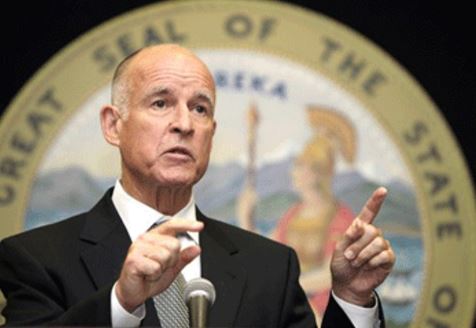
Governor Jerry Brown never saw a problem that could not be solved by just raising more taxes. This time, the state pension fund is going broke as we have been warning with the building Pension Crisis thanks to mismanagement and low interest rates thanks to Larry Summers. California has already increased its gasoline tax by 50% in the past decade. Now to bailout the state employee Pension fund, Gov. Brown has proposed a 42% increase in gasoline taxes and, get this, a 141% increase in vehicle registration fees. Nobody talks about cutting government employee pensions. NEVER! Why when you have a population to milk like the cow
Two great interviews with Commerce Secretary Wilbur Ross, aka “Wilburine”. Secretary Ross is easily the most comprehensively well-versed trade policy commerce secretary in modern history, perhaps ever.
Wilburine is discussing the recent U.S./China trade breakthrough. –BACKSTORY HERE– Additionally, at 08:30 of the interview Ross discusses NAFTA against the backdrop of the Senate not yet accepting his “letter of intent” to renegotiate the agreement. Secretary Ross discusses how Robert Lighthizer’s confirmation should help speed up the senate process.
.
In substantive terms the bigger aspect to remember is how much more leverage there is in bilateral trade negotiations than multilateral agreements.
The Trans-Pacific-Partnership (TPP) would have held the U.S. hostage to agreements that in many cases were against our interests and to the benefit of the larger group of TPP nations. Former Secretary of State John Kerry stated openly: while China was not part of the original TPP framework, the participating nations held open a back door for China to enjoin.
Because President Trump pulled away from TPP, the U.S. is able to negotiate terms for trade with our market that may have specific and purposeful benefit exclusive to the United States. This is critical as we review current negotiated bilateral deal with China.
.
As you watch this second interview it is worth noting FOX’s Neil Cavuto is very close personal friends with the U.S. Chamber of Commerce President Tom Donohue – the biggest lobbying group (spender) in Washington DC.
Donohue’s U.S. CoC wrote almost all of the structural language within the former TPP agreement. Trump won the presidency and trashed that globalist trade deal.
Wilburine politely smacks down Donohue as an annoying gnat; and Cavuto’s tender sensibilities show almost immediately thereafter.
On #1 – In two short months the Chinese market will be open to import from the U.S. beef industry. Previously, against the backdrop of BSE (bovine spongyform encephalopathy), ie. mad cow disease, China banned U.S. beef. That ban is now lifted.
#2 and #3 are connected. The U.S. will allow processed (cooked) Chinese chicken products to be imported to the U.S; However –important note– (#3) the U.S. politely forces China to adopt U.S. FDA type regulations, specifically HACCP (Hazard Assessment Critical Control Plans) in their manufacturing and processing of that product. China agrees.
This is important because under TPP there would have been a watering down of overall food-safety regulation due to the inability of TPP nations to be compliant with the stringent expectations exclusive to the U.S. However, because this deal is bilateral China is agreeing to a much more stringent set of food safety standards. Additionally, current U.S. “C.O.O.L (country of origin labeling) laws” will ensure that all China processed poultry will be readily identifiable. {remember, this is not raw product – it is processed}
#4 – Almost immediately the U.S. will be positioned to export Liquified Natural Gas to China. China is authorized to negotiate immediate import purchases of LNG from any U.S. energy company involved in the production and sale. Big boon for energy sector.
#5 – China begins a credit rating system for their citizens. This allows U.S. lenders to be able to evaluate the worthiness of loans to Chinese nationals, and also more stunningly removes the control authority from the Chinese government. This will expand freedom and democracy in China because the Chinese government will not as easily be able to control upward economic mobility based on patriarchy or oligarchy.
#6 – China agrees to a financial clearing house which guarantees payments to U.S. sellers who engage in trade with Chinese companies. Chinese manufacturers will not be allowed to default on their debts to U.S. exporters. In furtherance of this agreement #7 sets up the basis for electronic funds, bankcards and credit cards, which can be used in financial transactions between the U.S. and China. #8 retains the understanding that applicable U.S. law on these transactions applies to both nations. China/U.S. Buyers and Sellers are protected by the financial transactions as outlined in U.S. law.
“Compricated business froks, ..compricated business”…
President Donald Trump highlighted his commitment to faith, and to faith-based education, today with his decision to deliver the commencement speech for Liberty University and the graduating class of 2017.
President Trump delivered a wonderfully uplifting speech to the graduating class with a genuine appreciation of faith and, of course, his customary humor.
I have created this site to help people have fun in the kitchen. I write about enjoying life both in and out of my kitchen. Life is short! Make the most of it and enjoy!
This is a library of News Events not reported by the Main Stream Media documenting & connecting the dots on How the Obama Marxist Liberal agenda is destroying America





 This post was written in 2012. I have made some additions, but left the bulk of the post intact. For clarity, since my changes involve people and time, the additions are in italics.




 Centinel2012