President Trump Tried to Work Within the System


Posted originally on the conservative tree house on August 27, 2022 | Sundance 
In the spring and summer of 2018 everyone became aware of the DOJ and FBI collective effort to target President Trump under the false guise of a Trump-Russia collusion claim.

It must have been extremely frustrating for a sitting president to know there was nothing to the claims yet be constantly bombarded by media and political people in Washington DC who held a vested interest in maintaining them.

By the time we get to September of 2018 the basic outline of the FBI use of the Trump-Russia targeting operation were clear.  However, the Robert Mueller investigation was at its apex, and anyone in/around Donald Trump was under investigation for ancillary issues that had nothing to do with Russia.

It was into this fray of constant false narratives that President Trump first made statements that he would declassify documents related to his targeting.  It was after Trump made those statements when the real motives of putting Robert Mueller as a special counsel became clear.

With Attorney General Jeff Sessions recused from anything to do with the Trump-Russia investigation, it was Deputy Attorney General Rod Rosenstein who delivered the message to President Trump in September of 2018, shortly before the midterm election, that any action by him to release documents, now under the purview of the Mueller special counsel, would be considered an act of “obstruction” by the DOJ/FBI people charged with investigating him.

Immediately after meeting with Rod Rosenstein, Trump tweeted:
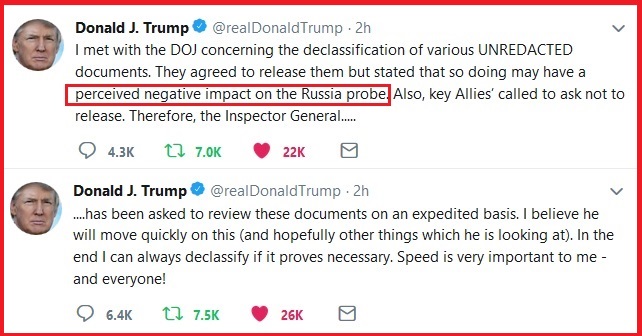
This was the first act of betrayal by political operatives within Main Justice who did not recognize or accept the concept of the ‘unilateral executive.’   According to Rod Rosenstein, FBI Director James Comey, Deputy FBI Director Andrew McCabe, and even later (including recently) AG Bill Barr, the office of the president cannot exercise unilateral executive authority when he himself is the subject of their investigative power.

In essence the DOJ and FBI, along with white house counsel and a collaborating senate and media, kept President Trump from declassifying and releasing documents by threatening him with impeachment and/or prosecution if he defied their authority.  The threats created a useful Sword of Damocles, and blocked Trump from acting to make documents public.

In the months that followed President Trump frequently made public statements and tweets about the frustration of documents not being declassified and released despite his instructions to do so.  Many Trump supporters also began expressing frustration.

The external debate and consternation surrounded how the Administrative State has seemingly boxed-in President Trump through the use of the Mueller/Weissman counterintelligence probe, authorized by Rod Rosenstein, where President Trump was the target of the investigation.

A widely held supporter perspective was that President Trump could expose the fraudulent origination of the counterintelligence investigation; of which he is now a target; if he were to declassify a series of documents as requested by congress and allies of his administration. This approach would hopefully remove the sword of Damocles.

The core issue within the debate surrounded two contradictory reference points: (1) President Trump has ultimate declassification authority.  Yes; however, in this example President Trump is also the target of the investigation; so, (2) declassification could be viewed by elements within the investigation as ‘obstruction’. Both of these points were true.

Also true was the reality that both laws and politics were in play.
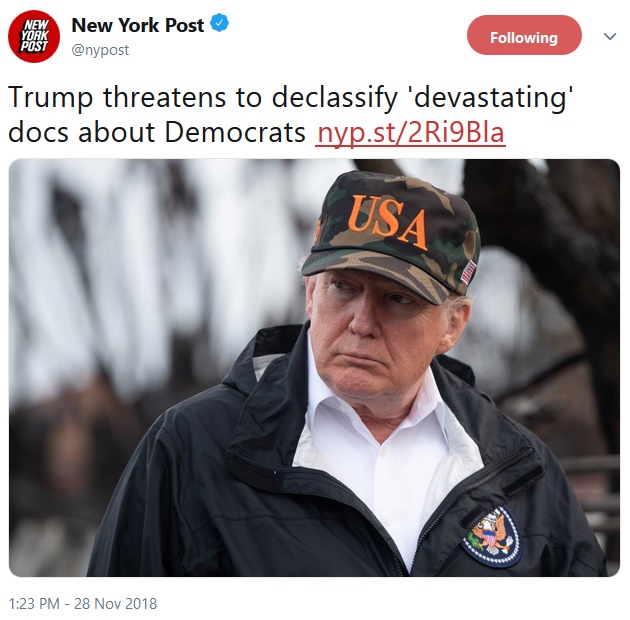
In November 2018 President Trump gave an interview where he discussed the situation as it was visible to him.  Democrats and republican opposition, writ large, were working earnestly to remove him from office.

Here’s a link to the General Principles of declassification [SEE HERE] Yes, the President can declassify anything; however, there is a process that must be followed. Executive order 13526 [Citation Here]

Following that declassification process the Office of the Director of National Intelligence, then Dan Coats, and the FBI Director, Christopher Wray, and the Attorney General, in this example Rod Rosenstein, needed to “sign-off” on the declassification.

The process reasoning is simple in the ordinary (non-corrupt) flow of events.  The intelligence agencies might need to protect part of the information, such as “sources or methods” of intelligence contained within the classified material.

Under ordinary declassification procedures the President would likely not want to compromise the ‘sources’ and ‘methods’ and would defer to the intelligence experts.

President Trump is aware of material that he can use to defend himself from the ongoing ‘impeachment’ plans of Nancy Pelosi and Chuck Schumer.  However, President Trump is also seemingly aware of the issues within the process to gain access to the material and actually use it.  This is where the concentric circle of lawyers around the Office of The Presidency come into play.

We have the constitution, we have laws, and we have politics.

Moving forward there are three background threads that are critical to understanding how this process has unfolded so far:

All three of these issues come into play.

Unfortunately, if you have not already invested the time in those three aspects it is easy, very easy, to get lost.

Because none of the legal linguistics took into account the reality of the actual process for declassifying information, many people were stuck thinking President Trump held sole authority to classify and declassify intelligence without understanding the process.

Declassification of intelligence is a process, and each person -within the executive branch- inside the process must agree to the process.  Making the process even more riddled with issues is the reality that President Trump was the target in a counterintelligence investigation. President Trump was being investigated by Mueller to see if he is under the direct or indirect influence of a foreign power. [In this example, Russia]

The Mueller probe is an originating counterintelligence investigation that ‘can find’ espionage (see Russian indictments) as well as violations of law (Papadopoulos, Manafort, Flynn).  It is critical to remember, the originating probe is not a criminal probe; but Mueller and Weissmann can charge criminality if the investigators encounter interference of their counterintelligence probe; these are the process crimes (perjury, obstruction, lying to congress); or if the probe uncovers direct criminal activity (tax evasion, money laundering, FARA violations etc.).

Yes, technically President Trump can declassify anything. However, it is also true that technically POTUS doesn’t actually declassify anything.  The Office of the President asks for a document to enter into a declassification review process.

Officials within that process (ODNI, DoD, DoS, FBI, DOJ-NSD, CIA, NSA, etc), based on their unique relationship to the interests within the document(s), can approve or refuse to sign-off based on their specific intelligence interests.  This is where compartmented intelligence comes into play.

Any officer who refuses the request for declassification must justify to the intelligence hub; the Office of the Director of National Intelligence (ODNI, Dan Coats). The executive branch intelligence official tells the ODNI (Dan Coats) why they, their unique interests, cannot approve of the declassification request.

DNI Dan Coats then informs POTUS why the document is not cleared for declassification.

If he disagrees with the decision of the intelligence official, POTUS then would have to fire, replace and hope the next person in the chain-of-command would sign-off.  Given the nuance in the example of President Trump declassifying information that would show he was targeted, and considering the President is under a counterintelligence cloud it was unlikely any officer would break ranks.

President Trump would have to fire people, and keep firing people, until he gets to a person, inside that specific agency, who would comply.

Now stop and be reasonable.

Think about the general political ramifications to that decision.  And then think about the ramifications against the reality that President Trump is a target, under the cloud of a counterintelligence probe.

President Trump asks DNI Dan Coats (intelligence hub) to coordinate the declassification of [fill_in_blank].  If he agrees, in November of 2018 Dan Coats then asks all of the compartmented principles with interest in that specific document.  That likely includes the DOJ (after the midterm it’s Matt Whitaker), FBI (Chris Wray), and likely DoS (Mike Pompeo – because of the State Dept aspect to Chris Steele). Also, possibly the NSA and/or Cyber Command.

If FBI Director Christopher Wray refuses to declassify the document(s) because it is part of the current Mueller counterintelligence probe, of which Trump was a target, then President Trump would have to fire Chris Wray; and, while awaiting a replacement (Senate confirmation seriously doubtful), the request then falls on FBI Deputy Director David Bowdich.  [Who would also likely refuse]

As this hypothetical declassification example is unfolding you can imagine the political damage being carried out.  In addition, there’s the looming impeachment process waiting to start. Hopefully, you can see how President Trump could easily be accused of interference or obstruction of justice.  So, he had to wait for Mueller to finish.

Here comes the second betrayal and threat.

Mueller completed his investigation in April of 2019.
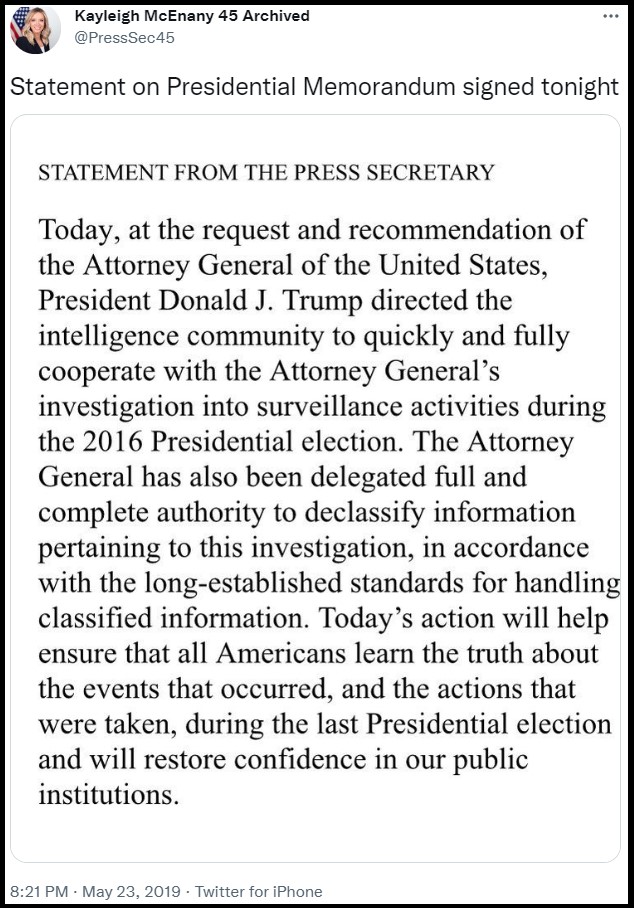
Within a few weeks, May 2019, the newly appointed and confirmed Attorney General Bill Barr tells President Trump to remove himself from the declassification issue and give him the authority to declassify and release documents because Barr has an investigator (John Durham) to look into the corrupt activity behind the Trump-Russia collusion hoax.

Ten days before he made the request, Bill Barr had enlisted John Durham to look into all of the issues surrounding the targeting of President Trump and the Clinton campaign involvement in the creation of the Trump-Russia collusion story.

At the time most people thought what Barr was doing was a good thing.  As a result, President Trump agrees to support Bill Barr and on May 23, 2019, delegates the declassification and release to the Attorney General.

The President is trusting his cabinet officer, the highest law enforcement officer in the country, to do the right thing and expose the wrongdoing he has been the subject of for the past two years.

It was an easy sell, because the purpose of declassification was ultimately to facilitate a DOJ review of how the intelligence apparatus was used in the 2016 election.

However, because the DOJ review encompassed intelligence systems (DOJ, FBI, NSA) potentially weaponized in 2016 for political purposes and intents, a strange dynamic existed.

President Trump carries: (a) declassification authority; but also: (b) an inherent conflict.

In the DOJ endeavor using John Durham, candidate Trump would have been the target of corrupt agency activity; and therefore, Trump would be considered the target/victim if weaponization were affirmed by evidence collected by Durham.

To avoid the conflict President Trump designated the U.S. Attorney General as arbiter and decision-maker for the purposes of declassifying evidence within the investigation:

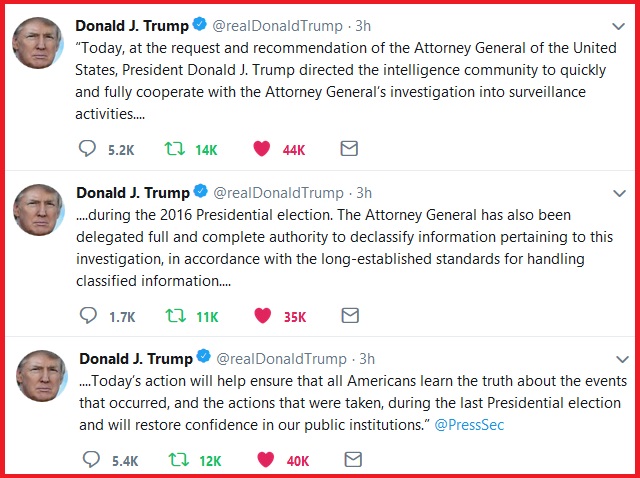
…”The Attorney General has also been delegated full and complete authority to declassify information pertaining to this investigation, in accordance with the long-established standards for handling classified information.

Additionally, AG Bill Barr did not need to assemble the intelligence product for approval by the executive (Trump).  Instead, the office of the president is granting the AG full unilateral decision-making as to each product being considered for declassification.

At the time we noted, this was a huge amount of trust from the President to the Attorney General, and a big responsibility for William Barr:

[Sec 2] …”With respect to any matter classified under Executive Order 13526 of December 29, 2009 (Classified National Security Information), the Attorney General may, by applying the standard set forth in either section 3.1(a) or section 3.1(d) of Executive Order 13526, declassify, downgrade, or direct the declassification or downgrading of information or intelligence that relates to the Attorney General’s review referred to in section 1 of this memorandum.”

The position-designate slightly works around custom insofar as the intelligence hub, the Office of the Director of National Intelligence (Dan Coats), is given conference – but the decision-making was designated to the Attorney General (Bill Barr).

Essentially the DNI will be following the instructions of the AG for this Memorandum.  This is slightly unusual; but given the purpose, necessary and expected.

Following protocol, the 2019 Memorandum was specific to the agencies carrying the documentation to be reviewed by the Attorney General: The Secretary of State (Pompeo); the Secretary of Treasury (Mnuchin); the Secretary of Defense (Shanahan); the Secretary of Energy (Perry); the Secretary of Homeland Security (McAleenan); the Director of National Intelligence (Coats); the Director of the CIA (Haspel), and the Attorney General himself (Barr).

Within the memorandum President Trump did not allow AG Bill Barr to delegate authority.  However, all agencies were required to respond to Barr’s authority.

The purpose of the Declassification Directive, as it was sold to President Trump, also appeared to permit the DOJ Inspector General to include classified material in the body of the (early 2019) pending report on FISA abuse; this memorandum was granting AG Bill Barr the autonomy to make that decision and declassify that content.

While the purpose of the authority was to empower AG Bill Barr to collect, process and declassify intelligence product that was part of the DOJ investigative review, President Trump did not preclude the public release of intelligence information in advance of the 2019 IG report on FISA abuse.

Much of the intelligence information may be collected external to the IG review parameters (FISA process) and may be released independently as part of stand-alone declassification that pertains to weaponized DOJ, FBI and CIA political activity.  Ultimately the decision to release, and the timing therein, was then in the hands of U.S. Attorney General William Barr.

On May 23, 2019, with the Mueller investigation in the rear-view President Trump tweeted:
Unfortunately, as time continued throughout 2019, Attorney General Bill Barr took no action that would declassify any material of interest to the targeting of President Trump.

AG Bill Barr used the “ongoing criminal investigation,” led by the man he appointed, John Durham, as a justification for non-release of documents.

Frustration continues to mount as impeachment efforts against President Trump and the painful reality of the Bill Barr motive starts to settle in.
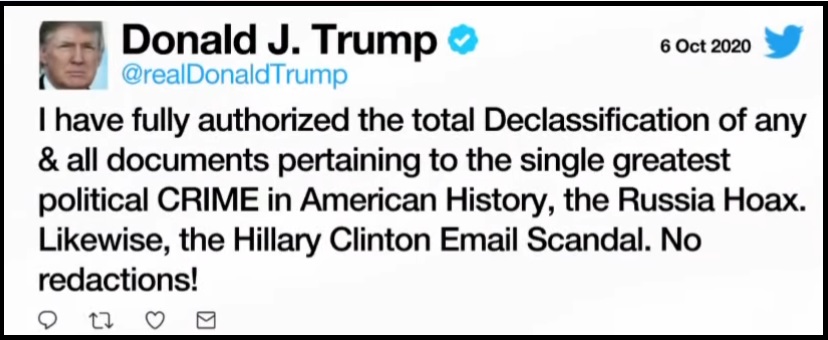
Bill Barr replaced the obstruction and interference threat carried by Mueller special counsel, with the obstruction and interference threat carried by the Durham special counsel.   The ‘ongoing investigation‘ narrative created both swords of Damocles.  One created by Rosenstein/Mueller the other created by Barr/Durham.

Then Bill Barr did something even worse.  He made sure President Trump could never remove it.
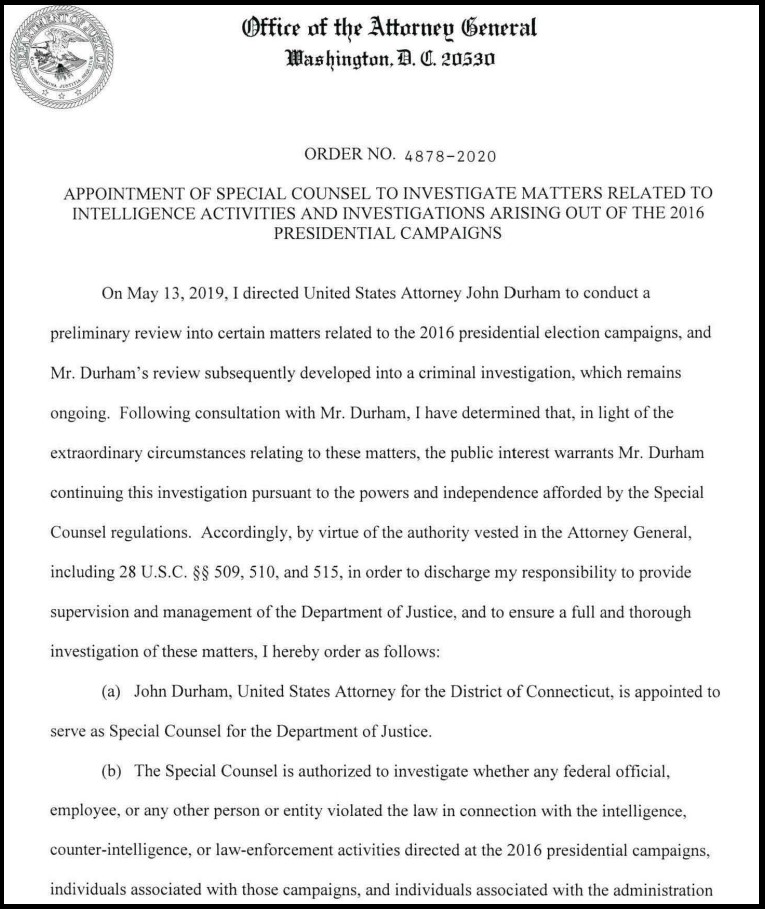
The result?

The special counsel block of investigative material continued from May 13, 2019, all the way to today.  The Durham special counsel is an active and ongoing investigation.

This is the dynamic behind the declassification of records.

This is the dynamic where the law is used, structurally weaponized by the institutions who are sworn to uphold it, to protect the interests of the DC Deep State.

This is the dynamic that exposes how the DOJ and FBI are structurally corrupt.

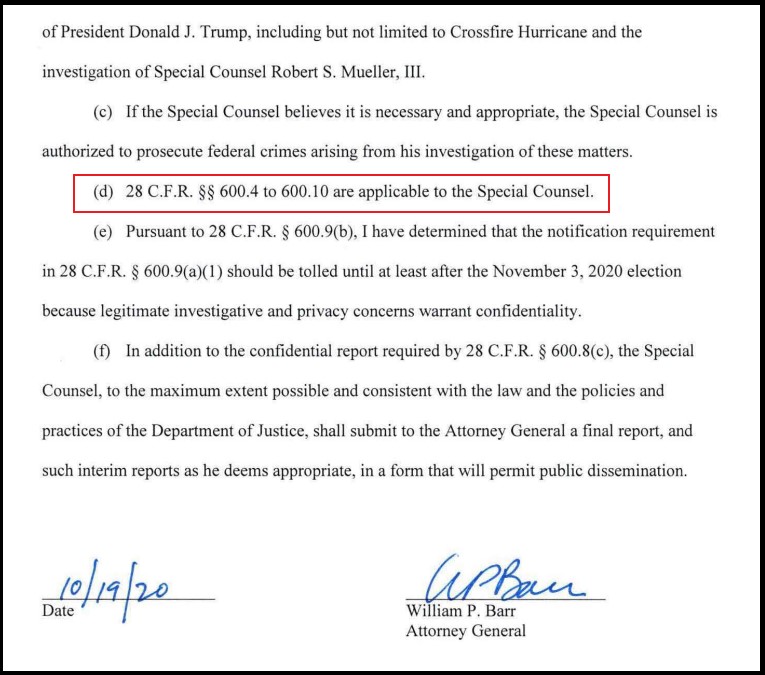
Even as he was departing office, President Trump wanted those documents released.  Documents he declassified and outlined in this memo to the DOJ:
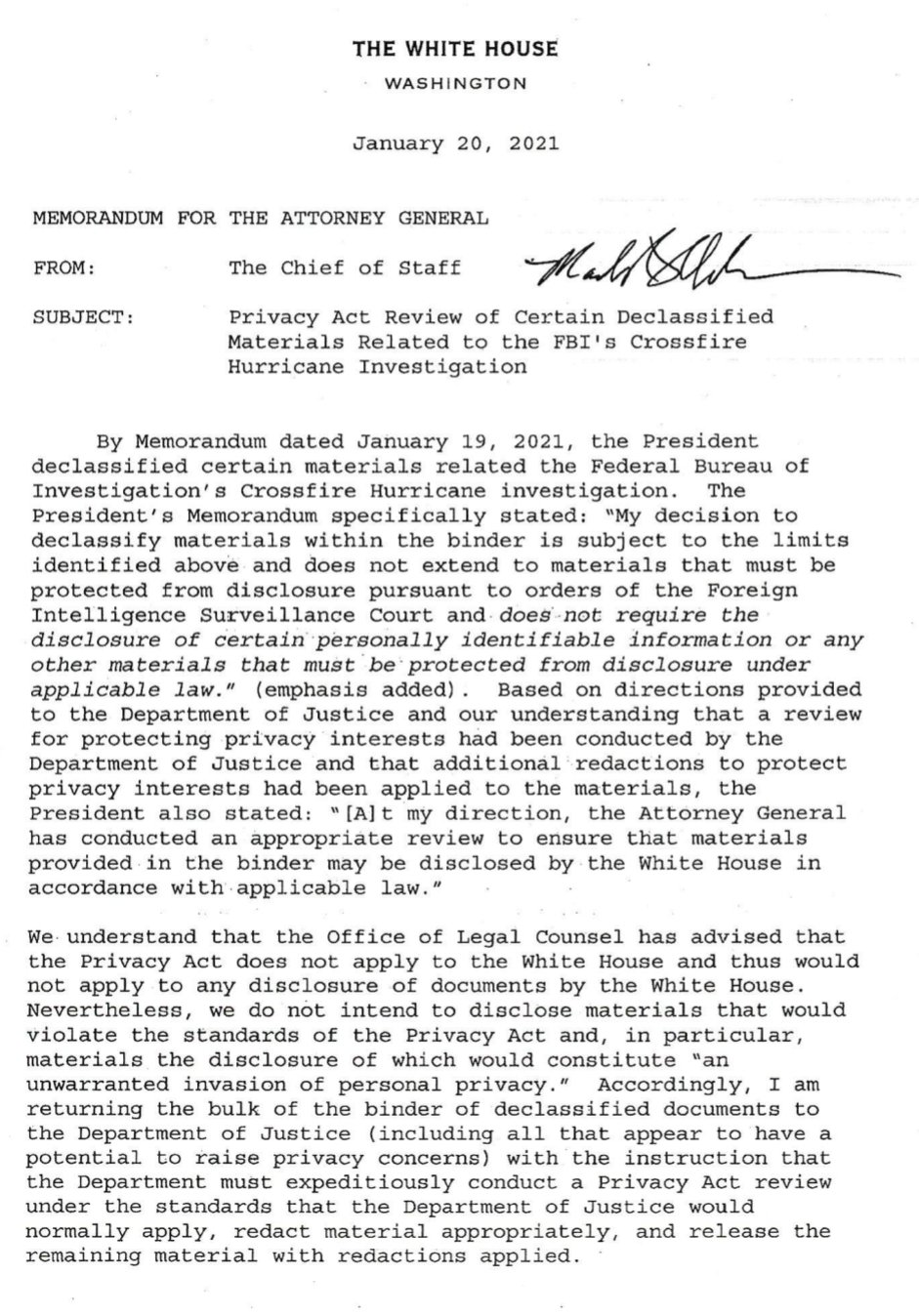
[January 19, 2021, Declassification Directive Link]

This is the heart of the battle over documents between the current DOJ/FBI and President Trump.

Again, the threats of a corrupt administration of justice are at the heart of the issue.

This four-year sequence of events, including all of the betrayals and threats made against Donald Trump, all intended to keep him from allowing the public to see the full nature of the corrupt Deep State operation that lies at the heart of our current political strife, is ultimately what led to an FBI raid on his home in Mar-a-Lago.

This is the scale of the issue.

The DOJ and FBI will do everything they can to stop the release of documents outlining how the system worked to target candidate and President Trump.

If the broader American public understood what tools and surveillance systems were used; if the broad American public knew what the DOJ, FBI, intelligence apparatus and aligned Senate committees have done; if the broad American public became aware of the scale and scope of the corruption in DC as it now exists; entire institutions within that framework would start to collapse.

This is what they are trying to stop.  That is the scale of their zero-sum approach.

Support CTH Research Here ]

Lots of FBI Officials Work at Jack’s Magic Coffee Shop


Posted originally on the conservative tree house on August 27, 2022 | Sundance

The suspicions surrounding Jack’s Magic Coffee shop are not new.  {Go Deep} Indeed, the recent whistleblower claims of data insecurity seem to align with the overall theme that U.S. government interest are more than a little deeply involved in the domestic surveillance system known as Twitter specifically, and big social media in general.

In the latest datapoint assembly, a solid dive by MintPressNews into the number of former FBI officials working at Twitter, shows just how enmeshed the federal police are with the social media platform.  The scale is really quite remarkable. [SEE HERE]

Big picture – the number of FBI officials working for Twitter indicates some strong connective tissue behind both enterprises.

[MintPressNews] – […] The FBI is generally known as a domestic security and intelligence force. However, it has recently expanded its remit into cyberspace. “The FBI’s investigative authority is the broadest of all federal law enforcement agencies,” the “About” section of its website informs readers. “The FBI has divided its investigations into a number of programs, such as domestic and international terrorism, foreign counterintelligence [and] cyber crime,” it adds. (read more)

How would it damage the U.S. government if claims about the Chinese government having access to all user data on TikTok, are shown to be identical to the U.S. government having access to all user data on Twitter?

Let that question settle in for a few moments, because that is exactly what I have been alleging since, well, 2011, when the U.S. State Dept first collaborated with Twitter in a joint public-private partnership to use the platform as a communication tool exploiting the Arab Spring uprising in Egypt, Libya and beyond.

The issue of Jack’s Magic Coffee Shop is an issue of financial viability.  The business model of Twitter just doesn’t exist as a free social media discussion platform while running the ultra-expensive data processing system needed for millions of simultaneous users.  A global chat that requires exponential database responses as an outcome of simultaneous users is just ridiculously expensive. {Go Deep} However, if the computing system and massive database were being subsidized by the U.S. government, then the viability of the ‘free coffee‘ business model makes sense.

“Cloud computing is one of the core components of the strategy to help the IC discover, access and share critical information in an era of seemingly infinite data.” … “A test scenario described by GAO in its June 2013 bid protest opinion suggests the CIA sought to compare how the solutions presented by IBM and Amazon Web Services (AWS) could crunch massive data sets, commonly referred to as big data.” … “Solutions had to provide a “hosting environment for applications which process vast amounts of information in parallel on large clusters (thousands of nodes) of commodity hardware” using a platform called MapReduce. Through MapReduce, clusters were provisioned for computation and segmentation. Test runs assumed clusters were large enough to process 100 terabytes of raw input data. AWS’ solution received superior marks from CIA procurement officials”… (MORE)

The integration between Twitter and the United States Intelligence Community has been hiding in plain sight:

July 26, 2021, (Reuters) – A counterterrorism organization formed by some of the biggest U.S. tech companies including Facebook (FB.O) and Microsoft (MSFT.O) is significantly expanding the types of extremist content shared between firms in a key database, aiming to crack down on material from white supremacists and far-right militias, the group told Reuters.

Until now, the Global Internet Forum to Counter Terrorism’s (GIFCT) database has focused on videos and images from terrorist groups on a United Nations list and so has largely consisted of content from Islamist extremist organizations such as Islamic State, al Qaeda and the Taliban.

Over the next few months, the group will add attacker manifestos – often shared by sympathizers after white supremacist violence – and other publications and links flagged by U.N. initiative Tech Against Terrorism. It will use lists from intelligence-sharing group Five Eyes, adding URLs and PDFs from more groups, including the Proud Boys, the Three Percenters and neo-Nazis.

The firms, which include Twitter (TWTR.N) and Alphabet Inc’s (GOOGL.O) YouTube, share “hashes,” unique numerical representations of original pieces of content that have been removed from their services. Other platforms use these to identify the same content on their own sites in order to review or remove it. (more)

A shared hashing protocol is a form of data system integration.

The databases of the identified social media platforms appear to be integrated with the U.S. intelligence system.  This relationship makes the U.S government a stakeholder in the financial sustainability of the enterprise(s).  Thus, a collaborative effort to subsidize the underlying data processing fits the mutual benefit scenario.

EMERGENCY MEETING – THE MATRIX ATTACKS.


TateSpeech Published originally on Rumble on August 25, 2022 

Andrew Tate Attacks the Matrix — We took the RED PILL We are the Alpha beware of what you have done!

Wish We All Could Leave California Now


Armstrong Economics Blog/Humor Re-Posted Aug 27, 2022 by Martin Armstrong

Beach Boys – Wish We All Could Leave California Now

Corruption Within the Federal Bureau of Investigation


Posted originally on the conservative tree house on August 26, 2022 | Sundance 

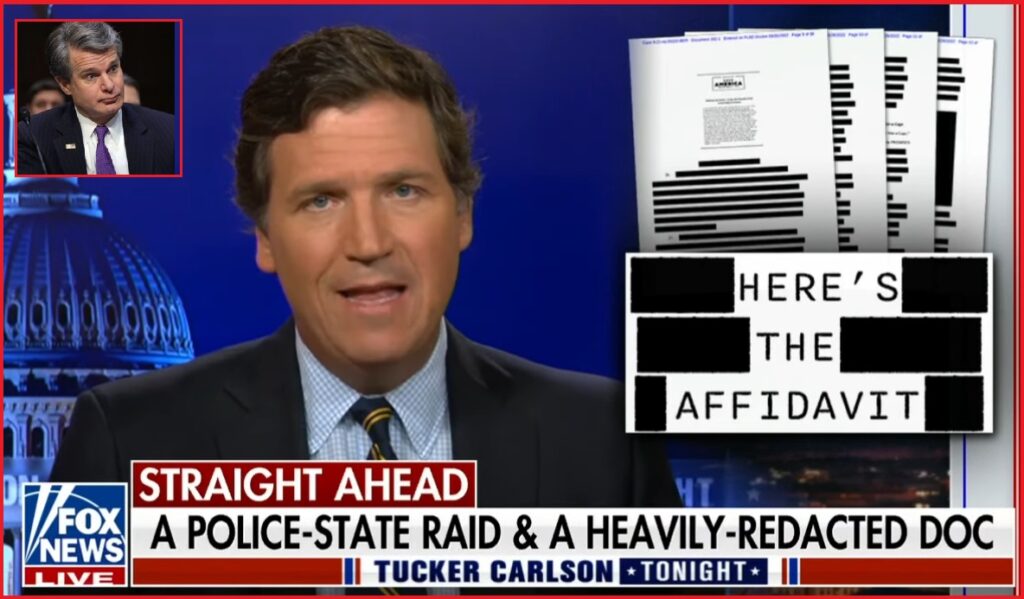
What Tucker Carlson outlined on his broadcast tonight is not a surprise to anyone here; however, it is good to see the direct accusations presented to millions of Americans.  The FBI is a corrupt politically motivated institution from top to bottom.  WATCH:

.

The collapse of institutional credibility has nothing to do with deplorable Americans and everything to do with the FBI’s own conduct.  As noted recently by Senator Chuck Grassley:

“If these allegations are true and accurate, the Justice Department and FBI are – and have been – institutionally corrupted to their very core to the point in which the United States Congress and the American people will have no confidence in the equal application of the law. Attorney General Garland and Director Wray, simply put, based on the allegations that I’ve received from numerous whistleblowers, you have systemic and existential problems within your agencies.” (LINK)

BACKGROUND on FBI –  As we discovered in January of this year, the FBI was fully aware of the terrorist who was planning to shoot the synagogue in Colleyville, Texas, and yet they did nothing.

The FBI knowledge of the shooter, Malik Faisal Akram, who was known as Faisal Akram was confirmed by The Daily Mail. Akram ranted, prior to his travel to the U.S, that he wished he had died in the 9/11 terror attacks. He was a regular visitor to Pakistan, and reportedly a member of the Tablighi Jamaat group set up to ‘purify’ Islam. To say the U.S. intelligence system knew Faisal Akram would be an understatement.

The FBI was also fully aware of the Boston Marathon bombers, the Tsarnaev brothers, before they executed their plot.  The FBI took no action.

The FBI knew about the San Bernardino terrorists, specifically Tashfeen Malik, and were monitoring her phone calls and communications before her and Syed Farook executed their attack killing 14 people and leaving 22 others seriously injured.  The FBI took no action.

The FBI knew Colorado grocery store shooter Ahmad Alissa before he executed his attack.  The FBI took no action.

The FBI knew in advance of the Pulse Nightclub shooter (Omar Mateen) and were tipped off by the local sheriff. The FBI knew in advance of the San Bernardino Terrorists (Tashfeen Malik). The FBI knew in advance of the Boston Marathon Bombers (the Tsarnaev brothers) tipped off by Russians.  The FBI knew in advance of the Parkland High School shooter (Nikolas Cruz). The FBI knew in advance of the Fort Hood shooter (Nidal Hasan), and the FBI knew in advance of Colorado grocery store shooter Ahmad al-Aliwi Alissa.  The FBI took no action.

The case of the first recorded ISIS attack on U.S. soil was in Garland, Texas in 2015.

The FBI not only knew the shooters (Elton Simpson and Nadir Soofi) in advance, BUT the FBI ALSO took the shooters to the venue and were standing only a few yards away when Simpson and Soofi opened fire.  Yes, you read that correctly – the FBI took the terrorists to the event and then watched it unfold.  “An FBI trainer suggested in an interview with “60 Minutes” that, had the attack been bigger, the agency’s numerous ties to the shooter would have led to a congressional investigation.”

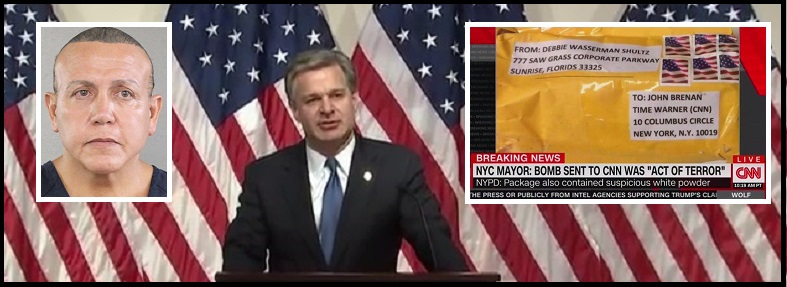
Remember, shortly before the 2018 mid-term election, when Ceasar Syoc – a man living in his van – was caught sending “energetic material that can become combustible when subjected to heat or friction”, or what FBI Director Christopher Wray called “not hoax devices”?

Remember how sketchy everything about that was, including the child-like perpetrator telling a judge later that he was trying to walk back his guilty plea, because he was tricked into signing a confession for a crime he did not create.

Or more recently, the goofball plot to kidnap Gretchen Whitmer that involved 18 suspects, twelve of them actually working for the FBI as the plot was hatched?  And we cannot forget the January 6th. DC protest turned insurrection effort, which is clearly looking like an FBI inspired and coordinated effort; and unlike Syoc, despite the numerous CCTV cameras and resources in the area, they cannot find who placed the pipe-bombs?

Have we forgotten the Atlanta “Olympic Park Bombing”, and the FBI intentionally setting up transparently innocent, Richard Jewel?

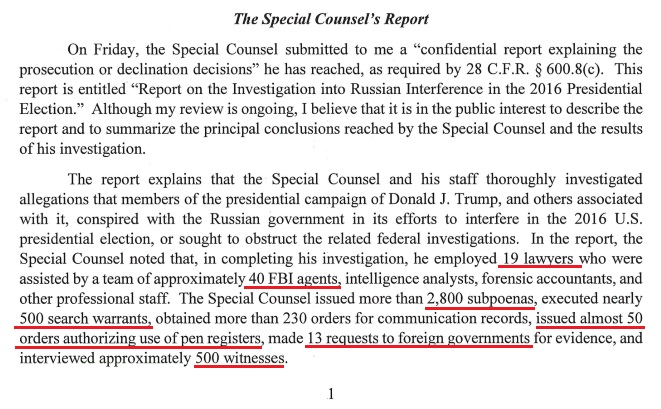
Then, there’s the entirety of the FBI conduct in “Spygate”, the demonstrably evident FBI operation to conduct political surveillance against Donald Trump using their investigative authorities; and the downstream consequences of a massive institutional effort to cover up one of the biggest justice department scandals in the history of our nation.   The original effort against Donald Trump used massive resources from the DOJ and FBI.  Heck, the coverup operation using the Mueller/Weissmann special counsel used more than 50 investigative FBI agents alone.

And of course, the FBI still had 13 extra agents available to rush to a NASCAR racetrack to investigate a garage door pull-down rope that might have been perceived as a noose; but the serial rape of hundreds of teenage girls, eh, not-so-much effort – even when they are standing in front of the FBI begging for help.

[At this point, I am increasingly convinced by evidence there are elements within the FBI that are enablers involved in sex trafficking, human smuggling, abduction, counterfeiting and money laundering as part of their operational mission.]

The FBI didn’t make a mistake or drop the proverbial ball in the Olympic gymnast case, they intentionally and specifically maintained the sexual exploitation of teenage girls by doing absolutely nothing with the complaints they received.   This is not misconduct, this is purposeful.

Then, as if to apply salt to the open wound of severe FBI politicization…. what did the FBI do with the Hunter Biden laptop?

[Notice I’ve set the issue of the disappearing Huma Abedin/Anthony Weiner laptop –in the known custody of the FBI– over there in the corner, next to missing investigation of the Awan brothers.]

More recently the FBI executed a search warrant on the home and office of Project Veritas and the founder James O’Keefe.  While the raid was taking place a New York Times reporter called O’Keefe to ask him about his thoughts on getting raided. The same New York Times journalist, a few days later, then begins writing about the confidential, attorney-client privileged information illegally retrieved then leaked by the FBI during their raid.

My point is this…

What the Federal Security Service (FSB) is to the internal security of the Russian state; so too is the FBI in performing the same function for the U.S. federal government.

The FBI is a U.S. version of the Russian “State Police”; and the FBI is deployed -almost exclusively- to attack domestic enemies of those who control government, while they protect the interests of the U.S. Fourth Branch of Government.  That is the clear and accurate domestic prism to contextualize their perceived mission: “domestic violent extremists pose the greatest threat” to their objective.

Put another way, “We The People”, who fight against government abuse and usurpation, are the FBI’s actual and literal enemy.

Let me be very clear with another brutally obvious example.  Antifa could not exist as an organization, capable to organize and carry out violent attacks against their targets, without the full support of the FBI.   If the FBI wanted to arrest members of Antifa, who are actually conducting violence, they could do it easily – with little effort.

It is the absence of any action by the FBI toward Antifa, that tells us the FBI is enabling that violent extremist behavior to continue.  Once you accept that transparent point of truth, then, you realize the FBI definition of domestic violent extremism is something else entirely.

The FBI is not a law enforcement or investigative division of the U.S. Department of Justice.  The FBI is a political weapon of a larger institution that is now focused almost entirely toward supporting a radical Democrat and left-wing agenda to destroy civil society in the United States.

The current mission of the FBI is to facilitate, preserve and protect the administration of Joe Biden.  Anyone who continues to push the fraudulent “honorable FBI rank and file talking point”, is, at this point in history, willfully and purposefully operating to deceive the American people on behalf of government interests who are intent on destroying us.

It is not a difference of opinion any longer.  Personally, I have lost the ability to sit comfortably or intellectually with anyone who pushes or accepts the ‘mistakes are made‘ nonsense.  The FBI is not making mistakes, they are doing well what is important to them.

To me, it comes down to a simple matter of accepting what is continually staring us in the face.

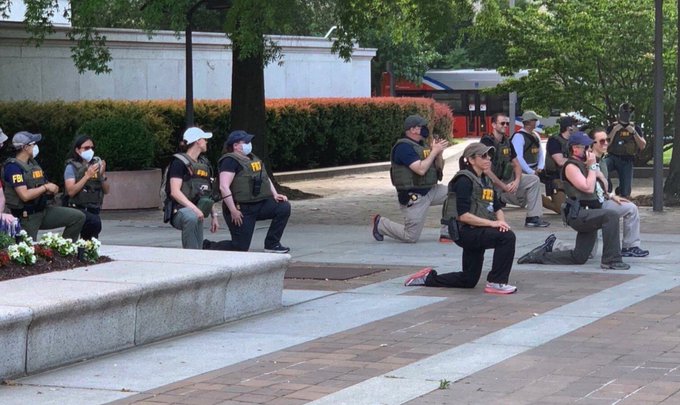
As you read the media pearl-clutching toward anyone who questions the FBI, never lose sight of the fact that 40 FBI agents were involved in the Mueller-Weissmann probe to investigate the fraudulent construct of Hillary Clinton and crew.  40 agents.

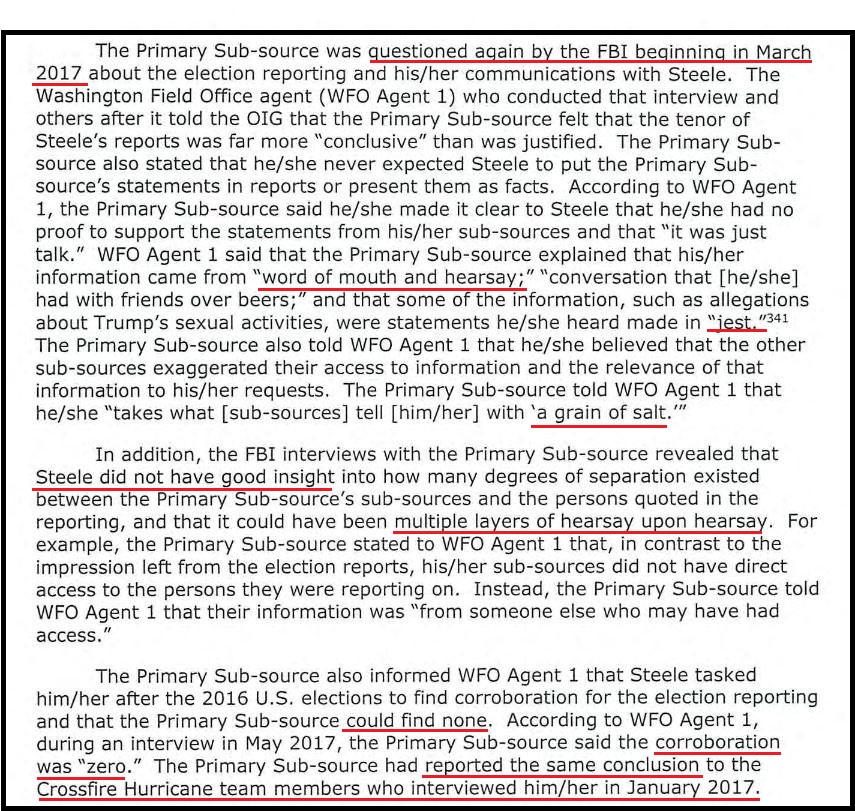
The people within the FBI knew from the outset in early 2017 their investigation was based on nonsense.  The FBI interview with Chris Steele’s primary sub-source, Igor Danchenko, confirmed it was nonsense.

… Yet the FBI continued with a two-year long Mueller investigation; all of it to cover up their own misconduct and criminal wrongdoing in the original targeting of President Trump.

That coverup motive remains today within the FBI raid of Mar-a-Lago.

It is one long and corrupt continuum.

Every single action now is an attempt to cover up the evidence of their own wrongdoing.

Institutional Corruption, The Direct Evidence Against the FBI that Congressional Oversight Willfully Ignored


Posted originally on the conservative tree house on August 26, 2022 | Sundance

Amid a series of documents released by the Senate Judiciary Committee in April of 2020 [SEE HERE] there is a rather alarming letter from the DOJ to the FISA Court, dated July of 2018, that highlights a direct and unequivocal institutional cover-up.   [Link to Letter]

Before getting to the substance of the letter, it’s important to put the 2020 release in context.  After the FISA Court reviewed the DOJ inspector general report on the Carter Page FISA application assembly (2019), the FISC ordered the DOJ-NSD to declassify and release documents related to the Carter Page FISA application.

In the cover letter for this specific release to the Senate Judiciary and Senate Intelligence committees, the DOJ, then being run by AG Bill Barr, cites the January 7, 2020, FISA court order:

Keep in mind that prior to this release only the FISA court had seen this letter from the DOJ-National Security Division (DOJ-NSD).  As we walk through the alarming content of the letter, I think you’ll identify the original motive behind the FISC order to release it.

First, the letter in question was sent by the DOJ-NSD to the FISA Court on July 12, 2018.  It is critical to keep the date of the letter in mind as we review the content.  The Weissmann/Mueller team was in full control of Main Justice.

Aside from the date the important part of the first page is the motive for sending it. The DOJ is telling the court in July 2018: based on what they know the FISA application still contains “sufficient predication for the Court to have found probable cause” to approve the application.   The DOJ is defending the Carter Page FISA application as still valid.

However, it is within the justification of the application that alarm bells are found. On page six the letter identifies the primary participants behind the FISA redactions:

As you can see: Christopher Steele is noted as “Source #1”.  Glenn Simpson of Fusion-GPS is noted as “identified U.S. person” or “business associate”; and Perkins Coie is the “U.S-based law firm.”

Now things get very interesting.

On page #8 when discussing Christopher Steele’s sub-source, the DOJ notes the FBI found him to be truthful and cooperative.

This is an incredibly misleading statement to the FISA court because what the letter doesn’t say is that 18-months earlier the sub-source, also known in the IG report as the “primary sub-source”, informed the FBI that the material attributed to him in the dossier was essentially junk.

Let’s look at how the IG report frames the primary sub-source, and specifically notice the FBI contact and questioning took place in January 2017 (we now know that date to be January 12, 2017):

Those interviews with Steele’s primary sub-source took place in January, March and May of 2017; and clearly the sub-source debunked the content of the dossier itself.

Those interviews were 18-months, 16-months and 14-months ahead of the July 2018 DOJ letter to the FISC.   The DOJ-NSD says the sub-source was “truthful and cooperative” but the DOJ doesn’t tell the court the content of the truthfulness and cooperation.  Why?

Keep in mind this letter to the court was written by AAG John Demers in July 2018.  Jeff Sessions was Attorney General, Rod Rosenstein was Deputy AG; Christopher Wray was FBI Director, David Bowditch is Deputy, and Dana Boente is FBI chief-legal-counsel.

Why would the DOJ-NSD not be forthcoming with the FISA court about the primary sub-source?  This level of disingenuous withholding of information speaks to an institutional motive.

By July 2018 the DOJ clearly knew the dossier was full of fabrications, yet they withheld that information from the court and said the predicate was still valid.  Why?

It doesn’t take a deep-weeds-walker to identify the DOJ motive.

In July 2018 Robert Mueller’s investigation was at its apex.

This letter justifying the application and claiming the current information would still be a valid predicate therein, speaks to the 2018 DOJ needing to retain the validity of the FISA warrant…. My research suspicion is that the DOJ needed to protect evidence Mueller had already extracted from the fraudulent FISA authority.  That’s the motive.

In July 2018 if the DOJ-NSD had admitted the FISA application and all renewals were fatally flawed Robert Mueller would have needed to withdraw any evidence gathered as a result of its exploitation.  The DOJ in 2018 was protecting Mueller’s poisoned fruit.

If the DOJ had been honest with the court, there’s a strong possibility some, perhaps much, of Mueller evidence gathering would have been invalidated… and cases were pending.  The solution: mislead the court and claim the predication was still valid.

This is not simply a hunch, because that motive also speaks to why the FISC would order the current DOJ to release the letter.

Remember, in December 2019 the FISC received the IG Horowitz report; and they would have immediately noted the disparity between what IG Horowitz outlined about the FBI investigating Steele’s sub-source, as contrast against what the DOJ told them in July 2018.

The DOJ letter is a transparent misrepresentation when compared to the information in the Horowitz report. Hence, the court orders the DOJ to release the July letter so that everyone, including congressional oversight and the public can see the misrepresentation.

The court was misled; now everyone can see it.

The content of that DOJ-NSD letter, and the subsequent disparity, points to an institutional cover-up; and as a consequence the FISC also ordered the DOJ to begin an immediate sequestration effort to find all the evidence from the fraudulent FISA application.  The proverbial fruit from the poisonous tree.

Moving on…

Two more big misstatements within the July letter appear on page #9.  The first is the DOJ claiming that only after the application was filed did they become aware of Christopher Steele working for Fusion-GPS and knowing his intent was to create opposition research for the Hillary Clinton campaign.  See the top of the page.

According to the DOJ-NSD claim the number four ranking official in the DOJ, Bruce Ohr, never told them he was acting as a conduit for Christopher Steele to the FBI.   While that claim is hard to believe, in essence what the DOJ-NSD is saying in that paragraph is that the FBI hoodwinked the DOJ-NSD by not telling them where the information for the FISA application was coming from.  The DOJ, via John Demers, is blaming the FBI.

The second statement, equally as incredulous, is at the bottom of page nine where the DOJ claims they had no idea Bruce Ohr was talking to the FBI throughout the entire time any of the FISA applications were being submitted.  October 2016 through June 2017.

In essence the claim there is that Bruce Ohr was working with the FBI and never told anyone in the DOJ throughout 2016 and all the way past June 29th of 2017.  That denial seems rather unlikely; however, once again the DOJ-NSD is putting the FBI in the crosshairs and claiming they knew nothing about the information pipeline.

Bruce Ohr, whose wife was working for Fusion-GPS and assisting Christopher Steele with information, was interviewed by the FBI over a dozen times as he communicated with Steele and fed his information to the FBI.  Yet the DOJ claims they knew nothing about it.

Again, just keep in mind this claim by the DOJ-NSD is being made in July 2018, six months after Bruce Ohr was demoted twice (December 2017 and January 2018).  If what the DOJ is saying is true, well, the FBI was completely off-the-rails and rogue.

Neither option speaks well about the integrity of either institution; and quite frankly I don’t buy the DOJ-NSD spin.  Why?  The reason is simple, the DOJ is claiming in the letter the predication was still valid… if the DOJ-NSD genuinely didn’t know about the FBI manipulation, they would be informing the court in 2018 the DOJ no longer supported the FISA application due to new information.  They did not do that.  Instead, in July 2018, they specifically told the court the predicate was valid, yet the DOJ-NSD knew it was not.

The last point about the July 2018 letter is perhaps the most jarring.  Again, keep in mind when it was written Chris Wray is FBI Director, David Bowditch is Deputy and Dana Boente is FBI chief legal counsel.

Their own FBI reports, by three different INSD and IG investigations; had turned up seriously alarming evidence going back to the early 2017 time-frame; the results of which ultimately led to the DC FBI office losing all of their top officials; and knowing the letter itself was full of misleading and false information about FBI knowledge in/around Christopher Steele; this particular sentence is alarming:

“The FBI has reviewed this letter and confirmed its factual accuracy?”

Really?

As we have just shared, the July 2018 letter itself is filled with factual inaccuracies, misstatements and intentional omissions.  So who exactly did the “reviewing”?

This declassification release raises more questions than any other in recent memory.  Not a single person in legislative oversight ever asked these direct questions to FBI Director Christopher Wray.

Here’s the Full Letter.  I strongly suggest everyone read the 14-pages slowly.  If you know the background, this letter is infuriating.

This is the institutional corruption the DOJ and FBI are trying to keep from the public.  This is the type of evidence they are seeking to remove from the custody of Donald Trump.

How Convenient, Biden State Dept Says They Will No Longer Publish List of U.S. Weapons Given or Sold to Foreign Countries


Posted originally on the conservative tree house on August 26, 2022 | Sundance 

Buried inside Section 5114(b)(4) of the National Defense Authorization Act for Fiscal Year 2022 was a repeal of 1994 law that required the U.S. State Department to publish an annual list of arms sales to foreign countries.  The “World Military Expenditures and Arms Transfers” report (WMEAT) put sunlight every year on what weapons the U.S. was selling to foreign countries.

Conveniently timed with the $60+ billion aid package to Ukraine, the U.S. State Dept, now says the WMEAT report will not be published any longer.  If a person was to believe the Ukraine arms deals were essentially money laundering operations, well, this announcement by the State Dept. might be interpreted as a way to hide it. [LINK]

State Dept – WMEAT 2021, which the Department of State published in December 2021, is the final edition of World Military Expenditures and Arms Transfers (WMEAT). Section 5114(b)(4) of the National Defense Authorization Act for Fiscal Year 2022 repealed the 1994 statutory provision that required the Department of State to publish an edition of WMEAT every year. Consistent with this repeal, the Department of State will cease to produce and publish WMEAT.

Copies of all editions of WMEAT dating from 1974 to 2021 remain publicly accessible as Adobe PDF or Excel spreadsheet documents  (LINK)

Jerome Powell Says Fed Effort to Make U.S. Economy Smaller Will Create “Some Pain” for Americans During Biden Transition to Clean Energy


Posted originally on the conservative tree house on August 26, 2022 | Sundance

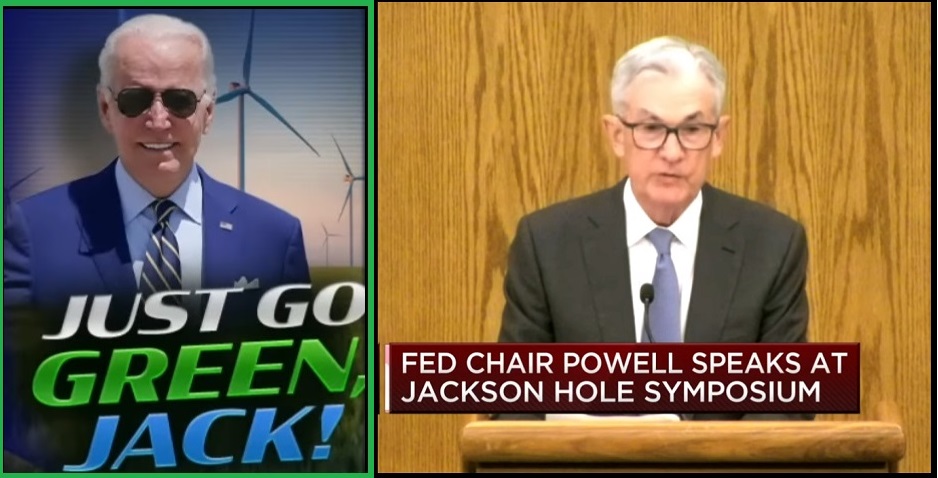
When Chairman Powell says things are really, really going to suck as monetary policy tries to support Biden’s goals to reduce energy supplies, will people believe him?

The agenda of the federal reserve was clearly outlined today in the remarks from Chairman Powell in Jackson Hole, Wyoming.  The Fed chair is trying to manage the economic policy transition by reducing economic activity to match intentionally diminished energy supplies.  Lowering economic activity drops demand for energy. Unfortunately, as admitted by Powell today, this means a period of “some pain” for Americans as the central banks join together in an effort to lower consumption.  WATCH:

What does “some pain” mean?  It means lower incomes, higher prices, lowered standards of living and more scarce resources.   During this transition to owning nothing and being happy about it, the pain is your wealth being stripped as the economy is intentionally diminished.

We will not be able to afford much; we won’t be able to afford the foods we want; we will not be able to purchase anything except the essentials, and those essentials will cost much more; we won’t be able to vacation, travel, or enjoy recreational activities; we won’t be able to afford any indulgences; but at the end of the process, we will learn to live more meager existences based on lowered expectations needed for sustaining the planet.   Pay no attention to the elites who don’t have those concerns, comrade.

[Transcript] – POWELL: “At past Jackson Hole conferences, I have discussed broad topics such as the ever-changing structure of the economy and the challenges of conducting monetary policy under high uncertainty. Today, my remarks will be shorter, my focus narrower, and my message more direct.”

The Federal Open Market Committee’s (FOMC) overarching focus right now is to bring inflation back down to our 2 percent goal. Price stability is the responsibility of the Federal Reserve and serves as the bedrock of our economy. Without price stability, the economy does not work for anyone. In particular, without price stability, we will not achieve a sustained period of strong labor market conditions that benefit all. The burdens of high inflation fall heaviest on those who are least able to bear them.

Restoring price stability will take some time and requires using our tools forcefully to bring demand and supply into better balance. Reducing inflation is likely to require a sustained period of below-trend growth. Moreover, there will very likely be some softening of labor market conditions. While higher interest rates, slower growth, and softer labor market conditions will bring down inflation, they will also bring some pain to households and businesses. These are the unfortunate costs of reducing inflation. But a failure to restore price stability would mean far greater pain.

The U.S. economy is clearly slowing from the historically high growth rates of 2021, which reflected the reopening of the economy following the pandemic recession. While the latest economic data have been mixed, in my view our economy continues to show strong underlying momentum. The labor market is particularly strong, but it is clearly out of balance, with demand for workers substantially exceeding the supply of available workers. Inflation is running well above 2 percent, and high inflation has continued to spread through the economy. While the lower inflation readings for July are welcome, a single month’s improvement falls far short of what the Committee will need to see before we are confident that inflation is moving down.

We are moving our policy stance purposefully to a level that will be sufficiently restrictive to return inflation to 2 percent. At our most recent meeting in July, the FOMC raised the target range for the federal funds rate to 2.25 to 2.5 percent, which is in the Summary of Economic Projection’s (SEP) range of estimates of where the federal funds rate is projected to settle in the longer run. In current circumstances, with inflation running far above 2 percent and the labor market extremely tight, estimates of longer-run neutral are not a place to stop or pause.

July’s increase in the target range was the second 75 basis point increase in as many meetings, and I said then that another unusually large increase could be appropriate at our next meeting. We are now about halfway through the intermeeting period. Our decision at the September meeting will depend on the totality of the incoming data and the evolving outlook. At some point, as the stance of monetary policy tightens further, it likely will become appropriate to slow the pace of increases.

Restoring price stability will likely require maintaining a restrictive policy stance for some time. The historical record cautions strongly against prematurely loosening policy. Committee participants’ most recent individual projections from the June SEP showed the median federal funds rate running slightly below 4 percent through the end of 2023. Participants will update their projections at the September meeting.

Our monetary policy deliberations and decisions build on what we have learned about inflation dynamics both from the high and volatile inflation of the 1970s and 1980s, and from the low and stable inflation of the past quarter-century. In particular, we are drawing on three important lessons.

The first lesson is that central banks can and should take responsibility for delivering low and stable inflation. It may seem strange now that central bankers and others once needed convincing on these two fronts, but as former Chairman Ben Bernanke has shown, both propositions were widely questioned during the Great Inflation period.1 Today, we regard these questions as settled. Our responsibility to deliver price stability is unconditional. It is true that the current high inflation is a global phenomenon, and that many economies around the world face inflation as high or higher than seen here in the United States.

It is also true, in my view, that the current high inflation in the United States is the product of strong demand and constrained supply, and that the Fed’s tools work principally on aggregate demand. None of this diminishes the Federal Reserve’s responsibility to carry out our assigned task of achieving price stability. There is clearly a job to do in moderating demand to better align with supply. We are committed to doing that job.

The second lesson is that the public’s expectations about future inflation can play an important role in setting the path of inflation over time. Today, by many measures, longer-term inflation expectations appear to remain well anchored. That is broadly true of surveys of households, businesses, and forecasters, and of market-based measures as well. But that is not grounds for complacency, with inflation having run well above our goal for some time.

If the public expects that inflation will remain low and stable over time, then, absent major shocks, it likely will. Unfortunately, the same is true of expectations of high and volatile inflation. During the 1970s, as inflation climbed, the anticipation of high inflation became entrenched in the economic decisionmaking of households and businesses. The more inflation rose, the more people came to expect it to remain high, and they built that belief into wage and pricing decisions. As former Chairman Paul Volcker put it at the height of the Great Inflation in 1979, “Inflation feeds in part on itself, so part of the job of returning to a more stable and more productive economy must be to break the grip of inflationary expectations.”2

One useful insight into how actual inflation may affect expectations about its future path is based in the concept of “rational inattention.”3 When inflation is persistently high, households and businesses must pay close attention and incorporate inflation into their economic decisions. When inflation is low and stable, they are freer to focus their attention elsewhere. Former Chairman Alan Greenspan put it this way: “For all practical purposes, price stability means that expected changes in the average price level are small enough and gradual enough that they do not materially enter business and household financial decisions.”4

Of course, inflation has just about everyone’s attention right now, which highlights a particular risk today: The longer the current bout of high inflation continues, the greater the chance that expectations of higher inflation will become entrenched.

That brings me to the third lesson, which is that we must keep at it until the job is done. History shows that the employment costs of bringing down inflation are likely to increase with delay, as high inflation becomes more entrenched in wage and price setting. The successful Volcker disinflation in the early 1980s followed multiple failed attempts to lower inflation over the previous 15 years. A lengthy period of very restrictive monetary policy was ultimately needed to stem the high inflation and start the process of getting inflation down to the low and stable levels that were the norm until the spring of last year. Our aim is to avoid that outcome by acting with resolve now.

These lessons are guiding us as we use our tools to bring inflation down. We are taking forceful and rapid steps to moderate demand so that it comes into better alignment with supply, and to keep inflation expectations anchored. We will keep at it until we are confident the job is done.” [Transcript End]

Three Minutes of Pure Sunlight, The Truth and The Constitution are President Trump’s Weapons


Posted originally on the conservative tree house on August 26, 2022 | Sundance

Attorney and former Constitutional Law Clerk for Justice Gorsuch, Mike Davis, highlights the reason why the U.S. Dept of Justice and FBI will never allow their fabricated political case against President Trump to ever reach a courtroom.  This is a must watch

.

Davis nails everything in that first three minutes, including the background motives of the DOJ, FBI and even congressional oversight authorities like the Senate Select Subcommittee on Intelligence, to desperately fear the evidence held by President Trump in Mar-a-Lago.   All of the events are a massive cover-up effort to retrieve evidence of their own wrongdoing.

CTH knows part of what is in those boxes being discussed because CTH assembled a 4-year, 600-page, brief pointing directly to the location of the agency silos that contained the documents. Essentially a roadmap and specific index showing where the documents are, what they are titled, who is the agency holding them and how it is all connected.

Copies of that brief were distributed to ensure a very visible record was always known.  The truth has no agenda.  Yes, you followed that effort, and I can tell from the activity of the stakeholders discussed, that evidence is a part of the trail Main Justice is trying to quash…. but it’s too late.

Declassification Memorandum ]

DeSantis Beats Trump on Fundraising – However, Donor Financials Highlight Corporate Version vs Grassroots Version of The Republican Party


Posted originally on the conservative tree house on August 25, 2022 | Sundance 

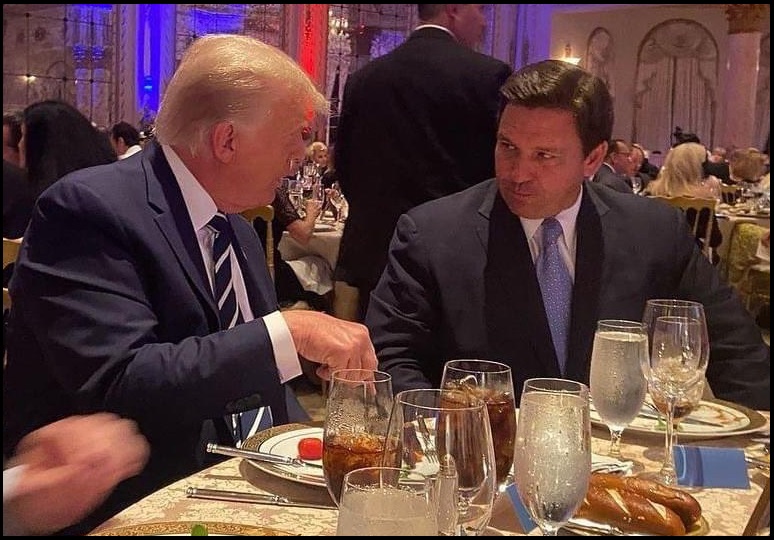
A solid dive by Law.Com and Daily Business Review into the background of who is financing Donald Trump versus who is financing Ron DeSantis should help to clarify the nature of the difference between them.

President Trump is funded primarily from massive amounts of small contributions from small donors, the MAGA base.

Governor Ron DeSantis is funded primarily by a small group of exclusive Wall Street corporations, billionaires and hedge fund managers, and almost no small donors.

Essentially, if you are thinking about MAGA populism -vs- corporate republicanism; well, there’s the issue in easiest to understand data form.

Additionally, the new managers of DeSantis have recently noticed the vulnerability and hired firms to try and stimulate small donor amounts in an effort to avoid the jaw dropping difference in average donation.  A strategy deployed by Jeb Bush in 2015.    Pay attention to the names giving large donations to DeSantis and you will see: (a) where the economic policy distinction comes from; and (b) where the RDS branding and consulting image is coming from.

Business Daily Review – Republican Florida Gov. Ron DeSantis has raised more money than Donald Trump since the former president left office, relying on deep-pocketed donors rather than the small-dollar contributors he’ll need if he seeks the White House in 2024.

DeSantis … has amassed $142 million from the start of 2021 through Aug. 5 this year from donors such as the hedge fund billionaires Ken Griffin and Paul Tudor Jones.  That tops the $136 million Trump collected over a slightly shorter period.

Unlike Trump, who relies largely on a network of small-dollar donors to fund his postpresidential political operations, DeSantis has raised the bulk of his money from a small number of wealthy donors writing him giant checks. That gives him plenty of money for his reelection effort in Florida, where laws allow unlimited contributions.

But it also raises doubts about the level of grassroots support for DeSantis and suggests he’ll have to widen his fundraising base for any presidential bid because federal rules limit direct contributions to candidates to just $2,900 per donor.

About 500 donors have given $50,000 or more to Friends of Ron DeSantis, his political action committee which under Florida law can accept donations in unlimited amounts, accounting for $88 million of his fundraising haul. His big donors come from finance and real estate, health care and construction and a wide range of other businesses, a Bloomberg analysis of Florida campaign finance filings shows.

By contrast, donors who made contributions of less than $200 accounted for $8 million, or just 6%, of his haul. Unlike Trump, who’s raised $74 million or 54% of his total from January 2021 through June 30 from small-dollar donors, DeSantis doesn’t send multiple, daily fundraising pitches to supporters. Recently his campaign went a month without sending a text message to potential donors who signed up to receive them.

His top 500 donors include 10 billionaires, including Citadel’s Griffin, who moved his hedge fund’s headquarters to Miami from Chicago 14 months after giving $5 million. Other contributors include Tudor Jones, the chief executive officer of Tudor Investment Corp., Home Depot Inc. co-founder Bernard Marcus and Thomas Peterffy, the chairman of Interactive Brokers Inc. (read more)

Ron DeSantis has done a great job in Florida, mostly on social impact issues.  However, on a national policy level, specifically on a presidential level for 2024, the donor influence becomes troubling.

Issues around school choice, school boards, woke policy and social issues in general are easier to handle for voters at a local level.  City, county and state representatives, and the elections they come from, are the people and places where voters can make a substantive difference in their own outcome.

As a parent or individual you have the ability to fight back against social and ideological issues at a city, county and state level.   However, when it comes to issues of national economics, international trade policy and national energy policy, those battles happen at the federal level.  That’s where the President of the United States has a major influence.

As examples, the price of gasoline and energy are influenced by the president through regulatory policy.  Similarly, international trade agreements, economic policy and monetary policy, have consequences for domestic investment, economic growth, jobs, employment, wage growth and expanded domestic wealth.

Simply put, the president has a strong impact on the nation, and the people within it, from an economic perspective.

All modern republicans are incapable of executing a policy that is pro-U.S. worker, because every modern republican is a beneficiary of Wall Street, hedge funds and multinational corporate contributions; exactly like those outlined for Ron DeSantis.  As a consequence, economic policy adverse to the interests of Wall Street, Banks, hedge funds and multinational corporations do not come from modern republican politicians.

This dynamic reflects the distinction that made Donald Trump unique.

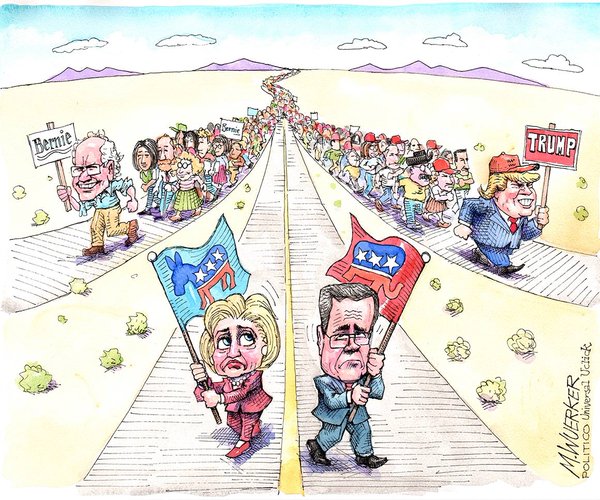
Unlike traditional republicans, Donald Trump and Bernie Sanders both agreed on the problem.  Where they disagreed was the solution.

Donald Trump used domestic economic policy tools like trade tariffs and countervailing duties to change the corporate behavior of the multinationals.  Bernie Sander’s approach is to regulate the corporations and force a behavior change.

Put another way, Bernie wants to change the economic referees, while Trump’s approach is to change the economic rules of the game and let the teams play it.

You might remember a large percentage of Bernie Sanders voters joined team Trump in 2016.  That’s because both teams agreed on the problem within our national economic situation.   The result was MAGA, a massive coalition of working-class voters, based on economics, that cuts through every social distinction of race, color, sex, orientation, etc.  The issue that binds the MAGA voters together is economic policy.

Florida Governor Ron DeSantis is a good governor for Florida, and he should be reelected easily.  However, do not fool yourself into believing the massive coalition of MAGA voters would ever transfer to a corporate republican.  It will not. EVER.

When people ask me who should come in after Trump, my answer is simple….  Show me the economic nationalist.

If there isn’t another one,… well, what does that tell you about the Republican party?

Last point.  Florida republicans have a major blind spot they keep ignoring and DeSantis is very lucky Charlie Crist doesn’t have the resources to exploit it.

Housing costs, rents and homeowners’ insurance in Florida have skyrocketed.  In some places home insurance has tripled just this year; yes, tripled.  Energy costs also increased massively in Florida, in many areas electricity rates have doubled.  Water utility costs in Florida have consistently been the highest in the nation due to the nature of the infrastructure and rapid expansion of the population.  Additionally, property tax costs -even with homestead protections- are a serious issue for lots of voters.

Put those economic issues, all being ignored by the governor’s office – as he campaigns around the country to raise his national profile, on top of high gasoline and food prices and DeSantis is very vulnerable on the way Floridians feel about their economic security.

Focusing on wokeism and social issues is an option when economic issues are not in crisis.  However, focusing on social issues while ignoring the economic pain and crisis, and you find yourself looking detached. aloof and vulnerable to political attack….. Then again, a typical republican.

.

The Managing of DeSantis HERE

The Branding of DeSantis HERE

The Selling of DeSantis HERE