Posted originally on Jun 4, 2025 by Martin Armstrong
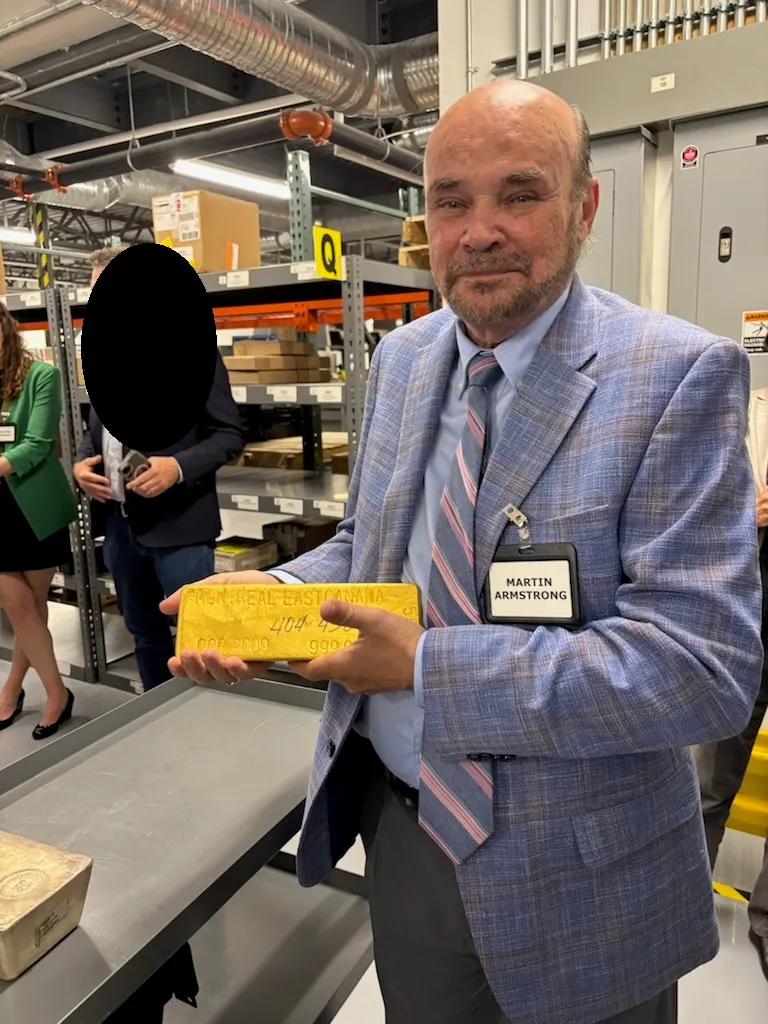
Holding a 400 oz Gold Bar – Central Bank Standard
QUESTION: Hello Martin – Here in Canada, we have a vexing question – why no Gold Reserves at BofC? USA has a date with destiny aka Ft Knox Audit that Trump and Bessent seemed engaged on this file but are preoccupied lately with a litany of distractions, I’m 74 with health issues surfacing, which rearrange one’s priorities – many millions of Boomers in same boat – but that’s the price you knew was coming
jw
ANSWER: Canada’s lack of significant gold reserves is the result of a deliberate policy decision spanning several decades, primarily driven by the following reasons:
Opportunity Cost: Gold pays no interest or dividends. The Bank of Canada (BoC) decided it could achieve better returns by holding interest-bearing assets like foreign government bonds (US Treasuries, German Bunds, etc.) and deposits.
The Shift to More Liquid Assets: The BoC prioritized holding foreign exchange reserves (primarily US dollars, euros, yen, etc.), which are highly liquid and easily used for direct intervention in currency markets to stabilize the Canadian dollar (CAD).
Canada began the process of gradually selling off its gold in the 1980s, when gold rallied to $875 on January 21, 1980, and then began a 19-year decline to $250. Canada significantly accelerated its gold sales during the 1990s and early 2000s under the leadership of Finance Minister Paul Martin and Governor Gordon Thiessen, aiming to optimize reserve asset management. By 2016, Canada sold its last significant holdings. As of today, Canada’s official gold reserves are reported as zero tonnes (or negligible amounts – e.g., 77 ounces reported in 2022, worth a trivial sum relative to total reserves). In essence, Canada decided that the costs and lack of yield associated with holding large gold reserves outweighed the traditional benefits. They opted instead to hold foreign currencies and bonds that are easier to use for market intervention and generate income, relying on the strength of the Canadian economy itself to support the value of its currency.
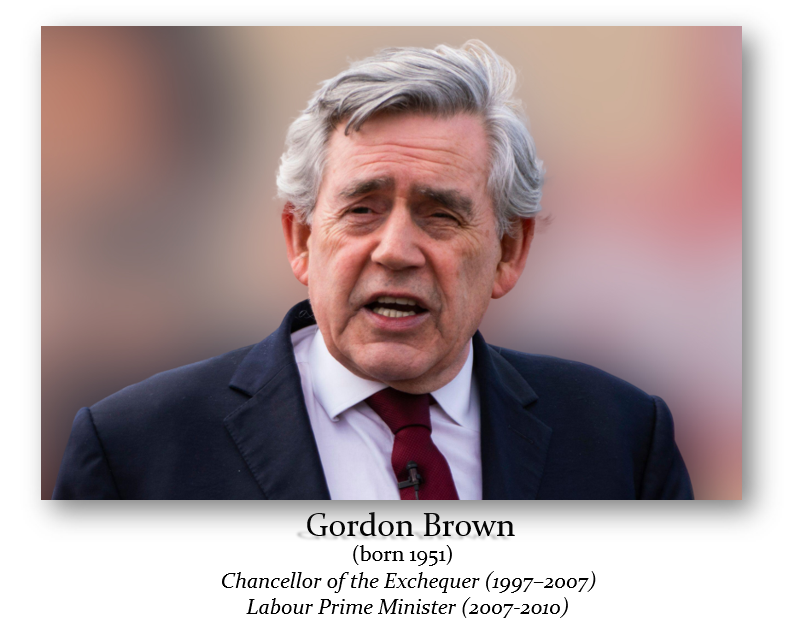
Gordon Brown, as Labour Chancellor of the Exchequer (1997-2007), authorized the sale of a very significant portion (roughly half) of the UK’s gold reserves. He was a member of the Labour Party, which viewed gold as a rich man’s toy. He sold approximately 395 tonnes of gold. The sales took place between July 1999 and March 2002. This represented about 58% of the UK’s total gold reserves at the time (which were around 715 tonnes before the sales). After the sales, the UK’s reserves stood at about 310 tonnes, where they remain today. The sales occurred during a period when the gold price was near a 20-year low, averaging around $275 per ounce. Shortly after the sales concluded, the gold price began a historic bull run, rising dramatically over the next decade to peak over $1,900 per ounce in 2011. This timing led to massive criticism that the UK sold at the absolute bottom of the market, potentially losing billions of pounds in potential value. The period is often referred to as the “Brown Bottom” in financial circles. Brown was ignorant of how markets function. He announced in advance the strategy to sell its gold reserves, so the market held back, anticipating a greater supply. The proceeds were invested in foreign currency and government bonds. While these assets generated interest income, the capital appreciation of gold vastly outstripped the returns on those bonds over the following years.
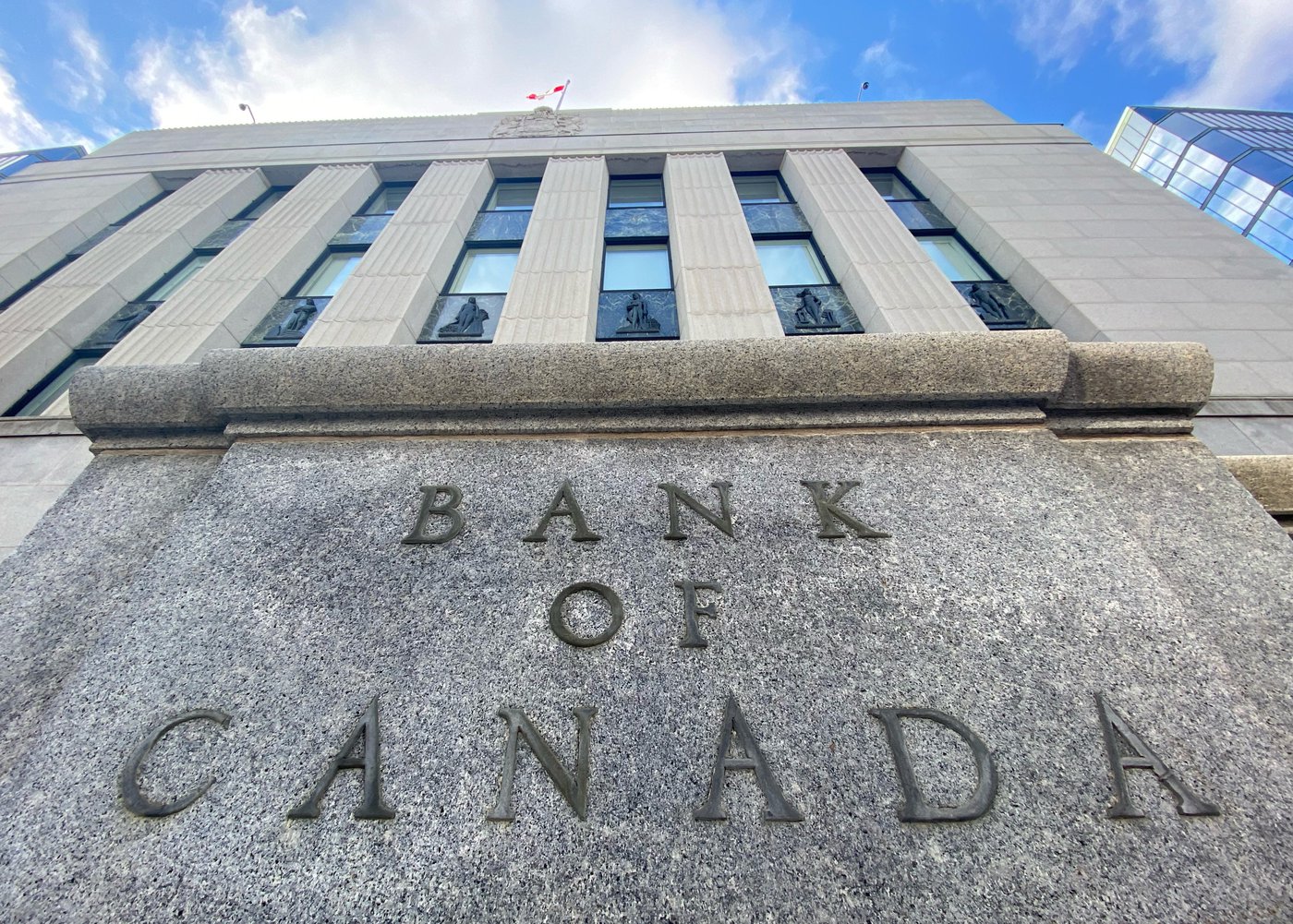
The head of the Bank of Canada during the main phase of Canada’s gold reserve sell-off (mid-to-late 1990s) was Gordon Thiessen (born 1938). He served as Governor from February 1, 1994, to January 31, 2001. Thiessen spent his entire career within the Bank of Canada, joining in 1963. However, it was his predecessor, John Crow (1987-1994), who began reducing its gold reserves significantly in the 1980s. While the Bank of Canada managed the sales operationally, the ultimate decision to sell the gold rested with the Government of Canada (specifically, the Minister of Finance and the Department of Finance). The Bank acted as the government’s agent in this matter.
Posted originally on CTH on May 29, 2025 | Sundance
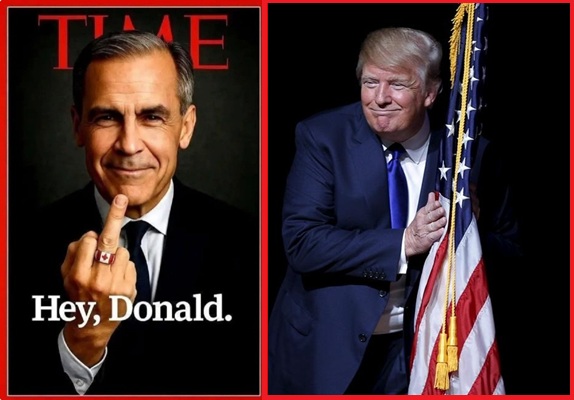
The current Canadian Prime Minister is genuinely a walking meme of a Canadian Prime Minister parody.
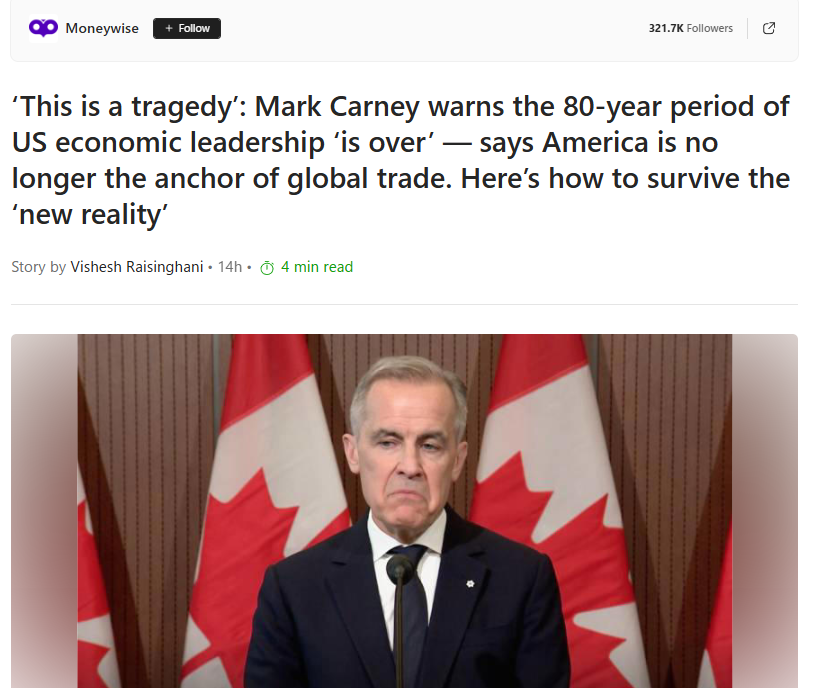
During his remarks to parliament today, Prime Minister Carney waxed gleefully about the U.S. federal trade court ruling against President Trump’s tariffs, just moments before the federal appeals court stayed the opinion of the lower court. It’s a little funny.
PM Carney doesn’t seem to recognize the reality of the economic landscape before him. He complains about blocked access to the U.S. consumer base with a level of entitlement that’s genuinely humorous. Meanwhile, the Canadian economy around him is collapsing. WATCH:
♦ BACKGROUND – Following the 2024 presidential election, Prime Minister Justin Trudeau traveled to Mar-a-Lago and said if President Trump was to make the Canadian government face reciprocal tariffs, open the USMCA trade agreements to force reciprocity, and/or balance economic relations on non-tariff issues, then Canada would collapse upon itself economically and cease to exist. In essence, in addition to the NATO defense shortfall, Canada cannot survive as a free and independent north American nation, without receiving all the one-way benefits from the U.S. economy.
To wit, President Trump then said, if Canada cannot survive in a balanced rules environment, including putting together their own military and defenses and meeting their NATO obligations, then Canada should become the 51st U.S state. It was following this meeting that President Trump started emphasizing this point and shocking everyone in the process. However, in the emotional reaction to Trump’s statements, no-one looked at the core issues outlined by Trudeau that framed President Trump’s opinion.
Representing Canada, Justin Trudeau was not expressing an unwillingness to comply with fairness and reciprocity in trade with the USA, what Trudeau was expressing was an inability to comply.
Quite simply, after decades of shifting priorities, Canada no longer has the internal economic capability to comply with a fair-trade agreement (FTA). Trudeau was not lying, and President Trump understood the argument; hence his 51st state remarks.
This is where it becomes important to understand the core reason why Trump, Ross and Lighthizer (2017) did not structurally want to replace the NAFTA agreement with another trilateral trade deal. Mexico and Canada are completely different as it pertains to trade with the USA. President Trump would rather have two separate bilateral agreements; one for Mexico and one for Canada.
♦ Firstly, Canada is a NATO partner, Mexico is not. As President Trump affirmed to Justin Trudeau during the meeting, it would be unfair of President Trump to discuss NATO funding with the European Union, while Canada is one of the worst offenders. Trump is leveraging favorable trade terms and tariff relief with the EU member states, as a carrot to get them into compliance with the 2.0 to 2.5% spending requirement for their military.
If the NATO member states contribute more to their own defense, the U.S. can pull back spending and save Americans money. However, Canada is currently 26th in NATO funding, spending only 1.37% of their GDP on defense (link).
Canada would have to spend at least another $15 billion/yr on their defense programs in order to reach 2.0%. Justin Trudeau told President Trump that was an impossible goal given the nature of the Canadian political system, and the current size of their economy ($2.25 trillion).
♦ Secondly, over the last 40 years Canada has deindustrialized their economy, Mexico has not. As the progressive political ideology of their politicians took control of Canada policy, the ‘climate change’ agenda and ‘green’ economy became their focus. The dirty industrialized systems were not compliant with the goals of the Canadian policy makers.
The dirty mining sector (coal, coking coal, ore) no longer exists at scale to support self-sufficient manufacturing. The dirty oil refineries do not exist to refine the crude oil they extract. Large industrial heavy industry no longer exists at a scale needed to be self-sufficient. Instead, Canada purchases forged and rolled steel component parts from overseas (mostly China). Making the issue more challenging, Canada doesn’t even have enough people skilled to do the dirty jobs within the heavy manufacturing; they would need a national apprenticeship program. Again, all points raised by Trudeau to explain why bilateral trade compliance was impossible.
♦ Thirdly, the trade between Canada/U. S and Mexico/U. S is entirely different. The main imports from Canada are energy, lumber and raw materials. The main imports from Mexico are agriculture, cars and finished industrial goods. Mexico refines its own oil; Canada ships their oil to the USA for refining. There are obviously some similar products from Mexico and Canada, but for the most part there is a big difference.
♦ Forth, USA banks are allowed to operate in Mexico, but USA banks are not allowed to operate in Canada. USA media organizations are allowed to broadcast in Mexico, but USA media organizations are regulated and not permitted to broadcast in Canada. The Canadian government has strong regulations and restrictions on information and Intellectual Property.
All of these points of difference highlight why a trilateral trade agreement like NAFTA and the USMCA just don’t work out for the USA.
Additionally, if President Trump levies a tariff on Chinese imports, it hits Canada much harder than Mexico because Canada has deindustrialized and now imports from China to assemble into finished goods destined to the USA. In a very direct way Canada is a passthrough for Chinese products. Canada is now more of an assembly economy, not a dirty job manufacturing economy.
When Trudeau outlines the inability of Canada to agree to trade terms, simply because his country no longer has the capability of adhering to those trade terms, a frustrated President Trump says, “then become a state.”
There is no option to remain taking advantage of the USA on this level, and things are only getting worse. Thus, the point of irreconcilable conflict is identified.
Because the Canadian government became so dependent on their role as an assembly economy, they enmeshed with China in a way that made them dependent. The political issues of Chinese influence within Canada are a direct result of this dynamic. In fact, China was the big winner from the outcome of the recent election because all of their investments into Canada are grounded on retaining Liberal government dependency.
If Trump targets China with punitive tariffs, the Canadian economy will be collaterally damaged. Canada will end up paying a tariff rate because they use cheap Chinese component parts in their finished goods. Canada has structurally designed their economy to do this over multiple years.
Understanding the unique nature of the Canadian economic conundrum, the only way to address the issue is to break out the USMCA into two separate bilateral trade agreements. One set of trade terms for Mexico that leverages border security, and one set of trade terms for Canada that leverages NATO security and border security. The only substantive similarity between them will be in the auto and agriculture sector.
If you think the multinational corporations, political leftists and UniParty Republicans in the USA are strongly opposing Trump now, just wait until later this year when the Trump administration proposes the elimination of the trilateral North American trade agreement, USMCA.
According to the World Bank, the USA economy is $27.3 trillion. Canada is $2.1 trillion.
Do the math!
[…] The expectation, according to two people close to the White House, is that negotiations to permanently remove the threat of painful 25 percent tariffs on Canada — which Trump mostly rolled back earlier this month — and other sector-specific tariffs are likely to be folded into the upcoming review of the U.S.-Mexico-Canada Agreement. That review is due in 2026, but the Trump administration wants to accelerate to this calendar year.
“It makes sense to separate out Canada and Mexico from the rest because they are going to want to redo the USMCA,” said one of the people close to the White House, who were granted anonymity to discuss ongoing deliberations. “They’re going to have separate tariffs that focus specifically on Mexico and Canada, and they’re going to take some actions to squeeze them a little bit.” [LINK]
Posted originally on May 29, 2025 by Martin Armstrong
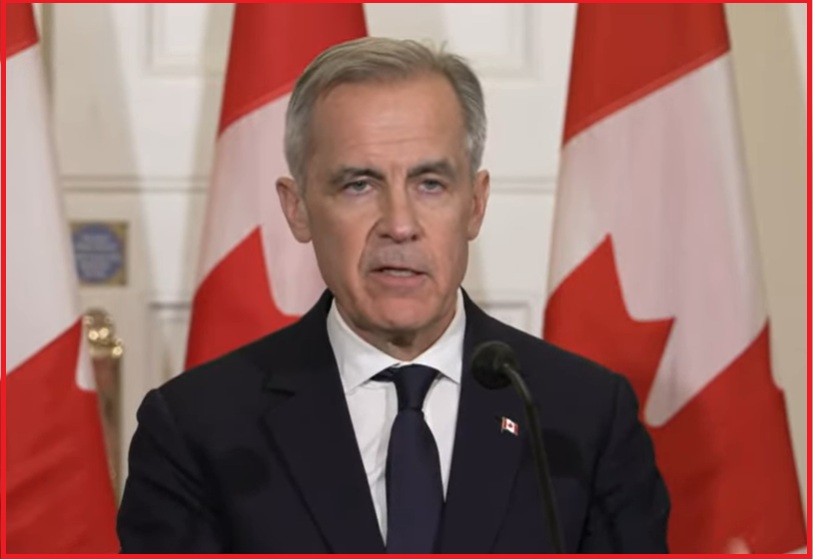
Mark Carney’s call for aligning with the EU in a war against Russia reveals more about his ideological alignment than any strategic necessity. As a former central banker turned World Economic Forum alumnus, Carney has long abandoned the notion of free markets in favor of globalist control. He is keen to support the EU’s Marxist-style top-down approach, which has economically gutted Europe and driven capital flight, and is extremely eager to distance Canada from the United States in every possible way.
“Seventy-five cents of every dollar of capital spending for defence goes to the United States. That’s not smart,” Carney stated about his nation’s former top ally. He does not want the United States to remain the world’s superpower, per WEF protocol, as this sentiment was felt long before Trump. Carney would like to spend at least $1.25 trillion on defense over the next five years. “We’re making great progress on that, and by Canada Day, we’d like to see something concrete there,” Carney said, noting that Canada will be penning a deal with the European Union in the coming weeks.
Meanwhile, US President Trump has offered Canada protection under his proposed “golden dome.” As he continues to pressure Canada to become a state, Canada runs further into the arms of the EU. NATO Secretary General Mark Rutte is also keen to find a way to support his plans for war without the support of the United States. Rutte is expected to ask the 32-member alliance to up current spending to around 3.5% of GDP.
Canada currently spends 1.37% of its GDP on defense, below the current 2% NATO target. Carney believes Canada can meet NATO standards by 2030, but NATO is increasingly requesting more. “We are going to have to spend more, sooner,” the prime minister said. “That’s one of the reasons why we will have a fall budget, not a budget tomorrow, because we’re part of deeper discussions on the defence side.”
Canada has already stationed troops in the Arctic on a near-permanent basis. Operation Nanook in the Far North has expanded as Canada attempts to secure its place in the Arctic region. Canada and Greenland are both in strong opposition of the current US administration as Trump continues to pressure both to abandon sovereignty. But the true nature of Arctic operations is to intimidate Russia.
“We want to be in the Arctic on a near permanent basis,” Lt.-Gen. Steve Boivin stated. “The current approach to Operation Nanook puts us in the Arctic for five to six months a year. We’re looking at being there 10 plus months per year.” The federal government has already spent an additional C$420 million on the operation.
In a way, Trump is receiving everything he once requester,d from increased NATO spending to forcing nations to defend their own lands without the support of the US. On the other hand, nations are now eager to begin offloading their increased defense budgets outside the US. The capital expended on war would funnel back into the US. NATO was not entirely a charity case for the US as it did receive those funds recycled back into the US economy.
It is clear that Carney is eager to join the alliance of nations taking their arms up against Russia. Russia poses no threat to Canada. Carney’s eagerness to join EU efforts has nothing to do with Ukraine and everything to do with consolidating power by forcing the West into a global war.
Posted originally on May 27, 2025 by Martin Armstrong
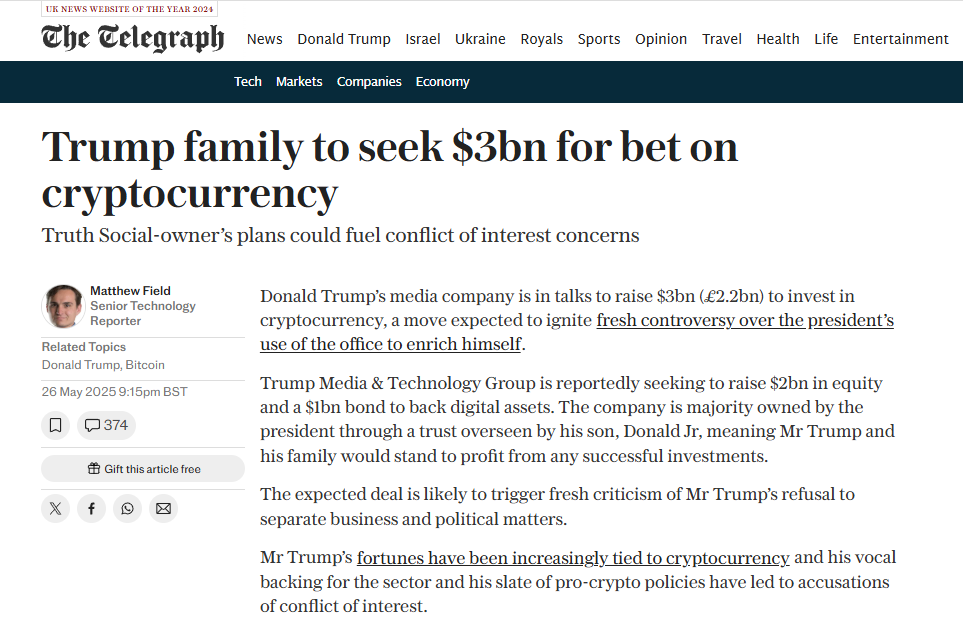
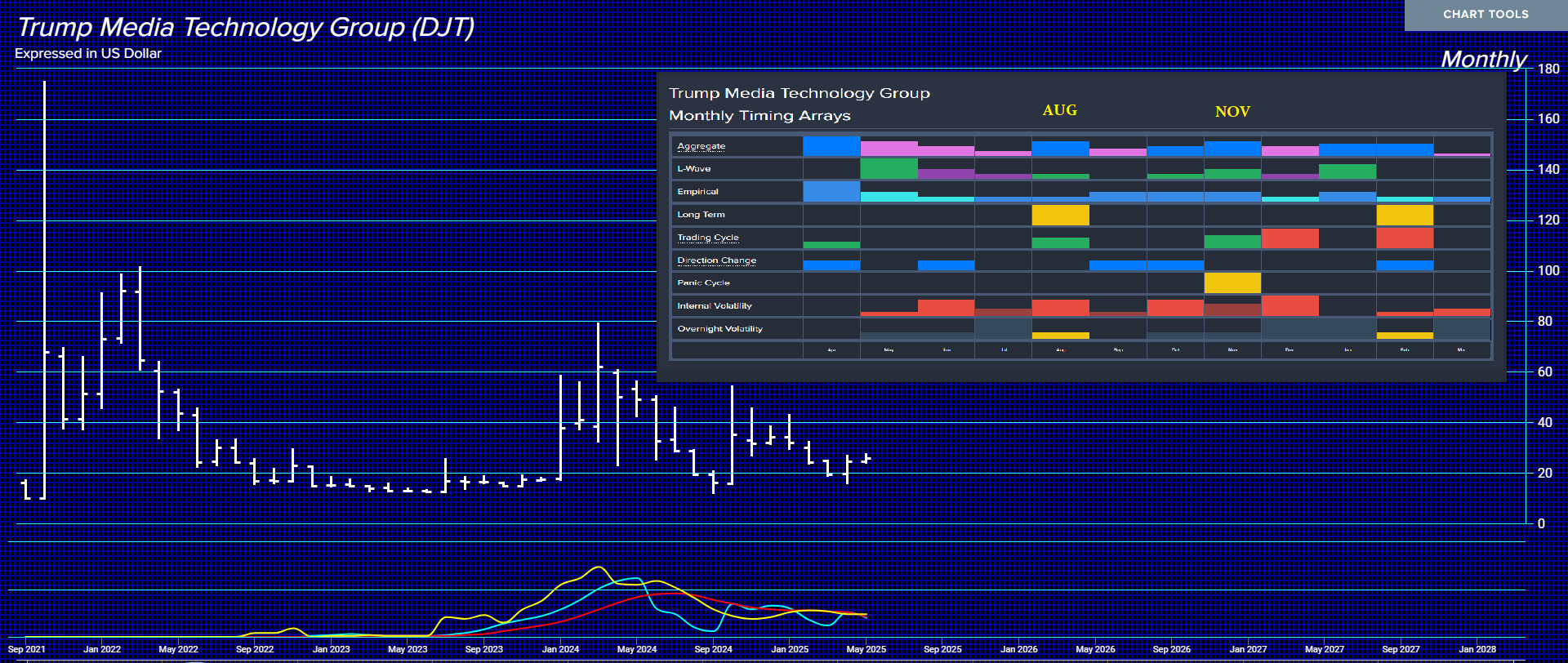
We know we are approaching a major high in Bitcoin when Trump Media and Technology Group (TMTG), a publicly traded media company controlled by the U.S. president’s family, announced a plan to purchase $2.5 billion worth of Bitcoin on Tuesday. This is a warning that we are in the throes of a typical bubble that will not end nicely.
As a trader, you come to understand that every market, no matter what, acts the same because it is NOT the instrument, be it tulips, stocks, commodities, or bonds – it is human nature and the madness of crowds. A crash becomes inevitable when 97% of the people are all long and they run out of fresh buyers. Like the Russian collapse, because all the bankers were long and the hedge funds, then they tried to sell and discovered that they were the market. When they try to sell, the broker says there is NO BID! Bitcoin is a trading vehicle like everything else. It is no exception to the rules of markets. It is just the next Tulip or Dot.COM or AI craze.
I would NOT invest in Trump Media and Technology Group. It appears to be a brief rally, but this decision is misguided and emotional. They are risking the company on a speculation and are all caught up in the typical bubble, assuming the majority is correct. Why not convert your cash to yuan or euros when your expenses and revenue are in dollars? I can’t even recall the number of companies that came crawling to me for help after making the same risky FX trades.
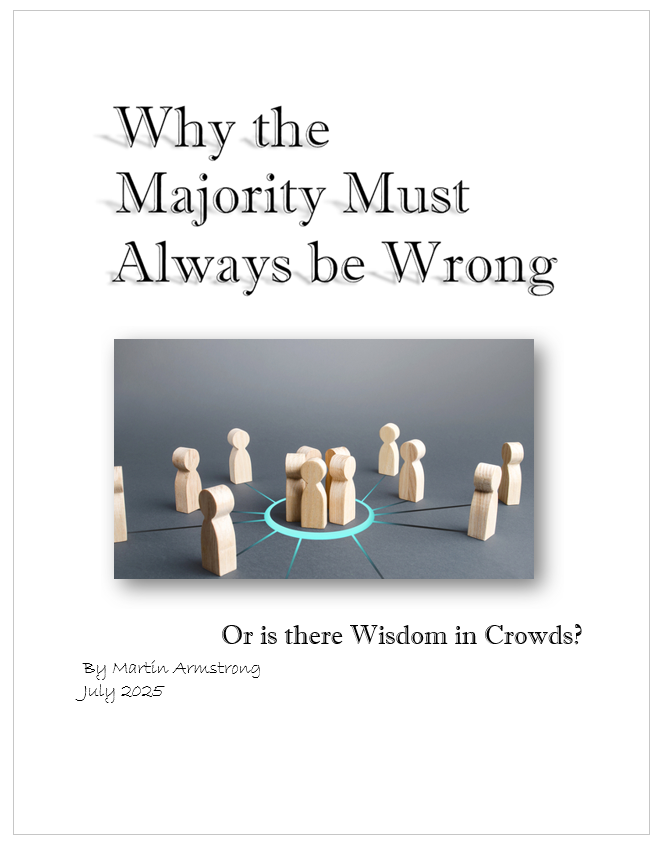
The problem remains, the majority is ALWAYS wrong, and that is why no market is ever exempt from the inevitable boom and bust cycle. This is also when it only takes a minority to bring down a government or a market.
Posted originally on CTH on May 27, 2025 | Sundance
I’m sorry, but when I finally got around to review the appearance of King Charles in the Canadian Parliament, I could not get past the optics on display.
My background thoughts are HERE, but boy howdy does this picture encapsulate the dynamic.
And yes, King Charles waxed eloquently in both French and English about the terrible issue that Canadian sovereignty is facing.
The same issue, albeit to a lesser -but increasing- extent, is the core impetus between U.S. President Trump’s manufacturing policies in the USA. President Trump is urgently attempting to rebuild a collapsed industrial manufacturing base. However, from the leftist position of Canada, the easier route that affords them the ability to chase the green energy rainbows is to retain a dependency manufacturing model. These are political decisions.
At the core of this dynamic you will find the reason why President Trump is likely to dissolve the U.S/Mex/Canada (USMCA) trade agreement and instead turn toward two independent bilateral trade agreements between the USA-Mexico and USA-Canada. Extend this reasonably accurate predictive economic reality to its logical conclusion and you see why the U.K wants to help bolster Canada.
In the battle against President Trump’s economic ferocity, Canada is relying on the friendly, duplicitous and influential mask work by Great Britain.
Posted originally on CTH on May 26, 2025 | Sundance
King Charles is arriving in Canada today in advance of an opening speech he will deliver to the Canadian Parliament. Canadian Prime Minister Mark Carney invited King Charles to attend, and while the media portray the visit as mostly symbolic there is no doubt the substantive issue for Canada is the economic dependency on the USA and how the U.K can bolster the position of Canada against that threat.
Everything is always about the money of the thing, this dynamic between the U.K and Canada is no different. What we would call the ‘western’ global financial system is contingent upon all U.S. allies retaining the United States as their consumer base and stable currency center. President Trump has exposed the vulnerability of Canada as he confronts the parasitic relationship {GO DEEP}.
In advance of the U.K positioning itself as the skirt behind which Canada can hide from the horrible Trump, British Prime Minister Keir Starmer extended an invitation for President Trump to attend a state visit in his honor later this year. The effusive praise from Starmer during the White House meeting was keenly strategic, so too was their urgency in creating the first new-era free trade agreement with the USA.
Perhaps President Trump’s embrace of Qatar, the UAE and Saudi Arabia should be viewed through this financial prism where the EU, U.K and Canada will ultimately go to war (together) against the efforts of President Trump. Within the partnership of the UK, EU and Canada, the Snow Mexicans are the weakest link, the most vulnerable to collapse from Trump’s economic policy.
Canada no longer has any substantive ability to create heavy machinery industrial goods. Most of the Canadian manufacturing equipment is imported from China and the EU.
The same issue, albeit to a lesser -but increasing- extent, is the core impetus between U.S. President Trump’s manufacturing policies in the USA. President Trump is urgently attempting to rebuild a collapsed industrial manufacturing base. However, from the leftist position of Canada, the easier route that affords them the ability to chase the green energy rainbows is to retain a dependency manufacturing model. These are political decisions.
At the core of this dynamic you will find the reason why President Trump is likely to dissolve the U.S/Mex/Canada (USMCA) trade agreement and instead turn toward two independent bilateral trade agreements between the USA-Mexico and USA-Canada. Extend this reasonably accurate predictive economic reality to its logical conclusion and you see why the U.K wants to help bolster Canada.
In the battle against President Trump’s economic ferocity, Canada is relying on the friendly, duplicitous and influential mask work by Great Britain.
LONDON/OTTAWA (Reuters) – King Charles flies to Canada on Monday for a highly symbolic visit showing support for the nation that recognizes him as its sovereign but is coveted by U.S. President Donald Trump as a 51st U.S. state.
Following an invitation from Prime Minister Mark Carney, Charles will open parliament in Ottawa on Tuesday, the first time a British monarch has carried out the duty since his mother, the late Queen Elizabeth, did so 68 years ago.
Trump has repeatedly expressed a desire to annex Canada, a proposition fiercely rebuffed by Carney whose election win last month came partly on the back of that stance.
“The prime minister has made it clear that Canada is not for sale now, is not for sale ever,” Canada’s envoy to the UK, Ralph Goodale, told reporters during a visit last week by Charles to Canada’s high commission.
“The king, as head of state, will reinforce the power and the strength of that message.”
Charles has made subtle signals of his backing for Canada in recent months, wearing Canadian medals, calling himself the king of Canada, and describing its flag as “a symbol that never fails to elicit a sense of pride and admiration”. (read more)
Remember, the core of the thing is money.
What does that mean?
Well, in addition to the zero-sum mindset of the Canadian and British governments, it also means both Republicans and Democrats in congress will fight President Trump with extreme prejudice.
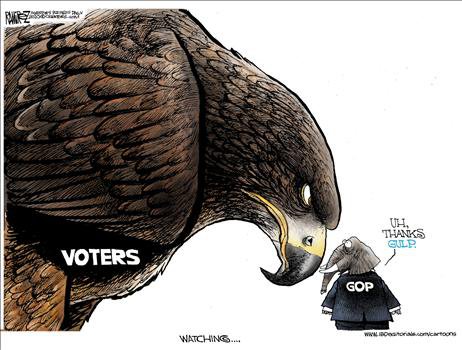
If you want to see a Republican fight, start to threaten their financial status and suddenly all those spineless Republicans will attack the disruption with a ferocity that could fuel ten-thousand Dragon-X launches. If you doubt that truism, go back and look at the Republican support for President Obama weaponizing the IRS against the Tea Party. If you still doubt that truism, look around right now at how hard the Republicans are fighting to retain the Ukraine laundry operation.
There is no such thing as a “Republican ideology,” it is always about the money.
The UniParty is two wings of the same bird, a vulture.
Republicans will soon profess their undying love for a free and sovereign Canada, and if President Trump doesn’t return the effusive praise for King Charles things will get ugly.
If President Trump walks through the firestorm of the influence campaign and exits to the other side still intending to demand trade reciprocity -using tariffs to deliver it- he will be as isolated from the Republican party apparatus as MAGA voters are.
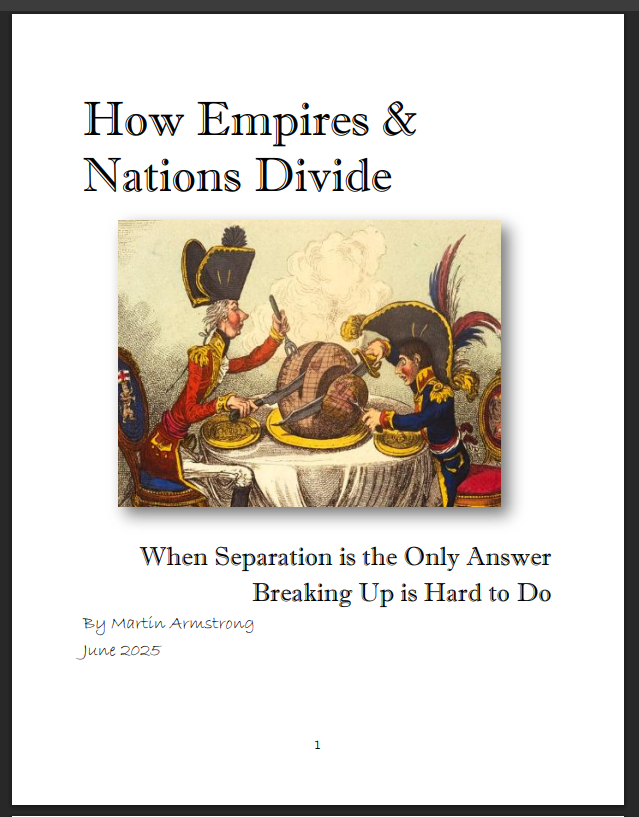
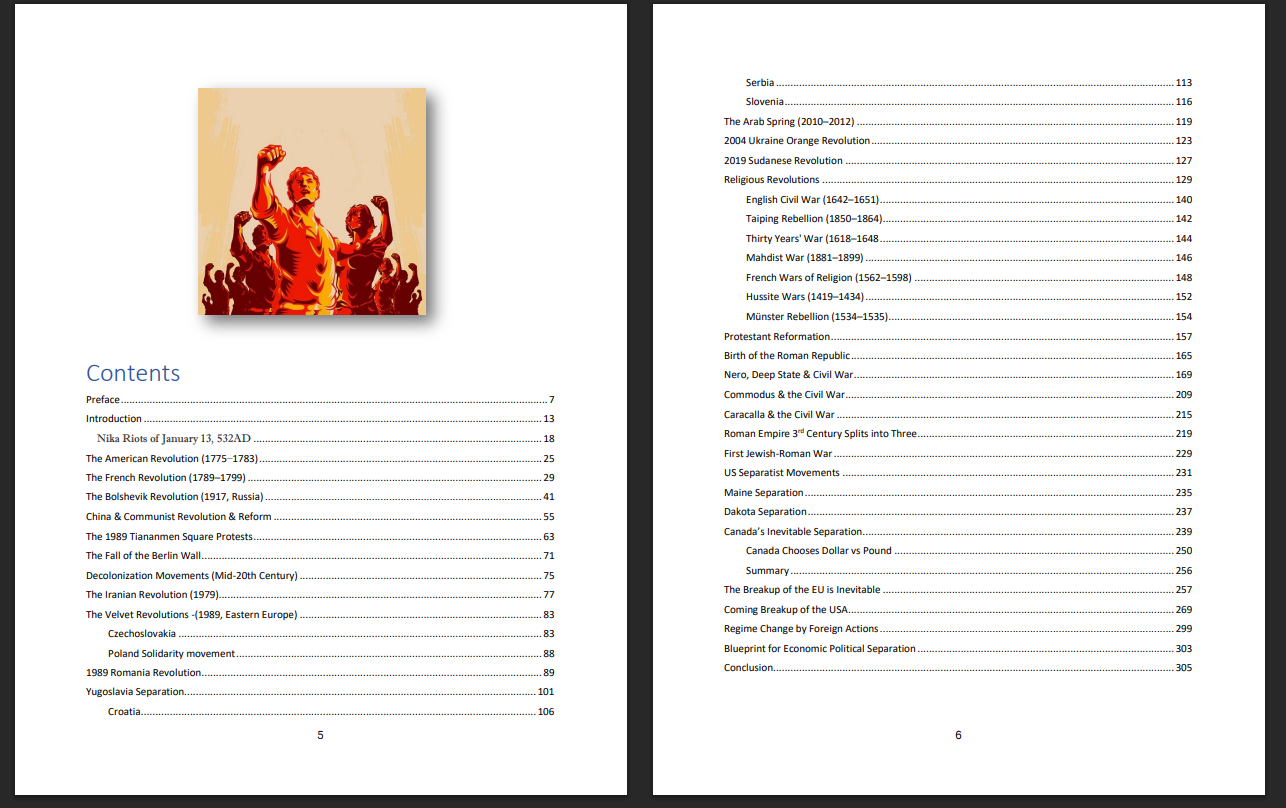
This is perhaps one of the most fascinating reports I have ever written. This was inspired by my invitation to speak in Alberta concerning their movement to separate from Canada. A few propose being the 51st State, but the more practical move would be to become a sovereign state on their own, which I lay out in the proposal that would rock the entire world and propel Alberta to a leader among nations.
But what is far more critical is that I have gathered historical separation events to take the best from that and what to avoid. However, in the process, such separations and revolutions have ALWAYS taken place with the minority and not the majority. The average number of what percent of the population is required to pull off a separation or revolution is LESS THAN 15%!!!!!
Pulling together this research blew my mind. This goes against what most would expect. It also shows how this process has unfolded; not all are violent. As you can see, the significant events like the American Revolution, the French Revolution, and the 1917 Russian Revolution are included. In these events, I have focused on the percentage of the population it took to achieve the result. I have included the ancient revolution, including the Roman-Judaea War, and the shocking realization that the Zealots were a tiny fraction of the Jewish population.
This Report will shock you as it did me.
It is Reasonably Priced at $19.95 and comes out to 314 pages, fully illustrated.
I have created this site to help people have fun in the kitchen. I write about enjoying life both in and out of my kitchen. Life is short! Make the most of it and enjoy!
This is a library of News Events not reported by the Main Stream Media documenting & connecting the dots on How the Obama Marxist Liberal agenda is destroying America









 Centinel2012