Ho-Lee-Cats: Freight Haulers Order 450,000 New MAGAnomic Big Rigs in 2018 – Backlog for Delivery Extends into 2019….


Freight hauling trucks are like the lymphatic system within a healthy economy.  As the economy writ large needs to move stuff around, it’s the truckers who git-r-done; and no time in U.S. economic history has there been such a demand for haulers.

In a stunning Wall Street Journal Report they note Analyst group ACT Research says manufacturers are on track for 450,000 orders for heavy-duty trucks this year, easily breaking a 14-year-old record. In July alone, North American fleets ordered more than 52,000 trucks, the largest order in history.   Whoot, Whoot !!

(Via WSJ) An unprecedented run of orders for big rigs has pushed the backlog at truck factories to nine months, according to industry analysts, the largest since early 2006, when truckers stocked up to get vehicles in place before tougher environmental restrictions would take effect. Typically the backlog is about five months for the truck industry’s manufacturers, analysts said.

“It is longer than it should be,” said Magnus Koeck, vice president of marketing for Volvo AB’s North America operation, where Class 8 truck orders this year soared to 25,000 from 11,000 during the first six months of 2017. “Of course we are not alone in this situation,” he said. “Everyone is in the same boat.”

North American freight-haulers ordered more than 300,000 Class 8 trucks in the first seven months of this year and are on track to order a record 450,000 of the heavy-duty vehicles for the full year, according to ACT Research. That would be the largest book since 2004, when orders reached 390,000, according to analysts.

[…] Freight-hauling fleets are trying to keep up with swelling demand in a robust U.S. economy even as they say they face difficulty finding drivers. New trucks are one recruiting tool, and the new vehicles also get better fuel mileage—an attractive feature for fleets as other costs are rising. (read more)

Fleet companies making this scale of an investment is one of the more visible performance indicators that we haven’t seen anything yet.  The Main Street economy is only just beginning to get started.   This is the beginning, of the beginning, of the most massive middle-class economic expansion in the history of our United States.

This KPI also aligns with the sector seeing the largest initial wage and benefit increases:

  (More Data)

BLS Report: Productivity Increases 2.9% in Second Quarter…


Economic analysis can get weedy…. so a simple way to look at productivity is to think about baking bread in your kitchen.

If you were going to bake 4 loaves of bread it might take you 2 hrs start to finish. However, if you were going to bake 8 loaves of bread it would not take you twice as long because most of the tasks can be accomplished with simple increases in batch size, and only minor increases in labor time.  Your productivity measured in the last four loaves is higher.

Economic Productivity is measured much the same way, within what’s called a production probability equation.  Additionally, if two hours of your time are worth $40, each of four loaves of bread costs $10; but if you make 8 loaves in the same amount of time the labor cost is only $5/per loaf.

From 2007 through 2017 the average rate of productivity increase was 1.3%.  However, in the second quarter of 2018 productivity jumped to 2.9%.  That means total business output increased significantly as more product was demanded from within the business operation.  Throughout the economy people just wanted more stuff.

Improved gains in efficiency/productivity (more bread needed) supports faster economic growth without generating higher inflation; no need to raise prices because your cost to make each loaf of bread decreases the more you make.  Higher sales and lower per unit cost means more profit for the bread-maker.  No need to raise prices.  Without inflation, there’s no motive for the Fed to raise interest-rates.

Increases in productivity generally means the economy is generating more stuff.  The more stuff generated the higher the value of all economic activity; this increases GDP growth.

When we see higher productivity in direct alignment with GDP increases, the increased production indicates sustainable GDP growth.

BLS Report: “Nonfarm business sector labor productivity increased 2.9 percent during the second quarter of 2018, the U.S. Bureau of Labor Statistics reported today, as output increased 4.8 percent and hours worked increased 1.9 percent.” (link)

We made 4.8 percent more stuff, and only worked 1.9 percent longer.  The net is a 2.9 percent productivity increase.

.

MAGAnomic Status Report…


.

The future’s so bright…

…he’s gotta wear shades!

President Trump Impromptu Presser Departing White House…


Departing the White House for New York and New Jersey, President Trump delivers impromptu remarks and holds a brief unscheduled presser prior to climbing aboard Marine-One.

Secretary of State Mike Pompeo Introduces The Iran Action Group and Director Brian Hook…


Earlier today Secretary of State Mike Pompeo introduced the newest geopolitical strategy from the U.S. Department of State, the Iran Action Group.  The goal of the coordinated effort is to assemble a unified action front from all allies toward the destabilizing activity stemming from within the Iranian regime.

.

[Transcript] SECRETARY POMPEO: Good afternoon, everyone. Today I am happy to announce the creation of the Iran Action Group.

The Iran Action Group will be responsible for directing, reviewing, and coordinating all aspects of the State Department’s Iran-related activity, and it will report directly to me.

For nearly 40 years, the regime in Tehran has been responsible for a torrent of violent and destabilizing behavior against the United States, our allies, our partners, and indeed the Iranian people themselves. In May of this year, President Trump withdrew from the flawed Iran nuclear deal, which failed to restrain Iran’s nuclear progress or its campaigns of violence abroad. In its place President Trump has instituted a campaign of pressure, deterrence, and solidarity with the long-suffering Iranian people.

Our hope is that one day soon we can reach a new agreement with Iran. But we must see major changes in the regime’s behavior both inside and outside of its borders. The Iranian people and the world are demanding that Iran finally act like a normal nation.

The Iran Action Group will drive daily progress on these objectives and I hope do much more.

We are committed to a whole-of-government effort to change the Iranian regime’s behavior, and the Iran Action Group will ensure that the Department of State remains closely synchronized with our interagency partners. The IAG will also lead the way in growing efforts with nations which share our understanding of the Iranian threat. President Trump is making our Iran strategy a true multinational undertaking, and the Iran Action Group will be key to further progress in that regard.

I am also announcing that Brian Hook will lead the Iran Action Group with the formal title of Special Representative for Iran. Brian has served as the Director of Policy Planning here since February of 2017, and he has worked tirelessly to advance President Trump’s foreign policy priorities across multiple domains. Brian’s diplomatic expertise and broad experience with Iran policy makes him an outstanding choice to lead the State Department’s Iran Action Group.

Since the President’s decision to withdraw from the Iran deal in May, Brian has played an important role in shaping our strategy of maximum diplomatic and economic pressure.

We are going to continue to rely on him and his team to lead our efforts to counter the Iranian regime’s malign activity, to support Iranian voices, and to galvanize international support for our efforts.

And with that, I’d like to introduce our new Special Representative for Iran, Brian Hook.

President Trump Invites Media To Remain for Another White House Cabinet Meeting…


When we elected a successful businessman as President of the United States and leader of the executive branch, we elected a person who fundamentally changed the framework of accountability and transparency in government. President Donald J Trump holds an average of two to three full cabinet meetings each month where the cabinet members give direct updates on execution of policy priorities.

No President in modern history has put that much accountability into the position of each cabinet member. No President has ever coordinated strategic objectives with such a high level of expectation and scrutiny. No President has folded transparency into the cabinet with full media access over White House cabinet meetings. This is a new executive branch standard.

NEC Director Larry Kudlow break-out discussion on the economy at 03:45. WATCH:

NEC Director Larry Kudlow: Take Home Pay is Rising, The Economy is Booming….


National Economic Council Director Larry Kudlow appears on Fox News to discuss the incredible strength of the economy and how the media is refusing to cover the story.

Chairman Kudlow goes through a series of economic Key Performance Indicators (KPI’s) to stress how this specific set of MAGAnomic Main Street policies is delivering real, tangible, financial benefits to the middle-class and average Americans.

President Trump Retweets The Reason for the Media’s Recent Racist Attack Narrative…


Rasmussen did a survey of U.S. voters and discovers a significant jump in black support for President Trump from 19% last year to 36% now.   Not coincidentally, the DNC media apparatus has been pushing a recent racist narrative against President Trump.

(Rasmussen Link) (President Trump Tweet Link)

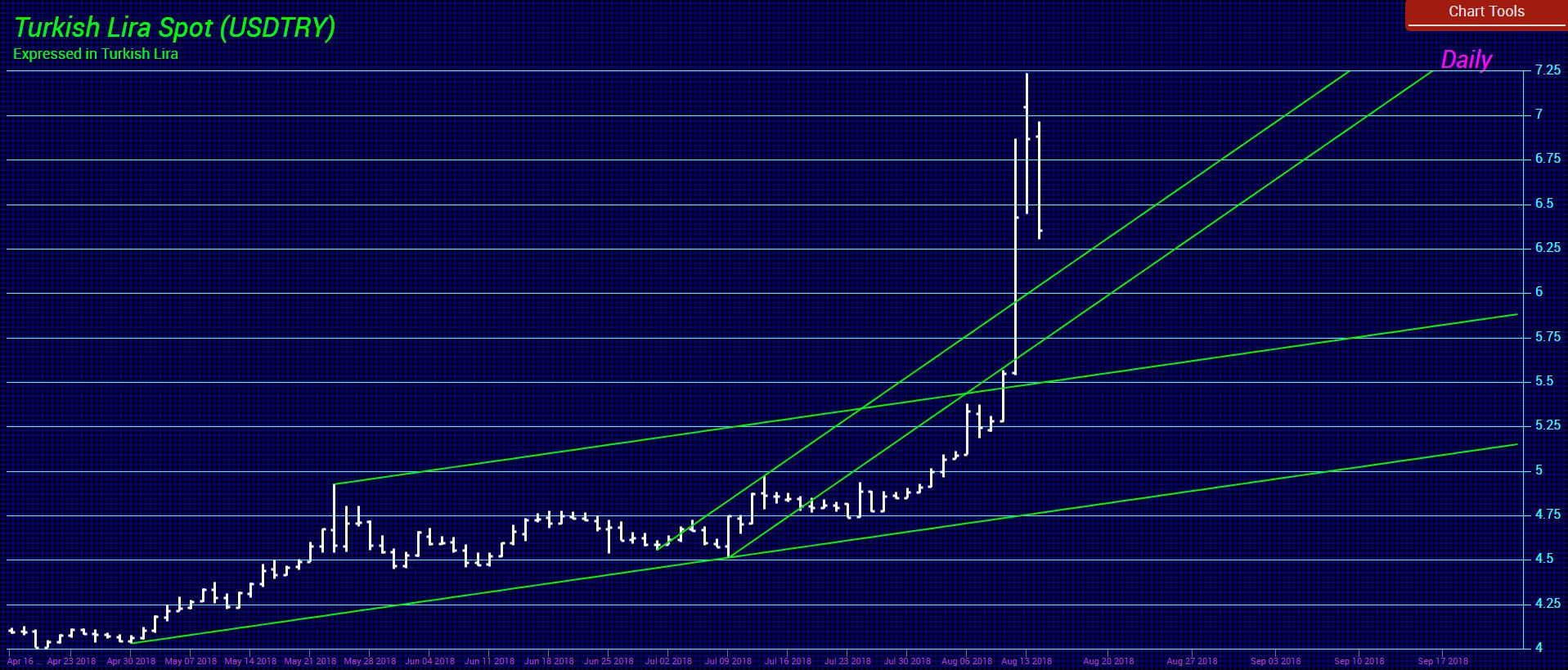
The Crisis is Turkey


President Recep Tayyip Erdogan of Turkey is finding his dreams of an all-powerful resurrection of the Ottoman Empire are falling apart. Qatar has come to the aid of Turkey offering $15 billion in a loan, but keep in mind that the entire issue with Syria began with Qatar proposing a pipeline through Syria to compete with natural gas with Russia. Therefore, it is in Qatar’s best interest to keep Turkey trying to invade Syria. The price will be the pipeline, which we seriously doubt will ever take place.

Erdogan has sent the Turkish economy into a downward spiral for some time. Its soaring inflation has exceeded 100% and rising debt-to-GDP of about 70% under President Recep Erdogan’s regime has been a growing problem. As central banks pumped money into the system over the past decade, nations like Turkey and other emerging market economies used the opportunity to raise more and more “cheap” debt to boost their productivity. Turkey has attracted capital from Europe seeking higher yields because of the negative interest rates policy of the ECB. Now we have a crisis in Turkey that is also the result of Draghi’s Quantitative Easing that drove capital to Turkey and FAILED to revived the European economy.

Erdogan’s dream of restoring the Ottoman Empire is no joke. It has been European money seeking higher yield that kept him in power. It is curious how those who seek dictatorial power are the ones who dream of restoring the power of empires long since dead. Erdogan has wanted to recreate the Ottoman Empire just as the dream of the reestablishment of the old Roman Empire as was the desire behind Napoleon and Hitler. The days of Empire Building are long gone and Erdogan has been living in the past. His goal was to expand his country’s military operations in Syria and this, he hoped, would be the first step as with Hitler’s invasion of Poland.

Nevertheless, the Turkish lira collapse and the expensive dollar have been conspiring against him reflecting his disastrous management of the economy and the collapse in confidence among the Turkish people. There remain serious questions about elections in Turkey being rigged to keep him in power. Therefore, on the one hand, Erdogan is attracted to dealing with Russia who is on the opposite side of the game board with Qatar. Erdogan has the free markets moving against him and he is more likely to turn to Russia than the West to retain personal power and the free markets show what most likely the real sentiment of the Turkish people was for the fake elections. Consequently, Erdogan turned to Qatar because he was desperate for money to retain personal power. If he loses the support of his military, then they will side with the people and Erdogan’s head may end up on a spike. Qatar will discover they are dealing with someone who will not be loyal to them either. Yet, the financial markets are working against Erdogan and as the crisis continues to evolve in the months ahead as $15 billion will not reverse the crisis, Turkey can hardly afford military adventures. Erdogan will be more likely to turn to Russia when he cannot retain power otherwise. He can blame the USA all he wants publicly, but the free markets are conspiring against him and that includes his own people.

Many European institutions rushed into Turkey and bought their bonds at 20%. Many Spanish banks had capital was invested in Turkish bonds to get the higher yield to the tune of on average 20%+. Based on the phone calls, there are way too many institutions who invested into Turkey. They simply assumed that NO government defaults because the powers that be will always bail out the bondholders. This time the IMF is really powerless. They can make some noise and others will say the crisis is subsiding. However, this is just talking. There is nobody who can save Turkey at this point as long as Erdogan remains in power. Qatar will discover that Turkey is a bottomless pit. They will try to now ease the crisis with words because of the extensive foolishness of banks and pension funds who bought Turkey bonds to try to get yield.

The fall in the Turkish lira has also benefited the Syrian Army, which launched an offensive on the last large mercenary fortress in Idlib. Turkey was actually against the offensive because it feared that it would fall to Syria and that is against Erdogan’s dreams of taking more territory. What is not really looked at internationally is the plain fact that Turkey does not have its own arms industry. Erdogan needs arms to be imported and as the lira crisis materialized, his Turkish operation Olive branch and shield of the Euphrates in Syria become rapidly too expensive. Back in January 2018, the Siyasi Haber newspaper reported that an estimated $400 million was being spent on Operation Olive Branch alone. Erdogan has spent over $1 billion so far in his attempt to conquer that region of Syria.

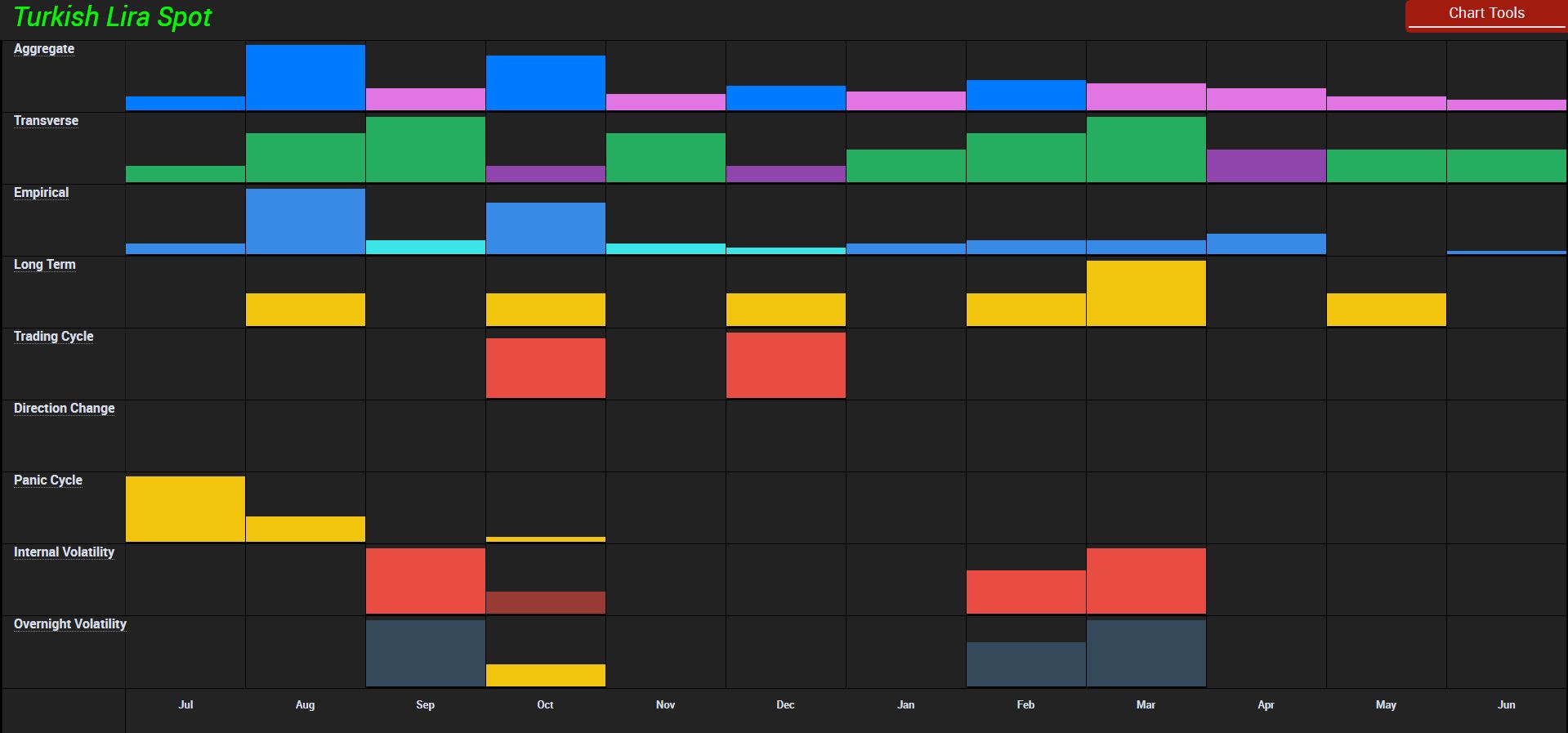
Instead of building his economy and benefiting the people of Turkey, Erdogan has been more interested in resurrecting the Ottoman Empire. It has been his mismanagement of the economy and his hostile attitude even to Greece that is behind the Turkish Lira Crisis. He has lost the confidence of his own people! August has been our target for the crisis and so far the computer has been correct on that score. However, volatility will remain high going into October and then we see it will return as the new year begins. Qatar coming to the rescue should help support the lira for now. Those who are wise had better sell their Turkish bonds and step oy of this trade. August should prove to be only a temporary low for the lira

July Retail Sales Growth: 6.4% “Unexpected”, “Well Beyond Expectations”, “well beyond what experts predicted”…


Remember that 2016 conversation about retail inflation, Q2 wage growth, durable goods spending and non-durable goods expenditures…  Well, in a growing economy; a bigly expanding economy; with wages actually increasing as an authentic outcome of expanded hiring and jobs, jobs, jobs… in conjunction with lowered tax rates…. you get more money in your pocket.

This natural Main Street dynamic leads to increased consumer spending, specifically in the retail sectors influenced by who?… Oh, yeah, those middle-class economic beneficiaries of all the above.

The expert financial pundits are shocked, shocked I tell you… shocked; when, all of a sudden, the convergence of MAGAnomic Main Street policies delivers results.  DUH!

The Commerce Department – Economic and Statistics Administration – released the figures from July 2018 retail sales today (full pdf available here), showing an incredibly strong .5% increase in spending in July, bringing a 6.4% increase year-over-year;  and the results have dropped the jaws of the “experts”:

“Economists polled by Reuters had forecast retail sales nudging up 0.1 percent in July.” (link)

“Retail spending in the United States increased a half-percent during the month of July — well beyond what experts predicted.” (link)

“U.S. retail sales rose more than expected in July as households boosted purchases of motor vehicles and clothing, suggesting the economy remained strong” (link)

(pdf link)

With expanded jobs available; higher wages and the highest workforce in the history of the country currently; and with more U.S. workers re-entering the workforce again; and with expanded optimism and opportunity; the retail sector is a natural benefactor.

Notice the drop in the “sporting goods, hobby, etc.” sector?  Americans love to work… when you’re working, you’re earning…. when you’re earning you ain’t playing as much etc.

Retail sales growth is directly related to the middle-class.  Retail store volume is directly related to the wealth of the middle class.  Build a strong Main Street and you simultaneously build a strong, financially secure, middle-class.  It is a self-fulfilling economic prophecy; this is common sense.

Remember, two-thirds of our GDP, and the subsequent economic growth measured by GDP growth, is directly influenced by retail sales.  The more goods Americans purchase, the higher our GDP growth in the making, manufacturing, distribution and selling of those goods.   This is the Main Street growth cycle dynamic never discussed when all of the economic emphasis is on a service-driven economy (Wall Street).

BIG PICTURE – As a direct result of President Trump’s multifaceted economic strategy, manufacturing companies are having to look at TCO which is “Total Cost of Ownership”. You see, President Trump is not only approaching manufacturing growth policy from the trade-agreement and investment side, his policies also approach the larger impacts on raw material, energy and labor.

This multi-pronged policy approach forces companies to look at transportation and location costs of manufacturing. In combination with more favorable tax rates; if domestic costs of material and energy drop, in addition to drops in regulatory and compliance costs of operating the business, the total operating cost differences drop dramatically.

This means labor and transportation costs become a larger part of the consideration in “where” to manufacture. All of these costs contribute to the TCO. Transportation costs are very expensive on durable goods imported. If the durable goods are made domestically, the transportation costs per unit shipped drop significantly. The TCO analysis then further reduces to looking at labor.

U.S. Labor is more expensive, yes. However, if material costs, energy costs, regulatory costs, taxes and transportation costs are part of the TCO equation – then higher labor costs can be offset by the previously mentioned savings.

… […] Chinese wages have been rising by about 15% a year since 2000. As a result, the Chinese labor cost in dollars per unit of output is now about four times what it was in 2000. We estimate that about 25% of what is now offshored would come back if companies quantified the total cost. These products would generally have characteristics such as high freight cost vs. labor cost, frequent design changes, volatility in demand, intellectual property risk, and regulatory and compliance requirements. (link)

For two years CTH has repeatedly stated that under Trump’s proposals “total costs” drop so dramatically, that off-shored manufacturing is no longer the best play. We are seeing that shake out right now. For the first time in 30 years companies are reviewing the TCO of products and finding less and less financial reasons for off-shore manufacturing.

Their response?….  Well, we need more workers !!

Winnamins baby… moar winnamins.