Posted originally on Sep 4, 2025 by Martin Armstrong |
China’s military parade was historic in size, spectators, and weaponry. Known as a leader in technology, President Xi used his moment on the world stage to showcase China’s military advancements, which span from land to air and sea.
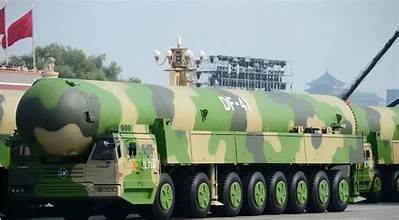
The Dong Feng 5C is a new intercontinental ballistic missile (ICBM) capable of launching a dozen warheads with a global strike range of over 20,000 kilometers. This is perhaps the most dangerous weapon on display, providing China with the ability to strike any nation in the world with a nuclear explosive.
Hypersonic Missiles (YJ-15, YJ-17, YJ-19, YJ-20, YJ-21 “Carrier Killer”) were also on display. These swiftly maneuverable, high-speed missiles are designed to evade traditional defenses. It is believed that these weapons could evade America’s most advanced aircraft carriers and naval vessels.
The HQ-29 Space Defense System is designed to destroy satellites. This specific weapon is part of China’s broader plan to eventually militarize space.
Extra-large Uncrewed Underwater Vehicles (XLUUVs), especially the AJX002 Sea Drone—an underwater drone designed for reconnaissance missions and spying. The underwater drone can operate fully autonomously and is allegedly not easily detectable by radar systems. Not to be outdone, the JL-1 and JL-3 Air- and Submarine-launched Nuclear Missiles are part of China’s triad nuclear program, capable of striking enemies from any angle.
AI drones and robot dogs were one of the most highly discussed weapons on display. These “robot wolves” come equipped with cameras and guns. They could assist infantry units in battle, carry equipment, or carry out surveillance missions. Think back to the US Navy SEAL raid that allegedly killed bin Laden. Those trained Belgian Malinois played an essential role in taking down the world’s most wanted terrorist. These robot wolves would have the ability to operate even more efficiently and effectively in herds.
AI is at the forefront of modern warfare. Nuclear weapons no longer require strategic positioning to hit a target and cause mass casualties. Unleashing these weapons, using them against fellow humans, would create an unrecognizable planet and permanently alter humanity. Those cheering for warfare underestimate the sheer destruction that modern technology will unleash.
Posted originally on Aug 26, 2025 by Martin Armstrong |
COMMENT: Mr. Armstrong, I have come to understand that your cross in life is that you created a computer that always beats you. That must be a strange feeling to play chess, and it always puts you in checkmate. You are correct. The EU will never allow Zelensky to agree to peace. His purpose is to create World War III, and Socrates is always correct.
WS
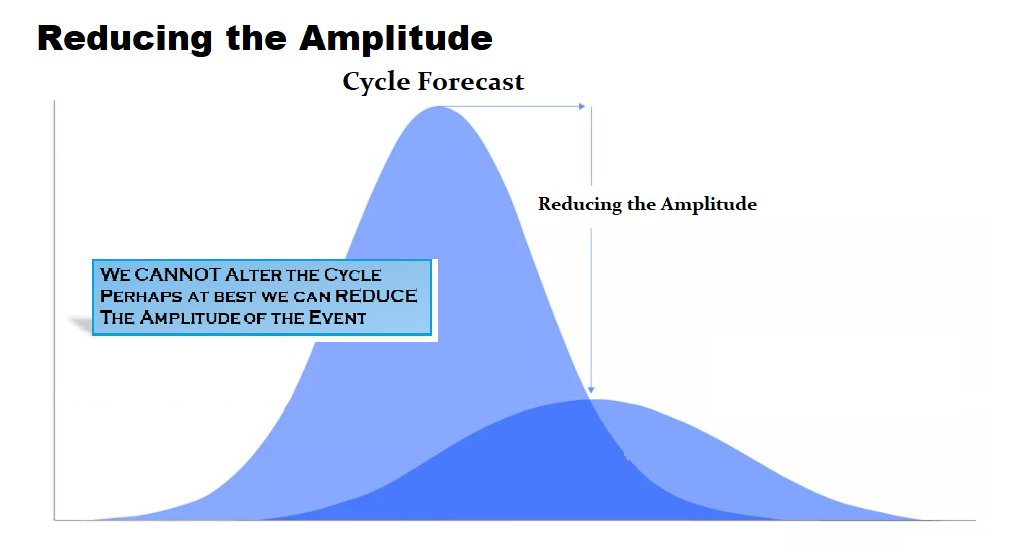
REPLY: Yes, I have come to accept that I cannot defeat my own computer. My only remaining hope is that if I scream loud enough, perhaps, just maybe, I can reduce the amplitude which was the excuse of locking us all down during COVID (Except Florida) to “flatten the curve.” I cannot do this alone. We need to get as many people screaming, let NATO self-destruct, and stay the hell out of this European War.
Posted originally on Aug 19, 2025 by Martin Armstrong |
COMMENT: Mr. Armstrong, I just wanted to thank you for participating in our board meeting. We had come to the same conclusion that all of this talk of BRICS and de-dollarization was being promoted by people in the conspiracy category, lacking any honest experience in international commerce. Before the meeting, we called one, and our Chairman listened. They could not answer any real economic question. The claims that this is the end of dollar hegemony only exposed their lack of expertise.
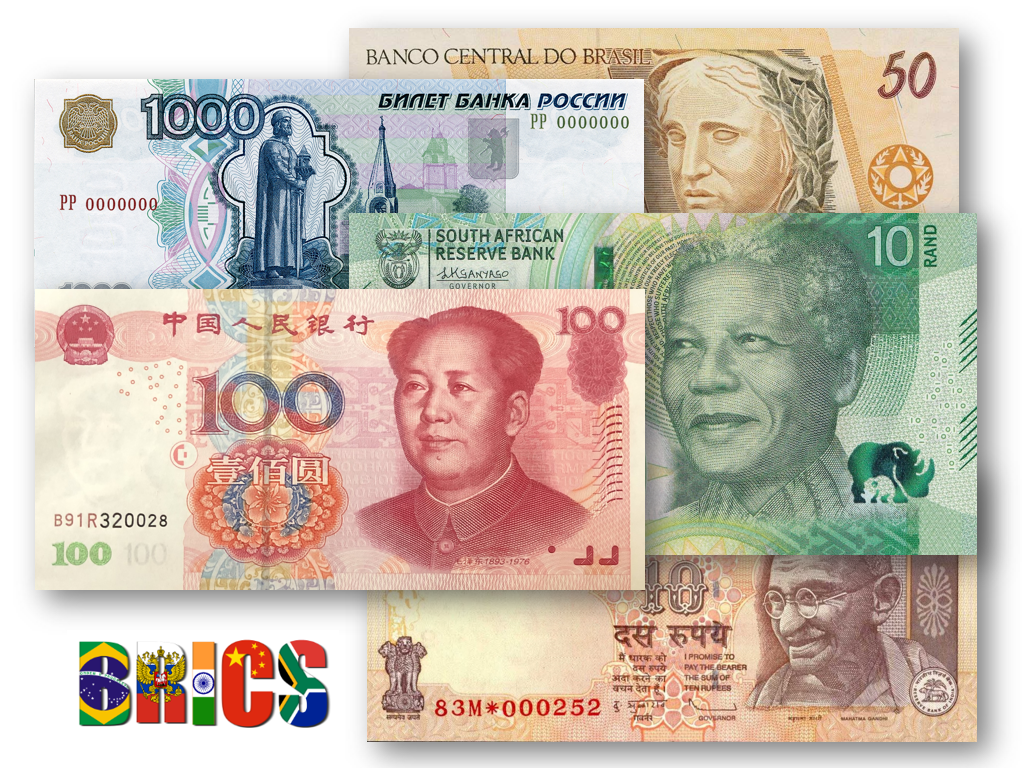
Trump’s tariffs, Biden’s sanctions, and the freezing of Russian assets were all supposed to kill the dollar as Russia, China, India, Brazil, and South Africa were to construct parallel financial systems as if they would no longer sell to the United States. Then there was the mention of backing by gold. Our chairman was very impressed that you could answer every question. You pointed us in the right direction with common sense and your real-world experience.
Thank you once again. As you said, us is about one third of the entire world consumer market, and global financial transactions to IPO are predominantly in dollars. Our Chairman will be at your WEC personally this time.
SFD
ANSWER: Thank you. Because this is such an important topic and I do not have the time to attend every board meeting internationally, I thought it best that I lay out the gist of our discussions. Your company is in the global business, and it is pathetic how the majority of these people preach the same nonsense without understanding world commerce. The US dollar’s dominance in international finance is clear despite BRICS, but its share varies across different areas. Before World War II, countries issued their debt in British pounds in order to sell it in London.
U.S. Multinational Dominance: U.S. companies earn massive profits overseas. This is the PRIMARY reason why these analysts do not understand world commerce. Apple, Microsoft, and Pfizer all generate more than 50% of revenue abroad. In 2022, U.S. multinationals earned $1.6 trillion from foreign affiliates (BEA data). Then there is the Intellectual Property (IP) and Services such as our firm with offices around the world. The US is a net exporter of IP, royalties, and high-value services (e.g., Google’s ad revenue abroad).
The US traditionally runs a goods deficit (manufacturing) of $1 trillion/year but a services surplus of $300 billion if we look at the accounting based on the ownership of companies rather than location, US overseas affiliate sales ($6 trillion/year) dwarf foreign affiliate sales in the US ($4.5 trillion/year). Now throw in the net IP receipts ($100 billion surplus), the U.S. likely shows a net Trader Surplus on an ownership basis.
When combined with services, IP, and overseas profits, the overall balance shifts to a surplus. The US benefits disproportionately from globalized production because its firms capture value through branding, R&D, and IP—elements obscured by traditional trade metrics. This highlights why trade deficits alone are an incomplete measure of economic health. Looking at the ownership-based accounting better reflects where value is captured in global supply chains. I have argued this in Washington, but it goes in one ear and out the other.
Global Trade Invoicing & Settlement (Primary Focus):
Approximately 40-50% of all global trade (exports) is invoiced in US dollars. This means the prices of goods traded internationally are set in dollars, regardless of the countries involved. Over 80% of global trade finance (letters of credit, etc.) is conducted in dollars!!!!! Around 88% of global foreign exchange (FX) transactions involve the US dollar on one side (according to the BIS Triennial Survey). This underpins trade settlements and makes the whole stupid argument of de-dollarization laughable, for they are mixing geopolitical with economics.
SWIFT data (payment messages) accounts for roughly 46-48% of international payment messages (by value) that are denominated in USD (as of mid-2024). This is a key indicator of actual settlement currency. Given that the latest consumer spend at the end of 2025 amounts to $55.5 trillion, of which the American consumer is now $17.9 trillion, US consumer spending accounts for 32.3% of the entire world! So, will BRICS displace the dollar? Come on. They said the same BS about the Euro. The United States is the LEAST socialist country, and that above all accounts for its Dominant Share of the world economy. Despite having only about 4% of the world’s population, the U.S. consistently accounts for nearly one-third of global consumer spending. This underscores the immense size and importance of the U.S. consumer market to the global economy and thus the dollar.
The dollar’s dominance does impact consumer spending globally because many goods that consumers buy locally are imported in other countries. If those imports were invoiced and paid for in dollars, fluctuations in the dollar’s value could affect local prices (inflation/purchasing power). This is why your key commodities like oil, metals, and grains are predominantly priced in dollars. Changes in the dollar affect the cost of energy and raw materials globally, impacting production costs and ultimately consumer prices for a vast array of goods. When the US is about 1/3rd of the world’s consumer spending and about 50% of all world trade, that is why they are priced in US dollars rather than the pesos.
The next HUGE area these one-issue analysts ignore is the Debt & Financial Markets. Countries and corporations borrowing in dollars face repayment costs affected by dollar strength, influencing their economies and potentially consumer spending power within those countries. This has often been one area that I get called into a lot. Currency Pegs/Reserves have been a critical issue over the years. Many countries manage their currencies relative to the dollar or hold significant dollar reserves, influencing their domestic monetary policy and economic stability. This includes Foreign Exchange Reserves. The dollar constitutes about 59% of allocated global foreign exchange reserves held by central banks (IMF COFER data Q1 2024).
Approximately 75-80% of emerging market (EM) external sovereign bonds are denominated in US dollars. For corporate EM bonds, the share is slightly lower, around 60-70%. As I pointed out, before World War II, EMs would issue their debt in British pounds because that was where there was a market to sell their debt. Today, the pound has been replaced with dollars, and the FINANCIAL CAPITAL OF THE WORLD is now New York – not London or Paris.
Of the Sovereign Debt issues globally (Government Issuance), that works out to be 75-80% USD-denominated (e.g., IMF, BIS, and J.P. Morgan EMBI Index data). For example, as of 2023, over 75% of EM government bonds held by foreign investors were in USD. Turn to the corporate world. There we see 60-70% USD-denominated corporate debt issues (e.g., Bank for International Settlements data). This is even higher in sectors like commodities or multinationals.
New York City is unequivocally the world’s leading global financial center, and its banks play a dominant role in key aspects of international banking. This ensures the dollar’s role in global transactions. The vast majority of international trade and finance is conducted in USD. NYC banks are at the heart of that system. On a clearing basis alone, the Clearing House Interbank Payments System (CHIPS) in NYC clears roughly $1.5 trillion daily in cross-border USD payments. That represents a massive share of global USD flows.
Then there is the Correspondent Banking network. Major NYC banks act as correspondent banks for thousands of banks worldwide, facilitating their international USD transactions. Investment Banking (Capital Markets) takes place in the heart of the NYC-based banks (Goldman Sachs, JPMorgan Chase, Morgan Stanley, Citigroup) and this consistently dominates global aspects of Mergers & Acquisitions, Equity and Debt underwriting (IPOs, bond issuances), and Sales & Trading (especially of US Treasuries, the world’s most profound and most important bond market). Even if we look at the global investment banking fee revenue, you will find that more than 50% takes place in New York City.
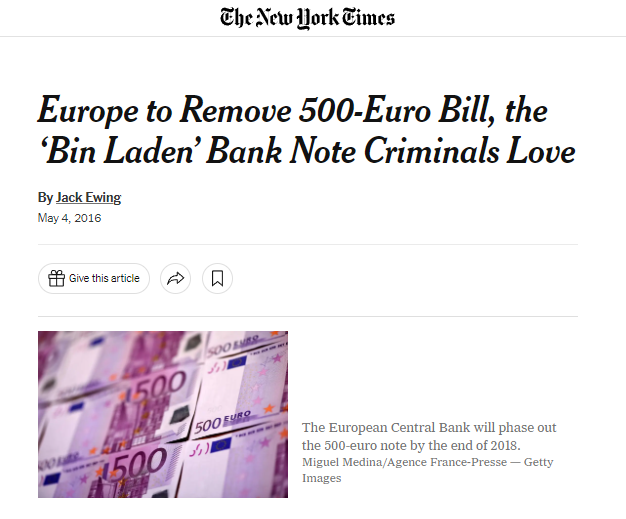
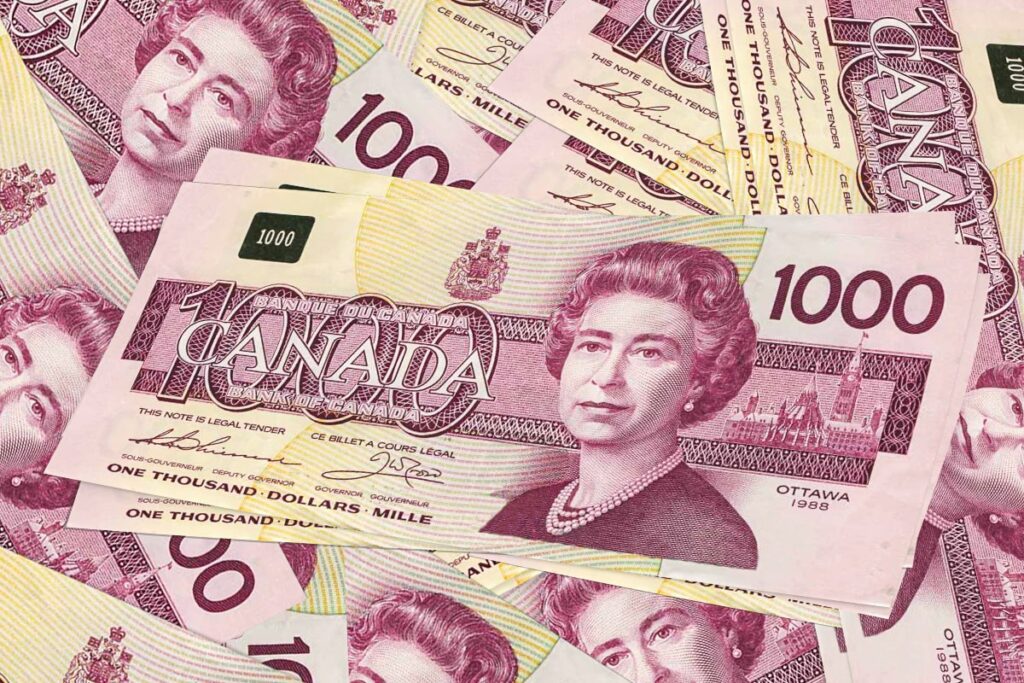
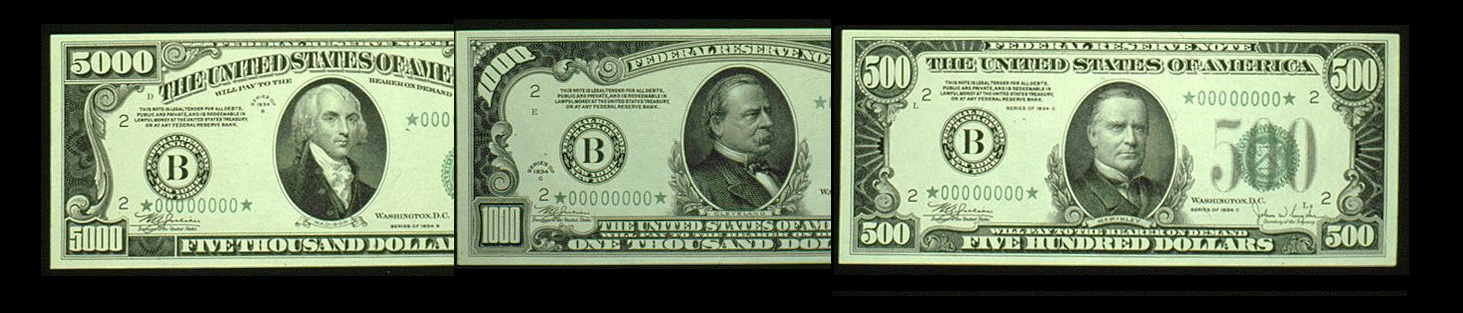
Europe and Britain, along with India and Switzerland, cancelled their currency. The $500 and $1,000 Canadian banknotes were withdrawn from circulation and are no longer legal tender as of January 1, 2021. However, they can still be redeemed at banks or the Bank of Canada for their face value, and they may hold additional value for collectors. Trump has proposed bringing back the $500 bill. Yet, while Roosevelt stopped issuing high-denomination bills, they are still valid. This is a MAJOR issue that the dollar remains the reserve currency around the world – it is TRUSTED!!!!!! While 60% of all U.S. bills circulate abroad, about 80% of $100 notes dominate foreign holdings due to their high value and portability.
The dollar is involved in roughly 40-50% of trade invoicing, over 80% of trade finance, and about 46-48% of international payment settlements. Research has shown that allocating world commerce according to ownership rather than location results in the US having a trade surplus, not a deficit.
The dollar remains the undisputed dominant global reserve and transaction currency, involved in the vast majority of cross-border financial flows. All of the nonsense about “de-dollarization,” with some countries (like China, Russia, Brazil) increasing the use of other currencies in bilateral trade agreements, is a distraction. Such a shift is gradual and hasn’t significantly eroded the dollar’s overall global share, and cannot until the economic changes, and that will not come until AFTER 2032.
Anyone who says the BRICS are displacing the dollar cannot possibly have any experience in world finance.
I have created this site to help people have fun in the kitchen. I write about enjoying life both in and out of my kitchen. Life is short! Make the most of it and enjoy!
This is a library of News Events not reported by the Main Stream Media documenting & connecting the dots on How the Obama Marxist Liberal agenda is destroying America








 Centinel2012