Logical thought is antithetical to the interests of the coup-plotters. Nuance and obfuscation are their shields; that’s why they, writ large, will not release the classified documents. A common sense American Thinker article cuts through the chaff and countermeasures for many interests:
[…] The implications of intercepting the communications of a U.S. citizen who is associated with the political campaign of a candidate seeking the presidency rings nearly every “bell” in the FBIs and Attorney General’s Guidelines for sensitive investigations. As discussed in the IG report, by regulation, these cases cannot be initiated without the written approval of the Director and the Attorney General.
In addition to the approval obviously granted by the Director and AG, the IGs report identified the following additional high level officials who reviewed and approved the Page FISA affidavit: “NSD’s Acting Assistant Attorney General, NSD’s Deputy Assistant Attorney General with oversight over 01, 01’s Operations Section Chief and Deputy Section Chief, the DAG, Principal Associate Deputy Attorney General, and the Associate Deputy Attorney General responsible for ODAG’s national security portfolio.”
The suggestion that somehow, seventeen significant errors, omissions of fact, falsehoods, or deliberate misrepresentations made their way into a FISA affidavit/s (accidentally, at the hand of an anonymous case agent) and then were not immediately noted and corrected throughout the course of this exceptional review process is simply not believable. ~ Continue Reading
Natasha Bertrand is the stenographer for Fusion-GPS smear activities with a reputation for egregious lying and narrative engineering. As a result it doesn’t come as a surprise to see Bertrand writing a collaborative article in Politico taking swipes on behalf of a thoroughly corrupted intelligence community.
Consider this paragraph using another vile creature from the political swamp:
[…] When it comes to Durham, Haspel is likely “confident there has been no serious wrongdoing, and will therefore find a means to cooperate” with the investigation, said John Sipher, a 28-year CIA veteran.
Too funny. The spooks and scribes live a life so deeply enmeshed in the world of fraud and lying they cannot even see themselves exposing their own character. Put another way: ‘if Haspel was confident of serious wrongdoing, she wouldn’t cooperate with the investigation’.
See, they just can’t help exposing themselves. If it wasn’t serious, it would be funny. These inherently vile liars cannot stop themselves from exposing their nature…. it just flows out.
The good news in the article; and there is a lot of accidentally placed good news within it for those who follow closely; comes from these paragraphs:
[…] Haspel’s plight, though, may depend on how deeply Durham investigates an uncorroborated theory pushed by Trump allies that a key player in the Russia probe, a Russia-linked professor named Joseph Mifsud, was actually a Western intelligence asset sent to discredit the Trump campaign — and that the CIA, under Brennan, was somehow involved.
Haspel was the CIA’s station chief in London in 2016 when the U.S. Embassy there was made aware of Mifsud’s contact with a Trump campaign adviser, George Papadopoulos, by Australian diplomat Alexander Downer. Haspel was briefed on Downer’s outreach to the embassy, according to a person familiar with the matter, but it’s unclear whether she was then made aware of the FBI’s plans to interview him or knew about the bureau’s use of an informant in London.
[…] “It is unprecedented and inappropriate to do this via Justice Department prosecutors, who will tend to apply the standards of a courtroom to the more nuanced, and often more challenging world of intelligence analysis,” said John McLaughlin, who served as both deputy director and acting director of the CIA from 2000 to 2004.
Sipher asked why such a review would be “done over the head of” the intelligence community’s inspector general.
[…] Another issue former officials have flagged: It isn’t clear whether Durham has consulted with the intelligence community inspector general, Michael Atkinson, as part of his review, which reportedly evolved into a criminal probe in October.
Normally, potential intelligence community misconduct is reviewed by an agency’s internal watchdog, who would then recommend criminal charges if warranted to a U.S. attorney with jurisdiction, noted Greg Brower, a former FBI assistant director. (read more)
Apparently, if the article is semi-accurate, John Durham and Bill Barr are working around ICIG Michael Atkinson. That would be good news because Atkinson is a dirty cop, completely compromised.
Atkinson was the former head lawyer at the DOJ-NSD and legal counsel to dirty John Carlin, dirty Mary McCord, and dirty Dana Boente.
Michael Atkinson was involved in the fraudulent creation of the Carter Page FISA application; and not coincidentally he’s the ICIG who manipulated ‘whistle-blower’ rules to allow CIA gossiper Eric Ciaramella to create his fraudulent hearsay complaint about President Trump and Ukraine.
At this point anyone who was or is confirmed by a corrupt Senate Intelligence Committee consisting of Chairman Richar Burr and Vice-Chair Mark Warner should be considered dirty and compromised. This includes both CIA Director Gina Haspel and ICIG Michael Atkinson.
In essence, if the SSCI confirmed them, we should start from a position the confirmed intel official is dirty, compromised or in alignment with the larger corrupt IC needs for self-preservation. That’s why I’m highly confident President Trump will remove Mike Pompeo after the 2020 election.
POTUS has to deal with all these creatures, while knowing their larger agenda. Quite a remarkable and untenable position; also disappointing from the aspect of executive trust.
On a positive note, you know what really scares these people?
TRIGGER WARNING! DO NOT PLACE THIS CARTOON WITHIN 25 FEET OF A LEFTY! WE ARE NOT RESPONSIBLE FOR EXPLODING HEADS! THANK YOU
“It’s Smackdown Time!” Guest Post by a Canadian Patriot
There are several politicians that talk a great deal, but always come up short time after time when it comes to fight.
Just in case Justin ‘Two-Face’ Trudeau has not had enough of bad news in losing his majority government, being ridiculed by the whole world or being ousted as blackface three times and gaining the title of world class hypocrite; he will not be able to offer any resistance to his superior adversary who will send him to his corner, beaten!
Sleepy Creepy Joe will finally meet justice. He has single handedly given a new definition to rope-a-dope! The canvas will soon be his only friend. If only his son Hunter could be found to come to his aid. Hunter’s sniffing days are numbered!
Trump understands that process matters. Armed with courage and audacity and hardcore persistence, he has overcome many past fights in his journey as president with boundless energy and firm resolve.
He is in a league of his own. None are his equal. He will continue to dispatch the globalist puppets and all will meet the same fate as Two-Face and Sleepy Joe!
Trump is the STORM! He’s the silent majority’s strength and Canada’s best hope.
With the great First Lady and true Canadian patriot and icon such as Don Cherry in Trump’s corner, the globalists and climate warriors are going down!
It’s time for patriots to stand up and join the fight against corruption and not fall victims to their lies, tricks, and deceit.
David Horowitz Published in 1972, Saul Alinsky’s Rules for Radicals still enjoys brisk sales. With a former community organizer now commander-in-chief, and the idea of transformative leadership through radical change not just a theory, it is important for partisans of the Constitution to understand the roots of today’s radicalism. Presented as part of the First Principles on First Fridays series for the month of July, 2010. Recorded July 9, 2010. (c) Hillsdale College, 2010. http://kirbycenter.hillsdale.edu/
New Democrat threat to impeach President Trump again emerges from court filing. They may do it if former White House counsel Don McGahn doesn’t testify about Trump’s possible obstruction of justice during the Mueller probe of Russian interference in the 2016 U.S. election. Do the Democrats know something that the polls don’t show about how the American people see their endless efforts to replay 2016, and to eject the 45th President of the United States? And if they’re plunging to their 2020 electoral doom, why are conservatives like Bill Whittle so angry about it? Bill Whittle, Scott Ott, Stephen Green, and our Members and friends, will be aboard a Royal Caribbean ocean-liner sailing to the Bahamas for three nights in May 2020 — and you can be with us. In addition to all of the great food and activities of a Caribbean cruise, you’ll enjoy live productions of our shows, and get to know your hosts and fellow Members. Get details and reserve your cabin now at https://BillWhittleCruise.com Visit our friends at The Patriot Post: America’s News Digest: http://bit.ly/2LevyAG Become one of our producers, and enjoy full access at https://BillWhittle.com/register/ Listen to the the podcast versions of these shows: http://bit.ly/BWN-Podcasts
In this era of #MeToo and rampant sexual assault allegations, many media outlets, politicians, and scholars are misleading people about the prevalence of rape. They accomplish this by publicizing unscientific studies, mischaracterizing reliable ones, and making statements that have no basis in reality. Although precise figures on rape don’t exist, credible data gathered from females in the U.S. indicates that:
about 11.5% of women say they have been the victim of acts that fit the legal definition of forcible rape.
each year, about 0.2% of women enrolled in college explicitly state that they have been raped, but this figure grows to 1.0% if they are prompted with graphic descriptions of acts that fit the legal definition of rape.
each year, roughly 2.1% of college women say they have been the victim of acts that fit the legal definition of rape. However, only 1.0% consider these acts to be rape.
college-age women who are not enrolled in college are about 50% more likely to be raped than women who are enrolled in college.
about 40% of female rape victims were first raped before the age of 18, and 79% were first raped before the age of 25.
cases that involve “date-rape drugs” appear to be a very small portion of all rapes, but the data is uncertain.
Contrary to the claims of some reporters and notable organizations, there are no sound estimates for the portion of rape claims that are false. In fact, a widely cited study alleged to show that only 2% of rape claims are false actually shows many times more than that.
Certain preventative measures appear to be very effective at reducing the incidence of rape, but they chafe against notions of political correctness. Hence, many people ignore them, leaving more women vulnerable to rape.
Confirmation bias and poor critical thinking skills lead people to embrace or dismiss rape-related claims based merely on their personal experiences, assumptions, or prejudices. Coupled with false information that arises from across the political spectrum, there is ample opportunity for all sides to become misinformed. This article corrects the record by thoroughly documenting numerous facts about this horrid crime and ways to thwart it.
Defining Rape
An essential part of measuring how often rape occurs is defining it. This is more complex than it may seem, because the definition of rape varies depending upon the source.
From a federal legal perspective, a law that governs the conduct of military personnel definesrape in ways that involve “force,” threats of “bodily harm,” “rendering” a victim “unconscious,” and giving someone “without the knowledge or consent of that person, a drug, intoxicant, or other similar substance and thereby substantially impairing the ability of that other person to appraise or control conduct.” Beyond sexual intercourse, this also includes sexual “penetration, however slight, of the vulva or anus or mouth, of another by any part of the body or by any object….”
Others define rape in ways that are broader and more subjective. For example, a 2014 reportby the Centers for Disease Control and Prevention (CDC) measures the prevalence of rape by including everyone who has had sex and later said they were “unable to consent” because they were “drunk” or “high.”
The same CDC report measures “sexual violence” by including all people who have engaged in any kind of sexual activity (including kissing) because they felt “pressured in a nonphysical way.” In addition to situations like a boss “using their influence or authority over you,” this can also involve someone:
“telling you lies.”
“making promises about the future they knew were untrue.”
“wearing you down by repeatedly asking for sex, or showing they were unhappy.”
Senator Dianne Feinstein (D–CA) cited this CDC report before the widely watched testimony of Christine Blasey Ford against Supreme Court nominee Brett Kavanaugh, claiming, “In the United States, it’s estimated by the Centers for Disease Control one in three women and one in six men will experience some form of sexual violence in their lifetime.” On the next day, Senator Cory Booker (D–NJ) said the same, while adding that “this toxic culture—this pernicious patriarchy in this country—has to stop.”
Prominent and influential people have muddled this issue by grouping together very different circumstances under blanket terms like “rape” and “sexual violence.” In contrast, this article primarily covers cases of sexual penetration that involve force, threats of force, and covertly administered drugs. This does not include situations like drunken hookups or kissing a liar. Reports to Police Are Not Comprehensive
The FBI collects and tabulates reported cases of rape from local law enforcement agencies, but these figures don’t account for all rapes, because rape victims often don’t report these crimes. Also, local law enforcement agencies sometimes fail to properly record them.
As documented by the National Academy of Sciences in a 2014 report on rape and sexual assault, “There is ample evidence that the crimes of rape and sexual assault are substantially undercounted through police reports….” The authors cite an array of evidence for this, such as:
a 2012 report from the U.S. Department of Justice, which found that 65% of rapes and sexual assaults were not reported to the police during 2007–2010. This figure is based on a nationally representative sample of people who said they were raped or assaulted but did not report it. Among their most important reasons for not reporting:
28% said they feared reprisal or getting the offender in trouble.
20% said they dealt with it in another way or considered it a personal matter.
13% said they thought the police wouldn’t help.
6% said they felt the incident was not important enough to report.
33% gave another reason or said they didn’t have a single most-important reason.
a joint university/law enforcement investigation that began in 2009 and found thousands of untested sexual assault kits in Detroit Police storage facilities.
a 1998 Philadelphia Inquirerarticle, which quoted Philadelphia police officers and other sources to show that “downgrading major offenses to minor ones to polish the image of commanders and police commissioners and make the city look safer—has been a reflex in police station houses for decades.”
The bottom line is that many sexual assaults go unrecorded and unreported. Thus, contrary to President Trump, the fact that Christine Blasey Ford or her parents didn’t “immediately” file charges with “local law enforcement” doesn’t mean that the alleged attack was not “as bad as she says.” Scientific Surveys Can Be Accurate
Some believe that surveys can never be accurate, due to various notable failures. Others tend to believe any poll that tells them what they want to hear. Surveys are indispensable tools to discovering the truth, but an understanding of their inner workings is necessary to assess their accuracy and usefulness. The detailed facts in this section provide that knowledge for the skeptical and interested.
Because it is expensive and frequently impossible to collect information on every person in the United States, governments, scientists, and scholars often obtain such data through scientific surveys. This is true of frequently quoted government data on crime, education, employment, the economy, and an enormous array of Census data.
An important benefit of such surveys is that they can achieve considerable accuracy while polling only a tiny portion of the population. As the book Statistics for K–8 Educators states, “a national random sample of 1,000 people can accurately represent 200 million people.” The textbook Statistics: Concepts and Controversies explains why this is so:
Imagine sampling harvested corn by thrusting a scoop into a lot of corn kernels. The scoop doesn’t know whether it is surrounded by a bag of corn or by an entire truckload. As long as the corn is well mixed (so that the scoop selects a random sample), the availability of the result depends only on the size of the scoop.
A vital and widely unknown fact is that a small number of positive responses to a certain question does not undermine a poll’s validity. For example, if only 20 respondents in a survey of 1,000 women say they were raped, this result is no less credible than if 500 respondents in another survey of 1,000 women say they have been whistled at. In fact, the textbook Mind on Statistics shows that mathematical confidence in survey results actually increases when the portion of people who answer a poll question in a certain way is well below or above 50%.
More specifically, a poll with only 20 out of 1,000 respondents who say they were raped has a ±0.9 percentage point margin of sampling error with 95% confidence, while a poll with 500 out of 1,000 respondents who say they have been whistled at has a ±3.1 percentage point error. This is something that certain reporters and “fact checkers” don’t seem to understand.
However, surveys can be highly inaccurate if they don’t use random samples of respondents. This is often true of internet and mail surveys, because the people who respond to them typically differ in material ways from the people who don’t. As explained in Mind on Statistics: “Surveys that simply use those who respond voluntarily are sure to be biased in favor of those with strong opinions or with time on their hands.” The textbook then analyzes a poll of scientists that had a 34% response rate and states that “with only about a third of those contacted responding, it is inappropriate to generalize these findings” to most scientists.
A key point to realize about that poll is even though it surveyed scientists, was conducted by scientists, and was published in a prestigious journal named Science, it is not a scientific poll. In the words of a book about polling published by Pennsylvania State University Press: “Scientific polls use sampling procedures where random samples are used, that is, where each individual in the group has an equal chance of being selected into the sample, or where some variation on this pattern is used to account” for any differences.
To account for such differences, pollsters often use a process called weighting. Per the textbook American Government and Politics Today: Essentials, this involves “adding extra ‘weight’ to the responses of underrepresented groups,” For example, if 40% of respondents for a poll of registered voters are females, the pollster may place more mathematical weight on the responses of these women, because 53% of registered voters are women. Pollsters also perform weighting based on age, race, education, income, and many other variables.
Weighting, however, does not guarantee that a poll’s results are accurate. This is because respondents may differ in ways that transcend the factors that are weighted. For instance, because of their experiences, rape victims may be more apt to respond to an internet survey about sex crimes than those who have not been raped. Weighting for race, income, etc. will not necessarily correct for this.
Finally, even scientific surveys with perfectly random samples can still be inaccurate if respondents have a motive to lie and then do so. For example, unauthorized immigrants who participate in polls sometimes claim they are citizens in order to conceal the fact that they are in the U.S. illegally. This was proven by a 2013 paper in the journal Demographic Research, which compared Census Bureau survey data on citizenship to the number of naturalized citizens recorded by the U.S. Office of Immigration Statistics. The study found that certain groups of immigrants—including Mexican men of all ages, Mexican women aged 40 years and older, and immigrants who have been in the U.S. for less than five years—frequently misrepresent themselves as citizens. Forcible Rape
The 2014 CDC report mentioned above presents the results of a 12,727-person telephone survey of noninstitutionalized adults during 2011. For phone surveys, a key indicator of their randomness is their cooperation rate, which is the portion of “persons contacted who agreed to participate in the interview and who were determined to be eligible.” For this poll, the weighted cooperation rate was 83.1%.
Despite the solid methodology used for this survey, the CDC’s report of it is written in a way that can easily deceive. This is because the abstract uses the word “rape” 10 times without a hint that this includes everything from violent rapes to regretted drunken stands. Even the full report doesn’t make this clear. Instead, it uses the term “alcohol- or drug-facilitated penetration” without defining it. Does this only mean cases where predators secretly spiked the drinks of victims with alcohol or date-rape drugs? The report doesn’t say, but a file of supplementary information discloses that it includes all situations where people later felt they were “unable to consent” because they “were drunk, high, drugged, or passed out.”
Readers must dig four pages into this report before it reveals that about 11.5% of adult females say they have been the victim of acts that constitute forcible rape. Accounting for the margin of sampling error with 95% confidence, this result ranges from 10.3% to 12.7%. The study identifies cases of forcible rape by positive responses to questions about vaginal, oral, or anal sex acts done unwillingly because of physical force or threats of physical harm. These all fit with the definition of rape under federal law.
Like all surveys, this one has limitations. Among the most noteworthy are these:
A “telephone survey might be less likely to capture some populations that could be at higher risk for victimization (e.g., persons living in nursing homes, military bases, prisons, or shelters, or those who are homeless).”
“Victims who are involved in violent relationships or who have recently experienced severe forms of violence might be less likely to participate in surveys or might not be willing to disclose their experiences because of unresolved emotional trauma or concern for their safety, among other reasons.”
It does not address the subject of false rape reports.
It does not account for the fact that some younger respondents will be victimized later in life. Per correspondence from the CDC to Just Facts, “the estimates provided in the report were estimates at a single point in time and do not adjust for the possibility of future victimization.”
This study’s definition of forcible rape doesn’t include surreptitious drugged rapes, which are arguably forcible, because victims do not willingly consume these substances.
Even so, the results of this CDC study are in the same ballpark as a 1987 study by the U.S. Department of Justice. This study used data from the National Crime Victimization Survey (NCVS) during 1973 through 1982. It found that about 8% of females aged 12 years and older will be the victim of a completed or attempted rape at some point during those years. This study defined rape as “carnal knowledge through the use of force or the threat of force, including attempts. Statutory rape (without force) is excluded.” For reasons detailed below, the results of the study almost certainly underestimate the rate of rape as defined by federal law. College Rape
The prevalence of rape among college students is a hotly debated topic, and different studies about it have come to very different conclusions. The results of two nationally representative scientific surveys shine a great deal of light on the reasons for these differences and help sort out the big picture.
In 2014, the U.S. Department of Justice published a study of rapes and sexual assaults of college-age females during 1995 to 2013. It found that during each year an average of 0.2% of women enrolled in a college, university, trade school, or vocational school said they were raped. For college-age women not enrolled in school, the rate was 0.3%, or 50% higher than those who were enrolled.
The study was based on data from the NCVS, which polls a nationally representative sample of about 90,000 households and 160,000 people twice per year. Respondents are first interviewed in person and then via phone every 6 months for 3.5 years. The overall response rate for this study was 74%.
Unlike the CDC’s survey, this one directly asked people if they were raped. An advantage of this is that it straightforwardly measures people’s perceptions about what happened to them. A disadvantage is that people’s perceptions of rape appear to be more narrow than federal law. This may be because some people think rape only involves intercourse, while federal law states that it also covers situations like forced oral sex and penetration with a finger.
This is illustrated by a scientific survey of 4,446 college females conducted during 1997 by researchers from the U.S. Department of Justice and National Institute of Justice. The survey had a response rate of 86%, and it defined rape in precise terms, asking women if since the start of the school year someone had used force or the threat of force to sexually assault them in any of the following ways: penile-vaginal, mouth on your genitals, mouth on someone else’s genitals, penile-anal, digital-vaginal, digital-anal, object-vaginal, and object-anal. About 1.7% of the women said that others had done such things to them, but when they were asked, “Do you consider this incident to be a rape?” only 46.5% answered “Yes.”
The researchers who designed this survey also conducted a comparison survey with the same methodology except that it used the sexual assault questions posed by the NCVS. This survey found that only 0.16% of the respondents said they were raped, or about one-fifth as many who said they were raped in the primary survey. Based on these conflicting results, the authors concluded that their use of graphic questions in the primary survey “likely prompted more women who had experienced a sexual victimization to report this fact to the interviewer.” These graphic questions, which were asked before the direct question about rape, were:
Has anyone made you have sexual intercourse by using force or threatening to harm you or someone close to you? Just so there is no mistake, by intercourse I mean putting a penis in your vagina.
Has anyone made you have oral sex by force or threat of harm? By oral sex, I mean someone’s mouth or tongue making contact with your vagina or anus or your mouth or tongue making contact with someone else’s genitals or anus.
Has anyone made you have anal sex by force or threat of harm? By anal sex, I mean putting a penis in your anus or rectum.
Has anyone ever used force or threat of harm to sexually penetrate you with a foreign object? By this, I mean for example, placing a bottle or finger in your vagina or anus.
In other words, the survey described actions that fit the legal definition of rape before it asked respondents if they had been raped.
Combining the results of the studies above and assuming that the 1997 data is still roughly correct, several points emerge about the annual prevalence of rape among college-age females:
When not prompted with graphic descriptions of acts that fit the legal definition of rape, about 0.2% of women in college say they were raped.
When prompted with such graphic descriptions, roughly 1.0% of college women say they were raped.
Approximately 2.1% of college women say they have been the victim of acts that fit the legal definition of rape, but only 46.5% of these women consider these acts to be rape.
College-age women who are not enrolled in college are about 50% more likely to be raped than women who are enrolled.
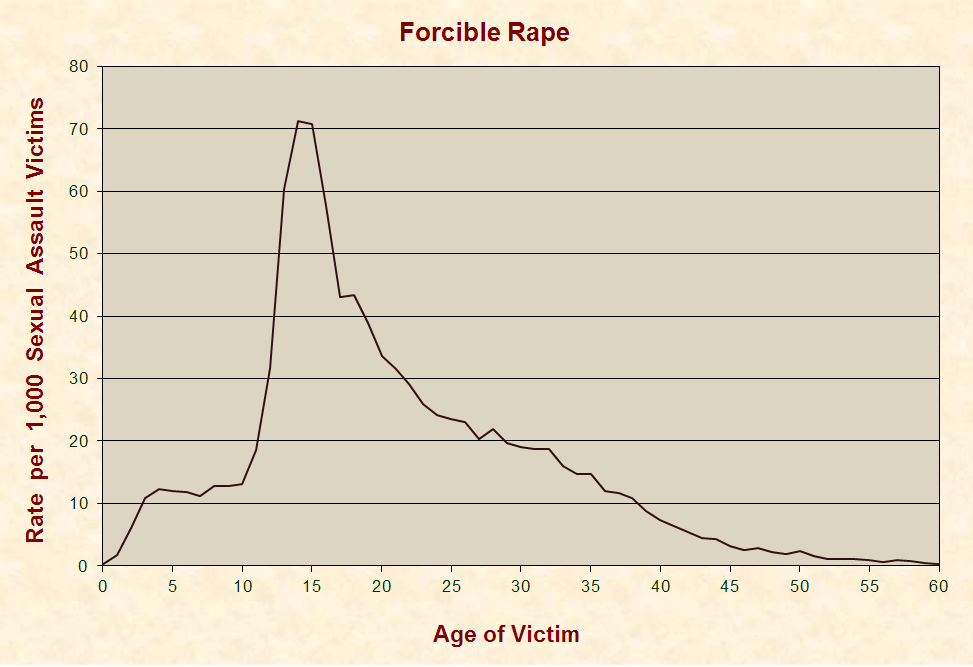
Given the last of these facts, the media’s focus on college rape appears misplaced, because this issue is primarily about age, not the safety or culture of universities. Other studies point to the same conclusion. For instance, CDC’s 2014 report on sexual assault found that 40% of female rape victims were first raped before the age of 18, and 79% were first raped before the age of 25.
Likewise, a 2000 U.S. Department of Justice study of crimes reported to law enforcement in 12 states from 1991 to 1996 found that the incidence of forcible rape peaked at the ages of 14 and 15 years and remained relatively high through the age of 25:
Drink Spiking
“Date-rape drugs” or “club drugs” are a class of recreational and prescription drugs that sexual predators covertly give to their victims to disable them. They go by street names such as Roofies, Easy-Lay, Liquid X, and Special K.
These drugs are readily available in the U.S. and are often odorless, colorless, and tasteless. Hence, they can be easily slipped into drinks. Given the nature of these attacks and high-profile cases like that of Bill Cosby, the press has devoted significant attention to such crimes.
A 2016 paper in the journal Psychology of Violence notes that there are “frequent media reports and discussions of drugging on college campuses,” but knowledge of this issue is “based almost exclusively on anecdotal data.” Various scholars, including the authors of this paper, have conducted studies on this issue using data that is not nationally representative and possibly not random, because some are based on web surveys. Thus, they cannot determine the prevalence of such crimes. Nonetheless, such studies have found that:
7.8% of students at three U.S. colleges said they suspected or knew they were unwillingly drugged, and 14.5% of these students “experienced either unwanted sexual touching” or were “forced to have sexual intercourse” while under the influence of these drugs. This amounts to a drugged sexual assault rate of 1.1%. (Psychology of Violence, 2016)
19% of emergency room patients at an urban/rural hospital in England who were alleged victims of drink-spiking tested positive for drugs that they said they did not knowingly take. None of them tested positive for common date-rape drugs, and the authors determined that their “symptoms are more likely to be a result of excess alcohol.” (British Medical Journal, 2007)
0.6% of women at two universities said they were certain someone had sexually assaulted them after slipping them a drug, and 1.7% said they suspected this happened. (Journal of American College Health, 2010)
4.9% of female sexual assault complainants at four U.S. clinics tested positive for typical date-rape drugs. Most of these women had prescriptions for the drugs and had taken them “by their own accord and not received them surreptitiously.” However, it “is possible that some of the subjects who believed they were given a drug … did not report to the clinic quickly enough for our analysis to detect” it. (University of Illinois, Department of Biopharmaceutical Sciences, 2005)
The imperfect evidence above suggests that a very small portion of rape cases involve secretly administered date-rape drugs. Similarly, a 2008 paper in the journal Trauma, Violence, & Abuse reviewed 11 studies on covert drugging and concluded:
All but one of the studies “failed to remove voluntary consumption of alcohol and drugs in their interpretation of results.”
“The only robust estimate,” which was a study conducted in the U.K., “shows that only 2% of instances of alleged drug-facilitated sexual assault were due to covert drug administration.”
“Although public health campaigns focusing only on covert drug administration are laudable, they are detracting attention from the much greater risk of being sexually assaulted following voluntary drug and/or alcohol consumption.”
False Reports
As a battle has raged over the nomination of Brett Kavanaugh to the Supreme Court, many prominent people have stated or implied that Christine Blasey Ford and the other women who have accused him of sexual assault are probably telling the truth, because false sexual assault accusations are extremely rare. Such claims appear in a broad range of articles and commentaries from media outlets like Time, ABC News, USA Today, the New York Times, the Los Angeles Times, and Vox.
To support their assertions, every one of those pieces appeals to one of two organizations:
The American Psychological Association, which states, “Research demonstrates that false claims of sexual assault are very low—between 2 and 7 percent.”
The National Sexual Violence Resource Center, which says that “the prevalence of false reporting is low between 2% and 10%.”
Tracing these claims back to the sources on which they depend reveals that the studies don’t state what these organizations declare. For instance, the “2%” figure comes from a study of rapes reported to police during 2000 to 2003 in Victoria, a state in southeastern Australia. Starting with the obvious, this study does not represent the U.S. or even all of Australia. Also, this is a study of rapes reported to the police, which as detailed above, are small portion of all alleged rapes. Moreover, these tend to be the most brutal cases. A 2002 study by the U.S. Department of Justice found that “59% of female rape victims whose victimization was reported to police received medical treatment, compared to 17% of victims whose crime went unreported.”
Most importantly, the Australian study says that the figure of 2% only counts cases that were “clearly categorized as a false report and the alleged victim was either charged” or warned that “she would be charged unless she dropped the complaint.” The study then states:
While this represents only a fraction of the sample, the findings will show a much larger proportion of cases where police were confident, or reasonably confident, that the allegations were false but there was no attempt to institute charges against the alleged victim.
How much larger? Beyond the 2% of rapes reported to police where the accusers were charged or threatened with charges for making false allegations, the study found that in 9.5%of the cases, members of the Criminal Investigation Unit “were confident or reasonably confident that the victim was making a false report.” The study also found that:
15.1% of the allegations were withdrawn.
46.4% of the allegations resulted in No Further Police Action.
21.3% of the allegations “were ‘still ongoing’ or could not be determined on the basis of the information in the case records.”
Adding together only those cases where (1) the accusers were legally imperiled for making false allegations, (2) the complaints were withdrawn, and (3) the Criminal Investigation Unit was reasonably confident that the accusers made false reports, this amounts to 27% of the reported rapes.
Adding together all cases of false, likely false, and unsubstantiated rape allegations, the total rises to 85%. Put another way, the report directly states that only 15% of rape reports resulted in charges against the accused, much less convictions. This, of course, does not mean that only 15% of the reported rapes actually occurred. By the same token, the fact that only 2% of the accusers were legally jeopardized for making false allegations does not mean that these were the only false reports.
There is no shortage of politicians, victim’s advocates, and news articles claiming that the nationwide false report rate for rape and sexual assault is almost nonexistent, presenting a figure of around 2%. This figure is not only inaccurate, but also it has no basis in reality. Reporting it publicly as a valid frequency rate with any empirical basis is either scientifically negligent or fraudulent.
So what is the actual rate of false rape allegations? A 2006 paper in the Journal of Investigative Psychology and Offender Profiling states “there is currently no way of knowing,” because:
Determining whether allegations are true or false can be extremely difficult. And, at times, the investigator will simply not have enough evidence to deem with any sufficiently small margin of error that the charges are in fact true or false.
With flagrant disregard for these facts, Snopes, an organization that claims to be “engaged in the battle against misinformation,” states that “the most recent and credible research on this topic suggests that around 5% of rape or sexual assault allegations are false.” Snopes bases this claim on a 2016 meta-analysis of seven studies, which allegedly shows that “5.2% of rape allegations were false.”
However, the meta-analysis does not say that. Instead, it states that “at least 5%” of sexual assault allegation are “confirmed false reports” and “potentially many more false report cases” exist. In fact, this paper lists four different studies that measure the frequency of “suspected” false allegations and “found false reporting rates above 40%.”
Ironically, the very first study examined in this meta-analysis is the Australian one detailed above, and the meta-analysis does not accurately represent it. The analysis says that this study found that beyond the 2% of false reports, “several more” cases were “in question” by investigators. In contrast, the study says that the number of such cases is “much larger” and doesn’t use a mealy phrase like “in question” to describe them. Again, it states that these are cases where investigators “were confident or reasonably confident that the victim was making a false report.” The analysis also mischaracterizes the 2% as “confirmed false reports of rape.” Once more, this figure only applies to cases where the accusers were charged or threatened with charges for making false allegations.
To summarize the nature of all this disinformation, media outlets and so-called fact checkers are mischaracterizing their sources, and in turn, their sources are mischaracterizing the relevant studies. This is a prime example of how the press and scholars mislead the public. It also highlights the importance of digging back to primary sources, which are those that provide “direct or firsthand evidence.”
Another common fiction surrounding the Kavanaugh nomination is that his accusers have “no motive“ to lie. This is belied by academic literature and law enforcement professionals who have identified numerous reasons why people make false allegations of rape.
For example, Linda Fairstein, former head of the Manhattan District Attorney’s sex crimes unit and “one of America’s foremost legal experts on violent crimes against women,” wrote a book titled Why Some Women Lie About Rape. In it, she details real-world cases where false accusers were motivated by “pure and simple greed,” the desire to “get back at a man for something,” and other reasons. She also notes that “sometimes there’s no real motive all, and the allegations seem to come out of thin air. Often in these cases the woman making the charges is psychologically unstable.”
Going into greater depth, a 2006 paper in the Journal of Investigative Psychology and Offender Profiling identifies “14 possible pathways” to false allegations of sexual harassment. In it, the authors present actual examples of false accusations fueled by motives like “financial gain,” “secondary gain from victim status,” “excusing poor performance,” and “hurting an individual or institution.”
The last of those motives is especially relevant given the political stakes of the Kavanaugh nomination. It also speaks to the recent epidemic of fake hate crimes that feed progressive narratives. Preventative Measures
Even though definitive data on the prevalence of rape is not available, the bulk of evidence indicates that perhaps one in 10 women in the U.S. have been forcibly raped. Add to this cases of statutory rape and attempted rape, which are not included in the data above, and the actual number may be significantly worse.
This raises the question of how to prevent rape. Beyond wholesale societal changes, there are certain actions individuals can take that appear to be very effective at reducing the risk of rape. However, they often break the boundaries of political correctness and liberal sensibilities, which makes a lot of people unwilling or afraid to discuss them.
Before delving into this, it is crucial to note that nearly all findings in this area are tentative, because they only involve associations, which cannot prove cause-and-effect. This is becausethere is always a chance that other unmeasured factors are at play. Plus, the statistical methods used to control for such factors are subject to various pitfalls.
One of the most common factors associated with rape is the voluntary consumption of alcohol and drugs. A 2014 article in the Chronicle of Higher Education explains that this topic is taboo on many college campuses, because faculty and students say it amounts to victim-blaming. Thus, some scholars who have raised this issue have been scolded and censored. Nonetheless, here are just a few of many facts that speak to this matter:
“The consumption of alcohol and/or drugs … lowers a person’s inhibitions and affects their judgment, and thus renders them more susceptible to sexual assault….” (Trauma, Violence, & Abuse, 2008)
Data “from 119 schools participating in three Harvard School of Public Health College Alcohol Study surveys” found that 72% of rape victims “experienced rape while intoxicated.” (Journal of Studies on Alcohol, 2004)
“Data from the nationally administered 2005 Core Alcohol and Drug Survey showed that 82% of students who experienced unwanted sexual intercourse during the current academic year were under the influence of AOD [alcohol and/or other drugs] when they were victimized.” (Journal of American College Health, 2009)
Another politically incorrect reality is that women who use weapons to resist sexual violence are far less likely to be raped or otherwise injured:
A 2008 paper in the journal Crime & Delinquency examined 782 rapes recorded by the NCVS during 1992 to 2004. It found that resisting attempted rape with “an object, knife, or gun reduced the odds” of being raped by 91%.
A 2014 paper in the journal Violence Against Women examined 733 rapes and 1,278 non-rape sexual assaults recorded by the NCVS during 1992 to 2002. It found that none of the 26 women who resisted these attacks with a gun, knife, or other weapon were raped or injured after she used the weapon.
A 2008 paper in the Journal of Contemporary Criminal Justice about rape risk reduction strategies states, “The empirical data clearly have shown that forceful resistance strategies do increase avoidance of rape without increasing the risk of injury by strangers and known perpetrators.”
Such findings seem to be lost on certain people who claim that physically resisting rape, especially with a gun, often leads to more harm.
A glaring example is Democratic Colorado state Senator Evie Hudak, who told a rape survivor it was good that she didn’t have a gun when she was raped. She said this to Amanda Collins, a woman who was raped at gunpoint in a parking garage just a few feet from a campus police station at the University of Nevada-Reno. Collins was a concealed carry permit holder but was banned by Nevada law from carrying it on campus. After she testified to the Colorado Senate against legislation that would similarly disarm college students, Hudak replied, “I just want to say that, actually statistics are not on your side even if you had a gun. And, chances are that if you would have had a gun, then he would have been able to get that from you and possibly use it against you.” As documented above, the facts indicate just the opposite.
The above-cited 2008 paper found that virtually all forms of forceful resistance are associated with lower rates of rape completion—the more aggressive—the better. It states that:
“victim resistance levels were inversely related to rape completion.”
“nonforceful verbal resistance” like “trying to reason with the offender, pleading, begging, or crying” has “generally been found to be ineffective in avoiding rape” except in some cases of acquaintance rape.
“forceful verbal resistance … aimed at scaring the offender and/or attracting outside help” reduced the odds of rape completion by 66%.
“forceful physical resistance” like “punching, biting, scratching, kicking” reduced the odds of rape completion by 85%.
using a weapon reduced the odds of rape completion by 91%.
To repeat, such findings are not an end-all, but they are suggestive. As explained in the above-cited 2014 paper, “given the impossibility of experimental research on this topic, it should be noted that our findings are necessarily based on observed associations between victim actions and assault outcomes, thereby precluding definitive conclusions about causal effects.”
Also, both the 2008 and 2014 papers challenge the notion that it is better for rape victims to “just lay back and take it” because resisting might lead to injury. In the words of the 2014 paper:
Researchers who found positive associations between injury and self-protection (SP) actions, and concluded that resistance provoked offenders into attacking victims, failed to establish whether SP actions preceded or followed the offender’s inflicting of injury…. In these studies, crimes where a victim was injured before doing something to resist were effectively treated as cases in which resistance provoked injury. In contrast, studies that established the injury-SP sequence have generally found that all or most types of resistance either reduce the risk of subsequent injury or have no net effect one way or the other….
In addition to the aforementioned fact that females are at the greatest risk of rape from their teen years through the age of 25, other correlations that are helpful for recognizing risk factors were revealed in a nationally representative survey of 4,446 college women:
“For both completed and attempted rapes, about 9 in 10 offenders were known to the victim. Most often, a boyfriend, ex-boyfriend, classmate, friend, acquaintance, or coworker sexually victimized the women.”
“The majority of sexual victimizations, especially rapes and physically coerced sexual contact, occurred in living quarters.”
“51.8 percent of completed rapes took place after midnight, 36.5 percent occurred between 6 PM and midnight, and only 11.8 percent took place between 6 AM and 6 PM.”
The previously cited 2008 paper on rape risk reduction strategies examines a number of means to accomplish this goal. Among the findings:
“Educating women how to identify and navigate different risky behaviors (e.g., alcohol and drug use, sexually coercive tactics), and situations (e.g., parties, bars, dating) coupled with learning how to use effective self-protective action when threatened or assaulted is critical to preventing rape.”
“Anecdotal evidence abounds as to the success of self-defense training, yet there are very few empirical evaluations of this type of training on woman’s likelihood of avoiding rape…. A few studies, primarily dissertations, have provided indirect support for the efficacy of self-defense training….”
“Rape awareness and educational programs” meant to change male mindsets “rarely work,” and “improved attitudes immediately following program participation typically rebound to preprogram levels within 2 to 5 months….”
Tom Patire, who is one of the world’s leading experts on personal protection, writes that some of the best ways to avoid rape are:
“Keep away from isolated areas; stay on main roadways and well-lit streets; be alert to your surroundings; and be selective in choosing the people with whom you fraternize.”
“If you do fall victim to rape, it’s important to keep your wits about you. Don’t expend all your energy on futile attempts to escape. Wait for your best moment—such as when your attacker is using his hands to pull down his pants—and then use your self-defense training, if you have any, or just hit (or kick) and run.”
“Notify the police” if you are stalked, and “if the behavior persists or escalates, file a harassment complaint.”
With regard to self-defense training, a very practical and quickly learned martial art is Krav Maga, which is used by the Israeli Defense Forces and many law enforcement agencies. Another good option is Model Mugging, which is an intense, highly realistic, one-weekend course where women learn to fight off a padded assailant with the full force they would use in real-life situations.
Insofar as non-lethal weaponry, high-quality gel pepper sprays are inexpensive and can be legally and privately carried in most places. These twovideos provide guidance on how to use them effectively.
Many gun owners seem to think that the mere possession of a firearm will render them able to contend with whatever life-threatening situations the world dishes out. History tells us otherwise, supporting the fact that individuals rarely (if ever) “rise to the occasion” under stress. Instead, they generally default to the skill level they have mastered. Hence, if you want to perform when it counts, training and practice are key.
Such instruction is available at gun ranges that offer tactical training. However, in the vast majority of defensive gun uses, the defender never even fires a gun, because the criminal flees when he sees that his target is armed.
It is also important to be aware of the tactics of sex traffickers. Regarding date-rape drugs, WomensHealth.gov offers tips on how to avoid becoming a victim.
In summary, stay sober, be cautious, get trained, arm yourself—and in the event of an attack—fight with everything you have.
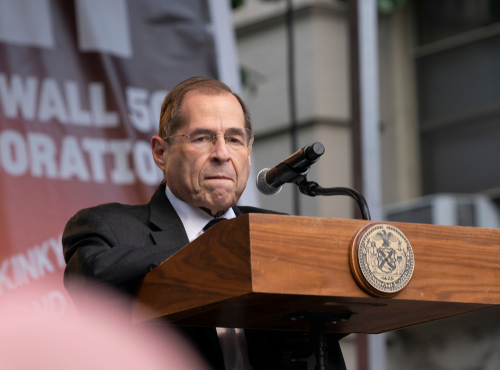
Jerrold Nadler from the 10th district of New York City, has probably done far more damage to the nation than any person who has ever been elected to Congress. He has been elected to 13 terms and he may actually lose his seat in 2020 if he dares to run. He may have been given a golden parachute to impeach Trump. Nadler has only a 20.1% approval rating, reducing the incumbency advantage. While the 10th district has been a Democratic thiefdom for 100 years, there is a risk that could change.
The speculation has been that Nadler was paid off to try to overthrow Trump because he does not want to see American boys die in the Middle East for a never-ending war. It is true that Nadler was born into a Jewish family in Brooklyn, the son of Miriam (née Schreiber) and Emanuel “Max” Nadler. However, this does not confirm that he hates Trump so much that he is engaging in treason himself.
Cyclically, if he decides to run again in 2020, he may actually lose. But this is not based upon a Democrat v Republican analysis but on his personal career. His performance in these impeachment proceedings has been one of a totally dishonest politician rigging the game.
Nancy Pelosi has also acted strangely unconstitutionally by her holding back the articles of impeachment to the Senate demanding Senate Republicans to deliver concessions. She is clearly acting beyond the Constitution for she has no authority to interfere with an impeachment trial. She is obviously fully engaged in this coup and conspiracy to overthrow Trump. But she may be delaying for another covert reason. This holding back on the articles of impeachment demanding concessions is totally unimaginable for the Constitution is very clear.
Art. I, § 3, cl. 6
The Senate shall have the sole power to try all impeachments. When sitting for that purpose, they shall be on oath or affirmation. When the President of the United States is tried, the Chief Justice shall preside: And no person shall be convicted without the concurrence of two thirds of the members present.
Trump is NOT impeached until the articles at delivered to the Senate the articles of impeachment. Just because the House can impeach without interference from the Senate or Judiciary on a simple majority vote, the Republicans hold all the cards in the Senate and she knows that. So what is her real game?
The Constitution clearly states that the trial of an impeachment is solely within the discretion of the Senate. Impeaching Trump claiming and abuse of power is precisely what both Nadler and Pelosi are engaged in these days. Pelosi has no constitutional basis to try to control the Senate.
Art. I, § 2, cl. 5
The House of Representatives shall choose their speaker and other officers; and shall have the sole power of impeachment.
There are those claiming the Senate can acquit Trump even if the House withholds the articles of impeachment. My reading of the Constitution does not support that conclusion. The House has the exclusive power to impeach so the Senate cannot acquit Trump unless he is impeached. There can be no trial without the House formally delivering the articles of impeachment.
Pelosi has no constitutional authority to try to dictate the terms of impeachment to the Senate. This is the sole discretion of the Senate – not the House. The Senate can indeed acquit Trump even without a trial constitutionally. Those who claim Trump is impeached even if the Senate withholds the articles is highly questionable, since the act of filing an impeachment is exclusively in the House. My reading of this does not support the proposition that the Senate can now just acquit without receiving a formal impeachment.
This is smelling like something is indeed seriously wrong. I believe Pelosi is stalling to be able to add to the counts and continue the impeachment hearings because she knows the current articles are not valid for impeachment.
The likelihood of Trump being removed from office by the Senate is zero. However, the Democrats may be preparing to impeach Trump twice. While this current impeachment is unconstitutional and focused on this nonsense with Ukraine, Congress is pursuing in the courts the strategy to compel White House counsel Don McGahn to testify, who defied a subpoena from the House Judiciary Committee. His testimony regarded Robert S. Mueller III’s investigation into the Russia scandal implying an obstruction of justice.
Trump argued that there’s no longer any need for the courts to rush in to decide whether McGahn has to testify to the Judiciary Committee since he was impeached. However, the lawyers representing the Democrats argued that if this testimony produces a charge of obstruction of justice, then the committee could impeach Trump a second time. Keep in mind that Nixon fought the subpoenas and eventually lost in the Supreme Court.
This entire impeachment process has become just another political weapon. It was never intended to be used in this manner and indeed Trump has been only the third president to be impeached. Nixon resigned before the House voted for impeachment based upon bipartisan support for impeachment which has not taken place this time as both parties simply clash.
A second impeachment is possible and would be pursued by the Democrats. This will be taken much more seriously than the current nonsense over Ukraine. For that reason, the turning point of the ECM come January 18th, could be much more important to the market reactions than currently suspected.
This may provide the true answer as to why Pelosi has been holding back on sending the Articles of Impeachment to the Senate. She may actually be holding back to add to the impeachment depending upon the court ruling,
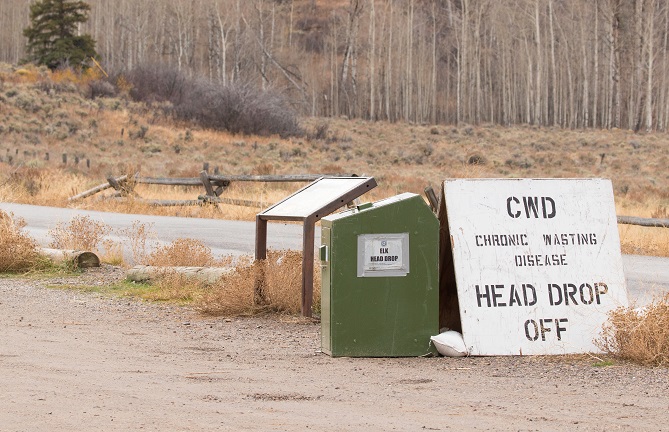
Most people have never heard of Chronic Wasting Disease (CWD) but it is a highly contagious neurological disease affecting deer, elk and moose. CWD causes a characteristic spongy degeneration of the brains of infected animals. This results in emaciation, abnormal behavior, loss of bodily functions and death. The risk of CWD transmission to humans remains unknown. However, in a test conducted to determine if nonhuman primates were susceptible to CWD, two squirrel monkeyswere inoculated and contracted the disease.
CWD belongs to a group of diseases known as transmissible spongiform encephalopathies (TSEs). Within this family of diseases, there are several other variants that affect domestic animals: scrapie, which has been identified in domestic sheep and goats for more than 200 years, bovine spongiform encephalopathy (BSE) in cattle (also known as “mad cow disease”), and transmissible mink encephalopathy in farmed mink.
CWD is in North America in deer, elk, and moose. There are now several rare human diseases are also TSEs. Creutzfeldt-Jakob disease (CJD) occurs naturally in about one out of every one million people worldwide. Variant Creutzfeldt-Jakob disease (v-CJD) has been associated with the large-scale outbreak of BSE in cattle herds in Great Britain.
Preliminary testing warns that it is possible for CWD to infect humans. So far that has not taken place. Hunters might not want to be eating venison these days and should consult the environmental agencies of the state you are in. It has now spread to Pennsylvania and even New Jersey.
Tammy Bruce is filling in for Sean Hannity. Refreshing. Congressman Louie Gohmert discusses the status of the political impeachment effort and Speaker Pelosi’s refusal to send the articles to the Senate. Ms. Bruce notes the DC reaction to an outsider administration was predictable; President Trump is adverse to their self-interests.
I have created this site to help people have fun in the kitchen. I write about enjoying life both in and out of my kitchen. Life is short! Make the most of it and enjoy!
This is a library of News Events not reported by the Main Stream Media documenting & connecting the dots on How the Obama Marxist Liberal agenda is destroying America

 […] The implications of intercepting the communications of a U.S. citizen who is associated with the political campaign of a candidate seeking the presidency rings nearly every “bell” in the FBIs and Attorney General’s Guidelines for sensitive investigations. As discussed in the IG report, by regulation, these cases cannot be initiated without the written approval of the Director and the Attorney General.








 Centinel2012