The Daily Caller has a good outline today showing how one of the people involved with the June 9th, 2016, Natalia Veselnitskaya meeting with Donald Trump Jr. was actually a U.S. State Department contracted employee.
(Via Daily Caller) […] Anatoli Samochornov, a Russia-born professional translator who worked as a part-time contractor for the State Department, worked with Veselnitskaya last year on an effort to roll back the Magnitsky Act, a law passed in 2012 which allows for sanctions against Russians accused of human rights abuses. (link)
As each day passes, and as more information is revealed, it looks increasingly likely the entire meeting on June 9th was being guided by purposeful construction. Our early research into the motives behind the players involved appears to have been accurate.
Of course all oppositional entities who are antagonistic toward the president shout “conspiracy theory”. However, the political motives are almost identical in construct to the 17 sexual harassment Trump accusers that mysteriously disappeared shortly after the election.
Having followed the deep weeds of politics for quite a while, here’s the most likely scenario.
Professional democrats are notorious for their creation of false outrage within political campaigns. Mitt Romney’s binders of women, and 47% controversy are merely examples of nothingburgers thrown up against a politician not skilled enough to push back against the false narratives.
It is becoming increasingly clear that as soon as the Democrats saw Donald Trump was most likely going to win the GOP nomination (May 2016), they assembled their opposition research crews to build-out the best scandals for use in the general election.
The Russian Conspiracy scandal was one of the approaches; the ‘sexual harassment’ scandal was another. Two ongoing attack angles both of which could be deployed depending on the consulting poll test results.
Not surprisingly the Clinton Team, which includes the Clinton media as revealed by WikiLeaks, decided to go with the “sexist”/”sexual harassment” angle. It didn’t work.
It didn’t work, but they still had the “Russian’s support Trump” angle at the ready; so it was only a matter of a few phone calls to expand the narrative and put the wheels in motion to undermine, marginalize and disrupt…
If Team Clinton, writ large, had originally chosen the Russian angle for the general election it too would have failed. AND we would currently be bombarded with the sexual harassment accusations etc. Both narratives were/are essentially interchangeable because ultimately the objectives of both were/are the same.
Part I is HERE. Part II is HERE. Because U.S. President Trump’s special envoy Brett McGurk was so good at explaining the current state of issues in Iraq and Syria in Part II, we are revisiting his overview to the D-ISIS alliance in this part III.
Mr. McGurk is speaking to the 70 nations who are part of the coalition to defeat ISIS (“D-ISIS”) globally, not just regionally. However, the majority of the current confrontation is happening within Iraq and Syria.
The stunning video (see here) and stories (example here) from the liberation of Mosul are honestly some of the most remarkable foreign conflict events in the past century.
[Transcript] MR MCGURK: Thank you, Terry. Good morning. Distinguished ambassadors, coalition partners, friends, and colleagues, it’s my pleasure to welcome you again to Washington as members of our Global Coalition to Defeat ISIS. Today’s discussion will allow us to really roll up our sleeves as we look ahead in Iraq, Syria, West Africa, East Asia, and anywhere else ISIS seeks to export its terror.
This discussion today comes on the heels of three days of working group meetings with all 72 members of our Coalition, and we’re looking forward to a very productive day.
When our ministers gathered here in March in this room, Secretary Tillerson emphasized that President Trump had asked all of us to accelerate the campaign against ISIS. And over these last four months, that is exactly what we have done.
So my remarks this morning will provide an update focusing on the ISIS core in Iraq and Syria, our recent discussions with Russia in Syria, and our vital work as a Coalition beyond the Iraq and Syria theaters.
But before I begin, let us all offer our respect and congratulations as a Coalition and as partners to the Government of Iraq on the recent liberation of Mosul. The Government of Iraq is represented here today by Dr. Naufel Hassan from the office of the Prime Minister, and our good friend Ambassador Fareed Yasseen. Welcome. We’re also pleased to have Bayan Rahman, the Kurdistan Regional Government’s representative here in Washington with the Iraqi delegation. Bayan, welcome.
We all owe a debt of gratitude to the leadership of Prime Minister Abadi and the heroism of the Iraqi Security Forces, the Kurdish Peshmerga, and so many volunteers that took up arms against ISIS. These forces have suffered significant casualties in one of the most difficult and intense urban battles since the Second World War, while placing protection of the civilian population at the top of their campaign plan.
As President Trump told Prime Minister Abadi in a phone call just a couple days ago, the liberation of Mosul is a milestone in our shared fight against ISIS, but it is not the end of the war, and we are committed as a country and a coalition to ensure ISIS’s total destruction.
I was in Iraq when Mosul fell to ISIS a few years ago, and I happened to be there just days ago as the battle culminated, working with our Iraqi partners, many of whom seated in this room. This has been a long three years, from the collapse of seven Iraqi Security Force divisions to their rebuilding into one of the most proficient and now battle-tested forces in the region.
So it’s worth reflecting a moment on how far we’ve come.
In June of 2014, ISIS, fueled by tens of thousands of foreign fighters from as many as 120 countries around the world, was able to mass and maneuver large military formations nearly at will across Iraq and Syria. Journalists and analysts predicted the imminent fall of Baghdad. ISIS rounded up and massacred one by one 1,700 Iraqi Air Force cadets near Tikrit and uploaded the footage on YouTube. It committed acts of genocide against minority groups, Yezidis and Christians, and murdered anyone who contested its rule. The ISIS spokesman, a terrorist named Mohammed Adnani, declared, quote, “This battle will soon rage in Baghdad.” He declared to the world that this so-called caliphate would, quote, “remain and expand throughout the Middle East and into Europe,” and he called upon Muslims from around the globe to come and join their fight in Syria and Iraq.
ISIS, of course, never reached Baghdad. The Iraqi people and its security forces, with support from so many in this room, regrouped and fought back. Today, ISIS’s so-called caliphate is rapidly shrinking, and the units we have trained as a Coalition in Iraq have never lost a battle. I think it’s worth reflecting on that point for a moment. We’ve now trained as a coalition over 100,000 members of the Iraqi Security Forces, and the units we have trained have defeated ISIS in every engagement. Not only that, these units are now the pride of Iraq.
Just last week, when Iraq’s elite counterterrorism forces began a recruiting drive for 3,000 positions, they received nearly 300,000 applicants. This is a remarkable trend and a total transformation from only three years ago.
The terrorist I mentioned earlier, Mohammed Adnani, who also planned attacks abroad, including in Paris and Brussels, is now dead, killed by a Coalition airstrike last year near the Syrian town of al-Bab. This is the fate of nearly all ISIS leaders.
In total, Iraqi forces, supported by our coalition, have cleared over 65,000 square kilometers of territory in Iraq and Syria. All of this territory has held. ISIS has not reclaimed any of this ground. We have freed over 4 million people who had been living under ISIS in 2014, and most importantly, we’ve helped set the conditions for people to return to their homes.
In Iraq alone, nearly 2 million people who fled ISIS have since returned to their homes to restore life to their communities once controlled by these terrorists. That rate of returns in a post-conflict environment is unprecedented historically, and it’s testament to what we have done as a coalition by working together.
So Mosul is the prime example. Nearly one year ago, we gathered here in Washington to prepare the pending campaign in Mosul. A quote that was used during that day was from our former president, Dwight D. Eisenhower, who said, quote, “The plan is often useless. It’s the planning, the planning together that is indispensable.” By planning, we anticipate, we adapt in a dynamic environment.
In Mosul, we worked together for six months in a comprehensive military, political, and humanitarian campaign plan. On the political level, thanks to the leadership of Prime Minister Abadi, and President of the Iraqi Kurdistan Region Masoud Barzani, we worked to ensure full cooperation between Iraqi Security Forces and the Peshmerga – a level of cooperation we later saw on the ground. Few, including ISIS, anticipated that.
We supported Prime Minister Abadi’s policy and the Government of Iraq’s policy of decentralization, empowering local people to take charge of their communities after the battle, and ensuring full coordination between regional, provincial, and national authorities.
On the humanitarian level, we planned with the United Nations and the Government of Iraq for nearly 1 million displaced people from Mosul. Our Coalition raised the funds to ensure that the UN and associated NGOs had what they needed to address even a worst-case scenario. To date, over the course of the Mosul campaign, there have been nearly 940,000 displaced people; and our colleague, Lise Grande, who’s here, who led the humanitarian response for UNDP, reports that every single one of them – every one – received assistance and aid. Lise has done a tremendous job, and I think we all owe you our respect and gratitude. I think this is one of, really, an unprecedented combination of military and humanitarian response plan with the international community working together.
At the stabilization level, we planned for the day after with emphasis on immediate needs, including locally drawn police force, clearing land mines left by ISIS, restoring electricity, water, sewage, rubble removal, and work programs. The results are now visible in east Mosul, where, only months after the battle, over 220,000 people have returned to their home. 350,000 boys and girls – 350,000 boys and girls, who about six months ago were living under ISIS – are now back in school. Markets are bustling and life is returning to the streets. Even in west Mosul, where the battle was most intense over the past four months, we are seeing thousands returning to their homes and beginning, beginning to pick up their lives after ISIS.
Now, the Old City of Mosul is a different story. This dense urban core was the final stage of the battle and has been in the news with photos of devastation for months of house-to-house and room-to-room fighting. There is one reason for the intensity of this battle. Hundreds of ISIS terrorists from all around the world, as far away as China, gathered in the Old City, nearly all of them wearing explosive suicide vests, barricaded in fighting positions, using civilians as human shields. Over ISIS radios, terrorists hold up in the old city were speaking French, Chinese, Dutch, Russian, and Arabic with a non-Iraqi dialect. These terrorists rigged buildings with explosives, destroyed them as Iraqi Forces approached, including the Grand Mosque of al-Nuri, which has stood for nearly seven centuries. They paraded civilians in front of their fighting positions, hid behind women and children, and use a hospital just north of the Old City as a killing tower, placing snipers to murder civilians trying to escape.
The world has not seen an enemy like this in decades at least, and there is no neat and tidy way to root out suicidal terrorists from urban buildings. This is a war, yet Iraqi Forces place protection of the civilian population at the top of their mission, often at great risk to themselves. Where Iraqi Forces failed to live up to their own high standards, the Iraqi Government is investigating allegations, which we encourage. Iraqi Forces also sought, at the top of their campaign plan, to ensure that suicide bombers from Tajikistan or Tunisia who found their way to Mosul to terrorize the Iraqi people would die in Mosul, rather than escape to terrorize us elsewhere. And they succeeded in that mission. For ISIS foreign fighters, there is no escape.
The battle in Iraq is far from over. Iraqi Forces, with our support, will soon move to liberate remaining territories controlled by ISIS, including Tel Afar, Hawija, and Al-Qaim. We will support them in the military campaign and in what comes next at the humanitarian, stabilization, and governance levels. That is why we are here.
And on behalf of President Trump and Secretary Tillerson, the United States requests that every member of our coalition identify new areas in which to contribute. To date, as a coalition, the U.S. has provided nearly three-quarters of the military resources required to support our partners on the ground, but only one-quarter – the U.S. has provided only one-quarter of the financial resources for humanitarian and stabilization assistance, the rest being picked up by our coalition. This ratio, 4:1 coalition contributions to U.S. contributions for the post-ISIS phase, must continue and further expand over the vital months ahead. And the needs remain vast.
At our working group meetings yesterday, the UN outlined a total appeal of $1.3 billion for post-ISIS humanitarian and stabilization requirements. Nearly three-quarters of this appeal focuses on stabilization, particularly in Mosul and the most devastated areas. And given the record of our stabilization programs to date, with every dollar, euro, and dinar tracked and accounted for, and nearly 2 million people back in their homes, this is a worthy investment and helps ensure that ISIS can never return.
The United States last week announced an additional $150 million for these stabilization programs. Today, we are announcing more than $119 million in additional humanitarian assistance, and we hope to see similar contributions from our partners in this room over the coming weeks.
Over the longer term, the Government of Iraq has developed its plans for significant economic reform and investment through 2030, its Vision 2030 plan, a program it presented to the World Bank on Monday. The United States fully supports this initiative and we commend Iraq for its work with the World Bank and the IMF to stabilize its macroeconomic situation and implement key reforms for long-term growth.
Our coalition partner Kuwait – and we welcome the Government of Kuwait here today – at the invitation of His Highness Sheikh Sabah will also host a meeting on long-term – long-term reconstruction in Iraq early next year, and we welcome this important initiative.
We also welcome the historic opening between Iraq and Saudi Arabia, marked by Prime Minister Abadi’s breakthrough visit to the kingdom last month and the ongoing work to restore vital commerce routes between Iraq, Saudi Arabia, Kuwait, and Jordan.
All of these pieces fit together in a phased approach. Immediate stabilization and essential services follow the military battle. We are right now in that phase in Mosul. Iraqi Government reforms establish conditions for sustainability and growth with support from the IMF and the World Bank. Longer-term reconstruction will be a focus of the Kuwait meeting with the Iraqi Government identifying its prioritized needs. Iraq’s integration into the region allows the private sector to recover. And in parallel, we will continue to train Iraqi Security Forces and support their efforts to ensure that as ISIS is defeated, all armed groups operate under control of the state consistent with the Iraqi constitution and laws. So I look forward to the meetings throughout the course of the day as we discuss these phases and our ongoing global coalition support to Iraq and to the Government of Iraq.
Syria is far more complicated. We do not have a government to work with in Syria. And in the absence of a credible political horizon that allows the Syrian people to determine their fate beyond the Assad regime, here is the reality: The international community will not be prepared to help rebuild Syria. Such a credible political horizon is a necessary condition for significant investments required to restore Syria after a catastrophic civil war.
As a Coalition, however, drawing on the models of what has worked in Iraq and pending a longer-term political settlement, we will focus on immediate stabilization needs of communities freed from ISIS in coalition-enabled operations. Our basic goal is to establish the conditions that will allow the local population from the areas freed of ISIS control to restore life to their communities and voluntarily return IDPs to their homes.
Last month, I visited Syria and walked the streets of Tabqa approximately 40 kilometers just to the west of Raqqa. This city of nearly 90,000 people was a stronghold for ISIS for over three years. It was freed only two months ago in what was a daring military operation across an eight-kilometer stretch of water by helicopter led by our partner Syrian Democratic Forces. Coalition-supported groups cleared IEDs on the main roads only days before we were able to visit. In downtown Tabqa, a civilian council has already formed, led by technocrats – men and women who suffered under ISIS and are now working to restore their community. These are motivated people and they deserve our support.
An initial shipment of aid, nearly 40 tons, reached Tabqa on the day of my visit, and I am very pleased to report that since then – since then, UN agencies and NGOs have arrived in the city to assess and respond to immediate needs. Emergency response teams made up of local people with knowledge – local knowledge and expertise have now formed to identify immediate stabilization sites focused on water, electricity, sewage, and rubble removal. Our development experts are on the ground and working with them. As we identify and assess these sites, members of our coalition will have the opportunity to support their demining and restoration.
On Monday, importantly, in the lead-up to these meetings here in Washington, the Syrian Recovery Trust Fund, the SRTF, approved the expansion of an essential multi-donor mechanism into areas liberated from ISIS, including Raqqa. This is an important and timely decision that will free up potentially hundreds of millions of dollars to address immediate stabilization needs for the local population.
In addition, building on the lessons from Iraq, today we are launching a new initiative within the Coalition Stabilization Working Group, a donor consortium for early recovery in liberated areas. The consortium will aim to unite donors around the restoration of essential services with prioritized project lists drawn from the local population, building on the model that has worked in Iraq.
Inside Raqqa, the battle is ongoing at this hour and is quite intense. Syrian Democratic Forces – the Syrian Democratic Forces have penetrated into the center of the city, overcoming multiple defensive barricades, IED belts, sniper nests, tunnels, and suicide bombers in armored vehicles. They have suffered significant casualties already and there will be more to come as they advance to clear the city, but we are proud to support them.
As the battle unfolds over the coming weeks and months, as we did in Mosul, our stabilization planning will move in parallel. We have identified a hundred critical stabilization sites in and around Mosul* which will be the immediate focus for demining and restoration. Local governance in Raqqa in the initial phases will be led by a Raqqa civilian council now based just north of Raqqa in Ayn Issa. This council includes nearly 120 individuals, most of whom stayed in Syria during the civil war and escaped from Raqqa and other towns within the province as ISIS moved in.
This interim council will receive support from the United States to enable immediate stabilization. It is committed to welcoming back exiles, including members of the former council that temporarily governed Raqqa in 2013, and we encourage these exiles to return to Syria. The council importantly has also committed to hold an election in the city by May of next year for a new council to ensure that the people of Raqqa can choose their own leaders, pending an ultimate solution to the Syrian civil war. And we support this initiative.
As we work to defeat ISIS in Syria, we are also committed to de-escalating the underlying civil war through ceasefires or other arrangements. We are encouraged by recent de-confliction arrangements agreed between our militaries with Russia that have helped enable an accelerated pace of operations against ISIS.
We are also encouraged by the recently agreed ceasefire in southwest Syria, approved by President Trump and President Putin just last week. This initiative was painstakingly negotiated by Jordan, the United States, and Russia. It’s one of many to de-escalate the underlying war, maintain the territorial integrity of Syria, and set the conditions for a Syrian-led political settlement in line with UN Security Council Resolution 2254. So we call on all sides in this terrible conflict to ensure that adherence to the ceasefire arrangement holds, as it is defined by a very carefully drawn line of contact.
Beyond Iraq and Syria, our coalition is equally focused on ISIS networks and affiliates around the world. Our working groups over the last few days here at the State Department focused intensively on curbing the flow of foreign fighters, countering ISIS finance, countering its false propaganda, and focusing on areas where ISIS seeks to plant roots as it loses its phony caliphate in Iraq and Syria.
We’ve made progress in all of these areas. It’s now extremely difficult for foreign fighters to get into Syria, and we’re grateful for Turkey’s efforts to seal its borders to these fighters. Those who had already entered earlier, it is our mission to ensure that they cannot get out, and they will die in Iraq or Syria. Meanwhile, we are building a global database of known foreign fighters, now with 18,000 verified names with the support of our coalition partner Interpol.
ISIS propaganda is also under strain and lacking credibility, thanks to our work with key partners: UAE, Saudi Arabia, UK, and others, as well as the efforts of the private sector: Twitter, Facebook, and YouTube, all of which have recently enhanced their capacity to track and remove ISIS content on a daily basis.
ISIS financing is now nearly all self-generated inside Iraq and Syria, and as it loses territory, it’s losing resources, which our military campaign targets relentlessly. As we know, it’ll take a global network to defeat the ISIS network over the long term, and that is what this coalition represents.
This afternoon, we will discuss extremism and ISIS networks in Africa, and we are pleased to welcome today three of our newest coalition members: Chad, Niger, and Djibouti. We will have an announcement later today on an additional member.
Indeed, as we defeat ISIS in Iraq and Syria, this extraordinary coalition continues to grow. NATO joined in May, and we are now at 72 members – 68 countries and four international organizations: the EU, Arab League, Interpol, and NATO. It is now one of the largest coalitions of its kind in history.
Of course, we cannot hide from the fact that many countries in this room, many countries within our coalition, do not see eye-to-eye on all issues. And that is the nature of a coalition. It is why we meet regularly in forums like this. There is no question, however, that three years into this global effort we stand united, 72 members from around the globe in common purpose – the destruction of ISIS and the protection of our own citizens and homelands through our joint cooperation.
So on behalf of President Trump, Secretary Tillerson, Secretary Mattis, our entire National Security team, I welcome you again to Washington. I look forward to the detailed and candid discussions about the next phase of our campaign.
So I want to thank you – okay. Why don’t I just adlib? Why don’t I give Naufel Hassan five minutes, if that’s okay, to present the views from the Government of Iraq. Because while we are all equal in this coalition, we are all also here to support the Government of Iraq, and we’re grateful that Naufel made the visit all the way from Baghdad. So we’ll give you five minutes, and then we will ask the press to leave, and we’ll start the important meeting. Again, I thank you all for attending. (Applause.)
* Raqqa
MR AL-HASSAN: Well, thank you, Brett.
Thank you, Brett. Good morning, everybody.
It’s three years ago, many people in this city and other cities in the world, include region and even inside Iraq thought Iraq is gone. Hundreds of villages and cities fall by Daesh and destroyed by terrorists. Millions of people left their homes.
When everybody thought Iraq was gone, we said, “No.”
We said, “Iraq will stay.
With more than 5,000 years of civilization, it’s not going to be gone by a terrorist group like Daesh.”
We had a clear vision in that time and we turn that setback to be a turning point for a new Iraq. The fatwa of Marja Ayatollah Sayyid Sistani was that turning point. The clear vision of the Prime Minister Haider al-Abadi and the togetherness from all Iraqis – the volunteers from Basra, from Baghdad, from Najaf, from all Iraq working together make that turning point and make defeat to be a victory, like the moment that we are celebrating the Mosul victory.
We should celebrate together. However, we do need to learn the lessons from not only Mosul city and not only from the recent battles. We also need to remember those people we lost them in the battles, and those people who were injured, their families. We need also to thank the Coalition, the volunteers from Iraq. We stand together and fight.
Everybody talk about the military victory, but it’s not only military victory. It’s a political victory. When we put everybody together – Arab, Kurd, Turkman, other minorities, Muslim, Christian work together, fight together, for one goal, one common goal, which is defeating Daesh.
Now, we say Daesh and their fake state over, but our commitment, it’s not over. Our togetherness, it’s not over. Actually it’s just started. We all need to protect this victory. In order to protect this victory, we need to focus on all the factors that brought this victory. We need to work together and help Iraqi Government to sustain our institution, the level of professionalism that we have it right now for our military forces, federal and local police, the volunteers – al-Hashd al-Shaabi. We also need to work together and understand Daesh came because there was a weaknesses. Daesh came because there was a differences – unmanageable differences.
So in Iraqi Government we have a clear vision where we are heading. As our friend Brett and, before that, our friend Lise mentioned, in the short term we are working together with the UN and other partners for stabilization efforts, our goal to bring all Iraqis who left their home to their home. We need to also work in the other challenge that Iraqi Government face, which is economic and financial challenges, where the oil price is fault. We have economic reform agenda just presented to the World Bank a few days ago, and we are working together with all our partners to make this moment celebrated after we finish all the battle. After we clear Tal Afar, Hawija, and west of Anbar, we need also to work together in term of activate the national security resolutions that deal with the root that make Daesh came to Mosul, the ideology. We need to work together to protect the civilian minorities who live there; villages and cities in Sinjar, in Tal Afar, in Tooz, and many other cities.
I don’t want to take a lot from your time. I would like again to thank the coalition, to our partners who work with us, and looking forward to celebrate the full victory in Iraq soon. Thank you very much. (Applause.) LINK
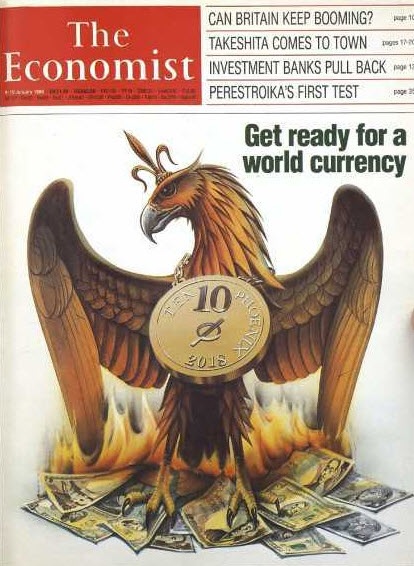
QUESTION: Mr. Armstrong; Are you aware of the 1988 Economist article predicting that in 30 years from then we would all be using the same currency? That is strangely your target of 2018 when you have warned that the Monetary Crisis will begin then. I met an attendee from your 1985 WEC there in Hong Kong. He said you gave that date of 2018 way back at that conference. Did the Economist take your work for that article?
PH
ANSWER: The Economist did not really make a forecast. They were just generalizing what might happen in 30 years from then. I do recall speaking to them back then, but I disagreed with the concept that everyone would be shopping with the same currency around the world. I was one of the people called in back in 1985 when they were creating the G5 (now G20) at the Plaza Accord. I had originally proposed back then that we adopt the SDR at the IMF as the new reserve currency.
After dealing with many governments at that time, it became crystal clear that this idea of a single world currency that people would be using in everyday commerce was not practical. It was at the Plaza Accord in 1985 when the idea of the Euro was born. This article in the Economist was inspired by this idea of surrendering monetary authority to a single government in Europe. We can see how screwed up the outcome has been. After working with governments in Europe and America, it was abundantly clear that a single currency that would be used in daily commerce by everyone would never exist without monumental collapse in governments and a new one world government. But that would not last very long as we see the rebellion in Europe against Brussels. It demands also the surrender of one’s culture.
This idea of a one world government where everyone willingly surrenders their sovereignty and culture to some central power is the stuff of movies. Here is a letter from the White House. The chief objection is universal. It requires the surrender of domestic policy objectives to international.
There is no possible way this is happening without the entire world collapsing and a single government emerges by FORCE. Politics as we know will could no longer function. Politicians argue vote for them and they will tax the rich and hand it to the poor. How can that take place in such a system? They could not promises nonsense against the global trend as they do currently. The policy would be determined at the central power and politicians would be subordinate in every country unable to offer anything to get elected.
I do not support the corruption that has engulfed the world. However, this idea that everyone will be using the same currency is a pipe-dream with no basis in reality for the amount of political change would require a bloodbath in revolution. It could NEVER unfold willingly with the political system we currently have. Even then, counter-revolutionary forces would emerge. It will not be just BREXIT, it will be countless civil wars against a central political institution.
The very best will be a single new reserve currency to replace the dollar. But every country would still need to retain its own currency because the business cycle cannot be defeated so while some countries benefit, others must suffer. The entire world cannot possibly have a trade surplus all simultaneously until we begin trading with other planets.
The Economist wrote:
Title of article: Get Ready for the Phoenix Source: Economist; 01/9/88, Vol. 306, pp 9-10
THIRTY years from now, Americans, Japanese, Europeans, and people in many other rich countries, and some relatively poor ones will probably be paying for their shopping with the same currency. Prices will be quoted not in dollars, yen or D-marks but in, let’s say, the phoenix. The phoenix will be favoured by companies and shoppers because it will be more convenient than today’s national currencies, which by then will seem a quaint cause of much disruption to economic life in the last twentieth century.
–
At the beginning of 1988 this appears an outlandish prediction. Proposals for eventual monetary union proliferated five and ten years ago, but they hardly envisaged the setbacks of 1987. The governments of the big economies tried to move an inch or two towards a more managed system of exchange rates – a logical preliminary, it might seem, to radical monetary reform. For lack of co-operation in their underlying economic policies they bungled it horribly, and provoked the rise in interest rates that brought on the stock market crash of October. These events have chastened exchange-rate reformers. The market crash taught them that the pretense of policy co-operation can be worse than nothing, and that until real co-operation is feasible (i.e., until governments surrender some economic sovereignty) further attempts to peg currencies will flounder.
… The new world economy The biggest change in the world economy since the early 1970’s is that flows of money have replaced trade in goods as the force that drives exchange rates. as a result of the relentless integration of the world’s financial markets, differences in national economic policies can disturb interest rates (or expectations of future interest rates) only slightly, yet still call forth huge transfers of financial assets from one country to another. These transfers swamp the flow of trade revenues in their effect on the demand and supply for different currencies, and hence in their effect on exchange rates. As telecommunications technology continues to advance, these transactions will be cheaper and faster still. With unco-ordinated economic policies, currencies can get only more volatile.
….
In all these ways national economic boundaries are slowly dissolving. As the trend continues, the appeal of a currency union across at least the main industrial countries will seem irresistible to everybody except foreign-exchange traders and governments. In the phoenix zone, economic adjustment to shifts in relative prices would happen smoothly and automatically, rather as it does today between different regions within large economies (a brief on pages 74-75 explains how.) The absence of all currency risk would spur trade, investment and employment.
–
The phoenix zone would impose tight constraints on national governments. There would be no such thing, for instance, as a national monetary policy. The world phoenix supply would be fixed by a new central bank, descended perhaps from the IMF. The world inflation rate – and hence, within narrow margins, each national inflation rate- would be in its charge. Each country could use taxes and public spending to offset temporary falls in demand, but it would have to borrow rather than print money to finance its budget deficit. With no recourse to the inflation tax, governments and their creditors would be forced to judge their borrowing and lending plans more carefully than they do today. This means a big loss of economic sovereignty, but the trends that make the phoenix so appealing are taking that sovereignty away in any case. Even in a world of more-or-less floating exchange rates, individual governments have seen their policy independence checked by an unfriendly outside world.
–
As the next century approaches, the natural forces that are pushing the world towards economic integration will offer governments a broad choice. They can go with the flow, or they can build barricades. Preparing the way for the phoenix will mean fewer pretended agreements on policy and more real ones. It will mean allowing and then actively promoting the private-sector use of an international money alongside existing national monies. That would let people vote with their wallets for the eventual move to full currency union. The phoenix would probably start as a cocktail of national currencies, just as the Special Drawing Right is today. In time, though, its value against national currencies would cease to matter, because people would choose it for its convenience and the stability of its purchasing power.
…..
The alternative – to preserve policymaking autonomy- would involve a new proliferation of truly draconian controls on trade and capital flows. This course offers governments a splendid time. They could manage exchange-rate movements, deploy monetary and fiscal policy without inhibition, and tackle the resulting bursts of inflation with prices and incomes polices. It is a growth-crippling prospect. Pencil in the phoenix for around 2018, and welcome it when it comes
Believe it or not, Australia has a Black Economy Taskforce that hunts down citizens in every possible way. They look at where they send their kids to school and then inquire at the school who pays the bills and how. They are using technology to hack people’s phonesof anyone suspected of hiding money to get all their messages and emails as well as where they call overseas. Their own website says:
The Black Economy Taskforce has been established to develop an innovative, forward-looking whole-of-government policy response to combat the black economy in Australia, recognising that these issues cannot be tackled by traditional tax enforcement measures alone.
The black economy refers to people who operate entirely outside the tax and regulatory system or who are known to the authorities but do not correctly report their tax obligations.
Michael Andrew, the head of this 1984 style Taskforce to spy on citizens, has proposed that the government should keep track of your $100 and $50 notes by implanting hi-tech nano-chips. He could simply scan your house to see where you are hiding money that the government can confiscate.
What I have been warning about is that government will not reform. Instead they will push us up against the wall and do everything against a free society to survive. This is simply how government responds every time throughout history. It is all about them paying their own pension at the expense of the citizen. They will always pretend the problem is the rich do not pay their fair share, but in reality, the crisis is the government will simply consume everything until it collapses.
So just recognize these bureaucrats are drunk with power for they look upon the people as stupid cattle to be slaughtered for their survival – them against us. Everything that was worth fighting for to preserve our way of life have been eliminated not by some foreign enemy, but by our rulers.
Government bureaucrats connive ways to gain power as they treat the people like mushrooms — they keep us in the dark and feed us mountains manure and mainstream media conspire to make sure we remain buried so deep we cannot reach the surface for air. They foam at the mouth of the through of creating a cashless society. The abolition of cash would be absolutely “absurd” and it is interesting how they argue against creating voter ID requirements saying it will prevent minorities from voting because they are backward and do not live in the modern world. As stupid and racist as that argument really is by the left, can you imagine eliminating cash from people who are so backward according to their arguments?
The Bureaucrats love their slogan – “Cash is for Criminals” and will distort every possible instance to support the elimination of cash. There was terrorism and then there was drugs. Eliminate cash, they say, and you will eliminate all crime.
So on the one hand they are against any requirement to prove who you are to vote, but then they want to eliminate cash from people they also claim cannot even find where to get ID in a city. Interesting conflicts.
OMB Director Mick Mulvaney has an explanatory outline, promoted by the White House, explaining the administration’s economic principles: “MAGAnomics”.
Introducing MAGAnomics
By Mick Mulvaney – Wall Street Journal – July 13, 2017
If the Trump administration has one overarching goal, it’s to Make America Great Again. But what does this mean? It means we are promoting MAGAnomics—and that means sustained 3% economic growth.
For most of our nation’s modern history, a healthy American economy meant one that grew at roughly 3.5%. That was the average growth rate between the late 1940s and 2007. Since then, it has hardly topped 2%.
The difference between those two growth rates is staggering. If the American economy had grown at only 2% between the end of World War II and 2000, average household income would have been roughly $26,000 instead of $50,000.
Over the next 10 years, 3% growth instead of 2% will yield a nominal gross domestic product that is $16 trillion larger, federal government revenues $2.9 trillion greater, and wages and salaries of American workers $7 trillion higher.
For merely suggesting that we can get back to that level, the administration has been criticized as unrealistic. That’s fine with us. We heard the same pessimism 40 years ago, when the country was mired in “stagflation” and “malaise.” But Ronald Reagan dared to challenge that thinking and steered us to a boom that many people thought unachievable. In the 7½ years following the end of the recession in 1982, real GDP grew at an annual rate of 4.4%. That is what a recovery looks like, and what the American economy is still capable of achieving.
The focus of MAGAnomics is simple: Grow the economy and with it the wealth of, and opportunity for, all Americans.
…
MAGAnomics is for everyone, but especially for those who left for work this morning in the dark but came home after their kids were asleep. It’s for those who are working part-time but praying for a full-time job. It’s for folks whose savings are as exhausted as they are.
This president hears you. He knows America’s greatness doesn’t spring from higher taxes or unnecessary regulations or broken welfare programs. It doesn’t come from government at all. It comes from you.
If we enact the president’s broad agenda—if MAGAnomics is allowed to work—we will have set the stage for the greatest revival of the American economy since the early 1980s. It will remind people—including those who have forgotten, or those who don’t want you to remember—what a great America means. That is driving everything we do. (read more)
QUESTION: Hello Marty,just came across an interesting project called Numerai
with the ambitious goal of creating a hedge fund to manage ALL the money in world(!) in an efficient manner using AI (machine learning, neural networks and whatever the data scientists can come up with).
At the core of this project is the historical data made accessible for free to the data scientists in encrypted form, but still usable since the structure is still there. The data scientists then compete with their AI methods against each other in auctions when evaluating their methods on a to them at auction time unknown validation set (latest data set).
The hedge fund will be the combination of the best AI methods driven in a purely evolutionary fashion with the purpose to allocate the money to where it is needed best. A nice feature is that the AI methods developed and put to use by a data scientist can be kept secret from the other data scientists and the hedge fund itself, The data scientist only needs to make the output of the AI algorithm available, pretty much like you do with Socrates :-).
The data scientist can always take his/her algorithm elsewhere if not happy with the hedge fund.
I think this sounds like a really innovative idea, but there might be some pitfalls that you would be able to highlight. For example I would expect your Socrates database to bigger than the Numerais at the moment.
Best Regards
/M
ANSWER: The problem with such a project is that the best of genius will fail. The complexity of the markets globally is far beyond description. Even the Global Market Watch is best in the financial main markets and less in agriculture and individual stocks. Why? It is all complexity. The GMW has now exceeded 150,000 possible patterns each day and counting. I just uploaded the latest 6 months of creation of patterns. It has blown my mind looking at what it has done. Moves greater than 40% on the upside it reclassified as phase transitions.
I have experimented with Neural Nets and other interesting attempts to recreate the structure of the human mind. Neural Nets are notoriously subject to complete failures. There is no such program that has been able to demonstrate consistency. This is all due to complexity.
The effort to create option models known as Black–Scholes completely broken down and resulted in the Long-Term Capital Management debacle. That was covered in the book – When Genius Failed. The failure took place because they did not have the database. They only tested the algorithm back to 1971.
There is no such computer model that can possible accomplish that and quite frankly anyone claiming to have some Neural Net Artificial Intelligence you should beware because it is just a sales pitch. Ask who wrote the code. You will find no real system other than a simple expert system based upon IF this THEN that ELSE expect this.
I was recently approached with a plea to buy into our technology by a very major company offering unlimited resources to help expand it to all sectors. I must admit, that is an interesting concept.
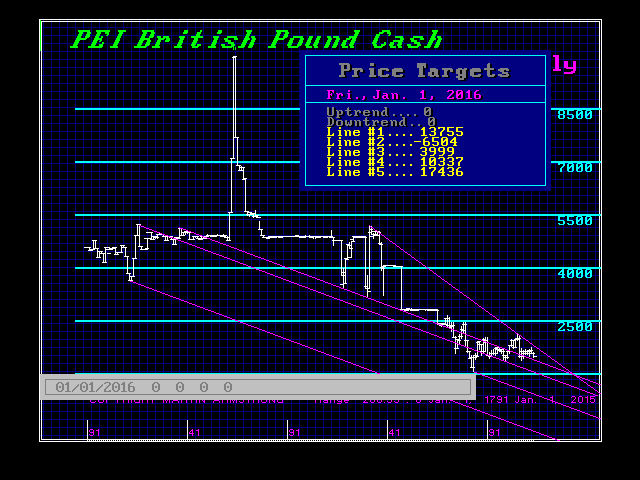
Anyone who claims to have such a system is pulling a sales promotion. You cannot rely upon a program to forecast the future on the cheap without a profound and in-depth database. The British Pound for example, all the data even in major data banks go back to 1971 and many only on a monthly closing basis. You cannot forecast trends without the full picture. A computer will not be able to learn all scenarios if the data does not cover all scenarios. Plain and simple. Just ask – SHOW ME THE DATA and WHERE DID YOU GET IT?
Secretary of State Rex Tillerson has been keeping an exhaustive schedule for the past week and especially in the past few days. In the ongoing diplomatic effort against mid-east terror networks, the GCC/Trump coalition have kept up pressure against Qatar.
Kuwait is acting as the primary mediator between Qatar and the rest of the Gulf States; T-Rex conducted three days of shuttle diplomacy in an effort to assist and reassert the position of the Trump administration. Tillerson traveled to Kuwait, Qatar, Saudi Arabia, UAE and back to Qatar with extensive meetings within each nation.
It would take a bazillion words to explain all the nuances, shifts, agreements and diplomatic ongoing efforts. However, to keep it simple we boiled it down to the current, most consequential, outcome within this graphic:
Qatar has signed a promise to stop the financing of The Muslim Brotherhood; and just to keep them honest, the GCC and coalition nations are keeping them in the spotlight.
Note, the Gulf Cooperation Council, the gulf states, and the Mid-East coalition including Egypt and Jordan, are the ones confronting and managing the issues with Qatar. President Trump and Rex Tillerson are in a supportive role.
I hope you are well and enjoying your front-beach house in the Sunshine State.
I read your blog every day, since 2011. I ask you:
1. Why your office was destroyed, on July 3rd?.
2. It was a threat to your work or to your person?.
3. Are you afraid for your life?.
I look forward to hearing from you as soon as possible.
Sincerely,
JV
ANSWER: No. They just broken in it appears looking for system software. We do not keep anything in the office of that nature. Even the Socrates System, all that is on the web is the results – not the program. So they can hack all they want, the system is not accessible in such a manner.
Our office was not destroyed. They targeted our floor when there were banks and other operations in there which would have offered a better target. It was not a direct threat against me or the company. It was clearly an exploratory venture that yielded nothing.
I do not fear for my life. My problem was with New York, not Washington. New York banks control the Federal NY court (SDNY) and have used it to destroy any competition. REFCO, the Chicago Commodity Firm was charged and destroyed in NYC. Drexel Burnham was the Philadelphia firm where Michael Milken worked. It too was charged in NYC and destroyed. Frank Quatrone of First Boston did the DOT.COM IPOs. They were charged in NYC. You will find anyone who takes business from NYC is charged in NYC, destroyed, and then NYC banks absorb their business. It is a very carnivorous operation in NYC so that court is dangerously corrupt.
Compete with New York at your own risk.
When I have gone to Capitol Hill, I was introduced as this is the guy with model they were trying to suppress. The New York courts are the most corrupt in the nation. Judges can change the transcripts altering the words spoke in court in direct violation of 28 U.S. Code § 753.
The US Federal Court of Appeals (Second Circuit) is appalling and if I were president, that court would be closed, everyone fired, and the judges put on trial for treason. The Second Circuit Court of Appeals is supposed to supervise the lower District Court. The Second Circuit Court of Appeals (NYC) R E F U S E S to do its job. In US v Zichetello (see page 97), it had the audacity to admit the Judges are committing felonies changing transcripts, and wrote it did not have the “power” to tell them to obey the law. If the Court of Appeals has no power, then it should be shut down. The Court of Appeals wrote:
“The Southern District of New York follows a practice that is unusual and perhaps unique…. The court reporter does not release a transcript to the parties until after the judge reviews, and in some cases corrects, it. … Because the parties receive only a printed transcript that incorporates the judge’s revisions, the parties are not informed of such revisions.
…
Courts do not have power to alter transcripts in camera and to conceal the alterations from the parties.11 Given the issues that arose in this case as a direct result of this practice, there appears to be little justification for continuing the practice in its present form. To be sure, a procedure that corrects obvious mistakes in transmission is useful, and the parties have little interest in closely monitoring such a procedure so long as the alterations are cosmetic. Monitoring by the parties, however, provides some assurance that only cosmetic changes will be made or, if not, that changes will correctly reflect what transpired in the particular proceeding. Moreover, there is little cost in informing the parties of cosmetic changes or at least of directing court reporters to give parties access to the original transcript when they request it.
Nevertheless, whether we have the power to order a change in such a practice is unclear.12 We review judgments, and our review of the convictions and sentences here may not be an appropriate vehicle for the fine tuning of this practice. However, we invite the judges of the Southern District to consider revision.”
Other court reporters as in Virginia call it “improbable conspiracy” theory. They wrote: “Accurate trial records are essential in protecting the validity and verification of trial cases. This is why tampering with court transcripts is considered a serious crime.”They seem to have had inquiries but do not want to admit that in NYC Federal Court SDNY they are still changing transcripts and the court reporters do not sign the transcript swearing they are correct.
I am fascinated by what you have accomplished in this model. You mentioned in your post about the Orlando conference a sling shot and phase transition, and I am trying to comprehend what that would look like exactly. Is that to say the DJIA wont complete its advance from 2015.75 to 2018,but that the cycle inversion underlying this market and the ECM will extend the high into 2020? When will the special report on these issues be released?
Thank you for the invaluable education,
NE
ANSWER: Yes. We can see from the Global Market Watch that the current year if it closed right here would imply a temporary high. That can change since it is based upon a dynamic view assuming each day that passes were the last trading day of the year. Nevertheless, it warns that we must stay on point.
There are two separate objectives – TIME and PRICE. With regard to PRICE, our three targets given back in 2011 were 18500, 23000, and 40,000. The minimum TIME objective was 2016/2017. Our next target in TIME becomes 2020 followed by 2022. This appears to be setting up for a major vertical move. This is why we will be reviewing how to trade a vertical market.
The markets are far more precise than anyone could have ever imagined. It is unfortunate that the analytical field is plagued by people pretending to be prophets or gurus like the old snake-oil medicine salesmen of the 19th century. Nobody can forecast anything from as personal opinion perspective on a consistent basis. Sure, everyone can make a single forecasting call based upon a gut feeling. But they cannot accomplish that on any consistent basis. This is all about a journey into a world of hidden order – the chaos theory. It is not being a prophet, guru or physic. Such titles reduce the analyst to a snake-oil salesman.
I have created this site to help people have fun in the kitchen. I write about enjoying life both in and out of my kitchen. Life is short! Make the most of it and enjoy!
This is a library of News Events not reported by the Main Stream Media documenting & connecting the dots on How the Obama Marxist Liberal agenda is destroying America

 (Via Daily Caller) […] Anatoli Samochornov, a Russia-born professional translator who worked as a part-time contractor for the State Department, worked with Veselnitskaya last year on an effort to roll back the Magnitsky Act, a law passed in 2012 which allows for sanctions against Russians accused of human rights abuses. (link)






 The markets are far more precise than anyone could have ever imagined. It is unfortunate that the analytical field is plagued by people pretending to be prophets or gurus like the old snake-oil medicine salesmen of the 19th century. Nobody can forecast anything from as personal opinion perspective on a consistent basis. Sure, everyone can make a single forecasting call based upon a gut feeling. But they cannot accomplish that on any consistent basis. This is all about a journey into a world of hidden order – the chaos theory. It is not being a prophet, guru or physic. Such titles reduce the analyst to a snake-oil salesman.
