Is the Fed the Only Means of Creating Money?


QUESTION: I am confused. Is it true that only the Federal Reserve can create money and not the Treasury?

HB

ANSWER: It all depends upon your definition of money. If you are asking about paper currency, then the answer is yes. If you are speaking of “elastic money,” which really is just book-entries, then that is also truly confined to the Federal Reserve. If you are including in your definition of money all government borrowings, then that is the prerogative of the Treasury. Now, if you are talking about leveraged book-entries where a bank is lending out money so two accounts will show an entry for the same money or close to it, then that is private banking lending. The definition is fluid. It depends greatly upon what you are calling money.

Changing the World v Dark Forces of Corruption


QUESTION:

Hi Marty !

How can we really expect politicians to make any kind of decisions when even the best humans can only think of 2 MAYBE 3 aspects at a time…. let alone complex dimensions that your computer seems to be able to interpret so well. Are we due for a reality check in what the public should realistically expect from our “leaders”?

It seems that if politicians actually had some skin in the game like CEO’s and investors they might act differently?

Hope the weather is nice in Florida ! its raining as per usual on the west coast !

–N

Vancouver Island, BC, Canada


ANSWER: I really believe that creating a fully functioning AI computer that can answer the questions because it can see everything as a whole is essential for the complexity we live in. I have tried to do that in the field of economics, but there are dark forces that are trying very hard to prevent what I have spent my life trying to create. There are tremendous conflicts where people do not want change because it would end the gravy train. I am not naive. There are those who would love to kill me or conjure up a civil contempt again to imprison me until I die to shut me up. This is the world we live in. They will say anything to win and there is never a constitutional right that is worth anything to protect you. As I have written many times, they get to do as they like and it is always your burden to prove you have any human rights at all.

So I share this vision of an honest government that is really for the people and by the people. They are easy words to write or to say. So many people have died fighting for the true meaning of those words. The dark forces of corruption are powerful and very hard to overcome.

World War III – 2024-2027?


QUESTION: Besides the Bible, there are many clairvoyants who predict that there will be World War III. Your models predict the rise in war tensions. What is your “opinion” about the prospects for a third world war?

JC
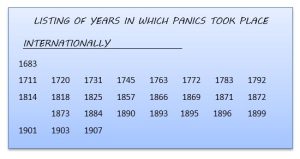
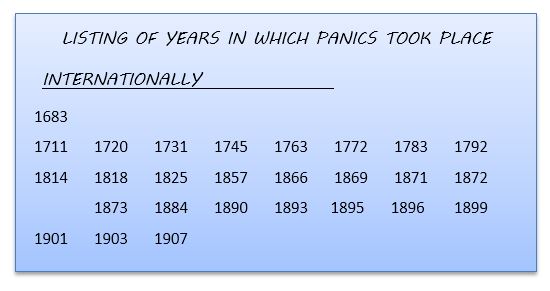
ANSWER: There is no doubt that we are in the process of a rising war cycle. It really appears to be more of a bitter war between leaders once again, as was the case with the last two World Wars. World War I was really about destroying the former Holy Roman Empire which had its seat of power in Vienna. That city was besieged in 1683 when the Ottoman Empire sought to conquer Europe. If you recall, the financial panics I used to discover the Economic Confidence Model began with the Panic of 1683 caused by the invasion of the Ottoman Empire.
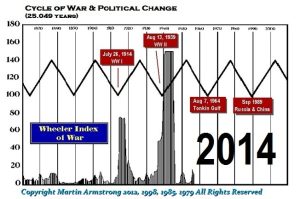
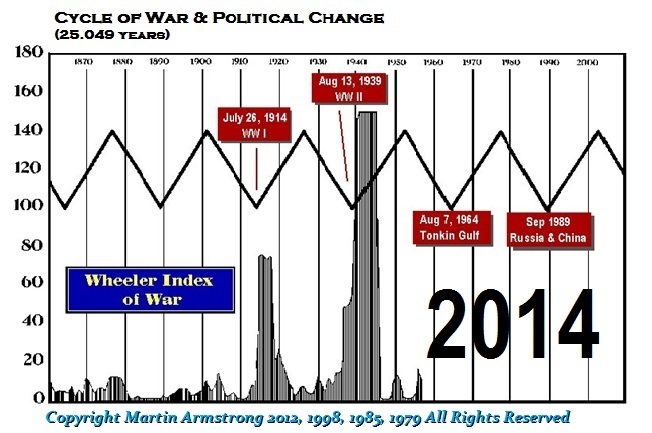
The War Cycle is turning up and we are looking at a possible peak as early as 2027. This is why I have been concerned about the economic crisis in 2021-2022. Once the economy turns down, it will be the fuel for the war.
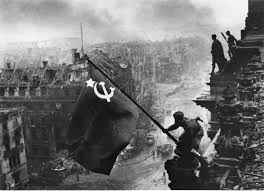
We must also respect that this particular cycle is the combination of both civil and international unrest. I do not believe we are in a cycle of conquest. Nobody wants to conquer and occupy each other — neither China, Russia, nor the USA. So, on the international level, it appears we are dealing with old grudges. When I have asked why Russia is our enemy since they abandoned communism, the only response I get is that, “Well, they are Russian!” World War I unfolded when the Archduke of Austria was assassinated by a Serb. He was heir to the throne of the old Holy Roman Empire. The French hated Germany for they were defeated under Napoleon. Additionally, in the first Treaty of Versailles in 1871 Germany became an empire at the expense of France. So it was really very much about settling old debts.

World War II was created by the oppression of the German people for the sins of their leaders. That led the German people to turn to Hitler because they were humiliated.

We would classify Napoleon and Hitler as warmongers of conquest. The Russian Revolution in 1917 and that in China led by Mao were class warfares instigated domestically that manifested into revolutions arising from civil unrest.

In Russia, the revolution really began in October 1905 when czarist troops opened fire on a peaceful group of workers marching to the Winter Palace in St. Petersburg to petition their grievances to Czar Nicholas II. Some 500 protestors were massacred on “Bloody Sunday,” setting off months of protest and disorder throughout Russia. It was 8.6 years later that World War I erupted in 1914. This signaled that there would be a rise in tensions 112 years later which would be 2017.

Vladimir Lenin was born in 1870 into a middle-class family in Ulyanovsk, Russia, but when he was a teenager, he became political after his older brother was executed in 1887 for plotting to assassinate Czar Alexander III. When he reached the age of 17, he was expelled from Kazan Imperial University for taking part in an illegal student protest. Then in December 1895, Lenin and the other leaders of the Union were arrested. Lenin was jailed for a year and then exiled to Siberia for three years. Upon his release in 1900, Lenin went to Western Europe. In 1902, he published a pamphlet entitled “What Is to Be Done?” Lenin argued that only a revolution would bring socialism to Russia by force. In 1903, Lenin met with other Russian Marxists in London and established the Russian Social-Democratic Workers’ Party. From the outset, Lenin’s Bolsheviks (Majoritarians) advocated violence and the Mensheviks (Minoritarians) advocated a democratic movement toward socialism. The split became official in the 1912 conference of the Bolshevik Party. If we use this as the start date, then we arrive at 2024 where we may see the sharp rise in tensions on a class warfare foundation worldwide once again. This may mark the culmination of the Marxist-Socialism movement that could end in blood in the streets once again.

Consequently, this World War III is more likely to be a combination of class warfare and settling old scores. The period of concern would be the 2024-2027 time frame from a cyclical perspective (sorry, no visions for I lack the clairvoyant ability).


The Rise in Agriculture for the Next ECM


The Fall Army Worm (FAW; Spodoptera frugiperda) is a crop-eating pest that was first detected in China back in January 2019. It has now spread across China’s southern border and currently impacts about 8,500 hectares (127,000 mu) of grain production in Yunnan, Guangxi, Guangdong, Guizhou, Hunan, and Hainan provinces. Officially, Chinese authorities have employed an emergency action plan to monitor and respond to the pest. FAW has no natural predators in China and its presence may result in lower production and crop quality of corn, rice, wheat, sorghum, sugarcane, cotton, soybean, and peanuts among other cash crops. Experts warn that there is a high probability that the pest will spread across all of China’s grain production area within the next 12 months.

This is obviously a contributing factor to what the computer is projecting for agriculture. Keep in mind that the patterns the computer identifies come from the price movements. We have wheat prices back to 1259. Clearly, the projections it makes are all inclusive of weather and disease, for everything unfolds in a cycle.

Endless Cycle of Corruption


QUESTION: I read your articles on Capital flows regularly and I appreciate how you interlace different concepts together.
Where is the money?

European rulers essentially drained the Asia/Africa of their resources in the last 400-500 years. With all of it piped into Europe, it should have sustained the population for way more time than what we see.

Did it get utilized or was it financially mismanaged or lost in wars? Was it a population mismanagement or an governance issue? If the Asia/Africa don’t have the resources…Europe doesn’t have it? Where is it?

– PR

ANSWER: It always seems to be mismanagement more than anything. The downside of a “representative” form of government (Republic) is that those who “represent” the people as their full-time career are subject to bribes. A Democracy is more direct insofar as the career people in government are the bureaucrats who are subject to review by the people. As long as they are not career politicians, then they will perform more of a check and balance against the corruption that always takes place in every type of political system. Career politicians accept money from lobbyists BECAUSE they continually need funds to run in the next election. It is an endless cycle of corruption.

Will Basel-III Changing Gold’s Status as a Reserve Asset for Banks Change the Future?


The Bank of International Settlements under Basel-III changed the status of gold as a reserve asset effectively on April 1, 2019. Gold used to be viewed by the banks as a risky asset and classified under “Tier-3”, which meant it was considered risky and could only be carried on the books at 50% of the market value for reserve purposes.  Naturally, gold has historically been classified as a Tier 3 asset because its value fluctuated. To the extent that the value was reduced for reserve status by 50% ensured that there was little incentive for banks to retain gold as a reserve asset regardless of their beliefs.

Since the BIS reclassified gold as a “Tier-1” asset, its value is now no longer reduced but is reflected as 100%. Now people assume banks will run out and buy gold. The problem is that it is not a fixed price on the balance sheet but it is regarded only as a 100% of market value.  While some claim that this makes Gold a “riskless” asset in the eyes of world banking authorities, they fail to note it is market value. Cash does not fluctuate $1 is still $1 regardless of what it buys.

Banks are NOT in a mad rush to buy gold and shift their reserve asses when they cannot employ gold in the banking business. True, there was once upon a time when banks cherish gold reserves but that was when gold was fixed on a standard. It will by no means increase confidence in any bank or the system as a whole. Gold remains illiquid insofar as a reserve asset is concerned.

While there is no incentive for banks to load up on gold even if it is a Tier-I asset from a banking and economic standpoint since we are not on a gold standard and its value will fluctuate unlike cash reserves, There is another reason why a small portion would make sense to retain in gold outside of the United States especially in Europe. The reserve status that is Tier-I in Europe would be bonds of all member states of the EU. There is obviously a risk in that respect.

These standards, collectively called Basel III, compare a bank’s assets with its capital to determine if the bank could stand the test of a crisis. Capital is required by banks to absorb unexpected losses that arise during the normal course of the bank’s operations. The Basel III framework tightens the capital requirements by limiting the type of capital that a bank may include in its different capital tiers and structures.

Because not all assets have the same risk, the assets of a bank are weighted based on the credit risk and market risk that each asset presents. For example, take a government bond may be characterized as a “no-risk asset” and given a zero percent risk weighting. On the other hand, a subprime mortgage may be classified as a high-risk asset and weighted 65%. So Basel III considering government debt as “no-risk” is a little foolish when we look into the years ahead.

Gold will offer a neutral bank with respect to government debt holdings, but it will still not provide a stable base of an asset since it will fluctuate rather than the immediate currency base. Gold will offer a hedge against sovereign debt among European banks more so than America.

Interest Rate & Currency Pegs


QUESTION: Martin,

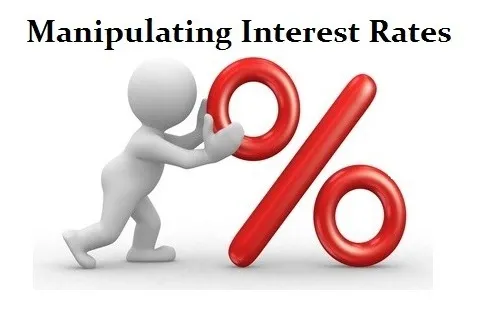
I went over three blogs this morning (both public and private); they are The FED Between a Rock & a Hard Place, Manipulating interest rates & Public vs Private Interest Rates. A common theme of the FED possibly pegging interest rates and inflation. My question is: If the FED is induced to peg rates at artificially low levels and the traditional method of combating inflation is raising rates, something must give, so are metals and commodities getting ready for “prime time?”

CF

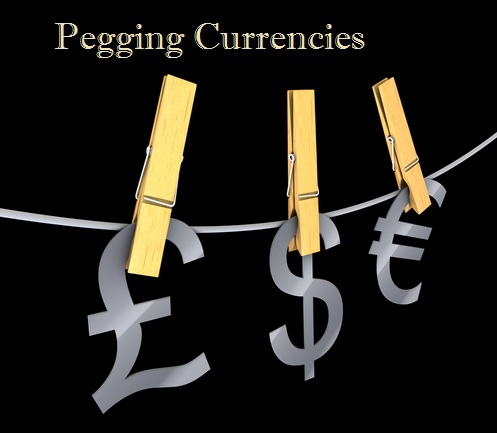
ANSWER: Behind the curtain the system of pegging rates, as I have stated, is viewed substantially differently than QE. The rates on the U.S. debt will be pegged, but not the Fed funds rates. They will be able to raise rates to the marketplace, but the bonds will be “pegged” like the Swiss attempted to “peg” the franc/euro.

This is a hybrid interest rate system that would eventually collapse as all pegs do. But it will allow, initially, for a bifurcation of rates.

They REALLY REALLY REALLY REALLY REALLY do not want me to talk about this publicly.

This is feeding into what we see coming for the next wave. They realize QE has failed. They cannot allow rates to rise as it would blow out the budgets.

This is not a long-term solution. The interest rate peg collapsed in 1951 due to Korean War inflation

Public v Private Interest Rates & Sovereign Debt Crisis


QUESTION: Dear Martin I have a question for the blog. There has been forecasts for a sovereign debt crisis but recently you have discussed how various governments may manipulate govt bond interest rates down as has happened in Europe and Japan. If Europe and Japan are anything to go by then this could go on for some time. If govts are successful in this, does this mean that there may not be a sovereign debt crisis?

ANSWER: The Sovereign Debt Crisis involves crossing the line where the private sector no longer trusts government debt. We have begun to cross that lines in Europe and Japan where the central banks are buying the debt in bulk. There have even been German auctions of bonds where there was no big.

Yes, the central banks can artificially keep government interest rates low, but that is only possible when they are the buyers.

We are experiencing already interest rates rising in the peripheral governments where their central banks do not engage in QE – namely emerging markets. We will witness private rates rise for that is a free market. However, from the government side of the table, the Sovereign Debt Crisis among the developed countries engaging in QE has unfolded as NO BID. They can artificially keep rates low ONLY because the central banks buy the debt – nobody in the private sector would buy 10 years paper at 1% to 3% when they need 8% to break even in pension funds.

Also, pay attention to the state/provincial debt where they do not have the ability to buy their own nonsense. The manipulation of rates will be at the federal level, not in the state/provincial and municipal levels of government.

So, pay attention to the bifurcation in rates that is unfolding between PUBIC v PRIVATE.


The Fed is Between a Rock & a Hard Place


QUESTION: Dear Mr Armstrong,
Not sure if I am understanding it correctly. Is the FED currently between a rock and a hard place? The FED is not able to cut rates (implement QE) due to the current pending/ongoing crisis of the US pensions, and they cannot raise interest rates as it’s going to cause more USD liquidity stress. However, rates are still going to rise as they have lost control of the interest rates. May I know is it possible for them to change the rules and allow pension funds to invest in the equity markets like how the Japanese are doing it so that they can achieve the higher returns for the pensions as well as hoping to keep interest rates as low as possible? Then this will be part of the energy (funds) pushing US equity markets to all-time highs?

Appreciate the daily education.

Warmest Regards,
MC

ANSWER: The Fed realizes that QE has been a complete failure. What they are looking at is the 1942-1951 period when the Treasury ordered the Fed to create a peg and support the bond market at benchmark rates of interest thereby installing caps. This is slightly different than QE which buys in debt on a wholesale basis. The Fed may try the peg and this will result in a bifurcation of interest rates where private sector rates will rise and public rates will become fixed even on the 2 to 10-year paper. I believe they will come under pressure to try to prevent the national debts from exploding, which will introduce yet another crisis of inflation. By trying to peg the rates, when the market smells a rat, they will end up in a position of having to monetize the entire debt. We have some very interesting times ahead.

Gold & The Hedge Against Government


QUESTION: Hi Martin,

You have mentioned repeatedly that gold is a hedge against political uncertainty. For the past several years the price has hovered at the cost of production and exploration is virtually non-existent as capital has dried up.

Nevertheless, the world is a political mess as far as the eye can see. So, it seems odd that gold is not bid more aggressively.

Regards,

Eric

ANSWER: The only time gold has rallied significantly is when the CONFIDENCE in government declines. That was the case during the post-1976 era for people saw inflation as running away. That was because of OPEC creating STAGFLATION meaning it was cost-push inflation that eventually converted to demand-push inflation by mid-1979. I understand that all of these gold-bug analysts have been preaching hyperinflation for decades. The whole Quantitative Easing (QE) was supposed to create $10,000 gold years ago. Here, after 10 years of QE, gold remains trapped in a consolidation.

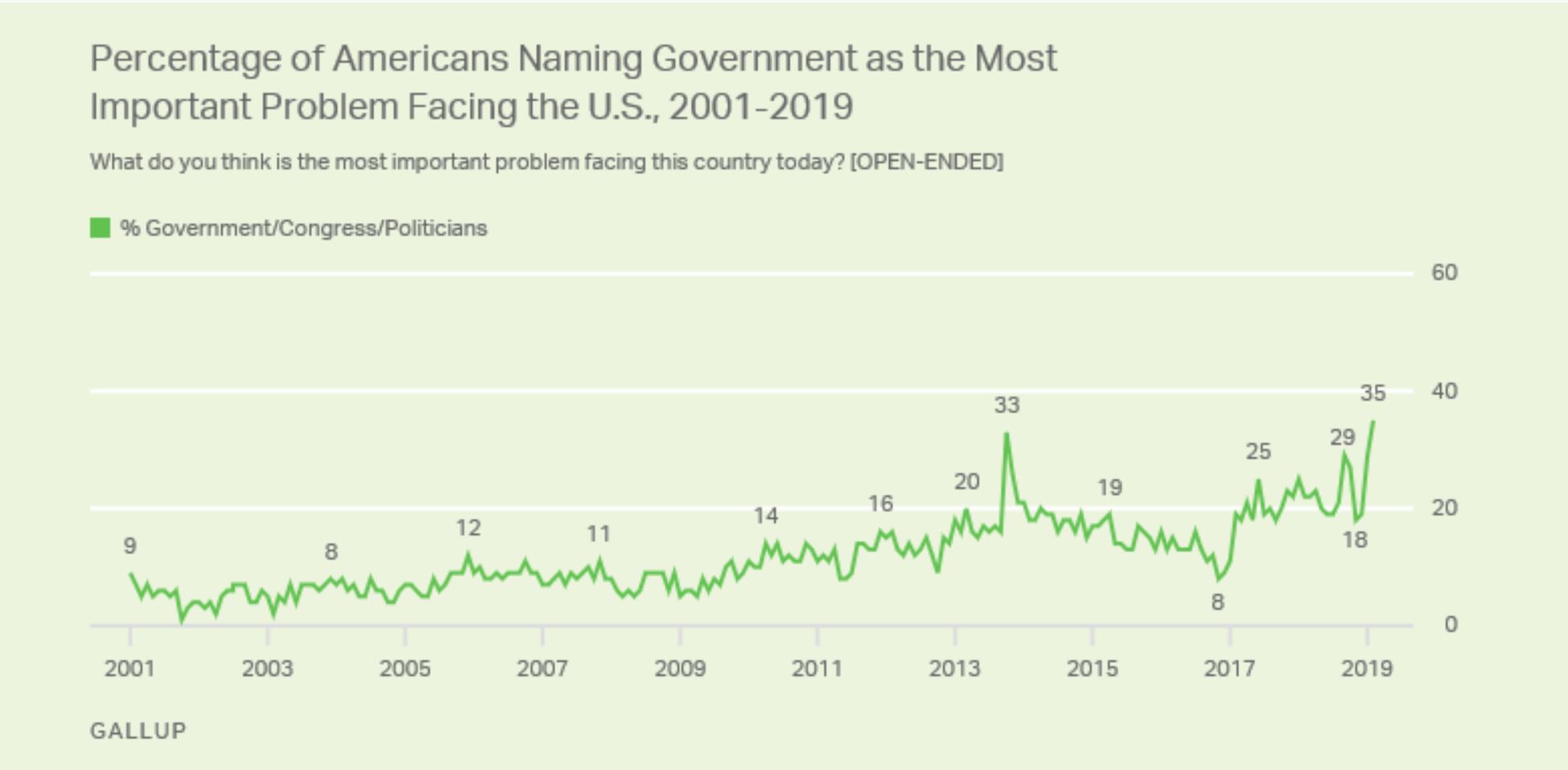
Gold will be the hedge against political uncertainty and government ONLY when the people reach that critical point of losing faith in government. We are at the 35% level where people believe the government is the number one problem. When that crosses the 45% mark, things will start to become different. This has nothing to do with the quantity of money. Most millennials use their phones to buy things or credit cards – not cash. The idea of gold as a store of value has faded between generations. The worst thing you could do is judge the world by what you believe. Everyone will act only on their own reasoning and belief system.