Retail Sales Growth Drops Below Rate of Inflation, What Does That Tell You?


Posted originally on the conservative tree house on October 14, 2022 | Sundance 

You often hear me talk about how financial pundits and economic analysts are disconnected from Main Street.  Today we get a prime example of that from the Wall Street Journal.

The topline of the WSJ article is essentially that people are not spending money on anything except essential goods (housing, energy, fuel, food, etc), which is somewhat of a ‘duh tell us something we don’t know‘ type article.   However, the analytical part of the article is where you find the insufferable disconnect.   Here’s one example:

[Data Point 1] Gasoline prices dropped in September for the third month in a row, falling 4.9% from August.”  [Data Point 2] Sales at gasoline stations, a proxy for spending by car owners, declined 1.4% last month.” 

If gasoline dropped 4.9% in price, but sales only declined 1.4% that would indicate more physical gasoline was purchased at a lower price than the month before.   It’s not a hard concept to understand.

This is a retail sales reality even identified in the article itself, “Unlike many government reports, retail sales aren’t adjusted for inflation, so some swings reflect price changes rather than shifts in the amounts purchased.”

However, now look at this:  “Spending at restaurants and bars grew 0.5% in September from the prior month. But prices at restaurants grew 0.9% in the same month, according to a separate Labor Department report released Thursday, meaning that consumers are getting less for their spending.

No, that’s not what this means.

If restaurant prices increase 0.9%, but restaurant sales only increase 0.5% it means you are selling/serving fewer customers.  It doesn’t mean consumers getting less food, it means fewer consumers are eating at restaurants….   Which is caused by consumers having to prioritize their spending.

(WSJ) – […] Spending declined in categories linked to big purchases like cars, televisions, beds and golf clubs. Purchases at electronics and appliance stores declined 0.8% in September while spending at furniture stores fell 0.7%.

[…] Scott Brave, the head of economic analytics for Morning Consult, said consumers have started to pull back on optional purchases while still spending on the essentials.  “They are having to make tough decisions,” he said. (more)
STEVE BANNON: WE ARE NEARING A FINANCIAL CRISIS – THIS IS WHAT IT MEANS FOR THE AMERICAN PEOPLE


The Charlie Kirk Show Published Originally on Rumble on October 12, 2022

Charlie and Steve are both good to listen too

New Interview: The Plot to Seize Russia


Armstrong Economics Blog/Armstrong in the Media Re-Posted Oct 14, 2022 by Martin Armstrong

Watch the video above or click here to listen to my latest interview.

Commentary from Rico Potkaars:

"Historian and Economist Martin Armstrong, as a computer programmer created the system called socrates that analyses history, current affairs and the flow of money and extrapolates to what may lie ahead. It gave him the nickname ‘the Forecaster’ and a documentary that to this day is forbidden in the USA.

Armstrong through FOIA retreived information from the Clinton Library about what happened after the Soviet Union fell. He’s written that down in a book called ‘the Plot to Seize Russia.

In this interview we discuss his upcoming book, the current state of collapsing global finance and the inescapable war on Russia as a result of that.."

NBC Nibbles Carefully During Report on Fall Harvest Inflation


Posted originally on the conservative tree house on October 13, 2022 | Sundance

In this brief segment on fall harvest inflation, NBC notes consumer prices for food stuffs continue increasing regardless of the economic action by the Biden administration. The reason is very simple and is outlined within the segment by Jacob Goebbert, the Goebbert’s farm general manager.  WATCH:

.

The current inflation is embedded in the cost of products, because it’s a supply side issue.

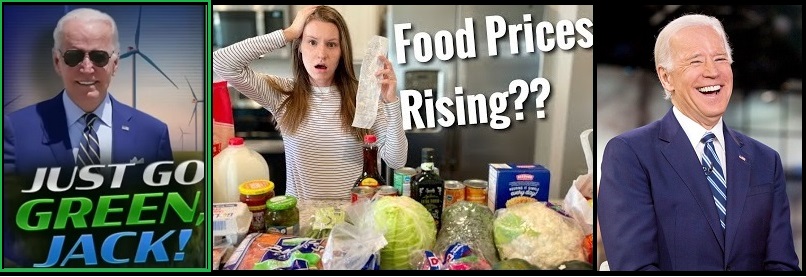
Financial “experts” can shout all day long about the fiscal policy (spending) being the origin of inflation (ie. demand side), they’re wrong.  Our current inflation cycle, most notably evident within massive increases in food prices, is a supply side issue created by the increased energy costs.  Full stop.  It’s a Biden policy outcome.

Social Security Administration Announces 2023 Cost of Living Adjustment (COLA) at 8.7 Percent, Biggest Inflation Driven Increase Since Jimmy Carter Era


Posted originally on the conservative tree house on October 13, 2022 | Sundance

Joe Biden’s economic and energy policies have resulted in another record matching former President Jimmy Carter.  The Social Security Administration (SSA) has announced an inflation driven increase in SAA benefits of 8.7% beginning in January 2023.  This is the largest cost of living adjustment in 40 years.

(Social Security Administration) – Approximately 70 million Americans will see a 8.7% increase in their Social Security benefits and Supplemental Security Income (SSI) payments in 2023. On average, Social Security benefits will increase by more than $140 per month starting in January.

Federal benefit rates increase when the cost-of-living rises, as measured by the Department of Labor’s Consumer Price Index (CPI-W). The CPI-W rises when inflation increases, leading to a higher cost-of-living. This change means prices for goods and services, on average, are higher. The cost-of-living adjustment (COLA) helps to offset these costs.

We will mail COLA notices throughout the month of December to retirement, survivors, and disability beneficiaries, SSI recipients, and representative payees. But if you want to know your new benefit amount sooner, you can securely obtain your Social Security COLA notice online using the Message Center in your personal my Social Security account. You can access this information in early December, prior to receiving the mailed notice. Benefit amounts will not be available before December. Since you will receive the COLA notice online or in the mail, you don’t need to contact us to get your new benefit amount.

If you prefer to access your COLA notice online and not receive the mailed notice, you can log in to your personal my Social Security account to opt out by changing your Preferences in the Message Center. You can update your preferences to opt out of the mailed COLA notice, and any other notices that are available online. Did you know you can receive a text or email alert when there is a new message waiting for you? That way, you always know when we have something important for you – like your COLA notice. If you don’t have an account yet, you must create one by November 15, 2022 to receive the 2023 COLA notice online. (more)

A 25% increase in the rate for those who qualify for federal food stamp assistance….

An 8.7% increase in the rate for those who qualify for Social Security benefits….

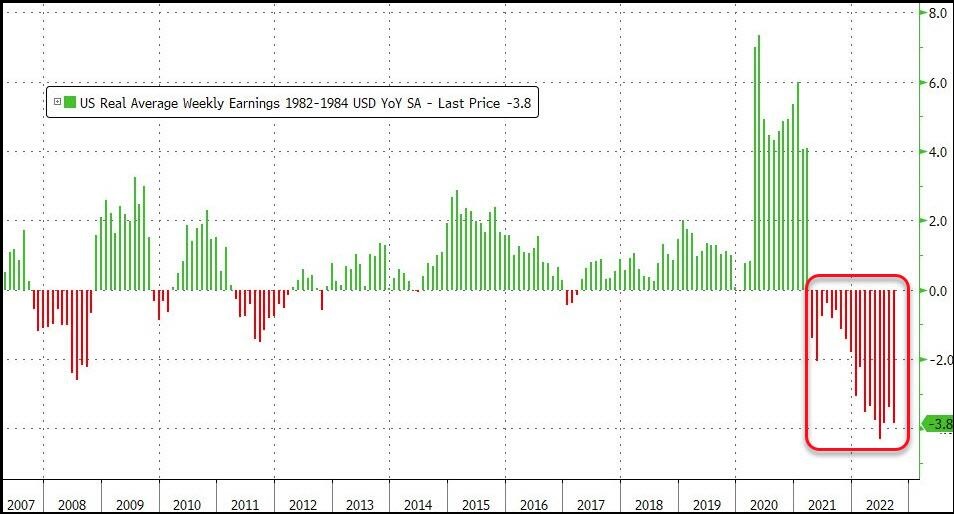
Meanwhile real wages decreased 3.8% in September and the borders are wide open for cheap labor to pour in.

September Consumer Price Index Shows Inflation Continuing to Rise More Than Expected, Fed Raising Rates Having No Impact Because it is NOT Demand Side Inflation


Posted originally on the conservative tree house on October 13, 2022 | Sundance

The Bureau of Labor and Statistics released the September Consumer Price Index (CPI) today [DATA HERE].  The financial and business media call the continued rise of consumer inflation “unexpected,” however, the results are not a surprise to those who are not pretending.

This CNBC headline highlights the economic pretense still entrenched: “Inflation increased 0.4% in September, more than expected despite rate hikes.”  Those who are not pretending fully understand the economic dynamic, but you will not find reality expressed by the mainstream media.

FED rate hikes can only impact the demand side of the inflation issue. U.S (and global) inflation is NOT the result of excess demand. It has not been driven by demand for over a year.  The root cause of inflation is on the supply side. That root is grounded in the energy policy making everything entering the marketplace more expensive.

The historic rise in energy prices; the result of Joe Biden’s specific energy policy to limit oil, gas and coal as energy resources; are what have driven inflation throughout the economy.  The monetary policy (Fed policy) continues to pretend this dynamic does not exist.  The FED is trying to support the political policy, but the bloom is off the ruse.

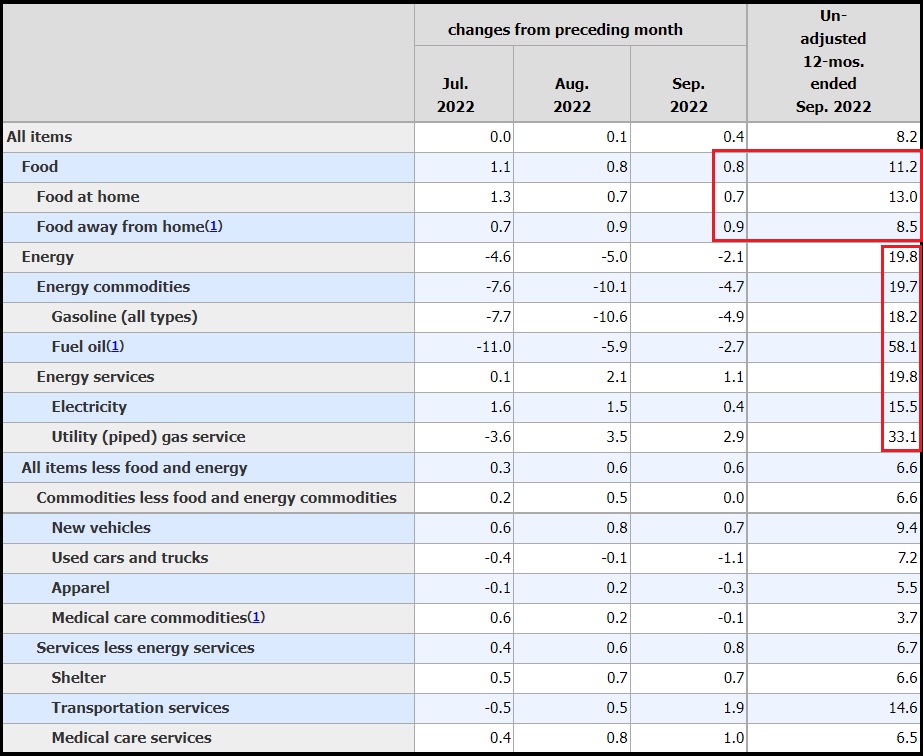
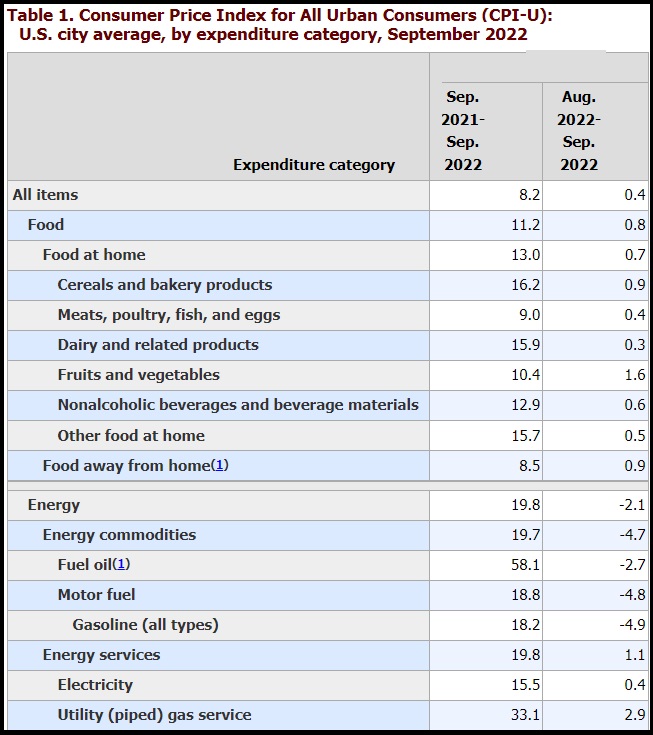
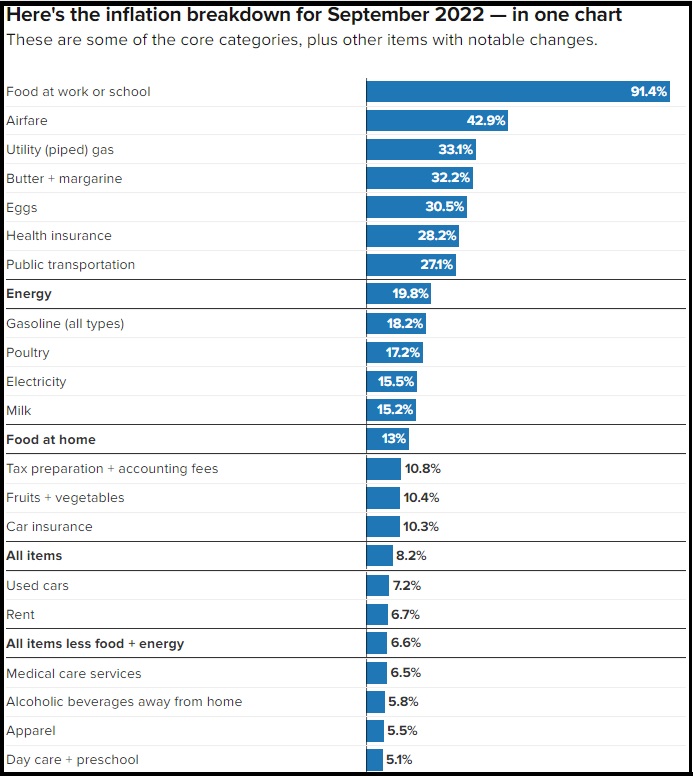
Overall inflation increased 0.4% in September, leading to a result of 8.2% year over year.  Food and energy prices continue driving inflation, additionally core inflation (everything except food and energy) continues to be driven by the originating issue of extreme energy costs.

Everything costs more because energy costs more.  That is the reality of this inflation issue.

[Modified Table-1, removing the noise]

(CNBC) […] “The Federal Reserve has made it very clear they’re committed to price stability, they’re committed to reducing the inflationary pressures,” said Michelle Meyer, chief U.S. economist at the Mastercard Economics Institute. “The more inflation comes in above expectations, the more they’re going to have to prove that commitment, which means higher interest rates and cooling in the underlying economy.”

Another large jump in food prices boosted the headline number. The food index rose 0.8% for the month, the same as August, and was up 11.2% from a year ago.

That increase helped offset a 2.1% decline in energy prices that included a 4.9% drop in gasoline. Energy prices have moved higher in October, with the price of regular gasoline at the pump nearly 20 cents higher than a month ago, according to AAA.

Closely watched shelter costs, which make up about one-third of CPI, rose 0.7% and are up 6.6% from a year ago. Transportation services also showed a big bump, increasing 1.9% on the month and 14.6% on an annual basis. Medical care services costs rose 1% in September.

The rising costs meant more bad news for workers, whose average hourly earnings declined 0.1% for the month on an inflation-adjusted basis and are off 3% from a year ago, according to a separate BLS release.  Inflation is rising despite aggressive Federal Reserve efforts to get price increases under control. (more)

I feel like we are living in a parallel universe, where this grand game of pretense continues.

Every financial pundit knows the root cause of inflation is Joe Biden’s energy policy, yet they maintain the lies in order to protect the regime.

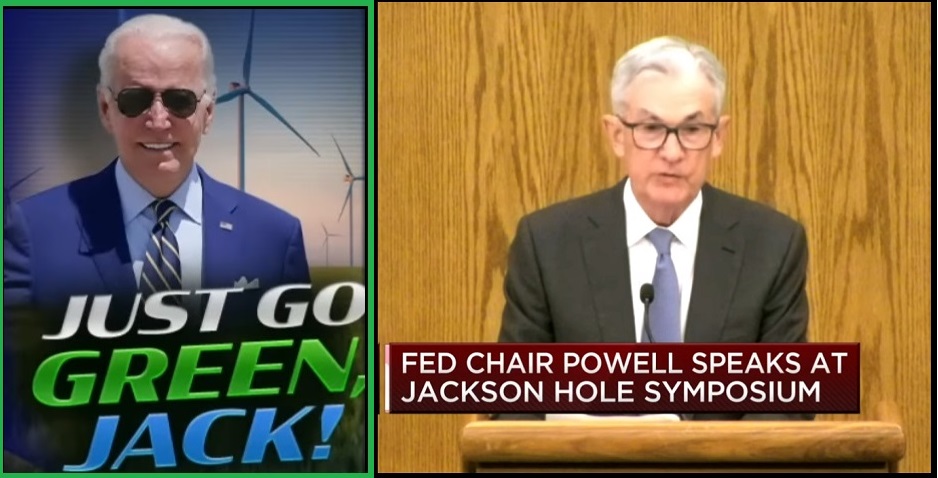
Raising interest rates in a supply side inflation economy only does one thing, it makes the economy contract faster.  The only reason to intentionally shrink the economy is to try and reduce the demand for energy resources as part of the “transition to a green economy.”  Together, the Biden administration and Federal Reserve are trying to lower economic output to meet a lowered amount of energy being produced.  That is the reality of our situation.

They are destroying the working and middle class in order to chase their climate change agenda.  These people must be removed from power.

Real Average Hourly Wages Continue to Decline as Inflation Destroys Economy and Now Hours Worked is Contracting


Posted originally on the conservative tree house on October 13, 2022 | Sundance

The Bureau of Labor and Statistics (BLS) released the September wage report [DATA HERE] delivering worse economic news for workers.

Real wages are dropping at a historic rate as inflation continues to rise and as a result wages buy less.

[BLS] “Real average hourly earnings decreased 3.0 percent, seasonally adjusted, from September 2021 to September 2022. The change in real average hourly earnings combined with a decrease of 0.9 percent in the average workweek resulted in a 3.8-percent decrease in real average weekly earnings over this period.” (link)

REAL WAGE CHART:

As the Biden economic/energy policy and Federal Reserve monetary policy merge together, the economy shrinks.  As the economy shrinks, fewer goods and services are purchased.  As less consumer goods are purchased, employment hours drop.  As employment hours drop, wages decline.

Declining wages combined with increased inflation forms the perfect storm against middle-class and working-class families.  This dynamic means lowered income and higher prices for essential goods and services like food, fuel, energy and housing.  It’s not difficult to see why this is happening.

The declining wage rates, and the more substantive drop in real wage rates due to massive inflation, are specifically hitting the lower tier of the working class harder.  Yet despite this, Biden is intent on importing even more economic migrants to put even more downward pressure on wages for the working class.

These are very real outcomes of policy.  Working class Blacks and Latinos will feel this even more, yet this is the special interest group that Democrats claim to support.  The reality is exactly opposite from the narrative sold by the Biden administration.

The Democrats know this. These outcomes are not accidental; they are a feature not a flaw in their policy.  This is why they need to keep spending to retain the ruse.

There’s no way around this.  Despite the pundit and financial class selling a counter-narrative, home prices will crash, and unemployment will go up.  I know this is directly against the current talking points, but the statistical reality is clear.

CTH was the first place who said a year ago that home sales will plummet, that is starting to happen right now.  There’s no way for it not to happen, the big picture tells us why.

Leading Edge of Field to Fork Inflation Starts to Arrive in September Producer Price Index


Posted originally on the conservative tree house on October 12, 2022 | Sundance 

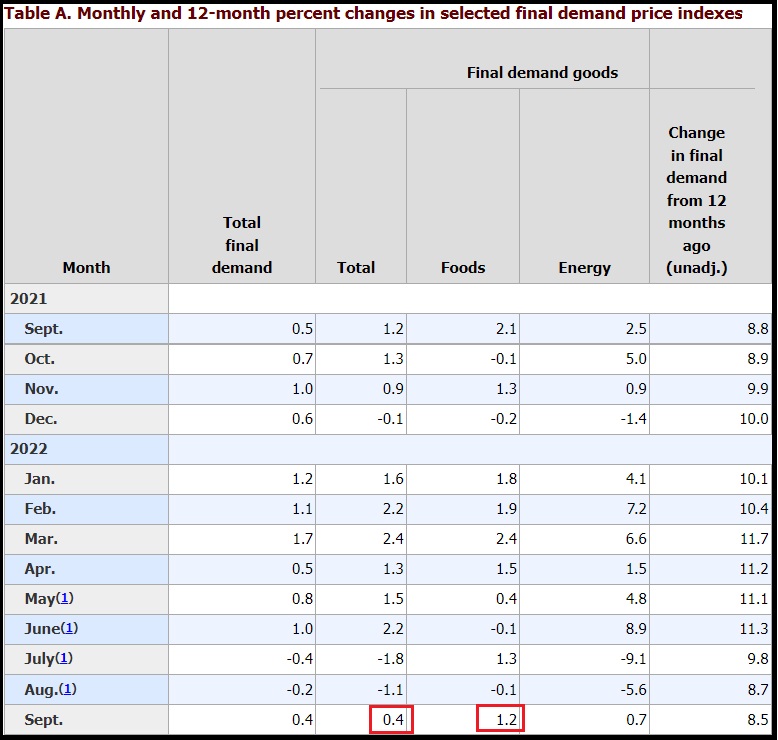
The “Producer Price Index” (PPI) is essentially the tracking of wholesale prices at three stages: Origination (commodity), Intermediate (processing), and then Final (to wholesale). Today, the Bureau of Labor and Statistics (BLS) released September price data [Available Here] showing another 8.5% increase year-over-year in Final Demand products at the wholesale level.  However, that’s not the bad news in this data.

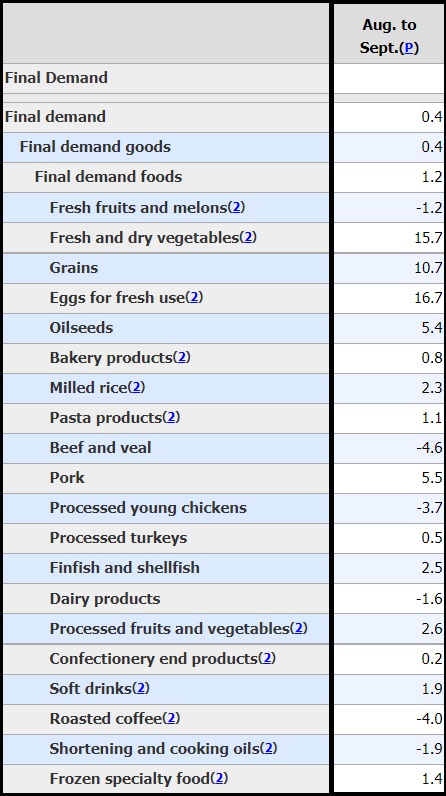
While the overall September PPI was higher than expected at 0.4%, the Final Demand Producer Price for food products in September was a whopping 1.2% (14.4% annualized).

The BLS notes the driver by saying, “a major factor in the September increase in prices for final demand goods was a 15.7-percent advance in the index for fresh and dry vegetables. Prices for diesel fuel, residential natural gas, chicken eggs, home heating oil, and pork also moved higher.”

That’s a 15.7% increase in price, in one month, for fresh and dry vegetables.  Annualized that’s a rate of price increase of 188.4% for vegetables.   Remember the warning about farm costs (energy, fertilizer, fuel) driving field to fork inflation at harvest?  This is the leading edge of that third wave of food price increases.

I have modified BLS Table-2 to focus specifically on food costs.  The data is on left.

You will note that ‘row crops’ are the big drivers along with grain and seed products.  This is exactly as we predicted it would be because those specific farming costs are the ones with greatest increase from energy, fuel, fertilizer, weed and insect control, and diesel costs.

All of those higher costs have been growing in the fields and will now surface at harvest.   The higher farm costs transfer from the field to the fork via the food supply chain.  This is only the leading edge of the price increase.

In October 2021 we first warned of the food price increases coming in distinct waves.  The first was Jan, Feb and March 2022.   The second wave was May through July 2022.  This third wave will be bigger than the first two and starts arriving this month, October 2022.

People laughed at me when I said in late 2022 eggs were going to reach .50¢ EACH ($6/doz).

Well, in September the price of fresh eggs jumped 16.7% in a single month.  That’s an annualized rate of price increase for eggs over 200%.

With hindsight you can clearly see the three waves of food price increases (BLS Table A):

Get ready and shop smart.

The October, November and December price increases in the grocery store are going to make the prior fresh food increases look small, as the full increased costs of farming operations starts to arrive at the supermarket.   Unfortunately, this will coincide with a wave of gasoline price increases, and the prices of natural gas are already skyrocketing.

.

Liz Truss’ Approval Plummets


Armstrong Economics Blog/Politics Re-Posted Oct 12, 2022 by Martin Armstrong

Truss inherited a beaten-down United Kingdom. The Bank of England declared that a recession was inevitable, sterling continues to fall, pension funds are evaporating, and the death of the queen caused an overall feeling of pessimism. Recent polls show that Truss is actually less popular than her predecessor Boris Johnson, even when Johnson was under fire for partying amid COVID lockdowns. Liz Truss currently has an approval rating of -47.

Theresa May had a score of around -46 before she resigned. Based on an Opinium poll of around 2,000 people, 53% would like Truss to resign. Even around 25% of Tory voters want her out of office only a month into the job. Even voters divided over the Brexit ruling disapprove of her with 61% of Leave voters noting disapproval, as well as 61% in the Remain camp.

“I am prepared to be unpopular,” Truss said shortly after taking office. Her proposed tax cuts for the wealthy and removal of caps on bankers’ bonuses caused the average citizen to feel as if she did not represent them. The International Monetary Fund said her plans would “increase inequality,” only adding to her criticism. She is under pressure to increase welfare payments and social programs.

Truss simply inherited a massive problem. Her government is also blamed for the rising mortgage crisis. The Bank of England is set to meet again on November 3, but many believe they may reveal their policy beforehand. They want to avoid the downturn that occurred after the mini-budget was released at the end of September. In the end – it is politics. Truss needs to appeal to the people before the Conservatives find a replacement scapegoat.

The Bank of Canada Should Admit QE FAILED


Armstrong Economics Blog/Canada Re-Posted Oct 11, 2022 by Martin Armstrong

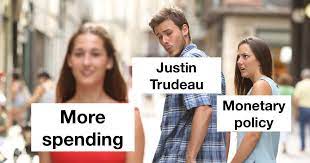
In 2020, Pierre Poilievre, chief Conservative spokesman on finance issues, said Canada’s central bank “should not be an ATM for Trudeau’s insatiable spending appetites.” Conservatives cooperated with the Liberals when it came to COVID-19 emergency spending. Everyone was in on that power grab. Now the nation is in worse shape, further in debt, and inflation is soaring.

Yet, Trudeau continues to spend recklessly without hesitation. The Bank of Canada (BoC) should remain neutral on political issues. Similar to the Federal Reserve, the BoC is the largest buyer of domestic debt. In response to criticism, the bank launched a social media campaign to deflect blame. “#YouAskedUs if we printed cash to finance the federal gov’t. We didn’t,” the Bank of Canada tweeted on August 25. Due to the pandemic, the central bank “took various measures, like buying bonds, to support and ensure a strong and stable #economy,” the bank tweeted. “We bought existing gov’t bonds from banks on the open market. Why? This helped unblock frozen markets at the start of the #pandemic. It let households, companies and governments access funding when they really needed it.”

This is the problem with those who believe they can manipulate the economy. Governments completely shut down the world for over a year and then claimed that they needed to spend as much as possible to save us from the crisis they created. “We did not use cash to pay for the bonds. We bought the bonds with settlement balances — a kind of central bank reserve — not with bank notes,” the bank continued to Tweet back in August. Basically, the strategy all along was Quantitative Easing. It failed.

They artificially lowered rates for too long and purchased government debt with no method for repayment. Their stupid idea of Quantitative Easing and lowering rates were under their theory that people would borrow if it were cheap enough. The central banks fail to understand that people will absolutely not borrow at any rate if there is no confidence. It has become conventional wisdom that when all else fails to make economies grow, create new money and buy government bonds. Of course, the “all else” never includes deregulation and lowering taxes.

Now Governor Tiff Macklem is posting videos on Twitter to explain why the bank raised rates by 300 bps in the past six months. Yes, “inflation is too high,” as Macklem pointed out, but he’s acting a bit too late. “It is by raising interest rates that we’re going to slow spending in the economy, give the economy time to catch up and take the steam out of inflation,” Macklem said in the video. “That’s gonna [sic] get inflation back down.” WHAT ABOUT GOVERNMENT SPENDING? Monetary policy does not align with the bank’s goals, as Trudeau’s continued spending will prolong inflation.