April Home Prices Reflect Largest Year-Over-Year Drop in Decade, April Prices Drop 1.7%, Decline 23.2% from Prior Year


Posted originally on the CTH on May 18, 2023 | Sundance 

Homeowner equity is being erased. As higher interest rates continue to put pressure on borrowers, the ability of the average person to afford a mortgage diminishes.  Higher mortgage rates lead to downward pressure on residential home values as fewer borrowers can afford higher payments.  Simultaneously, commercial real estate is dropping in value as vacancies continue increasing.
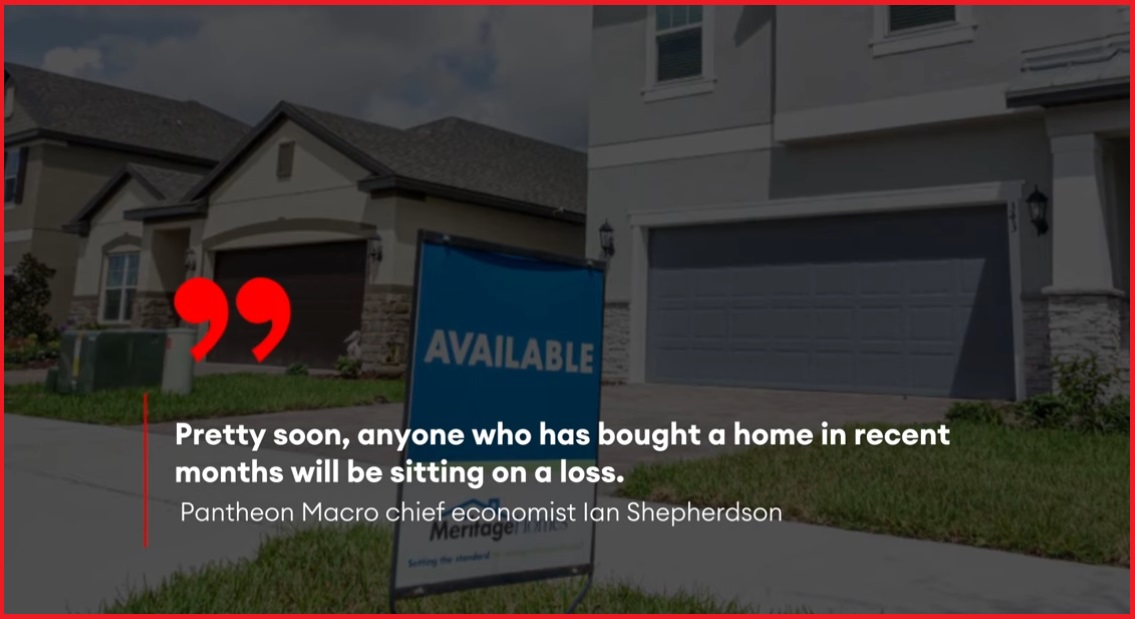
Put both of these issues together and already tenuous banks holding mortgage bonds as assets can become more unstable.

This dynamic creates the continual tremors in the background of an economy already suffering from high inflation and low consumer purchasing of durable goods.

A perfect storm starts to realize.

(Wall Street Journal) – Sales of previously owned homes fell in April from the prior month and prices declined from a year earlier by the most in more than 11 years.

U.S. existing home sales, which make up most of the housing market, fell 3.4% in April from the prior month to a seasonally adjusted annual rate of 4.28 million, the National Association of Realtors said Thursday. April sales fell 23.2% from a year earlier.

The national median existing-home price fell 1.7% in April from a year earlier to $388,800, the biggest year-over-year price decline since January 2012, NAR said. Median prices, which aren’t seasonally adjusted, were down 6% from a record $413,800 in June. Home prices have fallen the most in the western half of the U.S., while prices continue to rise from a year earlier in many eastern markets. (read more) 

Before looking at today’s graph showing median existing home values, remember me saying this in 2021?:

“I said in June, at a macro level home prices had reached their peak (last two weeks of May, first two weeks of June was apex).  Obviously, there are some geographic home value increases still happening as COVID related regional issues and work opportunities are shifting populations.  There is also a lag and ripple effect that takes time to work through the economy.  The macro-apex will not be visible until next year.”

When I said that in 2021, people said I was wrong.   Well, with hindsight now visible within the data as it is reflected, look at the result:
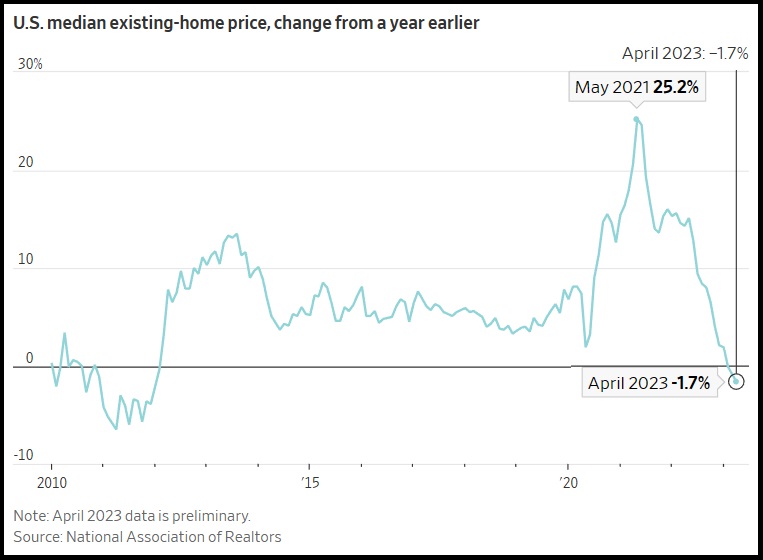
May and June 2021 was the peak of year-over-year percent of change in median home value increases.

So, what was going on?

As CTH outlined in 2022:  If you look closely at the timing (keep in mind the data reporting lag) what you will notice is that financial institutions began a big surge in purchasing hard assets, specifically real estate, as soon as Joe Biden took office (Jan ’21), and the economic policy became evident.   Intangible financial instruments became an immediate risk as the professional financial control groups recognized energy policy would drive inflation (supply side) and devalued money would fuel it (demand side).

As an offset to predictable inflationary policy (the insiders’ game), institutional money (Blackrock, Vanguard, etc) was moved into hard assets with tangible value.

This shift in asset allocation, institutional sales, helped fuel a false surge in home prices and their valuations.  CTH was writing about this in 2021, and sounding alarms as it took place.  25% of all real estate purchases were being made by institutional investors.
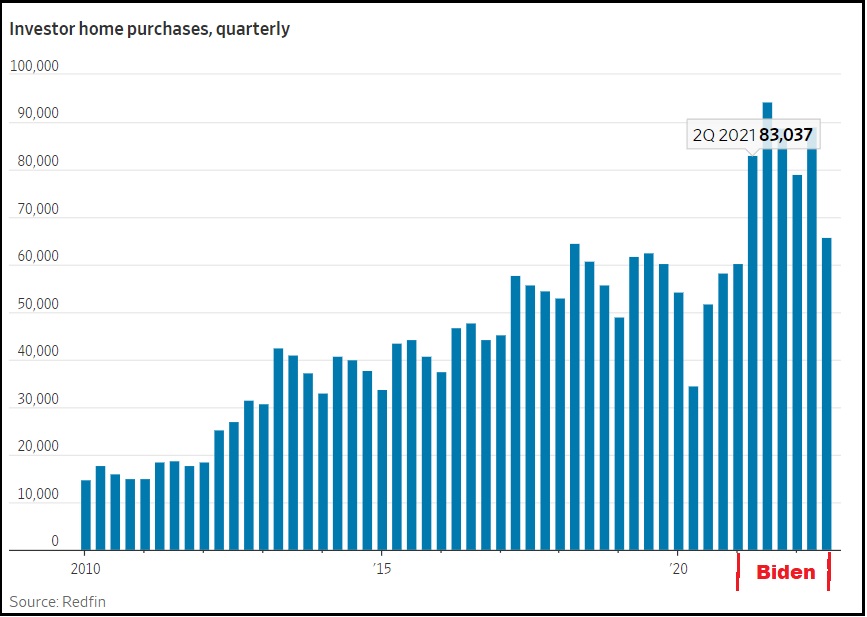
We The People got screwed. 

The dynamic was predictable.  The Biden administration economic policy, energy policy and monetary policy, was going to cause massive inflation.  CTH was shouting about it in early 2021 and warning everyone to prepare for waves of price increases that would naturally surface first on high-turn consumable goods, and then embed into longer-term durable goods.

Despite claims to the contrary, this 2021 inflationary explosion had nothing to do with the pandemic or supply chain shortages.  It was entirely self-created by western governmental policy – the collective ‘Build Back Better’ agenda.  You can see now from the background moves within the financial sectors, they too knew the reality and their money shifts reflected that despite their ‘transitory’ pretending they were mitigating their own exposure.

We the People were yet again going to be victims of specifically intended monetary, regulatory, energy and economic policy.

The investment class rulers of the WEF assembly shifted assets to avoid the pain that we would feel.   We “would own nothing and be happy,” and their shifts would position them to own everything and be in control.

Overall govt spending and regulatory controls drove inflation for these past two years.  The ‘demand side’ was blamed, despite the lack of demand. I will be proven right when history is concluded with this.  Interest rates were raised by central banks in an effort to support the policies that are driving ‘supply side’ inflation – not demand side.

Energy policy was/is crushing the consumer by driving up the cost of all goods and services.  To support the overall goal of changing global energy resource and development (a false and controlled global operation), central banks raised interest rates.  Various western economies, including our own, have been pushed deeper into a state of contraction by central banks crushing consumer demand, and eliminating investment via increased borrowing costs.

In short, the goal was/is to lower energy consumption by shrinking the economic activity.  This, according to the BBB plan, was needed at the same time as energy development was reduced.  These economic outcomes are not organic, they are all being controlled by collective western government agreement.

Within this control dynamic, there was always going to be a point where the reaction of the people to their economic reality means the financial control elements need to shift direction.  They will always maximize profit and minimized risk, while knowing what the larger objective remains.

Just like every other durable good, housing demand contracts as prices and costs become unaffordable.  The loss of equity within your home is damaging to your own value or ability to borrow against it.

From the perspective of an institutional asset, that same equity drop is an investment loss.  However, the investment loss is not materialized until the sale of the lower valued asset is completed.  Retaining declining real estate on investment books creates an artificially high appearance of the investment result; unless and until the real estate is sold at a diminished value.

As mortgage rates rise, just as a consumer would pull back from the housing market, so too will institutional investment groups now control the slow dumping of the asset to remove the equity they pumped into it.  Much of the investment housing will be retained as rental housing, with the monthly rents being part of the returns on the investments.    However, as this dynamic unfolds, further investment purchases of houses stop, because the asset overall is declining in value.  This halt of investment activity also worsens a steeper drop in home values.

America Has Been Invaded


Armstrong Economics Blog/USA Current Events re-Posted May 17, 2023 by Martin Armstrong

The end of Title 42 has been an absolute disaster. There is no telling how many migrants entered the border last week. These are not simply women and children seeking a new life. The majority of those entering are military-aged MEN who feel entitled to enter America illegally. These are not struggling individuals. American Door Dash drivers were sending food deliveries to the border as over 60,000 migrants lined up around the immediate border area in anticipation of midnight on May 11.

One extremely troubling issue is El Salvador’s recent crackdown on gang crime. The nation locked up all affiliated gang members and saw a drastic decrease in crime. The gang members who escaped had nowhere to go, and no one wanted to infringe on Mexico’s feared cartels. Neighboring Honduras was forced to follow suit after declaring a state of emergency over violent crime in November 2022. Guatemala would be wise to go this route as well, but gangs will be more successful when selling to people using the USD.

Haiti is in ruin and people have been attempting to flee for years. Venezuela’s economy is a glimpse at how well socialism works. Nicaragua and Cuba are also unfortunate examples. There is a reason people want to leave their home countries for a better life. Yet, there are no checks and balances. Every border state has said they’ve been overrun and overpowered by the huge influx of migrants.

An Afghan terrorist on the FBI’s wanted list was recently caught trying to cross the border near San Diego. Do people think this man was alone? On the days leading up to the end of Title 42, 30% of apprehended migrants escaped border custody. These are merely the people who were caught. Chairman Mark Green, R-Tenn. Admitted “we have no idea who is entering this country and being released into the U.S. interior.” Green commented that it is “chilling” to think of the 1.4 million migrants who already evaded Border Patrol under Biden before Title 42 ended.

The US has been compromised. The border is wide open and those who wish to come in without respecting the nation’s asylum laws may do so with little pushback. Our nation is already facing a housing shortage crisis, and cities with leaders who claimed to be refugee friendly are desperately trying to find a way to house and feed all of these people who cannot legally work in America. The problem is going to worsen in the coming weeks once cities realize what they have done by ignoring America’s border and permitting an invasion.

Supply Chain Crisis and Inflation


Armstrong Economics Blog/Inflation Re-Posted May 17, 2023 by Martin Armstrong

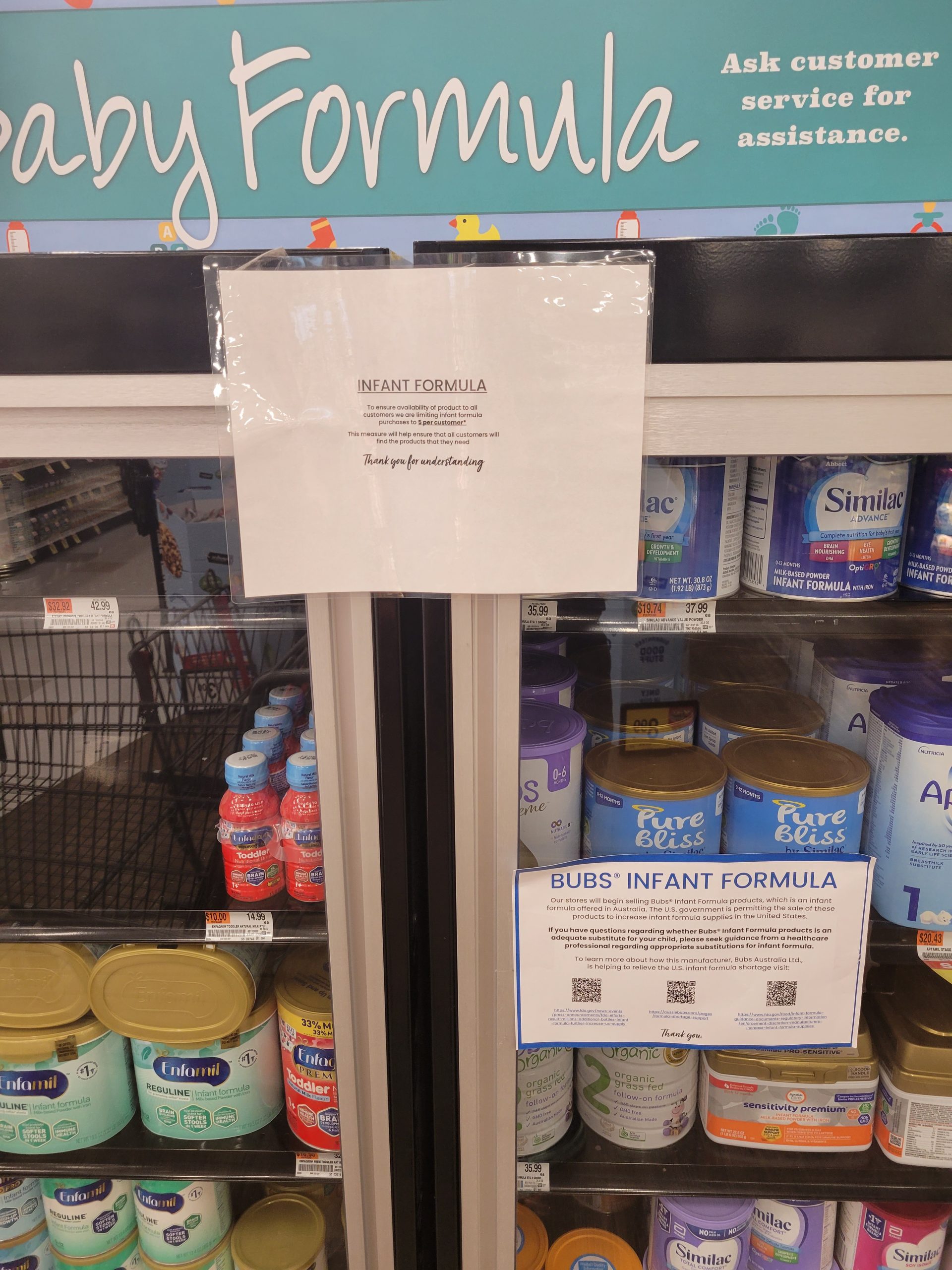
COMMENT: Hello Mr. Armstrong. Thank you for my daily dose of reality. Your blog is one of the last sources of untainted news. I would like to show these pictures my daughter sent me last week. We live in an affluent neighborhood in New Jersey where petty theft does not occur. The news outlets have not mentioned baby formula shortages. I do not believe they are locking up the baby formula to prevent crime. What is going on here?

Thanks — C.G.

REPLY: The supply chain issue has never been resolved. It improved from the days of bare shelves in the grocery stores, but many essentials are stuck in the pipeline. Products that expire will see additional shortages naturally. The supply shortage is fueling inflation and raising rates will not solve the problem.

The Fed thinks that raising rates will curb inflation by raising the cost of borrowing. That is not the problem here. Part of the inflationary crisis we are witnessing is due to demand outweighing available supply across industries. The Fed cannot control government spending nor the money supply. People are viewing the crisis today from the perspective of the ‘60s when it was NOT possible to borrow on T bills. After the collapse of Bretton Woods in ’71, you COULD trade off government debt and that eliminated the idea that it was less inflationary to borrow rather than spend. Artificially low rates that created a borrowing addiction among institutions who believed it was safe to do so.

Powell cannot come out and criticize Congress for their spending. These rate hikes are not good for the supply chain shortages. Inflation went up two years before the Fed even addressed rates due to the supply chain crisis. The central bank only began to hike rates after the war in Ukraine began. Notice how at the last meeting, the FOMC incorporated that they will monitor “international events.” WAR is the primary driver of inflation and there is nothing that the central bank can do to prevent the destruction caused by government and years of poor monetary policy.

The 14th Amendment & the Destruction of the United States


Armstrong Economics Blog/Sovereign Debt Crisis Re-Posted May 10, 2023 by Martin Armstrong

Interpretation of the Constitution is often caught up in controversy. What is beautiful to one person is average or ugly to another. The best construction regarding law was the cornerstone of Justice Scalia who I regard as probably one of the most brilliant minds that ever sat on the bench. Of course, the left will send me hate mail on that one because they did not like the outcome. But Scalia held to what is known as Strict Construction which requires a judge to apply the text only as it is written. Once the court has a clear meaning of the text, no further investigation is required.

I will give you an example of the “liberal” wing and how they want to interpret the Constitution. They cannot even define what is a WOMAN anymore. I am waiting for them to declare the LGBQT have been so disadvantaged, that they will be exempt from also paying taxes since they are exempt from all social regulations. Since I like women, then I should “identify” as a Lesbian and enjoy all sorts of protection and be exempt from taxation.

This entire WOKE agenda has gone nuts. Just because some guy has a sex change does not justify changing all the definitions of everything and changing all social norms. Women’s sports have been completely destroyed.  What about the girls that hoped to break records and win scholarships? Nothing works anymore. Just because a guy changes his sex does not make him a woman who can have biological children which is different from carrying a child because they now have a uterus. There is still a difference! Why must a woman surrender her identity? The simple solution was there are males and females, and in Thailand, the transgenders simply identify as a ladyboy.

This is precisely the same irrational interpretation they are using to justify the 14th Amendment which will destroy everything and this is far more serious than just suspending debt payments. By invoking this 14th Amendment, there will never be a debt ceiling and then you will have runaway inflation, taxation, and a complete breakdown in all liberty. The executive can then use executive orders to deny Congress even the opportunity to vote on any spending. The head of the EU did that to buy 3 times the number of vaccines from Pfizer than the population of Europe. And Ukraine put out the propaganda that they are fighting to preserve democracy yet refuse to honor the Minsk Agreement to allow the Donbas to vote! Our Western governments have killed democracy long ago and executive order circumvents everything – it is the tool of choice for dictators.

To illustrate the constitutional crisis, Garrett Epps, who was a professor of law at the University of Baltimore until his retirement in June 2020, wrote back on November 22, 2022, claiming that the Constitution’s text bars the federal government from defaulting on the debt  “even a little, even for a short while.” Epps claims that “[t]here’s a case to be made that if Congress decides to default on the debt, the president has the power and the obligation to pay it without congressional permission, even if that requires borrowing more money to do so.” I tried really hard to follow his legal argument and I could not with any Strict  Construction InterpretationQuite frankly, he also probably cannot define what is a woman either.

The “Intent” behind the 14th Amendment has nothing to do with this argument of default. Britain suspended the gold standard and declared a moratorium on debt during the Great Depression – they resumed. The City of Detroit suspended its debt payments in 1937 and resumed in 1963. Yet people insist there was no default. What is the definition of “default”? That traditionally means the abandonment of all obligations on a permanent basis. There is NOTHING in the statutory construction nor in the Constitution that would bar a “suspension” of debt payments. Ukraine suspended its debt until the US paid everything for them so they did not default.

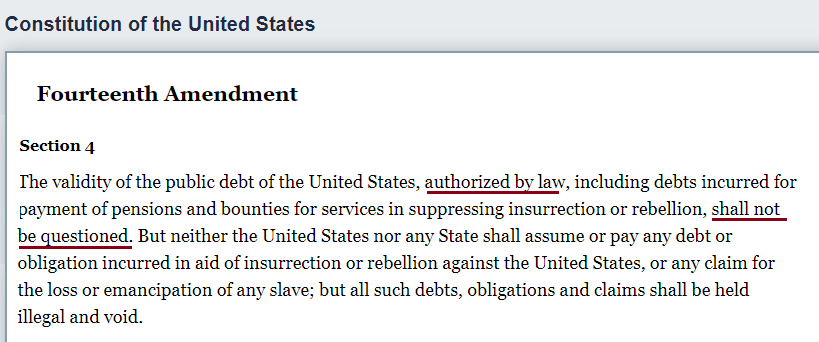
Looking at the 14th Amendment, Section 4 provides that “the validity of the public debt of the United States … shall not be questioned.” The “intent” of that was that the debt incurred by the North was to be the national debt and the Confederate States would not question having to pay those debts. But it continued and made it clear that it would not honor any debts incurred by the Confederate States to fund their side of the war.

In order to understand what this means, we must turn to Statutory Construction which begins by FIRST looking at the plain language of the Amendment to determine its original intent. We must look at the words to determine the original intent and apply their usual and ordinary meanings. If after looking at the language and the meaning remains unclear, then we must attempt to ascertain what was the intent of the legislature by looking at legislative history and other related sources. Normally, a court must not create an interpretation that would create an absurd result that would be counter to the original Legislature’s intent.

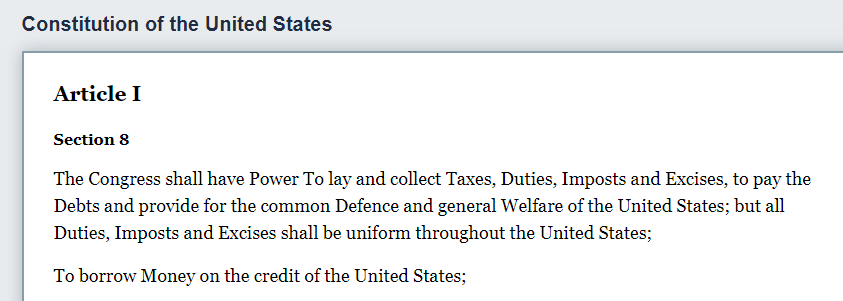
Epps claims that “Shall not be questioned” doesn’t mean “shall be paid most of the time unless you can score political points against the other party by not paying it.” That is creating an absurd result and opening the door to the total collapse of the United States. Article I, Section 8 is pretty clear that borrowing and repaying indebtedness are congressional, not executive, powers! Article I would be nullified if the 14th Amendment granted the power to the president to spend as he wants and to pay all debts when that is expressly the power of Congress.

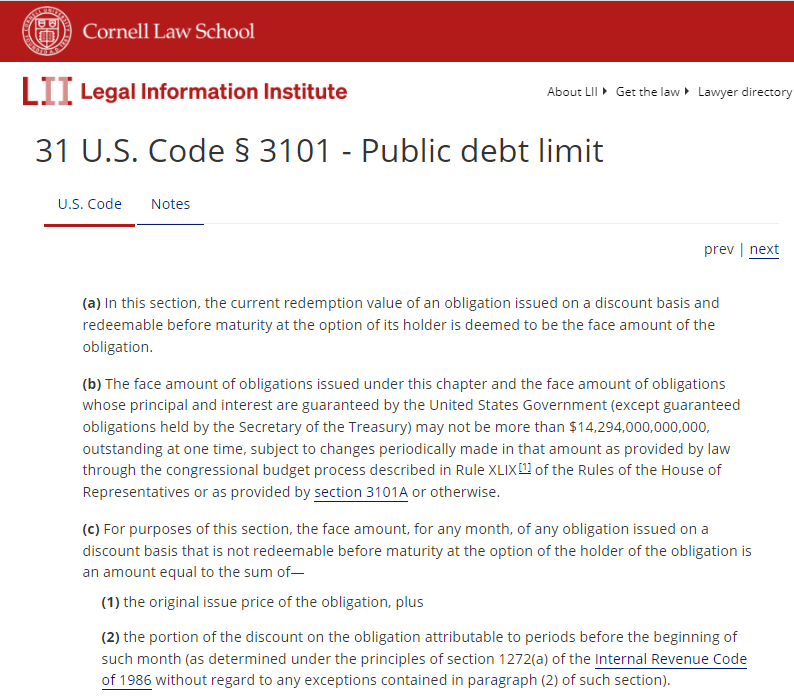
Now we turn to 31 USC §3101 which some try to claim is UNCONSTITUTIONAL and therefore there should be no debt limit. Up to now, this statute has proved to be a good tool for forcing budgetary reform aimed at debt reduction.

The statute was passed in 1982 and became law. The ORIGINAL intent was to do precisely what it has been used for. The only grounds for it to be unconstitutional is if Congress did not have the power to limit the debt. Looking at Article I, this entire argument that Biden can just pay debt and spend without the approval of Congress is the death knell to the Constitution. This is a direct assault upon the separation of powers between the President (Executive branch) and Congress. Since Article I delegates all questions of debt to Congress, I cannot rationally see where Congress lacked the power to curtail the debt when that was the original intent as well.

The ONLY person who wants those provisions to be UNCONSTITUTIONAL so they can spend whatever is left-wing and they have ZERO intention of EVER paying off the national debt. This is really a fraud on their part because you borrow with only the intent to repay the debt. Lacking that, their actions are totally UNCONSTITUTIONAL and a fraud upon the people of the United States and the world.

The Largest Landlord in the US


Armstrong Economics Blog/Real Estate Re-Posted May 10, 2023 by Martin Armstrong

Anyone familiar with the housing market conditions post-pandemic knows that cash buyers and institutions consistently outbid the average buyer. I know a realtor who has spoken primarily to consultants working on behalf of companies, and they’re willing to purchase properties over-market on a consistent basis. They know they can buy these properties and rent them out for a fraction of what they paid because they have the liquidity to do so. Currently, BlackRock is the largest landlord in America, with over $120 billion in residential real estate.

BlackRock has invested significantly in mortgage securities since the pandemic. The company insists that they are not purchasing single-family homes, meaning they’re not flipping homes to resell. “Our focus is on building single-family rental housing that can be managed and operated similar to multifamily properties with dedicated property management, leasing and amenities,” the company’s website states. “Additionally, BlackRock invests in multifamily properties, apartment complexes, and other residential real estate.”

The goal is to own as much land as possible so that the people can become perpetual renters. BlackRock also is part of the World Economic Forum and promises “sustainability” and “ESG integration,” and is a member of GRESB (formerly the Global Real Estate Sustainability Benchmark). GRESB is the global standard for providing and acquiring real estate and infrastructure in a sustainable way.

BlackRock noted that “displacement” from the pandemic and other economic downturns will provide a great investment opportunity. “In the near-term, we expect dislocation and opportunity, yet there is greater dispersion between markets and sectors with logistics of storage, high-quality residential, and data centers having emerged as clear winners, while hotel, retail, and student housing will likely face a longer road to recovery.” They’ve been on top of the downturn in real estate since the beginning. This is not limited to the US as they have investments and branches worldwide.

BlackRock is one of many institutions purchasing land and real estate at a rapid pace. Invitation Homes, a BlackRock investor, owns over 80,000 single-family rentals in the US alone. Again, the goal is to profit off of rental income. This is another reason inventory is at a historic low and will remain tight since most institutions do not plan to sell the real estate they have acquired.

US City to Roll Out Guaranteed Basic Income


Armstrong Economics Blog/USA Current Events Re-Posted May 10, 2023 by Martin Armstrong

The “Rise Up Cambridge: Cash Payments for Families with Kids” will provide low-income households with a monthly check for $500 to test guaranteed basic income. Those eligible are families with children who earn under 250% of the federal poverty level ($75K for a family of four). The 18-month program will not be based on a lottery like other guaranteed basic income rollouts, and anyone eligible may apply. The city has allotted $22 million for the initiative and expects around 2,000 families to apply.

The money to fund the program will primarily come from the American Rescue Plan, distributing our Federal tax dollars to others, and some independent donors will pitch in too. This program is only eligible for people with children under 21 and will not make a noticeable dent in the homeless population, nor will it help the elderly who live alone. That said, families with children already receive the most in Federal funds and if they’re living in high-cost Cambridge, chances are they’re receiving income elsewhere. The cost of living in Cambridge is 73% higher than the national average. The median rental price is around $4,277 per month, and the median home price is over $1.4 million.

“We want to stabilize as many households as possible and make sure that they have a chance to continue to stay in our city that, you know, is not easy to stay in,” Cambridge Mayor Sumbul Siddiqui stated. A $500 payment in a high-cost city will never financially stabilize families. Instead, it will increase inflation and bypasses the middle class. Unlike traditional welfare programs, those eligible will receive direct deposit payments that they may spend as they see fit.

The American Rescue plan was not marketed as a guaranteed basic income initiative. Siddiqui is buying votes with Federal funds. The city is pricing out the middle class by providing handouts to those who cannot afford to live in an expensive city. Free money becomes like a drug and the people become hooked on receiving that monthly direct deposit. But, as with all drug, they will become dependent and will need more and more as the cost of living increases. This will only incentivize people to not work and vote for politicians who promise handouts at the expense of responsible taxpayers.

Powell on Bank Acquisitions


Armstrong Economics Blog/Banking Crisis Re-Posted May 9, 2023 by Martin Armstrong

After the FOMC decision, Jerome Powell stated during his Q&A that the Federal Reserve does not have a plan to consolidate banks. “I personally felt that having small, medium, and large were a great part of our banking system,” Powell stated, noting that they all serve different customers. Powell said it could have been a good outcome had one of the regional banks bought failed First Republic instead of JPMorgan Chase. However, the chairman noted that the FDIC mandates that banks be acquired using the least costly resolution option.

The FDIC says it does not give preference to bidders. How can a bank qualify? According to the FDIC website: “Bid lists are created for each acquisition opportunity based on potential acquirer’s qualifications and interests and characteristics of the failing bank such as capital ratios, regulatory ratings, assets and core deposits as reported on the most recent Call Report and geographic location of the bank. Each bid list is developed using several criteria sets to identify approved potential bidders for an acquisition opportunity, while considering factors that match likely approved bidders to an acquisition opportunity.”

Due to the recent banking failures, the FDIC has also created guidelines specifically for failed bank acquisitions:

“The FDIC markets troubled institutions to healthy insured depository institutions. The FDIC is statutorily required to resolve failed institutions using the least costly resolution option minimizing losses to the Deposit Insurance Fund. The FDIC's primary objective is to maintain financial system stability and public confidence. Returning assets to the private sector in an orderly manner at the best price is another key objective. The FDIC also tries to reduce the impact on the community.

Recapitalization before failure is the preferred method to resolve open troubled financial institutions. FDIC markets institutions in case a failing institution is not able to resolve its issues on its own. If an insured depository institution is unable to resolve its issues, the FDIC will implement its resolution process by which qualified bidders may seek to acquire the assets and assume the liabilities of the failing institution.”

Obviously, smaller banks will not have the ability to compete. All banks are struggling with liquidity issues, and mid-sized institutions will likely be unable to offer the “least costly resolution option.” Ideally, they want failing banks to be attained prior to failure, and only large institutions can provide that cushion. Nothing in the FDIC guidelines at the time of this writing currently limits what a large institution could acquire. The computer states that we will see more banking failures across the globe. Based on these guidelines in the US, it is reasonable to assume that large banks like JPMorgan Chase will benefit from future acquisitions and continue to grow. It is unclear whether banking monopolies are permitted under the 1890 Sherman Antitrust Act, but it remains to be seen what alternatives the system will have as more banks go under.

CBDC – The Real Target


Armstrong Economics Blog/Central Banks Re-Posted May 8, 2023 by Martin Armstrong

A lot of people somehow think that the move to Digital Currency is a completely new monetary system, It is targeted to eliminate cash transactions so everything is taxable and nothing can be hidden from our overlords. If we look at commerce in the United States during 2022, 82% of all transactions were digital – Debit cards (20 percent), credit cards (30 percent), and digital wallets 32 percent. That was e-commerce.

They are hunting down what they believe is 30% of all commerce and cash and lick their lips at the thought of having their hand in your pocket. Make no mistake about it. They know major upheaval threatens their power. Like Trudeau seizing accounts of anyone who donated to the Truckers, that is the agenda. Control all transactions and turn off anyone who they see as a threat.