“The Biggest Show Of Force Since World War II”: Japan To Send Its Largest Warship To South China Sea


Tyler Durden's picture

The tension over the disputed territory in the South China Sea is about to escalate to another level: according to a Reuters report, Japan is preparing to to dispatch its largest warship on a three-month tour through the South China Sea beginning in May, in “its biggest show of naval force in the region since World War Two.”

Japan Maritime Self Defense Force’s helicopter carrier Izumo

The 249 meter-long (816.93 ft) Izumo is as large as Japan’s World War Two-era carriers and can operate up to nine helicopters. It resembles the amphibious assault carriers used by U.S. Marines, but lacks their well deck for launching landing craft and other vessels.

While China claims almost all the disputed waters despite the regular complaints of other nations in the region, and its growing military presence has fueled concern in Japan and the West, with the United States holding regular air and naval patrols to ensure freedom of navigation, so far Japan’s territorial claims have involved the Senkaku island chain in the East China Sea; that however appears to be changing as Japan seeks to stake a military presence in the contested region.

The Izumo helicopter carrier, commissioned only two years ago, will make stops in Singapore, Indonesia, the Philippines and Sri Lanka before joining the Malabar joint naval exercise with Indian and U.S. naval vessels in the Indian Ocean in July, before returning to Japan in August.

Why create another point of Chinese antagonism over the region? “The aim is to test the capability of the Izumo by sending it out on an extended mission,” said one of the sources who have knowledge of the plan. “It will train with the U.S. Navy in the South China Sea,” he added, asking not to be identified because he is not authorized to talk to the media. A spokesman for Japan’s Maritime Self Defense Force declined to comment.

  Taiwan, Malaysia, Vietnam, the Philippines and Brunei also claim parts of the sea which has rich fishing grounds, oil and gas deposits and through which around $5 trillion of global sea-borne trade passes each year. Japan does not have any claim to the waters, but has a separate maritime dispute with China in the East China Sea.

 Japan wants to invite Philippine President Rodrigo Duterte, who has pushed ties with China in recent months as he has criticized the old alliance with the United States, to visit the Izumo when it visits Subic Bay, about 100 km (62 miles) west of Manila, another of the sources said. Asked during a news conference about his view on the warship visit, Duterte said, without elaborating, “I have invited all of them.”

He added: “It is international passage, the South China Sea is not our territory, but it is part of our entitlement.” On whether he would visit the warship at Subic Bay, Duterte said: “If I have time.”

Japan’s unexpected flag-flying operation comes as the United States is conflicted between taking a tougher line with China and making concessions ahead of Xi’s visit to Trump next month. Washington has criticized China’s construction of man-made islands and a build-up of military facilities that it worries could be used to restrict free movement. Beijing responded in January said it had “irrefutable” sovereignty over the disputed islands after the White House vowed to defend “international territories”.

As Reuters notes, Japan in recent years, particularly under Prime Minister Shinzo Abe, has been stretching the limits of its post-war, pacifist constitution and has been making aggressive pushes for a return to militarism. It has designated the Izumo as a destroyer because the constitution forbids the acquisition of offensive weapons. The vessel, nonetheless, allows Japan to project military power well beyond its territory. Based in Yokosuka, near to Tokyo, which is also home to the U.S. Seventh Fleet’s carrier, the Ronald Reagan, the Izumo’s primary mission is anti-submarine warfare.
Sturgeon To Give May An “Ultimatum” As UK Preapres For Critical Vote Ahead Of Article 50


Tyler Durden's picture

Britain’s minister for leaving the European Union, David Davis, urged lawmakers not to hold back PM Theresa May’s ability to negotiate a Brexit deal in talks she could trigger as early as this week. Davis on Sunday called on lawmakers to vote to drop two amendments that were added to a bill authorizing the talks with the bloc’s other member states, saying May should be able to enter with no strings attached the WSJ reported.

On Monday the Brexit bill returns to the House of Commons, the U.K.’s lower house, for debate after the House of Lords said it wanted guarantees that EU citizens living in the U.K. could stay after Brexit and that Parliament could vote on the final terms. The final bill must be approved by both houses. Should the bill pass Monday, the government could invoke Article 50 as early as Tuesday according to weekend press reports, but negotiations in Parliament could last several days. The Brexit spokesman for the main opposition Labour Party, Keir Starmer, told Sky News he expects the government to trigger it on Wednesday or Thursday.

Even if the House of Commons votes in favor of the amendments, May is expected to keep her timetable of triggering by the end of the month. But it would underline how small her majority is in the lower house. Complicating matters is a tweet moments ago by BBG political editor Laura Kuenssberg, who reported that Scotland’s Nicola Sturgeon will give May an ultimatum: give Scotland a different Brexit deal or she’ll call for section 30, the indyref process.

On the topic of Brexit, Reuters reported on Sunday that David Davis is also drawing up “contingency plans” for Britain in the unlikely event it has to walk away from divorce talks with the European Union without a deal. Ahead of the start of Article 50 negotiations, which could be triggered as early as Tuesday, a committee of lawmakers warned it would be a serious dereliction of duty if the government failed to plan for the possibility of not reaching an exit deal. “I don’t think, firstly, that is remotely likely,” Davis told the BBC’s Andrew Marr Show, responding to the report. “It’s in absolutely everybody’s interest that we get a good outcome.”

Parliament’s Foreign Affairs committee warned that a breakdown in negotiations would be a “very destructive outcome,” causing economic harm to both sides as well as creating uncertainty and legal confusion for individuals and businesses.

 “The simple truth is we have been planning for the contingency – all the various outcomes, all the possible outcomes of the negotiations,” Davis said. “One of the reasons we don’t talk about the contingency plan too much is that we don’t want people to think ‘Oh, this is what we’re trying to do.'”

Asked when May would trigger talks, Davis declined to name a specific date. “Each date has different implications in terms of when it could be responded to by the (European) council … I’m not going to get into the details why, but there’s politics in terms of achieving success.”

Finally, for a frank, “on the ground” take on the current state of Brexit, here is an excerpt from Bill Blain’s latest Morning Porridge edition:

Turkish Riots In The Netherlands | Erdogan Threatens Europe!


Geert Wilders Has a Message for Turkey…


Source: Geert Wilders Has a Message for Turkey…

Why Canada will come to regret its embrace of refugees


Seems like a good deal… lol

Turkey Vows “Harsh Retaliation” After Dutch PM Says “Not Apologizing, Are You Nuts”


Tyler Durden's picture

The diplomatic scandal between Turkey and the Netherlands deteriorated overnight, when Prime Minister Binali Yildirim warned on Sunday that Turkey would retaliate in the “harshest ways” after Turkish ministers were barred from speaking in Rotterdam, leading to a major protest in front of the Turkish consulate in Rotterdam, while the Dutch embassy in Istanbul was closed off due to “safety concerns.”

“This situation has been protested in the strongest manner by our side, and it has been conveyed to Dutch authorities that there will be retaliation in the harshest ways … We will respond in kind to this unacceptable behavior,” Yildirim said in a statement.


Turkey’s Prime Minister Binali Yildirim

At the same time, continuing his ongoing tirade in which he has compared virtually all of his political foes to Hitler or Nazis, president Tayyip Erdogan said “Nazism is still widespread in the West” after the Netherlands joined other European countries worried about political tensions inside Turkey spilling beyond its borders that have prevented Turkish politicians from holding rallies.

As reported on Saturday, the Dutch government first barred Turkish Foreign Minister Mevlut Cavusoglu from flying to Rotterdam and later stopped Family Minister Fatma Betul Sayan Kaya from entering the Turkish consulate in the port city, before escorting her out of the country to Germany.

Dutch police used dogs and water cannon early on Sunday to disperse hundreds of protesters waving Turkish flags outside the consulate in Rotterdam. Some threw bottles and stones and several demonstrators were beaten by police with batons, a Reuters witness said. Meanwhile, Dutch officers carried out charges on horseback.

Protesters also gathered outside the Dutch embassy in Ankara and consulate in Istanbul, throwing eggs and stones at the buildings.

The Dutch government, which is set to lose about half its seats in elections this week as the anti-Islam party of Geert Wilders makes strong gains, said the ministers’ visits were undesirable and it would not cooperate in their political campaigning in the Netherlands.

Erdogan warned the Netherlands that “if you can sacrifice Turkish-Dutch relations for an election on Wednesday, you will pay the price,” during an awards ceremony in Istanbul. “I thought Nazism was dead, but I was wrong. Nazism is still widespread in the West,” he said. “The West has shown its true face.” Speaking to reporters before a public appearance in the northeastern French city of Metz, Cavusoglu said Turkey would continue to act against the Netherlands until it apologizes.

Meanwhile, Dutch Prime Minister Mark Rutte said he would do everything to “de-escalate” the confrontation, which he described as the worst the Netherlands had experienced in years. But he said the idea of apologizing was “bizarre”.

“This is a man who yesterday made us out for fascists and a country of Nazis. I’m going to de-escalate, but not by offering apologies. Are you nuts?” he told a morning talk show.

Supporting Rutte’s decision to ban the visits, the Dutch government said there was a risk of Turkish political divisions flowing over into its own Turkish minority, which has both pro- and anti-Erdogan camps. It cited public order and security worries in withdrawing landing rights for Cavusoglu’s flight.

Turkey fired back saying the Dutch ambassador to Ankara should not return from leave “for some time”. Erdogan is looking to the large number of Turks living in Europe, especially in Germany and the Netherlands, to help secure victory next month in a referendum that would give the presidency sweeping new powers.

Concerns about Turkey’s erratic diplomacy spread to Germany where Chancellor Angela Merkel said she will do all she can to prevent Turkey’s domestic tensions spreading onto German territory. Austria and Switzerland have also canceled Turkish rallies due to the escalating dispute. A senior member of her conservative bloc in parliament, Hans Michelbach, demanded on Sunday that the EU stop aid to Turkey and ruled out any hopes that it would join the EU. “There is no prospect of entry in the long run. Turkey is getting further and further away from the European Union. Support programs (that it gets as an EU candidate) are therefore a waste of taxpayers’ money,” he said in a statement.

In what may have been the harshest recent diplomatic takedown of Turkey, Michelbach said that “it is time that the EU stops performing like a diplomatic paper tiger towards Ankara. Europe must not be led by the nose round the Turkish election arena.” Needless to say, such a move would delight Putin as the Kremlin has been aggressively courting Erdogan and Turkey as Russia seeks to make headway with its new middle-eastern Axis which also includes Syria and hopes to add Iran.

In the near-term, however, the outstanding question is how will Saturday’s events impact Wednesday’s Dutch general election, and whether the diplomatic clash will boost votes for Geert Wilders. As Reuters notes, “the diplomatic row comes in the run-up to the coming week’s Dutch election in which the mainstream parties are under strong pressure from the far-right party of Geert Wilders.”

After Kaya, the Turkish family minister, was escorted out of the country, Wilders told her on Twitter “go away and never come back”.

Erdogan’s spokesman responded by saying the Netherlands had bowed to anti-Islam sentiment.

“Shame on the Dutch government for succumbing to anti-Islam racists and fascists, and damaging long-standing Turkey-NL relations,” presidential spokesman Ibrahim Kalin wrote on Twitter.

In a sign the row could spread further, the owner of a venue in Sweden where a senior official from Turkey’s ruling party had been due to hold a rally on Sunday canceled the rental contract, Turkey’s private Dogan news agency reported. The news agency said the owner had not given a reason for their decision. Cavusoglu also decided against traveling to Zurich, Switzerland, for an event on Sunday after failing to find a suitable venue. Zurich’s security authorities had unsuccessfully lobbied the federal government in Bern to ban Cavusoglu’s appearance.

Global Leaders Rattle Their Sabers As The World Marches Toward War


Tyler Durden's picture

Authored by Michael Snyder via The Economic Collapse blog,

Iran just conducted another provocative missile test, more U.S. troops are being sent to the Middle East, it was just announced that the U.S. military will be sending B-1 and B-52 bombers to South Korea in response to North Korea firing four missiles into the seas near Japan, and China is absolutely livid that a U.S. carrier group just sailed through contested waters in the South China Sea.  We have entered a season where leaders all over the globe feel a need to rattle their sabers, and many fear that this could be leading us to war.  In particular, Donald Trump is going to be under the microscope in the days ahead as other world leaders test his resolve.  Will Trump be able to show that he is tough without going over the edge and starting an actual conflict?

The Iranians made global headlines on Thursday when they conducted yet another ballistic missile test despite being warned by Trump on numerous occasions…

As tensions between the U.S. and Iran continue to mount, the semi-official news agency Tasnim is reporting that Iran’s Revolutionary Guard has successfully conducted yet another ballistic missile test, this time from a navy vessel.  Called the Hormuz 2, these latest missiles are designed to destroy moving targets at sea at ranges up to 300 km (180 miles).

Reports on the latest test quotes Amir Ali Hajizadeh, commander of the IRGC’s Aerospace Force, who confirmed that “the naval ballistic missile called Hormuz 2 successfully destroyed a target which was 250 km away.”

The missile test is the latest event in a long-running rivalry between Iran and the United States in and around the Strait of Hormuz, which guards the entrance to the Gulf. About 20% of the world’s oil passes through the waterway, which is less than 40 km wide at its narrowest point.

So how will Trump respond to this provocation?

Will he escalate the situation?  If he does nothing he will look weak, but if he goes too far he could risk open conflict.

Elsewhere in the Middle East, things are already escalating.  It is being reported that “several hundred Marines” are on the ground in Syria to support an assault on the city of Raqqa, and another 1,000 troops could be sent to Kuwait to join the fight against ISIS any day now.  The following comes from Zero Hedge

While the Trump administration waits to decide if it will send 1,000 troops to Kuwait to fight ISIS, overnight the Washington Post reported that the US has sent several hundred Marines to Syria to support an allied local force aiming to capture the Islamic State stronghold of Raqqa. Defence officials said they would establish an outpost from which they could fire artillery at IS positions some 32km (20 miles) away. US special forces are already on the ground, “advising” the Kurdish-led Syrian Democratic Forces (SDF) alliance according to the BBC.

The defence officials told the Washington Post that the Marines were from the San Diego-based 11th Marine Expeditionary Unit, and that they had flown to northern Syria via Djibouti and Kuwait. They are to set up an artillery battery that could fire powerful 155mm shells from M777 howitzers, the officials said. Another marine expeditionary unit carried out a similar mission at the start of the Iraqi government’s operation to recapture the city of Mosul from IS last year.

Meanwhile, China is spitting mad for several reasons.  For one, the Chinese are absolutely furious that South Korea has allowed the U.S. to deploy the THAAD missile defense system on their soil…

China is lashing out at South Korea and Washington for the deployment of a powerful missile defense system known as the Terminal High Altitude Area Defense system, or THAAD, deposited at the Osan Air Base in South Korea on Monday evening.

The deployment of THAAD follows several ballistic missile tests by North Korea in recent months, including the launch of four missiles on Monday, three of which landed in the sea off the coast of Japan. Though THAAD would help South Korea protect itself from a North Korean missile attack, China is vocally protesting the deployment of the system, claiming it upsets the “strategic equilibrium” in the region because its radar will allow the United States to detect and track missiles launched from China.

Of course the U.S. needed to do something, because the North Koreans keep rattling their sabers by firing off more ballistic missiles toward Japan.

But it is one thing to deploy a missile defense system, and it is another thing entirely to fly strategic nuclear bombers into the region.

So if the Chinese were upset when THAAD was deployed, how will they feel when B-1 and B-52 bombers start showing up in South Korea?

Earlier this week, trigger-happy Kim pushed his luck once more when he fired off four ballistic missiles into the seas near Japan.

Now US military chiefs are reportedly planning to fly in B-1 and B-52 bombers – built to carry nuclear bombs – to show America has had enough.

South Korea and the US have also started their annual Foal Eagle military exercise sending a strong warning to North Korea over its actions.

A military official said 300,000 South Korean troops and 15,000 US personnel are taking part in the operation.

The Trump administration has openly stated that all options “are on the table” when it comes to North Korea, and that includes a military strike.

It has been more than 60 years since the Korean War ended, but many are concerned that we may be closer to a new Korean War than we have been at any point since that time.

And of course our relationship with China is tumbling precariously downhill as well.  Another reason why the Chinese are extremely upset with the Trump administration is because a U.S. Navy carrier battle group led by the USS Carl Vinson sailed past islands that China claims in the South China Sea just a few weeks ago.

In China, the media openly talks about the possibility of war with the United States over the South China Sea.  Most Americans are not even aware that the South China Sea is a very serious international issue, but over in China this is a major focus.

And the U.S. military has recently made several other moves in the region that have angered the Chinese

Also in February, the U.S. sent a dozen F-22 Raptor stealth fighters to Tindal AB in northern Australia, the closest Australian military airbase to China, for coalition training and exercises. It’s the first deployment of that many F-22s in the Pacific.

And if that didn’t get the attention of the Chinese government, the U.S. just tested four Trident II submarine-launched ballistic missiles during a nuclear war exercise, sending the simulated weapons 4,200 miles from the coast of California into the mid-Pacific. It’s the first time in three years the U.S. has conducted tests in the Pacific, and the first four-missile salvo since the end of the Cold War.

I can understand the need to look tough, but eventually somebody is going to go too far.

If you are familiar with my work, then you know that I believe that war is coming.  Things in the Middle East continue to escalate, and it is only a matter of time before a great war erupts between Israel and her neighbors.  Meanwhile, U.S. relations with both Russia and China continue to deteriorate, and this is something that I have been warning about for a very long time.

We should hope for peace, but we should also not be blind to the signs of war that are starting to emerge all over the planet.  Relatively few people anticipated the outbreak of World War I and World War II in advance, and I have a feeling that the same thing will be true for World War III.

Turkish Islamists Riot in Rotterdam Holland After Turkish Minister Refused Entry…


Source: Turkish Islamists Riot in Rotterdam Holland After Turkish Minister Refused Entry…

So what is the big deal this is what Muslims always do if you let them in your country in large numbers.

Turkish Islamists Riot in Rotterdam Holland After Turkish Minister Refused Entry…


Source: Turkish Islamists Riot in Rotterdam Holland After Turkish Minister Refused Entry…

European Parliament Censors Its Own Free Speech


Tyler Durden's picture

Authored by Judith Bergmann via The Gatestone Institute,

  • The rule strikes at the very center of free speech, namely that of elected politicians, which the European Court of Human Rights has deemed in its practice to be specially protected. Members of the European Parliament are people who have been elected to make the voices of their constituents heard inside the institutions of the European Union.
  • The rule can only have a chilling effect on free speech in the European Parliament, and will likely prove a convenient tool in trying to shut up those parliamentarians who do not follow the politically correct narrative of the EU.
  • By lifting Le Pen’s immunity while she is running for president of France, the European Parliament is sending the clear signal that publicizing the graphic and horrifying truth of the crimes of ISIS, rather than being received as a warning about what might soon be coming to Europe, instead ought to be punished.
  • Where does this clearly totalitarian impulse stop and who will stop it?

The European Parliament has introduced a new procedural rule, which allows for the chair of a debate to interrupt the live broadcasting of a speaking MEP “in the case of defamatory, racist or xenophobic language or behavior by a Member”. Furthermore, the President of the European Parliament may even “decide to delete from the audiovisual record of the proceedings those parts of a speech by a Member that contain defamatory, racist or xenophobic language”.

No one, however, has bothered to define what constitutes “defamatory, racist or xenophobic language or behavior”. This omission means that the chair of any debate in the European Parliament is free to decide, without any guidelines or objective criteria, whether the statements of MEPs are “defamatory, racist or xenophobic”. The penalty for offenders can apparently reach up to around 9,000 euros.

“There have been a growing number of cases of politicians saying things that are beyond the pale of normal parliamentary discussion and debate,” said British EU parliamentarian Richard Corbett, who has defended the new rule. Mr. Corbett, however, does not specify what he considers “beyond the pale”.

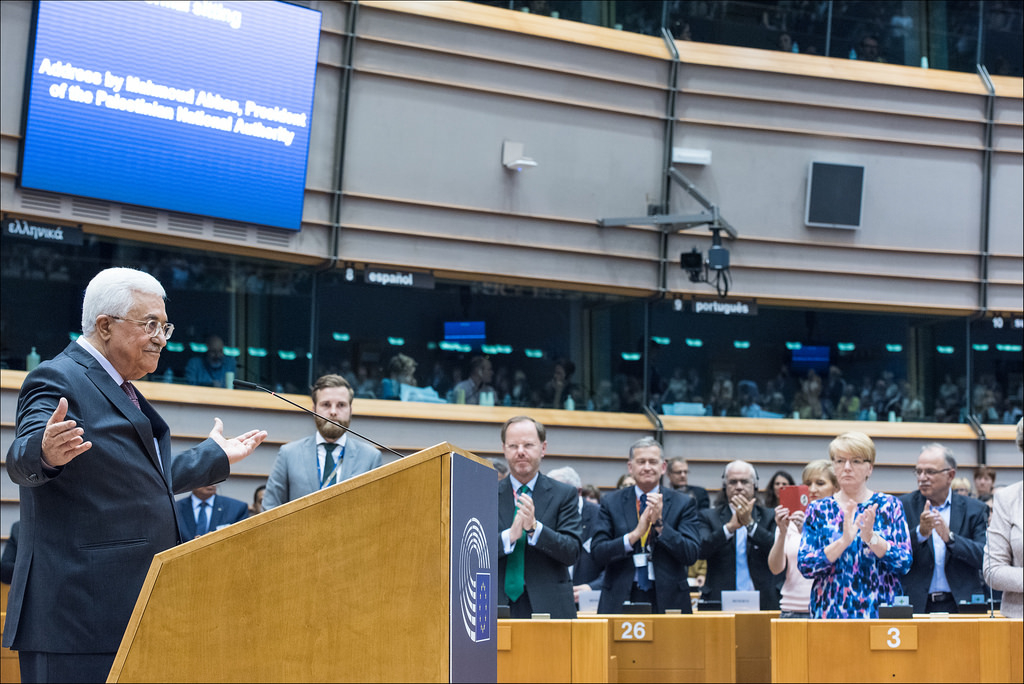
In June 2016, Mahmoud Abbas, president of the Palestinian Authority, addressed the European Parliament in a speech, which drew on old anti-Semitic blood libels, such as falsely accusing Israeli rabbis of calling on the Israeli government to poison the water used by Palestinian Arabs. Such a clearly incendiary and anti-Semitic speech was not only allowed in parliament by the sensitive and “anti-racist” parliamentarians; it received a standing ovation. Evidently, wild anti-Semitic blood libels pronounced by Arabs do not constitute “things that are beyond the pale of normal parliamentary discussion and debate”.


Palestinian Authority President Mahmoud Abbas receives a standing ovation at the European Parliament in Brussels on June 23, 2016, after falsely claiming in his speech that Israeli rabbis were calling to poison Palestinian water. Abbas later recanted and admitted that his claim had been false. (Image source: European Parliament)

The European Parliament apparently did not even bother to publicize their new procedural rule; it was only made public by Spain’s La Vanguardia newspaper. Voters were, it appears, not supposed to know that they may be cut off from listening to the live broadcasts of the parliamentarians they elected to represent them in the EU, if some chairman of a debate subjectively happened to decide that what was being said was “racist, defamatory or xenophobic”.

The European Parliament is the only popularly elected institution in the EU. Helmut Scholz, from Germany’s left-wing Die Linke party, said that EU lawmakers must be able to express their views about how Europe should work: “You can’t limit or deny this right”. Well, they can express it (but for how long?), except that now no one outside of parliament will hear it.

The rule strikes at the very center of free speech, namely that of elected politicians, which the European Court of Human Rights has deemed in its practice to be specially protected. Members of the European Parliament are people who have been elected to make the voices of their constituents heard inside the institutions of the European Union. Limiting their freedom of speech is undemocratic, worrisome and spookily Orwellian.

The rule can only have a chilling effect on freedom of speech in the European Parliament and will likely prove a convenient tool in trying to shut up those parliamentarians who do not follow the politically correct narrative of the EU.

The European Parliament lately seems to be waging war against free speech. At the beginning of March, the body lifted the parliamentary immunity of French presidential candidate Marine Le Pen. Her crime? Tweeting three images of ISIS executions in 2015. In France, “publishing violent images” constitutes a criminal offense, which can carry a penalty of three years in prison and a fine of 75,000 euros. By lifting her immunity at the same time that she is running for president of France, the European Parliament is sending the clear signal that publicizing the graphic and horrifying truth of the crimes of ISIS, rather than being received as a warning about what might soon be coming to Europe, instead ought to be punished.

This is a bizarre signal to be sending, especially to the Christian and Yazidi victims of ISIS, who are still largely ignored by the European Union. European parliamentarians, evidently, are too sensitive to deal with the graphic murders of defenseless people in the Middle East, and are more concerned with ensuring the prosecution of the messengers, such as Marine Le Pen.

So, political correctness, now effectively the “religious police” of political discourse, has not only taken over the media and academia; elected MEPs are now also supposed to toe the politically correct line, or literally be cut off. No one stopped the European Parliament from passing this undemocratic anti-free speech rule. Why did no parliamentarian out of the 751 MEPs raise red flags about the issue before it became an actual rule? Even more importantly: Where does this clearly totalitarian impulse stop and who will stop it?