Posted originally on the CTH on March 26, 2023 | Sundance
One of many things to like about Hungary is their brutal honesty when it comes to the United States meddling in their domestic affairs. {Background}
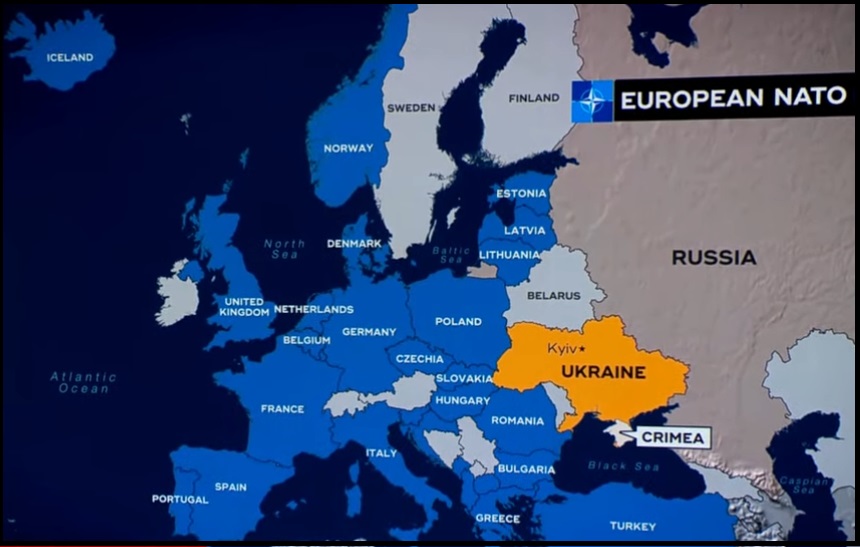
Hungarian Foreign Minister Péter Szijjártó gave an interview recently where he said it is more challenging to support the NATO objective, when the United States is so committed to overthrowing the Hungarian government. He has a good point.
(Via Associated Press) – The West’s steady criticism of Hungary on democratic and cultural issues makes the small European country’s right-wing government reluctant to offer support on practical matters, specifically NATO’s buildup against Russia, Hungary’s foreign minister said.
In an interview with The Associated Press, Hungarian Foreign Minister Péter Szijjártó also said Friday that his country has not voted on whether to allow Finland and Sweden to join NATO because Hungarian lawmakers are sick of those countries’ critiques of Hungarian domestic affairs.
Lawmakers from the governing party plan to vote Monday in favor of the Finnish request but “serious concerns were raised” about Finland and Sweden in recent months “mostly because of the very disrespectful behavior of the political elites of both countries towards Hungary,” Szijjártó said.
“You know, when Finnish and Swedish politicians question the democratic nature of our political system, that’s really unacceptable,” he said.
The timing of a vote on Sweden is harder to predict, Szijjártó said.
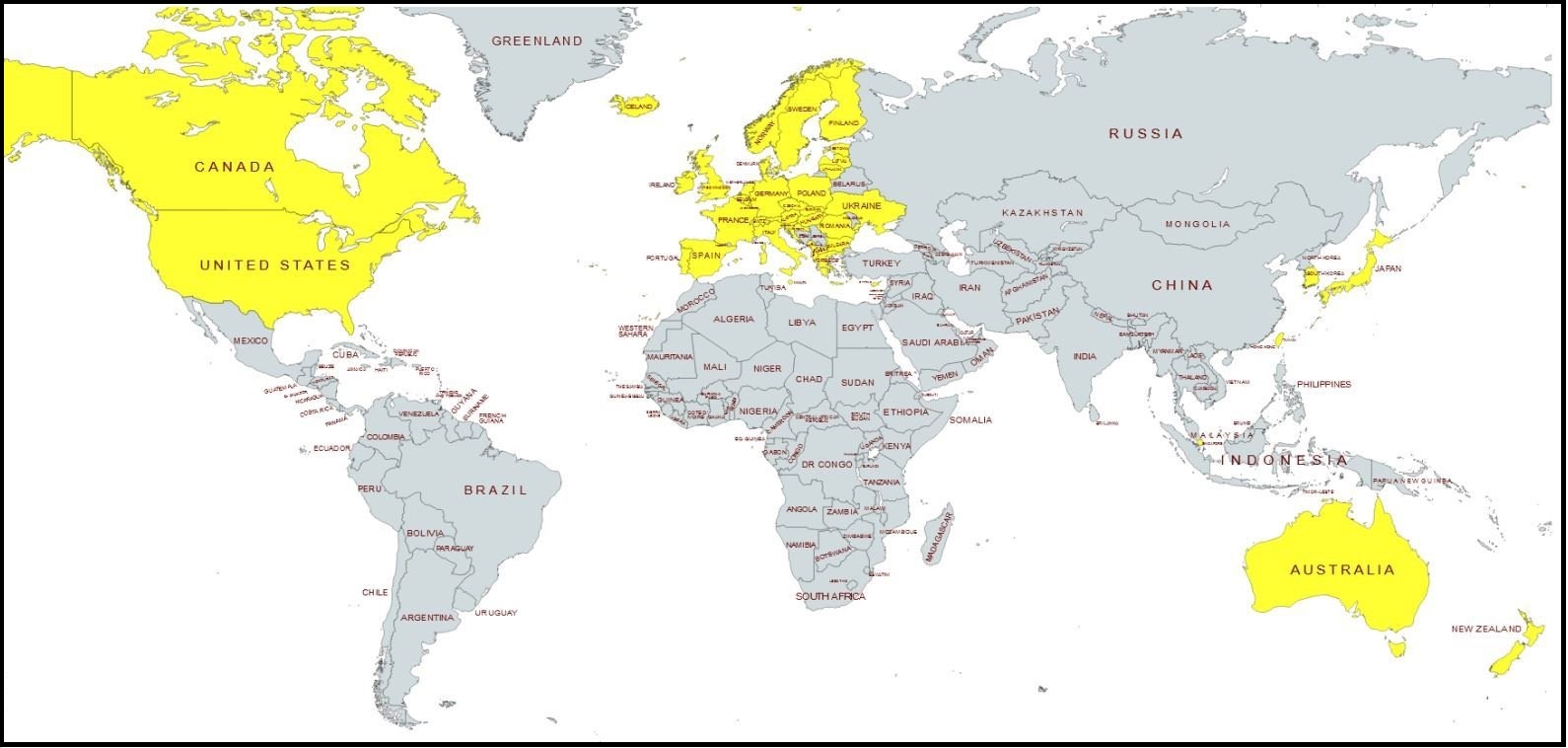
The EU, which includes 21 NATO countries, has frozen billions in funds to Budapest and accused populist Prime Minister Viktor Orban of cracking down on media freedom and LGBTQ rights. Orban’s administration has also been accused of tolerating an entrenched culture of corruption and co-opting state institutions to serve the governing Fidesz party. (read more)
Hungary has been in the crosshairs of the Biden/Obama administration ever since Prime Minister Viktor Orban refused to align with the WEF Western Democracies in their quest for regime change in Russia. As the NATO led western alliance assembled to use Ukraine as a proxy war against Russia, Hungarian Prime Minister Orban would not join.
In early April 2022, Hungarian Prime Minister Viktor Orban was overwhelmingly reelected {LINK}, despite the massive efforts against him by the European Union, western and euro-centric multinational globalists. As a result of the victory, Brussels was furious at the Hungarian people. Associated Press – […] “Orban — a fierce critic of immigration, LGBTQ rights and “EU bureaucrats” — has garnered the admiration of right-wing nationalists across Europe and North America.” (link)
Within the statements reported from his 2022 victory speech, Prime Minister Orban warned citizens of the NATO and western allied countries about the manipulation of Ukraine and how he views the Zelenskyy regime: […] “while speaking to supporters on Sunday, Orban singled out Zelenskyy as part of the “overwhelming force” that he said his party had struggled against in the election — “the left at home, the international left, the Brussels bureaucrats, the Soros empire with all its money, the international mainstream media, and in the end, even the Ukrainian president.” (link)
This put Hungarian Prime Minister Viktor Orban in the crosshairs of the western alliance, specifically the EU and U.S. bureaucrats who use their power, position and intelligence apparatus to manipulate foreign nations. A year later and now we see USAID Administrator Samantha Power in Hungary openly discussing her seeding of the NGO’s and political activist systems in order to generate yet another color revolution. {Direct Rumble Link} – WATCH:
Samantha Power, the wife of Cass Sunstein, is well known as the Obama/Biden administration’s advance operative who uses her position in U.S. government to influence activism in targeted nations. Hungary is now a target.
QUESTION: Hi. I do not understand why you keep advocating over and over how the depositors should be bailed out over 250k. It makes no sense from a moral hazard perspective. It is fact that should they do that, in spite of depositors signing agreements acknowledging that deposits over 250k would not be guaranteed, the Fed will also need to cancel all outstanding debt instruments, whose borrowers also signed an agreement that if they don’t pay they lose the asset. The moral hazard is so severe as to bloody the eyes. Why do you keep endorsing the bailout which will have to be at least initially funded by taxpayers even if they get the money back? The money to shore up bank reserves in exchange for collateral has to come from somewhere. What is the real fear, that people will move deposits direct to T-bills and in so doing, set up funding for a US CBDC? Please address the moral hazard aspect of your position. So far, I’ve heard nothing to defend the immorality of it.
FO ANSWER: Do not confuse a bank depositor with (1) an investor in a fund, or (2) bank shareholders & Management. A bank depositor is NOT an investor. The $250k is by NO MEANS sufficient for small businesses. They need to keep large amounts on hand for payroll etc. You do business and accept credit cards and they deposit that into your bank account.
Bank depositors are unsophisticated average people. The sophisticated investor moves their, money to a hedge fund or money market fund and fully understands that there is a risk associated with that investment. The bank depositor accepts no risk on any investment the bank makes. It does not give them, a piece of their profits. That goes to shareholders. It is a bailout of the entity and thus the shareholders which presents the moral hazard perspective.
If deposits in excess of $250 are NOT covered, you wipe out small businesses, they cannot pay employees and the ripple effect will be the total destruction of the entire economy. Your house will become worthless for its value will drop to only what someone can pay in cash.
There is a HUGE difference between investing and losing and simply depositing your money in a bank because we are moving to an electronic monetary system that there will be no way for a depositor to even demand money from a bank. Some are restricting wires to $3,000 and limiting the amount of cash one can withdraw. There is also not enough paper currency to facilitate bank withdrawal on a grand scale. Bank robbery will come to an end without cash.
None of that will unfold if a hedge fund fails. We must look deeper into this entire question.
QUESTION: Hello Martin, I have been reading you since your handwritten and from memory letters were getting out from your incarceration. You are truly an amazing man sir. I realize that both the Kondratieff and the Brenner cycles are mostly just coincidental to market cycles today but my question is are both the Kondratieff and the Brenner cycles still accurate for agriculture goods and the farm economy to this day? Thank you for your consideration of this question as well as for all the good you have done for mankind. Thank you. Respectfully, Mark
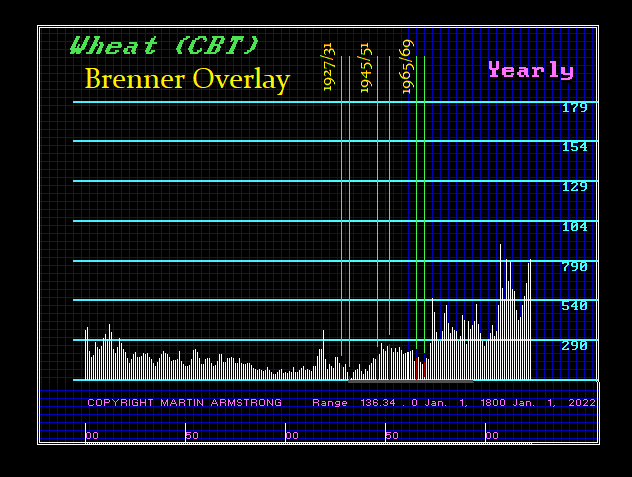
ANSWER: I think your question is very important. I have in my library Brenner’s actual publication. They are very rare, to say the least. Overlaying Brenner onto Wheat, we can see that during the 20th century, they did not work. The question then became why?
People are far too often confused when observing a market. They think that that instrument itself possesses some inherent trading character all by itself. I have often said that when I went to Economics class, the professor said there is no definable business cycle because everything is random. Then I went to Physics class and was told that nothing is random. I came to the conclusion that it was the economics professor who was wrong.
In Physics, we have two separate principles that are far too often confused as the same. The Uncertainty Principle was articulated by the German physicist Werner Heisenberg (1901-1976). It states that the position and the velocity of an object cannot both be measured exactly at the same time, even in theory. The very concepts of exact position and exact velocity together, in fact, have no meaning in nature. Effectively, if we increase the precision in measuring one quantity, we are forced to lose precision in measuring the other.
The Uncertainty Principle has been frequently confused with the Observer Effect whereby the disturbance of an observed system by the act of observation takes place as the result of utilizing instruments that alter the state of what is being measured. To put this in common terms, let’s say you take a gauge to test the tire pressure on your car. The very act of measuring the air pressure results in some air escaping. Hence, the act of observing changes the actual pressure in the tire even minutely.
This is one of the most fascinating aspects of Physics. Here is my favorite cartoon explaining an important aspect of cyclical analysis as well.
So what does this have to do with analysis in markets? What are we actually observing? The innate object be it gold, wheat, or the stock market. If a tree falls in a forest and nobody is around, does it make a sound? That all depends on your definition of a sound. If you define “sound” as requiring it to be heard by a person or animal, the answer is no. Yet is that the proper definition?
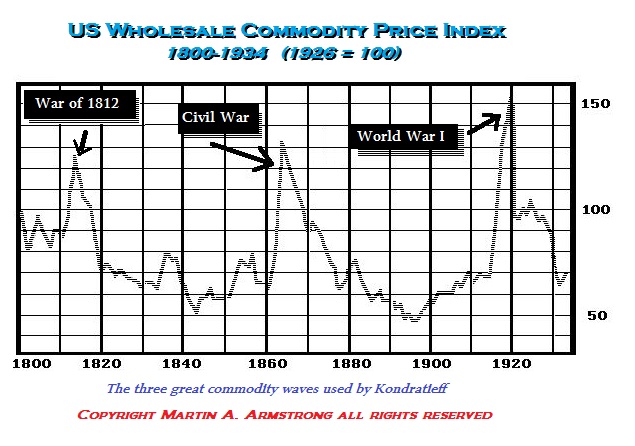
This brings us to Kondratieff and Benner waves. Were they actually measuring commodities, or were they measuring the cyclical interference of climate, war, and 70% of the GDP being confined to agriculture? We clearly have a problem with the human interpretation of an observation. We are then confined by our own prejudices formed in life. If we have NEVER read about war or experienced war, then is it possible to look at the 19th century and realize that there was an interference in the market behavior by war?
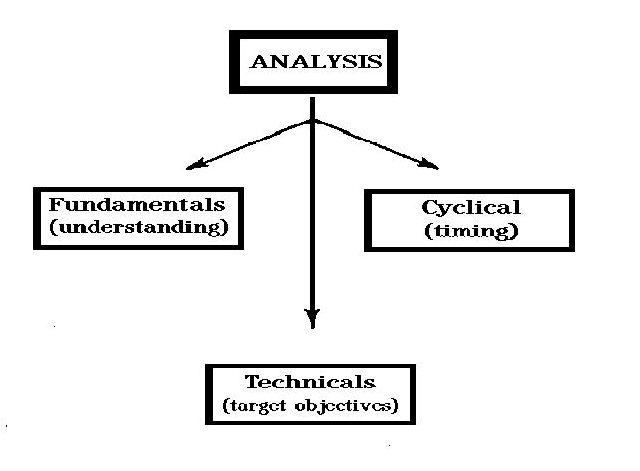
This is why fundamental analysis always fails. Claims that this is the guy who forecasts whatever based upon his opinion or fundamental analysis is simply nothing more than a broken clock is also correct twice a day. The vast array of fundamentals that are taking place simultaneously can never be sorted out by any human being. It depends upon the experience of the observer. I have often explained that people focus only domestically and often on whatever the Federal Reserve wants us to do. They do not see that in turn the Federal Reserve is influenced by international events. Thus, those who focus domestically, are blind to global trends. This is primarily why I developed Socrates for it is humanly impossible to monitor absolutely everything. No human being can do this and then it is impossible to sort out the fundamentals in advance – only hindsight. Many have ignored the fundamental approach and turned to Technical Analysis. Then the third branch is cyclical analysis focused on TIME.
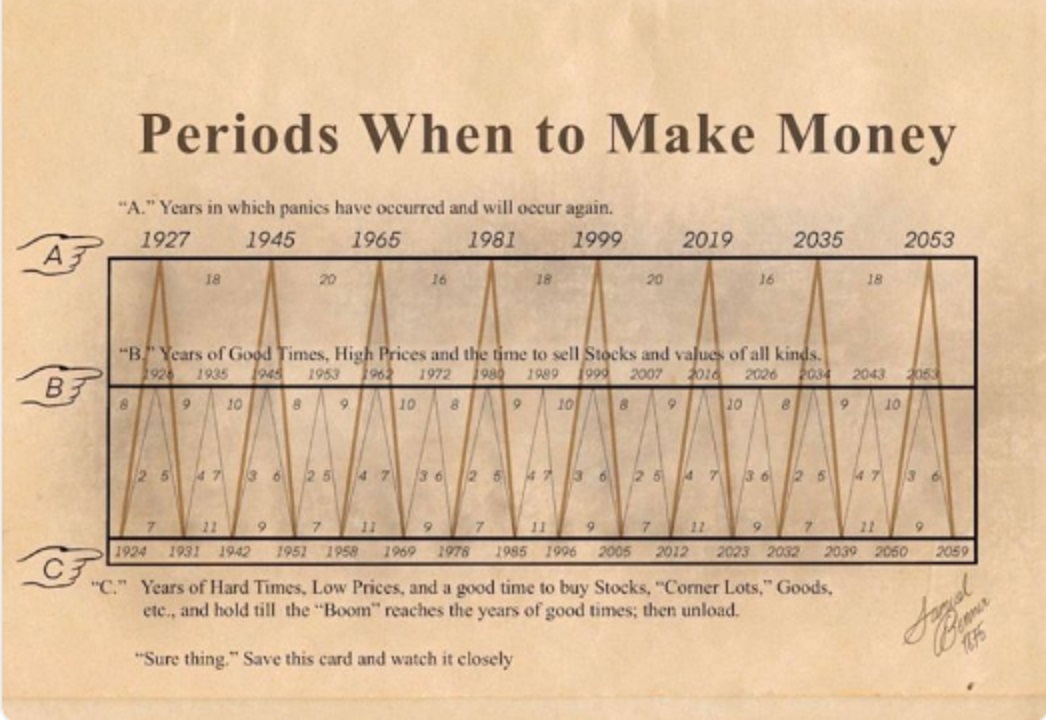
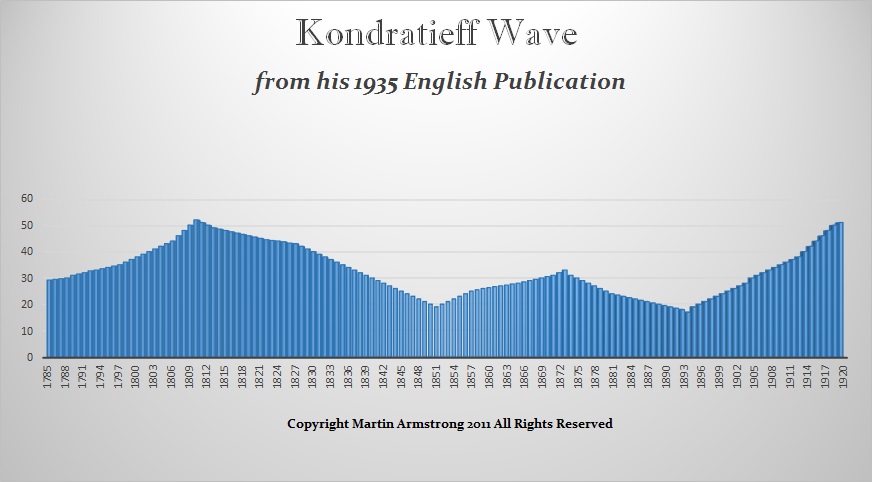
Cyclical Analysis must also incorporate physics to achieve accuracy. Otherwise, someone who then identifies some cycle of 25 units and says see, it worked 5 times in a row, will lose the house for that relationship will change. This is the question of the Kondratieff and Brenner cycles. Kondratief saw broad cyclical trends throughout history. But they were averages and he did not seek a definitive time frequency. Brenner focused on sunspots and agriculture for he was a farmer and saw the cyclical patterns unfolding before him.
However, the complexity of the market and economic behavior is much like the double-slit realization. A single particle moving through a single slit produces a linear output. But when a second slit is introduced, then cyclical waves emerge. This illustrates the complexity. Each market is like a separate particle in that cartoon. By itself with a single slit, the outcome tends to be linear as expected. But adding that second slit produces complexity and cyclical wave interference. Thus, in analysis, we must consider the entire global basket of particles to approach the cyclical waves and interference.
There are so many layers to price activity each displaying a unique frequency. This once again comes down to human interpretation and can the analyst even see the complexity. Our arrays are the best shot at accurate cyclical forecasting and there are 72 models inside that – not a simple one-time frequency of a linear cycle. It is the computer that projects the outcome, not any human interpretation. Then you have to have a database that is unprecedented to back-test the entire analysis. Without recreating the monetary system of the world, it would be impossible for the computer to forecast war, the collapse of communism, or the 1929-style even in Tokyo in 1989.
Fundamental analysis can ONLY be used to explain AFTER the fact – not to forecast the future. Consequently, the Kondratieff and Brenner cyclical waves are not accurate in trying to predict the economy or the next great crash in markets. We must respect that they observed the top layer of cyclical activity, but behind that mask was climate change coming out of the last ice age, the wave of innovation that brought the Industrial Revolution which diminished the commodity influence, and war.
It is not that their work was wrong. They were the leaders in cyclical analysis and pointed the way. It simply required more exploration to understand the complexity and wave interference from the impact of everything, everywhere. The analysis of Benner failed during the 20th century because what he was observing was the complexity of the times and one really needed to sort out each and every component that produced the wave structure during the 19th century to be able to accurately forecast the 20th century.
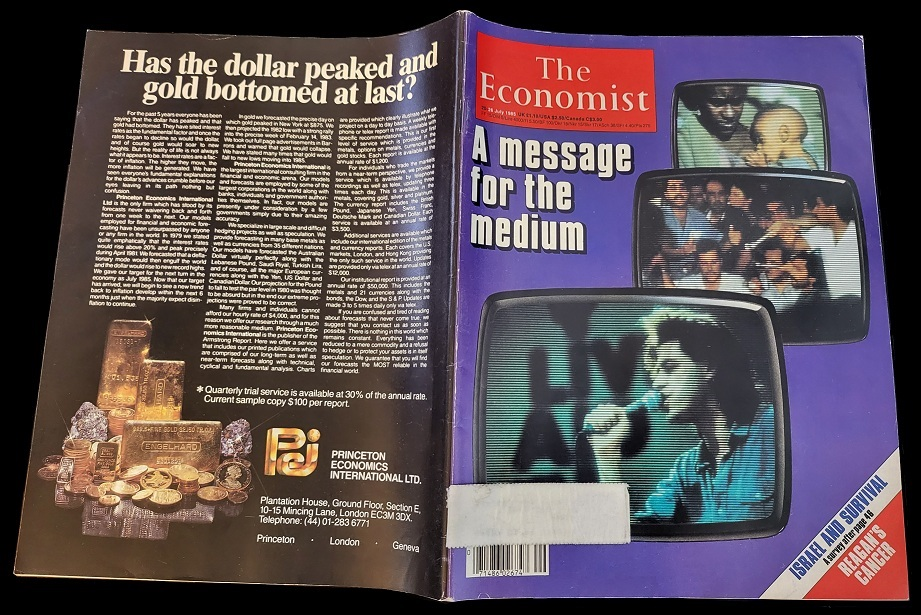
COMMENT: Marty, I began following you in 1985. That is when everyone was using the Kondratieff Wave and admitted it averaged 45 to 60 years. They were all predicting another Great Depression. You were the only one right back then as well. I remember your advertisement in the Economist saying a new Private Wave was beginning. The ECM has called every turn ever since and even to the very day.
Now the Brenner Chart is floating around all because it points to 2023. The 1999 turning point which was supposed to be the high, was not just off from the stock market and the 2000 Dot-Com Bubble, but 1999 was low in gold. The 2019 target was also off for it was 2020 which was a low.
I think both the Kondratieff and the Brenner cycles have caused more harm than good in furthering cyclical analysis. You are right. They were commodity based not economic-based.
I just wanted to share my observations because people need to understand the difference.
Jeff
REPLY: Oh yes. I remember 1985. It was high in the dollar and the British pound hit nearly par dropping from $240. Yes, we took the back cover of the Economist for 3 weeks during July 1985 to announce the start of inflation and the Private Wave. I was shocked that people held on to those advertisements and we would get letters even 2 years later.
The Kondratieff and Benner cycles were constructed during the 19th century. You cannot create a model on Wheat and then try to use it to trade Copper. Sometimes it will line up, and other times it will not.
Both Kondratieff and Brenner waves were not just based on commodities/sunspots, but they were in turn influenced by war and climate, unbeknownst to either. Kondratieff and Brenner followed agriculture/commodity prices when agriculture accounted for 70% of the GDP pre-20th century. That only began to decline from 1850 forward, dropping to 40% by 1900 as the Industrial Revolution emerged with the invention of the steam engine. Then there was climate change. The Little Ice Age bottomed in the 1600s.
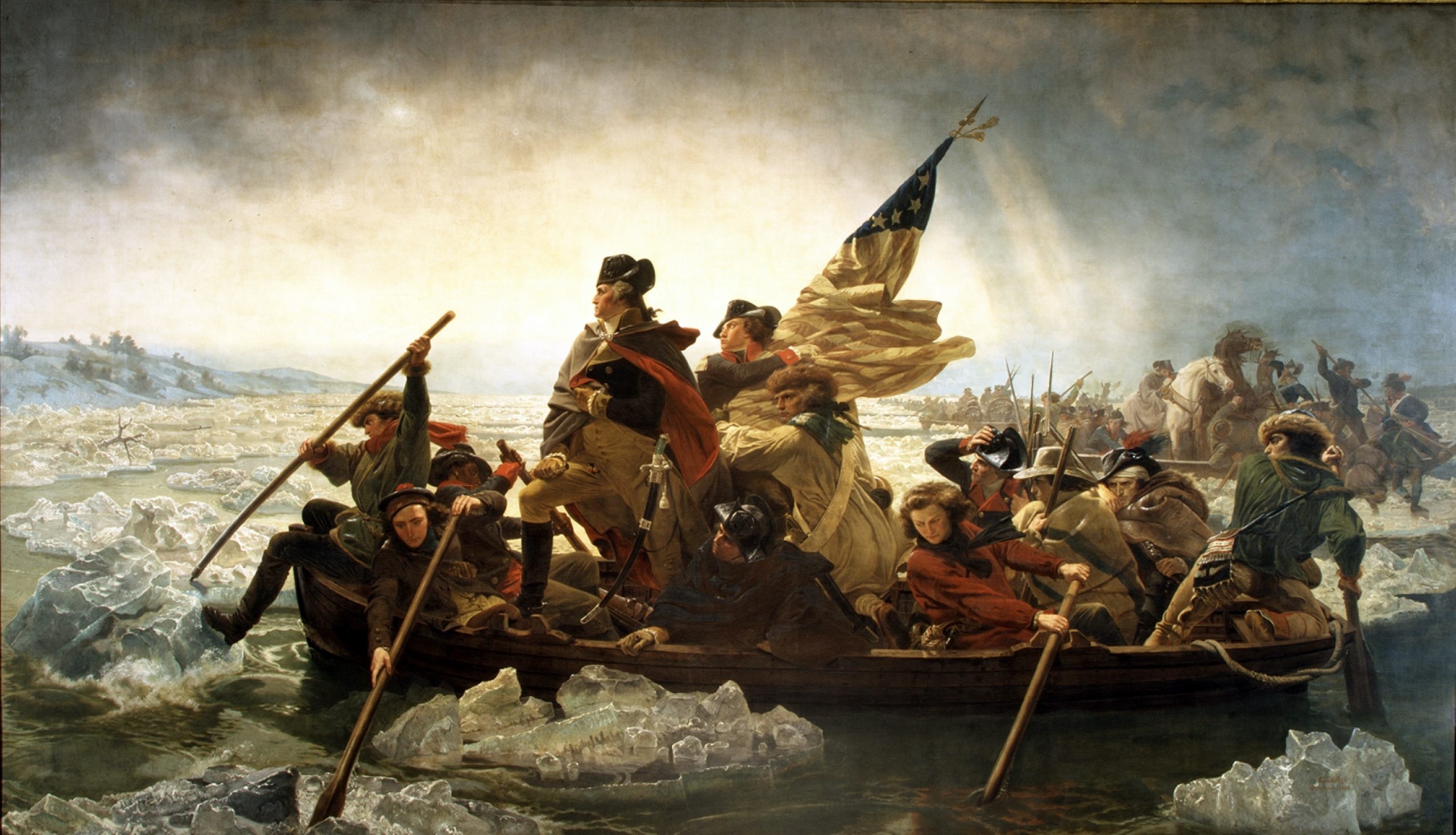
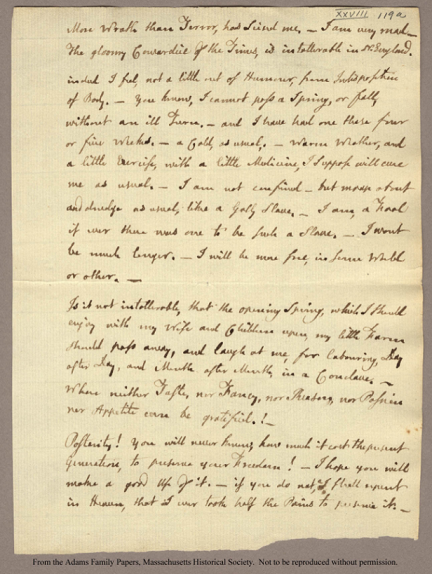
Then there was the volatility in weather that also impacted the commodity prices. This too has contributed to the inaccuracy of both waves. During the late 18th to early 19th century, it was still very cold and the ground would freeze down a couple of feet preventing winter crops. The ground froze to a depth of 2 feet according to John Adams. When John Adams set out to travel to Philadelphia, it was bitterly cold and there was a foot or more of snow that covered the landscape that had blanketed Massachusetts from one end of the province to the other. Beneath the snow, after weeks of severe cold, the ground was frozen solid to a depth of two feet. I grew up near the Delaware River. NEVER in my lifetime did I ever see the river frozen as you see in paintings of Washington crossing the Delaware River. In a letter to his wife, John Adams wrote:
“Indeed I feel not a little out of Humour, from Indisposition of Body. You know, I cannot pass a Spring, or fall, without an ill Turn — and I have had one these four or five Weeks — a Cold, as usual. Warm Weather, and a little Exercise, with a little Medicine, I suppose will cure me as usual. … Posterity! You will never know, how much it cost the present Generation, to preserve your Freedom! I hope you will make a good Use of it. If you do not, I shall repent in Heaven, that I ever took half the Pains to preserve it.”
On September 8, 1816, Jefferson described the weather in a letter to Albert Gallatin:
“We have had the most extraordinary year of drought and cold ever known in the history of America. In June, instead of 3¾ inches, our average of rain for that month, we had only 1/3 of an inch; in August, instead of 9 1/6 inches our average, we had only 8/10 of an inch; and it still continues. The summer too has been as cold as a moderate winter. In every state North of this there has been frost in every month of the year; in thisstate we had none in June and July but those of August killed much corn over the mountains. The crop of corn through the Atlantic states will probably be less than 1/3 of an ordinary one, that of tobacco still less, and of mean quality.”
Obviously, the Kondratieff and Brenner Waves did not understand the external forces. The climate was impacting the food supply, there were also wars. This is why their waves have not been consistent. If we extend the K-Wave 54 years from the commodity high in 1919, that brings us to 1973 which missed the end of Bretton Woods in 1971 by 2 years, but it was near the OPEC Oil crisis, which was imposed in retaliation for helping Israel in war. The Dow Jones Industrials peaked in January 1973 and crashed into December 1974. The Brenner wave did not bottom until 1978.
Another 54 years from there will bring us to 2027 while the Brenner Wave targeted 2019 and projects the low in 2023. Wheat peaked in March 0f 2022. So you can see if any of these targets were to actually work on time, it tends to be more of a coincidence rather than an accurate forecast. So I can see what you say that they have perhaps led some to think cyclical research is snake oil. It is so important to understand that you cannot create a model on potatoes and then use it to trade the Dow. We must understand the nature of markets to comprehend what we are really looking at in the first place.
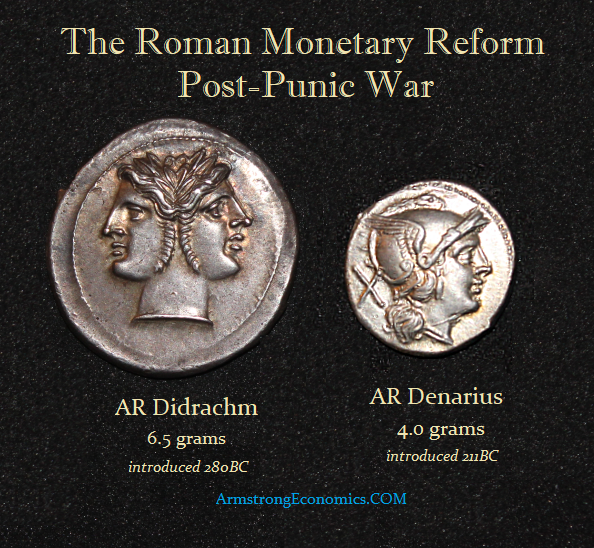
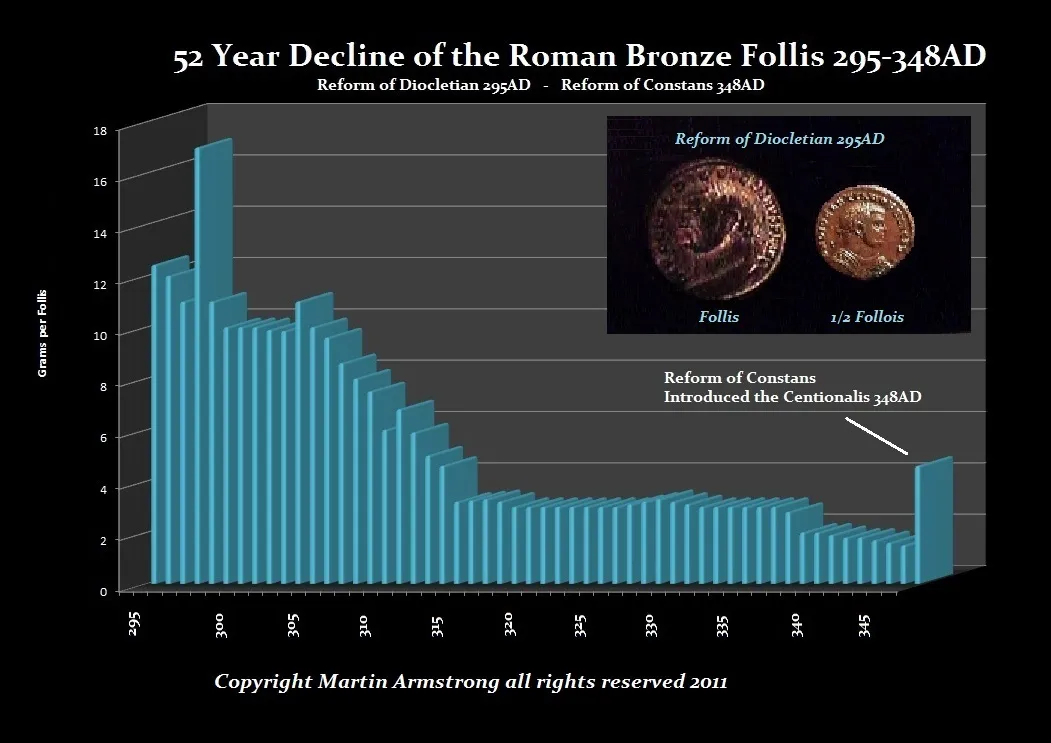
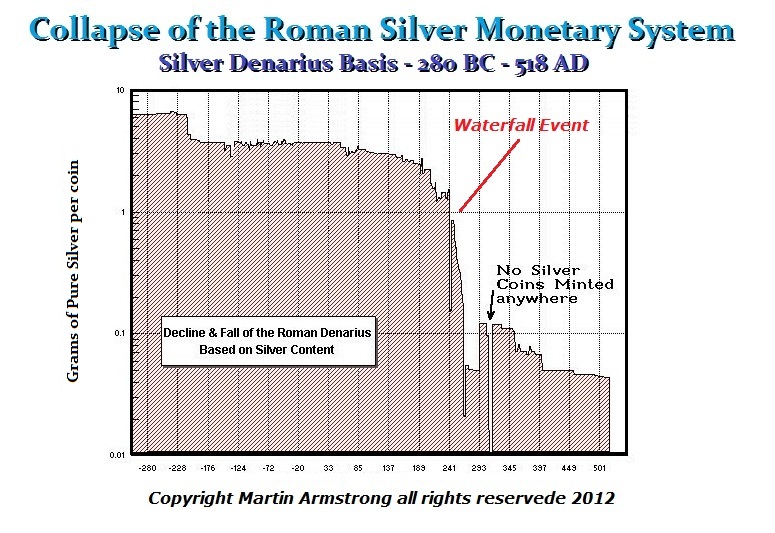
There is a cycle of industrialization as well. Rome began as an agrarian society and moved toward trade, which brought them into conflict with Carthage. We see this cycle even in their coinage. The first silver coins of Rome were struck using the monetary system that was Greek in origin from the days of Athens and Alexander the Great. Only after the Second Punic War did Rome create its own monetary unit which was a debasement (reduction in weight) from 6.5 grams to 4 grams. That reflected both the inflation due to war, but also the rise of Rome whereby they no longer cared about complying with the Greek standard but set out to establish the Roman standard. To this day, many denominations still retain derivatives of the word “denarius” such as in the Iraqi Dinar or the French denier. The Germans called it the pfennig and the English adopted that as the penny.
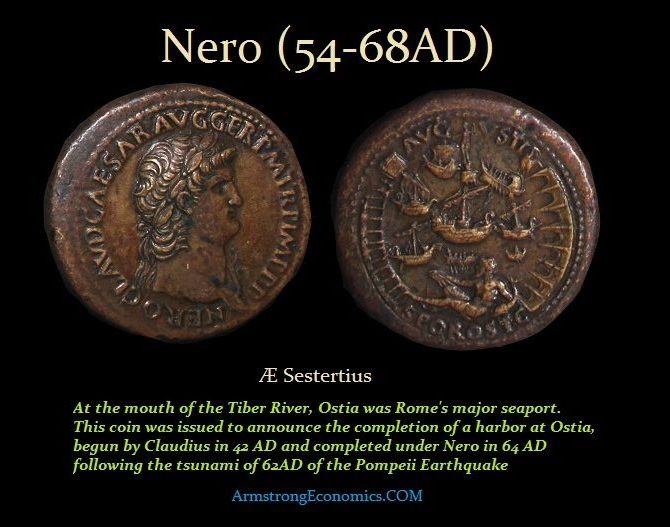
Rome itself became more like New York and grain was imported from Egypt. As agriculture became more of an import, Rome blossomed like New York in the arts and culture. It built the massive port of Ostia which was celebrated on the coinage of Nero (54-68AD) securing the food supply.
The shift toward industrialization in the Roman Empire also resulted in a decline in birth rates for children as we see in modern times. Large families were needed in an agrarian society, but not so much in a developed society – hence the family laws of Augustus. We see the same patterns repeat throughout history.
The first known Clean Air Act occurred in 535 AD by Emperor Justinian in Constantinople. He proclaimed the importance of clean air as a birthright. “By the law of nature these things are common to mankind—the air, running water, the sea.” Even Cicero wrote about pollution in the ancient city of Rome. This went hand and hand with developed societies and urbanization.
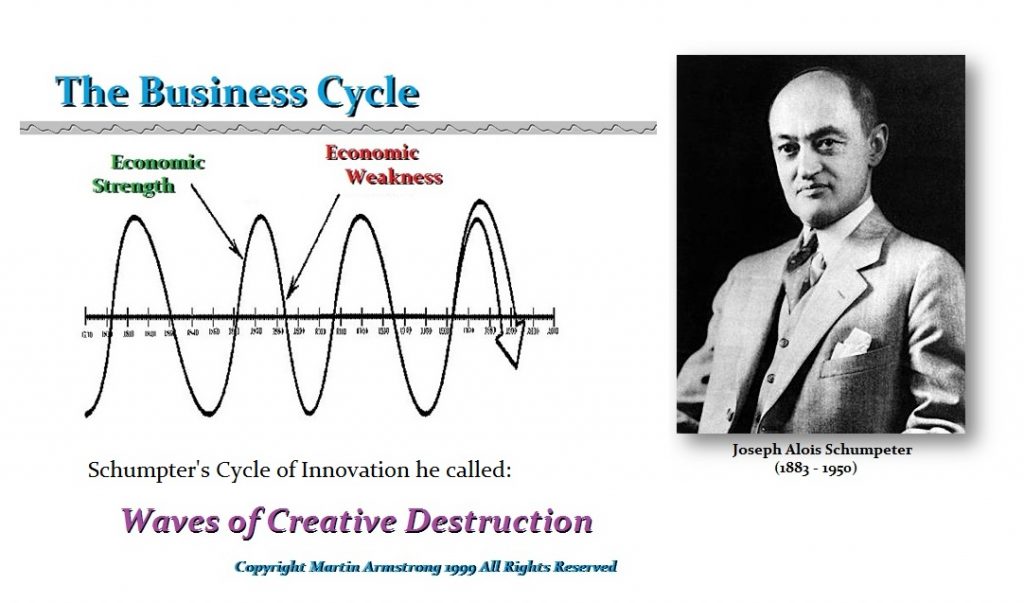
Joseph Mois Schumpeter (1883-1950) was an Austrian economist, educated in Vienna. He taught at Czernowitz, Graz and Bonn. In 1932, he moved to Harvard where he taught until his death. Among Schumpeter’s writings is Theory of Economic Development (1912), Business Cycles (1939), Capitalism, Socialism and Democracy (1942), and History of Economic Analysis (1954).
Schumpeter developed a theory of trade cycles and growth; he argued that abnormal profit was the entrepreneur’s reward for innovation. He predicted, however, that the scope for innovation would be declining in the course of capitalist development as competitive market structures were replaced by monopolies. He believed that capitalism would gradually evolve into socialism. Like Malthus, he could not look into the future and see all the technological advancements that would constantly create waves of new innovation.
In 1939, it was actually Schumpeter who suggested naming the cycles “Kondratieff waves” in his honor. To explain the Kondratieff Wave, Schumpeter called them waves of innovation that result in waves of creative destruction. Each wave of some new innovation destroys the last. Cars wiped out horses & buggies. The internet is wiping out local stores, and the post office, as technology has introduced streaming that has wiped out VCRs and DVDs, and even movie theaters. The cryptocurrency advocates promote the end of central banks and paper currency.
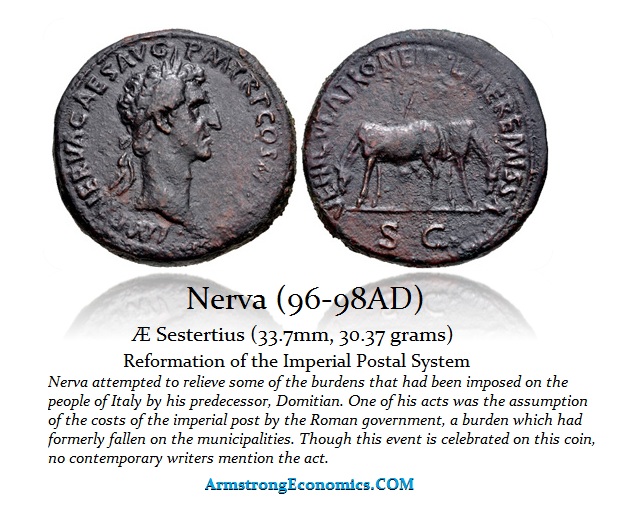
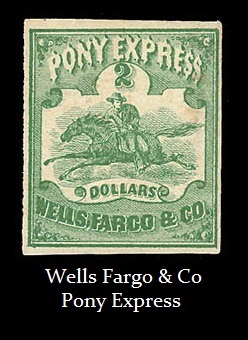
There has always been a cycle of innovation. That was one of Joseph Schumpeter’s main theories to explain the business cycle. For example, first, there was the Canal Bubble that peaked during the Panic of 1825. There was the invention of the telegraph followed by the telephone. The ancient Romans had invented the first version of the Pony Express and could get a letter from Britain to Rome in about 7 days. That too was celebrated on the coinage of Emperor Nerva(96-98AD).
This age of communication with the Pony Express and stagecoach travel was followed by the invention of the steam engine. That gave birth to the railroad boom which lasted from the 1860s and peaked in 1907. It was on May 10th, 1869, when the Union Pacific and Central Pacific railroad lines joined 1776 miles of rail at Promontory Summit, Utah Territory connecting the East and West by rail. The Railroad Barrons became famous millionaires and that innovation boom peaked initially with the Panic of 1893, but the final rally in the railroads peaked in 1907. Thereafter, the combustion engine took over for the next wave of innovation giving birth to the automobile took over and peaked in 1929, tractors, and air travel.
On January 1, 1914, the world’s inaugural scheduled flight with a paying passenger hopped across the bay separating Tampa and St. Petersburg, Florida. Planes were used during World War I, but after the war, there were thousands of unemployed pilots and a surplus of aircraft along with an appreciation for the future significance of this new technology.
It was after World War I that civilian airliners began to emerge. The Fokker Trimotor built in Europe by the Dutch with an 8-12 passenger capacity was the most popular airliner in the 1920s. It had a range of about 600 miles. World War II was coming into play when the USA built Douglas DC-3 with a capacity of 28 passengers. It had a range of nearly 1500 miles. The DC-3 made its maiden commercial flight in 1936 between New York and Chicago and thus the airline stocks were the big innovation for the rally into 1937.
It was 1938 when televisions first began to be commercially available. It would be after World War II when this became the next real innovation boom. It was 1954 when color RCA TV C-100 systems were sold across America. By 1960, there were four debates between John F. Kennedy and Richard Nixon that were broadcast and changed the manner in which presidents would campaign. By 1969, Neil Armstrong walked on the moon for the first time as millions of American viewers watched live on network TV.
Of course, we have the internet boom in 2000, etc., and there is a clear cycle of innovation that Kondratieff and Brenner could not see before even the invention of the combustion engine that led to tractors changing agriculture forever. There is a difference between when something is invented and when it becomes commercially viable.
For example, the FAX machine was actually invented by the Scottish inventor Alexander Bain (1811–1877) who was famous for being the first to patent the electric clock and was also involved in installing the telegraph lines between Edinburgh and Glasgow in Scotland. He could see in his mind’s eye that the Morse Code of dots and dashes invented several years earlier by Samuel Morse, could take an image and transmit it by reducing it to a binary image. He envisioned the first fax machine. In 1846, he was able to reproduce graphic signs in laboratory experiments. He applied and received a British patent #9745 on May 27, 1843, for his “Electric Printing Telegraph”, but it took more than 100 years to actually become usable. We have embarked on the next wave of innovation that includes quantum computers and Artificial Intelligence.
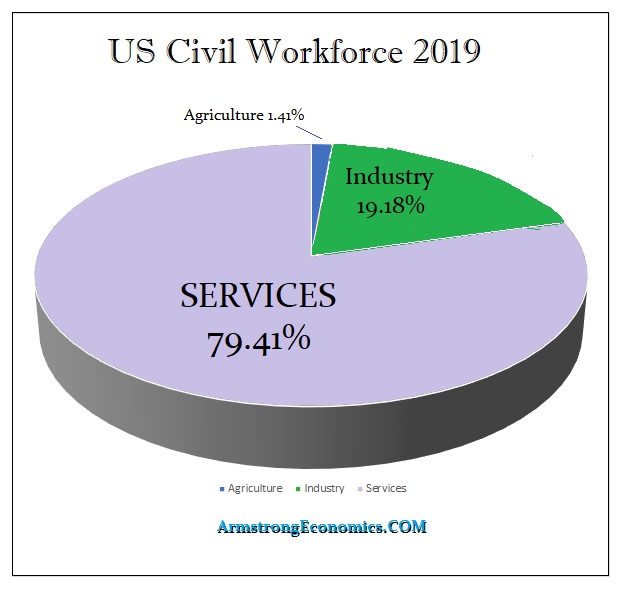
Consequently, when you are looking at long-term cycles, a few hundred years is not enough data. If Kondratieff were alive today and based his study on just the current system, he would be focusing on services rather than commodity-based economies. Agriculture has fallen to just 1.41% of the civil workforce.
It is simply vital to grasp the very nature of the data that you are intending to use to create models, which is itself in its own cycle of innovation. This is why the Economic Confidence Model is totally different. It is NOT panic on any single sector. It is based on the boom and bust movement irrespective of the sector and it embraces the entire world, not a single economy. Back-testing revealed that not only did the Roman Monetary System collapse in just 8.6 years, but this cyclical frequency appears throughout the ancient monetary systems globally.
There is a lot more hidden behind the cloak of what people think is just chaos.
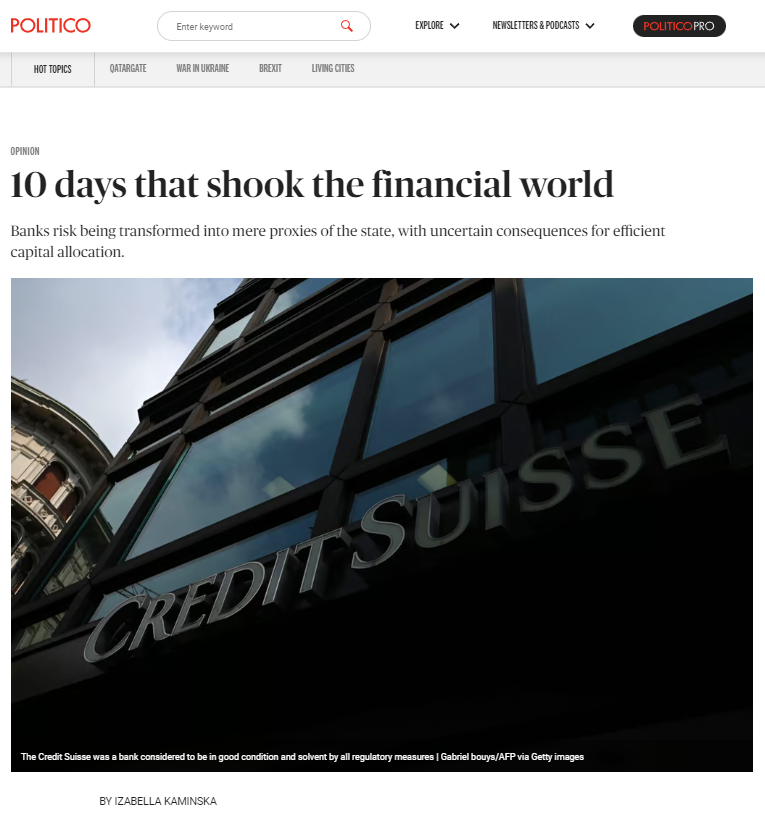
It is refreshing when you actually find a journalist who is honest and is not being included by the Neocons to put out their propaganda. Her review of Credit Suisse is a worthwhile read. Especially when this is not over yet and the winds of finance are now turning toward questioning Deutsche Bank.
Izabella Kaminska is senior finance editor at POLITICO Europe.
Over the span of 10 days, the global financial system was once again shaken.
And as we witness the fallout, so far it appears contained. Stock markets are up, bank stocks seem stabilized and government bonds are in high demand. Officials reassure ad nauseam that the financial system remains strong and stable.
But the truth is, even if so, what happened in this period of time has changed the financial system forever — and worryingly, most people haven’t even noticed.
Governments and central banks would have you believe that in both cases, private sector solutions were found to resolve the failures. No taxpayer funds were used.
But that is likely not true.
In the United States, growing calls from the country’s top billionaires and hedge fund bosses to guarantee the full extent of customer deposits would, if acted on, deliver a backstop that must be underwritten by public funds. That’s the case even if costs are distributed among whatever healthy banks remain later. The sums involved are eye-watering — by some measures up to $17 trillion of unfunded liabilities.
If the rule is passed — and all indications are that it will be — this would finally make the implicit explicit: that the financial system was never really rescued following the 2008 financial crisis but merely put on life-support. And that has now failed, which means socialization of the losses beckons.
Over in Europe, things are potentially worse. This time, it wasn’t the storming of the Winter Palace Hotel in Gstadt that seized the means of financing but something far more mundane: an untidy bank resolution for Credit Suisse, which relies far too heavily for comfort on Swiss National Bank (SNB) guarantees.
As one former top British central banker told POLITICO, “They could have used bail-in; it would have worked; and banking would become part of a capitalist market economy” — a reference to the loss-absorbing processes regulators came up with after 2008 to ensure bank failures didn’t have to draw on public resources ever again. “The only stable equilibrium is one where bank resolution works, or socialism,” he added.
But the resolution didn’t work. And investors are belatedly realizing this.
Key to this reality is that Credit Suisse was a bank considered to be in good condition and solvent by all regulatory measures. As one bank analyst told POLITICO, going by the assets, you would never have seen the problem coming. Even the SNB and financial markets regulator FINMA said so as recently as last week.
The SVB Private logo is displayed on an ATM outside of a Silicon Valley Bank branch in Santa Monica, California | Patrick Fallon/AFP via Getty images
So were the regulators lying? Or is the accounting somehow fundamentally broken?
What we know for sure is that markets questioned the numbers, and this was evidenced by a run on the bank’s deposits, equity and bonds. And the discrepancy poses a big problem going forward, as it knocks trust in the accounting of all similarly assessed banks, which, thanks to international accounting standards, means pretty much all of them.
Credit Suisse’s sale to domestic rival UBS at cents on the dollar of what regulators claim the underlying assets are worth presents another problem too. If similar assets are lurking in UBS’ own balance sheet — and chances are that is the case, as the assets in question are probably government bonds — they might have to be written down to a similar degree. This is probably why UBS needed the guarantee from the SNB to be doubled to 100 billion Swiss francs to do the deal.
In light of this, Switzerland now faces an even larger issue: If UBS were to become stressed — and it very well could due to this discrepancy — there’s no private sector pathway for resolution left. The country now only has one major bank and, thus, only two possible pathways to deal with a failure — nationalization or acquisition by a foreign buyer with enough cash to keep the valuation of all the consolidated assets at a price that brings everything back to par. And there are few of those in the Western hemisphere.
With a full foreign acquisition off the table due to global discord, this leaves only an unthinkable solution for the home of Swiss private banking — the dawn of a type of finance more commonly seen in communist countries, where banks are directed by the state to allocate funds to activities they prioritize. Combined with a central bank digital currency, this would reduce banks to mere proxies of the state, with uncertain consequences for efficient capital allocation and inflation.
How things would unfold from then on is unclear. The only thing we can be sure of is that nothing in banking, or capitalism, may ever be the same again.
Posted originally on the CTH on March 24, 2023 | Sundance
Joe Biden is in Canada visiting Justin Trudeau Friday and they held a joint press conference. WATCH:
[Transcript] – We’ll be taking two questions from the American delegation, two questions from the Canadian delegation. One question and one follow-up.
Mr. President, first question over to you.
PRESIDENT BIDEN: All right. I guess the first person I’m calling on is Josh. Josh Boak. Josh?
Q Thank you, Mr. President. Two questions, one for each of you.
Mr. President, you talked today about the security and economic partnership with Canada. President Xi just went to Russia and expanded China’s economic commitment with that country. Why do you think many leading countries are choosing to form competing partnerships? And what does that mean for the world?
PRESIDENT BIDEN: It —
Q Prime Minister Trudeau —
PRESIDENT BIDEN: Oh, sorry.
Q — Canada recently banned TikTok on government devices. Knowing what you know, are you comfortable with the idea of your children or family members using TikTok? Thank you.
PRESIDENT BIDEN: I respond to the question first here?
Well, first of all, look, in 10 years, Russia and — and China have had 40 meetings. Forty meetings.
And I disagree with the basic premise of your question. I have — we have, you know, significantly expanded our alliances. I haven’t seen that happen with China and/or Russia or anybody else in the world.
We’re in a situation in the United States where NATO is stronger, we’re all together — the G7, the Quad, the ASEAN, Japan and Korea.
I have — my staff pointed out to me: I have now met with 80 percent of the world leaders just since I’ve been President. We’re the ones expanding the alliances. The opposition is not.
Name for me where that’s going, and tell me what ha- — I don’t mean literally you, but rhetorically — tell me how, in fact, you see a circumstance where China has made some significant commitment to Russia. And what commitment can they make, economically? Economically.
Q Their trade has increased, sir.
PRESIDENT BIDEN: Pardon me?
Q Their trade has increased, sir.
PRESIDENT BIDEN: Yeah, their trade has increased compared to what?
Look — look, I don’t take China lightly. I don’t take Russia lightly. But I think we vastly exaggerate.
I would hear — I’ve been hearing now for the past three months about “China is going to provide significant weapons to Russia, and they’re going to…” — you all have been talking about that. They haven’t yet. Doesn’t mean they won’t, but they haven’t yet.
And if anything has happened, the West has coalesced significantly more.
How about the Quad? How about Japan and the United States and South Korea? How about what we’ve done in terms of AUKUS? How about what we —
I mean, so I just — I just want to put it in perspective. I don’t take it lightly what Japan — what China, excuse me, and — and Russia are doing. And it could get significantly worse.
But let’s put it in perspective: We are uniting coalitions. We. We, the United States and Canada.
PRIME MINISTER TRUDEAU: On TikTok, we made a similar decision to the American government and others when we said that we do not feel that the security profile is safe for government-issued phones. There are concerns around privacy and security, and that means — that is why we have banned TikTok from government-issued phones.
But your question, Josh, was about what I do as a parent of teenagers and my kids on social media. And on that, I —
PRESIDENT BIDEN: Pray.
PRIME MINISTER TRUDEAU: — (laughs) — on that, I am obviously concerned with their privacy and their security, which is why I’m glad that on their phones — that happen to be issued by the government — they no longer access TikTok. (Laughter.)
That was a big frustration for them. “Really? This applies to us too, Dad?” “Yes, I just did that.” (Laughter.)
But I think as parents, we are understanding, particularly of teenagers, just how much of our kids’ lives are lived online and how much they are impacted not just by — influenced the way their friends are and peer pressure that all of us went through as teenagers, but a degree of misinformation, disinformation, and malicious activity that is allowed for by incredible advances in technology that we are benefiting from in so many different ways.
As governments, we have to make sure we’re doing what we can to keep people safe in the public square, making sure we’re pushing back against hate speech and incitations to violence online. And we’re carefully calibrating legislation to do that.
As a parent, I spend a lot of time talking to my kids about what’s online and how they should try and, you know, go outside and play a little more sports and not get so wrapped up in their phones. And we’re going to continue to do that.
Our concerns around TikTok are around security and access to information that the Chinese government could have to government phones.
It’s just a personal side benefit that my kids can’t use TikTok anymore — that I recommend everyone to use my en- — my encouragement to try and do.
MODERATOR: (As interpreted.) We’ll now go to a Canadian question. Christian Noel.
Q (As interpreted.) Good afternoon, Mr. President. Good afternoon, Mr. Prime Minister. I’d like to ask a question about Roxham Road. The agreement has been ready for a year. Why did you wait so long?
And for the 15,000 migrants that Canada will welcome, why so few? What have we offered to the U.S. in exchange?
PRIME MINISTER TRUDEAU: (As interpreted.) Thank you, Christian. We’ve known for a long time theoretically what modernization needed to be made to the Roxham Road, to the agreement. We couldn’t simply shut down Roxham Road and hope that everything would resolve itself, because we would have had problems. The border is very long. People would have looked for other places to cross.
And so that’s why we chose to modernize the Safe Third Country Agreement so that someone who attempts to cross between official crossings will be subject to the principle — the same principle as someone who should seek asylum in the first safe country they arrive at.
Now, for people who are coming from the U.S., that is where they should be asylum seekers, using this means of uniformly applying the agreement, which we knew theoretically would be the solution, but it takes complex processes to manage the border. It took months before we could move forward with the announcement.
But by doing so, we protected the integrity of the system. And we’re also continuing to live up to our obligations with respect to asylum seekers.
At the same time, we continue to be open to regular migrants, and we will increase the number of asylum seekers who we accept from the hemisphere — the Western Hemisphere — in order to compensate for closing these irregular crossings.
Thank you.
Q Mr. President, this question is for you.
(As interpreted.) Please feel free, Mr. Trudeau, to answer as well.
Are you disappointed that Canada is not part or hasn’t taken a bigger role in the multilateral forces in Haiti? And what would you like Canada to do more, in addition to the $100 million announced today?
PRESIDENT BIDEN: Well, no, I’m not disappointed. Look, this is a very, very difficult circumstance, the idea of how do we deal with what’s going on in Haiti, where gangs have essentially taken the place of the government, in effect. They run — they rule the roost, as the saying goes.
And so I think that what the Prime Minister has spoken about makes a lot of sense. The biggest thing we could do, and it’s going to take time, is to increase the prospect of the police departments in Haiti having the capacity to deal with the problems that are faced. And that is going to take a little bit of time.
We also are looking at whether or not the international community, through the United Nations, could play a larger role in this event, in this — this circumstance. But there is no question that there is a real, genuine concern, because there are several million people in Haiti, and the diaspora could cause some real — how can I say it? — confusion in the Western Hemisphere.
And so — but I think that what the Prime Minister is suggesting, and we are as well going to be contributing, to see if we can both increase the efficiency and capacity of the training and the methods used by the police department, as well as seeing if we can engage other people in the hemisphere, which we’ve been talking to, and they’re prepared to do some. So it’s — it’s a work in progress.
PRIME MINISTER TRUDEAU: (As interpreted.) For 30 years, Western countries have been involved in Haiti to try to stabilize the country, to try to help the Pearl of the Antilles. And the situation is atrocious. It’s affecting the security of the people of Haiti. We must take action.
And we must keep the Haitian people in the approach that we build for security. And that’s why the approach that we are working on with the U.S. involves strengthening the capacity of the Haitian National Police, bringing more peace and security and stability. This won’t happen tomorrow. It will, of course, be a long process, but we will be there to support the capacity of the police in Haiti, the National Police.
At the same time, part of the insecurity and instability in Haiti is because of the Haitian elite, who have for too long benefited from the misery of the Haitian people. They work for their own political gain, their own personal gain. And this has prevented the country from recovering. And that’s why we’re proceeding with sanctions. We will continue to bring pressure to bear on the elite, the political class in Haiti, to hold them accountable for the distress facing the Haitian people, but to hold them accountable for ensuring their wellbeing.
We’re going to continue to work together. We fully understand how important this task is.
MODERATOR: Mr. President, over to you.
PRESIDENT BIDEN: Can I follow up with one point on Haiti? And that is that any decision about military force, which it’s often raised, we think would have to be done in consultation with the United Nations and with the Haitian government. And so that is not off the table, but that is not in play at the moment.
I’m sorry.
MODERATOR: Over to you for the question, Mr. President.
Jordan, you have a question?
Q Thank you, Mr. President. Some on Wall Street have expressed frustration that it’s unclear what more your administration is willing to do to resolve the banking crisis. The markets have remained in turmoil. So how confident are you that the problem is contained? And if it spreads, what measures, such as guaranteeing more deposits, are you willing or not willing to take?
PRESIDENT BIDEN: First of all, have you ever known Wall Street not in consternation? Number one.
Look, I think we’ve done a pretty damn good job. People’s savings are secure, and even those beyond the $250,000 the FDIC is guaranteeing them. And the American taxpayer is not going to have to pay a penny. The banks are in pretty good shape. What’s going on in Europe isn’t a direct consequence of what’s happening in the United States.
And I — what we would do is if we find that there’s more instability than appears, we’d be in a position to have the FDIC use the power it has to guarantee those — those loans above 250, like they did already.
And so I think it’s going to take a little while for things to just calm down. But I don’t see anything that’s on the horizon that’s about to explode. But I do understand there’s an unease about this. And these mid-sized banks have to be able to survive, and I think they’ll be able to do that.
Q And, Mr. Prime Minister, the U.S. has included Canada in electric vehicle subsidies, as you’ve discussed, that were included in the Inflation Reduction Act. But the IRA also raises some competitiveness concerns and challenges for Canada. You know, President Biden supports “Buy American” provisions very strongly, and that has historically led to some trade tensions.
So are you planning to announce anything in your budget to keep up, so to speak? And are you asking the U.S. government for exceptions to the “Buy American” provisions in other areas?
PRIME MINISTER TRUDEAU: First of all, there’s nothing new about Canada having to make sure that we remain competitive with the United States as a place for investment. That’s something that we have long known as a friendly competition between us that has led to tremendous growth and benefits in both of our countries.
Right now, we’re in a time where — Joe talked about it as an inflection point; I think that’s exactly right. We can feel the global economy shifting — shifting in very real ways towards lower carbon emission technologies, cleaner tech, great jobs in the natural resource and manufacturing industries that are going to be increased on our continent after years of outsourcing and offshoring. There is a real opportunity for both of us.
And the IRA, which is bringing in massive investments and massive opportunities for American workers and companies, is also going to have strong impacts on supply chains and producers and employees in Canada.
Yes, we’re going to have to make sure we’re staying competitive and targeting the areas where we think we can best compete. And we’ll have more to say about that in our budget next week.
But let us take a moment to step back and see that North America — Canada and the United States in particular — are incredibly well positioned to be the purveyors of solutions and economic growth that the net-zero economy around the world will need over the coming decades. The innovation, the know-how, the ability of us to make big things together leave us, in a time of global uncertainty, extremely certain that we are well placed for the future.
Whether it’s investments that have seen Canada go from fifth or sixth in the world, in turn of — in terms of battery supply chains, to now second in the world in terms of battery supply chains.
Whether it’s continuing our leadership on the cleanest aluminum in the world, moving towards cleaner steel and zero emission steel.
Whether it’s moving forward on critical minerals that the world is understanding they can no longer rely on places like China or Russia for — that they can rely on Canada to be not just a purveyor of ores, but of finished materials that will be built in environmentally responsible, union or good middle-class jobs — wages, strong communities, and the kind of leadership that the world is increasingly looking for.
There’s long been a bit of a weakness, I think, to our argument that we’ve made over the past decades as Western democracies that says that our model is the best one, it leads to the most prosperity. But so much of our model — we sort of turned our back to the fact that it relied on cheap imports —
PRESIDENT BIDEN: Bingo.
PRIME MINISTER TRUDEAU: — of goods or resources from parts of the world that didn’t share our values and weren’t responsible on the environment or on human rights or on labor standards.
And what we are doing right now is showing that we can and will build resilient supply chains between us and with friends around the world that adhere every step of the way to the values that we live by, that make sure that there are good jobs for workers in communities, urban and rural, right across our continent; there are good careers for kids long into the future, not in spite of a changing world, but because of that changing world, and how well we are positioned to see the future and meet the future.
That’s why it’s so exciting to be able to work alongside Joe in these challenging times where we know we are better positioned than just about anyone else. And those friends of ours who share our values and our democracies around the world will benefit from the strength and the relations they have with us. And those who choose to continue to turn their backs on the environment, on human rights, on the values of freedom and dignity for all, will increasingly not be able to benefit from the growth that our societies, that our communities are creating every single day. PRESIDENT BIDEN: And, by the way, we each have what the other needs. We each have what the other needs.
The idea that somehow Canada is somehow put at a disadvantage — because we’re going to probably be investing billions of dollars in their ability to package what is coming out of the semiconductor area — I don’t get it. How’s that in any way do anything other than hire and bring billions of dollars into Canada?
I also don’t understand how, when we talk about it, we — we greatly need Canada, in terms of the minerals that are needed.
Well, you guys — we don’t have the minerals to mine. You can mine them. You don’t want to produce — I mean, you know, turn them into product. We do.
I mean, it’s — I’m a little confused, at least thus far, on why this is a disadvantage for — for Canada and the United States. I think we each have what the other needs.
And let me conclude by saying: You know, when I started talking about we’re going to build our economies from the middle out and the bottom up, not the top down, I was being literal. Because what happened is, if you think about it — in Democrat and Republican administrations beginning over 30 years ago or more in the United States — corporate America decided that what they’re going to do is they’re going to export jobs and import product because it was cheaper labor.
Well, guess what? Now we are making sure they import jobs here — jobs here — and we export product. Canada is doing the same thing.
So this is a real — this is a real shift in the world economy, in terms of what we’re prepared to do. And I’ll be darned if I’m going to stick in a situation where, as long as I’m President, where we have to rely on a supply chain in the other end of the world that is affected by politics, pandemics, or anything else.
We’re not hurting — we’re not hurting anyone in terms of having access to the start of the supply chain. It’s available.
But again, I — I predict to you, you’re going to see, after we’re both out of office, both China — I mean, China out of the game, in terms of many of the — the product they’re — they’re producing, and the United States and Canada pretty solid economically situated for the future in terms of also bringing back manufacturing jobs.
MODERATOR: Merci.
PRESIDENT BIDEN: Sorry. And they’re telling me I’m talking too long because we got to go to dinner. (Laughter.)
MODERATOR: Thank you.
(In French.) (As interpreted.) We’ll take one last question.
Q My first question is for the Prime Minister. But, Mr. President, feel free to weigh in before my follow-up.
Prime Minister, we know you’ve — we know that you’ve appointed a special rapporteur, but with what we’ve learned about Han Dong’s communication with the Chinese Consular General, do you believe he advocated for the delayed release of the two Michaels?
PRIME MINISTER TRUDEAU: First of all, Han gave a strong speech in the House that I recommend people listen to, and we fully accept that he is stepping away from the Liberal caucus in order to vigorously contest these allegations.
But I do want to take a step back and point out that foreign interference, interference by authoritarian governments, like China, Russia, Iran, and others, is a very real challenge to our democracies and is absolutely unacceptable.
It’s why, over the past number of years, the President and I have had many conversations about this. And indeed, we’ll continue to work together with our democratic allies around the world to keep our institutions and our democracies safe from foreign interference.
In 2018, when Canada hosted the G7 in Charlevoix, we actually created the G7 Rapid Response Mechanism to protect our democracies in cases of interference. And we will continue to work together to make sure we’re doing everything necessary to protect our democracies, which, by definition, are more open and therefore more vulnerable to foreign actors trying to weigh in in our politics, in our business, in our research institutions, and particularly impact on citizens themselves — which is why, over the past years, Canada, like our allies around the world, has given itself new rigorous tools to counter foreign interference.
And with the work that our expert rapporteur will do, with the work that our National Security Committee of Parliamentarians will be doing, and other institutions, we will continue to do everything necessary to keep Canadians safe.
PRESIDENT BIDEN: I have nothing to add. (Laughter.)
Q Thank you. And, Mr. President, when you took office, you cancelled the Keystone XL pipeline. This week, your government delayed the environmental assessment to reroute Enbridge Line 5, and at the same time, you’re approving oil drilling in Alaska.
So what’s your response to people who say it’s hypocritical to stymie Canadian energy projects while allowing your own?
PRESIDENT BIDEN: First of all, I don’t think it is, but I’ll be very brief.
The difficult decision was on what we do with the Willow Project in Alaska, and my strong inclination was to disapprove of it across the board. But the advice I got from counsel was that if that were the case, we may very well lose in court — lose that case in court to the oil company — and then not be able to do what I really want to do beyond that, and that is conserve significant amounts of Alaskan sea and land forever.
I was able to see to it that we are literally able to conserve millions of acres, not a — not a few — millions of acres of sea and land forever so it cannot be used in the future.
I am banking on — we’ll find out — that the oil company is going to say not — that’s not going to be challenged, and they’re going to go with thr- — with three sites. And the energy that is going to be produced they’re estimating wou- — would account to 1 percent — 1 percent of the total production of oil in the world.
And so I thought it was a good — a — the better gamble and a hell of a tradeoff to have the Arctic Ocean and the Bering Sea and so many other places off limits forever now.
I think we put more land in conservation than any administration since Teddy Roosevelt. I’m not positive of that, but I think that’s true.
Q So why are you delaying efforts then?
MODERATOR: Thank you all. This is what concludes today’s press conference.
PRESIDENT BIDEN: Thank you.
Q Mr. President, Iran keeps targeting Americans. Does there need to be a higher cost, sir?
Posted originally on the CTH on March 24, 2023 | Sundance
Almost as soon as German Chancellor Olaf Schulz said, “The banking system is stable in Europe – Generally, I think we are in good shape,” shares of German-based Deutsche Bank began dropping.
After a Friday loss of 14%, the bank came back to close -9.8%, and on the heels of the Credit Suisse collapse and subsequent purchase, concerns are still reverberating.
After a meeting in Brussels, the EU government heads said lenders in Europe are generally in sound health and in a position to weather a combination of rising interest rates and slowing economic growth.
“The banking system is stable in Europe,” German Chancellor Olaf Scholz told reporters after the summit. Dutch Prime Minister Mark Rutte said: “Generally, I think we are in good shape.”
The EU deliberations came in the wake of U.S. regulators’ shutdown of two U.S. banks, including Silicon Valley Bank, and a Swiss-orchestrated takeover of troubled lender Credit Suisse by rival UBS.
The emergency actions on both sides of the Atlantic revived memories of the 2008 global financial meltdown and the ensuing EU sovereign debt crisis, which almost broke apart the euro currency now shared by 20 European countries.
In a sign of market jitters in Europe, shares of Deutsche Bank, Germany’s largest lender, fell as much as 14% in Frankfurt on Friday. The drop, which dragged down the stocks of other European lenders, followed a steep rise in the cost of financial derivatives known as credit default swaps that insure bondholders against the bank defaulting on its debts.
Scholz dismissed the idea of basic weaknesses at Deutsche Bank, saying it has become “very profitable” after modernizing its business. “There is no reason to have any concerns,” he said. (read more)
The German bank has lost about a fifth of its market value this month. Other European banks were also down at closing, including Deutsche Bank German rival Commerzbank, which was down 9%. Credit Suisse and its new parent company, Barclays and Societe Generale were all down over 6% on Friday.
Posted originally on the CTH on March 24, 2023 | Sundance
The ABC article is worded to engineer the most nefarious narrative possible. However, if you read the actual story, there’s likely not only nothing to it, but it’s also a total conflation of different issues.
A white substance was found in the mailroom of a New York City building. The building houses an office that District Attorney Alvin Bragg sometimes uses. The powder was identified as coming from a letter that was addressed to “Alvin”. Inside the envelope was a letter containing the typewritten message, “Alvin: I am going to kill you,” with 13 exclamation points. The white substance was not hazardous.
(VIA ABC) – A white powder was discovered in the mailroom at 80 Centre Street, where the Manhattan District Attorney has offices and where a grand jury has been meeting to hear evidence in former President Donald Trump’s case, according to a court official. The powder was determined to be non-hazardous, officials said.
The powder came in an envelope addressed to “Alvin,” an apparent reference to Manhattan District Attorney Alvin Bragg, according to police sources. Inside the envelope was a letter containing the typewritten message, “Alvin: I am going to kill you,” with 13 exclamation points, according to sources.
This envelope followed a series of unfounded threats that targeted municipal offices in New York this week. “For three days we got four emails,” Susan Stetzer, district manager at Manhattan Community Board 3, told ABC News on Friday. (read more)
The narrative has that particular FBI feeling of “energetic material that may become combustible when subjected to heat or friction.” {link} aka, powered coffee cream.
The only thing missing to complete the FBI version of the story was a noose. However, that might have been a little too telling.
Posted originally on the CTH on March 24, 2023 | Sundance
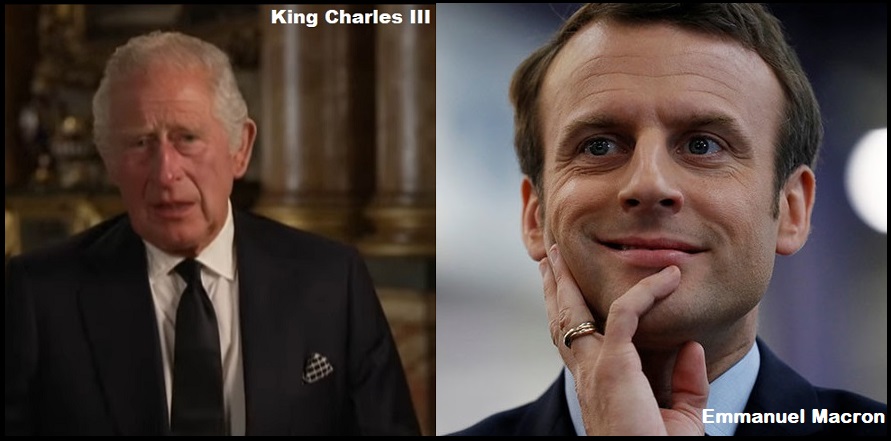
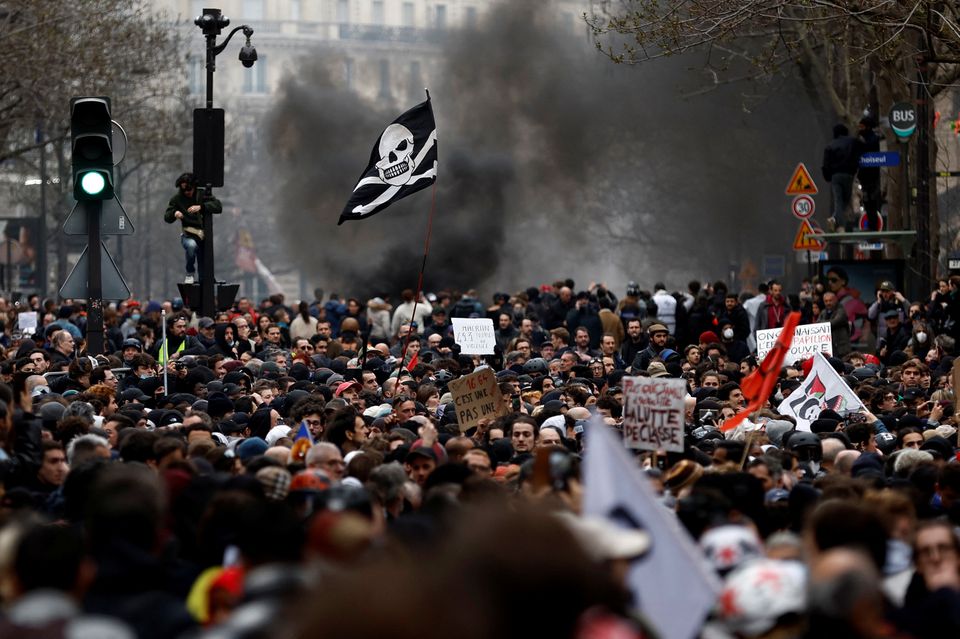
No, despite the historic rhyming, we have been assured it remains 2023 not 1629. However, King Charles has cancelled his trip to France amid an angry revolution that has broken out in several regions of the country, including Paris.
(International News) – United Kingdom King Charles III’s state visit to Paris has been postponed amid the mass protest against the unpopular pension reforms.
The King had been scheduled to arrive in France on Sunday on his first state visit as monarch, before heading to Germany on Wednesday.
This decision was taken by the French and British governments, after a telephone exchange between the President of the Republic and the King. According to the French president’s office, this State visit will be rescheduled as soon as possible. (link)
..”Listen, you stupid little dwarf, I don’t care about your Donbas…. He’s having dinner with Justin right now and we need the codes to the bunker. Just give me the codes or I will cancel your wife’s credit line at Lanvin and La Perla boutiques!”…
I have created this site to help people have fun in the kitchen. I write about enjoying life both in and out of my kitchen. Life is short! Make the most of it and enjoy!
This is a library of News Events not reported by the Main Stream Media documenting & connecting the dots on How the Obama Marxist Liberal agenda is destroying America