Installed Prime Minister Mark Carney Schedules Canadian SNAP Election for April 28th


Posted originally on CTH on March 24, 2025 | Sundance

Interim installed Canadian Prime Minister Mark Carney has confirmed the snap election for Canada is scheduled for April 28, 2025.

Given that Conservative Leader Pierre Poilievre generally sealed his fate with criticism of President Trump while aligning himself with a surging patriotic-leftist movement, it is now expected that Mark Carney will win the election.

Politico has an article about the dynamic underway, and the following quotes are noteworthy:

CANADA – […] Trump has even taken credit for turning the Liberals’ fortunes around.

“Before I got involved and totally changed the election — which I don’t care about, probably, it’s our advantage, actually — but the Conservative was leading against, I call him Governor Trudeau. The conservative was leading by 35 points,” he said Friday, while exaggerating the polls.

“I think Canada is a place, like a lot of other places, if you have a good candidate, the candidate is going to work,” Trump said.

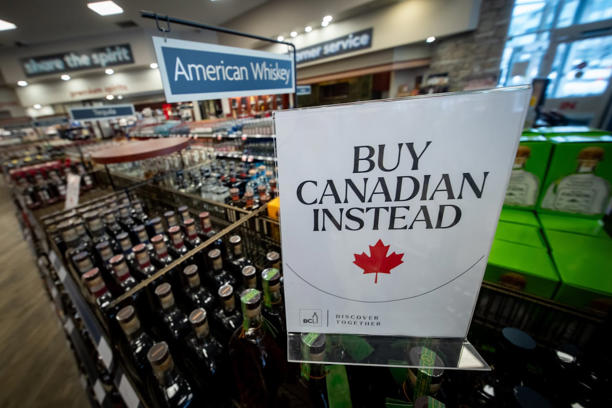
[…] Canadians have responded to Trump’s intimidation tactics with an outburst of patriotism. They are canceling spring break plans, buying made-in-Canada products, damaging Teslas and booing “The Star Spangled Banner” at professional sporting events.

Carney’s campaign slogan is “Canada Strong” while Poilievre’s is “Canada First.”

[…] In a recent interview with Fox News, the president was asked about how his recent treatment toward Canada appears to be helping the Liberal party.

I don’t care,” he said. “I think it’s easier to deal, actually, with a liberal and maybe they’re going to win, but I don’t really care.

Trump went on to say Poilievre “is stupidly no friend of mine” because of the “negative things” he has said about the president.

Poilievre has tried to frame the comments as proof that Trump is endorsing Carney, while the Conservative leader attempts to revamp his strategy to meet the moment. (read more)

From the perspective of President Trump, the main asset in the arsenal of the Canadian tariffs is “energy.”  As a consequence, having a strong “climate change” prime minister up there will mitigate any use of the energy sector and help the strategic North American economic strategy of President Trump.

{GO DEEP}

Boycotts by Canadians are generally welcomed in the U.S. hospitality industry, not coincidentally an industry of great familiarity to President Trump.   Canada simply doesn’t have any tariff weapons in their arsenal for countervailing duties.

The latest strategy by the Canadian government is to rent billboards in various red states, trying to convince Americans they need Canada more than they need Donald Trump’s reciprocity tariffs.  It is a dubious proposition at best, and a little funny all things considered.  But hey, the feels. [Prompted]

Canadians Boycott US Travel


Posted originally on Mar 17, 2025 by Martin Armstrong 

airplan air travel airtravel

Canadians are outraged at US President Donald Trump’s repeated threats to annex Canada. Canadian consumers began boycotting American products and are now boycotting America in general as tourism sank by nearly a quarter this February. Statistics Canada reported a 23% decline in trips via car from the US this February, marking the second consecutive monthly decline, while trips to the US by air declined 2.4%.

Based on personal conversations with Canadian friends, I do not believe this decline is simply correlated with the falling Canadian dollar or unfavorable exchange rate. The US was the top travel destination for Canadian tourists, and many state and local economies depend on those tourism dollars. Canadian license tags nearly equate to US tags in the spring and summer months down here in Florida. Yet, Canadians are genuinely outraged by Trump’s comments on their nation becoming a US state and want to boycott the US and anything manufactured here. I have even heard of companies canceling conferences in the US due to tensions.

Hotel reservations near the Canadian border have seen notable decreases as well. Niagara Falls, New York, reported a 8.1% decline in Saturday night bookings and Bellingham, Washinton, recently saw a 10.8% dip. Canadian travel agency Flight Centre rang the alarm that booking to the US in February plummeted an alarming 40% YoY.

There were over 20.4 million visits to the US from Canada in 2024, aiding in $20.5 billion in spending. The US Travel Association believes a 10% decline in Canadian tourism could shed $2.1 billion from the US economy and cost up to 14,000 jobs. The association noted that if the current trend continues, the US economy will lose at least $4 billion in tourism. Tourism states like Florida, New York, Nevada, Texas, and California will experience the worst repercussions of this travel boycott.

Canada is a sovereign nation, and the people wish to keep it that way. We had an excellent relationship with our neighbors to the north despite political warfare. Now, it seems as if anti-American sentiments are growing across Canada since President Trump has been keen on potentially annexing it.

For our Canadian readers— as you know with Trudeau and now Carney, our leaders do not always speak on behalf of those they claim to represent. Americans have no desire to annex Canada. In fact, the majority on both sides of the political spectrum thought Trump was simply mocking Trudeau when he proposed making Canada a state. The majority of Americans respect Canada’s sovereignty and wish we could lay this topic to rest already.

Monetary History ofCanada


Posted originally by Martin Armstrong on March 12


Early 1600s: Beaver pelts are the one universally accepted medium of exchange, though wheat and moose skins are also legal tender

Mid 1600s: Wampum, or strings and belts made from shell beads, becomes legal tender in colonial New England. Eight white beads or four purple beads buy one penny.

Canada Playcard Money - 3

June 8, 1685: The first issue of card money occurs, which is printed on playing cards. The practice is criticized because it’s easy to counterfeit.

1722: Copper coins are introduced, though merchants didn’t like them; they continued to let people buy goods based on their own credit standing.

Eighteenth century: The lack of a standard currency and the differences in ratings given to the many coins in circulation in the colonies, “undoubtedly hindered trade and was a major source of economic inefficiency.”

Canada 1819 First Bank Note

1817: The Montreal Bank (subsequently the Bank of Montreal) issued the first bank notes in Canada after its establishment in 1817. Other banks soon followed suit. The notes were well received and became the main means of payment in British North America.

Canada 1911 $500

1854 – 1914: The Dominion of Canada is under the gold standard. The value of the Canadian dollar was fixed in terms of gold and valued at par with the U.S. currency. Both U.S. and British gold coins are legal tender in Canada.

July 11, 1864: The greenback sinks to less than 36 cents (Canadian), an all-time peak for the Canadian dollar, from close to parity in early 1862. It subsequently recovers through the decade and the currencies trade around par until the outbreak of the First World War.

Canada 1954 $1000

Mid-1950: Canadian dollar depreciates. The federal government cancels fixed parity, putting it at odds with the International Monetary Fund, and the Canadian currency appreciates.

Aug. 20, 1957: The Canadian dollar hits a peak of $1.06 (U.S.).

May 2, 1962: The government establishes a new par for the Canadian dollar, fixing it at 92.50 cents (U.S.) with a fluctuation band of 1 per cent.

May 31, 1970: The government floats the Canadian dollar amid a growing budget surplus and rising inflation.

April 25, 1974: The dollar hits a high of $1.04 (U.S.) against the greenback as global demand boosts the price of raw materials. The strength sparked fear about Canada’s export industries at a time when the unemployment rate was already high.

Nov. 15, 1976: The Parti Québécois is elected, causing markets to “make a major reassessment of the Canadian dollar’s prospects.” At the same time, commodity prices start to soften, inflation picks up. By 1979, the currency slides to 84 cents (U.S.).

August, 1981: The Bank of Canada’s key rate hits 21.2 per cent. By 1982, the dollar traded below 77 cents (U.S.).

Feb. 4, 1986: The Canadian dollar hits a record low of 69.13 cents (U.S.) as falling commodity prices hurt the economy.

1988-1989: The currency rebounds somewhat to close the decade at 86 cents (U.S.).

1990s: The currency weakens again, closing the decade at 69.29 cents (U.S.). Inflation and interest rates fall and commodity prices soften.

1998: The international crisis in emerging markets such as Russia and Latin America causes the dollar to slide as low as 63.11 cents (U.S.).

2002: The currency hits a record low of 61.98 cents (U.S.) on Jan. 18, 2002.

2006: The loonie tops 90 cents (U.S.), prompting calls for parity. It then weakens for much of the balance of the year.

2007: The loonie takes flight again. On May 31, it topped 94 cents (U.S.) – the highest level in 30 years. Later that year it hit parity in September. That fall the loonie hit its modern-day intra-day high of $1.10 (U.S.), and hit its highest closing price of $1.08 (U.S.) on Nov. 6, 2007.

2008: The loonie continued to trade near parity until it dipped below that level on July 21, 2008.

2009: The Canadian dollar closed at a recent low of 76 cents U.S. on March 9, 2009, before restarting a rapid ascent higher against a basket of international currencies.

2010: The loonie touches parity for the first time in 20 months on April 6, 2010.

Chrystia Freeland Canada Needs to Arm Nuclear Against the USA


Posted originally on Mar 2, 2025 by Martin Armstrong

Chrystia Freeland, Klaus Schwab’s stooge, has gone rogue and is pitching to become the next prime minister of Canada. She claims that the world is looking to Canada to be the new leader of the Free World. She is advocating joining with NATO against the United States, with Britain and France adding as nuclear powers, all to protect this leftist agenda because they know they are losing support globally. She said:

“The US is turning predator, and so what Canada needs to do is work closely with our democratic allies, our military allies. I would start with our Nordic partners, specifically Denmark who is also being threatened, and our NATO European allies. I would be sure that France and Britian were there who possess NUCLEAR WEAPONS and I will be working urgently with these partners to build a closer security relationship that guarantees our security in a time when United States can be a threat.”

We live in Interesting Times

Canada’s Freeland Says She Will Form Nuclear-Armed Alliance Against United States


Posted originally on CTH on February 26, 2025 | Sundance

Canada’s top-four Moonbats held a debate to decide which of the leaders of the Snow Mexicans will take control of the party now that Justin Trudeau is leaving.  Chryistia “take your bank account” Freeland is the top contender.

For the Snow Mexicans, the #1 priority is fighting U.S President Donald Trump.  No other issue had anywhere near the level of importance or time during the debate.  Every facet of the leadership debate centers around how to confront, attack, and “outwit” President Trump. [Full Debate Here]

When you listen to four professional Canadian leftists explain how they will control the Canadian government and what their plans are for the future, you realize just how lost the nation of Canada has become.  To wit, hearing Chrystia Freeland explain how she will bring together a nuclear armed international alliance to fight President Trump, is really something special.  Here’s a few soundbites:

.

“The US is turning predator, and so what Canada needs to do is work closely with our democratic allies, our military allies. I would start with our Nordic partners, specifically Denmark who is also being threatened, and our NATO European allies. I would be sure that France and Britian were there who possess NUCLEAR WEAPONS and I will be working urgently with these partners to build a closer security relationship that guarantees our security in a time when United States can be a threat.”

.

Comment from Canada


Posted originally on Feb 21, 2025 by Martin Armstrong 

canada

Martin,

I polls just like in the US are never correct. There’s no doubt that many Canadians suffer from Trump derangement, my guess is most Canadians still view the US in a favorable light.

As you are aware Canada really doesn’t produce very much any longer, we’ve become a very unfriendly Country to do business in. With the pending changes to the Capital Gains tax, it will completely kill small businesses.

I really believe what we are witnessing is a well executed plan to continue to decide the people and the media is the main propaganda tool.

The same people who control the media are the same people who are part of the evil and corrupt system?

SYSTEM OF CONTROL.

Crimes against Humanity.

You are not meant to think for yourself.

You are not meant to challenge their power [control].

Obey and accept.

Illusion of Democracy.

Illusion of Freedom.

Why does the media push division?

Why does the media incite violence?

Why does the media pit race v race?

Why does the media pit religion v religion?

Why does the media pit sex v sex?

Why does the media pit class v class?

Divided you are weak.

Divided you fight each other.

Divided you pose no threat to their system of control.

UNITY IS STRENGTH.

UNITY IS POWER.

UNITY IS HUMANITY.

Controlled media plays a major role in shaping the narrative(s) to keep you mpowerless [helpless] and asleep [unaware of truth].

ENEMY OF THE PEOPLE.

ENEMY OF HUMANITY.

Jim M

Over a Quarter of Canadians See US as an Enemy


Posted originally on Feb 21, 2025 by Martin Armstrong 

BuyCanadian

The once strong alliance between Canada and the United States has come to an abrupt halt. More so than tariffs, Canadians were offended when President Donald Trump continually stated that America should absorb Canada as the 51st state. A recent poll found that over a quarter of Canadians now see the US as an enemy nation.

The Leger survey of 1,500 Canadians and 1,000 Americans found that 27% of Canadian respondents view the United States as an “enemy,” although 30% still consider the neighboring nation an “ally.” On the flip side, only 1% of Americans see Canadians as an “enemy,” with 56% believing they remain an “ally.”

Canadians from every political party expressed unfavorable views of Donald Trump. Overall, 74% of respondents do not see him in a favorable light. Conservative Party members were most likely to have a favorable view with 27% approving of the US president and only 18% deeming the US an “enemy.” Only 21% of Liberals and NDP supporters see the US as an ally, with 34% and 47% deeming America an “enemy” nation.

There have been calls throughout Canada to boycott American products. Amazon revealed it would be closing its Quebec warehouse, eliminating 2,000 jobs, leading to a widespread call among Canadians to boycott Amazon and cancel Prime memberships. Others are calling for a boycott on other American streaming services like Netflix and Disney.

Canadian consumers are boycotting American food items. I have friends in Canada who have said that US products have been sitting on the shelves at a discount as Canadians no longer wish to contribute to the US economy. Even certain coffee shops have renamed the “Americano” espresso drink to the “Canadiano,” and many have begun boycotting American fast food chains like Starbucks and McDonald’s. Some are calling for a travel boycott and urging fellow Canadians to vacation elsewhere for at least the next four years until Trump is out of office.

Anti-American sentiment will only rise if these tariffs go into effect. Trump told Canada that the US was subsidizing its economy and no longer considered it a vital trading partner. Americans would understandably take offense if another world leader suggested that Americans abandon sovereignty to join a foreign nation. The only positive is that this patriotic nationalism has repaired domestic tensions among Canadians amid much political turmoil.

Canada Created its Own Trade Barriers


Posted originally on Jan 21, 2025 by Martin Armstrong 

CanadaTradeRestrictions

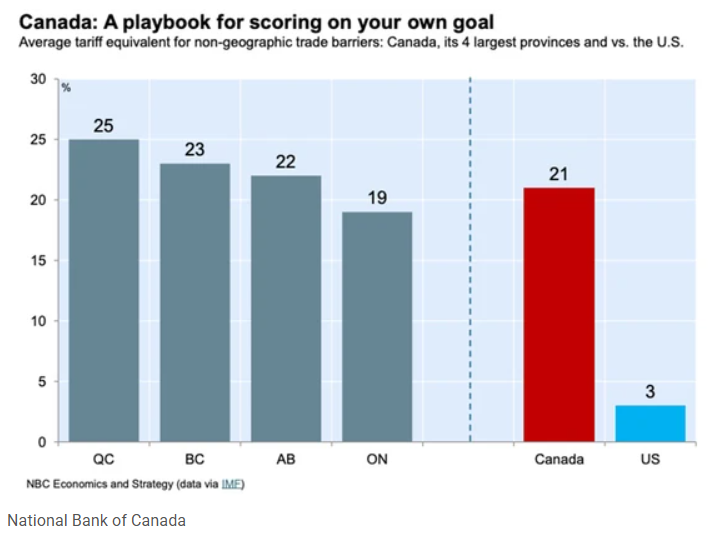
Stéfane Marion, chief economist of the National Bank of Canada, has urged the Canadian government to reconsider their own trade barriers amid criticism of Donald Trump’s proposed tariffs. The International Monetary Fund (IMF) stated in a 2019 study that Canada’s own restrictions are “regarded as the most comprehensive analysis of internal trade barriers.” Rather than tariffs, Canada’s eagerness to attract foreign investments has proved to be a barrier for domestic corporations.

Canada has trade agreements with over 40 nations as it has sought to attract international capital since 1989 since its first free trade deal with the USA. “[C]ompared to an ambitious and successful international trade strategy, progress in reducing internal trade barriers across Canada has not kept pace,” the IMF noted. The astounding amount of red tape has simply made it more expensive for Canadian companies to conduct business. Some estimates believe non-geographical internal trade barriers in Canada are equivalent to a 21% tariff. On the contrary, those barriers amount to a 3% tariff for the United States.

Marion noted that interprovincial trade relevant to international trade has declined from 50% to 40% in recent decades. The Canadian Federation of Independent Business has long fought for government to stop taxing its own corporations into oblivion. “It’s ridiculous that it’s still easier for Canadian small firms to do business overseas or across the border than within their own country,” said Chorine Pohlmann, CFIB’s executive vice president of advocacy.

Canadians are ready to welcome fresh leadership after Trudeau’s failure. Trump’s proposed 25% tariffs on Canadian goods would be disastrous for both economies. However, the Canadian government has shot itself in the foot with policies aimed at boosting international trade while ignoring domestic objectives. We have seen that happen countless times throughout history when nations are so focused on world trade that they end up dampening their own competitiveness. Canada must consider the steps it can currently take to boost business domestically without punishing companies from operating within Canada.

Romanian Election Overturned


Posted originally on Dec 9, 2024 by Martin Armstrong 

RomanianFlag

There is new turmoil during the final month of the Political Year from Hell emerging in Romania after the constitutional court annulled the presidential election. Calin Georgescu, who the media declared as a far-right extremist, won the election. The establishment cried “RUSSIAN INTERFERENCE!” and has refused to acknowledge the results.

Georgescu is a critic of NATO and the neocons. He does not support the ongoing war nor does he adhere to the Build Back Better agenda of the New World Order. President Klaus Iohannis released declassified documents ahead of the election that claim Russia interfered in the election by promoting the candidate on social media, TikTok in particular. The establishment also claimed Russia launched 85,000 cyber attacks that primarily targeted social media platforms.

How many nations have blamed Russia for interfering in their elections in recent years? More so, why do we allow them to continue perpetuating this lie when no concrete evidence has been found?

The press release called into question Article 146(f) of the Constitution states that elections must be legal. The courts had already demanded a recount of first votes, and now, the secondary election against Elena Lasconi of the Save Romania Union Party has been permanently canceled. The election cycle must now restart and the people’s wishes must be silenced.

Georgescu ran on a platform of ending Romania’s involvement in the Russia-Ukraine war and vowed to end all funding to Ukraine. He does not believe in climate change and does not want to decimate Romania’s energy industry to accommodate net zero emission goals. Georgescu also questioned the COVID narrative. All of his leading speaking points were anti-establishment, thus, the establishment ensured he could not take office.

“There Is A Dollar Shortage”: James Rickards Reveals How Globalists Are Destroying The Real Economy


originally on Rumble By Bannons War Room on Dec 03, 2024 at 03:00 pm EST