
Obama apologizes to everyone for all the bad things that we have done. One wonders if he can ever admit that we did anything good or right; I don’t think he can.
Tag Archives: TTIP
BREXIT: What Would Happen to Brits Living in EU?
Armstrong Economics Blog
Re-Posted May 22, 2016 by Martin Armstrong

QUESTION: Mr. Armstrong; The scaremongering going on here is claiming that if BREXIT becomes reality, we will be thrown out of Europe and have to pay massively for healthcare outside of Britain. Do you have any information on this?
Thank you
A former neighbor
DS
ANSWER: There is something most Europeans are clueless about. The EU is by no means a free deal for all. The EU will be in dire straights if BREXIT goes through. Britain will be in far better shape than Europe. The EU will most likely offer the UK a European Economic Area (EEA) deal, which would have no impact on Brits at all. What is that? An EEA option will have virtually no effect on expats living in the EU. There is no doubt that single market participation will not change for the EU would be shooting itself in the head.
As for the question of healthcare, I do not doubt that they are lying about that as well. Currently, anyone from Britain living in Europe on a pension receives free healthcare. It is true that this is not the case outside the EU. However, unknown to most, the UK currently pays a large sum to countries in the EEA to cover British healthcare. For example, the British Department of Health already reimburses other EEA countries as well as Switzerland for the cost of providing treatment to people for under EU law, irrespective of nationality. The likelihood of that ending is probably nil for it would mean any EU citizen would be denied healthcare in Britain.
I seriously doubt that leaving the EU would disturb trade or healthcare. The net effect of BREXIT would retain independence of London as a financial center, eliminate the necessity to open its borders, and exit the likelihood of the Bank of England being subordinated to the ECB, which will come, not to mention freedom for its own taxes and regulation. Despite the “scaremongering”, Britain would get the benefits of trading with the EU without surrendering its sovereignty to an unelected bureaucracy that the people would have no possible way to disagree with, outside of war.
Paradox of the Bell Curve
Armstrong Economics Blog
Re-Posted May 22, 2016 by Martin Armstrong

QUESTION: Mr. Armstrong; On the one hand you show the debasement of the Roman currency, but then you say there was also massive hoarding and deflation. Can you explain how do you get deflation with debasement?
Thank you for the the mind food
PH
 ANSWER: It may seem to be a paradox, but everything unfolds like a bell curve. This is why you do not get the same result by simply moving in a straight line. This is the same thing we are experiencing currently under Quantitative Easing by central banks. We have increased the money supply, but we are also moving toward negative interest rates and this promotes hoarding. People have not been investing. They have been sitting on the sidelines trying to figure out what to do.
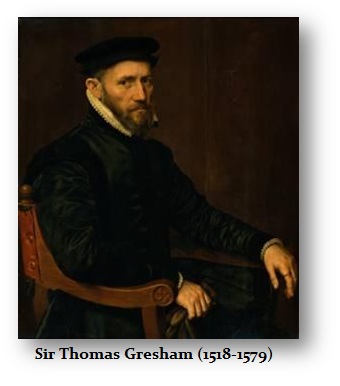
Sir Thomas Gresham made the observation that debasing the currency results in bad money drives out good. But what does that really mean? What he is saying is that people then start hoarding the old money. It may be a paradox, but debasement does not cause hyperinflation, it causes deflation because the vast money supply that was circulating is hoarded. Therefore, the government needs to further debase desperately trying to keep a sufficient degree of money in circulation. The more it debases, the more people hoard. As people hoard, they contract from commerce and GDP contracts. This results is a reduction in tax revenue, which then causes government to further debase to make up shortfalls in revenue.

When you then introduce a collapse in confidence within government, then if people no longer “feel” secure, they then hoard even the based currency. This is why we find so many hoards of debased Roman currency during the chaotic 3rd century.
It is a curious paradox. Right now, people are hoarding as are the banks and corporations. It is hard to hoard paper currency for you will not be able to distinguish between old and new. This means that the hoarding will migrate ti tangible assets, shares, gold, silver, and antiquities.
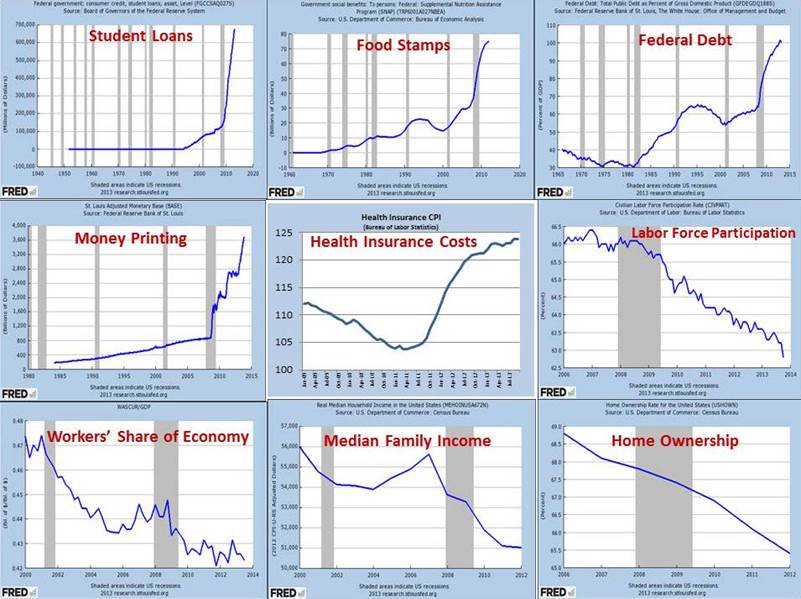
A Snapshot of what Obama has accomplished in 7 years and 3 months and there are still 9 months to go.
A friend sent me an email with this series of charts in it today and after looking at it I thought I would pass it on. There is no explanation needed the charts all speak for themselves.
Austrian Elections Today Too Close to Call!
Armstrong Economics Blog
Re-Posted May 22, 2016 by Martin Armstrong

The people who count the votes claim the election is a dead-heat in Austria today. Norbert Hofer of the Freedom Party and Alexander Van der Bellen are each on 50%, according to the estimate, which includes postal votes not yet counted. The pools really put Hofer ahead, so there may be some voting counting issued, Stalin fashion. Nevertheless, what this is demonstrating is that 50% of the people are fed up with the EU. Instead to addressing the crisis, those in Brussels refuse to ever change course.
Diet Leninism – Coca Cola Halts Production in Venezuela Due To Sugar Shortage…
This is what communism or socialism gets you when you run out of the ability to pay for the free stuff. Anyone that votes for Hillary is voting to bring what you see in Venezuela here — so if you don’t want to have any beer, toilet paper or soda vote for Hillary.
ECM 2015.75: The Rock vs. Hard Place
Armstrong Economics Blog
Re-Posted May 21, 2016 by Martin Armstrong

QUESTION: Mr. Armstrong, with your 2015.75 turning point on the ECM, you said that was the peak in government and the following 4.3 years would turn down rather hard. You also said 2016 would be a strong rise in 3rd party activity and people are now talking even about Bernie running 3rd party. You said 2017 would be the year from political hell and it looks really crazy here in Europe and with Merkel gone, everything will change. Then you said the monetary system would change by 2020 but could come as early as 2018. You said interest rates would start to rise in 2016 as early as March and that would be the fuel behind the dollar and help create the Sovereign Debt Crisis. I understand this is not your opinion and I can now see how each is linked to create the trend. The Berlin conference was fantastic and really helped me understand how this all fits together. My question is simply this. Do you have any idea what the type of monetary system we are headed into? What survives? You said the IMF is trying to position itself for that role which you opposed. Any clue yet?
ANSWER: The Fed is between a rock and a hard place and is trying to be that little flower that sees the light. It has two choices: (1) deal with the pension crisis at home by raising rates to prevent defaults, or (2) keep rates low to save other governments in emerging markets who continue to borrow and are doomed anyhow. Then there is the question of whether the budget deficit in the USA will explode with rising rates.
The Fed has really lost control of the economy, but the mainstream still needs to figure this out. Our model goes nuts from 2018 into 2020. This is part of the peak in 2015.75. Of course, the general public does not see this yet. They should by next year and then the game will change.
 Governments will not go quietly into the light. They will rage at every possible moment. They are moving toward electronic money since their solution is to force everyone to pay whatever tax they demand. On January 1, 2017, G20 will begin sharing info on everyone. Compliance in business will cost tens of billions of dollars alone. Even companies who do not have foreign clients will have to confirm they do not.
Naturally, governments will act in the most stupid manner for they will not reform. Even if they grab everything, it would not be enough to save them. So be prepared. They will get very punitive. Expect crazy laws to benefit them like constitutional amendments. They will find whatever excuse to confiscate assets; mere suspicion will become proof and it will be your burden to prove innocence.
The old guard is near death. People like John McCain and Barbara Boxer, who was shouted down in California by Bernie supporters, are out the door. We are looking at new people coming to power — the changing of the guard. In this respect, Trump is part of the new and Hillary is the old world of corrupt politics. We are turning the corner. Those in government remain clueless.
What survives is always tangible assets be it land, industry, shares, or something of value like gold, silver, antiques, etc. Whatever currency we use is only a medium of exchange between tangible assets. Currency is not “money,” it never holds its value, and by no means is it a store of wealth. It is just a medium of exchange like a language. So whatever we end up with, which I believe will be some basket of currencies, will become the new medium of exchange through which everything else is measured.
Stunning Judicial Ruling From Judge Andrew Hanen – Requires “All DOJ Attorneys” Attend Ethics Classes – Gives U.S. Attorney General Loretta Lynch 60 Days To Present Correction Plan…
I just finished reading the ruling of Texas federal Judge Andrew Hanen (full pdf below) directed to the U.S. Attorney General Loretta Lynch and all DOJ Attorneys appearing in any federal court of …
The Dow & the Confusion
Armstrong Economics Blog
Re-Posted May 20, 2016 by Martin Armstrong

The Dow does not need to break last year’s low. That was accomplished in the NASDAQ and S&P500. Nothing has changed there. The entire interest rate issue has far too many people brainwashed. No doubt, they would initially sell. However, the market will rise with higher interest rates as it has always done historically. Therefore, as shorts build, we can easily create a bear trap and that is the fuel to rally again. This is the churning we are in until it appears at least after September.
This time, we have a far more serious problem with where to put money – big money. Stocks are the modern-day version of what what gold use to be decades again when you could jump on a plane with a suitcase full and sell it wherever you landed. Today, metal detectors prevent that from taking place. Stocks are being used to move money but they must be the high-end shares that are traded globally (see article posted on Egypt).
There is ABSOLUTELY NO INDICATION yet that we are in a bearish trend poised to break last year’s low in the Dow. Another retest of support – YES. Breaking last year’s low would ONLY be indicated with a monthly closing beneath 16000 and prior to August. That said, we have a more important number for month-end at 17579 followed by 17210. A May closing below 17210 would signal a possible test of the 16000 level in the months ahead.
Nevertheless, it is the first Minor Weekly Bearish Reversal in the Dow lies at 17434 which we have flirted with on Thursday. We need a closing below this today to suggest a correction is unfolding. However, make no mistake about it, the next critical area is 17120, which happens to be a Daily and Weekly Bearish Reversal. That is the level to watch for a serious short-term break.

Keep in mind that people continue to think this market is “rich” in price and the are concerned about earnings. Those ideas are so out of touch with reality. The PE Ratio reach 50:1 in 2000 during the DOT.COM Bubble, but it exceeded 120:1 during the 2007-2009 meltdown because blue chips are the place to secure money. The market is by no means “rich” from a historical perspective.
Growing Shortage of US Dollars & Capital Flows
Armstrong Economics Blog
Re-Posted May 20, 2016 by Martin Armstrong

There have been a some unusual capital flow developments involving Egypt illustrating that there is a shortage of dollars building which has been caused by the decline in oil prices. This decline in oil has resulted in a decline in subsidies for Egypt from other Arab nations. What has been taking place is interesting. Shares of Commercial International Bank Egypt on the Cairo market have been bought using Egyptian pounds and then dumped in London sold for dollars taking a loss between 20% and 30%. There is such a shortage of dollars building, there are developing net capital movement through proxy instruments.
These trades have been creating regulatory problems. Typically, regulatory limits dictate how much of the company’s shares can be be traded offshore in the form of global depository receipts. This flow of shares is impacting regulations all because of a shortage of dollars.

