
Armstrong Economics Blog/Interest Rates
Re-Posted Jun 28, 2019 by Martin Armstrong

Austria was able to sell its second 100-year bond in history at just a yield of just over 1.00%. Some argue that capital has been forced to buy anything that has a yield which the ECB has been forcing negative interest rates. Why would anyone in their right mind buy a 100-year bond for 1%? The buyers appear to be pension funds who MUST own government debt as a matter of law.
Austria launched the sale of a 100-year bond on Tuesday after overwhelming investor interest gave its debt officials confidence it could become the first Eurozone country to sell a “century” bond publicly through a group of banks. There has been no paper on this part of the yield curve. Because of comments by Draghi, it is also expected that positive yielding paper will vanish in the Eurozone. As it stands, it will take investors 44 years to recoup their original capital. That will surely be a huge loss.
Austria is planning to sell the bonds via syndication to help access a wider base of investors. The banks involved are Bank of America Merrill Lynch, Erste Group, Goldman Sachs, NatWest Markets and Societe Generale. There is a serious problem brewing where as a matter of law pension fund must buy government paper and at low rates, the pension funds face massive failures going into the next 6 years.
President Trump Participates in Working Dinner With New Prime Minister of Australia Scott Morrison…
June 27, 2019
After landing in Osaka, Japan, for the G20 Summit that begins tomorrow (tonight EDT), President Trump and the U.S. delegation have dinner with Australia’s newly elected Prime Minister Scott Morrison. [Video and Transcript]
.
[Transcript] PRESIDENT TRUMP: Hello everybody. I hope you all had a nice flight — those that came with me. (Laughter.) It’s very nice to have dinner.

And, really, I want to congratulate the Prime Minister on a tremendous victory. He had a fantastic victory, as you know. He didn’t surprise me, but he surprised a lot of other people. See, I knew him, so I said, “He’s going to do very well.” And he did. He did. They called it an upset, but I don’t call it an upset. You probably didn’t. Your wife didn’t call it an upset. (Laughter.) But I want to congratulate you very much. It’s a fantastic thing you did.
PRIME MINISTER MORRISON: Well, thank you, Mr. President. And thanks for hosting us here tonight. It’s going to be an important few days. But there’s no better or stronger or deeper relationship than the United States and Australia.
As you said, we’ve been together for a very long time — 100 years — as our ambassadors have been involved in that program in the United States of fighting together but working together. And the achievements speak for themselves.
PRESIDENT TRUMP: That’s exactly right.
Q Mr. President, are you coming to Melbourne for the President’s Cup Golf?
PRESIDENT TRUMP: I’ll tell you what: I’d like to. (Laughter.)
PRIME MINISTER MORRISON: There’s a warm invitation. It’s standing.
PRESIDENT TRUMP: It might not be easy, but I’d like to. (Laughter.) That’s a big deal. That’s going to be great. That’s going to be great.
Q Mr. President, you talk about “America first” a lot. Do you recognize that, for many of your allies, sometimes it’s seen as “America alone” because it has adverse impacts on countries like Japan and Australia — like on trade, for example?
PRESIDENT TRUMP: Yeah, well, I think I can say very easily that we’ve been very good to our allies. We work with our allies. We take care of our allies. Generally speaking, I’ve inherited massive trade deficits with our allies. And we even help our allies militarily.
So we do look at ourselves, and we look at ourselves, I think, more positively than ever before. But we also look at our allies. And I think Australia is a good example. We’ve worked together very closely – – just recently, on a big trade situation. We had a little bit of a trade deal going, and it worked out very well for both of us.
And I think especially when it comes to those great allies, and Australia would be right there. We’re very proud of it. It’s one of our oldest and one of our best. We were just talking about the battles that we fought together. These are big-name battles, and they were tough battles, and we won every one of them.
So, it’s great to be with you.
PRIME MINISTER MORRISON: Thank you very much.
END 8:02 P.M. JST – 7:02am EDT
Iran says new US sanctions end chances of diplomacy

Shooting Down Conspiracy Theories about U.S. War with Iran

Published on Jun 21, 2019
Trump Clarifies Attack Not Appropriate Since No American Loss of Life
Armstrong Economics Blog/War
Re-Posted Jun 21, 2019 by Martin Armstrong
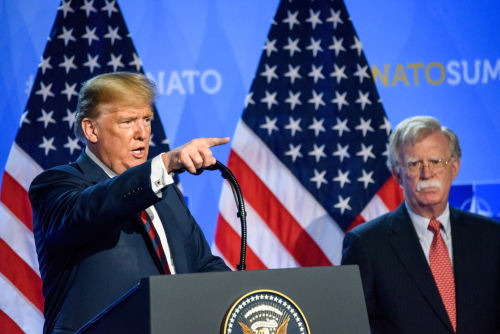
To the hatred of the neocons, including Bolton, Trump has explained that it was inappropriate to retaliate against Iran when 150 people would be killed for the downing of a drone. This not merely shows the nature of Trump, but clearly displays the efforts behind the curtain to get rid of him to wage another war.
Iran Shoots Down US Drone Wednesday Night NY Time
Armstrong Economics Blog/War
Re-Posted Jun 20, 2019 by Martin Armstrong

The news of Iran downing a US drone was circulating in the Middle East before it hit the news wires. It was actually shot down at 7:35 pm New York time on Wednesday night, giving time for the pop in gold. The U.S. Central Command leaders said the attack was “unprovoked” and it took place in international airspace while Iran claims it was over their territory.
Apple Inc. Exploring China Exit – More Supply Chain Moves…
June 19, 2019
This is interesting… but not simply because of the surface visibility. Yesterday there was an event in Charlotte, North Carolina, that brought together Apple CEO Tim Cook, Commerce Secretary Wilbur Ross, U.S. Workforce policy advocate Ivanka Trump and U.S. CoC President Tom Donohue (on the margin).

Today, Apple Inc announces a restructuring of their supply chain away from China. In the media report notice the nations that likely stand to gain, and reference Trump’s 2017 golden ticket tour of Asia.
(Reuters) – Apple Inc has asked its major suppliers to assess the cost implications of moving 15%-30% of their production capacity from China to Southeast Asia as it prepares for a restructuring of its supply chain, according to a Nikkei Asian Review report on Wednesday.
Apple’s request was a result of the extended Sino-U.S. trade dispute, but a trade resolution will not lead to a change in the company’s decision, Nikkei said s.nikkei.com/31zCGhw, citing multiple sources.
The iPhone maker has decided the risks of depending heavily on manufacturing in China are too great and even rising, it said.
Earlier this month, credit rating agency Fitch said it views Apple, Dell Technologies Inc and HP Inc as potential blacklist candidates if China blacklists U.S. companies in retaliation for restrictions on Huawei.
The countries being considered include Mexico, India, Vietnam, Indonesia and Malaysia. India and Vietnam are among the favorites for smartphones, Nikkei said, citing sources who did not want to be identified as the discussions are private.
Last week, Foxconn said it had enough capacity outside China to meet Apple’s demand in the American market if the company needed to adjust its production lines, as U.S. President Donald Trump threatened to slap further $300 billion tariffs on Chinese goods. (read more)

In November of 2017, President Trump traveled to a specific set of Asian nations to meet with their leaders in advance of the APEC summit. Included in the individual bilateral discussions (disconnected from APEC) was: Moon Jae-in (S Korea), Shinzo Abe (Japan), Tran Dai Quang (Vietnam), Rodriquo Duterte (Phillipines) and Narenda Modi (India).

Notice the flow… Shinzo Abe, then Moon Jae-In, then meeting with Xi Jinping.
Who are the principals in the DPRK hostage release of Kim Jong Un? Abe, Moon and Xi.
It’s clear that for two-and-a-half years U.S. President Trump has been working on two connected objectives: (1) removing the threat posed by North Korea by severing the ability of Beijing to use the proxy province as a weapon (Kim is hostage to China); and (2) deconstructing the growing economic influence of China.
The second phase of the 2017 tour took place after Trump visited China. Additionally, there was a simultaneous shift in language. President Trump began using the term “Indo-Pacific”. The tour continued with extended bilateral trade discussions with Vietnam (Tran Dai Quang), India (Modi), and Philippines (Duterte).
In hindsight the connection and strategy is clear. Prime Minister Shinzo Abe is the fulcrum for the two objectives: (1) North Korea (denuke via hostage release); and (2) China (global trade rebalance).
There are ASEAN regional economic beneficiaries for #2, breaking the Chinese supply chain and targeting a manufacturing retreat. Namely: Japan, Vietnam, India, South Korea, Philippines, Malaysia, Indonesia… and Mexico (think USMCA).
[Additionally, Singapore and Tokyo pick up the financial benefits from worries over Hong Kong. More pressure on Chairman Xi]
Back to yesterday… Tim Cook, Wilbur Ross and Ivanka Trump:


Flashback to June 2018:
.

There It is – Chairman Xi Jinping Announces Magnanimous Panda: DPRK Hostage Release is “Correct Direction”…
June 19, 2019
As we noted on Day #1, if we watch how Beijing scripts the messaging we should be able to identify if Chairman Xi Jinping is taking the dragon approach toward his captive Kim Jong Un, or if Xi would instead reshape the geopolitics by announcing his release of Kim as a hostage: The magnanimous panda approach. [Critical Background HERE and HERE]
It looks like we have an answer today as Chairman Xi writes a personal op-ed, published on the front page of North Korea’s state newspaper, where Xi is releasing Kim from proxy province captivity:

…”China supports North Korea’s “correct direction” in politically resolving issues on the Korean Peninsula.”…
Yes, though important details are yet to follow, it appears Beijing is acquiescing to the unrelenting pressure from hostage rescuer President Donald Trump and allowing the DPRK to exit the controlled captivity of China. Likely denuclearization will commence.
SEOUL (Reuters) – Chinese President Xi Jinping said in an op-ed in North Korean state newspaper Rodong Sinmun on Wednesday that China supports North Korea’s “correct direction” in politically resolving issues on the Korean Peninsula.
The front-page op-ed is an honor rarely granted to foreign leaders and comes a day before Xi is set to visit Pyongyang on Thursday and Friday at the invitation of North Korean leader Kim Jong Un, making him the first Chinese leader to visit in 14 years.
[…] Xi’s visit kicks off a flurry of high-level diplomatic activity around the Korean Peninsula ahead of the G20 summit in Japan later this month. Xi said the two Asian countries will “strengthen our strategic communication and exchanges,” adding that China will firmly support Kim’s achievements in “socialist construction” aimed at economic development and improving people’s lives, according to the newspaper.
Xi said North Korea and China would expand and develop relations in civilian sectors, including education, culture, sports, tourism, youth and rural areas.
“We will actively contribute to peace, stability, development and prosperity in the region by strengthening communication and coordination with the Democratic People’s Republic of Korea,” Xi said. China will also engage with other stakeholders “by jointly expediting progress on dialogue and negotiations on the issues of the Korean peninsula,” he added. (read more)
We now enter a phase of great nuance and subtle signaling where we will need to carefully evaluate the scale of hostage release. Obviously western media -writ large- are oblivious to the multidimensional hostage dynamic; heck, most major western media don’t even acknowledge that China controls North Korea… So we have a front row seat to review the generally coded signals.
Two days ago (Monday) Beijing announced Chairman Xi and South Korean President Moon Jae-in were scheduled for a bilateral meeting at the G20 (Osaka, Japan – June 28th and 29th). Obviously Xi has a plan to position the best face for his magnanimous panda approach. We also know on the issue of DPRK hostage release, Chairman Xi will need to save face against President Trump very carefully (hence the phone call between Xi and Trump on Tuesday).
One way for Xi to avoid the appearance of acquiescence to Trump would be for Xi, with Beijing approval, to place the optic of victory at the feet of Moon Jae-in. As we noted from the outset the most likely scenario is China positioning themselves as magnanimous panda and South Korea as the beneficiary. Hence the pre-planned G20 meeting.
“Peace is the Prize” ~ Donald Trump

Ultimately, I don’t think President Trump really cares about who gets credit for the victory, hostage release of Chairman Kim, and denuclearization of North Korea. The world will know, though the media will not say, the victory is only because President Trump has outwitted Chairman Xi and his communist regime…. and Trump did that though strategic economic pressure.
For two-and-a-half years U.S. President Trump has been working on two connected objectives: (1) removing the threat posed by North Korea by severing the ability of Beijing to use the proxy province as a weapon (Kim is hostage to China); and (2) deconstructing the growing economic influence of China.
Both issues are directly connected to U.S. national security; and both issues are being approached by President Trump through the use of economic leverage to achieve national security results.
In the dynamic of the denuclearization of North Korea, the most likely scenario is Chairman Xi playing the role of magnanimous panda and *guiding* Chairman Kim Jong Un into the world of nations. Hence the op-ed outlined today.
South Korean President Moon Jae-in will be positioned as the hero so that Xi doesn’t look like he lost Kim to Trump. However, what we don’t know is how much autonomy Chairman Xi will allow Chairman Kim. It’s the “guiding” part we need to watch closely.
Beijing isn’t going to let Kim go fully antonymous and independent; not when they share a border; and certainly not after generations of strategic influence and control over the DPRK as a proxy province and hedge against the West. Unfortunately, South Korean President Moon Jae-in will be useless as a counter wedge against the cunning of Xi Jinping in this very important aspect.
Moon is essentially the Asian Obama; and has about as much strategic intelligence, foresight and usefulness, as a bag-of-rocks being used as a weather vane. Moon is good for the international optics of unification and dancing joyfully etc, but he’s oblivious to how Beijing may infiltrate and influence all things in/around Korea. Ideological naivete’ makes Moon the perfect person for Chairman Xi to work with.
So we need to keep eyes open for the amount of freedom Chairman Xi will give to Chairman Kim; however, simultaneously we can enjoy watching President Trump exploit the shifted dynamic by engaging with Kim as a freed hostage with full independence.
We can expect that President Trump will immediately start engaging with Chairman Kim Jong Un very openly, as if his captivity never existed. That will drive Beijing bananas, as they will not know of possible private influence by Trump. In turn, President Trump will know the engagement with Kim will drive Beijing bananas; and so Trump will take the U.S. engagement to even higher levels of independence just to watch the dragon flare his nostrils. But that’s still a long way from today….

Remember, two connected objectives: (1) removing the threat posed by North Korea by severing the ability of Beijing to use the proxy province as a weapon; and (2) deconstructing the growing economic influence of China.
With #1 achieved, President Trump will still intend to get #2. Heck, Trump has spent 30-years openly advocating for the principle of restoring American wealth. That means the economic pressure will continue until Beijing is defeated. If Chairman Xi expects POTUS Trump to retreat from the massive geopolitical leverage he has created, well, it’s doubtful that will happen.
President Trump has threatened more tariffs and more consequential action as it relates to non-tariff barriers, IP protection, forced technology transfers etc as a result of China reneging on their prior agreement. Additionally, President Trump has been openly, albeit with coded messages, telling the world North Korea was already no longer a threat.
The best offer -the most likely offer- from President Trump at the G20, is a return to the original 150-page agreement, constructed by USTR Lighthizer and Vice-Premier Liu He, that Beijing and Chairman Xi walked away from. However, even that offer by President Trump is tenuously optimistic at best, because Trump knows China is on its heels.
President Trump has simply outwitted and outmatched Chairman Xi in this economic confrontation. While Xi thought he was outmaneuvering his rival, it was President Trump who was the one wearing the Panda mask all along.
In hindsight every move since early 2017 including: (1) the warm welcome of Chairman Xi Jinping to Trump’s Mar-a-Lago estate; (2) the vociferous praise poured upon Xi; (3) the U.N. sanctions where China and Russia agreed; (4) the November 2017 “golden ticket’ tour of Asia; (5) the direct engagement with North Korean Chairman Kim Jong Un; (6) the strategic relationship with Japanese Prime Minister Shinzo Abe; and a host of smaller nuanced moves were all quietly building toward this conclusion.
For President Trump to have navigated Chairman Xi into such a position is the pinnacle of strategic success. The Chinese culture doesn’t even have a frame of reference for a position that includes ‘less losing’ as their better option.
 BenTallmadge@BenKTallmadge
World’s Top Bicycle Maker Says Era Of “Made in China” Is Over
Giant Manufacturing Co. is moving US orders to Taiwan factory.
Chairwoman says company acted swiftly on Trump’s tariff threat.https://www.bloomberg.com/news/articles/2019-06-17/world-s-top-bicycle-maker-says-era-of-made-in-china-is-over …
World’s Top Bicycle Maker Says the Era of ‘Made in China’ Is Over
Giant Manufacturing Co. saw the writing on the wall early on. The world’s biggest bicycle maker started moving production of U.S.-bound orders out of its China facilities to its home base in Taiwan…
bloomberg.com

BenTallmadge@BenKTallmadgeJun 19, 2019
Trade Tensions Kick Asian Business Confidence To 10 Year Low… the lowest since the June quarter of 2009.https://www.reuters.com/article/us-asia-businesssentiment/trade-tensions-kick-asian-business-confidence-to-10-year-low-thomson-reuters-insead-idUSKCN1TK073 …Trade tensions kick Asian business confidence to 10-year low:…
Confidence among Asian companies in the June quarter fell to its lowest since the 2008-09 financial crisis, as a U.S.-China trade war disrupts global supply chains and shows little sign of easing…
reuters.com


Report: Former Egyptian Muslim Brotherhood Leader Mohamed Morsi Dies in Court…
June 17, 2019
Mohamed Morsi was Egypt’s leader of the Muslim Brotherhood, supported by President Obama, Hillary Clinton and John Kerry, and installed as Egyptian president by extremists during the Islamist Spring. According to Reuters Morsi collapsed in court today and died:

CAIRO (Reuters) – Ousted former Egyptian Islamist president Mohamed Morsi died on Monday after he fainted in court following a hearing, state television reported.
State television said Morsi, who was 67, was in court for a hearing on charges of espionage emanating from suspected contacts with the Palestinian Islamist group Hamas.
Mursi was serving a 20-year prison sentence for a conviction arising from the killing of protesters during demonstrations in 2012 and a life sentence for espionage in a case related to the Gulf state of Qatar. (more)


 Both President Obama and Secretary Hillary Clinton praised Mohamed Morsi when he was ruling Egypt as the chosen representative of The Muslim Brotherhood.
After taking power Morsi immediately opened all the prisons letting the jailed Brotherhood terrorists run free. Then Morsi began jailing his political opponents; he disbanded the court system, and instituted a Sharia compliant constitution while slaughtering hundreds of Coptic Christians.
President Obama and Secretary Clinton praised Morsi – the majority of Egyptian people hated him.
Egyptian military General Abdel Fattah el-Sisi was quickly recruited by the people to take over and remove Mohamed Morsi from office. President el-Sisi stopped the chaos, removed the extremists; exiled the Brotherhood; destroyed Hamas border tunnels into Gaza; began fighting radical Islam, and provided security for all Egyptians, including the Coptic Christians.


[If you put “Morsi” in the search bar [example], you can read dozens of stories about him and the mayhem he created for the people of Egypt. Mohamed Morsi was bad news.]
China vs the US in Trade Negotiations
Armstrong Economics Blog/Basic Concepts
Re-Posted Jun 17, 2019 by Martin Armstrong

QUESTION:
Mr Armstrong
In your opinion of Trump’s trade war policy, you disagree with him because it makes China look weak. What is your solution when the real problem is China stealing intellectual property and they have been called out on it. A person or party always looks weak when they get caught doing something illegal or immoral. Is a little dose of humility and acknowledgment of the error too much to ask?
JM
ANSWER: When dealing with nations, you really cannot humiliate the other side. The best way to deal with that is privately to make it appear there is cooperation and dignity. Both sides must save face. This is not a brawl nor is it a negotiation in a lawsuit. I believe that there is a huge cultural divide and that is a big problem. Many in the private sector in Asia do not negotiate the same way things are done in the West.
The best way is to negotiate behind the curtain and allow the victory to be shared. Head to head confrontation will never win. They cannot afford to yield. This is the same problem with Russia. How can anyone expect Putin to say, “Oh, sorry, you are right. I will yield to your sanctions!” There is less than a zero percent chance of that EVER happening and it would be political suicide for Putin to adopt such a policy in Russia.
I have been in that position of trying to negotiate between two foreign governments. It is not an easy task. One government asked me to see what I could do because I knew the leadership in the other. You must respect the dignity of each player when you are at that level of negotiation

