Major Media is Never Interested in Forecasting


Armstrong Economics Blog/Press Re-Posted Feb 7, 2023 by Martin Armstrong

COMMENT: Marty, it has become obvious that the media promotes everyone but you. I have attended your WEC events and have met central bankers and people from all the major investment banks both in Hong Kong and at your Berlin Conference. The media avoids you like the plague. But everyone of any substance attends your events. Obviously, the media avoids you to suppress the truth when those in power listen to you. Very interesting.

Can’t wait for Dubai

FW

ANSWER: What I do know is that the major media needs its talking heads. It is irrelevant if what they say is right or wrong. It is only the content they need. They do not want someone like me telling the world what you preach about interest rates is not just wrong, it hurts a lot of people.

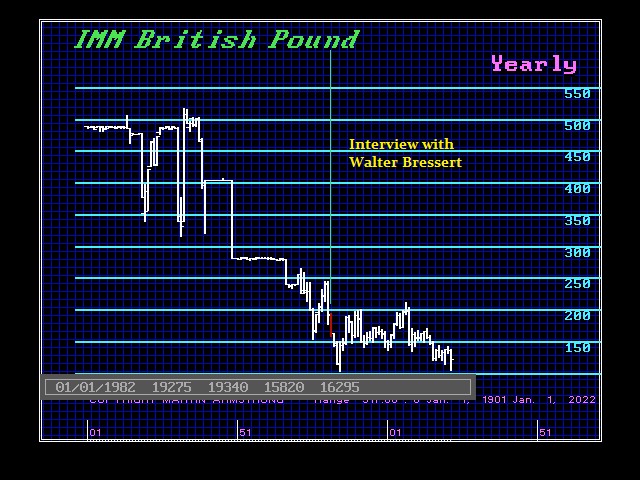
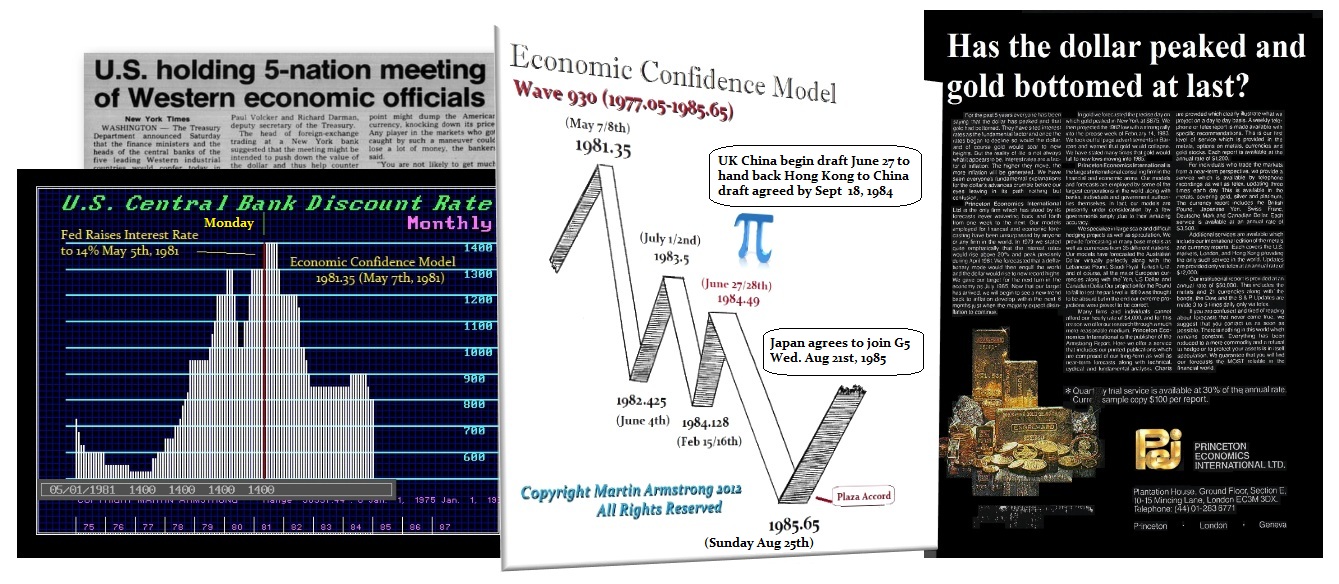
I was doing a TV spot I think in 1983. It was FNN that became CNBC. I was doing an interview with Walter Bressert. I gave our forecast that the British pound would fall to par by 1985. The pound was near the $2 level at the time so it was a 50% drop. The host was shocked. He turned to Walt and asked – “What do you think about that forecast?” Walt and I were good friends. He replied, “I would not bet against his computer.”

That was the last time I was on FNN. They want the standard BS. They do not want real analysis, especially long-term which our computer has been the best at compared to anyone. So, I’m not sure it is some conspiracy plot. I think it’s just self-interest. Major media will occasionally cover our forecasts, but generally only after the events.

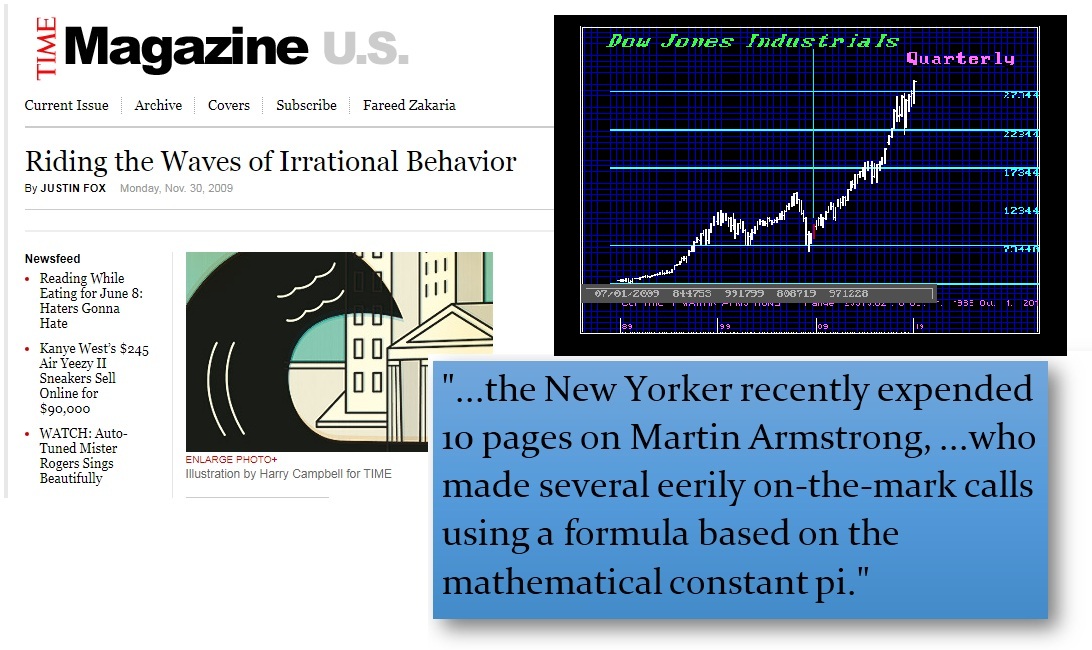
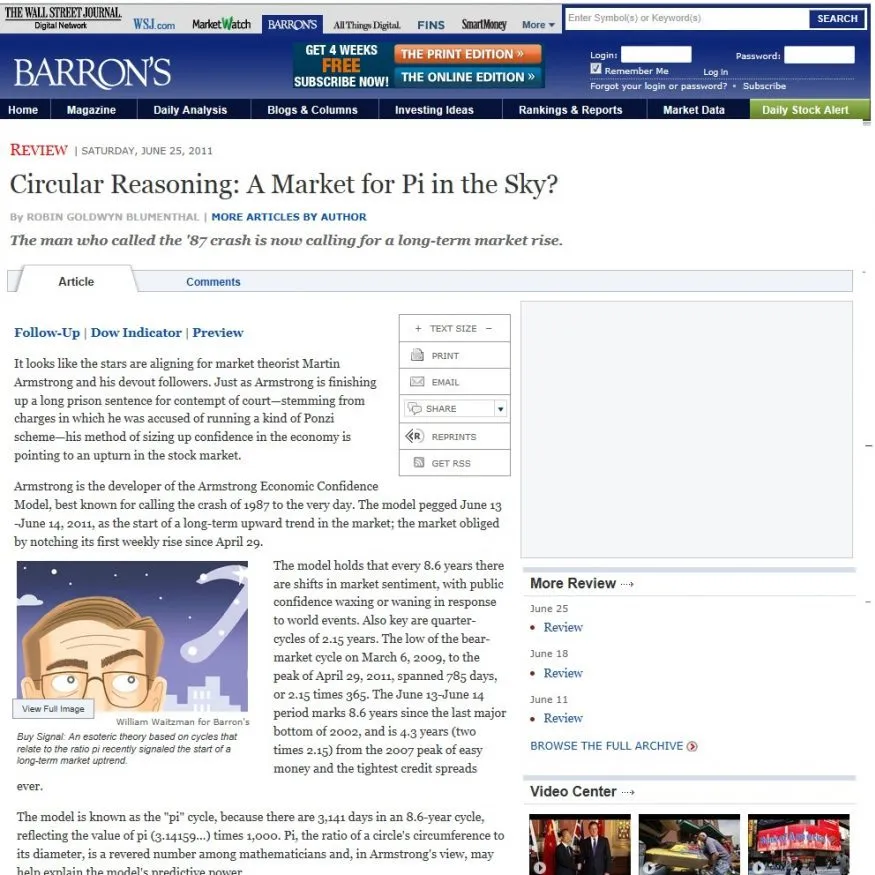
Barrons had reported our forecast from 2010 that the stock market would make new highs, only when they thought it was a joke. When it happened, they never reported that we were the only ones with that forecast.

Major media is not interested in actual forecasting. They only fill content. They just need the talking heads. They do not care if they are ever right. They are selling content – not real analysis. Even the BBC wrote about the economic forecast at DAVOS on how they are always just wrong. They wrote: “There is just one problem: economists have a poor track record for getting it right.” Why? Simply. When people forecast they are expressing an opinion. They are influenced by the current trend and as such, they can never see in advance the change in that trend.

Our computer is usually correct on the long-term trends. It has never missed a shift in the business cycle that I can recall. The media is just not interested in something like that. They want the controversy and personal opinions for they themselves form personal opinions just as they have bought into Climate Change and now they are promoting World War III.

Horrific Death Toll Continues Rising from Earthquake in Turkey/Syria as Aftershocks Continue – So Far 5,600 Buildings Have Collapsed


Posted originally on the CTH on February 6, 2023 | Sundance

I did not have internet access for most of today, another long-term recovery issue.  However, now that I am seeing the footage of the earthquake in Southern Turkey and Northern Syria, my prayers are for all of those in the region.  The devastation is just incredible.

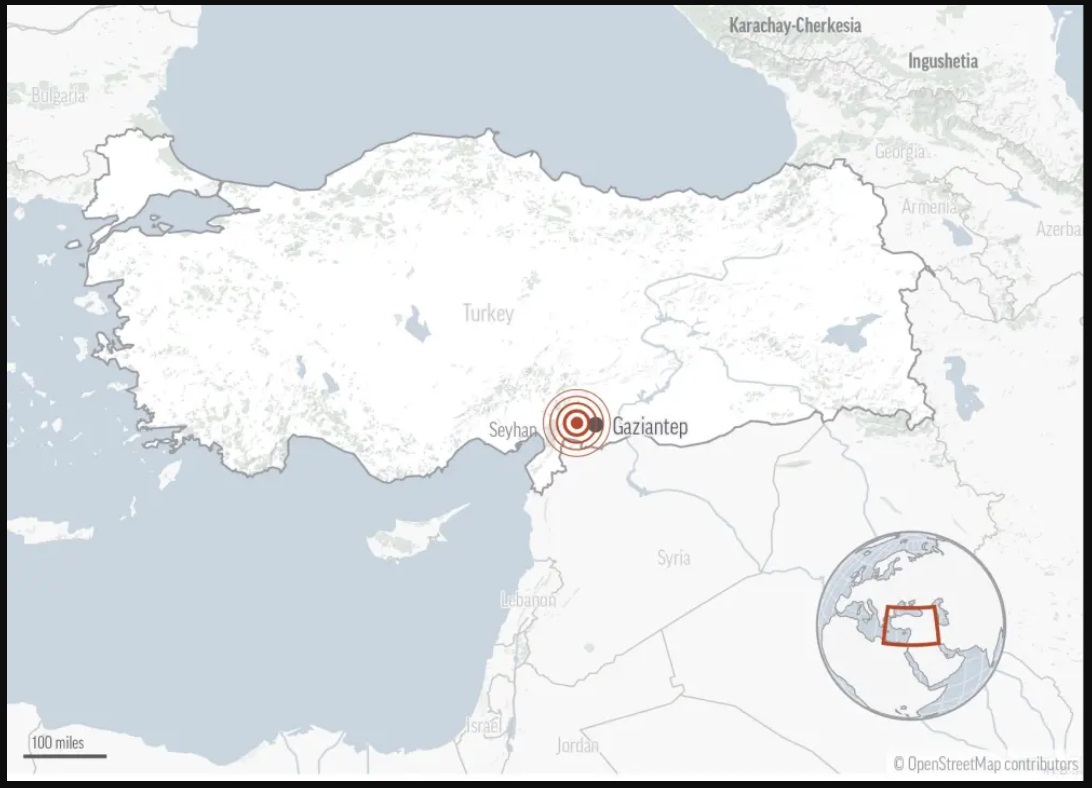
According to the Associated Press, 5,600 buildings have collapsed and several of them came down today during aftershocks amid search and rescue operations.  The current recorded death toll is over 4,300 people, with the World Health Organization (WHO) predicting the total loss of life could exceed 20,000.  This is just horrific.

The estimated 7.8 magnitude earthquake hit over an area of several major population centers. The Guardian reports, “the population of the ten provinces in southern Turkey affected by the earthquakes are home to 13.5 million people. So far, according to the Andalou agency, more than 5,600 buildings have collapsed.

It is just after 6am in Turkey, and we’re seeing stories of people rescued after a very long day and night, which means they survived not only the rubble’s collapse but the cold. There are many, many more who have not yet been found, with the WHO predicting the death toll could reach 20,000 in the coming days. For now, here are videos of a three-year-old toddler and a woman who were freed from collapsed buildings by rescuers.” (link)

(Via Reuters) […] The magnitude 7.8 quake brought down whole apartment blocks in Turkish cities and piled more devastation on millions of Syrians displaced by years of war. It struck before sunrise in harsh weather and was followed in the early afternoon by another large quake.

In Diyarbakir in southeast Turkey, a woman speaking next to the wreckage of the seven-storey block where she lived said: “We were shaken like a cradle. There were nine of us at home. Two sons of mine are still in the rubble, I’m waiting for them.”

She was nursing a broken arm and had injuries to her face.

“It was like the apocalypse,” said Abdul Salam al-Mahmoud, a Syrian in the northern town of Atareb. “It’s bitterly cold and there’s heavy rain, and people need saving.” (more)

All-powerful Father, as we see all of the destruction caused by this natural disaster, we mourn for all that has been lost and the fragility of this life.

Lord God of mercy, please comfort those who have lost somebody they love, and those who are yet still searching. Give them comfort and peace.

Heavenly Father, be a protective wing for those who have survived, but lost their home. Grant the men, women and children the needed fortitude and assistance they need to recover and rebuild.  Show me how best to pray for their needs and guide my prayer. 

Lord God of all creation, be strong with directed purpose for those whose job it is to search through the rubble for those lost.  Give them endurance and strength as they complete their responsibilities.

God of comfort and mercy, help us come together as one body in You during this time of tragedy.

You are the redeemer, the source of our strength and courage, please provide us with reassurance, humanity and faith. 

In Your holy and merciful name, we humbly kneel and pray. 

Amen.

Can Forecasting be Infallible?


Armstrong Economics Blog/Socrates Re-Posted Jan 30, 2023 by Martin Armstrong

QUESTION: Do you think that Socrates will ever achieve infallibility?

KJ

ANSWER:  I have only shown our Global Market Watch model at conferences. It is a pattern recognition model that is learning every day. I have pointed out that nothing is infallible but if anything can achieve that, it will be this model. Right now, it’s not too bad, but it is still in its infancy. What has shocked me more than anything is that it has identified over 80,000 patterns. This is incredible to me. However, it explains why it is impossible for a person to actually forecast correctly. There are so many subtle variances that something may not be what we think is unfolding.

Eventually, it is theoretically possible that we reach some limitations of the pattern variances. If that can be achieved, then and only then would you be able to forecast infallibly.

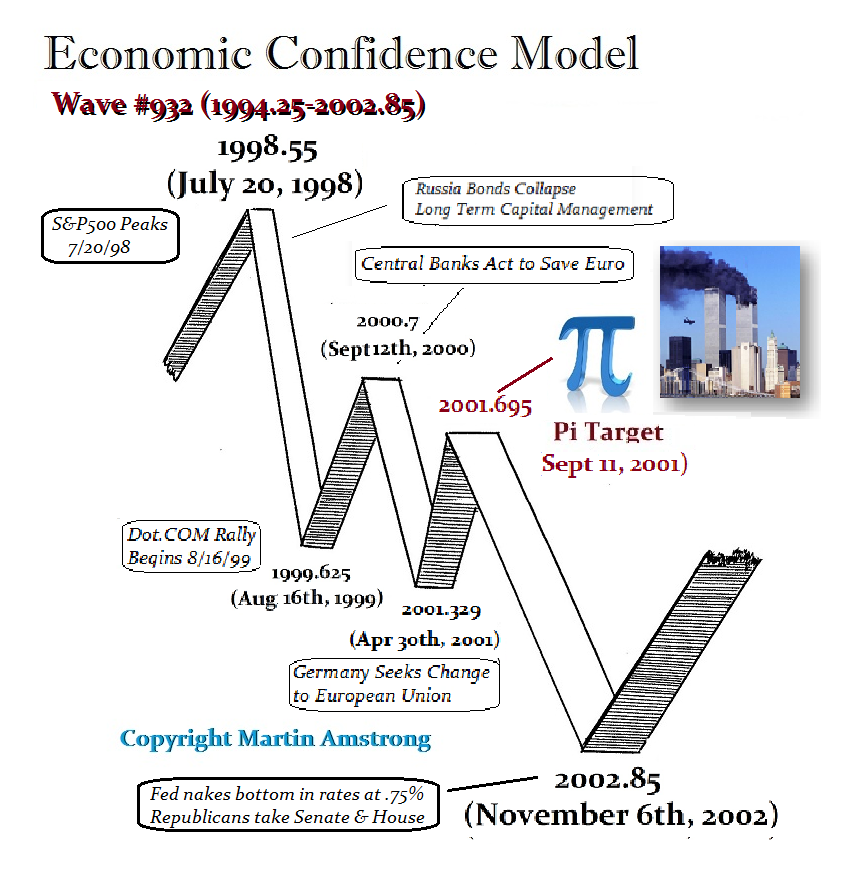
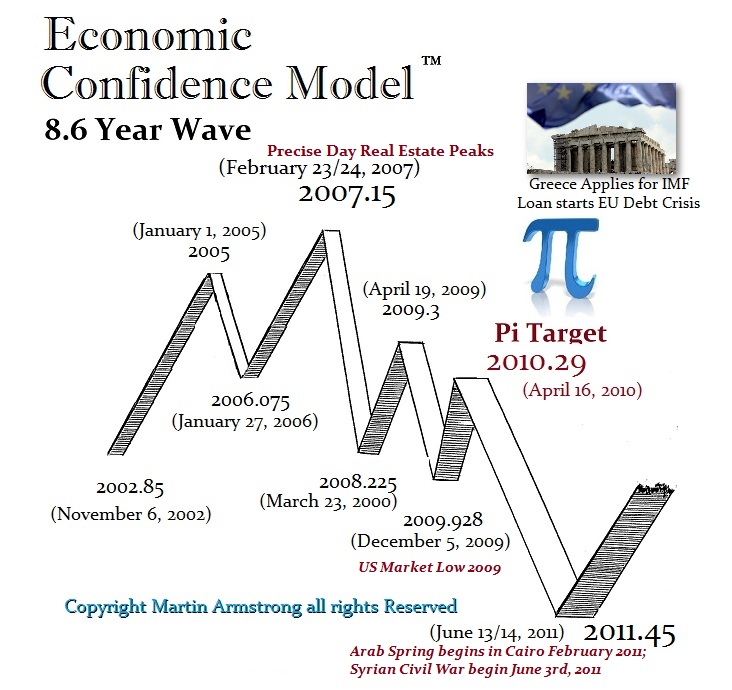
Yet there is something else of tremendous importance. Socrates has been virtually infallible on the long-term trends and events. What I have come to understand is that there are so many possible variations in the day-to-day trends, but it does not alter the long-term. It projected a financial panic in 2008 10 years in advance. How do so many events unfold to the very day of the Economic Confidence Model? All I can say is that these events, which have nothing to do with my personal opinion, confirm that there is a hidden order of complexity that the make human eye cannot possibly see. There are just way too many events that unfold precisely on the very day of a target to be just coincidence. There is a far greater order that exists and people will disparage these forecasts because they think they only work because we have a huge client base.

Shortage of Bread Contributed to French Revolution


Armstrong Economics Blog/Agriculture Re-Posted Jan 27, 2023 by Martin Armstrong

Food shortages have historically contributed to revolutions more so than just international war. Poor grain harvests led to riots as far back as 1529 in the French city of Lyon. During the French Petite Rebeyne of 1436. (Great Rebellion), sparked by the high price of wheat, thousands looted and destroyed the houses of rich citizens, eventually spilling the grain from the municipal granary onto the streets. Back then, it was to go get the rich.

There was a climate change cycle at work and today’s climate zealots ignore their history altogether for it did not involve fossil fuels. The climate got worse at the bottom of the Mini Ice Age which was about 1650. It really did not warm up substantially until the mid-1800s. During the 18th century, the climate resulted in very poor crops. Since the 1760s, the king had been counseled by Physiocrats, who were a group of economists that believed that the wealth of nations was derived solely from the value of land and thereby agricultural products should be highly priced. This is why Adam Smith wrote his Wealth of Nations as a retort to the Physiocrats. It was their theory that justified imperialism – the quest to conquer more land for wealth; the days of empire-building.

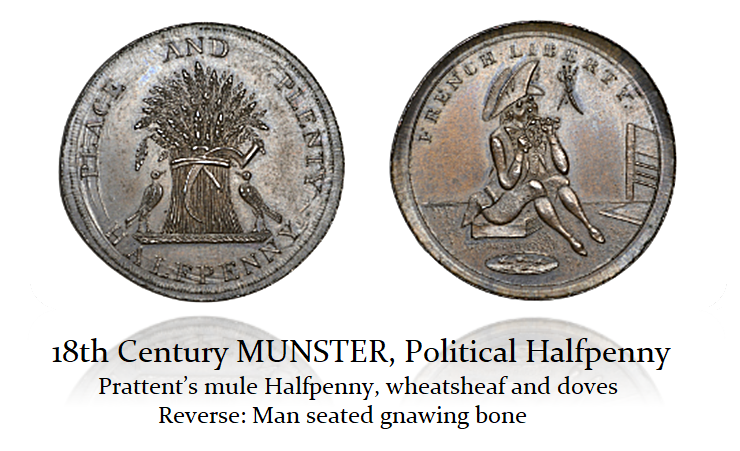
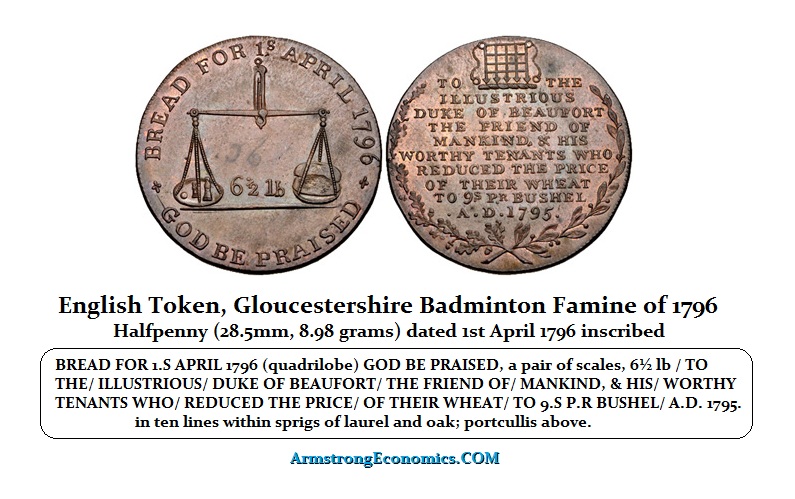
The King of France had listened to the Physiocrats who counseled him to intermittently deregulate the domestic grain trade and introduce a form of free trade. That did not go very well for there was a shortage of grain and this only led to a bidding war – hence the high price of wheat. We even see English political tokens of the era campaigning about the high price of grain and the shortage of food to where a man is gnawing on a bone.

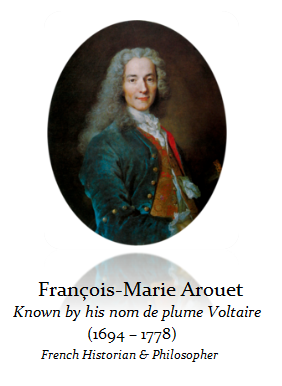
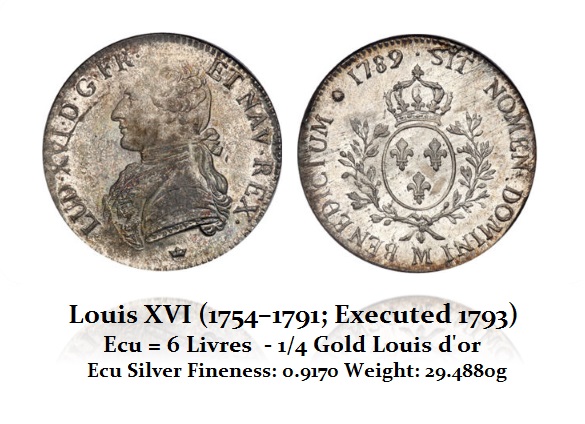
Voltaire once remarked that Parisians required only “the comic opera and white bread.” Indeed, bread has also played a very critical role in French history that is overlooked. The French Revolution that began with the storming of the Bastille on July 14th, 1789 was not just looking for guns, but also grains to make bread.

The price of bread and the shortages played a very significant role during the revolution. We must understand Marie Antoinette’s supposed quote upon hearing that her subjects had no bread: “Let them eat cake!” which was just propaganda at the time. The “cake” was not the cake as we know it today, but the crust was still left in the pan after taking the bread out. This shows the magnitude that the shortage of bread played in the revolution.

In late April and May of 1775, the food shortages and high prices of grain ignited an explosion of such popular anger in the surrounding regions of Paris. There were more than 300 riots and looking for grain over just three weeks (3.14 weeks). The historians dubbed this the Flour War. The people even stormed the place at Versailles before the riots spread into Paris and outward into the countryside.

The food shortage became so acute during the 1780s that it was exacerbated by the influx of immigration to France during that period. It was a period of changing social values where we heard similar cries for equality. Eventually, this became one of the virtues on which the French Republic was founded. Most importantly, the French Constitution of 1791 explicitly stipulated a right to freedom of movement. It was mostly perceived to be a food shortage and the reason was the greedy rich. Thus, a huge rise in population was also contributed in part by immigration whereas it reached around 5-6 million more people in France in 1789 than in 1720.

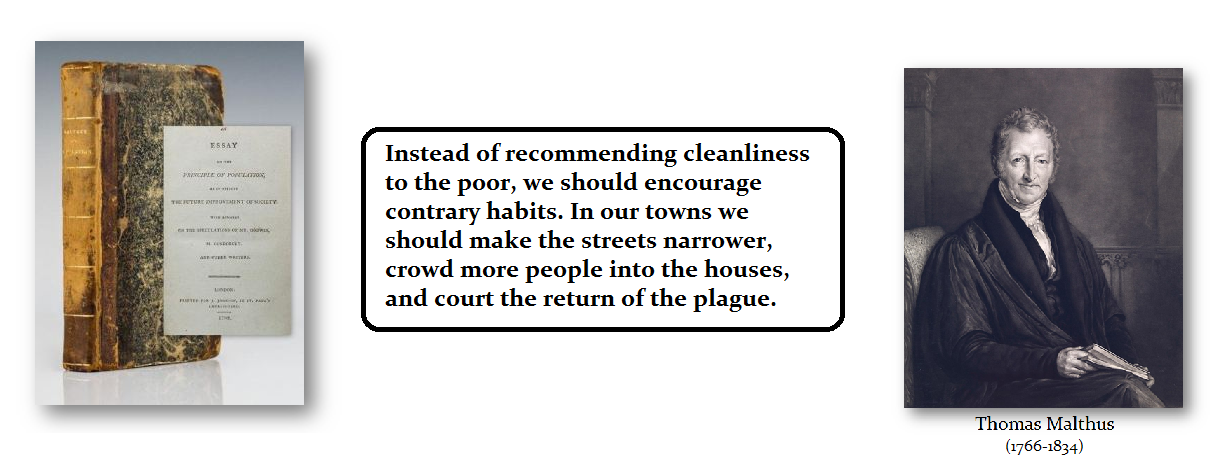
Against this backdrop, we have the publication by Thomas Malthus (1766-1834) An Essay on the Principle of Population was first published anonymously in 1798. He theorized that the population would outgrow the ability to produce food. We can see how his thinking formed because of the Mini Ice Age that bottomed in 1650. All of this was because of climate change which instigated food shortages. Therefore, it was commonly accepted that without a corresponding increase in native grain production, there would be a serious crisis.

The refusal on the part of most of the French to eat anything but a cereal-based diet was another major issue. Bread likely accounted for 60-80 percent of the budget of a wage-earner’s family at that point in time. Consequently, even a small rise in grain prices could spark political tensions. Because this was such an issue, and probably the major cause of the French Revolution among the majority, Finance Minister Jacques Necker (1732–1804) claimed that, to show solidarity with the people, King Louis XVI was eating the lower-class maslin bread. Maslin bread is from a mix of wheat and rye, rather than the elite manchet, white bread that is achieved by sifting wholemeal flour to remove the wheatgerm and bran.

That solidarity was seen as propaganda and the instigators made up the Marie Antoinette quote: Let them eat cake. . Then there was a plot drawn up at Passy in 1789 that fomented the rebellion against the crown shortly before the people stormed the Bastille. It declared “do everything in our power to ensure that the lack of bread is total, so that the bourgeoisie are forced to take up arms.” 

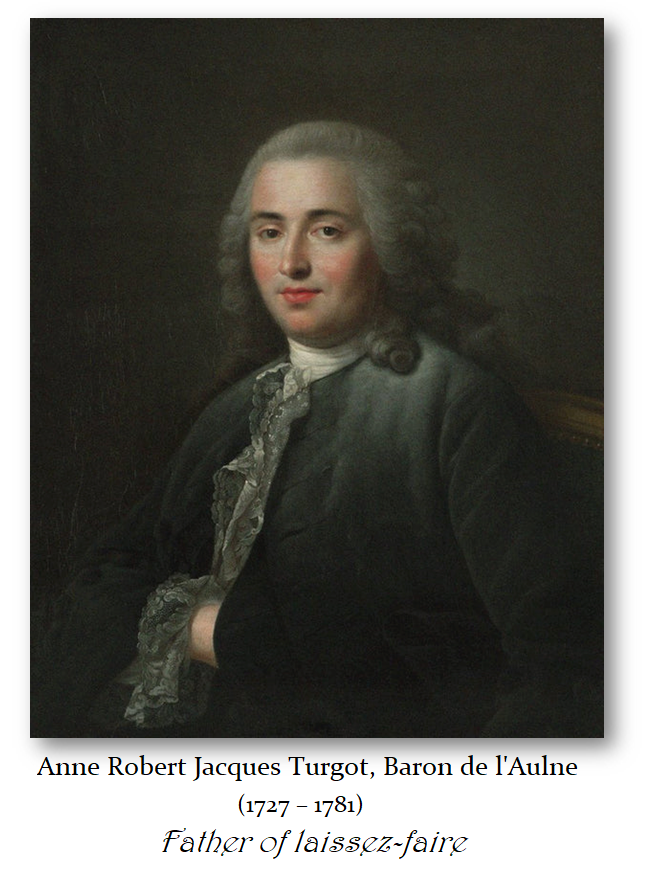
It was also at this time when Anne Robert Jacques Turgot (1727-1781), Baron de l’Aulne, was a French economist and statesman. He was originally considered a physiocrat, but he kept an open mind and became the first economist to have recognized the law of diminishing marginal returns in agriculture. He became the father of economic liberalism which we call today laissez-faire for he put it into action. He saw the overregulation of grain production was behind also contributing to the food shortages. He once said: “Ne vous mêlez pas du pain”—Do not meddle with bread.

The French Revolution overthrew the monarchy and they began beheading anyone who supported the Monarchy and confiscated their wealth as well as the land belonging to the Catholic Church.  Nevertheless, the revolution did not end French anxiety over bread. On August 29th, 1789, only two days after completing the Declaration of the Rights of Man and of the Citizen, the Constituent Assembly completely deregulated domestic grain markets. The move raised fears about speculation, hoarding, and exportation.

Then on October 21st, 1789, a baker, Denis François, was accused of hiding loaves from sale as part of a conspiracy to deprive the people of bread. Despite a hearing which proved him innocent, the crowd dragged François to the Place de Grève, hanged and decapitated him, and made his pregnant wife kiss his bloodied lips. Immediately thereafter, the National Constituent Assembly instituted martial law. At first sight, this act appears as a callous lynching by the mob, yet it led to social sanctions against the general public. The deputies decided to meet popular violence with force.

So, food has often been a MAJOR factor in revolutions. We are entering a cold period. Ukraine has been the breadbasket for Europe. Escalating this war will also lead to accelerating the food shortages post-2024. It is interesting how we learn nothing from history. Wars are instigated by political leaders while revolutions are instigated by the people.

Forecasting the Future


Armstrong Economics Blog/AI Computers Re-Posted Jan 27, 2023 by Martin Armstrong

QUESTION: So if I read you right, you never anticipated that your computer would also forecast war and geopolitical events. ChatGPT seems to be able to find things and answer questions. But it cannot forecast the future by itself. So what did you do that is even more impressive than ChatGPT?

DW

ANSWER: Being a programmer since my teens, was the key. Being a trader, I had experience in both fields, which enabled me to TEACH my system how to analyze. So Socrates is not going out to the web and collecting what everyone has to say. It is analyzing the data all on its own.

Because I was also a history buff, I saw how civilization rose and fell. There was obviously a  cycle to absolutely everything. Since even taking energy, we use to just burn wood, then oils, then whale oil, and then oil. There is a cycle to innovation. Not personally knowing if that will change to something else, I had to construct my system with my experience and then allow it to discover entirely on its own.

I have explained at conferences that we had a client, the Universal Bank of Lebanon, who found a ledger recording the daily prices of their currency back decades. They asked if we could create a model. The data was input and the system forecasted that their country would go into chaos in 8 days. I thought something was wrong with the data. They calmly asked – What currency would be best? They saw themselves the crisis coming and in 8 days the civil war began. The same took place with a Sausi client who was a big shipper. He wanted to know what gold was going to do for Iran was going to start attacking shipping in the Gulf the next day. I asked: Are you telling me a war will start tomorrow? Oh yes, he replied. So by 1998, it was clear that the computer was capable of projecting wars. That is when I stood up in our London WEC in June 1998 and warned that Russia was about to collapse in 30 days. That became the Long-Term Capital Management collapse with the Russian bond market.

So ChatGPT is cool and it will dazzle everyone. I wrote such a program during the early ’80s to teach my computer how to use natural language to communicate. I used my children as the input. The program I wrote was designed to have a conversation. It would retain a database of who you were so if it asked if you had a dog and you said yes, it would ask you its name and remember that. So the next time you came back it would ask you how is your dog. It had so impressed my daughter should bring all her friends over. I was working with Dragon Systems back then when it was hardware. So the computer would talk verbally to them and they thought it was alive.

We will release a portal where you can ask Socrates questions and it will respond. But this is focused on the economy, not the name of Lady Gaga’s dog. Socrates is totally different from ChatGPT.

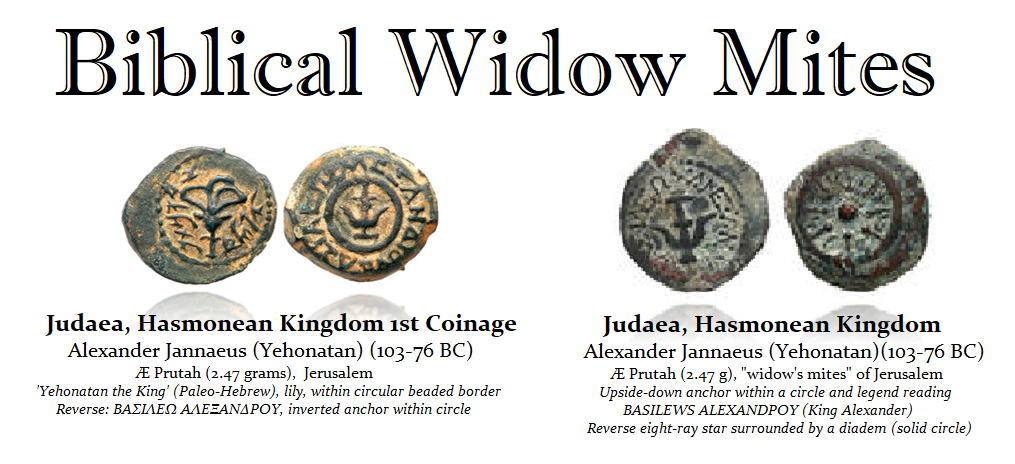
The Biblical Widow Mites


Armstrong Economics Blog/Products and Services Re-Posted Jan 27, 2023 by Martin Armstrong

Mark 12:41-44:
“And Jesus sat over against the treasury, and be beheld how the people cast money into the treasury:k and many that were rich cast in much. And there came a certain poor widow, and she threw in two mites, which make a farthing. And he called unto him his disciples, and saith unto them, Verily I say unto you, That this poor widow hath cast more in, than all they which have cast into the treasury: For all they did cast in of their abundance; but she of her want did cast in all that she had…”.


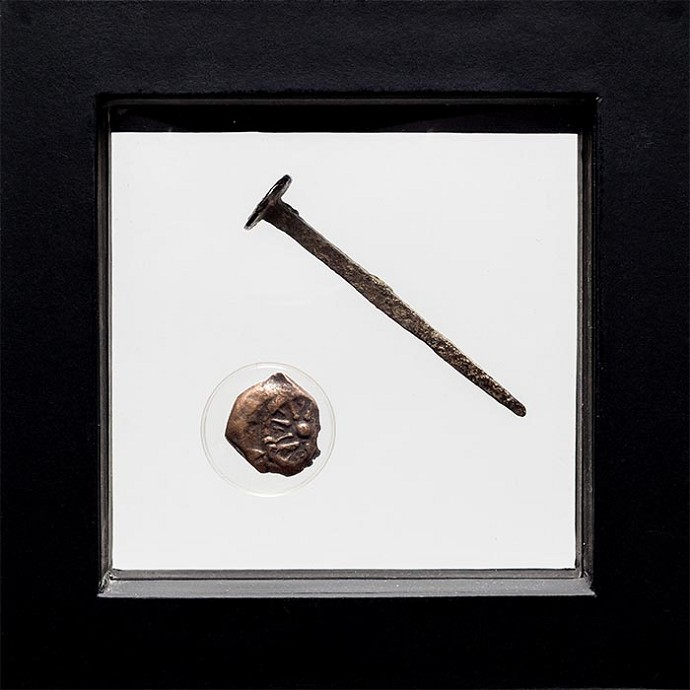
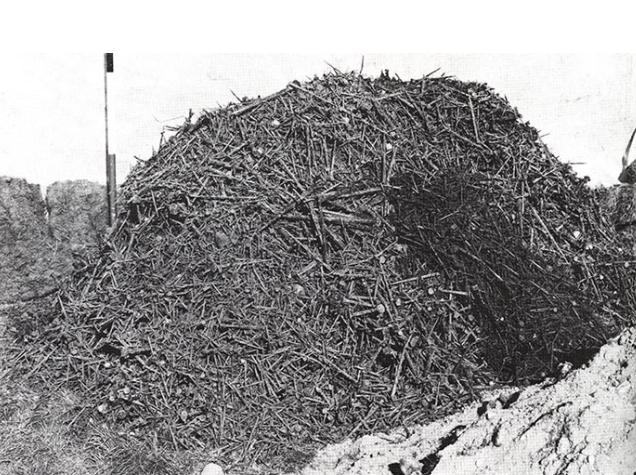
A lot of people are asking if I have any more biblical Widow Mites I could put together. The answer is yes, but I will have to see what I have left.  For those who want the unusual showpiece, we can frame a Widow’s Mite with a Roman Nail documented from the 1st century at the time of the Crucifixion. While most of the nails were retained by the museums after the discovery, a small portion was allowed to be sold privately.

Roman nails were made of iron. This hoard was buried to prevent others from finding them from which they would make weapons and shields. Iron was a valuable metal to many of the barbarian tribes. Hence, this hoard was a remarkable find from the 1960s. They finally allowed some to be sold only in 1999.

Those interested in such a unique gift, send an email. Obviously, we would need to know how many people really want to have them framed up.

The price would be $125 for a Roman nail and a Widow Mite framed

Two More Bodies Recovered in Aftermath of Hurricane Ian


Posted originally on the CTh on January 14, 2023 | Sundance

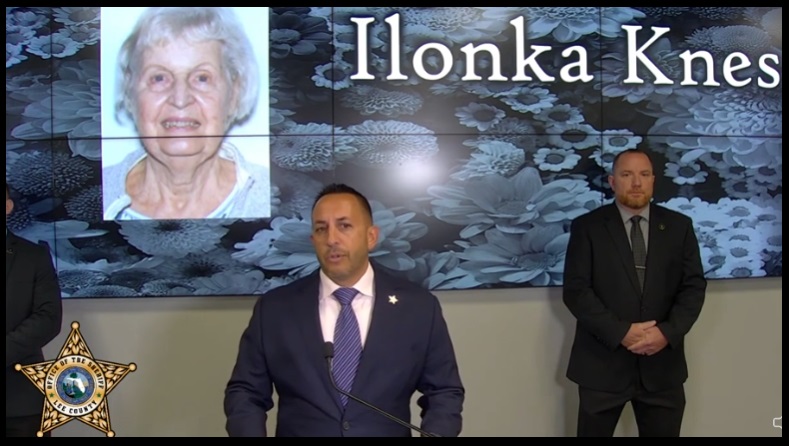
Their names will not make national headlines, and generally everyone has moved on, but to their families and friends Ilonka Knes and James Hurst mattered.  As CTH readers may remember, in the aftermath of Hurricane Ian we shared that many missing people would be found in the months after the storm, and unfortunately many more will likely never be found.

The body of Mrs Ilonka Knes (82) was found in the mangroves and back bay salt marsh near Fort Myers Beach and has been positively identified. The body of her husband Robert was found in the days immediately following Hurricane Ian.

Additionally, the sailboat “Good Girl” was found submerged with human remains believed to be the body of James ‘Denny’ Hurst (73).

Mrs. Knes and Mr Hurst bring the total number of Hurricane Ian victims in Lee County, Florida, to seventy-five.  Mr. Hurst was the final “official” missing person on the local list; however, there are many more yet unaccounted that were not from this immediate area.   The physical devastation is widespread, but the emotional toll on the families and friends of the missing has been beyond imagining.  Tonight, two more families have answers.

(FLORIDA) – During Thursday’s news conference, Lee County Sheriff Carmine Marceno released new information regarding the area’s recovery.

“Most of us have gotten back to a sense of the new normal. For some, still missing their loved ones, every day since the storm has been difficult,” said Marceno.

The sheriff said his agency originally attempted a well-being check at what was left at the home of Ilonka and Robert Knes in the aftermath of the storm.

The body of Robert Knes was found shortly after Ian struck, but there were no signs of his wife during the days and weeks following the disaster.

Marceno said it wasn’t until mid-January that a debris removal crew found remains in a dense patch of mangroves, that later tested positive, through the use of dental records, to be that of Ilonka. (more)

The power and duration of Hurricane Ian killed more people than Hurricane Andrew and the storm that hit Southwest Florida last September is now recorded as the deadliest storm in the past 87 years.

If you live anywhere along the coastline of the United States, inland to about 50 miles, please remember to always take these storms seriously.

After this storm, and having been through four previous direct impacts, including Homestead AFB (Andrew), I would say this….  If there is even a remote chance you would ever encounter this type of a hurricane event, EVACUATE.  Do not try and hunker down if there is a looming possibility of having to rely on a structure to withstand 150+ mph wind for a full day.  Just leave.  With all of my preparations in place, and all of the knowledge I possess in storm survival, I would never attempt it again.

It is more than three months since Hurricane Ian hit Southwest Florida and beyond the chaos and debris that still remains visible almost everywhere, they are still recovering bodies.  Please take hurricane preparations seriously.

Lessons from Ian – Part One

Lessons from Ian – Part Two