Posted originally on the conservative tree house on September 22, 2022 | Sundance
With most financial media being intentionally obtuse with the Biden economic impact upon Main Street, it is refreshing to see analysis that cuts to the heart of the matter. HatTip to ZeroHedge who provides a link to a great article outlining reality for blue and white-collar working families.
The folks at NerdWallet have taken the inflation date from the Bureau of Labor and Statistics (BLS) and applied the math to real life. The result is a good encapsulation of checkbook economics and how the Biden economy is painful for the working class.
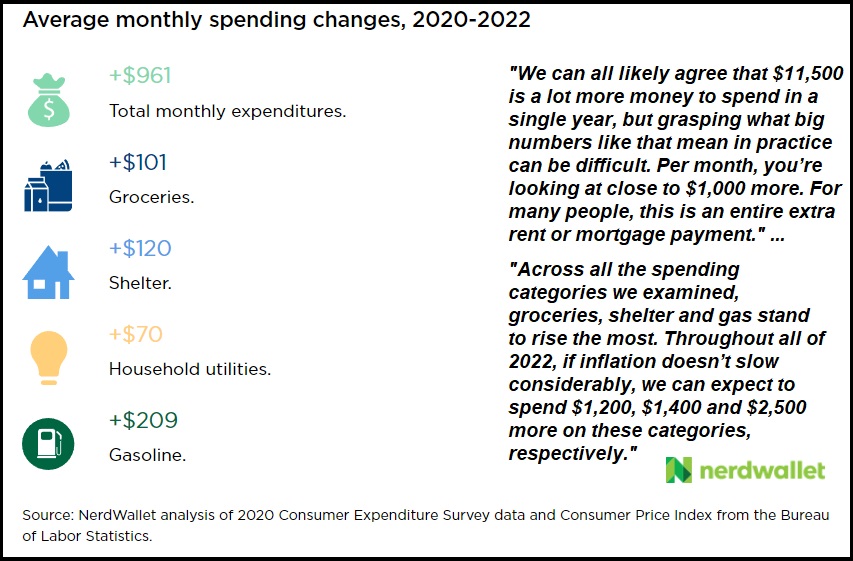
In total, Joe Biden’s energy policy driven inflation has added $961/month to preexisting expenses. That’s $11,532 a year just to retain the status quo standard of living.
(NerdWallet) – […] In all of 2020, American households spent $61,300, on average. This number includes everything we spend our money on: housing, food, entertainment, clothing, transportation and everything else. In 2022, it stands to reach $72,900, a difference of more than $11,500 if consumers want to maintain the same standard of living. Keep in mind, this is an average, a number that represents an approximation across all Americans, but one that’s exact to a very few. Those who earn (and therefore spend) more will see more dramatic dollar increases. Those who earn less may see less dramatic dollar jumps, but the impact of these rising prices could be more significantly felt. (read more)
If the average household spent $61,300 and inflation is adding $11,500 to the expense, that means we now have to spend 18.7% more just to maintain the current standard of living. That average is in line with what we are seeing in the real world.
Posted originally on the conservative tree house on September 21, 2022 | sundance
Federal Reserve Chairman Jerome Powell announced another 75-point increase in federal interest rates today. This is the third consecutive 0.75 percentage point increase. Additionally, Fed policymakers have pledged to continue raising rates as high as 4.6% in 2023.
While Powell walked through his reasoning to continue targeting inflation by lowering consumer demand, not once in any of his remarks did he mention energy policy driving up the cost of materials and goods. The Great Pretending continues. WATCH:
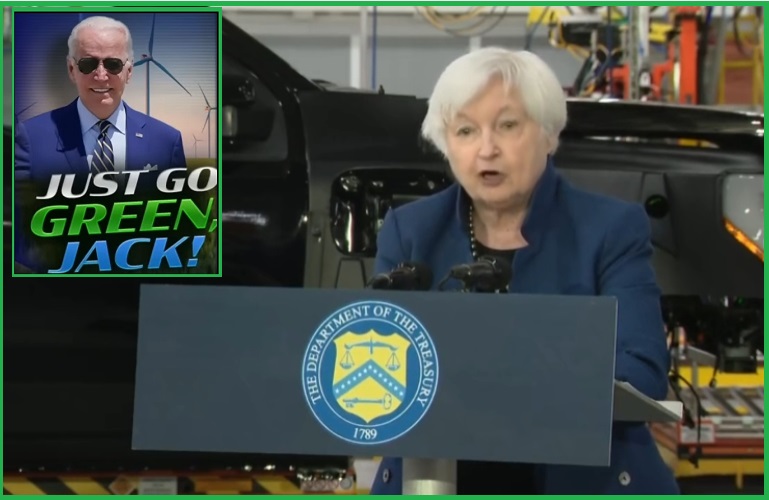
The Fed chair is trying to manage the economic policy transition by reducing economic activity to match intentionally diminished energy supplies. Lowering economic activity drops demand for energy. Unfortunately, as admitted by Powell on August 26, 2022, in Jackson Hole, this means a period of “some pain” for Americans as the central banks join together in an effort to lower consumption.
What does “some pain” mean? It means lower incomes, higher prices, lowered standards of living and more scarce resources. During this transition to owning nothing and being happy about it, the pain is your wealth being stripped as the economy is intentionally diminished.
We will not be able to afford much; we won’t be able to afford the foods we want; we will not be able to purchase anything except the essentials, and those essentials will cost much more; we won’t be able to vacation, travel, or enjoy recreational activities; we won’t be able to afford any indulgences; but at the end of the process, we will learn to live more meager existences based on lowered expectations needed for sustaining the planet. Pay no attention to the elites who don’t have those concerns, comrade.
Posted originally on the conservative tree house on September 20, 2022 | sundance
Trying to survive current price increases in housing costs, energy costs, electricity costs, food and fuel costs has forced consumers to reevaluate purchasing decisions. As consumer demand for non-essential items has collapsed, and as Americans dig deeper into their savings just to sustain current unavoidable expenses, major retailers are now cancelling Christmas inventory orders.
On one hand the leaders of large multinationals must pretend everything is splendid; after all, the only acceptable position they can articulate is to support interest rates being raised because demand is just too darned high. lololol… pretending. But on the other hand – those same retailers are furiously trying to calculate how to avoid being stuck with billions worth of unsold inventory.
RetailWire – Walmart, Target, Macy’s and Kohl’s are among retailers that have recently said they are canceling some orders to better balance inventory levels, a replay of a strategy used at the start of the pandemic.
Other steps retailers are using to clear inventories as spending has slowed on some non-discretionary categories are employing markdowns and packing away products for the following year. The elevated inventory levels also reflect intentional over-buying to mitigate shortages and the easing of supply chain constraints.
[…] Christina Hennington, Target’s EVP and chief growth officer, said steps being taken by the discounter’s buying team include “rigorously reforecasting expectations for the balance of the year and beyond and determining where to reduce future receipts and orders. In some cases, it meant working with vendor partners to reduce our fall receipts in light of our updated expectations. It also meant quickly building compelling promotional plans to drive unit velocity for product we already owned, all with a focus on providing great value and generating excitement for our guests.”
John David Rainey, Walmart’s EVP and CFO, said it had cleared most summer inventory, was reducing exposure in electronics, home and sporting goods, and canceled “billions of dollars in orders” to realign inventories. He said, “Our actions in Q3 will allow us to make significant progress toward rationalizing absolute levels and mix, which will enable our stores to be well positioned ahead of the holiday season.” (read more)
Well positioned Mr Beale. You must say we are “well positioned.”
Where “well positioned” means put loaves of bread and sausages where the flat screen televisions used to be located.
This is a reminder of why I warn against listening to the talking heads. Unlike advanced AI software, these mouthpieces speak from a biased perspective. On March 11, 2008, Jim Cramer told his audience on CNBC’s “Mad Money” that “Bear Stearns was fine!” At the time, the stock was going for $62 before crashing down to $2 only five days later.
When a viewer wrote in to Cramer to ask about Bear Sterns experiencing a liquidity crisis, Cramer shouted: “NO, NO, NO! BEAR STEARNS IS FINE! DO NOT TAKE YOUR MONEY OUT! If there’s one takeaway, Bear Stearns is not in trouble.” He added, “I mean, if anything, they’re more likely to be taken over. Don’t move your money from Bear. That’s just being silly. Don’t be silly.”
Cramer later tried to claim he never said to buy the stock, but was simply discussing the banking sector. He was trying to prevent a panic, he claimed. In reality, this man has repeatedly made poor calls, yet still remains on air. His screaming tirades are interrupted by commercials and his show is nothing more than the QVC of stocks.
Cramer is an entertainer. Even if I were to go on TV and make forecasts solely from my own viewpoint, I would be doing a disservice to my audience. If you’re looking for true analysis, then there is only one tool that is unbiased and capable of tracking every market around the world.
Posted originally on the conservative tree house on September 18, 2022 | Sundance
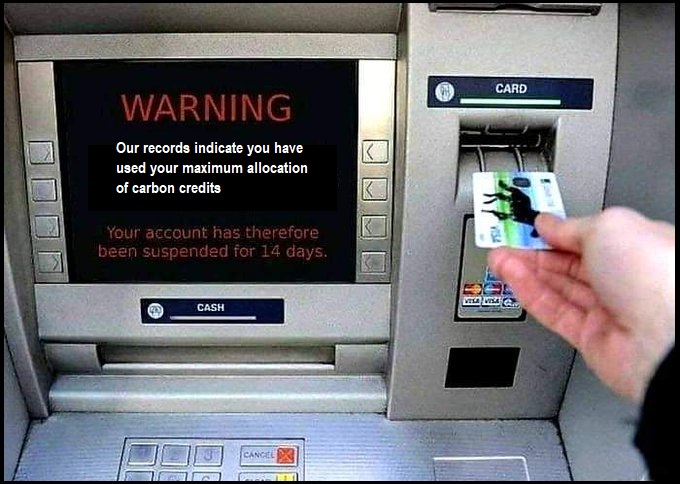
If you combine government use of energy policy, government regulation on individuals around that energy policy, and the self-interested need to control political opposition, you discover one of the most effective ways to control human activity is to control their finance.
Canadian Prime Minister Justin Trudeau gave us a great example of that when he weaponized the power of the Canadian government to target the protesting truckers and those who support them. You might remember Trudeau’s government locked down bank accounts, froze assets, denied loans, blocked mortgages and generally confiscated the wealth and incomes of his political opposition without any due process; all because the people were challenging his totalitarian COVID dictates. {Go Deep}
Take those reference points as an overlay and now consider this undiscussed recent announcement from the Biden administration:
[White House] – President Biden often summarizes his vision for America in one word: Possibilities. A “digital dollar” may seem far-fetched, but modern technology could make it a real possibility.
A United States central bank digital currency (CBDC) would be a digital form of the U.S. dollar. While the U.S. has not yet decided whether it will pursue a CBDC, the U.S. has been closely examining the implications of, and options for, issuing a CBDC. If the U.S. pursued a CBDC, there could be many possible benefits, such as facilitating efficient and low-cost transactions, fostering greater access to the financial system, boosting economic growth, and supporting the continued centrality of the U.S. within the international financial system. However, a U.S. CBDC could also introduce a variety of risks, as it might affect everything ranging from the stability of the financial system to the protection of sensitive data.
Notably, these benefits and risks might vary significantly based on how the CBDC system is designed and deployed. That is why Executive Order 14067, Ensuring Responsible Development of Digital Assets, placed the highest urgency on research and development efforts into the potential design and deployment options of a U.S. CBDC. The Executive Order directed the Office of Science and Technology Policy (OSTP), in consultation with other Federal departments and agencies, to submit to the President a technical evaluation for a potential U.S. CBDC system.
Today, OSTP is publishing its report, Technical Evaluation for a U.S. Central Bank Digital Currency System, which lays out policy objectives for a potential U.S. CBDC system and analyzes key technical design choices for a U.S. CBDC system. The report also estimates the technical feasibility of building a CBDC minimum viable product and describes how a U.S. CBDC system might affect Federal operations. The report makes recommendations on how to prepare the Federal Government for a U.S. CBDC system. Importantly, the report does not make any assessments or recommendations about whether the U.S. should pursue a CBDC, nor does it make any decisions regarding particular design choices for a potential U.S. CBDC system. (read more)
When you read that full announcement, you realize they have already built the system.
If the system is built and they are now making policy recommendations for implementation, the question becomes ‘what’s the goal’?
We do not have to look far for the explanation.
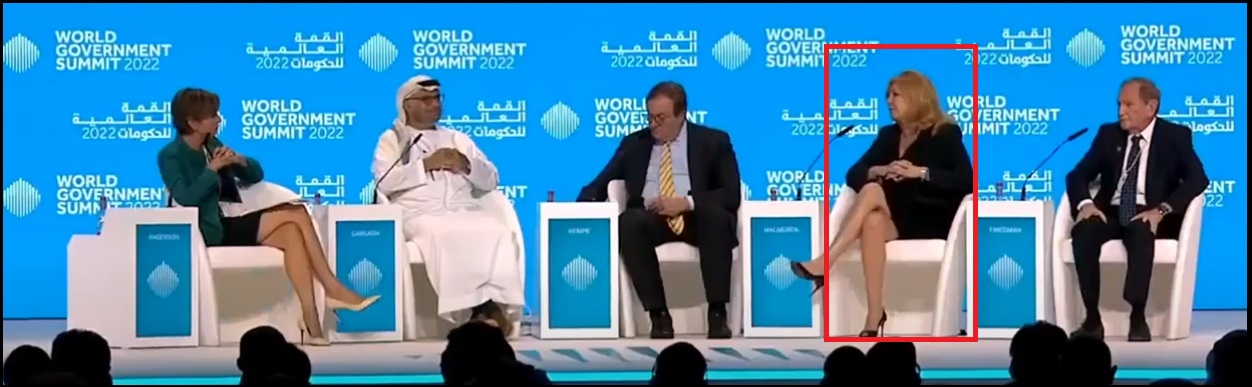
the World Government Summit 2022 took place on March 29 and 30 in Dubai, hosting more than 4,000 individuals from 190 countries including senior government officials, heads of international organizations, and global “experts.” The invited participants presented ideas and worldviews from within their various fields of specialty.
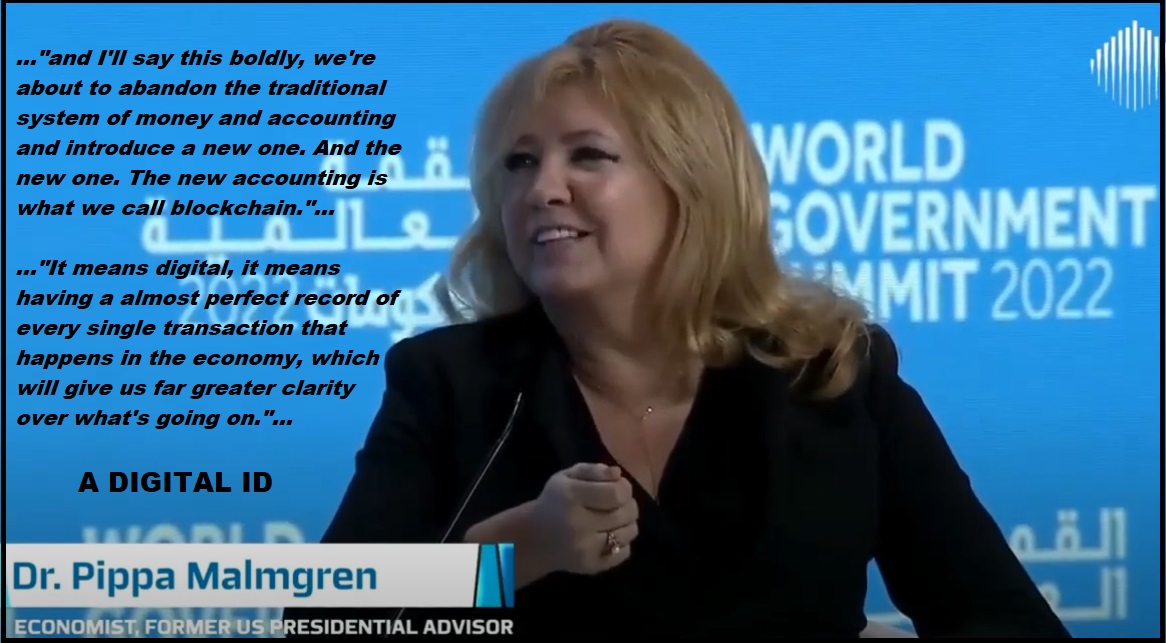
One presentation was from Dr. Pippa Malmgren, an American economist who served as special advisor on Economic Policy to President George W. Bush.
Her father, Harald Malmgren, served as a senior aide to US Presidents John F. Kennedy, Lyndon B. Johnson, Richard Nixon, and Gerald Ford. In this segment, Mrs. Malmgren says the quiet part out loud. Yes, they are no longer hiding the construct; indeed, as you will hear they are saying quite openly what the future will look like. WATCH (2 minutes):
Transcript – Dr. Malmgren: “What underpins a world order is always the financial system. I was very privileged. My father was an adviser to Nixon when they came off the gold standard in 71. And so, I was brought up with a kind of inside view of how very important the financial structure is to absolutely everything else.
And what we’re seeing in the world today, I think, is we are on the brink of a dramatic change where we are about to, and I’ll say this boldly, we’re about to abandon the traditional system of money and accounting and introduce a new one. And the new one. The new accounting is what we call blockchain.
It means digital, it means having a almost perfect record of every single transaction that happens in the economy, which will give us far greater clarity over what’s going on. It also raises huge dangers in terms of the balance of power between states and citizens.
In my opinion, we’re going to need a digital constitution of human rights if we’re going to have digital money. But also this new money will be sovereign in nature. Most people think that digital money is crypto, and private. But what I see our superpowers introducing digital currency, the Chinese were the first the US is on the brink, I think of moving in the same direction the Europeans have committed to that as well.
And the question is, will that new system of digital money and digital accounting accommodate the competing needs of the citizens of all these locations, so that every human being has a chance to have a better life? Because that’s the only measure of whether a world order really serves!”
The entry into a digital currency, needs a digital identity.
The end goal of a digital currency is why western political leaders have not been worried about following the COVID-19 spending demands from the World Economic Forum. {Go Deep}
When the global trade currency does not need to be pegged to anything to determine value, it is completely fiat. This is the current problem with global trade and transactions taking place in U.S. dollars, which arbitrarily lifts the standard of life for Americans while providing no similar benefit to other nations. That view became the underlying motive for Osama Bin Laden to target the World Trade Center, twin towers. That view was/is also the perspective carried by Barack Obama, that lay behind his “fundamental change” statement.
A digital currency allows ultimate control on a global basis by a one world government, or western system of collective governments, that can assign value. No other mechanism will have as much control over the life of a person than a digital currency that will create a system of transactional credits and debits, perhaps also influenced by your social credit score.
The digital currency requires a digital identity in order for apportionment based on your value to society. This is essentially an extension of the Fabian mindset into the world of financial transactions and monetary evaluations. Fabians believed that some form of socioeconomic tribunal would be needed in order for each citizen to be quantified according to their “worth” to society. The Chinese social credit score is a variant of that same concept.
The phrase “you didn’t build that,” when espoused by former President Obama and current Senator Elizabeth Warren is also based on this collective worldview. Both believe that individuals do not succeed independently, but rather gain their ability to grow wealth by using the resources of the larger society, infrastructure, labor and education. The phrase “it takes a village” to raise a child, as espoused by Hillary Clinton is another variant of the same collective advocacy.
A digital currency and digital identity is not a conspiracy theory, these “global leaders” are explaining it to us out loud. However, I am concerned that most will not hear it, or understand it, until it is too late.
Posted originally on the conservative tree house on September 14, 2022 | Sundance
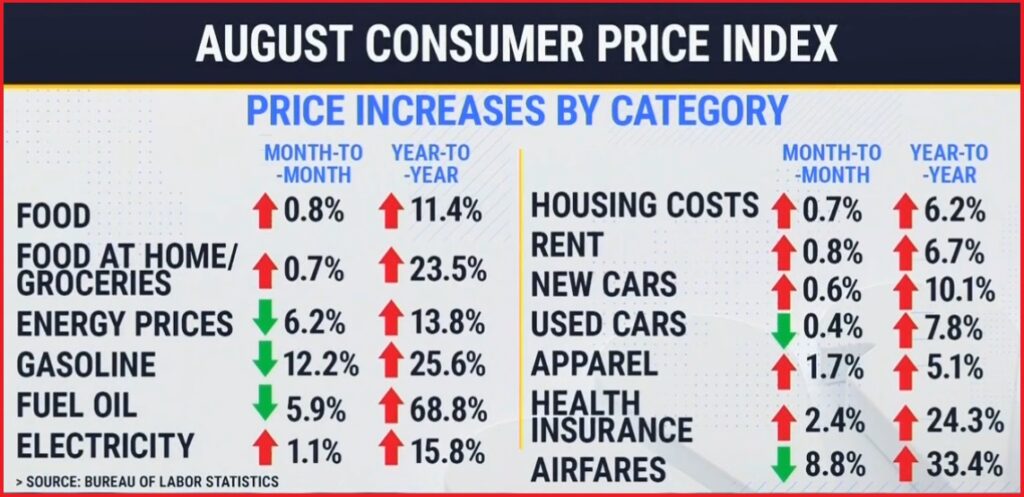
Someone had requested a simple to see infographic of the Bureau of Labor and Statistics August inflation data with monthly and yearly outcomes. I thought everyone might find this graphic as a good tool for sharing with your network. [Data Source Link]
Additionally, the BLS also released the producer price index today [DATA HERE]. The PPI for goods dropped slightly, as we expected, due to the August temporary decline in gasoline and diesel. However, the PPI for final demand services moved up 0.4 percent in August, the fourth consecutive rise.
We are now seeing service providers having to raise their prices to cover their increased costs. This could be trouble for employment in the long-term.
Posted Originally on the conservative tree house on September 13, 2022 | Sundance
We are in an abusive relationship with our own government. If you want a real-time example of how governmental bureaucracy fits into this statement, look no further than the footnote at the bottom of this article ¹cited from the BLS report today.
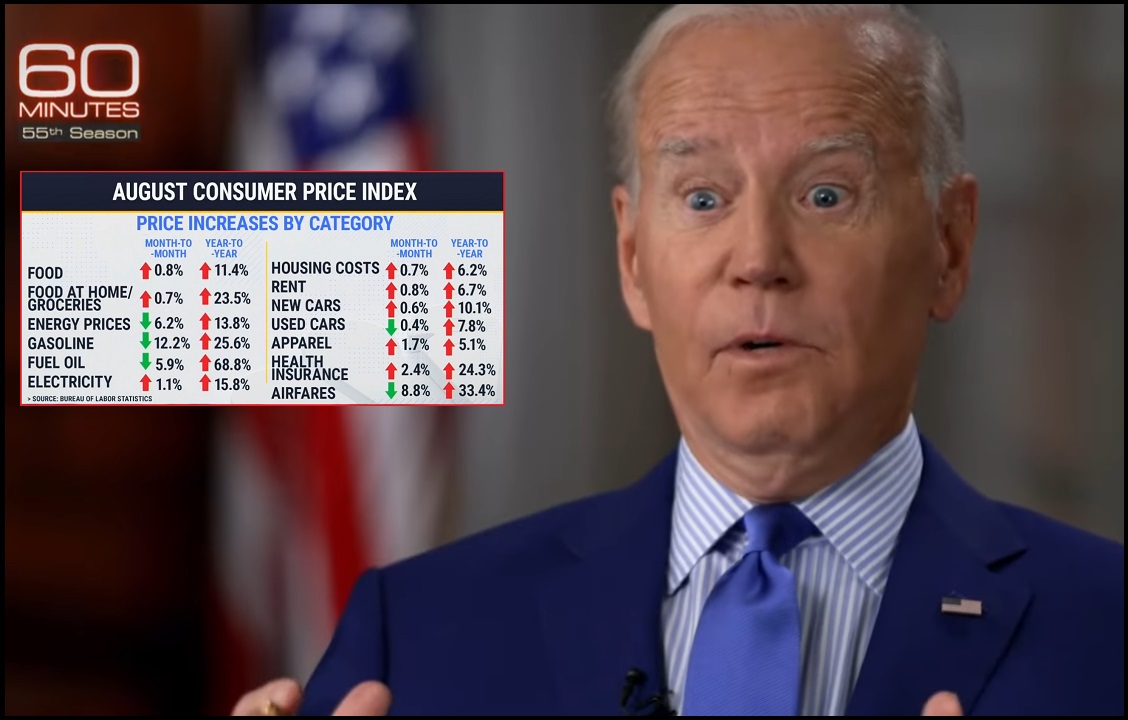
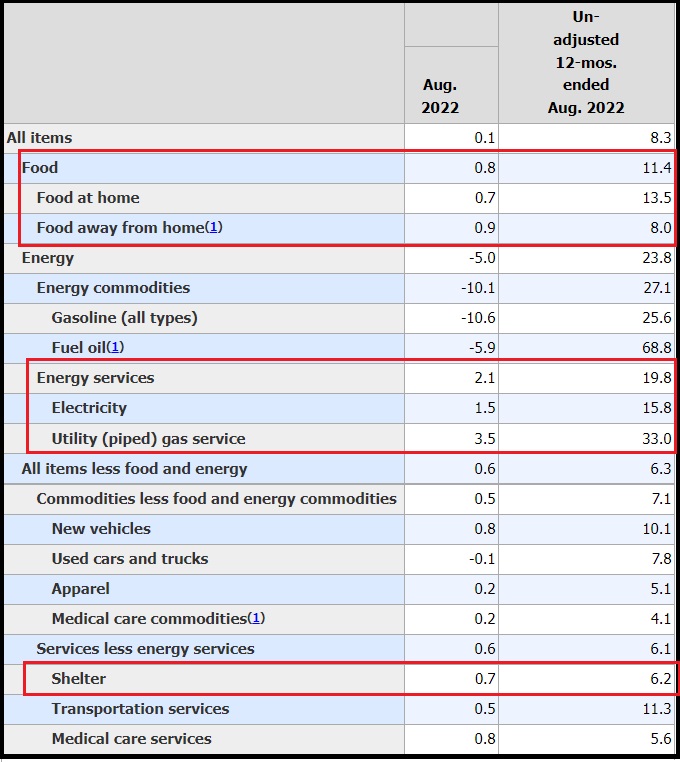
The Bureau of Labor and Statistics (BLS) has released the August inflation data today [DATA HERE] with a top line at 8.3 percent year over year. Unfortunately, things are unfolding exactly as we previously shared. [Modified Table 1 at left]
Despite the temporary drop in gasoline prices (-12%), the costs of food (+13.5%), electricity (+15.8%) and housing (+6.7%) are crushing U.S. consumers. The stock market is responding accordingly. We can only imagine the inflation data if the heavily weighted gasoline factor was not pushing overall toplines down. Estimation of inflation would be well over double digits.
Keep in mind, as you read this review the price of the current harvest (prior field costs) is only right now coming into the food supply chain.
Food inflation is running at its highest rate since 1979 (+11.4%) and it will go higher as the third wave in this sector hits.
To give you an example, margarine increased in price 7% in August alone, that’s an annualized rate of 94% [Table 2 details]. Flour is also on pace for another 22.8% increase right as the holiday baking season begins.
We cannot eat gold, silver or durable goods. Electricity, home heating (natural gas), food and housing costs are priorities right now. Main Street USA is being crushed by Joe Biden overall economic and energy policies. It’s bad now, and going to get worse – much worse, as the third wave of food inflation has only just begun.
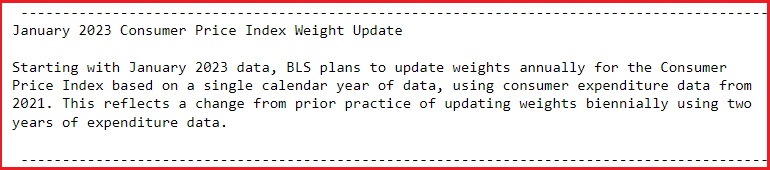
¹Before sharing a MSM perspective I want to draw your attention to the BLS notation for 2023. This innocuous footnote tells us just how manipulative the governmental bureaucracies are:
In order to give the statistical appearance of things being better than they are, the BLS is going to reset their weighting for the CPI to only compare against 2021. This is being done with purpose to give the illusion next year that things are not as bad. 2021 was when Joe Biden’s inflation policies first surfaced. By comparing consumer prices to the timing when those prices first increased, the scale of future price increases will be statistically diminished. We are in an abusive relationship with our government.
.
(CNBC) – Inflation rose more than expected in August as rising shelter and food costs offset a drop in gas prices, the Bureau of Labor Statistics reported Tuesday.
The consumer price index, which tracks a broad swath of goods and services, increased 0.1% for the month and 8.3% over the past year. Excluding volatile food and energy costs, CPI rose 0.6% from July and 6.3% from the same month in 2021.
Economists had been expecting headline inflation to fall 0.1% and core to increase 0.3%, according to Dow Jones estimates. The respective year-over-year forecasts were for 8% and 6% gains.
Energy prices fell 5% for the month, led by a 10.6% slide in the gasoline index. However, those declines were offset by increases elsewhere.
The food index increased 0.8% in August and shelter costs, which make up about one-third of the weighting in the CPI, jumped 0.7% and are up 6.2% from a year ago. (read more)
For readers who do advanced preparation to offset prices. THINK BEEF right now, you will thank me four months from now. If you see a deal now, buy it and freeze it now. Anticipate retail ground beef costs be somewhere around $10 to $15/lb by spring to mid 2023 perhaps even higher. Also remember, processed foods will increase in price at twice the rate of the fresh food sector. Both fresh and processed food prices will rise, but the increased costs associated with the food processing will double the price.
As in late times, as rulers come and go, the currency changes to reflect the change of power. In ancient Rome, for example, they would announce the coming of a new emperor on the coinage. The Romans used the reverse of their coinage as newspapers announcing victory, great building projects as the opening of the Colosseum, or political events such as the destruction of tax records by Emperor Hadrian recording one of the earliest tax amnesty events. Pictured here is the famous “Eid Mar” denarius of Brutus (85-42 BC), announcing he killed Caesar on the Ides of March in 44 BC.
Queen Elizabeth’s death will also cause numerous changes in currency. “Current banknotes featuring the image of Her Majesty The Queen will continue to be legal tender,” the Bank of England said shortly after her passing. The Royal Mint is continuing to “strike coins as usual” and has not announced when they plan to replace her image with the newly appointed Kings Charles III. The currency was updated five times during her rule to reflect the natural aging process. There are currently 4.7 billion UK banknotes in circulation worth an estimated 82 billion pounds ($95 billion). These bills will circulate for years to come as it takes an extensive amount of time to swap out currency.
The United Kingdom is not the only one who now must change its currency. Queen Elizabeth II broke the Guinness Book of World Records for being the longest reigning monarch after sitting on the throne for over 70 years. She also made history by appearing on more currencies than any other living monarch. At least 33 countries feature currency with the late queen’s image. Some countries removed the queen’s image decades ago after gaining independence. Jamaica replaced her image in 1966 with Marcus Garvey, while Bermuda changed its banknotes to feature native animals. Trinidad and Tobago also replaced her image with a coat of arms.
Canada, Australia, New Zealand, Belize, and many others will need to update some of their currency. While the UK is refraining from making a statement until after the 10-day mourning period, other nations have explained their plans. The Reserve Bank of New Zealand, for example, said, “All coin stock for a denomination showing the Queen will be issued before new stock goes out with her successor’s image. This is a few years away.” The central bank said that it would be “wasteful” to shorten the lifespan of the existing currency in circulation, but they do plan to transition to currency featuring the new king in “several years.” The bank is also concerned that a rapid transition could affect its liquidity due to supply chain disruptions or sudden demand.
All existing currency with the queen’s image is valid and legal tender. It takes years for the currency to change, as it is an expensive and gradual process.
India is the largest rice exporter in the world. The nation saw the highest volume of rice exported last year at 18.75 million metric tons. In contrast, the second-largest exporter, Vietnam, sold about 6.5 million metric tons of rice that same year. Rice is the main staple in diets throughout the world. In the midst of food shortages, the Indian government decided to impose a 20% export duty on rice.
Importers are not too keen on the new export levy, and the plan has backfired. One million tons of grain now stand idle at Indian ports as buyers are refusing to pay the additional 20%. BV Krishna Rao, President of the All India Rice Exporters Association (AIREA), has stated that India has stopped loading all vessels with rice shipments. Another problem is that many buyers already paid for their orders but are now expected to pay an additional 20%. The margin for rice is small, and most buyers are not willing to cut into profits.
Perhaps the Indian government would like the world to see it has a stronghold over the world’s rice supply. India currently sells to over 150 countries and now has leverage, considering the ongoing food shortages.
I have created this site to help people have fun in the kitchen. I write about enjoying life both in and out of my kitchen. Life is short! Make the most of it and enjoy!
This is a library of News Events not reported by the Main Stream Media documenting & connecting the dots on How the Obama Marxist Liberal agenda is destroying America








 Centinel2012